INTRODUCTION
The neotropical river otter (Lontra longicaudis) and the giant otter (Pteronura brasiliensis) are two mustelid species that occur in the river systems of the Brazilian Amazon (Carter & Rosas, Reference Carter and Rosas1997; Coletti et al., Reference Coletti, Michel, Sanfelice and Jardim2013.). The main habitats of these species are rivers, lakes, streams and wetlands, with open margins and vegetation (Coletti et al., Reference Coletti, Michel, Sanfelice and Jardim2013; Lima et al., Reference Lima, Marmontel and Bernard2013; Palmeirim et al., Reference Palmeirim, Peres and Rosas2014), with low levels of pollution and human occupation, although they do tolerate environments with anthropogenic factors (Palmeirim et al., Reference Palmeirim, Peres and Rosas2014).
Currently, the alteration of habitats caused by human occupation and the exploitation of natural resources in tropical forests constitute threats to these animals (Carter & Rosas, Reference Carter and Rosas1997; Coletti et al., Reference Coletti, Michel, Sanfelice and Jardim2013); other dangers include boat traffic, pollution and contamination of water resources (Carter & Rosas, Reference Carter and Rosas1997). In addition, these species are also threatened by the drainage of wetlands for agricultural practices, mining and fossil fuel extraction (Palmeirim et al., Reference Palmeirim, Peres and Rosas2014).
The various anthropogenic factors associated with impacts on water and land resources used by Neotropical river otter and giant otter, as well as the possibility of these species cohabiting with other wild and domestic animals, increase the vulnerability of those mustelids to infections caused by Cryptosporidium and Giardia (Gaydos et al., Reference Gaydos, Miller, Gilardi, Melli, Schwantje, Fritz and Conrad2007).
Due to the spread of Cryptosporidium spp. oocysts and of Giardia sp. cysts in different water resources (Fayer et al., Reference Fayer, Dubey and Lindsay2004; Lasek-Nesselquist et al., Reference Lasek-Nesselquist, Bogomolni, Gast, Welch, Ellis, Sogin and Moore2008), occurrence of infections by these aetiological agents has been reported in sirenians (Morgan et al., Reference Morgan, Xiao, Hill, O'Donoghue, Limor, Lal and Thompson2000; Borges et al., Reference Borges, Alves, Faustino and Marmontel2011), pinnipeds (Rengifo-Herrera et al., Reference Rengifo-Herrera, Ortega-Mora, Gómes-Bautista, García-Moreno, García-Párraga, Castro-Urda and Pedraza-Díaz2011), cetaceans (Hughes-Hanks et al., Reference Hughes-Hanks, Rickard, Panuska, Saucier, O'Hara, Dehn and Rolland2005) and mustelid (Gaydos et al., Reference Gaydos, Miller, Gilardi, Melli, Schwantje, Fritz and Conrad2007; Méndez-Hermida et al., Reference Méndez-Hermida, Gómez-Couso, Romero-Suances and Ares-Mazás2007).
The investigation of diseases in aquatic mustelids is an important priority in the conservation strategies for this taxonomic group (Gaydos et al., Reference Gaydos, Miller, Gilardi, Melli, Schwantje, Fritz and Conrad2007), since little is known about the aetiological agents that affect them. Studies of this nature – considering the capability that Neotropical and giant otters have to act as sentinels of environmental quality – enable the determination of water resource conditions and of possible risks to other species that use the same habitats (Méndez-Hermida et al., Reference Méndez-Hermida, Gómez-Couso, Romero-Suances and Ares-Mazás2007), including human populations (Xiao et al., Reference Xiao, Sulaiman, Ryan, Zhou, Atwill, Tischler, Zhang, Fayer and Lal2002; Appelbee et al., Reference Appelbee, Thompson, Measures and Olson2010; Wagnerová et al., Reference Wagnerová, Sak, Mcevoy, Rost, Matysiak, Jezková and Kvác2015).
Therefore, the aim of this study was to determine the frequency of infection caused by Cryptosporidium spp. and Giardia sp. in Neotropical river otters (Lontra longicaudis) and giant otters (Pteronura brasiliensis) in northern Brazil.
MATERIALS AND METHODS
Study areas
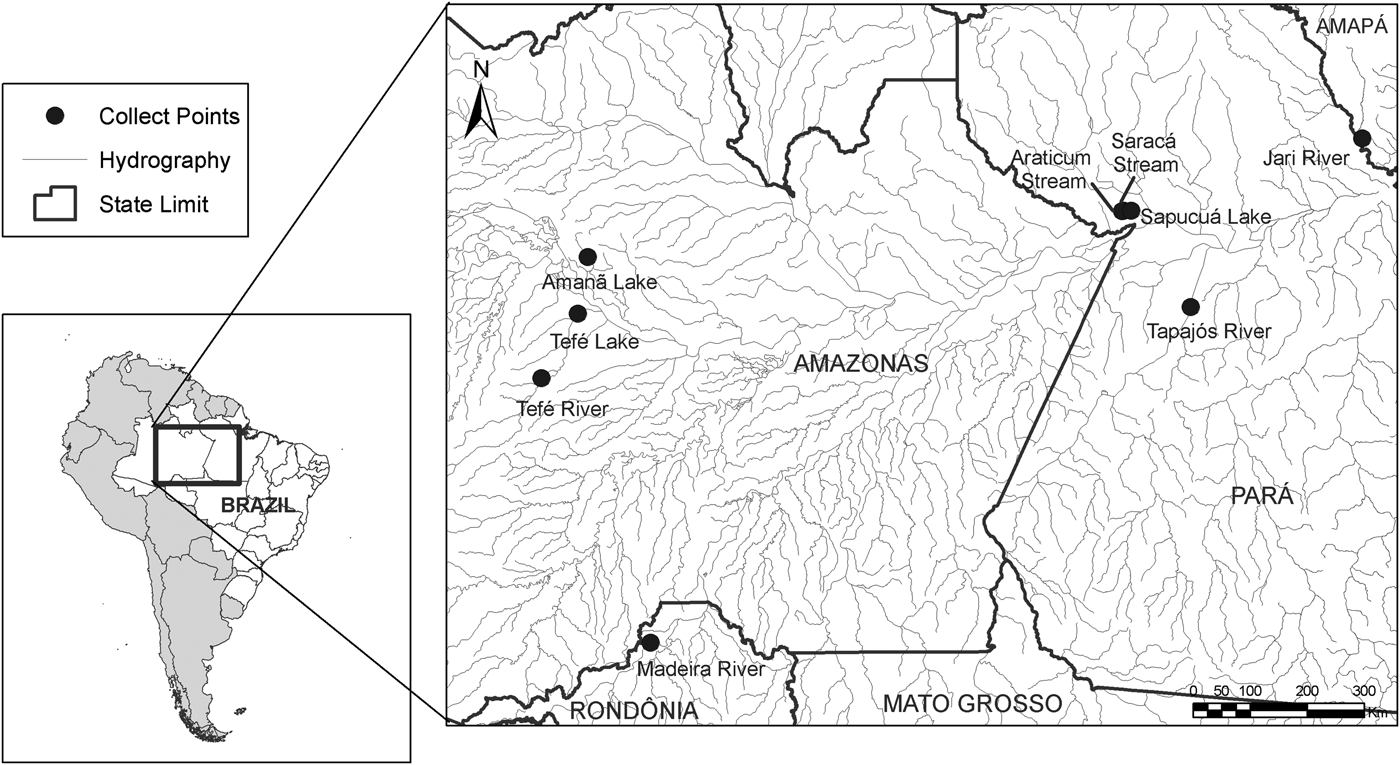
Samples were collected in the states of Amapá (Jari River), Amazonas (Amanã and Tefé lakes), Pará (Araticum and Saracá streams, Sapucuá lake and Tapajós River) and Rondônia (Madeira River) (Figure 1). These locations are within the Amazon biome, which consists of large tracts of rainforest, with lowland wetlands, flooded forest and upland forests (Ayres et al., Reference Ayres, Fonseca, Rylands, Queiroz, Pinto, Masterson and Cavalcanti2005).
Map of the states where the samples were collected.

Throughout these areas, in particular locations, there are great extensions of preserved lands with low population densities that are rich in animal and plant species (Ayres et al., Reference Ayres, Fonseca, Rylands, Queiroz, Pinto, Masterson and Cavalcanti2005; Lima, Reference Lima2009). However, there is also the presence of agricultural and animal husbandry activities, occurrence of domestic animals in the more urbanized areas, damming of rivers for hydroelectric dams (Junk & Mello, Reference Junk and Mello1990) and mineral extraction activities (Monteiro, Reference Monteiro2005).
At these sites there are seasonal variations in the water level which influence aquatic ecosystems (Junk et al., Reference Junk, Bayley and Sparks1989) – the periods of flooding and high water generally occur between November and March, and the receding and low water periods occur between the end of June and early November (Ayres, Reference Ayres1993; Lima, Reference Lima2009).
Collection of biological samples
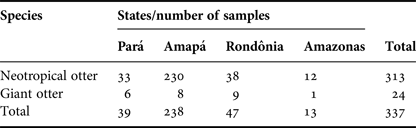
From 2011 to 2014, 313 faecal samples from Neotropical river otters and 24 from giant otters were collected (Table 1), identified by odour, colour and characteristics of the latrine (Quintela et al., Reference Quintela, Porciuncula and Colares2008; Cabral et al., Reference Cabral, Zuanon, Mattos and Rosas2010). During field trips, the biological samples were found in defecation sites and close to shelters. The activities occurred in both the high water (rainy season) and low water (dry season) periods.
Origin of faecal samples from Neotropical and giant river otters.

After collection, the material was placed in vials containing AFA solution (absolute alcohol, formaldehyde, glacial acetic acid and distilled water), in proportions suggested by Ueno & Gonçalves (Reference Ueno and Gonçalves1994). These were then properly identified and referred to further laboratory procedures.
Laboratory processing
For identification of Cryptosporidium spp. oocysts, samples were subjected to formol-ether sedimentation with subsequent preparation of smears and staining by Kinyoun's technique (Brasil, 1996). The zinc sulphate centrifugal flotation technique was employed to identify Giardia sp. cysts (Gaydos et al., Reference Gaydos, Miller, Gilardi, Melli, Schwantje, Fritz and Conrad2007; Bica et al., Reference Bica, Dillenburg and Tasca2011). Part of the sample was subjected to the direct immunofluorescence test, following instructions by the Kit Merifluor® Cryptosporidium/Giardia, and the oocysts and cysts were identified based on their shape, size and pattern of immunofluorescence intensity (Reboredo-Fernández et al., Reference Reboredo-Fernández, Ares-Mazás, Martínez-Cedeira, Romero-Suances, Cacciò and Gómez-Couso2015).
Samples were considered positive when one of the tests used allowed the identification of Cryptosporidium spp. oocysts and Giardia sp. cysts (Borges et al., Reference Borges, Alves, Faustino and Marmontel2011; Rengifo-Herrera et al., Reference Rengifo-Herrera, Ortega-Mora, Gómes-Bautista, García-Moreno, García-Párraga, Castro-Urda and Pedraza-Díaz2011). In order to compare the different diagnostic methods used, sensitivity, specificity, correct classification (accuracy) and incorrect classification were evaluated (Thrusfield, Reference Thrusfield2004), and the direct immunofluorescence test was defined as the gold standard in these analyses.
Data analysis
Chi-square tests were performed to evaluate the association between the species investigated in this study and the variables – origin (place of origin of the samples), infection by Cryptosporidium spp. and by Giardia sp., and seasonality (rainy and dry seasons). When the expected frequencies were less than five in more than 20% of the respective data set, the Fisher test was used (Quinn & Keough, Reference Quinn and Keough2002; Crawley, Reference Crawley2013). Analyses were performed using the software R (R Core Team, 2014).
RESULTS
Out of all samples analysed, 27% (94/337) scored positive for at least one pathogen studied. The frequency of infection by Cryptosporidium spp. was higher than that caused by Giardia sp., for both Neotropical river otters and giant otters (Table 2). In the samples analysed, some cases of co-infection by both protozoa were detected.
Absolute (AF) and relative (RF) frequency of infection by Cryptosporidium spp., Giardia spp. and co-infection in Neotropical and giant otters, using the Kinyoun technique, centrifugal flotation and direct immunofluorescence.

Subsequently, the association between the presence of Cryptosporidium spp. and of Giardia sp. was tested. In Neotropical river otters, an association between these two variables was found (χ2 = 30.708, gl = 1; P < 0.00001), but not in giant otters (P = 0.08501).
In Neotropical river otters, infection by Cryptosporidium spp. was higher during the rainy season (22.8%) compared with the dry season (12.21%), thus this protozoan was associated with the rainy season (χ2 = 5.6309; gl = 1; P = 0.01765). In this same mustelid, despite the fact that the occurrence of Giardia sp. was also higher during the rainy season (13.04%) compared with the dry season (8.16%), there was no significant difference (χ2 = 1.79877; gl = 1; P = 0.179861) in relation to seasonality.
In giant otters, the presence of infection by Cryptosporidium spp. (P = 0.2391) and Giardia sp. (P = 0.5296) occurred independently from season.
The results did not show any association between the studied areas and infection by the aetiological agents studied.
The sensitivity, specificity, correct classification (accuracy) and incorrect classification values for each aetiological agent are shown in Table 3.
Evaluation of laboratory techniques used for the diagnosis of Cryptosporidium spp. and Giardia sp. in Neotropical river otter and giant otter.

DISCUSSION
The findings of this study highlight the concern for infections caused by Cryptosporidium spp. and Giardia sp. in Amazonian aquatic mustelids, particularly in giant otters. The frequency of these pathogens in Pteronura samples was higher than that found in studies with the European otter Lutra lutra, in Spain (Méndez-Hermida et al., Reference Méndez-Hermida, Gómez-Couso, Romero-Suances and Ares-Mazás2007) and the Canadian otter Lontra canadensis, in the USA and Canada (Gaydos et al., Reference Gaydos, Miller, Gilardi, Melli, Schwantje, Fritz and Conrad2007).
The clinical significance of these pathogens for mustelids is unknown (Gaydos et al., Reference Gaydos, Miller, Gilardi, Melli, Schwantje, Fritz and Conrad2007). However, in Antillean manatees Trichechus manatus (Borges et al., Reference Borges, Alves, Faustino and Marmontel2011), some animals exhibited diarrhoea, abdominal discomfort, and increased respiratory intervals.
In studies with other species of aquatic mammals, prevalence of Cryptosporidium spp. was found in 5.1% of bowhead whales, Balaena mysticetus; in 24.5% of North Atlantic right whales, Eubalaena glacialis (Hughes-Hanks et al., Reference Hughes-Hanks, Rickard, Panuska, Saucier, O'Hara, Dehn and Rolland2005); 21.4% of bottlenose dolphins, Tursiops truncatus and 22.2% of striped dolphins, Stenella coeruleoalba (Reboredo-Fernández et al., Reference Reboredo-Fernández, Ares-Mazás, Martínez-Cedeira, Romero-Suances, Cacciò and Gómez-Couso2015); 4.3% of Amazonian manatees, Trichechus inunguis; and 25% of Antillean manatees, Trichechus manatus (Borges et al., Reference Borges, Alves, Faustino and Marmontel2011). Research studies on Giardia sp. found the occurrence of this parasite in 64.5% of ringed seals, Phoca hispida (Hughes-Hanks et al., Reference Hughes-Hanks, Rickard, Panuska, Saucier, O'Hara, Dehn and Rolland2005); 50% of Greenland seals, Phoca groenlandica (Measures & Olson, Reference Measures and Olson1999); and 33.3% of bowhead whale (Hughes-Hanks et al., Reference Hughes-Hanks, Rickard, Panuska, Saucier, O'Hara, Dehn and Rolland2005).
Co-infection by Cryptosporidium spp. and Giardia sp. was diagnosed in both Neotropical river otters and giant otters. This may be due, among other factors, to inherent conditions of the affected animals, such as immunity and age (Xiao et al., Reference Xiao, Sulaiman, Ryan, Zhou, Atwill, Tischler, Zhang, Fayer and Lal2002; Carey et al., Reference Carey, Lee and Trevors2004; Lasek-Nesselquist et al., Reference Lasek-Nesselquist, Bogomolni, Gast, Welch, Ellis, Sogin and Moore2008), as well as to characteristics of these agents, which present high resistance, fast dissemination through water courses (LeChevallier et al., Reference LeChevallier, Norton and Lee1991; Fayer et al., Reference Fayer, Dubey and Lindsay2004) and high morbidity (Cacciò et al., Reference Cacciò, Thopson, McLauchlin and Smith2005). The simultaneous occurrence of these protozoa was also found in the European otter (Méndez-Hermida et al., Reference Méndez-Hermida, Gómez-Couso, Romero-Suances and Ares-Mazás2007), minke whale, Balaenoptera edeni, and striped dolphin (Reboredo-Fernández et al., Reference Reboredo-Fernández, Ares-Mazás, Martínez-Cedeira, Romero-Suances, Cacciò and Gómez-Couso2015), California sea lions, Zalophus californianus (Deng et al., Reference Deng, Peterson and Cliver2000), North Atlantic right whale, bowhead whale and the ringed seal (Hughes-Hanks et al., Reference Hughes-Hanks, Rickard, Panuska, Saucier, O'Hara, Dehn and Rolland2005).
Although no association was found between the areas studied and infection by the protozoa evaluated, the occurrence of Cryptosporidium spp. in Amazonian rivers was previously evidenced by this coccidian affecting Amazonian manatees (Borges et al., Reference Borges, Alves, Lima, Luna, Aguilar, Vergara-Parente, Faustino, Lima and Marmontel2007). At the time, among the probable factors related to the spread of these aetiological agents, the limited sanitary conditions of several riverine communities studied in the region were highlighted, as well as livestock waste products and those released by vessels (Borges et al., Reference Borges, Alves, Lima, Luna, Aguilar, Vergara-Parente, Faustino, Lima and Marmontel2007). Similar results were observed in infections caused by Cryptosporidium spp. and Giardia sp. in Canadian otters and other species of aquatic mammals (Deng et al., Reference Deng, Peterson and Cliver2000; Hughes-Hanks et al., Reference Hughes-Hanks, Rickard, Panuska, Saucier, O'Hara, Dehn and Rolland2005; Gaydos et al., Reference Gaydos, Miller, Gilardi, Melli, Schwantje, Fritz and Conrad2007).
Although most areas evaluated in this study presented good environmental conservation status, in many locations – in addition to the reported anthropogenic impacts – there were large deforested areas, river damming for hydroelectric dams and mineral extraction. These factors can alter the ecological balance and contribute to the contamination of wild hosts by pathogens (Patz et al., Reference Patz, Graczyk, Geller and Vittor2000; Lallo et al., Reference Lallo, Pereira, Araújo, Favorito, Bertolla and Bondan2009; Palmeirim et al., Reference Palmeirim, Peres and Rosas2014).
Since the frequency of infection by Cryptosporidium spp. and Giardia sp. in both Neotropical and giant otters was higher in the rainy season than in the dry season, it is important to point out that throughout the studied areas in northern Brazil there is a seasonal variation of up to 10 metres in the river water levels. This phenomenon is caused by the melting on the Andes associated with the rainy season (Lima, Reference Lima2009) and influences the various associated aquatic ecosystems (Junk et al., Reference Junk, Bayley and Sparks1989). For example, most pastures used for animal husbandry activities are flooded during the rainy season. These sites may be used by Neotropical and giant otters, rendering them more vulnerable, especially considering the great potential for environmental contamination presented by cattle, where one single infected calf can eliminate from one to 10 billion oocysts in its faeces per week (Fayer et al., Reference Fayer, Dubey and Lindsay2004).
During this rainy season, the areas occupied by Neotropical and giant otters undergo flooding, directly affecting resource use. During the dry season these species leave the flooded areas and occupy the main water body channels, where there is greater availability of space, food (Lima, Reference Lima2009) and refuges (Duplaix, Reference Duplaix1980).
Having identified Neotropical river otters and giant otters as hosts of Cryptosporidium spp. and Giardia sp., it becomes evident that the ability of the oocysts and cysts of these protozoa, respectively, to remain infectious within specific environmental conditions for long periods of time (LeChevallier et al., Reference LeChevallier, Norton and Lee1991) increases the possibility of transmission of these agents to other aquatic and terrestrial organisms, as well as to human populations.
The findings of this research study highlight the importance of carrying out the genetic characterization of the studied protozoa, as a way to elucidate the impact of human activities as potential sources of infection of Neotropical river otters and giant otters by these coccidia. The findings of this study provide the first description of infection by Cryptosporidium spp. and Giardia sp. affecting Lontra longicaudis and Pteronura brasiliensis.
ACKNOWLEDGEMENTS
We appreciate the support of all employees of the Fundação Mamíferos Aquáticos, Biolex Consultoria Ambiental, Sete Soluções e Tecnologia Ambiental and STCP Engenharia de Projetos Ltda. The authors also acknowledge Mineração Rio do Norte for support offered in the Saracá-Taquera National Forest, and ICMBio-Trombetas and IBAMA for the research permits.
FINANCIAL SUPPORT
The results of this research study are part of the efforts carried out by the ‘Viva o Peixe-Boi Project’. João C.G. Borges also thanks CAPES for granting him a scholarship.