Implications
Comparative effects of two antibiotics (virginiamycin or zinc-bacitracin) and supplemental genistein were assessed in broiler chicks. Results showed that the birds fed on diets containing antibiotics and 20 to 80 mg/kg of genistein had the greater weight gains. Dietary genistein supplementation increased the relative weights of thymus and bursa of Fabricius. In addition, antibody responses against viral antigens were greater in genistein-supplemented chicks compared with those on antibiotics diets. Dietary inclusion of genistein increased lymphocytes proportion in peripheral blood. In overall, results indicate that dietary supplementation of 20 to 80 mg/kg of genistein could improve immuocompetence in broiler chicks.
Introduction
Domestic avian species have the limited natural resistance against many pathogenic and infectious diseases; therefore, the poultry industry relies on the application of antibiotics or related medications to increase disease resistance within poultry flocks. However, this practice has accompanied with prevalence and establishment of antibiotic-resistant species within the human populations (Phillips et al., Reference Phillips, Caswell, Cox, Groot, Friss, Jones, Nightingale, Preston and Waddell2004). Consequently, the use of these medicals in livestock production is being faced to extensive limitations, and poultry industry is compelled to find potential alternatives for antibiotics to increase disease resistance in poultry flocks and also to maintain proper markets for poultry products (Buchanan et al., Reference Buchanan, Hott, Cutlip, Rack, Asamer and Moritz2008).
Essential oils, organic acids and phytogenic compounds such as flavonoids are among the known important antibiotic alternatives, which were demonstrated to enhance production of gastric secretions and reduce pathogenic bacteria (Wenk, Reference Wenk2000). Isoflavones (ISF) are a subclass of flavonoids, which are a broad group of polyphenolic compounds widely distributed in foods of plant origin (Havsteen, Reference Havsteen2002). Biological effects attributed to flavonoids include antiestrogenic effect, antioxidant properties and anti-proliferative action (Harborne and Baxter, Reference Harborne and Baxter1999; Middleton et al., Reference Middleton, Kandaswami and Theoharidesi2000; Ross and Kasum, Reference Ross and Kasum2002). The three main ISF derivatives are daidzein, genistein and glycitein, which are found predominantly in soy and other legume crops (Setchell, Reference Setchell1998). The majority of ISF have estrogenic activity in classic estrogen-target tissues; hence, they have been referred as phytoestrogens (Middleton et al., Reference Middleton, Kandaswami and Theoharidesi2000; Havsteen, Reference Havsteen2002). The major ISF components of soy are genistein and daidzein (Payne et al., Reference Payne, Bidner, Southern and McMillin2001). Although daidzein is a relatively weak estrogen receptor agonist, genistein has been shown to bind estrogen receptor-β with an affinity similar to that of 17 β-estradiol (Kuiper et al., Reference Kuiper, Lemmen, Carlsson, Corton, Safe, van der Saag and Gustafsson1998). The antioxidant and anti-proliferative properties of ISF offer the additional important mechanisms through which they may protect against many prevalent chronic diseases, whereby increase disease resistance in different animal species (Zeng et al., Reference Zeng, Chen and Zhao2004). Regarding the immunostimulative effect of ISF, Rasouli and Jahanian (Reference Rasouli and Jahanian2011) reported that dietary genistein supplementation improved antibody responses against different viral antigens in broiler chicks. The current researchers showed that genistein-supplemented chicks had heavier thymus and bursa of Fabricius compared with control birds (Rasouli and Jahanian, Reference Rasouli and Jahanian2011). There are few, if any, research studies to examine the comparative effect of antibiotics and ISF on immunological responses of broiler chicks; the present study, therefore, was conducted to investigate the effects of dietary supplementation of genistein on lymphoid organs’ development and immunological responses in Ross broiler chicks.
Material and methods
Birds, diets and general experimental procedure
The study presented here was conducted in the Poultry Research Station of Isfahan University of Technology (Isfahan, Iran), and all procedures used were approved by Isfahan University of Technology Animal Care and Use Committee. The day-old male broiler chicks (Ross×Ross) were purchased from a commercial hatchery. The chicks were housed in floor pens containing pine shavings. A total of 675-day-old male Ross 308 broiler chicks were randomly allocated into nine dietary treatments with five replicates of 15 birds each. The chicks were assigned to pens so that initial body weight and weight distributions were similar among different experimental groups. Dietary treatments consisted of a negative control diet (not supplemented with antibiotic or genistein), two positive control diets (20 mg/kg of either virginiamycin, Stafac 98%; Phibro Animal Health, Ridgefield Park, NJ, USA; or zinc-bacitracin, Albac 15%; Alpharma, Fort Lee, NJ, USA), and groups supplemented with 10, 20, 40, 80, 160 or 320 mg/kg of genistein (96.5% in purity; Sigma-Aldrich Fine Chemicals, St. Louis, MO, USA).
The purity of genistein was confirmed using HPLC method as described by Carrão-Panizzi et al. (Reference Carrão-Panizzi, Favoni and Kikuchi2002) with slightly modifications. Briefly, the ISF was extracted from a 20 mg sample. Sample was placed in test tube with 4 ml of 70% ethanol (containing 0.1% acetic acid) at 22ºC. The sample was extracted for different time periods (1, 4, 8, 12, 16, 20 and 24 h), with a constant agitation (shaking at 250 r.p.m.). The extracted sample was centrifuged at 13 000 r.p.m. for 10 min at 10°C; thereafter, 100 μl of the supernatant was transferred to an autosampler. Genistein analysis was performed on ODS c-18 column (YMC-Pack ODS-AM; YMC Co., Ltd, Kyoto, Japan) S-5 mm 120 A (250×4.6 mm in dimensions). The effluent was monitored at 260 nm.
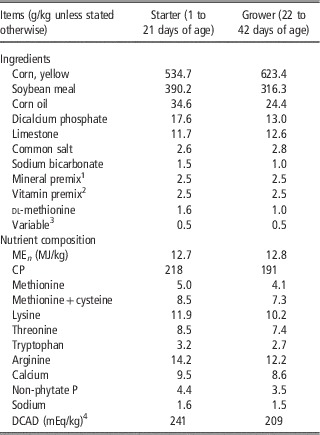
The basal experimental diets (Table 1) were formulated to meet all of the nutritional considerations during the starter (1 to 21 days of age) and grower (22 to 42 days of age) periods as National Research Council (1994) recommendations. All of the diets were mixed using a micro-mixer and had the similar nutrient composition based on analyzed values (Association of Official Analytical Chemists, 2002). Lighting schedule was continuous during the 1st week, and a 23 L : 1 D lighting regimen was maintained for the remaining trial period. Feed and water were provided for ad libitum throughout the duration of study. The temperature was set at 33°C during the 1st trial week and then was reduced by 3°C/week until the birds were 5-weeks old; thereafter, set on 21°C to 22°C.
Ingredient composition and chemical analysis of basal diets during starter and grower periods (as-fed basis)
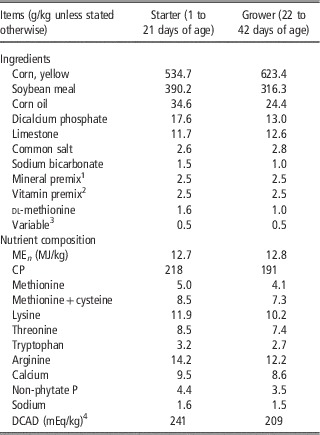
1 Mineral premix provided per kilogram of diet: Mn (from MnSO4×H2O), 60 mg; Zn (form ZnSO4×H2O), 55 mg; Fe (from FeSO4×7H2O), 50 mg; Cu (from CuSO4×H2O), 8 mg; I (from Ca (IO3)2×H2O), 1 mg; Se (from Na selenite), 0.25 mg.
2 Provided per kilogram of diet: vitamin A (from retinyl acetate), 11 700 IU; cholecalciferol, 3500 IU; vitamin E (from dl-α-tocopheryl acetate), 26 IU; vitamin B12, 0.03 mg; riboflavin, 6.2 mg; niacin, 48 mg; calcium pantothenate, 35 mg; menadione (from menadione dimethyl-pyrimidinol), 2.5 mg; folic acid, 0.8 mg; thiamine, 3 mg; pyridoxine, 6.5 mg; biotin, 0.4 mg; choline (from choline chloride 60%), 560 mg.
3 Variable amounts of genistein isoflavone and inert filler (washed builders sand), so that the nutrient composition was similar among the experimental diets.
4 DCAD represents dietary cation-anion difference and is defined as Na+K−Cl.
Performance parameters
Birds and feed remaining (on pen basis) were weighed to measure average daily weight gain (ADWG), average daily feed intake (ADFI) and feed conversion ratio (FCR) during the experiment. The mortality was recorded once observed to adjust FCR values. Total mortality percentage was 4.13% throughout the trial period and was not statistically different among treatment groups (data not shown).
Relative weights of lymphoid organs
At day 28 of age, three birds per pen nearest to the average weight of the same pen were selected on random to evaluate lymphoid organ weights. Feed was removed 3 h before slaughtering. Each bird was slaughtered by cutting the jugular vein. Thymus, bursa of Fabricius and spleen were then precisely removed and weighed separately on a sensitive digital scale as described by Jahanian (Reference Jahanian2009).
Immunological responses
Cellular immunity was assessed by a cutaneous basophil hypersensivity (CBH) test in vivo using phytohemagglutinin-P (PHA-P). At day 10 of age, the toe web of the right foot (three wing-banded chicks per pen) was measured in millimeters with a sensitive micrometer. Immediately after measurement, 100 μg of phytohemagglutinin-P (Sigma Chemical Co., St. Louis, MO, USA), suspended in a 0.10 ml of sterile saline, was injected into the toe web. The toe web swelling was measured 12 and 24 h after injection. The response was quantified by subtracting the skin thickness of the first measurement (Time 0) from the mean skin thickness at 12 and 24 h after dermal PHA-P injection (Corrier and DeLoach, Reference Corrier and DeLoach1990).
At day 13 of age, two chicks (wing-banded) from each replicate were infected by instilling one drop (7.2 log 10/0.1 ml) of stock solution of B1 strain of Newcastle disease virus (NDV) in each eye. The birds were bled from wing vein at days 6 and 12 after inoculation and serum samples were collected individually in separate sterile vials. The hemagglutination inhibition test (Jahanian, Reference Jahanian2009) was set up to determine the antibody production response against NDV as log2 of the reciprocal of the last dilution.
Also, vaccination against infectious bronchitis disease virus (IBV) was conducted at 23 days of age via eye dropping. At 6 and 12 days after vaccine inoculation, the birds were bled via wing vein, and serum samples were frozen (−20°C) until antibody assay could be performed. Briefly, serum samples were thawed at room temperature and diluted 500-fold (1 : 500) in diluent. Diluted serum was added (100 μl) to 96-well plates coated with IBV antigen. Plates were covered and allowed to incubate at room temperature for 30 min. After incubation, plates were aspirated and washed with 350 μl of sterile distilled water. A multichannel pipette was used to dispense 100 μl of the conjugate, and plates were allowed to incubate at room temperature again for 30 min. Substrate was then dispensed (100 μl) in the wells to facilitate a color reaction as plates were allowed to incubate at room temperature for an additional 15 min. A stop solution was then added to terminate enzymatic process. Plates were read on a Microplate Reader at 650 nm to determine of antibody titers against IBV (Kidd et al., Reference Kidd, Peebles, Whitmarsh, Yeatman and Wideman2001).
In addition to viral antigens, sheep red blood cell (SRBC) was used as a test antigen to quantify specific humoral antibody response. To prepare SRBC antigen, five sheep were bled into the EDTA-containing tubes and blood samples were centrifuged for 10 min at 4500×g and 4°C, and plasma was exactly removed. Thereafter, the samples were washed three times using phosphate buffer saline (PBS) and finally suspended in PBS at a dilution of 10% (vol : vol). The birds (three wing-banded birds per pen) were immunized intraperitoneally with 0.5 ml of 10% SRBC suspension at days 27 and 35 of age. At 7th day post each antigen inoculation, the birds were bled by brachial venipuncture, and 2 to 3 ml of blood was collected for measuring primary and secondary antibody responses against SRBC using 2-mercaptoethanol technique as previously described (Lepage et al., Reference Lepage, Bloom and Taylor1996). All SRBC antibody titers are expressed as log2 of the reciprocal of the highest serum dilution causing agglutination of SRBC.
Leukocyte subpopulations
To study the effects of dietary treatments on blood leukocyte subpopulations, three randomly selected birds from each pen were bled on day 42 of age, and EDTA-containing blood samples were immediately stained according to protocol described by Lucas and Jamroz (Reference Lucas and Jamroz1961). Briefly, a drop of blood was placed in the center of a microscope slide; thereafter, a blood film (smear) was made on slide using a pre-cleaned bevel-edged microscope slide. Giemsa stain was used for staining blood films. After staining, blood films were counted for leukocyte subsets under an optical microscope (Olympus CH-2 microscope, Olympus Corporation, Shinjuku-ku, Tokyo, Japan) using lens 40×.
Statistical analysis
All data were subjected to ANOVA using the GLM procedures of SAS software (SAS Institute, 1999). The treatment means were separated by Duncan’s multiple range tests (Duncan, Reference Duncan1955) at P<0.05 statistical level. Pen was the experimental unit for all measurements. The single degree of freedom contrast comparisons were made among the control group and antibiotics, control and genistein-supplemented birds, and also among the antibiotics and genistein groups.
Results
Performance parameters
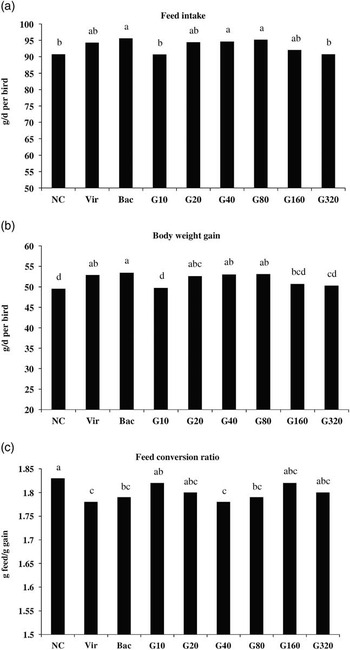
The effects of dietary supplementation with different levels of genistein on performance parameters including ADFI, ADWG and FCR are shown in Figure 1. As noted, there was a significant (P<0.01) difference between experimental diets for ADFI. Dietary inclusion of antibiotics increased (P<0.01) ADFI compared with control birds. Although ADFI of birds fed on diets supplemented with 20 to 80 mg/kg of genistein was greater than that of control birds, however, the lower feed consumption of birds fed on the higher genistein levels caused there was no significant difference between ADFI of control and genistein-supplemented birds. On the other hand, dietary antibiotics supplementation tended (P=0.067) to increase ADFI compared with genistein-supplemented diets.
Effect of dietary genistein supplementation on performance parameters during 1 to 42 days of age. NC=negative control (not-supplemented); Vir=virginiamycin; Bac=bacitracin; G10, G20, G40, G80, G160 and G320=supplemental levels of 10, 20, 40, 80, 160 and 320 mg/kg of genistein, respectively. abcdMeans with no common superscripts are significantly (P<0.05) different.
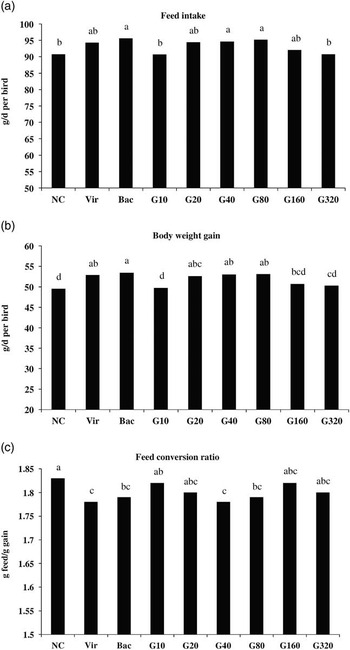
There was a marked (P<0.01) difference among experimental diets for ADWG during 1 to 42 days of age (Figure 1b). Supplementation of antibiotics into the diets increased (P<0.01) ADWG compared with those fed on control diet. In addition, dietary supplementation of genistein (low to moderate levels: 20 to 80 mg/kg) tended (P=0.051) to improve weight gains compared with control diet.
As shown in Figure 1c, feed efficiency was influenced (P<0.05) by dietary treatments, with the best FCR values assigned to the antibiotics- and 40 to 80 mg/kg genistein-supplemented groups. Contrast comparisons showed that dietary supplementation with both antibiotics (P<0.01) and genistein (P<0.05) improved FCR values compared with negative control group.
Lymphoid organ weights
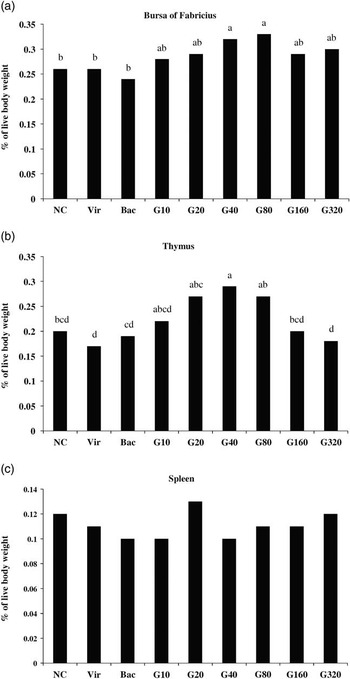
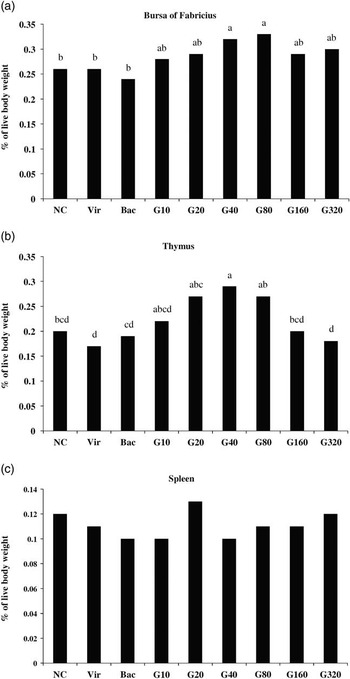
As noted in Figure 2, the relative weights of bursa of Fabricius (P<0.05) and thymus (P<0.01) were influenced by dietary treatments. The birds fed on genistein diets had heavier thymus (P<0.05) and bursa of Fabricius (P<0.01) than antibiotics-supplemented birds. Although spleen weight was greater in chicks fed on genistein-supplemented diets, this difference did not reach to the statistically significant level (P=0.055).
Effect of dietary genistein supplementation on lymphoid organ weights. NC=negative control (not-supplemented); Vir=virginiamycin; Bac=bacitracin; G10, G20, G40, G80, G160 and G320=supplemental levels of 10, 20, 40, 80, 160 and 320 mg/kg of genistein, respectively. abcdMeans with no common superscripts are significantly (P<0.05) different.
CBH and antibody responses
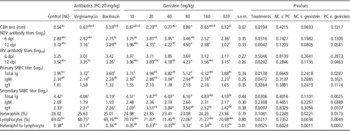
As shown in Table 2, dietary treatments affected (P<0.05) CBH response to PHA-P injection in 10-days-aged chicks, and genistein diets (especially diets containing 20 to 80 mg/kg of genistein) increased CBH response. In addition, there were marked differences between experimental groups for antibody titer against NDV at days 6 (P<0.05) and 12 (P<0.01) post vaccine inoculation. Supplemental genistein increased (P=0.058) NDV antibody titer at day 12 post vaccination. Moreover, genistein-supplemented diets increased (P<0.05) antibody production titer against IBV at day 12 post vaccine inoculation compared with antibiotics diets.
Effect of dietary genistein supplementation on immunological responses of broiler chicks
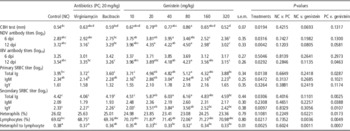
CBH=cutaneous basophil hypersensivity test as measured by increase in skin thickness after phytohemagglutinin-P injection; NDV=Newcastle disease virus; dpi=days post inoculation; IBV=infectious bronchitis virus; SRBC=sheep red blood cell; Ig=immunoglobulin; IgM=immunoglobulin M; IgY=Immunoglobulin Y.
s.e.m.=standard error of means.
abcdMeans with no common superscripts within each row are significantly (P<0.05) different.
Total antibody and IgM responses against SRBC were affected (P<0.05) by dietary treatments during the primary response, with the greater antibody titers observed for genistein-supplemented birds (Table 2). In contrast to primary response, the serum concentrations of total immunoglobulin and IgY were different (P<0.01) among the experimental groups during the secondary response. Although there was no marked difference between anti-SRBC titers of control and genistein chicks, the antibody responses against SRBC were lower (P<0.05) in antibiotics-supplemented chicks than those fed on genistein diets. Increase in supplemental genistein level depressed antibody titer against SRBC during both primary and secondary responses.
Leukocyte subpopulations
Although dietary treatments had no marked impact on heterophils (Table 2), genistein supplementation of diet increased (P<0.05) lymphocytes population in peripheral blood; consequently decreased (P<0.01) heterophil to lymphocyte ratio (H : L). The greatest population of lymphocytes was seen for birds fed on diets supplemented with 20 mg/kg of genistein, whereas the lowest H : L was allotted to the birds fed on 80 mg/kg genistein diets. Contrast comparisons showed that dietary genistein supplementation caused a significant increase in lymphocytes (P<0.01) and marked decreases in heterophils (P<0.05) and H : L (P<0.001) compared with both control and antibiotics diets.
Discussion
As noticed in Figure 1a, there was significant (P<0.01) difference between dietary treatments for ADFI. Dietary inclusion of antibiotics increased ADFI compared with control birds. In addition, dietary antibiotics supplementation tended (P=0.067) to increase feed intake compared with genistein-supplemented diets. The increasing effect of antibiotics on ADFI is mostly due to the depression of microbial populations of intestine especially the harmful ileal and cecal microbiota. These microbial colonies could produce toxic compounds and gases that damage epithelial cells and reduce bird’s appetite (Ricke et al., Reference Ricke, Kundinger, Miller and Keeton2005; Tellez et al., Reference Tellez, Higgins, Donoghue and Hargis2006). In this regard, it has been demonstrated that the harmful intestinal microbial colonies were diminished by administration of different flavonoid and isoflavonoid compounds (Bankova et al., Reference Bankova, De Castro and Marcucci2000; Havsteen, Reference Havsteen2002; Kosalec et al., Reference Kosalec, Pepeljnjak, Bakmaz and Vladimir-Knežević2005). The lower ADFI in groups fed on the higher dosages of genistein is consistent with findings of Jiang et al. (Reference Jiang, Jiang, Lin, Xi, Yu and Wu2007), who reported that the levels more than 20 mg soy ISF/kg depress feed consumption in broiler chicks. Of course, some researchers reported that genistein supplementation of broiler chicks had no marked impact on feed intake, weight gain or feed conversion efficiency (Iqbal et al., Reference Iqbal, Luo, Hashim and Zhu2014; Kamboh and Zhu, Reference Kamboh and Zhu2014).
As presented, dietary supplementation of antibiotics (P<0.01) and 20 to 80 mg/kg of genistein (P=0.051) increased ADWG compared with other experimental groups. Because the higher dosages of genistein were associated with lower weight gains, contrast comparisons showed the greater (P<0.05) ADWG for antibiotics-supplemented birds compared with those fed on genistein diets. The beneficial impact of low to moderate levels of genistein on ADWG is probably due to its antimicrobial and antioxidative properties. In agreement with present results, Kamboh et al. (Reference Kamboh, Hang, Bakhetgul and Zhu2013) reported that dietary supplementation of genistein and hesperidin improved weight gain of broiler chicks up to 11.3% in the finisher period compared with control birds. Seven (Reference Seven2008) observed that utilization of Turkish propolis (an ISF-enriched source) into the laying hens’ diets increased feed intake and improved egg production percentage and FCR values. In contrast, Kamboh and Zhu (Reference Kamboh and Zhu2014) reported that genistein and hesperidin did not affect weight gain and FCR in lipopolysaccharide-challenged broiler chicks. These variations in results may be partially explained by the fact that effects of these compounds are dependent on usage dose, duration of use and individual metabolism. Of course, these discrepancies may also be attributable to the chemical structure of flavonoid compound, bird’s age and specific responses of different species to these phytogenic compounds (Arora et al., Reference Arora, Nair and Strasburg1998).
As shown in Figure 1c, the best (P<0.05) FCR values assigned to the birds fed on diets supplemented with either antibiotics or 40 to 80 mg/kg of genistein. Consistent with our findings, Jiang et al. (Reference Jiang, Jiang, Lin, Xi, Yu and Wu2007) reported that dietary supplementation of 10 and 20 mg/kg of soy ISF improved FCR and weight gain, respectively, in broiler chicks.
As presented, dietary supplementation of genistein increased thymus and bursa weights. Because thymus, bursa of Fabricius and spleen are the main lymphatic tissues in the avian species, the changes in their size and weight could dramatically affect lymphocytes proliferation and subsequently immune responses (Whittow, Reference Whittow2000). Consistent with the present findings, it has been observed that the relative weights of thymus and bursa of Fabricius, and the T-lymphocyte transformation were all elevated by dietary addition of ISF (Gao et al., Reference Gao, Zhou and Han2000).
As noted in Table 2, both CBH response and antibody titers against different viral and non-viral antigens were influenced by dietary treatments. The beneficial impacts of genistein on immune responses are expected because the reports show that ISF have antioxidant, antimicrobial, anti-inflammatory and anti-carcinogenic properties, whereby could improve overall health and metabolic reactions in different animal species (Middleton et al., Reference Middleton, Kandaswami and Theoharidesi2000; Havsteen, Reference Havsteen2002). Interestingly, increasing genistein level up to 160 or 320 mg/kg not only did not additionally boost antibody responses to NDV and IBV, but also diminished antibody production titers. There is evidence that the higher doses of antioxidant compounds (such as ISF) suppress immunological responses (Harborne and Baxter, Reference Harborne and Baxter1999). In human dendritic cells, excess antioxidant can down-regulate the immune response (Verhasselt et al., Reference Verhasselt, Berghe, Vanderheyde, Willems, Haegeman and Goldman1999). Because ISF act as antioxidant (Jiang et al., Reference Jiang, Jiang, Lin, Xi, Yu and Wu2007), it is possible that the higher dosages of ISF could prevent from the initial increase in reactive oxidant species necessary to stimulate lymphocytes; whereby diminish lymphocytes’ responses. On the other hand, it has been shown that genistein is an inhibitor of protein tyrosine kinases at high concentrations, while acting as an estrogenic compound at low levels (Stahl et al., Reference Stahl, Chun and Gray1998). Trevillyan et al. (Reference Trevillyan, Lu, Atluru, Phillips and Bjorndahl1990) showed that genistein, a selective protein tyrosine kinase inhibitor, blocked the activity of p56lck in a concentration-dependent manner. Inhibition of enzyme activity could be associated with reduced IL-2 secretion. This is a probable reason why higher dosages of genistein had the suppressive effect on immune responses.
The organism’s cells are always subjected to a wide variety of superoxide ions, oxygen-reactive species, lipid peroxide radicals, etc. (Willcox et al., Reference Willcox, Ash and Catignani2004). These reactive compounds interfere with cell metabolism and function, and the main resultant problem is lipid peroxidation and membrane damages. These damages caused the cell inflammation and eventually cell death through the alterations in electrical charge and osmotic pressure of cells (Harborne and Williams, Reference Harborne and Williams2000). Flavonoids could neutralize free radicals and promote immune system and its responses.
The H : L is considered as an index in immunological evaluations and every factor, which could modulate immune system, has increasing effect on blood lymphocytes; consequently decreases H : L (Rink and Kirchner, Reference Rink and Kirchner2000). Dietary inclusion of genistein increased lymphocytes population and caused a significant decrease in H : L in the present study. Consistent with this observation, Zhang et al. (Reference Zhang, Li and Wang1997) demonstrated that soy ISF could increase B- and T-lymphocyte activities in rats. According to these findings, it seems that ISF at low to moderate levels could modulate immune responses.
Conclusions
The present results indicate that supplemental genistein at the levels of 20 to 80 mg/kg of diet could considerably promote immunological responses in broiler chicks. In addition to immune responses, genistein supplementation of diet had a beneficial impact on performance parameters. Based on the present findings, it seems that genistein can be used as a good antibiotic alternative in poultry diets. However, its effect on viral diseases resistance needs further investigation.