Case report
A 14-year-old boy with tetralogy of Fallot presented with a 1-month history of progressive weakness and fatigue associated with dyspnoea on exertion and intermittent febrile episodes. He also reported a worsening appetite with a 10-pound weight loss over 3 weeks, but no known sick contacts and no travel outside the United States of America. His past medical and surgical history was significant for repair of tetralogy of Fallot with a transannular patch at 3 months of age, followed by surgical revision of his right ventricular outflow tract using a 23-mm Carpentier-Edwards bioprosthetic valve (Edwards LifeSciences, Irvine, California, United States of America) at 8 years of age. At 12 years of age, owing to moderate stenosis and severe insufficiency of his bioprosthetic pulmonary valve, he underwent a transcatheter pulmonary valve-in-valve implantation, using the Melody® Transcatheter Pulmonary Valve (Medtronic, Minneapolis, Minnesota, United States of America).
Almost 2 years after the Melody® valve implantation and 5 months before the acute presentation, the patient complained of worsening dyspnoea on exertion that limited his activities. At that time he had no fevers, no general fatigue, and no weight loss. His physical examination was normal except for a III/VI harsh, medium to high frequency systolic ejection murmur along the left upper sternal border. A transthoracic echocardiogram showed a peak instantaneous gradient of 60 mmHg and a mean gradient of 34 mmHg, across the Melody® valve, which was increased from previous studies. The right ventricle was mildly dilated with moderate hypertrophy and normal systolic function. There was no evidence of vegetative endocarditis. The patient underwent a cardiac catheterisation, which demonstrated mild to moderate right ventricular outflow obstruction with a peak-to-peak gradient across the Melody® valve of 30 mmHg. Fluoroscopy revealed two to three small fractures in the Melody® valve framework, and there were no changes in the previously identified fracture in the Carpentier-Edwards valve. He recovered uneventfully from this procedure.
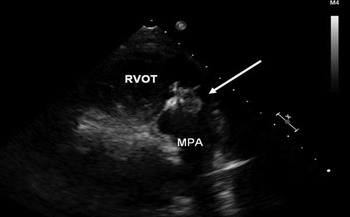
The patient presented 4 months after cardiac catheterisation with new symptoms, including recurrent low-grade fevers, weakness, lethargy and anorexia. At this time, physical examination showed his murmur was unchanged and he had no splenomegaly, petechiae, subungual haemorrhages, Osler nodes or Janeway lesions. A transthoracic echocardiogram performed at that time demonstrated a peak gradient of 70–80 mmHg across the Melody® valve with no masses or vegetations noted. His white blood cell count, C-reactive protein, and erythrocyte sedimentation rate were elevated. Initial blood cultures grew gram-positive rods, which were thought to be contaminants. However, multiple repeat cultures over the next several weeks continued to grow the same organism, eventually identified as Corynebacterium pseudodiphtheriticum. The patient was admitted to the hospital, where a repeat transthoracic echocardiogram showed a large mass on the Melody® valve with a peak instantaneous gradient across the valve of 100 mmHg (Fig 1).
Transthoracic echocardiogram parasternal long-axis view of the transcatheter pulmonary valve (Melody® valve). There is a mass seen on the pulmonary artery side of the Melody® valve (white arrow). MPA=main pulmonary artery; RVOT=right ventricular outflow tract.

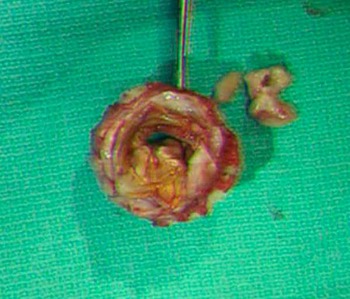
After 1 week of admission, the patient was taken to the operating room for removal of the vegetative endocarditis and pulmonary valve replacement. The Carpentier-Edwards valve that contained the Melody® valve was excised intact. Upon inspection, two of the leaflets of the Melody® valve were normal and pliable and the third appeared moderately thickened. There was a large, soft, non-mobile vegetation present in the valve sinus (Fig 2). After excision of the prosthetic valves, the right ventricular outflow tract was found to have no evidence of any residual infection or abscess. A 25 mm Epic bioprosthetic valve (St. Jude Medical, Minneapolis, Minnesota, United States of America) was used to replace the pulmonary valve. The right ventricular outflow tract was augmented with a patch. The pathology sections demonstrated extensive disruption and degeneration of the valve leaflets, focal acute inflammation and fibrinous vegetations having micronodular calcification and calcific degeneration. The gram stain of the vegetation showed gram-positive rods. This confirmed the diagnosis of Melody® valve endocarditis with C. pseudodiphtheriticum. The patient was treated with 6 weeks of penicillin and 1 week of synergistic gentamicin. After 6 months, he is clinically well and free from cardiovascular symptoms, as well as any signs or symptoms of infection.
Transcatheter pulmonary valve (Melody® valve) after surgical excision. With the Melody® valve en face, one of the leaflets is grossly thickened. The other two leaflets are thin and pliable. Next to the valve is the vegetation that was removed from one of the sinuses.

Discussion
There are no reported cases of endocarditis of a Melody® valve with C. pseudodiphtheriticum.Reference Bhat, Forbes and Aggarwal 1 – Reference Buber, Bergersen and Lock 4 A recent review demonstrated that at least one case of bacterial endocarditis occurred in all three prospective multi-centre studies of the Melody® valve.Reference McElhinney, Benson, Eicken, Kreutzer, Padera and Zahn 3 In this review, 16 of the 311 patients were diagnosed with infective endocarditis at a range of 50 days to 4.7 years after implant. The episodes of infective endocarditis in this series were not closely related to the implant procedure, similar to our patient diagnosed more than 1 year after implantation. A recent single-centre study showed that the rate of blood stream infection after Melody® valve placement was 9.5% and the infective endocarditis rate was 2.5%.Reference Buber, Bergersen and Lock 4 A search of the FDA Manufacturer and User Facility Device Experience database reported 17 cases of endocarditis with six cases of vegetations on the Melody® valve. The bovine jugular valve used in the Melody® valve is the same as the Contegra® valve (Medtronic, Minneapolis, Minnesota, United States of America). A review of the Contegra® valve experience in Europe showed a similar freedom from endocarditis rate of 92% compared with 97% reported in the Melody® valve experience.Reference McElhinney, Benson, Eicken, Kreutzer, Padera and Zahn 3 , Reference Breymann, Blanz and Wojtalik 5
Corynebacterium species are Gram-positive rods that are often considered non-pathogenic components of normal skin flora and mucosal membranes. However, it has been noted that this organism has the ability to cause life-threatening infection, specifically endocarditis.Reference Belmares, Detterline, Pak and Parada 6 , Reference Muttaiyah, Best, Freeman, Taylor, Morris and Roberts 7 The reported risk factors of Corynebacterium endocarditis include pre-existing cardiac disease and the presence of prosthetic devices.Reference Belmares, Detterline, Pak and Parada 6 In a case series species-specific review of C. pseudodiphtheriticum, this organism was associated with prosthetic valves.Reference Belmares, Detterline, Pak and Parada 6 Our patient had both of the identified risk factors for C. pseudodiphtheriticum endocarditis. These risk factors are common to essentially all patients who undergo heart valve replacement procedures.
Conclusion
This case illustrates that the Melody® valve, as with other implantable cardiac devices, can be susceptible to Corynebacterium infection. This organism can be difficult to culture, and many microbiology laboratories often consider this species a common lab contaminant. If patients present with fever and non-specific constitutional symptoms after Melody® valve implantation, Corynebacterium endocarditis should be considered in the differential diagnosis.
Acknowledgements
The authors are grateful to John F. Rhodes, MD, from Duke University Medical Center, Durham, North Carolina, United States of America, for his invaluable advice and expertise related to this manuscript.
Conflicts of Interest
None.
Financial Support
This research received no specific grant from any funding agency, commercial or not-for-profit sectors.