Mounting evidence shows that political leanings and adaptive behaviors related to politics are a dynamic combination of political socialization and evolutionarily processes that shape perceptions and responses to the social world. Reference Bradley, Lang, Lane and Nadel1,Reference Feldman and Huddy2,Reference Fowler and Schreiber3 An oft-discussed concept undergirding these biology connections is negativity bias — the fast avoidance of unpleasant stimuli and heightened surveillance of the environment for threat. Reference Cacioppo and Berntson4 Recent evidence specifically suggests that individuals who are high in conservatism are likely to exhibit a higher negativity bias than individuals who are high in liberalism. Reference Hibbing, Smith and Alford5,Reference Jost and Amodio6
Indeed, there is considerable research showing that political identification varies with specific psychological traits, Reference Homer-Dixon, Maynard, Mildenberger, Milkoreit, Mock, Quilley, Schoder and Thagard7,8 physiological traits, Reference Oxley, Smith, Alford, Hibbing, Miller, Scalora, Hatemi and Hibbing9,Reference Smith, Oxley, Hibbing, Alford and Hibbing10 genetic traits, Reference Smith, Oxley, Hibbing, Alford and Hibbing11 and neurocognitive structural Reference Amodio, Jost, Master and Yee12,Reference Feldman and Johnston13 and information-processing Reference Schreiber, Fonzo, Simmons, Dawes, Flagan, Fowler and Paulus14 differences. This study attempts to replicate these results regarding political identification and differences in biologically motivated processes. Specifically, this article uses a motivational system approach to human cognition, emotion, and behavior. Reference Cacioppo, Berntson, Norris, Gollan, Lang, Kruglanksi and Higgins15 Within this framework, much of human cognition, emotion, and behavior is thought to derive from activation in two motivational systems: the appetitive and the aversive. The appetitive system drives information intake and approach behavior; the aversive system is responsible for fast, defensive reactions (such as the startle response Reference Vrana, Spence and Lang16 ) and for more complicated behaviors such as fight or flight or general caution in a situation in which risk is present. 17
The extent to which variation in these motivational systems predicts political ideology, however, has not been directly tested. Further, the previously cited experiments draw inferences regarding properties of the motivational systems (e.g., the negativity bias hypothesis 18 ) from measures of neurophysiological activation such as functional magnetic resonance imaging and electroencephalography. However, this study uses a validated self-report measure that has been shown to index individual differences in trait-level activation in the appetitive and aversive motivational systems to predict differences in political ideology. In addition, there is a growing body of research that has demonstrated that these trait-level differences cause different media choice behaviors and preferences. Reference Potter, Lee and Rubenking19 Thus, this study looks at the role of trait motivational differences on political identification and how these differences then influence preferences and choices for media related to politics.
The data used for this study were obtained from a national survey (
 $N=1\text{,}039$
) of adults ranging in age from 18 to 70. Respondents reported how conservative or liberal their views were and completed the Motivation Activation Measure (MAM
Reference Lang, Shin and Lee20
) as an index of trait-level activation of approach system activation (ASA; a correlate of the positivity offset of the appetitive system) and defensive system activation (DSA; a correlate of the negativity bias of the aversive system). Participants also responded to questions concerning preferences for various technological platforms used to stay “up to date” on the latest news stories about politics. The larger survey included additional questions about preferences for various features of news across a range of topics that are not included in this article.
The assertion was that an individual’s DSA would be predictive of his or her self-reported liberalism and conservatism. Based on other recent work interested in the role of motivation activation in choice behavior, Reference Wang, Tchernev and Solloway21,22,Reference Shoenberger and Tandoc23 predictions are given for the relationship between liberalism conservatism and preferences for different technological platforms (traditional and interactive) used to obtain news about politics.
Psychobiological evidence of political identification
The study of the roots and effects of political identification has a rich history. 24,Reference Shafer and Claggett25 Recent research has attempted to discern the role of an individual’s psychology on his or her political identification and behavior. 26 Much of the research relates to the role of psychology in the development of political identification can be split into two views: the effect of psychological traits on the development of political identification and behavior 27,Reference Cacioppo and Visser28,29 and the effect of political identification on psychological states. Reference Bradley, Angelini and Lee30,Reference Liuzza, Vecchione, Dentale, Crostella, Barbaranelli, Caprara and Aglioti31,Reference Westen, Blagov, Harenski, Kilts and Hamann32 Researchers interested in the role of traits on political identification usually begin with a reference to Ralph Waldo Emerson’s discussion of political division as a product of something deep within “the human condition.” 33 In other words, the political divisions that have been apparent over the course of human history, at least according to Emerson, have their roots deep within human nature.
Previous research has demonstrated that political identification is, at best, a multidimensional construct that is the combined outcome of biological, psychological, and sociological inputs over time. Reference Jost, Federico and Napier34 From the biological and psychological perspective, there is growing evidence that conservatives and liberals exhibit differences in cognitive control and self-regulation, 35 heightened threat monitoring (among conservatives 36 ), and heightened negativity bias (again among conservatives 37 ).
Many scholars in this area are careful to state that these biological and psychological differences are not necessarily deterministic in nature; rather, they help us “determine why some people seem primed to adopt certain political attitudes, whereas others appear primed to adopt quite different attitudes.” 38 However, while these differences are not necessarily deterministic in nature, it is worth noting that many of the psychological variables being investigated (e.g., negativity bias) are relatively stable over the course of a life span. Reference Norris, Larsen, Crawford and Cacioppo39
This study builds on these ideas, specifically those related to the motivational processes underlying responses to threats and political identification, 40 in an attempt to further integrate the current research related to the neurocognitive roots of political motivation, emotion, identification, and behavior, 41 and how these biological and psychological differences influence preferences related to choice behavior. This integration is accomplished by the inclusion of the evaluative space model within the discussion of the neurological roots of motivation that might underlie the effects currently being reported. 42
The evaluative space model
At the risk of sounding overly reductionist, research into social neuroscience has shown that a large amount of human behavior can be traced to two evolutionarily developed, biologically based systems: the appetitive and the aversive. 43,44 The appetitive system activates automatically in response to situations that present possible rewards or life-sustaining activities (e.g., food and mating). Within communication, the appetitive system has been shown to activate in response to pleasant messages or situations that present a topic that the viewer has an affinity for. The aversive system activates automatically in response to threat or danger, and in communication research it has been shown to activate in response to unpleasant messages or situations in which the viewer does not like the specific content. When the situation is neutral, the appetitive system is more active than the aversive system, a concept referred to as positivity offset. However, as a situation becomes more intense, the aversive system activates more quickly than the appetitive. This faster activation is called negativity bias.
The Motivation Activation Measure
Recent work has attempted to reliably index these individual variations in positivity offset and negativity bias in a noninvasive and valid way. Lang and colleagues 45 have developed a pictorial, self-report scale that indexes individual differences in positivity offset and negativity bias under the evaluative space model.
The Motivation Activation Measure (MAM) is a parsimonious scale used to index an individual’s propensity to approach appetitive/rewarding situations and avoid aversive/threatening situations. Reference Lang, Bradley, Sparks and Lee46,Reference Lang, Kurita, Rubenking and Potter47 It does so by obtaining arousal and valence ratings of pictures from the International Affective Picture System Reference Lang, Bradley and Cuthbert48 and calculating two scores for each individual: an ASA score and a DSA score. These scores indicate the strength of positivity offset and negativity bias. Individual differences in ASA and DSA scores have been found to be significantly related to differences in how individuals respond to emotional stimuli. In addition, ASA has been found to be positively correlated with larger psychological constructs such as sensation seeking. 49
MAM and political ideology
Given the work of Hibbing and others discussed earlier, it is possible to predict a relationship between ASA and DSA and an individual’s political ideology. Specifically, we predict that DSA will covary with conservatism, as in previous research that has demonstrated a similar relationship between negativity bias and political leanings. Interestingly, previous work has not demonstrated an influence of positivity offset — or ASA within the MAM literature — on political identification. Thus, the following hypothesis and research question are put forth:
- H1:
-
Individuals who have a higher DSA will also self-identify as more conservative.
- RQ1:
-
Will ASA be predictive of an individual’s self-identified political ideology?
MAM and motivated choice behavior
Lang and colleagues originally developed this scale to study individual differences in responses to media content. 50 Variation in MAM scores has been found to significantly influence how individuals process a variety of media contents. Reference Lang and Lee51,52,Reference Sparks and Chung53 However, several recent studies have found that variation in MAM scores also predicts preferences for media content. Potter and colleagues 54 showed that ASA is positively correlated with a preference for material that is adventurous, pleasant, and unpredictable. In addition, they found that DSA is positively correlated with a preference for media that presents possible threats or information about the threats. These results have recently been replicated in a non-Western culture as well. Reference Samson and Detenber55
In addition, other work has demonstrated that MAM is predictive of online behavior within social networks. Specifically, differences in ASA are predictive of using social media for escape from reality or for excitement, Reference Bolls, Shoenberger, Schillenger, Almond and Williams56 the use of the social connection features of Facebook, and self-expression on the social media platform. 57 Conversely, DSA is predictive of the frequency of Facebook logins but not of continued behavior once logged into the site. These results are in line with previous findings 58,59 in that they demonstrate a general information-seeking behavior for individuals who are higher in DSA. But this behavior is more about information breadth than depth. In addition, individuals who are higher in ASA demonstrate a propensity to seek out interactive, exciting, or novel information in their social media interactions.
In addition to the work relating the psychobiological traits of ASA and DSA to general media and online behaviors, there is reason to believe that, given the relationship between these traits and political identification, these traits are also likely to impact an individual’s information-seeking behavior as it relates to political news. Reference Garrett60,61 Indeed, one of the core functions of media use — especially news — is information intake. Reference Shoemaker62 One implication of the relationship between trait-level activation of the appetitive and aversive systems and political ideology is that it could ultimately impact media-use preferences for scanning and staying up to date on the latest political news.
For this study, news is divided into two groups that define subsets of news sources: traditional and interactive media. Reference Thorson, Shoenberger, Karaliova, Kim and Fidler63 Traditional news sources are defined as newspaper, radio, network news, 24-hour news, and opinion shows. Interactive sources are defined as news presented through a website on a computer, through a smartphone or tablet app, or through social media platforms. These divisions can also be thought of as the media platforms mostly likely to be displaced (i.e., traditional media) versus the platforms likely to be doing the displacing (i.e., interactive media Reference Dutta-Bergman64,Reference Westlund and Färdigh65 ).
Given the previous work related to media choices and preferences and MAM, we expect that ASA and DSA will differentially predict preferences for interactive versus traditional media. Specifically, interactive media provide greater uncertainty, greater chances for social interaction, faster distribution of information, and greater depth of information across the aggregate of users. Traditional media provide a breadth of information and specifically are likely to focus on identifying important information for the public — as opposed to the specific user- or viewer-directed information that social media can present. However, little work has looked at how political identification influences choice behavior with news. Thus, the following hypotheses and a research question are posed:
- H2:
-
Individuals with a higher ASA will have a greater preference for interactive media sources of political information.
- H3:
-
Individuals with a higher DSA will have a greater preference for traditional media sources of political information.
- RQ2:
-
What is the indirect effect of political identification on ASA, DSA, and the choice between interactive and traditional media sources of political information?
Methodology
The data used to test these relationships were collected through a nationally distributed online survey (
 $N=1\text{,}039$
) of individuals ranging in age from 18 to 70 years. All the individuals were registered members of a commercial survey panel administered by HCD Research. Study participants completed the survey, and in return they received credits that could be redeemed for items through HCD’s incentive programs. Given the incentives offered, everyone that started the survey completed it without any issue. The total survey, of which a portion of the data were collected for this research question, was designed to be completed in 25 to 30 minutes. The participants indicated their sex and their age and were then admitted into the rest of the survey instrument.
Motivational activation
The MAM
66
uses 43 images selected from more than 1,000 images available in the International Affective Picture System.
67
The images used in MAM vary in arousal and valence such that they represent different levels of arousing content and increasing valence. Specifically, MAM includes two levels of pleasant images (low and very high) and three levels of unpleasant images (low, moderate, and very high). The survey participants were allowed to view each image for as long as they pleased. Then, after viewing, they were asked to separately rate the previous image for arousal, positivity, and negativity using nine-point scales that ranged from not at all to extremely. The scores for each participant’s ASA (
 $M=1.67$
, SD
 $=$
1.53) was calculated by subtracting the mean of the positivity ratings for both the pleasant and unpleasant images from the lowest level of arousal from the mean positivity of the highly arousing, pleasant images (see A. Lang and colleagues
Reference Lang, Kurita, Rubenking and Potter47
for a full description of the calculation of these values). DSA (
 $M=3.16$
, SD
 $=$
1.86) was calculated by subtracting the mean negativity of both the pleasant and unpleasant images that were low in arousal from the mean negativity of the unpleasant images that were in the moderate and high arousal categories.
Political ideology
Political ideology was measured through self-reported questions related to how liberal or conservative the individual described their own political views. The level of liberalism (
 $M=4.96$
, SD
 $=$
2.48) was determined by asking “In general, how liberal would you describe your political views?” with a nine-point scalar response that ranged from not at all to very liberal. Similarly, the level of conservatism (
 $M=5.08$
, SD
 $=$
2.44) was determined by asking “In general, how conservative would you describe your political views?” with a similar response scale.
Political news preferences
The participants also were asked to self-report their choice preferences for how they receive political news. These questions were randomly presented to the participant with a nine-point scale that ranged from not at all to extremely important. Each of the methods of news intake — news on a desktop computer (
 $M=5.07$
, SD
 $=$
2.85), news on a smartphone (
 $M=3.21$
, SD
 $=$
2.66), news on a tablet (
 $M=3.00$
, SD
 $=$
2.58), social media (
 $M=3.55$
, SD
 $=$
2.78), newspaper (
 $M=4.78$
, SD
 $=$
2.85), radio (
 $M=4.38$
, SD
 $=$
2.80), network television news (
 $M=5.00$
, SD
 $=$
2.90), 24-hour news (
 $M=4.86$
, SD
 $=$
2.90), or opinion shows (
 $M=3.95$
, SD
 $=$
2.85) — was presented with the question “How important are the following sources in helping you stay informed about local or national politics?” Four questions were asked about desktop, mobile, tablet, and social media news consumption, which were later aggregated into a latent variable for interactive media. Five questions were asked about users’ preference for newspaper, radio, network television, 24-hour cable news, and opinion news for their political news consumption. These questions were also aggregated into a latent variable for traditional media news consumption. The participants’ preference for the other methods of news intake was assessed individually.
Results
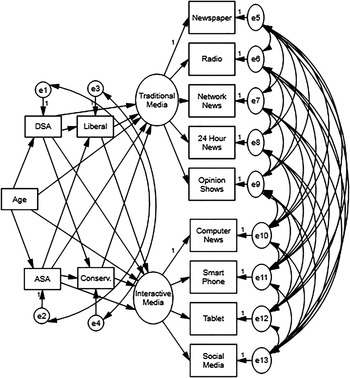
A structural equation modeling approach was used to formally examine the hypotheses. (See Figure 1 for the hypothesized model.) SPSS AMOS statistical software was used to estimate and examine direct hypotheses. Manifest and latent variables were included in the model. For instance, part of the model is a measurement model that assesses individual political news preferences split into two latent variables — traditional and interactive media. Before an examination of the hypotheses and research questions could occur, model fit indices were examined. The CFI
 $=$
0.97 and RMSEA
 $=$
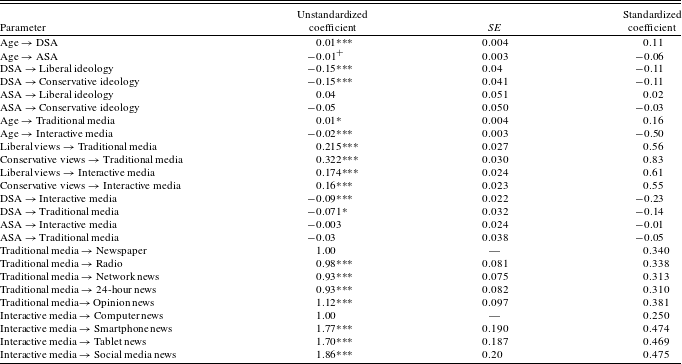
0.084 indicated adequate model fit. Thus, it was deemed appropriate to examine the direct influence of variables in the model. Only paths relevant to the proposed hypotheses are discussed. However, all unstandardized and standardized coefficients, with their associated standard errors, can be referenced in Table 1.
Full path model of political news preference.

Direct effects of age, trait motivational activation, and political ideology on political news preference.

Note: CFI
 $=$
0.97, RMSEA
 $=$
0.08. Both manifest variables of newspaper news and social media news were constrained to 1 for the measurement model to be estimated.
 $\text{}^{\ast }p<0.05$
;
 $\text{}^{\ast \ast }p<0.01$
;
 $\text{}^{\ast \ast \ast }p<0.001$
;
 $\text{}^{+}p<0.06.$
The first hypothesis predicted individuals who have higher DSA will also self-identify as more conservative. According to the model, there was a negative association between DSA and conservatism (
 $\unicode[STIX]{x1D6FD}=-0.11$
, SE
 $=$
0.041,
 $p<0.001$
). That is, as trait-level DSA went up, the level of self-reported conservatism went down, which was opposite of what was predicted. Thus, H1 was not supported. The relationship was in the opposite direction predicted.
The first research question asked whether ASA would be predictive of an individual’s self-identified political identification. According to the model, there was no relationship present between ASA and conservatism (
 $\unicode[STIX]{x1D6FD}=-0.033$
, SE
 $=$
0.05,
 $p=0.29$
) or between ASA and liberalism (
 $\unicode[STIX]{x1D6FD}=0.023$
, SE
 $=$
0.05,
 $p=0.46$
). Simply put, with these data, ASA did not predict an individual’s political ideology.
The second hypothesis posited that individuals with higher ASA will have a greater preference for interactive media sources of political information. However, this was not the case. The direct path between ASA and interactive media sources was not significant (
 $\unicode[STIX]{x1D6FD}=-0.01$
, SE
 $=$
0.02,
 $p=0.90$
). Therefore, H2 was not supported.
The third hypothesis posited that individuals with a higher DSA will have a greater preference for traditional media sources of political information. According to the model, there was a significant negative relationship between DSA and traditional media sources (
 $\unicode[STIX]{x1D6FD}=-0.14$
, SE
 $=$
0.03,
 $p=0.03$
), which was in the opposite direction of what was predicted. Thus, H3 was marginally supported, but the relationship was opposite what was predicted.
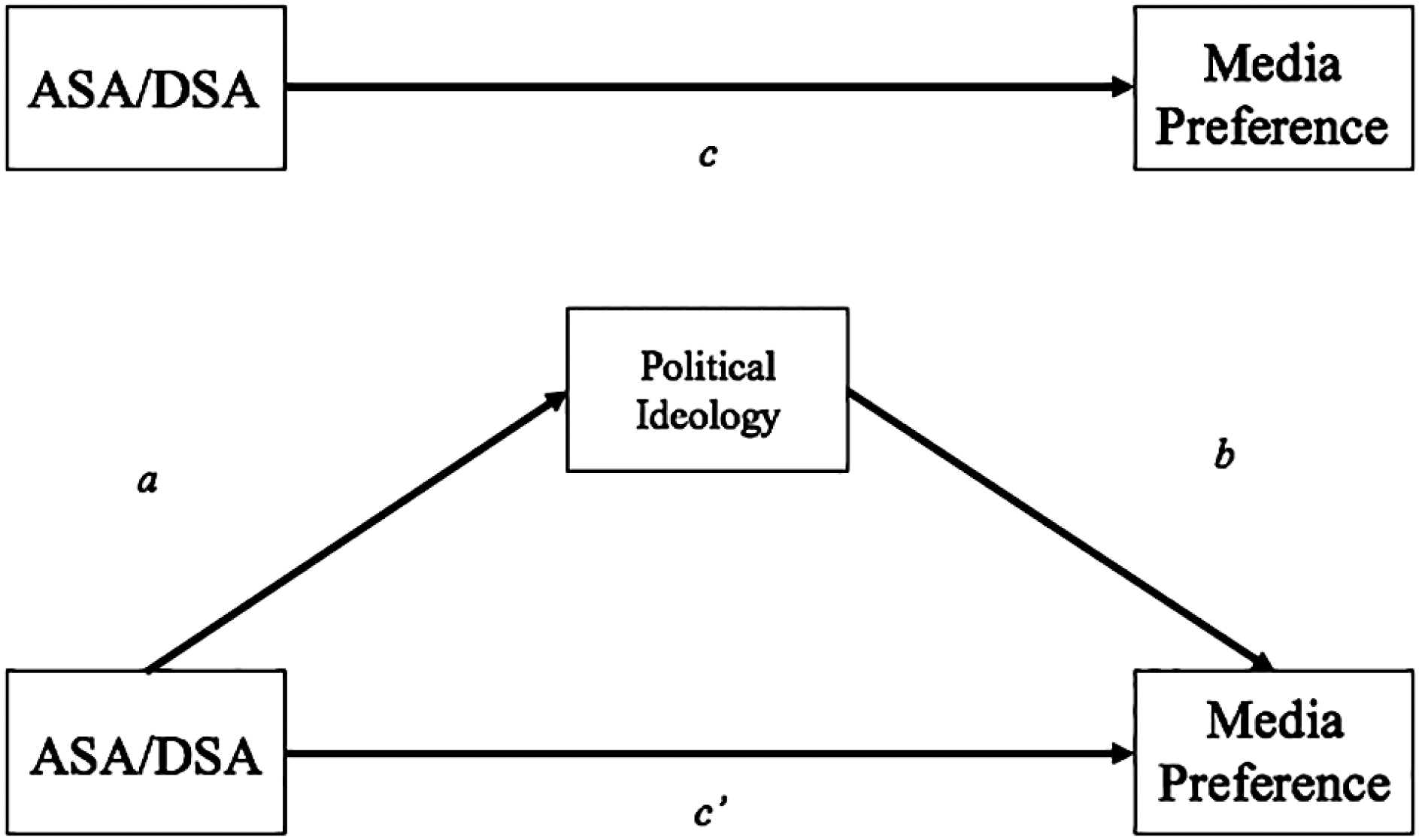
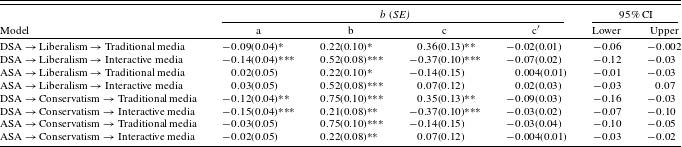
The second research question was interested in examining the indirect effects of political identification between trait motivational activation and political news preference. To assess the hypothesized indirect effects, we used the PROCESS macro for SPSS developed by Hayes. According to macro documentation, model 4, with the addition of various covariates, was required to fully examine RQ2. Reference Zhao, Lynch and Chen68 The general structural model used for the analysis can be referenced in Figure 2. Because of the various relationships to be examined, a total of eight models were run. A summary of all models’ coefficients can be referenced in Table 2.
Indirect effects model. Note: When not included within the model, trait motivational activation, political ideology, media preference, and age were included as covariates.

Indirect effects of political ideology between trait motivational activation and political news preference.

Note: 95% confidence intervals were based on 5,000 bootstrap samples.
 $\text{}^{\ast }p<0.05$
;
 $\text{}^{\ast \ast }p<0.01$
;
 $\text{}^{\ast \ast \ast }p<0.001.$
From these data we find that both liberal and conservative ideology play an indirect role in predicting the influence that trait motivational activation has on political news preference. First, liberalism mediated the relationships between DSA and traditional media (
 $b=-0.02$
, SE
 $=$
0.01, 95% CI:
 $-$
0.06,
 $-$
0.002) and interactive media (
 $b=-0.07$
, SE
 $=$
0.02, 95% CI:
 $-$
0.12,
 $-$
0.03). Liberal ideology also had an indirect effect on the relationship between ASA and traditional media (
 $b=0.004$
, SE
 $=$
0.01, 95% CI:
 $-$
0.01,
 $-$
0.03) but not interactive media (
 $b=0.02$
, SE
 $=$
0.03, 95% CI:
 $-$
0.03, 0.07). Second, conservatism mediated the relationships between DSA and both traditional media (
 $b=-0.09$
, SE
 $=$
0.03, 95% CI:
 $-$
0.16,
 $-$
0.03) and interactive media (
 $b=-0.03$
, SE
 $=$
0.02, 95% CI:
 $-$
0.07,
 $-$
0.19). Moreover, it mediated the relationships between ASA and both traditional media (
 $b=-0.03$
, SE
 $=$
0.04, 95% CI:
 $-$
0.10,
 $-$
0.05) and interactive media (
 $b=-0.004$
, SE
 $=$
0.01, 95% CI:
 $-$
0.03,
 $-$
0.02).
However, given our findings about the role of ASA and DSA in political ideology, we performed a secondary analysis to determine whether the effects of the motivational systems are present only for the extremes of political identification. The data were first screened for respondents who identified their views as at least moderately conservative or liberal by indicating at least a 5 on the nine-point scale for at least one of the items indexing conservatism and liberalism. A new variable representing degree of conservatism and liberalism was created by subtracting each remaining respondent’s response to the item measuring how liberal their views were from the item measuring how conservative their views were. Scores on this variable ranged from 8 to
 $-$
8. All individuals who had a value of zero on this variable, indicating equally conservative and liberal views, were excluded from this analysis. Positive scores identified conservatives (
 $n=302$
), and negative scores identified liberals (
 $n=294$
). For this analysis, no covariates were included.
A simple linear regression was then run separately for conservatives and liberals entering ASA and DSA as predictors in the model and degree of conservatism/liberalism as the dependent variable. Regression results for conservatives revealed that DSA was a significant positive predictor of conservatism (
 $R^{2}=0.02$
,
 $F$
(1,300)
 $=$
6.892,
 $p=0.009$
,
 $\unicode[STIX]{x1D6FD}=0.15$
). There appears to be a small positive effect of DSA on conservatism. In addition, the relationship between ASA and conservatism was not significant. Regression results for liberals revealed that DSA was a significant negative predictor of liberalism (
 $R^{2}=0.08$
,
 $F$
(1,292)
 $=$
26.182,
 $p<0.001$
,
 $\unicode[STIX]{x1D6FD}=-0.29$
). A moderate negative effect of DSA on liberalism was found, but there was not a significant relationship between ASA and conservatism.
These results offer some support for the initial assumption underlying this study: that trait-level activation in the appetitive and aversive systems predicts political ideology. The regression analysis results indicate that trait-level activation of the aversive system is predictive of polarized political ideology but not trait-level activation of the appetitive system. Higher trait-level activation of the aversive system appears to lead to more extreme conservatism among conservatives by predicting a small amount of variance in the strength of conservatism. The opposite, however, is true for liberals. Lower trait-level activation of the aversive system appears to lead to more extreme liberalism among liberals by predicting a moderate amount of variance in the strength of liberalism. Taken together with the results of the larger model presented earlier, trait-level activation is predictive of extreme political beliefs as well as choice behavior in relation to political news and information.
Discussion
This study presents findings related to the role of motivational activation differences such as negativity bias in the formation of extreme political identification. Specifically, the data presented here point to the complex nature of ASA and DSA activation in relation to political leaning and news consumption. We offer a rich series of results that point to consumption of media on many platforms regardless of resting trait activation and have generated findings that evoke discussion around the current political climate in the United States.
Notably, our results indicate that while DSA predicted lower levels of reported conservatism, ASA was not related to political ideology. Indeed, our secondary analysis indicates that DSA is particularly predictive of extreme political views. The relationship between resting motivation trait activation and self-reported political ideology is nuanced, and contextual variables such as the vulnerability of the region a participant calls home (e.g., crime rates, single-parent households, etc.) may be useful in future research. In addition, it is possible that moderates and individuals who are less politically inclined are not influenced by negativity bias in the same way as individuals who hold extreme views. The conditional nature of these data certainly points to a dynamic relationship between the variables, and future research should further investigate the role of motivational traits in the formation of attitudes that are tangential to political identification (e.g., social issues, tax reform, immigration issues, racial reconciliation, etc.). Regardless, it is apparent that DSA is predictive of extreme political views but not of overall political views, and ASA is not predictive of political behavior despite it being documented as influencing other behavior.
Further, we assumed that higher ASA would predict a preference for the use of interactive media to receive political news and that higher DSA would predict a preference for traditional media as a political news conduit. We hypothesized that those higher in ASA would prefer interactive news delivery because of the link between ASA and novel, more exciting stimuli. 69 However, it may be that interactive news, as we define it, is perceived as relatively normal today. In 2016, Pew Research Center reported that 62% of Americans were getting news on social media. Reference Gottfried and Mitchell70 Thus, the finding that DSA predicted less use of traditional media is, possibly, simply a sign of the times. New media are no longer new and are instead viewed as a traditional, acceptable, and useful way to gather news information about a specific topic.
Further research into this area should include the sources utilized by media consumers (e.g., New York Times, CNN, BuzzFeed, etc.) as most news content can now be delivered through many mediums. It would be interesting to explore whether those high in DSA prefer legacy news (e.g., New York Times) over sources such as BuzzFeed or whether their political affiliation may interact so that they consume more news that affirms their preexisting beliefs, essentially avoiding a challenge to their political worldview. It is possible, then, that those high in ASA may be more likely to consume news from more types of sources. In addition, future work should look at how these different preferences, political ideologies, and differences in baseline trait activation influence the cognitive processing of and emotional reactions to political information presented in various media (e.g., advertisements, debates, news coverage).
Finally, there are interesting indirect effects of political identification between trait motivational activation and political news preference. Liberalism mediated the relationship between DSA and the use of traditional and interactive media for political news. Liberalism also mediated the relationship between ASA and the use of traditional media for political news but not interactive media. Interestingly, a similar pattern of mediation emerged for the relationship between ASA, DSA, and conservative ideology, where conservative ideology mediated the relationship between trait motivational activation and media type. As noted earlier, it is possible that the political climate in which we reside has become increasingly partisan and hostile. Thus, it may be that strength of political ideology, in this moment in time, is more influential than resting trait motivation on the platform whereby political news is received.
One explanation is that more politically inclined people may be expressing frustration with the news media in general, and thus they are seeking out “alternative” media sources. Of interest here is our secondary analysis related to the role of baseline trait activation on political extremism. Indeed, taking our two analyses together, there may be an ideological spiral whereby an individual’s trait activation — specifically, their DSA — predicts their extreme political beliefs and then also leads them to select specific types of information, which then work to further solidify their previous political views. Future research should investigate the role of trait activation, political identification, and choice behavior situations like those explained by mood management to better understand the possible spiraling interactions that might be occurring. In addition, future research should look at the actual choices that individuals make related to political information, not just their intentions or preferences for particular types of information.
Limitations
While the results and analysis presented here are compelling and, in some ways, seem to replicate the findings of previous work related to the biological basis of political identification, there are some limitations. These limitations are related to our measurement, our sample, and our statistical approach. While the reliability and validity of MAM is well documented, some caution should be demonstrated with how we discuss the theoretical connections between the previous literature related to the role of negativity bias and political ideology and the data presented here. Notably, much of this previous research has demonstrated differences in the neurophysiology or emotional reactions of individuals with varying strength of views — particularly individuals with extreme political views. These differences — measuring negativity bias through self-reports versus neurophysiological differences — might explain why our initial analysis approach was unsuccessful despite the robust literature from which we derived our predictions. Although unrelated to the biological basis of political behavior, future research should better connect the outcomes of MAM to differences in neurophysiology.
Also, previous research has used various ways of measuring an individual’s political commitments. For this study, for the sake of parsimony, we chose to use a simple, self-reported measure. There are obvious limitations to such a limited approach to measuring ideology. Future research should attempt to measure political ideology through a more robust method that includes a mix of questions related to specific policy issues as well as overall political leaning.
In addition, the sample used was a professionally recruited sample of people who often complete surveys for money. Therefore, their understanding of how to answer the questions was likely higher than a regular representative sample, which might introduce some form of bias into the data. We did everything possible to avoid this situation, but future work might attempt to replicate our findings with a different randomly selected sample. Despite the work to replicate and validate MAM, this is the first study to use a large-scale sample with a large variance in the age range. Future work should continue to use the MAM as a measure of baseline trait activation. This measure could be of use where phrases such as negativity bias are used to describe some type of psychological trait or behavior (e.g., the literature on aging Reference Keil and Freund71 ).
Lastly, despite our use of modern statistical modeling techniques, we are cautious in making any causal statements regarding political ideology, baseline trait activation, and choice behavior from these data. Instead, we believe that this data presents us with a solid foundation to build from with a series of experiments that can more formally probe the causal nature of these constructs. Taken together, the data presented here demonstrate a strong picture of the complex, dynamic, and interconnected role that biological differences such as trait differences in approach and avoidance plays in both the formation of political ideologies and the choice to consume certain types of political information. Future work should continue to consider the basis of our views — particularly those that are extreme in nature — and how these various biological motivators influence our political outlook over the life span.