American democracy faces serious challenges, including hyperpartisanship, declining public confidence in government, and legislative paralysis. When government cannot or will not act, civil society and its philanthropic patrons offer an alternative mechanism of social change. This article documents how America’s billionaires are using their wealth, ideas, and political leverage to advance controversial policy goals, from deficit reduction, to school reform, to gun regulation. Drawing on an original dataset of almost 200 leading philanthropists, I found that more than half have serious policy interests and ambitions. Although receiving acclaim in some circles, these “policy plutocrats” often draw criticism for disregarding democratic processes, enhancing elite power, and inflicting ill-conceived experiments on disadvantaged populations. However, these donors also are subsidizing organizations that amplify the voice of unorganized issue publics and marginalized populations. Plutocrats and their activities have opened a vast research frontier for normative and empirical political science.
Democratic governance in the United States is under threat on several fronts: the growing concentration of wealth and political power in the hands of relatively few individuals, the public’s steadily declining faith in government’s ability to respond effectively to public problems, and hyperpartisanship that makes compromise—the “bread and butter” of American democracy—difficult to achieve (Bartels Reference Bartels2010; Gilens and Page Reference Gilens and Page2014; Hacker and Pierson Reference Hacker and Pierson2011; Mann and Ornstein Reference Mann and Ornstein2012). Coupled with the weakening of populist institutions such as mass-membership federations and unions (Hacker and Pierson Reference Hacker and Pierson2011; Skocpol Reference Skocpol2003), these larger economic and political developments tend to strengthen the power of elites, who already dominate the political system (Carnes Reference Carnes2013).
Big money in politics, including billionaire patronage of presidential candidates, has garnered significant attention (see, e.g., Beinart Reference Beinart2014; Vogel Reference Vogel2014; West Reference West2014). However, the concentration of wealth and the weakening of government capacity have given rise to another less-studied trend: public and private pledges by America’s wealthiest citizens to devote most of their resources to public betterment—and to do so soon, during their lifetime. Because government has failed to act and mass publics have failed to mobilize, many of America’s millionaires and billionaires are stepping into the void with ambitious plans to ameliorate public problems. These donors are directing not only their money but also their time, ideas, and political leverage toward influencing public policy. These men and women are important political actors whose activities raise important questions about democratic voice, government performance, and public accountability. Yet, scholars of politics and policy have paid scant attention to how “giving is becoming governance” (Rogers Reference Rogers2012; see also Eikenberry Reference Eikenberry2006).
Although philanthropic plutocrats have been a feature of public life at least since the Gilded Age, “as the 21st century unfolds it has become accepted, and even expected, that wealthy philanthropists, businesses, charities and social entrepreneurs, rather than governments alone, will take part in and even lead efforts to solve big problems” (Bishop and Green Reference Bishop and Green2015, 542). Compared to their forebears, today’s philanthropic tycoons are distinguished by the scale of their ambitions; by their application of business rhetoric and methods (e.g., venture-capital investment models and impact metrics) to their philanthropy; and by their desire personally to direct the liquidation of their fortunes during their lifetime (Bishop and Green Reference Bishop and Green2008; Jenkins 2010–Reference Jenkins2011). Freeland (Reference Freeland2013) captured the essence of these developments: “You might call it the Silicon Valley school of politics—a technocratic, data-based objective search for solutions to our problems, uncorrupted by vested interests.” This approach to giving has become known as “philanthrocapitalism” (Bishop and Green Reference Bishop and Green2008). An analytically important substrain has been termed “philanthro-policymaking” (Rogers Reference Rogers2011).
Although some history-minded critics have questioned whether philanthrocapitalism represents a new phenomenon or simply a new label (Beresford Reference Beresford2007; Harvey et al. Reference Harvey, Maclean, Gordon and Shaw2011), modern-day plutocrats are disrupting stable governing arrangements and reconfiguring the delicate balance of power between the state and civil society. Donors do so by leveraging their wealth through different strategies.
Many donors choose to focus on neglected policy domains, working on issues especially prone to collective-action problems or making it possible for government entities to experiment without concern about political constraints or scarce public funds. Billionaire Michael Bloomberg, for example, views his philanthropy as “a way to embolden government” (Allen Reference Allen2015). Other donors further leverage their wealth by combining with peers in secretive funding alliances, networks, and global conclaves, in which they coordinate strategies and channel donations to favored organizations (Freeland Reference Freeland2012; Goldenberg Reference Goldenberg2013; Jenkins 2010–Reference Jenkins2011; Kroll and Schulman Reference Kroll and Schulman2014; Skocpol, this issue; Vogel Reference Vogel2014; West Reference West2014). Some donors have joined forces around issue-specific organizations and campaigns, such as Ed in ’08 (i.e., school reform) and FWD.us (i.e., immigration). A few donors also integrate different types of financial investments—in policy ideas, legislative advocacy, election campaigns, and even for-profit startups—to tackle a single issue along multiple fronts. Footnote 1 Some billionaire philanthropies are actively partnering with government (Bishop and Green Reference Bishop and Green2015). Because of these leveraging strategies, the marginal value of a private donor’s dollar may far exceed its face value. Footnote 2
Policy plutocrats deploy other sources of leverage to amplify the effects of their philanthropy—for example, moral authority. Many of today’s most active donors are entrepreneurs and “self-made men” (and, increasingly, women) whose track record of successful ideas resonates with government officials and the broader public. Donors also carry the promise of campaign cash, necessary to compete in the campaign-finance arms race. These different sources of leverage—innovative philanthropic strategies, moral authority, and campaign cash—can add up to real political power. As journalist Bob Herbert (Reference Herbert2014) acerbically argued: “When a multibillionaire gets an idea…[on] matters of important public policy and the billionaire is willing to back it up with hard cash, public officials tend to reach for the money with one hand and their marching orders with the other.” These features of donor influence—money, leverage, authority, and access—may provide even greater advantages in an era of vast income inequality and weakening modes of mass organization.
Policy plutocrats deploy other sources of leverage to amplify the effects of their philanthropy—for example, moral authority. Many of today’s most active donors are entrepreneurs and “self-made men” (and, increasingly, women) whose track record of successful ideas resonates with government officials and the broader public.
Implicit in these accounts is that today’s billionaires may not be interested primarily in supporting traditional charitable endeavors (e.g., funding scholarships and hospital wings) but rather in tackling the systemic forces that produce and perpetuate public problems—and doing so through the policy process. Footnote 3 Certain plutocrats—Bill and Melinda Gates, Michael Bloomberg, and a few other especially prominent donors—do fit this description. They are generating policy ideas, mobilizing pressure campaigns, trying to influence who holds office, and reforming the systems through which policy is implemented. However, are these policy-engaged “philanthrocapitalists” representative of today’s billionaire donors? This study uses an original dataset of almost 200 prominent philanthropists to explore the following three questions:
-
1. What is their philanthropic capacity?
-
2. How many of them have serious ambitions to influence public policy, and which issues concern them?
-
3. Which mix of charitable, advocacy, and electoral giving strategies are they deploying?
This article sets the stage by briefly reviewing prominent work on the role of major donors in the democratic process—a literature that mainstream political science might incorporate more fully. This is followed by a description of the data used to assess the scope and interests of the policy plutocrats: those wealthy donors (including but not limited to philanthrocapitalists) who have serious policy interests. Next, the empirical questions about today’s policy plutocrats are asked: Who are they, what are they funding, and what strategies are they using? The article concludes with brief thoughts about why policy plutocrats should matter to political scientists and those concerned with democratic governance. The aim of this article is modest: to create a broad intellectual foundation for a more deeply focused inquiry.
WEALTHY DONORS AND THE DEMOCRATIC PROCESS: AN OVERVIEW
America’s philanthropic and political donors enjoy broad liberties as a result of the First Amendment’s free-speech guarantees, loose federal regulation and oversight, and a political consensus on the value of nongovernmental approaches to public problems. The wide berth given to donors has engendered a long-standing, nuanced debate about their impact on democratic governance and the appropriate level of oversight to which they should be subjected. Broadly speaking, a dominant perspective claims that plutocrats and their philanthropic foundations enhance democracy by promoting a pluralism of ideas, solving collective-action problems, and funding innovative models that government might adopt (Bishop and Green Reference Bishop and Green2008; Fleishman Reference Fleishman2007; Frumkin Reference Frumkin2006; Walker Reference Walker1991). This salutary view implies that the state should have a light regulatory touch, perhaps requiring donors to disclose the broad contours of their activities and prosecuting the misuse of funds but otherwise allowing donors to operate free of governmental intervention. Another less-sanguine perspective holds that wealthy donors and their giving reinforce social and political inequalities by replicating elite institutions, quashing political dissent and other minority viewpoints, and channeling activism into organizations unlikely to change existing power structures (Jenkins Reference Jenkins, Powell and Clemens1998; Roelofs Reference Roelofs2003). In this view, wealthy donors are antidemocratic actors meriting substantially more governmental scrutiny and regulation.
This long-standing debate has reignited in recent years as donors’ capacity to influence policy has grown. Booms in the technology and hedge-fund sectors—combined with a favorable tax system—have created a generation of youthful entrepreneurs and financiers with more money than they could possibly spend on themselves. Scores of leading donors are using moral suasion to establish a norm that wealthy people’s “excess” money should go toward public purposes. Indeed, establishing megaphilanthropy as an elite norm is a goal of the Giving Pledge, through which approximately 140 donors have publicly vowed to give away the majority of their wealth during their lifetime. To enhance their impact, the wealthy are increasingly combining in networks to share strategies, intelligence, and funding targets (Bishop and Green Reference Bishop and Green2015; Vogel Reference Vogel2014). Some of these collaborations, such as the Koch network on the Right and the Democracy Alliance on the Left, share ideological goals; others, such as the Giving Pledge network, are oriented toward mutual learning; and yet others, such as the Elders, are focused on issue domains, such as global challenges (Bishop and Green Reference Bishop and Green2015). On the political front, recent court rulings—notably, Citizens United v. Federal Election Commission (2010), SpeechNow v. Federal Election Commission (2010), and McCutcheon v. Federal Election Commission (2014)—have allowed wealthy people to give unlimited sums to influence elections through ideologically and issue-focused organizations. Such spending rose dramatically after 2010 (Burns and Haberman Reference Burns and Haberman2013; OpenSecrets 2015a).
Indeed, establishing megaphilanthropy as an elite norm is a goal of the Giving Pledge, through which approximately 140 donors have publicly vowed to give away the majority of their wealth during their lifetime.
Philanthrocapitalists and their activities have generated a lively debate about donor accountability, both procedural and substantive. The procedural-accountability critique contends that philanthropists are “bastions of unaccountable power” (Ravitch Reference Ravitch2010) who are hastening “the transition from public deliberation by an elected government to decisions of self-appointed individuals with no accountability to the public” (Kumashiro Reference Kumashiro2012), often with little transparency or public debate (Edwards Reference Edwards2011). Major donors “can become ‘mini-governments’ that can, through their individual funding decisions, make public policy decisions on their own, without input from other citizens or elected representatives” (Eikenberry Reference Eikenberry2006), with the effect of “outsourcing” major policy areas to the private sector (Katz Reference Katz2012). Highly directive, arguably paternalistic giving styles may disempower civil-society leaders on the ground and increase the power of elites vis-à-vis non-elites, whose interests civil-society organizations often represent (Jenkins 2010–Reference Jenkins2011, 759). In this view, leadership qualities appropriate for business may be ill-suited for making social and policy change, which “can alter the life chances of millions of other people” (Bustillos Reference Bustillos2012).
The substantive-accountability critique questions philanthrocapitalists’ theories of change and raises doubts about their success (Edwards Reference Edwards2011). In this view, philanthrocapitalists are prone to “imperious overreaching” (Barkan Reference Barkan2011) and blinded by naiveté, seeing entrenched social problems such as poverty “as an engineering problem” easily solved by “their brain power” (Stanley Reference Stanley2015). The substantive-accountability critique asserts that philanthropists are imposing failed policy experiments on an unwitting public while incurring no personal penalty for harm caused. As Herbert (Reference Herbert2014) noted, Bill Gates “spent $2 billion and disrupted 8 percent of the nation’s public high schools before acknowledging that his experiment was a flop.”
In practice, the line between procedural accountability and substantive accountability is blurry. Both critiques raise questions, as Rogers (Reference Rogers2015, 539) stated, about “the potential of philanthropy to further entrench—or to diminish—the power divide between the haves and the have-nots.” (For a related critique from an insider, see LaMarche Reference LaMarche2014.) If these arguments have merit, then philanthrocapitalists demand greater study by political scientists concerned with public policy and democratic governance. With notable exceptions—largely focused on donors’ school-reform efforts (Ravitch Reference Ravitch2010; Reckhow Reference Reckhow2013; Reckhow, Reference Reckhowthis issue) and conservative-movement building (Skocpol and Williamson Reference Skocpol and Williamson2012; Teles Reference Teles2008)—there have been few systematic scholarly efforts to understand the scope of plutocrats’ policy activities, much less their political impact and the normative implications of their work. Instead, the critiques have been based on a few publicly visible billionaire donors—especially Bill and Melinda Gates, Warren Buffett, George Soros, and Charles and David Koch—whose strategic orientation and policy focus may not be representative of megaphilanthropists, including those who have pledged to give away the bulk of their wealth during their lifetime. Although the debate about philanthrocapitalism has raised important issues, it has been short on systematic data.
DATA AND METHODS
This article presents results from an original dataset of major US-based philanthropists whose giving is focused (at least in part) on domestic organizations and causes. Footnote 4 The data capture the publicly identifiable population of major philanthropic donors, allowing an assessment of the extent of their policy and political giving. Thus, the data should not be construed as a census of major political donors (or even a representative sample thereof). Naturally, many major philanthropists are also major political donors, as reported herein, and that group was of special interest. The dataset includes 194 individuals (or couples/families) assembled from the following three sources:
-
• The Giving Pledge, through which people of wealth publicly self-identify as intending to donate more than half of their wealth during their lifetime (givingpledge.org);
-
• The Philanthropy 50, a yearly list compiled by The Chronicle of Philanthropy of the most generous charitable donors (data are for 2012, 2013, 2014; bequests are excluded); and
-
• foundations that made the Foundation Center’s Top 100 lists of the largest philanthropies (by assets and by grants) and had the donor(s) at the helm.
For each philanthropic donor, as much data as was publicly available were collected on the individual’s policy-oriented giving. This giving was defined as gifts going toward influencing the policy-making process at any stage by (1) conducting and disseminating policy-relevant research; (2) shaping or amplifying public opinion; (3) subsidizing organizations working for policy change through the legislative, executive, or judicial branch; (4) intentionally providing models for new ways that government can deliver public services (e.g., K–12 education); or (5) partnering with government to reconfigure public spaces.
Donors were coded as policy-oriented givers if they (1) identified one of those goals in their Giving Pledge; (2) gave at least one $100,000 grant from their private foundation, in the most recent reporting year, to further a policy goal; (3) identified public-policy interests on their foundation or personal website; (4) contributed any amount to a campaign organization oriented to a specific policy issue (e.g., abortion rights) between 2010 and mid-2015; or (5) were publicly identified as having founded a policy-advocacy organization. Footnote 5
For each donor, policy interests were coded according to the scheme developed by the Policy Agendas Project (policyagendas.org), which includes 32 major topic areas. The philanthropists in the dataset had significant giving interests in 20 areas, including education, civil rights and liberties, energy, macroeconomic policy, and international affairs, among others.
Although different sources of public information are likely to capture many policy plutocrats, an unknown number undoubtedly eluded the data-gathering net. First, the net would miss at least some significant donors who give directly from a personal bank or investment account and who were not listed in The Philanthropy 50. The net would also miss donors who give anonymously through donor-advised funds housed in community foundations, other giving aggregators, and LLCs. [Note that donations channeled through a donor’s own 501(c)(3) private foundation would be disclosed on the foundation’s publicly accessible informational tax return. Footnote 6 ]
Second, the dataset omits major policy or political donors whose philanthropic activities do not meet one of the three thresholds for inclusion (i.e., signing The Giving Pledge, appearing on The Philanthropy 50, or overseeing a Top 100 Foundation). Thus, whereas many major policy donors have landed in the dataset—because they also are major philanthropists—the census would miss donors who give primarily through 501(c)(4) “dark money” organizations, which by law are not required to disclose their supporters to the public.
Third, the dataset omits donors who appear in media accounts as caring about an issue—perhaps by testifying before Congress—but whose donations to influence that issue could not be documented. The nonpublic nature of much giving means that far from being able to assess how wealthy donors influence public policy, one cannot even compile a definitive list of who those political actors are. However, the findings from this study suggest that even an incomplete census yields a useful contribution.
THE PHILANTHROPIC CAPACITY OF AMERICA’S POLICY PLUTOCRATS
The especially public, generous philanthropists in my sample have both a great capacity and an indicated willingness to give large sums for public purposes. Nearly half of the 194 individual and family donors in the dataset (47%) made the most recent Forbes 400 list of the wealthiest Americans. These donors had an estimated combined fortune of $968 billion. Footnote 7 The net worth of the other 53% of donors (n = 104) cannot be determined. However, if their combined assets equal even one quarter of the donors who made the Forbes list, the wealth represented in the dataset would exceed $1.2 trillion, more than one third of US government outlays in 2014. Footnote 8 Under this assumption, if these donors were a country, they would constitute the 16th largest national economy in the world. Footnote 9 Focusing on the US-based “Giving Pledgers” (57% of those in the dataset), half were listed on the Forbes 400, and their combined assets are estimated at $546 billion. Footnote 10 Considering the unrecorded wealth of Pledgers not on the Forbes 400, it appears that the philanthropic capacity of these especially eager donors, even after estate taxes, exceeds a half trillion dollars.
The majority of donors in the dataset (at least 83%) have institutionalized their giving by establishing a private foundation or other giving fund. These endowments held at least $110.1 billion in assets and distributed an estimated $7.8 billion in grants in the most recent year for which tax returns are available. Footnote 11 Providing circumstantial evidence that they are serving as drivers (Fleishman Reference Fleishman2007) of their giving, more than 75% do not welcome unsolicited grant inquiries. Jenkins (2010–Reference Jenkins2011, 781) found that the fraction of large foundations with these policies increased fivefold between 1994 and 2008.
THE POLICY PURSUITS OF MAJOR PHILANTHROPISTS
More than half of America’s most prominent philanthropists (56%) have serious policy interests: they are seeking to inform, advocate for or against, or reform the implementation of public policy through charitable, advocacy, and/or issue-specific electoral donations. This estimate surely underestimates philanthropists’ policy engagement, which may occur through nontransparent donations and take nondonative forms, such as speaking publicly about a cause. Among Giving Pledgers—those who have publicly promised to donate the bulk of their fortune to charity—the rate of policy engagement is significantly greater. Approximately two thirds of US-based Pledgers (63%) have indicated and typically acted on their commitment to informing or changing public policies. That figure is significant, given that only 27% (n = 30) of Giving Pledge signees wrote a pledge letter attesting to policy interests.
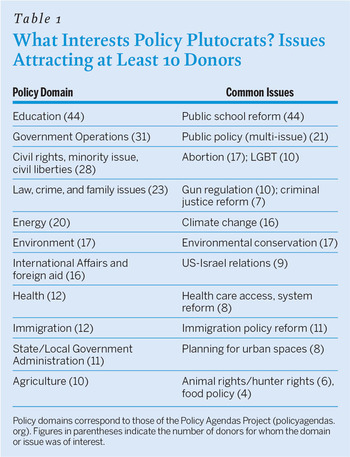
Table 1 lists the general interests of the policy plutocrats as well as specific issues within each category. In the sample, 108 of the 194 donors had traceable interests in policy through charitable giving, advocacy-group formation, or issue-centered outside spending—or some combination thereof.
What Interests Policy Plutocrats? Issues Attracting at Least 10 Donors

Policy domains correspond to those of the Policy Agendas Project (policyagendas.org). Figures in parentheses indicate the number of donors for whom the domain or issue was of interest.
A review of policy interests of the donors suggests that, with key exceptions, their orientation toward these policy issues is liberal: they are overwhelmingly pro-abortion rights, pro-gay rights, concerned about climate change, supportive of health care and immigration reform, pro-gun regulation, and in favor of animal rights. For comparison, an analysis of policy plutocrats’ political donations since 2010 suggests that they are evenly divided between Democrats (35%) and Republicans (37%), with the remainder either not giving politically or giving to committees from both parties. Conservative interests emerge in several ways. Approaches to public-school reform—the top issue interest of policy plutocrats—often reflect market principles embraced by conservatives. Another cluster of right-leaning policy giving is focused on supporting fiscal-policy reforms and conservative think tanks.
WHICH MIX OF GIVING STRATEGIES DO BIG DONORS USE?
One strategic approach to policy reform is to integrate different giving modalities: donations to (1) public charities specializing in research and public education; (2) advocacy organizations focusing on grassroots mobilization and inside lobbying; and (3) electoral organizations (i.e., candidates, parties, and outside groups) focusing on influencing campaign issues and outcomes. Privacy laws prevented the gathering of systematic data on donor activity in the advocacy realm. However, much charitable giving and federal electoral spending is publicly traceable, thereby providing an imperfect but instructive measure of strategic integration.
Most philanthropists in the dataset (83%) gave at least one publicly reported electoral contribution between 2010 and mid-2015. However, few of the major charitable donors also appeared as major donors to outside money groups—the vehicles of choice for electoral donors wanting to advance issue-based and ideological interests. Only 18% (n = 35) of major philanthropic donors in the dataset were also among the Top 100 donors to outside groups in either the 2012 or the 2014 election cycle (OpenSecrets 2015b, 2015c). This finding suggests that many donors are specializing in charitable or electoral contributions rather than channeling both types of donations toward a common policy goal. Supporting evidence for this conclusion comes from a separate analysis of the Top 50 charitable givers of 2012. With few exceptions, their political donations were modest—with a median total of $13,900 in the previous five years compared to a median charitable donation of $54.9 million (DiMento Reference DiMento2012). Likewise, not one of the 31 guests at a recent Koch Brothers gathering of conservative political donors appears in the dataset of major philanthropists (see Kroll and Schulman Reference Kroll and Schulman2014 for the list of attendees).
DISCUSSION: POLICY PLUTOCRATS AND POLITICAL SCIENCE
A lively and important debate is unfolding in America about the role of wealthy people in democratic governance. With more than half of America’s most prominent philanthropists actively engaging in the policy process, and other billionaires doing so in less-visible ways, this debate undoubtedly will grow louder, and calls for policy reforms will become more urgent. Political scientists have much to say, both normatively and empirically, to inform these conversations. With further attention to philanthropy, especially policy-oriented philanthropy, we could say even more.
With more than half of America’s most prominent philanthropists actively engaging in the policy process, and other billionaires doing so in less-visible ways, this debate undoubtedly will grow louder, and calls for policy reforms will become more urgent. Political scientists have much to say, both normatively and empirically, to inform these conversations.
Empirically, political science needs to pay much greater attention to how billionaires spend their wealth. Although studies of campaign contributions are valuable, America’s wealthy are seeking policy influence through a wide array of other means. Salamon (Reference Salamon2014) argued that a “significant revolution” in philanthropy is underway, with a “massive explosion” both in the tools available for social investment (not only grants but also loans, social-impact bonds, and equity-type investments) and in the “instruments and institutions being deployed” (not only foundations but also capital aggregators and social stock exchanges). Although we can see how donors are using these tools to influence political agendas and policy outcomes, we also must be attentive to how wealthy people may be exercising the “second face of power” to discourage consideration of alternative ideas (Bachrach and Baratz Reference Bachrach and Baratz1962). Although privacy laws pose challenges to large-scale data collection, scholars have demonstrated that studies can be conducted using a combination of publicly available sources (e.g., foundation grants) and qualitative methods (see, e.g., Reckhow Reference Reckhow2013 and Teles Reference Teles2008).
Normatively, the era of philanthrocapitalism calls for a revival of serious theoretical work on equality and democracy. For example, are we to think differently about billionaires who champion public philosophies that happen to benefit elites (e.g., a smaller state) compared to billionaires who champion causes benefiting difficult-to-organize groups, including the diffuse public or marginalized people? The articles in this symposium make one conclusion clear: the era of philanthrocapitalism has opened up a vast research frontier filled with intriguing questions ripe for scholarly investigation.
ACKNOWLEDGMENTS
I would like to thank Farzain Rahman, Shom Tiwari, Danielle Vance-McMullen, and Grant Williams for research assistance, as well as the anonymous reviewers for very helpful comments.