

Introduction
Chronic musculoskeletal pain is a costly, disabling health condition that affects nearly one-third of the citizens in industrialised countries (Du et al., Reference Du, Yuan, Xiao, Chu, Qiu and Qian2011). The annualised costs associated with caring for people with all types of chronic pain in Australia is estimated at AUD$34.3 billion (The MBF Foundation, 2007). People with chronic pain are at higher risk compared to those without pain for developing secondary health problems, such as overweight status and obesity (Shiri, Karppinen, Leino-Arjas, Solovieva, & Viikari-Juntura, Reference Shiri, Karppinen, Leino-Arjas, Solovieva and Viikari-Juntura2009). Both chronic pain and associated health conditions can lead to disability, in part, by interfering with motivation for physical activity and exercise. Nonetheless, physical activity is considered an effective rehabilitation strategy for people with chronic musculoskeletal pain (International Association for the Study of Pain [IASP], 2009; Warburton, Nicol, & Bredin, Reference Warburton, Nicol and Bredin2006). Regular physical activity and exercise among people with chronic pain can improve pain management, activities of daily life performance, weight loss or maintenance, muscle strength, physical stamina, and quality of life (Centers for Disease Control and Prevention [CDC], 2015; IASP, 2009; Scelza, Kalpakjian, Zemper, & Tate, Reference Scelza, Kalpakjian, Zemper and Tate2005; Wolfe et al., Reference Wolfe, McIntyre, Ravenek, Martin Ginis, Latimer, Eng, Hsieh, Eng, Teasell, Miller, Wolfe, Townson, Hsieh and Sakakibara2012). Despite these benefits, motivation towards physical activity and exercise behaviour remains understudied among persons with chronic musculoskeletal pain.
Motivation, such as the widely adopted motivation beliefs of autonomy (Verloigne et al., Reference Verloigne, De Bourdeaudhuij, Tanghe, D'Hondt, Theuwis, Vansteenkiste and Deforche2011), self-efficacy (Bandura, Reference Bandura1997), outcome expectancy (Resnick, Zimmerman, Orwig, Furstenberg, & Magaziner, Reference Resnick, Zimmerman, Orwig, Furstenberg and Magaziner2000), and perceived social support (Sallis, Grossman, Pinski, Patterson, & Nader, Reference Sallis, Grossman, Pinski, Patterson and Nader1987), associated with physical activity and exercise behaviour may vary by the readiness to engage in health-promoting behaviours. Thus, to facilitate motivation for engaging in physical activity and exercise, it would require knowledge of the person's readiness to change unhealthy behaviours and adopt new habits essential to pain management (Cardinal & Sachs, Reference Cardinal and Sachs1996; Kim, Hwang, & Yoo, Reference Kim, Hwang and Yoo2004; Ronda, Van Assema, & Brug, Reference Ronda, Van Assema and Brug2001). The developers of the stages of change models (e.g., Prochaska & DiClemente, Reference Prochaska and DiClemente1983; Prochaska, DiClemente, & Norcorss, Reference Prochaska, DiClemente and Norcross1992; Schwarzer, Lippke, & Luszczynska, Reference Schwarzer, Lippke and Luszczynska2011) propose a health behavioural change process approach to describing readiness with broadly encompassing stages, such as (a) preintenders, (b) intenders, and (c) actors. Preintenders are described as having minimal to no intentions to change maladaptive health behaviours, intenders indicate intentions to change health behaviours, and finally, actors report already performing the target health behaviour. However, there have been no studies, to date, which investigate the relationships between motivation and readiness levels for physical activity and exercise behaviour in people with chronic pain.
In short, physical activity and exercise is considered a basic health self-management strategy for all adults, yet people with chronic pain frequently engage in minimal physical activity, avoid exercise, or maintain a sedentary routine. On the other hand, many individuals with chronic pain are able to engage in physical activity and live optimally with their condition. It is necessary, therefore, to build an empirical foundation from self-reports of people with chronic pain on the varying degrees of motivation and readiness for physical activity and exercise behaviour. These data might inform tailored approaches to pain management and other health promotion interventions in rehabilitation counselling settings. The primary goal of the current study was to investigate the relationships between the motivation beliefs of autonomy, self-efficacy, outcome expectancy, and perceived social support, and readiness constructs of the stages of change for physical activity and exercise behaviour among persons with chronic musculoskeletal pain conditions.
Method
Participants and Setting
A convenience sample of 211 individuals with chronic musculoskeletal pain conditions including fibromyalgia participated in this study (females = 86.7%; mean age = 43.4 years, SD = 14.4 years). Participants were recruited from the following community and clinic networks: (a) Midwest churches, (b) Midwest pain, physical therapy, and primary care clinics, and (c) national chronic pain and fibromyalgia support groups in the United States. Prospective participants received a study announcement from emails, bulletins, flyers, and newsletters. Inclusion criteria included (1) 18 years or older, (2) a diagnosis of chronic musculoskeletal pain, (3) non-malignant pain, (4) living with pain for more than three months, and (5) ability to participate in any level of physical activity and exercise.
The majority of participants identified themselves as European American (89.1%), followed by African American (4.3%) and Native American (2.4%). For education level, the majority had completed high school (98%) and over half had earned a college degree (59.7%). More than half of the participants were married or in a long-term relationship (59.7%), nearly a quarter (27.0%) reported being single, and the rest were divorced (10.0%) or widowed (1.4%). The median annual household income for all participants was USD 42,500 (M = $48,425, SD = $46,455). In terms of employment, 41.2% were employed either in full-time or part-time jobs, 36.5% described themselves as retired or not seeking employment, 16.1% were seeking employment, and 5.6% were identified as volunteering. For body mass index (BMI), the largest percentage identified in the obese weight category (45.0%), followed by ‘normal weight’ (30.3%) and ‘overweight’ (23.7%). Participants were diagnosed with chronic pain, on average, 13 years prior to the study (SD = 9.8) at the mean age of 30 years (SD = 12.5). Participants used a 0–10 pain rating scale to report the level of pain intensity at the time of study (M = 6.2, SD = 1.9).
Measures
For the readiness stages of change measure, participants completed the Physical Activity Stages of Change Instrument (PASC; Nigg et al., Reference Nigg, Hellsten, Norman, Braun, Breger, Burbank and Williams2005). To self-assess their own motivation for change, the participants completed the Behavioural Regulation in Exercise Questionnaire-2 (BREQ-2; Markland & Tobin, Reference Markland and Tobin2004) that was converted to the Relative Autonomy Index (RAI; Verloigne et al., Reference Verloigne, De Bourdeaudhuij, Tanghe, D'Hondt, Theuwis, Vansteenkiste and Deforche2011), Exercise Self-Efficacy Scale (ESES; Bandura, Reference Bandura1997), Outcome Expectations for Exercise Scale (OEE; Resnick et al., Reference Resnick, Zimmerman, Orwig, Furstenberg and Magaziner2000), and the Friend Support for Exercise Habits Scale/Family Support for Exercise Habits Scale (FSS; Sallis et al., Reference Sallis, Grossman, Pinski, Patterson and Nader1987). All of the measures have been found to have adequate psychometric properties, including the following reports on Cronbach's alphas: 0.79 (PASC; Nigg et al., Reference Nigg, Hellsten, Norman, Braun, Breger, Burbank and Williams2005), 0.85 (BREQ-2; Murcia, Gimeno, & Camacho, Reference Murcia, Gimeno and Camacho2007), 0.94 (ESES; Shin, Jang, & Pender, Reference Shin, Jang and Pender2001), 0.89 (OEE; Brooks, Reference Brooks2014), and 0.76 (FSS; Brooks, Reference Brooks2014).
Procedure
The University of Wisconsin–Madison Social and Behavioural Sciences Institutional Review Board (IRB) granted permission for the study. Participants individually consented for study. After the completion of the surveys on SurveyMonkey, participants received the option to receive a $15 gift card incentive.
Data Analysis
Data analyses were performed using the Statistical Package for the Social Sciences, Version 23 (SPSS; IBM Corp., 2016). Multiple one-way analyses of variances (ANOVAs) and post-hoc comparisons using the Tukey HSD test were used to examine motivation differences by the readiness stages of change for physical activity and exercise behaviour (preintender, intender, and actor groups).
Results
Descriptive Statistics
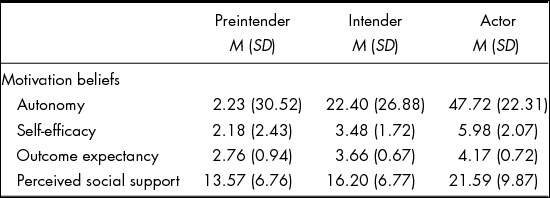
A total of 30 (14.63%) participants were in the preintender group, 94 (45.85%) participants were in the intender group, and 81 (39.51%) were in the actor group. The means and standard deviations of motivation beliefs by the readiness stages of change for physical activity and exercise behaviour groups are presented in Table 1. Most notably, the actor group reported the highest scores for autonomy (M = 47.72, SD = 22.3), perceived social support (M = 21.59, SD = 9.87), and self-efficacy (M = 5.98, SD = 2.07). The preintender group had the lowest outcome expectancy (M = 2.76, SD = 0.94), followed by the intender group (M = 3.66, SD = 0.67), and actor group (M = 4.17, SD = 0.72).
Means and standard deviations of motivation beliefs by the readiness stages of change for physical activity and exercise behaviour groups

Note: Autonomy was assessed by the Relative Autonomy Index. Self-efficacy was assessed by the Exercise Self-Efficacy Scale. Outcome expectancy was assessed by the Outcome Expectations for Exercise Scale. Perceived social support was assessed by the Friend Support for Exercise Habits Scale/Family Support for Exercise Habits Scale.
Motivation Beliefs
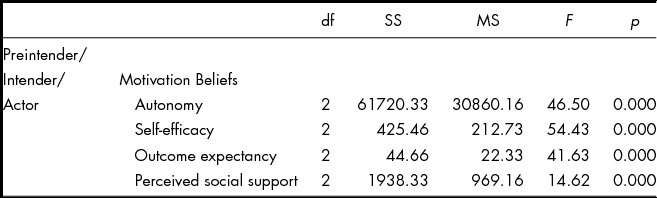
As shown in Table 2, significant differences were also found for the reported levels of autonomy [F (2,202) = 46.50, p < 0.001], self-efficacy [F (2,202) = 54.43, p < 0.001], outcome expectancy [F (2,202) = 41.63, p < 0.001], and perceived social support [F (2,202) = 14.62, p < 0.001] by the readiness stages of change for physical activity and exercise behaviour groups. Post-hoc comparisons using the Tukey HSD test indicated that the mean scores for autonomy, self-efficacy, and outcome expectancy in the actor group were significantly higher than the mean scores across the preintender and intender groups. In addition, the mean scores for autonomy, self-efficacy, and outcome expectancy in the intenders were significantly higher than the mean scores of the preintenders, albeit there was no significant difference for perceived social support.
Multiple one-way ANOVAs of motivation beliefs by the readiness stages of change for physical activity and exercise behaviour groups

Note: Autonomy was assessed by the Relative Autonomy Index. Self-efficacy was assessed by the Exercise Self-Efficacy Scale. Outcome expectancy was assessed by the Outcome Expectations for Exercise Scale. Perceived social support was assessed by the Friend Support for Exercise Habits Scale/Family Support for Exercise Habits Scale.
Discussion
Compared to intenders and preintenders from the physical activity and exercise behaviour change groups, actors reported increased levels of motivation, specifically higher autonomy, self-efficacy, perceived social support, and outcome expectancy scores. This is consistent with the extensive research literature that has documented motivation beliefs of autonomy, self-efficacy/competency, and perceived social support are significantly associated with exercise behavioural engagement in the general population (Edmunds, Ntoumanis, & Duda, Reference Edmunds, Ntoumanis and Duda2006; Pelletier, Martel-Pelletier, & Abramson, Reference Pelletier, Martel-Pelletier and Abramson2001; Silva et al., Reference Silva, Markland, Carraça, Vieira, Coutinho, Minderico and Teixeira2011; Teixeira, Carraca, Markland, Silva, & Ryan, Reference Teixeira, Carraça, Markland, Silva and Ryan2012; Wilson et al., Reference Wilson, Rodgers, Fraser and Murray2004). Our study's results might suggest, then, that people with chronic pain experiencing higher levels of motivation for physical activity and exercise behaviour are more engaged in desired behaviours than the persons with chronic pain reporting varying degrees of behavioural intentions. These findings also imply that rehabilitation clients may benefit in their chronic pain management from interventions that focus on motivational enhancement appropriate to their assessed readiness to adopt or maintain physical activity and exercise (Sutton, Reference Sutton2000).
Study limitations include its cross-sectional survey design and convenience sampling, which constrain generalizability of the findings. Further research should consider using a longitudinal design to evaluate the casual, interactive, or additive effects among the current study variables and other factors. The self-reported nature of an online questionnaire may also lead to reporting bias. Future research should aim to use objective measures of physical activity and exercise behaviour in replicative investigations of motivation beliefs among persons with chronic pain and other disabilities.
Conclusion
Given that people with chronic musculoskeletal pain either participate in minimal exercise or fully engage in physical activity, it is critical to improve our understanding of the persons experiencing varying levels of motivation and readiness for physical activity and exercise behaviour. We assessed the relationships between motivation beliefs and the readiness stages of change for physical activity and exercise behaviour. As expected, people in the actor groups of behavioural change had reported higher levels of motivation compared to people from the preintender and intender groups. These findings suggest that increased motivation for physical activity and exercise behaviour is more closely linked to engagement in desired behaviours than behavioural intentions. Advancing our knowledge of such varying degrees of motivation and readiness for physical activity and exercise behaviour might lead to the development of more effective, appropriately tailored, rehabilitation counselling interventions for people with chronic musculoskeletal pain.