Introduction
Climatic conditions are known to have a significant influence on the transmission of many species of parasites (Ollerenshaw & Smith, Reference Ollerenshaw and Smith1969). The relationship between climate and important veterinary diseases such as fascioliasis and nematodiriasis has been studied intensively, with reliable correlations established between levels of parasitic infection and climatic conditions (Ollerenshaw, Reference Ollerenshaw1966; Graham et al., Reference Graham, Harris and Ollerenshaw1984). For example, the occurrence of Fasciola hepatica in the snail intermediate host Lymnaea truncatula is dependent on rainfall and temperature. The incidence of fascioliasis in any given year is related to summer rainfall. During wet summers there is increased hatching of F. hepatica eggs, and a rise in the snail population allows more snails to become infected (Ollerenshaw, Reference Ollerenshaw1970). Only those habitats that remain wet and warm for a period sufficiently long to complete the parasite's life cycle will lead to disease outbreaks. The effects of weather on habitat conditions inhabited by snails largely account for any seasonal, annual and regional differences in the prevalence of F. hepatica (Wilson et al., Reference Wilson, Smith, Thomas and Anderson1982).
The correlation between climate and disease in wild vertebrate hosts has also been investigated (Kisielewska, Reference Kisielewska1964; Haukisalmi & Henttonen, Reference Haukisalmi and Henttonen1990; Jenkins et al., Reference Jenkins, Veitch, Kutz, Hoberg and Polley2006; Rogan et al., Reference Rogan, Craig, Hide, Heath, Pickles and Storey2007). Haukisalmi & Henttonen (Reference Haukisalmi and Henttonen1990) found that climate was of primary importance in the long-term dynamics of common helminth parasites of the bank vole (Clethrionomys glareolus). On the other hand, the long-term dynamics of rare helminth species responded less well to changes in climatic conditions. In contrast, Jenkins et al. (Reference Jenkins, Veitch, Kutz, Hoberg and Polley2006) found that climate warming in subarctic and arctic North America increased both the growing season and the optimal temperature available for larval development of protostrongylid nematodes of slugs and wild sheep.
Furthermore, climatic factors are known to have a significant effect on the occurrence of helminths in terrestrial molluscs (Williams, Reference Williams1942; Svadzhyan, Reference Svadzhyan and Petrov1953; Foster, Reference Foster1958a; Jenkins et al., Reference Jenkins, Veitch, Kutz, Hoberg and Polley2006). Foster (Reference Foster1958a) considered that the onset of dry and windy conditions contributed to a sudden decline in the seasonal occurrence of trematode metacercariae in slugs from an urban habitat in the UK. Svadzhyan (Reference Svadzhyan and Petrov1953) found that the highest prevalence of Dicrocoelium lanceatum in molluscs occurred in ‘mountain steppe’ areas, where frequent changes in weather and daily humidity encouraged high molluscan activity, in comparison to ‘semi desert’ areas, where long periods of molluscan aestivation led to low prevalences, and ‘sub alpine’ areas, where relatively lower temperatures slowed parasite development in molluscs. Jenkins et al. (Reference Jenkins, Veitch, Kutz, Hoberg and Polley2006) concluded that climate warming may also extend the seasonal activity of molluscs and increase the availability of free-living infective larvae.
Nevertheless, understanding links between disease and climate is difficult, given the paucity of baseline disease data. In particular, data that are unrelated to human, agricultural or commercial systems are rarely collected. This problem is particularly acute, as the monitoring of the prevalence and severity of wildlife diseases is considered a priority to improve predictions of the impact of climate change on disease (Harvell et al., Reference Harvell, Mitchell, Ward, Altizer, Dobson, Ostfeld and Samuel2002). Changes in climate are more likely to influence free-living and intermediate stages of parasites of terrestrial animals. For helminths with complex life cycles, the impact of climate presents a particular challenge as different life stages may be affected by variables with opposite effects on parasite fitness (Harvell et al., Reference Harvell, Mitchell, Ward, Altizer, Dobson, Ostfeld and Samuel2002).
Terrestrial molluscs, which are particularly vulnerable to changes in climate (Cameron & Redfern, Reference Cameron and Redfern1976), are therefore ideal model species to study the effects of seasonality on host–parasite dynamics. Moisture is a predominant variable controlling daily activity, which can be completely suppressed by dry spells lasting more than 10 days (Bailey, Reference Bailey1975) and would appear to be a factor in controlling parasite prevalences (Svadzhyan, Reference Svadzhyan and Petrov1953). Within the UK, most species of terrestrial molluscs have approximately annual life cycles with a prolonged breeding season. Adults often make up only a small proportion of the total population, with a marked peak of young snails in the autumn (Cameron, Reference Cameron1982).
In the present study the influence of climatic conditions on helminth prevalences within a molluscan population was monitored in southern England over a 10-year period, from 1974 to 1983. To evaluate the effects of climate on parasite transmission, the results are compared with the occurrence of helminth parasites in wild small mammals in the same locality, time and sampling period.
We have assumed that small mammals are the principal definitive hosts, as they appear to be the dominant snail predators in the area. Bird predation, predominantly by song thrushes, occurs mainly in woodland (Cain, Reference Cain and Russell-Hunter1983), with snails being considered only as a reserve food for birds, taken in quantity only when more palatable foods are scarce (Davies & Snow, Reference Davies and Snow1965). In grassland, such as that found in the Rogate field station, shrews are the most important predator, consistently preying upon large numbers of invertebrates, while wood mice feed relatively infrequently, with snails constituting one of the main food items taken (Churchfield et al., Reference Churchfield, Hollier and Brown1991). In addition, both shrews and terrestrial molluscs are mainly nocturnal in their activity, thereby increasing the chance of parasite transmission, in comparison to the diurnal activity of most bird species.
In Rogate the small mammal population was dominated by the common shrew Sorex araneus, and wood mouse Apodemus sylvaticus. The maximum life span of the common shrew is 15–18 months. Young are born during the summer and overwinter as juveniles. Maturity is reached the following spring, with breeding during the summer, females commonly having two litters, before dying off in the late summer and autumn (Corbet & Harris, Reference Corbet and Harris1991). The maximum life span of the wood mouse is 18–20 months. Females have 1–2 litters per year, with the late-born young predominating in the autumn and winter and most surviving into the following year. In spring, mature overwintered mice are joined by juveniles from April/May onwards, but few adults survive from one summer to the next (Corbet & Harris, Reference Corbet and Harris1991).
Studies on the relationship between helminth abundance in rodents and terrestrial molluscs over the period of a year have previously been undertaken by Kisielewska (Reference Kisielewska1961), Pojmanska (Reference Pojmanska1961) and Lewis (Reference Lewis1968). However, little is known about the effects of climate on long-term changes in parasite dynamics (Harvell et al., Reference Harvell, Mitchell, Ward, Altizer, Dobson, Ostfeld and Samuel2002). The aim of the present study was to establish any correlation between climatic conditions in the 12 months prior to each year of sampling, during 1974–1983, and helminth prevalences in the terrestrial molluscan population, and to relate any climatic effects with the occurrence of helminths in the definitive small mammal hosts.
Materials and methods
Study site
Samples were collected from the grounds of the former King's College field station at Rogate, West Sussex (National Grid Reference SU809237, elevation 64 m, 51.01°N latitude, 0.85°W longitude). The Rogate area experiences a cool-temperate climate, with winters that are only rarely severe (Wood, Reference Wood1977, Reference Wood1978). The mean annual (1969–1993) precipitation is 859 mm with a winter maximum. The annual potential evapotranspiration for the Sussex Wealden region is variable, generally in the order of 450 mm, with monthly evapotranspiration ranging from zero in mid-winter to 100 mm in summer (Collins, Reference Collins1981). The drainage system for the area is the River Rother. The Rogate mean (1969–1993) average maximum temperature is 14.2°C, mean average minimum temperature is 5.6°C.
The sampling area comprised an undulating meadow of undisturbed and overgrown rough grassland surrounded by an outer belt of deciduous trees with mature hedgerows consisting of hazel (Corylus avellana), holly (Ilex aquifolium) and bramble (Rubus sp.), together with horse chestnut (Aesculus hippocastanum) and lime (Tilia sp.).
Climate data
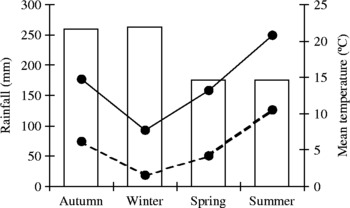
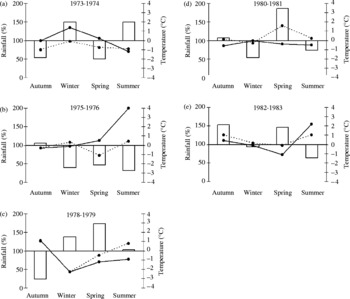
Climate data from the Rogate Field Centre weather station was utilized from the MIDAS Land Surface Stations data (1853-current), British Atmospheric Data Centre, 2006 (available from http://badc.nerc.ac.uk/data/ukmo-midas). Daily rainfall and maximum/minimum temperature data for the 12 months prior to each September were merged into four ‘seasons’, to improve clarity and avoid any short-term distortions from brief periods of extreme weather. The ‘seasons’ were autumn (September–November), winter (December–February), spring (March–May) and summer ( June–August). Long-term average (1969–1993) climate data for the Rogate field station are given in fig. 1. In addition, for each 12-month period prior to each September sampling, climate data were presented as deviations from long-term averages (see fig. 2) to provide an indication of long-term persistent changes in climate from the long-term average. Rainfall was expressed as a percentage, 100% being the average rainfall for the period. The minimum temperature was considered to be correlated with night-time temperature when nocturnal snails are most likely to be active. However, in accordance with Smith & Wilson (Reference Smith and Wilson1980) air temperature readings were considered only an approximate guide because temperatures at the soil surface of a habitat are always higher than the corresponding air temperatures between April and October and lower for the rest of the year, sometimes by as much as 4°C.
Long-term average seasonal climatic conditions in Rogate (1969–1993); rainfall (bars), mean maximum temperature (—), mean minimum temperature (- - - -).

Seasonal climatic deviations from the long-term rainfall and temperature averages in Rogate for the 12 months prior to each September sampling: (a) 1973–1974; (b) 1975–1976; (c) 1978–1979; (d) 1980–1981; (e) 1982–1983; rainfall (bars), mean maximum temperature (—), mean minimum temperature (- - - -).

Sampling and analysis of molluscs and small mammals
Molluscs were collected by hand in September of 1974, 1976, 1979, 1981, and 1983 in the late evening and early morning from under hedges, stones, logs and amongst clumps of long grass, and dissected and examined for helminth larval stages.
Shrews (Sorex araneus) and wood mice (Apodemus sylvaticus) were collected using Longworth traps in each September during 1973–1977, 1979–1981 and 1983, and killed by exposure to chloroform-soaked cotton wool. Each small mammal was dissected and examined microscopically in saline for molluscan-transmitted helminths.
Data were analysed with a chi-squared test using Quantitative Parasitology 2.0 statistical package (Reiczigel & Rozsa, Reference Reiczigel and Rozsa2001) and Pearson's product moment correlation coefficient using SPSS 14.0 statistical package (SPSS Inc., Chicago, Illinois, USA).
Helminth life cycles
In order to understand the dynamics of parasite transmission through the terrestrial mollusc population in Rogate, brief details of the life cycles of helminths encountered during the sampling period are given.
The cestode Molluscotaenia crassiscolex is an intestinal adult parasite of shrews of the genus Sorex. Eggs are released into the environment in faeces and the molluscan host is infected by ingesting eggs during its normal grazing activity. The cestode develops into a cysticercoid within 40 days and is transmitted to the shrew host through predation of the infected mollusc (Jourdane, Reference Jourdane1972).
Trematodes of the family Brachylaimidae are adults in mammals, birds and reptiles. Most species infect only a narrow range of definitive hosts, but some have been reported to infect both mammals and birds in nature (Butcher & Grove, Reference Butcher and Grove2005a). Trematode eggs are released into the environment with faeces and the molluscan host becomes infected following ingestion of eggs while feeding. Asexual development of the parasite takes place within the snail, producing cercariae after 5–11 weeks (Krull, Reference Krull1935; Butcher & Grove, Reference Butcher and Grove2003). Molluscs also act as second intermediate hosts and cercariae emerge from the snail and remain in the mucus covering the body surface, where they may either be transferred to another snail by bodily contact or re-infect the first intermediate snail host (Krull, Reference Krull1935; Lewis, Reference Lewis1969; Butcher & Grove, Reference Butcher and Grove2005a). Cercariae develop into mature metacercariae after approximately 4 months and may survive for at least a further 4 months in the snail (Cragg et al., 1957). Transmission to the definitive host occurs through predation of infected snails.
Dicrocoeliid trematodes have complex life cycles and only those species of veterinary importance have been fully elucidated. Adult worms develop in vertebrate hosts and eggs are released into the environment with faeces and are ingested by molluscs. Asexual development takes place in the mollusc, with the production of mature cercariae after 3–4 months. Cercariae migrate to the respiratory chamber where they are covered in mucus and expelled en masse in ‘slime balls’ through the pneumostome by respiratory movement. Transmission to the second intermediate host, usually an arthropod such as a species of ant, occurs when the ‘slime ball’ is ingested and metacercariae undergo further development. The definitive vertebrate host acquires an infection by the accidental ingestion of the infected arthropod during normal feeding activity (Manga-Gonzalez et al., Reference Manga-Gonzalez, Gonzalez-Lanza, Cabanas and Campo2001).
Adult rhabditoid nematodes are typically free-living. Parasitic third-stage larvae actively penetrate the molluscan integument to develop and then either migrate out of the host to complete their life cycle in the soil, or wait for the host to die before continuing development on the cadaver (Morand et al., Reference Morand, Wilson, Glen and Baker2004). Rhabditoid nematodes often demonstrate low host specificity, infecting a diverse range of snail species.
Results
Climate
Climatic conditions in the Rogate area were often found to deviate from the long-term average (fig. 2). Notable rainfall, substantially different from the average (>150%) was experienced in the summer of 1974, the spring of 1979 and 1981 and the autumn of 1982. Periods of low rainfall ( < 50%) included the dry period throughout the 1975–1976 season, which culminated in the summer drought of 1976, and the autumn of 1978. Temperatures regularly deviated from the long-term average for both maximum and minimum values, most notably in the summer of 1976, the winter of 1978–1979, the spring of 1981 and the summer of 1983 (fig. 2).
Species of molluscs recovered and their parasites
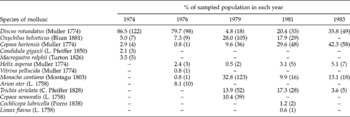
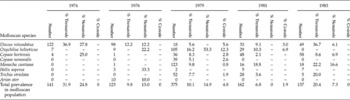
Many species of molluscs were aggregated in their distribution, occurring beneath dead leaves and logs, and the composition of the sampled molluscan population changed over the 10-year period (table 1). Initially in both 1974 and 1976 the snail Discus rotundatus dominated, with only a small number of examples of other species collected. However, by 1979 the sampled population mainly comprised the snails Oxychilus helveticus and Monacha cantiana, with significant numbers of Trichia striolata, Cepaea hortensis and C. nemoralis, but only a small number of D. rotundatus. However, the latter did increase in both 1981 and 1983, compared with a reduction in the numbers of O. helveticus which fell significantly over the period, being entirely absent by 1983. The number of both M. cantiana and T. striolata also began to decline during 1981 and 1983 compared to an increase of C. hortensis during the same period.
The proportion of terrestrial molluscs sampled (%) during 1974–1983 in Rogate, West Sussex (actual number of molluscs sampled included in brackets).

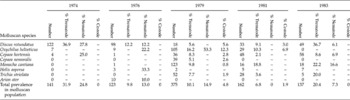
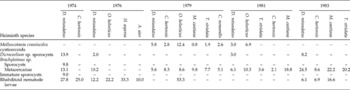
Discus rotundatus was found to be the most frequently infected intermediate host for helminths. It was the only species to harbour both trematode sporocysts and other infections throughout the 10-year period (tables 2 and 3). The highest prevalence of sporocyst infections occurred in 1974 (table 3) following a wet summer (fig. 2). This included both mature and immature infections, which were significantly higher in 1974 than in other sampled years (χ2 ≥ 8.202, P ≤ 0.004). No immature infections were recorded in any other year and only the summer of 1974 was found to show an increased rainfall compared to the long-term average. No sporocyst infections were recorded in 1979, corresponding with the low population of D. rotundatus (tables 1 and 2). Sporocysts of Brachylaimus sp. were only recorded in 1974, with sporocyst infections in other years identified as Dicrocoelium sp. Prevalences of Dicrocoelium sp. sporocysts were generally constant throughout, increasing slightly in 1974, with the only significant difference occurring between the years 1974 and 1976 (χ2 = 9.743, P = 0.002). Significant positive correlations between total sporocyst prevalence and climate occurred when the 1979 data were removed (where a population crash of the host snail occurred), with summer rainfall (r = 0.946, P = 0.027) and winter maximum temperature (r = 0.974, P = 0.013).
The prevalence (%) of helminths in the molluscan population in Rogate between 1974 and 1983 (uninfected molluscan species not listed).
The prevalence (%) of helminth species in the molluscan population in Rogate between 1974 and 1983.

Metacercariae of Brachylaimus sp. infected a range of molluscan species, but only D. rotundatus was found to be infected throughout the sampling period, and initially was the only snail to be infected in both 1974 and 1976 (table 3). As the numbers of D. rotundatus declined, there was a corresponding increase in the prevalence of metacercariae in other molluscan species. The proportion of the total sampled molluscan population infected with metacercariae remained relatively stable (χ2 = 8.670, P = 0.070), ranging from 6.2 to 16.1% over the sampling period. Even in 1974, when climatic conditions were particularly favourable for the development of sporocysts, the prevalence of metacercariae only reached 13.9%. The intensity of metacercarial infections remained in the range of 1–2 cysts per host, but on occasion up to 100 cysts per host were recorded. No significant correlation with climatic conditions was found.
Cystercercoids of the cestode Molluscotaenia crassiscolex were recovered only in 1979 and 1981 (table 3), which was related to substantially increased rainfall in the spring of both years (fig. 2). A significant positive correlation occurred between M. crassiscolex prevalence and climate for combined spring and summer rainfall (r = 0.894, P = 0.041) and a significant negative correlation with maximum (r = − 0.858, P = 0.031) and minimum (r = − 0.964, P = 0.004) winter temperature. In 1979 almost all molluscan species harboured M. crassiscolex, although by 1981 only D. rotundatus and O. helveticus were infected (table 3). However, there was no significant difference in prevalence between the two years (χ2 = 2.617, P = 0.106), with usually only one cystercercoid occurring per host.
The prevalence of rhabditoid nematodes (tables 2 and 3) varied significantly throughout the sampling period (χ2 = 48.253, P < 0.001). A weakly significant negative correlation with climatic conditions was only apparent with minimum spring temperature (r = − 0.806, P = 0.050).
Helminth species recovered from small mammals
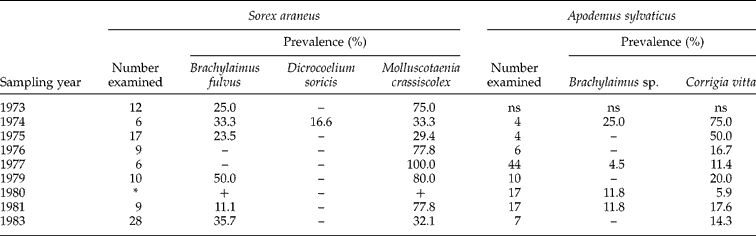
A number of mollusc-transmitted helminths were recovered despite the low number of small mammals examined (table 4). The cestode Molluscotaenia crassiscolex in the shrew and the dicrocoelid trematode Corrigia vitta in the wood mouse were the most frequently occurring helminths throughout the 10-year period (table 4). The trematode Brachylaimus fulvus was also common in the shrew, except for 1976 and 1977 (table 4) which coincided with the prolonged drought in 1976 (fig. 2). Two other trematode species, Dicrocoelium soricis in the shrew and Brachylaimus sp. in the wood mouse, were relatively rare, with D. soricis occurring only once following the wet summer of 1974.
The prevalence (%) of molluscan-transmitted helminths in the common shrew Sorex araneus and the wood mouse Apodemus sylvaticus from Rogate between 1973 and 1983.
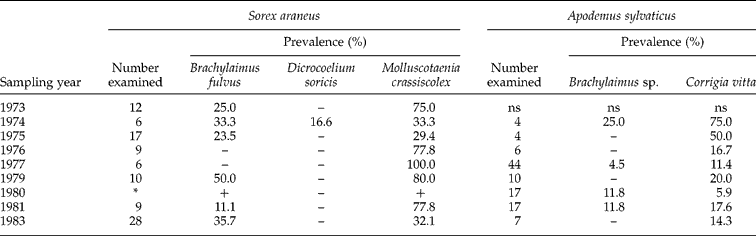
ns, not sampled; *, sampled but number examined not recorded; +, helminth present but prevalence not recorded.
Discussion
The relationship between precipitation, temperature, parasitic infections, and ultimately the control these factors command over the health of animal populations, is complex. Climatic conditions at Rogate over the sampling period fluctuated widely from the long-term average. Notable extremes included the wet summer of 1974, which followed a cycle of four successive mild winters beginning in 1970–1971 (Wright, Reference Wright1975); the very severe drought of 1976, which was the culmination of a prolonged dry period beginning in May 1975 and reported as the worst since records began in 1727 (Doornkamp & Gregory, Reference Doornkamp and Gregory1980). Subsequently the cold, wet winter of 1978–1979 was characterized by extensive prolonged snow cover throughout the country (Burt, Reference Burt1980), which was preceded by a widespread warm, dry autumn in 1978 where new record lows of October rainfall were recorded (Wood, Reference Wood1979); and the hot, dry summer of 1983, with record high temperatures occurring in July (Ratcliffe, Reference Ratcliffe1983), which was preceded by a very wet autumn in 1982 (Browne & Robinson, Reference Browne and Robinson1984).
The number and composition of molluscan species sampled in the present study demonstrated a good degree of stability, but there were clear fluctuations in the dominance of individual species. Initially D. rotundatus was the dominant species, but by 1979 this species had succumbed to a population crash and was replaced by M. cantiana and O. helveticus, before recovering towards the end of the sampling period. Reasons for these fluctuations are unknown, although adverse climate may influence mortality rates (Cameron & Redfern, Reference Cameron and Redfern1976). Snails are ectothermic animals and are particularly vulnerable to climatic change, not only due to physiological responses but also to a shift in plant community composition and structure impacting on their population dynamics (Sternberg, Reference Sternberg2000). The decline in the number of D. rotundatus may have been due to the very dry autumn or cold, wet winter of 1978–1979. Drought conditions, which appear to favour M. cantiana (Sternberg, Reference Sternberg2000), lead to an important increase in litter cover, a favoured food of this snail species (Chatfield, Reference Chatfield1976). The gradual increase in the occurrence of D. rotundatus up to 1983, suggests that this species was not permanently affected. Other changes in the composition and population of individual molluscan species also occurred, but these fluctuations were unlikely to have much impact on helminth transmission as D. rotundatus appeared to be the dominant host in this habitat.
Overall the species of molluscs recovered demonstrated only a low helminth biodiversity, with a limited number acting as hosts. This is not unexpected as Wiktorowa (Reference Wiktorowa1972) found that only 3 of 14 snail species were infected from a woodland site in Poland. In the present study D. rotundatus is the principal host species, as it was the only mollusc to harbour both sporocyst infections and less host-specific cestode, nematode and trematode metacercariae. Apart from nematodes, these larval parasites are likely to mature in vertebrate definitive hosts, especially small mammals.
At least four species of helminths used molluscs in the Rogate area. Each species has a specific kind of life cycle, which, with the exception of rhabditoid nematodes, requires at least one other host to complete it (see Materials and methods for details). Parasite transmission is influenced by a range of biotic and abiotic factors (Pietrock & Marcogliese, Reference Pietrock and Marcogliese2003; Morley & Lewis, Reference Morley and Lewis2004), with invertebrate hosts being particularly susceptible to changes in climatic conditions. Ollerenshaw (Reference Ollerenshaw1970) considered that variations from one year to the next in prevalence of F. hepatica in amphibious snails were due to soil moisture and its effects on both host and parasite. Ground conditions will be most favourable for the development of both parasite and snail when rainfall exceeds evapotranspiration. This assessment also applies to parasites transmitted through terrestrial molluscs. When infected molluscs aestivate, such as during summer droughts, parasite development is normally inhibited (Badger & Oyerinde, Reference Badger and Oyerinde1996; Solomon et al., Reference Solomon, Paperna and Markovics1996) and host survival is reduced compared to uninfected snails. Following prolonged unfavourable climatic conditions, the number of surviving infected molluscs is likely to be reduced, impacting on parasite transmission and population dynamics.
Temperature can also be a limiting factor on parasite development, both within invertebrate hosts and on free-living stages. In temperate climates, 10°C is often described as the minimum temperature necessary for parasite development (Ollerenshaw, Reference Ollerenshaw1970; Jourdane, Reference Jourdane1972), although some species continue development in temperatures as low as 4–5°C, e.g. the trematode Dicrocoelium dendriticum (Schuster, Reference Schuster1993) and the nematode Mullerius capillaris (Rose, Reference Rose1957). The helminth species found in molluscs at Rogate will therefore respond differently to low temperatures.
One of the main differences between the occurrence of F. hepatica and D. dendriticum in sheep and cattle and trematodes in wild hosts is the population stability of farmed animals. In wildlife hosts, the mammalian population may be affected by a range of abiotic and biotic factors, whereas molluscan hosts are principally governed by prevailing climatic conditions. A combination of these factors may therefore generate a number of unexpected fluctuations in parasite prevalences. For example, studies on shrew populations suggest that climate may not be a significant force in regulating population structure; instead, social factors including social dominance, patterns of home range and territoriality, in combination with predation, are likely to be dominant (Churchfield et al., Reference Churchfield, Hollier and Brown1995). In addition, during the summer and autumn population densities can change, with the mortality of overwintered adults followed by dispersal and immigration of juveniles (Churchfield et al., Reference Churchfield, Hollier and Brown1995), which may introduce or remove parasites from the population. Nevertheless, the activity of shrews shows a negative correlation with seasonal or daily temperature and a positive correlation with humidity and rainfall (Churchfield et al., Reference Churchfield, Hollier and Brown1995). This will influence not only the dispersal of parasite eggs by infected hosts but also their chances of encountering a molluscan intermediate host, which may also display increased activity during wet weather (Bailey, Reference Bailey1975). Churchfield et al. (Reference Churchfield, Hollier and Brown1991) established that snails were one of the main invertebrates preyed upon by shrews, with a significant preference for larger, older molluscs which, by virtue of their age, are likely to have acquired more parasites than smaller, younger snails. The susceptibility of the mammalian host population is also governed by intrinsic factors such as host immunity, hormones or physiological condition (Cattadori et al., Reference Cattadori, Haukisalmi, Henttonen, Hudson, Morand, Krasnov and Poulin2006).
Based on population fluctuations that small mammals and terrestrial molluscs demonstrate in the UK (Cameron, Reference Cameron1982; Corbet & Harris, Reference Corbet and Harris1991) there is likely to be some degree of synchronization in seasonal variation in the population densities of these potential hosts and helminth prevalences, related to climatic conditions. Therefore changes in climate and host population density are likely to be dominant factors controlling parasite dynamics.
The prevalence of helminths in molluscs at Rogate varied over the 10-year sampling period and this is likely to be a reflection of individual life cycles which, in turn, are influenced by prevailing climatic conditions.
Molluscotaenia crassiscolex occurred in the molluscan hosts only in 1979 and 1981, although its occurrence in shrews was recorded throughout the sampling period. It is possible that the absence of M. crassiscolex was due to infected snails earlier in the year, or preceding year, being selectively preyed upon, or suffering a low survival rate as a consequence of infection. Alternatively, conditions may have often been too poor to facilitate transmission to the snail host, and any infected shrews were migrants entering this locality from an area that more readily supported parasite transmission. Changing climatic conditions, in particular the spring and summer rainfall and winter temperature, may also influence parasite prevalence.
Molluscan infections of M. crassiscolex in September 1979 and 1981 coincided with extremely wet springs followed by average summer conditions, with the only other year with a similarly wet spring (1983) having a hot, dry summer. Lewis (Reference Lewis1968) found that a single peak of M. crassiscolex infection in molluscs occurred during mid summer in habitats near Aberystwyth, Wales, which is an area with a cool and wet climate. Seasonal variation in both shrew and snail host in this area was considered to be linked to their high population densities, leading to higher levels of infection. In the Rogate area, where the climate is much drier and milder, a peak infection is generally likely to occur earlier in the year, in more favourable conditions prevailing in the spring, with prevalences in decline by the time of the September sampling.
Wet spring conditions in 1979, 1981 and 1983 might also have caused increased activity in the snail population as this is predominantly controlled by the levels of moisture (Bailey, Reference Bailey1975), thus increasing the chances of encountering M. crassiscolex hexacanth embryos distributed on the soil surface by over-wintering infected shrews. An increase in spring humidity and a decrease in winter temperature would also enhance cestode egg survival (Gemmell, Reference Gemmell1978). However, the hot, dry summer of 1983 would increase snail aestivation and induce mortality of infected snails (Abdou, 1958) which, in turn, would reduce the chance of infected snails surviving until September.
In contrast, the extreme, long-lasting drought of 1975–1976, providing conditions of low humidity and high temperature, may also have induced mortality of cestode eggs in the field (Gemmell, Reference Gemmell1978), as well as reducing activity and increasing mortality of infected molluscs, and, in turn, lowering the chances of successful transmission through the snail population. The presence of adult M. crassiscolex in the shrews in September 1976 may have resulted from infections acquired during the previous autumn when a brief wet spell interrupted the dry period. Haukisalmi & Henttonen (Reference Haukisalmi and Henttonen1990) also noted the importance of moisture for cestode population dynamics when they found that high summer rainfall and temperatures resulted in high levels of infections of the cestode Catenotaenia sp. in a vole population during the autumn.
The occurrence of trematode sporocyst infections in snails in each September appeared to respond most readily to wet summer conditions, especially in 1974 when the preceding warm and wet winter may also have increased the survival of trematode eggs deposited on the soil surface. Wet springs of 1979, 1981 and 1983 had little effect on prevalences, whereas the cold, wet winter of 1978–1979 may have contributed to the lack of sporocyst infections in September 1979, by reducing the occurrence of the molluscan host, D. rotundatus in this year. Sporocysts of Brachylaimus sp. were only recorded in 1974 following a wet summer. Typically only 1% of molluscs have been found to be infected with brachylaimid sporocysts in the UK (Foster, Reference Foster1958b) and the presence of large numbers of sporocysts in 1974 is not unexpected as summer climatic conditions were particularly favourable, allowing molluscs to acquire infections continually due to reduced aestivation. Certainly, high spring/summer rainfall is known to be favourable for long-term transmission dynamics of the trematodes Plagiorchis muris in wood mice (Rogan et al., Reference Rogan, Craig, Hide, Heath, Pickles and Storey2007) and F. hepatica in sheep (Ollerenshaw, Reference Ollerenshaw1983).
Dicrocoelid sporocysts were recovered from D. rotundatus in Rogate in all years except 1979, when the snail population collapsed. This does not appear to have had a major effect on dicrocoelid prevalences in the small mammal population, where two species were recovered, Dicrocoelium soricis from the shrew and Corrigia vitta from the wood mouse. In the shrew, D. soricis occurred only in September 1974, following a wet summer, which favoured trematode infections in the molluscan host. In contrast, C. vitta occurred in the mouse population throughout the sampling period. The life cycle of C. vitta is unknown, but other dicrocoelids utilize arthropods as second intermediate hosts, transmission to the wood mouse occurring by accidental ingestion. Schuster (Reference Schuster1993) considered that the life cycle of D. dendriticum extended over two calendar years, with sporocysts of different developmental levels overwintering and maturing when snails become active in the spring.
The emergence of dicrocoelid cercariae is associated with molluscan activity, which is at its optimum during periods of high humidity and temperature (Svadzhyan, Reference Svadzhyan and Petrov1953). The long-term stability of ‘slime balls’ containing cercariae is also dependent on climate, with excessive dampness causing the dissolution of mucoidal masses, while extremely dry conditions induce shrinking and warping of the ‘slime ball’ spheres (Svadzhyan, Reference Svadzhyan and Petrov1953). The low prevalence of dicrocoelid sporocysts in September 1976 is again probably associated with severe drought, resulting in widespread aestivation of snails with consequently only limited opportunities to acquire an infection. In addition, due to increased stress, infected snails were more likely to die in the high summer temperature than uninfected snails. There were, however, no long-term effects on the occurrence of dicrocoelids in mice, suggesting that dicrocoelid stability was re-established relatively quickly once climatic conditions had improved. Following the collapse of the snail population in 1979, the prevalence of dicrocoelid sporocysts also declined but a slow recovery was observed as snail numbers increased.
In the present study no direct relationship between the prevalence of Brachylaimus metacercariae and climate was apparent. However, as transmission between first and second intermediate molluscan hosts is dependent on physical contact, the population density and activity of snails, which are influenced by climate (Bailey, Reference Bailey1975; Cameron & Redfern, Reference Cameron and Redfern1976), are likely to influence the occurrence of metacercariae. Brachylaimus metacercarial infections have been found to peak in either the spring (Pojmanska, Reference Pojmanska1961; Butcher & Grove, Reference Butcher and Grove2005b) or high summer (Lewis, Reference Lewis1968) and seasonality of infection is correlated with the population of both molluscan and mammalian hosts (Lewis, Reference Lewis1968). In Rogate, sampling in September may have corresponded with a period of decline in metacercarial prevalence as the ageing host population died off naturally, thus masking any climatic influences.
In the present study, definitive hosts harboured infections of Brachylaimus fulvus in the shrew and Brachylaimus sp. in the wood mouse over the sampling period. Brachylaimus fulvus appears to be a common helminth occurring in every year except for 1976 and 1977, which may have been associated with the extreme drought of 1975–1976.
There was only a weak relationship between the spring minimum temperature and prevalence of rhabditoid nematodes in snails over the sampling period, although the high prevalence in 1974 may possibly have been related to the wet summer and the mild climate of the previous winter. Little is known about seasonal dynamics of rhabditoid nematodes in molluscs, and the method by which nematodes make host contact has only been determined for one species, Phasmarhabditis hermaphrodita. In this species dauer larvae, which are chemotactically attracted by the mucus and faeces of molluscs, penetrate the host through the dorsal integumental pouch and canal (Hapca et al., Reference Hapca, Crawford, Rae, Wilson and Young2007), although prevalences are often found to be low in sampled communities (Morand et al., Reference Morand, Wilson, Glen and Baker2004). It seems likely, therefore, that host activity is important in attracting nematodes. Adult, and hence larger, molluscs generate stronger chemical signals than younger ones, and therefore the number of adults are important in recruiting nematodes into the host population, although they often make up only a small proportion of the total population (Cameron, Reference Cameron1982) and fluctuations in nematode abundance may be indicative of the relative status of adults in each year. In addition, most rhabditoid nematodes remain in the host until death before continuing their development on the cadaver and are therefore likely to be more common in adult molluscs, which have had more time to acquire an infection.
In conclusion, this long-term study has demonstrated a relationship between climatic conditions and helminth prevalences in terrestrial molluscs. Trematode sporocyst and cestode infections most closely reflect climatic conditions over the previous 12 months, and rainfall appears to be more of a controlling factor than temperature. However, changes in the molluscan helminth fauna are not directly replicated in definitive mammalian hosts, suggesting that the populations of both host groups are responding differently to climatic factors. Short-term fluctuations in helminth prevalences in one host group may be compensated by stability in the other host group, allowing recovery to occur rapidly following extreme climatic events. Only long-term and extreme changes in climate are likely to influence transmission via terrestrial molluscs and their definitive vertebrate hosts. In the present study only a limited number of molluscan species, such as D. rotundatus, were important for helminth transmission, and any persistent changes to their population structure, leading to their replacement by other less-susceptible species, may impact upon parasite biodiversity within vertebrate hosts. Nevertheless, in consideration of global climate change and its impact on disease transmission, the results of the 1974 season are of particular interest, as the preceding wet summer associated with a mild and wet winter in 1973–1974, which formed part of a cycle of successive mild winters from 1970–1971 (Wright, Reference Wright1975), may have contributed to increased trematode and nematode infections within the molluscan population. In the temperate zone, global climate change will probably lead to shorter and milder winters, increasing the spread of infection and disease (Harvell et al., Reference Harvell, Mitchell, Ward, Altizer, Dobson, Ostfeld and Samuel2002), and the present results appear to support this. Nevertheless, more long-term studies are needed to further our understanding of the influence of climate on the complex dynamics of parasite transmission.