




No CrossRef data available.
Article contents
Are humans cooperative breeders?: Most studies of natural fertility populations do not support the grandmother hypothesis
Published online by Cambridge University Press: 09 April 2010
Abstract
In discussing the effects of grandparents on child survival in natural fertility populations, Coall & Hertwig (C&H) rely extensively on the review by Sear and Mace (2008). We conducted a more detailed summary of the same literature and found that the evidence in favor of beneficial associations between grandparenting and child survival is generally weak or absent. The present state of the data on human alloparenting supports a more restricted use of the term “cooperative breeding.” Human stem family situations with celibate helpers-at-the-nest can be described as cooperatively breeding, but the term is a poor fit to many human family systems.
Information
- Type
- Open Peer Commentary
- Information
- Copyright
- Copyright © Cambridge University Press 2010
References
Beise, J. (2005) The helping grandmother and the helpful grandmother: The role of maternal and paternal grandmothers in child mortality in the 17th and 18th century population of French settlers in Quebec, Canada. In: Grandmotherhood: The evolutionary significance of the second half of female life, ed. Voland, E., Chasiotis, A. & Schiefenhövel, W., pp. 215–38. Rutgers University Press.Google Scholar
Borgerhoff Mulder, M. (2007) Hamilton's rule and kin competition: The Kipsigis case. Evolution and Human Behavior
28:299–312.CrossRefGoogle Scholar
Campbell, C. & Lee, J. Z. (1996) A death in the family: Household structure and mortality in rural Liaoning: Life-event and time-series analysis, 1792–1867. The History of the Family
1(3):297–328.Google Scholar
Cockburn, A. (2006) Prevalence of different modes of parental care in birds. Proceedings of the Royal Society of London B
273:1375–83.Google ScholarPubMed
Derosas, R. (2002) Fatherless families in 19th-century Venice. In: When Dad died: Individuals and families coping with family stress in past societies, ed. Derosas, R. & Oris, M., pp. 421–52. Peter Lang.Google Scholar
Gibson, M. A. & Mace, R. (2005) Helpful grandmothers in rural Ethiopia: A study of the effect of kin on child survival and growth. Evolution and Human Behavior
26:469–82.CrossRefGoogle Scholar
Griffiths, P., Hinde, A. & Matthews, Z. (2001) Infant and child mortality in three culturally contrasting states of India. Journal of Biosocial Science
33(4):603–22.CrossRefGoogle ScholarPubMed
Hill, K. & Hurtado, A. M. (1996) Ache life history: The ecology and demography of a foraging people. Aldine de Gruyter.Google Scholar
Hrdy, S. B. (2005b) Cooperative breeders with an ace in the hole. In: Grandmotherhood: The evolutionary significance of the second half of female life, ed. Voland, E., Chasiotis, A. & Schiefenhövel, W., pp. 295–317. Rutgers University Press.Google Scholar
Jamison, C. S., Cornell, L. L., Jamison, P. L. & Nakazato, H. (2002) Are all grandmothers equal? A review and a preliminary test of the “grandmother hypothesis” in Tokugawa Japan. American Journal of Physical Anthropology
119:67–76.CrossRefGoogle Scholar
Kemkes-Grottenthaler, A. (2005) Of grandmothers, grandfathers and wicked step-grandparents: Differential impact of paternal grandparents on grandoffspring survival. Historical Social Research
30(3):219.Google Scholar
Komdeur, J. (1992) Importance of habitat saturation and territory quality for evolution of cooperative breeding in the Seychelle's warbler. Nature
358:493–95.CrossRefGoogle Scholar
Kramer, K. L. (2005a) Children's help and the pace of reproduction: Cooperative breeding in humans. Evolutionary Anthropology
14:224–37.Google Scholar
Ladusing, L. & Singh, C. H. (2006) Place, community education, gender and child mortality in north-east India. International Journal of Population Geography
12(1):65–76.Google Scholar
Lawson, D. W. & Mace, R. (2008) Sibling configuration and childhood growth in contemporary British families. International Journal of Epidemiology
37:1408–21.Google Scholar
Leonetti, D. L., Nath, D. C., Hemam, N. S. & Neill, D. B. (2005) Kinship organization and the impact of grandmothers on reproductive success among the matrilineal Khasi and patrilineal Bengali of northeast India. In: Grandmotherhood: The evolutionary significance of the second half of female life, ed. Voland, E., Chasiotis, A. & Schiefenhövel, W., pp. 194–214. Rutgers University Press.Google Scholar
Pruett-Jones, S. G. & Lewis, J. J. (1990) Habitat limitation and sex ratio promote delayed dispersal in Superb fairy-wrens. Nature
348:541–42.Google Scholar
Sear, R. (2008) Kin and child survival in rural Malawi: Are matrilineal kin always beneficial in a matrilineal society?
Human Nature
19:277–93.Google Scholar
Sear, R. & Mace, R. (2008) Who keeps children alive? A review of the effects of kin on child survival. Evolution and Human Behavior
29:1–18.Google Scholar
Sear, R., Mace, R. & McGregor, I. A. (2000) Maternal grandmothers improve nutritional status and survival of children in rural Gambia. Proceedings of the Royal Society B: Biological Sciences
267:1641–47.CrossRefGoogle ScholarPubMed
Sear, R., Steele, F., McGregor, I. A. & Mace, R. (2002) The effects of kin on child mortality in rural Gambia. Demography
39(1):43–63.Google Scholar
Strassmann, B. I. & Clarke, A. L. (1998) Ecological constraints on marriage in rural Ireland. Evolution and Human Behavior
19:33–55.CrossRefGoogle Scholar
Strassmann, B. I. & Gillespie, B. (2002) Life-history theory, fertility and reproductive success in humans. Proceedings of the Royal Society of London B
269:553–62.Google Scholar
Strassmann, B. I. & Kurapati, N. (in preparation) Grandparenting, menopause, and cooperative breeding in humans: A reassessment.Google Scholar
Voland, E. & Beise, J. (2002) Opposite effects of maternal and paternal grandmothers on infant survival in historical Krummhörn. Behavioral Ecology and Sociobiology
52:435–43.Google Scholar
Voland, E., Siegelkow, E. & Engel, C. (1991) Cost/benefit oriented parental investment by high status families: The Krummhörn case. Ethology and Sociobiology
12:105–118.Google Scholar
Williams, G. C. (1957) Pleiotropy, natural selection, and the evolution of senescence. Evolution
11:398–411.CrossRefGoogle Scholar
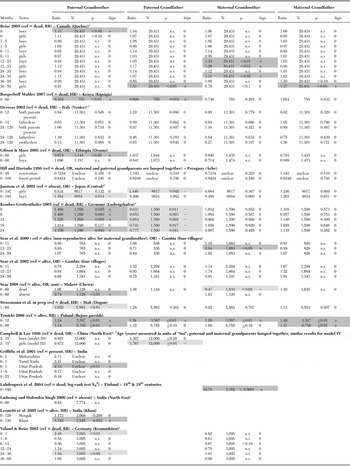
Table 1. Associations between grandparental and child survival. Effects are hazard ratios (HR), relative risks (RR) or Logistic regression odds ratios (OR). Sign:(+)= survival of the grandparent is positively associated with child survival (p<0.05), (0)= non-significant associations (p>0.05), (−)= survival of the grandparent is negatively associated with child survival (p<0.05).
 You have
Access
- 14
- Cited by
In the target article, “Grandparental investment: Past, present, and future,” Coall & Hertwig (C&H) provide a synthesis of widespread opinion on the evolutionary significance and underpinnings of grandparental nepotism. Their review is thorough and can serve as a useful entrée into the literature for researchers from disparate disciplines. The conjoining of perspectives from evolutionary biology, economics, and sociology is unique.
As first noted by Williams (Reference Williams1957), the long postmenopausal lifespan of women is an evolutionary enigma. Why should natural selection have extended the lifespan beyond the end of fertility? C&H provide an excellent summary of the main two adaptive hypotheses: the Good Mother Hypothesis and the Grandmother Hypothesis. Here we will comment on the data bearing on grandparental investment in natural fertility populations. A recent review (Sear & Mace Reference Sear and Mace2008) scored studies with a plus or a minus for whether or not the survival (or presence) of a particular kind of grandparent was associated with improved child survival. Based on this simple dichotomization, Sear and Mace conclude that: (1) “at least one relative is beneficial in almost all populations, suggesting that we are evolved to raise children as an extended family enterprise,” (2) “maternal grandmothers tend to improve child survival,” and (3) “paternal grandmothers are frequently beneficial but show rather more variation than maternal grandmothers in their effects on child survival” (Sear & Mace Reference Sear and Mace2008, p. 15). We attempted to replicate this review by looking up the same studies and generating a table that included all findings, together with p values and effect sizes, regardless of whether they were significant (Table 1). We also contacted the authors to request greater specificity (in regard to sample sizes, standard errors, and p-values) and a meta-analysis of the results is in progress (Strassmann and Kurapati, in preparation).
Associations between grandparental and child survival. Effects are hazard ratios (HR), relative risks (RR) or Logistic regression odds ratios (OR). Sign:(+)= survival of the grandparent is positively associated with child survival (p<0.05), (0)= non-significant associations (p>0.05), (−)= survival of the grandparent is negatively associated with child survival (p<0.05).
*Total sample size (not by sex or age)
‡ Person-years
In contrast to the conclusions of Sear and Mace (Reference Sear and Mace2008), our assessment of these data is that (1) overall, nonsignificant findings predominate over significant findings, and this is true even in the case of the maternal grandmother; (2) associations between the paternal grandfather and child survival tended to be either nonsignificant or negative; (3) associations for the maternal grandfather were overwhelmingly nonsignificant; and (4) in agreement with Sear and Mace, the situation for the paternal grandmother was extremely variable, but more studies reported positive than negative associations, although many reported nonsignificant associations.
The data are correlational and claims of causation may not be justified, especially in the presence of so many nonsignificant findings. It is also possible that beneficial effects of grandparents on child survival existed that were not discovered by the investigators. Nonetheless, it is unlikely that the weakness of the evidence in favor of grandparenting is entirely on account of problems of study design. The same studies consistently reported strong evidence that maternal survival improves offspring survival (Sear & Mace Reference Sear and Mace2008), giving these studies some credibility. Most of the children were living in patrilineal, patrilocal populations; negative associations were also found in some matrilineal, matrilocal situations (Sear Reference Sear2008), but not others (Leonetti et al. Reference Leonetti, Nath, Hemam, Neill, Voland, Chasiotis and Schiefenhövel2005). Additional positive associations between grandparernal survival and child survival might have emerged if more matrilocal and foraging societies had been included, but this was not possible to test given the available literature. Our review, like that of Sear and Mace (Reference Sear and Mace2008), focused on grandparental survival and grandchild survival, and did not consider other arenas for grandparental nepotism. In conclusion, as shown in Table 1, the data do not presently support the conclusion that “The presence of a maternal or paternal grandmother was associated with an increase in her grandchildren's probability of surviving in 69% (9 of 13 studies) and in 53% (9 of 17 studies) of cases, respectively” (target article, sect. 2.4, first paragraph).
If grandparents, including maternal grandmothers, are less important than has been argued, then the view that humans are a cooperatively breeding species (C&H in the target article; Hrdy Reference Hrdy, Voland, Chasiotis and Schiefenhövel2005b; Kramer Reference Kramer2005a) also requires reassessment. Space does not permit us to consider the evidence for sibling helpers, but it is not stronger than that for grandparents. Child survival and growth is often negatively associated with family size (Lawson & Mace Reference Lawson and Mace2008; Strassmann & Gillespie Reference Strassmann and Gillespie2002), which points to sibling competition rather than cooperation. With these concerns in mind, it is useful to consider the avian literature.
Cockburn (Reference Cockburn2006) classified bird species as cooperatively breeding if there is evidence that more than 10% of nests in one or more populations are attended by more than two birds. By this definition, cooperative breeding occurs in 9% of avian species (Cockburn Reference Cockburn2006). Using Cockburn's definition, humans are cooperative breeders if at least two different populations have regular alloparents in at least 10% of households. This condition is almost certainly met, since two populations out of the total number of human populations is not a high bar to meet. To the best of our knowledge, no one has worked out what proportion of human societies in the past or the present need to have alloparenting (and to what extent) in order for humans to qualify as cooperative breeders. Such a calculation would force us to expose implicit assumptions about the role of grandmothers and other extra-parental helpers.
Rather than using Cockburn's definition, we recommend a more specific and restrictive definition of cooperative breeding when speaking of humans. The helper-at-the-nest phenomenon, wherein grown offspring remain on their natal territory (or farm) and help their siblings to raise nieces and nephews, provides a useful analogy to the pattern of delayed marriage and celibacy among the 19th century rural Irish (Strassmann & Clarke Reference Strassmann and Clarke1998; see also, Voland et al. Reference Voland, Siegelkow and Engel1991 for a German data set). Marriage and celibacy rates in rural Ireland were directly proportional to the availability of farms, and unmarried/non-inheriting siblings often stayed home as helpers, or at least as unpaid laborers. This pattern is comparable to the ecological constraints on independent reproduction in birds (Komdeur Reference Komdeur1992; Pruett-Jones & Lewis Reference Pruett-Jones and Lewis1990; Strassmann & Clarke Reference Strassmann and Clarke1998).
By restricting the use of the term “cooperative breeding” to situations wherein alloparental behavior is prevalent and direct reproduction is delayed or forfeited, we will be better able to classify and to understand the diversity that exists in human family systems. In behavioral ecology it is more interesting to examine the underlying causes of socioecological or cultural variation than to impose species typical generalizations that may cause us to ignore contrary evidence. At present, the evidence in favor of grandmothering is far weaker than has been generally acknowledged. The significance of the nearly global breakdown of the extended family and the widespread occurrence of autonomous nuclear families, whether monogamous or polygynous, shows that cooperative breeding in humans is facultative. In a wide variety of contexts and countries, responsibility for child-care falls overwhelmingly on the parents. If humans were birds, most societies with nuclear families would not meet the 10% criterion for alloparenting.
Until the evidence in favor of grandparents and other helpers gets stronger, we suggest that we reserve the term “cooperative breeding” for those societies or family systems that seem to parallel the cooperative breeding found in other species. We should also take a closer look at the “Mother Hypothesis,” as the data convincingly show that maternal survival is crucial for offspring survival.