




No CrossRef data available.
Controversies about Controversial Issues in DemocraticEducation
Published online by Cambridge University Press: 19 April 2004
Abstract
An abstract is not available for this content. As you have access to this content, full HTML content is provided on this page. A PDF of this content is also available in through the ‘Save PDF’ action button.
Information
- Type
- Symposium
- Information
- Copyright
- © 2004 by the American Political Science Association
In a recent study of Americans' beliefs about how government should work, political scientists John Hibbing and Elizabeth Theiss-Morse (2002) painted a depressing picture of a populace that does not care much about political issues and policies. Contrary to the view that people yearn for greater and more meaningful involvement in self-governance, their research showed that the vast majority of Americans purposely avoid political participation, and that many actually recoil from a system they perceive as driven by narrow self-interest and rancorous conflict.
Hibbing and Theiss-Morse are not the only researchers documenting the low level of political engagement in the United States. Their study is particularly important, though, because it links declines in political engagement to the views that many hold regarding conflict and controversy. They identified a vexing paradox: While Americans generally like conflict and controversy (e.g., their addiction to watching competitive sports and reality shows on television), they generally dislike contentious disputes about politics, policy issues, and governance.
Hibbing and Theiss-Morse advocate teaching the populace to accept the inevitability, that there is “disagreement among Americans on how to resolve issues that are important to them and to accept that there is disagreement on which issues deserve to be on the political agenda in the first place” (2002, 223). One way they suggest changing Americans' views toward political conflict is to revamp what students in elementary and secondary schools are taught about the nature of democracy and democratic participation. They advocate loading the civic education curriculum with hotly debated political issues in order to teach young people that controversy is not an unfortunate byproduct of democracy, but one of its core and vital elements.
The idea that controversial political issues should be a central feature of a school-based democratic education program is not new. In an influential report about social studies issued in 1916, schools were encouraged to create “Problems of Democracy” courses that emphasized contemporary political issues (U.S. Bureau of Education). Enthusiasm for this approach continues today among some educators as evidenced by the recently released Civic Mission of the Schools Report (2002), which endorses covering political controversies in the curriculum. Specifically, it recommends that schools:
Incorporate discussion of current local, national, and international issues and events into the classroom, particularly those that young people view as important to their lives. When young people have opportunities to discuss current issues in a classroom setting, they tend to have greater interest in politics, improved critical thinking and communications skills, more civic knowledge, and more interest in discussing public affairs out of school (p. 6).
The rationales for teaching students to discuss controversial political issues in schools are multiple and wide ranging. Unlike many other venues, schools are particularly suitable sites for discussions of issues. As Amy Gutmann writes, “Schools have a much greater capacity than most parents and voluntary associations for teaching children to reason out loud about disagreements that arise in democratic politics” (1999, 58). Schools' greater capacity lies in the fact that they contain more ideological diversity than one would expect to find in a family, church, synagogue, mosque, or club. This diversity of views makes classrooms powerful places to promote what Gutmann deems the most important component of democratic education: “rational deliberations of competing conceptions of the good life and the good society” (44).
There is evidence to support the claim that discussions of controversial issues in schools can enhance democratic thinking. For example, research shows a positive relationship between discussion of complex policy issues (especially civil liberties controversies) and the development of tolerant attitudes and knowledge of the need for tolerance in democracies (Avery 2002). Participation in discussions of controversial issues also appears to influence other forms of political engagement. Findings from the International Association for the Evaluation of Educational Achievement (IEA) study of 90,000 students in 28 countries advances the importance of issues discussions in an open classroom climate (Torney-Purta, Lehmann, Oswald and Schultz 2001). In an open classroom climate, “students experience their classrooms as places to investigate issues and explore their opinions and those of their peers” (138). The IEA researchers reported that open classroom climate for discussion is a significant predictor of civic knowledge, support for democratic values, participation in political discussion, and political engagement (measured by whether young people say they will vote when they are legally able).
There is also evidence to suggest that participating in discussions in school influences students' civic behavior after they leave high school. Molly Andolina and her colleagues (2003) found that students who reported they had discussed issues in class were more likely to say they had participated in civic activities such as signing a written petition, participating in a boycott, and following political news most of the time.
The Controversies about Controversial Issues
Notwithstanding the promising research findings, and the enthusiasm among civic education leaders for an issue-srich curriculum, teaching young people how to discuss political issues is often quite controversial. Ironically, the very reason that Hibbing and Theiss-Morse give for Americans' low levels of political engagement (e.g., their aversion to political conflict) is the reason that the solution they propose (more conflict in civic education) is so difficult to put into practice. That is, the controversies that emanate from democratic education programs that include contentious political issues may be just the kinds of political controversies that people want to avoid. Many adults either want schools to mirror their ideas, or fear that adding controversy to the curriculum creates controversy, as opposed to simply teaching young people how to deal more effectively with the kinds of political controversies that exist outside of school. As one of Jonathan Zimmerman's students remarked, “You'll never see a parents' group called ‘Americans in Favor of Debating the Other Side’ in Our Schools” (2002, 197).
The general aversion to controversy serves as a barrier to enacting issue-rich democratic education programs. There are others barriers as well, including:
- differing views about the purposes of democracy education;
- fears that teachers, other students, or instruments of the “official curriculum” (such as textbooks and films) will indoctrinate students into particular positions on issues;
- and sharp conflicts about what should rightly be considered an issue in the first place.
The rancorous division that permeates the current political climate, coupled with the aftermath of September 11, make the terrain of controversial issues teaching especially treacherous now. For example, the Civic Mission of the Schools report from which I quoted earlier goes on to note that “teachers need support in broaching controversial issues in classrooms since they may risk criticism or sanctions if they do so (2002, 6). In the most dramatic instances, teachers were disciplined and even fired for teaching about controversial political issues that involved September 11. More commonly, teachers were instructed to eliminate or curtail plans to teach about such issues. One teacher in New York, for example, was ordered by her principal to spend no more than two 50-minute class periods teaching about 9/11-related controversies (such as whether the U.S. should bomb Afghanistan). The special challenges presented by September 11 and its aftermath layer onto the barriers that are always in place. That is, this approach to democratic education is always challenging—but those challenges are even more difficult to address effectively in the current climate.
Disagreement Over The Purposes of Democratic Education
Joel Westheimer and Joseph Kahne (2004) point out that while there is little disagreement over whether it is important for schools to educate toward democratic participation, there is marked dissension about the kind of participation schools should foster. This disagreement stems from larger questions about what “good” citizens in a democracy are supposed to do. Is it more important for the populace to monitor and critique political leaders or to volunteer to help community members in need? Is it more important to vote in every election or to use the marketplace to voice political views by buying or boycotting? Is it more important to deliberate political issues with people whose political views are different from your own or to join with like-minded people to advocate a partisan position on a political issue? While these activities are not mutually exclusive, research shows that very few people regularly engage in all of these forms of political involvement.
Given the disagreement about what constitutes effective democratic participation, it is not surprising that people also disagree about what kind of democratic education young people should receive. While some of these conceptions of what “good” citizens should do line up well with teaching issues in schools, others do not. For example, many service learning programs that focus on individual volunteerism are devoid of meaningful discussion of controversial political issues. And even some political advocacy programs assume that students agree about the best position on controversial issues, otherwise they would not have a position in common for which to advocate.
Charges of Indoctrination
A second and more challenging obstacle to including controversial political issues as a part of democratic education is that it opens teachers and school districts up to charges of indoctrination. This typically occurs in two different ways. First, a teacher (or teaching material) may be perceived as (or may actually be) promoting one position on a controversial issue as the “best” answer. Second, there may be something about the issue per se that makes the mere discussions about it indoctrination. For example, a discussion over whether the United States should withdraw its troops from Iraq might draw charges from conservatives that even discussing the question is a form of leftist indoctrination.
Because public opinion can shift over time, selecting subjects for issue discussions can be like shooting at a moving target. As an example, consider how the granting of women's suffrage in the United States shifted from a controversial political issue to a question about which virtually all Americans would now agree. It is far easier to teach about an issue when there is widespread agreement in the general public than when there is conflict about whether an issue is really an issue. But there is often disagreement about what constitutes a legitimate issue for discussion. This conflict shows up in the various ways that teachers define and approach issues in the classroom.
Teachers' Reponses to the Controversies over Controversial Issues
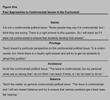
For a number of years I have been analyzing how middle and high school social studies teachers make decisions about teaching controversial political issues. To date, I have identified four distinct approaches (see Figure One) that illustrate the complexity of this approach to democratic education. A brief exploration of these approaches can help shed light on why this type of teaching can be so challenging.

Denial
The first approach occurs when teachers deny that an issue is controversial. When a teacher does not believe an issue to be controversial, then by disclosing her views, she is not taking a “side,” but speaking the “truth.” For example, one teacher argued that whether the death penalty should be used in the United States was not a controversial political issue, but a question for which there was a clear right answer that students should be taught to believe. She was a member of Amnesty International and deeply embarrassed to live in a nation that sanctioned capital punishment. “How can we ever make progress on human rights issues,” she asked, “if we pretend that there is no right or wrong?” She made a distinction between matters of “legitimate” controversy and matters of “illegitimate” controversy. She still wanted to include the topic of the death penalty in her curriculum—not as a legitimate issue, but as an illustration of how the United States is out of step with prevailing world opinion. By doing so, she hoped her students would understand that the United States has not realized its potential as a democracy and that changes are necessary. Despite a conception in the general public that this issue is controversial, this teacher's denial of its controversies served her aim of promoting a particular kind of social transformation.
Privilege
Conversely, the next approach involves teachers who believe a topic is controversial, but want to privilege a particular perspective in their teaching. An example of this approach is provided by a teacher, a political activist, who works on a number of social justice issues designed to achieve “equality and liberation in a true sense.” Shortly after returning from a weekend trip to Washington, D.C., to protest the proglobalization policies of the U.S. government, he taught a lesson about sweatshop labor that was designed to “counter the brainwashing” his students receive from a “biased media.”
Recognizing that the issue of globalization was indeed a genuine issue, he shared an article from the Gap's web site explaining their labor practices as a token toward balance. He acknowledged, however, that this was a ruse and that the lesson was not balanced. He struggled with whether it was ethical for teachers to purposely and explicitly create an ideological curriculum. “I worry,” he said, “that if I allow my ideology to control the content, then some right-winger will do the same thing in his classroom.” Yet he also wanted to “speak truth to power” and encourage his students to consider “what side they are on.” Doing this, however, caused him to question whether there was any real difference between teaching for social justice (which he wanted to do) and stacking the ideological deck so far toward his own perspective that he was, in fact, indoctrinating students.
Others would argue that his concerns are overblown, and that the very possibility that neutrality is a pedagogical possibility is naïve, impossible, or immoral. For example, when introducing their resource guide for teaching about globalization, William Bigelow and Robert Peterson state that “for educators to feign neutrality is irresponsible. The pedagogical aim in this social context needs to be truth rather than ‘balance’—if by balance we mean giving equal credence to claims that we know to be false and that, in any event, enjoy wide dispersal in the dominant culture” (2002, 5). In their view, striving for objectivity and neutrality is akin to worshipping false gods. Instead, teachers should realize that all of teaching is political and that teachers' political views can and should direct their teaching toward particular ends. Moreover, some teachers who take this position of privileging a particular position on an issue agree with Wayne Ross (2002), who argues that “the widely held belief in our society that activities strengthening or maintaining the status quo are neutral or at least non-political, while activities that critique or challenge the status quo are ‘political’ is wrongheaded.”
Avoidance
Even when teachers believe a topic is a controversial issue, they do not necessarily include it in their curricula. When talking with a group of high school teachers about what Supreme Court cases they think deserve attention in high schools, I encountered an example of avoidance: virtually all of them said they did not teach Roe v. Wade (1973) though they acknowledged it was a landmark case and that abortion rights were still an important controversial issue in the United States. Their reasons for avoiding this controversy fell into two categories. First, some teachers were afraid that the very mention of abortion in the classroom would cause uproar in the community. Some even taught in school districts that had explicitly forbidden coverage of the topic. More prevalent, however, was the influence of the teachers' own views. One teacher, a staunch Catholic, said her personal belief that abortion was a sin caused her to fear that she could not approach the issue fairly. Moreover, she feared her religious beliefs would invariably inform her comments to students (especially those who supported abortion rights), and she did not want to impose her religious views on her students. Another teacher had spent the past 10 years volunteering for an organization that supported abortion rights. She was furious about the tactics used by anti-abortion groups and simply couldn't stomach hearing her students' views about why abortion should be illegal. Thus, these teachers avoided including issues in the curriculum not because they thought it was an insignificant issue, but for precisely the opposite reason: Their strong views about the issue prevented them from teaching their students about it in the pedagogically neutral fashion they assumed was possible.
Balance
The fourth approach, what I call “balance,” typically involves applying a standard for determining whether a topic is an issue and, if it is, teaching about it without favoring a particular perspective. For example, two teachers whose course I studied (Hess and Posselt 2002) believed that if there was genuine controversy about a topic in the world outside of school, then it should be treated as a controversial issue in the classroom as well. Even when parents complained (as often happened when abortion's legality was the issue under discussion), the teachers treated especially controversial topics as legitimate issues and went to great lengths to ensure that students had exposure to different perspectives. One of the teachers gave this explanation of his goals:
Students have a right to whatever opinion they want, whatever perspective they want to take, but they need to understand both perspectives to intelligently take a position on an issue. I also argue that if they know the other side's position they can be more effective in their advocacy for their side. So I've argued with parents that my intent is not to propagandize in any way on an issue, and students have a right to take any position they want.
Many advocates of controversial political issues teaching support the distinction this teacher makes between teaching students a particular point of view about issues, versus aiming for a “best case, fair hearing of competing points of view” (Kelly 1989, 132). Such a standard would be met if especially well-informed advocates of differing perspectives on an issue listened to the discussion and felt their views had been given a fair hearing. This standard draws on ideals of objectivity (so perspectives can be analyzed fairly) and equality (so that different perspectives have equal power). Fred Newmann (1975) provided support for this perspective when he argued that it was inappropriate for teachers to convince students to support specific policies because they were genuinely controversial (i.e., infused with competing perspectives) and students' open inquiry into a variety of perspectives would be limited if they were presented with a prepackaged “best” answer.
The “balanced” approach, while on its face appeals to many educators, school administrators, and members of the general public, is not without its problems. As a number of the approaches described previously illustrate, there is often disagreement about whether a topic should be treated as an issue in the first place. Applying a “balanced” analysis to a topic that some parents believe is not a legitimate controversy would not strike them as balanced, but as wrongheaded propaganda. This concern, of course, often leads to avoidance or to the selection of controversial issues that don't actually spark a lot of controversy. That is, the very reason that this form of education is often advocated—to teach young people how to deal effectively with authentic and challenging political controversies—may be abrogated if relatively “safe” issues dominate the curriculum.
Conclusion
Just as Joel Westheimer and Joe Kahne (2004) point to the need to ask “What kind of citizen?” are we educating toward, we must apply the same kind of analysis to the oft-promoted goal of teaching young people how to engage productively in discussions of controversial political issues. We need to ask a series of questions: What constitutes a controversial political issue versus a question for which there is a right answer? Which issues should be included in the curriculum? Which approaches to them are pedagogically sound?
Moreover, we need to recognize how challenging this form of democratic education can be in practice. Not surprisingly, teaching young people how to do something well in school when there are few models for them to emulate outside of school is difficult. But there are many teachers who are incredibly skillful at enacting this challenging form of teaching, so it is clear it can be done (Hess 2002; Rossi 1995).
Finally, it is vital to understand that controversies about controversial political issues teaching are inevitable. To be sure, there are steps that can be taken to mitigate the controversies (such as ensuring that teachers are well prepared to enact this form of teaching, encouraging administrators to support their efforts, and educating parents about why it is important). But if young people are taught about controversial issues in the schools, there almost certainly will be some kind of controversy (either within the school or in the community) about this form of democratic education. Given the severity and number of challenges that schools in the United States face, it is natural to consider whether this form of education is worth the trouble. The research about what students learn from controversial political issues discussions (even if not as extensive or robust as we need) indicates that it is. Facing the challenges inherent in teaching controversial issues is essential if we take seriously the importance of teaching young people to deal forthrightly and effectively with the plethora of political controversies facing society.
References
Andolina Molly W.,
Krista Jenkins,
Scott Keeter, and
Cliff Zukin. 2002 “Searching for
the Meaning of Youth Civic Engagement: Notes from the
Field.” Applied Developmental Science
6 (4): 189– 195.Google Scholar
Avery P.G.
2002 “Political Tolerance, Democracy
and Adolescents.” In Education for Democracy:
Contexts, Curricula, Assessments, ed. Walter
C. Parker. Information Age
Publishing, 113– 130.Google Scholar
Carnegie Corporation of New York and the Center for
Information and Research on Civic Learning and Engagement
(CIRCLE). 2002
The Civic Mission of the Schools.Google Scholar
Bigelow William, and
Bob Peterson. 2002
Rethinking Globalization: Teaching for Justice in an Unjust
World. Milwaukee, WI: Rethinking Schools
Press.Google Scholar
Hess Diana E.
2002 “Teaching
Controversial Public Issues Discussions: Learning from Skilled
Teachers.” Theory and Research in Social
Education
30 (1): 10– 41.Google Scholar
Hess Diana E., and
J. Posselt. 2002 “How High School
Students Experience and Learn from the Discussion of
Controversial Public Issues.” Journal of Curriculum
and Supervision
17 (4): 83– 314.Google Scholar
Hibbing J., and
E. Theiss-Morse. 2002
Stealth Democracy: Americans' Beliefs about How Government
Should Work. University Press: Cambridge,
UK.Google Scholar
Kahne Joseph, and
Joel Westheimer. 1996 “In the Service
of What? The Politics of Service Learning.” Phi Delta
Kappan
77 (9): 593– 599.Google Scholar
Kelly T.
1986 “Discussing
Controversial Issues: Four Perspectives on the Teacher's
Role.” Theory and Research in Social Education,
14 (2): 113–
138.Google Scholar
Newmann F. M.
1975
Education for Citizen Action: Challenge for the Secondary
Curriculum. Berkeley, CA:
McCutchen.Google Scholar
Ross E. Wayne. 2003 “Redrawing the Lines: The Case Against
Traditional Social Studies.” Retrieved on March 15,
2003 from:
http://www.pipeline.com/~rgibson/RossWSSCh.htm.Google Scholar
Torney-Purta Judith,
R. Lehmann,
H. Oswald, and
W. Schultz. 2001
Citizenship and Education in Twenty-eight Countries: Civic
Knowledge and Engagement at Age Fourteen.
Amsterdam: International Association for the
Evaluation of Educational Achievement.Google Scholar
U.S. Bureau of Education. 1916
The Social Studies in Secondary Education.
Washington, D.C.: U.S. Government Printing
Office, Bulletin No. 28.Google Scholar
Westheimer Joel, and
Joseph Kahne. 2004 “What Kind of
Citizen? Political Choices and Educational Goals.”
PS: Political Science and Politics
37 (April).Google Scholar
Zimmerman J.
2002
Whose America?: Culture Wars in the Public Schools.
Cambridge, MA: Harvard University
Press.Google Scholar
 You have Access
- 149
- Cited by