Introduction
Adolescence and young adulthood, defined by the Office of Disease Prevention and Health Promotion (2010) as the developmental periods from ages 10 to 25, are marked by high (and in recent years growing) risk for self-injury (Curtin, Warner, & Hedegaard, Reference Curtin, Warner and Hedegaard2016; Mercado, Holland, Leemis, Stone, & Wang, Reference Mercado, Holland, Leemis, Stone and Wang2017; Ting, Sullivan, Boudreaux, Miller, & Camargo, Reference Ting, Sullivan, Boudreaux, Miller and Camargo2012). Indeed, self-harm is a global public-health concern that disproportionately affects adolescents and young adults. Defined as self-injurious thoughts and behaviors “performed intentionally and with the knowledge that they can or will result in some degree of physical or psychological injury to oneself” (Nock, Reference Nock2010, p. 341), self-harm includes both nonsuicidal self-injury (NSSI, involving deliberate bodily harm without the intent to end one's life) and suicidal behavior. The latter comprises suicidal ideation (SI, thoughts of ending one's life) and actual suicide attempts (SA, acts of self-injury in which there is intent to die). Although in the broadest sense self-harm can include both indirect (i.e., unhealthy behaviors like smoking) and direct (i.e., NSSI, SI, and SA) forms, the latter confer more immediate and direct consequences and are therefore the focus of our investigation.
Overall, self-harm peaks in adolescence and young adulthood (Nock, Prinstein, & Sterba, Reference Nock, Prinstein and Sterba2009). Earlier estimates of prevalence ranged from 13% to 45% of adolescents, depending on the severity level of the constituent behaviors (Lloyd-Richardson, Perrine, Dierker, & Kelley, Reference Lloyd-Richardson, Perrine, Dierker and Kelley2007), with the most severe forms estimated in the lower region of that range of percentages. Emergency room visits for self-harming behavior in female youth nearly doubled from 2001 to 2016 (Center for Disease Control, 2018). Tragically, recent data reveal that suicide is among the top two causes of death for girls between the ages of 15 and 19 worldwide—outranking accidents, illnesses, and complications from pregnancy (World Health Organization, 2018). Most recently, state-level data suggest that suicide rates have increased across the US by more than 30% across all age groups, with the greatest increases noted in females aged 10–14 (Hedegaard, Curtin, & Warner, Reference Hedegaard, Curtin and Warner2018).
Much of the research on self-harm is cross-sectional, so that the developmental course of self-injurious behavior remains understudied (Prinstein, Reference Prinstein2008). Thus, it is uncertain whether self-harming behaviors initiated during adolescence persist through young adulthood, or whether those who engage in self-harm at different ages represent distinct groups. Importantly, examinations of childhood predictors of such behaviors have yielded inconsistent findings, especially with respect to combinations of predictive factors. Longitudinal studies would allow for fuller understanding of developmental patterns and predictive models (e.g., Plener, Schumacher, Munz, & Groschwitz, Reference Plener, Schumacher, Munz and Groschwitz2015).
Despite their distinctions, NSSI, SI, and SA often co-occur within individuals. Nock, Joiner, Gordon, Lloyd-Richardson, and Prinstein (Reference Nock, Joiner, Gordon, Lloyd-Richardson and Prinstein2006) reported that 70% of adolescents who reported engaging in recent NSSI episodes made a later suicide attempt and 55% reported multiple attempts. A meta-analysis revealed that the strongest predictor of SA was SI, followed by NSSI frequency (see Victor & Klonsky, Reference Victor and Klonsky2014 for review). Crucially, identification of at-risk youth is essential, because it is rare for adolescents who self-injure to seek treatment (Whitlock et al., Reference Whitlock, Eckenrode and Silverman2006). Understanding pathways to self-harm includes understanding who is at risk and what the key risks entail. Uncovering theory-driven and evidence-based risk factors could inform mental health professionals about preventive strategies, enabling the targeting of populations at particularly high risk. Thus, in the present study, we make use of a well-characterized and prospectively followed sample of girls with attention-deficit/hyperactivity disorder (ADHD)—itself increasingly understood as a risk factor for self-harm (Hinshaw et al., Reference Hinshaw, Owens, Zalecki, Huggins, Montenegro-Nevado, Schrodek and Swanson2012)—and attempt to characterize (a) self-harm risk across the developmental period from adolescence through the end of young adulthood and (b) the single and interactive effects of a range of theoretically salient and evidence-based risk factors.
A considerable body of research, particularly over the last 50 years, has considered and debated the nature of risk factors for suicidal behavior (for an authoritative review, see Franklin et al., Reference Franklin, Ribeiro, Fox, Bentley, Kleiman, Huang and Nock2017; see also Fox et al., Reference Fox, Franklin, Ribeiro, Kleiman, Bentley and Nock2015, for a meta-analytic review of risk factors for NSSI). Many theoretical models propose risk factors for self-injurious thoughts and behaviors, including interpersonal theory (Joiner, Reference Joiner2005), clinical-biological models (Mann et al., Reference Mann, Arango, Avenevoli, Brent, Champagne, Clayton and Kleinman2009; Mann, Waternaux, Haas, & Malone, Reference Mann, Waternaux, Haas and Malone1999), cognitive theories (Wenzel & Beck, Reference Wenzel and Beck2008), and diathesis-stress theory (van Heeringen, Reference van Heeringen and Y.2012; for reviews of theories, see Barzilay & Apter, Reference Barzilay and Apter2014; and O'Connor & Nock, Reference O'Connor and Nock2014). Yet any single theoretical account does not completely explain self-harm. The meta-analysis of Franklin and colleagues contends that current risk-factor research is not sufficiently powerful and that more productive approaches will necessitate algorithmic strategies synthesizing multiple interactive risk factors.
Despite the methodological limits of the existing literature and the narrow focus on risk factor domains, attempts to examine self-harm risk factors have emerged. For example, Franklin et al. (Reference Franklin, Ribeiro, Fox, Bentley, Kleiman, Huang and Nock2017) concluded that demographic variables (e.g., age, gender), biological factors, indicators of internalizing and externalizing psychopathology, and measures of cognitive and social functioning serve as significant predictors of suicidal behaviors. Fox et al. (Reference Fox, Franklin, Ribeiro, Kleiman, Bentley and Nock2015) also found that hopelessness, depression, female gender, externalizing and internalizing psychopathology, and emotion dysregulation are all risk factors for NSSI. Like Franklin et al. (Reference Franklin, Ribeiro, Fox, Bentley, Kleiman, Huang and Nock2017), Fox and colleagues (Reference Franklin, Ribeiro, Fox, Bentley, Kleiman, Huang and Nock2017) called for research embracing combinations of risk factors to improve prediction models.
From a theoretical perspective, many proposed models focus on narrow constructs (i.e., focusing solely on cognitive factors). Moreover, a main empirical limitation is the use of cross-sectional designs. Thus, a longitudinal study that examines multiple risk factors across domains, along with their interactions, should provide a better understanding of the developmental psychopathology of self-harm. Herein we focus on a recently proposed neurodevelopmental psychopathology model of self-harm (Beauchaine, Hinshaw, & Bridge, Reference Beauchaine, Hinshaw and Bridge2019), which examines the intersection of dispositional (i.e., internalizing and externalizing psychopathology, executive functioning, perceived low self-competence) and environmental (i.e., adverse childhood experiences, peer rejection, and negative/invalidating family interactions) factors that predict self-harm outcomes in girls with ADHD.
Dispositional risk factors
Early psychopathology
Symptoms of ADHD, and its common comorbidities in both externalizing and internalizing domains, are significantly associated with risk for self-harm (Biederman et al., Reference Biederman, Ball, Monuteaux, Mick, Spencer, McCreary and Faraone2008; James, Lai, & Dahl, Reference James, Lai and Dahl2004). In a large population-based study of 51,707 patients with ADHD, Ljung, Chen, Lichtenstein, and Larsson (Reference Ljung, Chen, Lichtenstein and Larsson2014) found that even after adjusting for comorbid disorders, ADHD increased risk for attempted and completed suicide (odds ratio (OR): 3.62). In our own work, Hinshaw et al. (Reference Hinshaw, Owens, Zalecki, Huggins, Montenegro-Nevado, Schrodek and Swanson2012) found that girls with a childhood history of clinically significant inattention and hyperactivity/impulsivity (as denoted by diagnosis of the Combined presentation of ADHD) had markedly elevated risk for both NSSI and SA by the end of adolescence, compared with girls with a history of clinically significant inattention alone (i.e., girls with the Inattentive presentation of ADHD) and to typically developing girls. Also, Swanson, Owens, and Hinshaw (Reference Swanson, Owens and Hinshaw2014) found that those with persistent ADHD (i.e., present in both childhood and young adulthood) were at highest risk for (a) SA and (b) at least moderately severe NSSI by the earliest years of adulthood (see Owens, Zalecki, Gillette, & Hinshaw, Reference Owens, Zalecki, Gillette and Hinshaw2017, for extension of such findings through the end of young adulthood). In addition, adolescent externalizing behaviors mediated the link between childhood ADHD and young-adult NSSI, whereas adolescent internalizing behaviors mediated the link between childhood ADHD and later SA (Swanson et al., Reference Swanson, Owens and Hinshaw2014; see also Barkley, Murphy, & Fischer, Reference Barkley, Murphy and Fischer2008; for review, see James et al., Reference James, Lai and Dahl2004). Longitudinal studies of ADHD have reported that children with ADHD have an 18.4% prevalence of SAs in adolescence, compared with 5.7% of controls (Chronis-Tuscano et al., Reference Chronis-Tuscano, Molina, Pelham, Applegate, Dahlke, Overmyer and Lahey2010). Previous reviews of ADHD and self-harm also support that rates of SAs in ADHD groups range between 9% and 51.5% (Impey & Heun, Reference Impey and Heun2012). Similar rates are reported for SI: 15.8% of ADHD participants reported SI, compared with 3.2% of control participants (Impey & Heun, Reference Impey and Heun2012). Gender effects in longitudinal studies have also emerged, such that girls with childhood ADHD are at increased risk for SA in adolescence (Chronis-Tuscano et al., Reference Chronis-Tuscano, Molina, Pelham, Applegate, Dahlke, Overmyer and Lahey2010).
Executive functioning (EF)
Broadly defined, EF is a set of self-regulatory cognitive processes—including planning, inhibition, organization, set shifting, working memory, and problem solving—that help individuals achieve a goal (Pennington & Ozonoff, Reference Pennington and Ozonoff1996). EF deficits have frequently been linked to ADHD (Barkley, Reference Barkley1997; for a review, see Brown, Reference Brown2013); they are also associated with NSSI (Fikke, Melinder, & Landrø, Reference Fikke, Melinder and Landrø2011), SI (Marzuk, Hartwell, Leon, & Portera, Reference Marzuk, Hartwell, Leon and Portera2005), and SA (see Richard-Devantoy, Berlim, & Jollant, Reference Richard-Devantoy, Berlim and Jollant2014, for a review). In the longitudinal sample comprising the dataset for this study, childhood response inhibition—a measure of EF and a key facet of impulsivity (measured via a laboratory task)—significantly predicted young adulthood NSSI severity, SI, and SA (Meza, Owens, & Hinshaw, Reference Meza, Owens and Hinshaw2016). A current meta-analysis found that the link between EF deficits and suicidality was strongest for depressive and mixed diagnostic samples, yet EF deficits were a protective factor for later self-harm among those with psychotic disorders (Bredemeier & Miller, Reference Bredemeier and Miller2015). It was also concluded that broad rather than specific EF deficits are associated with self-harm (Bredemeier & Miller, Reference Bredemeier and Miller2015). In short, given the heterogeneity of such results, additional research is required to better understand the longitudinal links between EF deficits and self-harm, particularly among individuals with ADHD, given that EF deficits are a key feature of the disorder.
Perceived self-competence
Perceived self-competence (also referred to as self-esteem in other studies) is defined as the set of beliefs and evaluations people hold about their personal attributes and competencies (Mann, Hosman, Schaalma, & De Vries, Reference Mann, Hosman, Schaalma and De Vries2004). Several studies have examined the role of childhood perceived self-competence in predicting later self-harm, revealing that low perceived self-competence in childhood predicts SI in young adulthood (e.g., McGee, Williams, & Nada-Raja, Reference McGee, Williams and Nada-Raja2001). Despite the high co-occurrence of low perceived self-competence and depression, findings suggest that low perceived self-competence predicts suicidality over and above depression (Grøholt, Ekeberg, Wichstrøm, & Haldorsen, Reference Grøholt, Ekeberg, Wichstrøm and Haldorsen2000). For adolescent girls, one study found that after adjusting for depressive symptoms, low perceived self-competence predicted later SI (Kelly, Lynch, Donovan, & Clark, Reference Kelly, Lynch, Donovan and Clark2001). Other investigations reveal that low perceived self-competence moderates the link between internalizing symptoms and suicidality (Yoder et al., Reference Oder1999). That is, the link between internalizing symptoms and suicidality is stronger when low perceived self-competence is also present. A review also highlighted that across five investigations, low perceived self-competence was associated with SI and SA (Evans, Hawton, & Rodham, Reference Evans, Hawton and Rodham2004), particularly in females (Reinherz et al., Reference Reinherz, Giaconia, Silverman, Friedman, Pakiz, Frost and Cohen1995).
Environmental risk factors
Adverse childhood experiences/maltreatment
Importantly, when ADHD is accompanied by childhood maltreatment, risk for subsequent self-harm increases. That is, girls with ADHD who experienced physical abuse, sexual abuse, and/or neglect during childhood showed a SA rate of 34% by young adulthood, compared with 12.8% of girls with ADHD without maltreatment histories (Guendelman, Owens, Galan, Gard, & Hinshaw, Reference Guendelman, Owens, Galan, Gard and Hinshaw2016). Thus, heritable factors (in this case, ADHD) and environmental factors (such as maltreatment) appear to operate in tandem with respect to elevated risk. Independent of ADHD, there is strong evidence that adverse childhood experiences, including maltreatment, are associated with suicidal behavior (Brodsky & Stanley, Reference Brodsky and Stanley2008; Dube et al., Reference Dube, Anda, Felitti, Chapman, Williamson and Giles2001; Enns et al., Reference Enns, Cox, Afifi, De Graaf, Ten Have and Sareen2006; Molnar, Berkman, & Buka, Reference Molnar, Berkman and Buka2001; Yates, Carlson, & Egeland, Reference Yates, Carlson and Egeland2008). In particular, a case-control study revealed that exposure to childhood adversity uniquely predicted SA in adolescence (Beautrais, Joyce, & Mulder, Reference Beautrais, Joyce and Mulder1996). Moreover, despite the heterogeneity of methods for assessing adversity and self-harm, exposure to negative life events (including neglect) is consistently associated with self-harm (Fergusson & Lynskey, Reference Fergusson and Lynskey1995; Johnson et al., Reference Johnson, Cohen, Gould, Kasen, Brown and Brook2002; Madge et al., Reference Madge, Hawton and McMahon2011; O'Connor, Rasmussen, & Hawton, Reference O'Connor, Rasmussen and Hawton2010; O'Connor, Rasmussen, Miles, & Hawton, Reference O'Connor, Rasmussen, Miles and Hawton2009). Finally, studies examining the diathesis-stress model suggest that predisposing cognitive vulnerabilities (i.e., impaired decision making) interact with early adversity to increase the risk of self-harm across the lifespan (Brodsky, Reference Brodsky2016).
Peer rejection
Peer difficulties, including peer rejection, have been noted to either predict or accompany risk for self-harm (Hawton, Fagg, & Simkin, Reference Hawton, Fagg and Simkin1996). In fact, longitudinal studies examining the association between peer problems and self-injurious thoughts reveal that low peer preference is associated with increases in SI over time (Heilbron & Prinstein, Reference Heilbron and Prinstein2010). In our own longitudinal sample, Meza et al. (Reference Meza, Owens and Hinshaw2016) found that teacher ratings of negative peer social preference in adolescence emerged as a significant mediator of the predictive associations between poor response inhibition during childhood and young adulthood SI and SA. At the same time, adolescent self-reports of peer victimization served as a significant partial mediator of the response inhibition–NSSI link. Clearly, adolescents at high risk for self-harm typically have significant interpersonal difficulties with their peers (Meza et al., Reference Meza, Owens and Hinshaw2016). Finally, the link between peer-related processes and self-harm may be particularly salient in females, who—compared with males—appear to exhibit greater concerns related to peers’ evaluations of themselves (Rose & Rudolph, Reference Rose and Rudolph2006).
Negative parenting practices
Another risk factor for self-harm, which has generated considerable research, is early parenting behavior. More specifically, the potentially unique impact of paternal negative parenting on later NSSI has been explored. One study found that insecure attachment to fathers, which presumes problematic behavior on the part of fathers, was associated with NSSI in a co-ed university sample (Gratz, Conrad, & Roemer, Reference Gratz, Conrad and Roemer2002). Similar results emerged in an all-female undergraduate sample (Gratz, Reference Gratz2006). However, many studies examining the link between parenting behaviors and later self-harm have (a) focused on mother's parenting instead of father's parenting and (b) utilized parental rather than child perception of parenting and/or the parent–child relationship. Previous work on adolescent–parent relationships has found differential correlates of relationships with each parent (e.g., Gould, Shaffer, Fisher, & Garfinkel, Reference Gould, Shaffer, Fisher and Garfinkel1998; Shek, Reference Shek1998). For example, Gould et al. (Reference Gould, Shaffer, Fisher and Garfinkel1998) found that poor communication with fathers predicted SA among adolescents whereas poor communication with mothers did not. In the present investigation we focus on measures of both paternal and maternal negative parenting, but hypothesize that participants’ perceptions of negative interactions with fathers will emerge as the stronger risk factor. We specifically focus on the child's perception of parenting because perceived negative parenting may well be a reflection of an invalidating caregiving environment, which has been extensively linked to self-harm (Linehan, Reference Linehan1993; see also Beauchaine et al., Reference Beauchaine, Hinshaw and Bridge2019), particularly so in females (Bureau et al., Reference Bureau, Martin, Freynet, Poirier, Lafontaine and Cloutier2010).
Present study and hypotheses
In sum, adolescence is a period marked by elevated risk for self-harm, more so in girls than boys and particularly in psychiatric populations. Individuals with histories of ADHD show highly increased risk. Many studies on self-harm have suggested that self-harm desists after adolescence (Moran et al., Reference Moran, Coffey, Romaniuk, Olsson, Borschmann, Carlin and Patton2012; for review, see Plener et al., Reference Plener, Schumacher, Munz and Groschwitz2015), but some longitudinal studies posit that risk of suicide following self-harm is considerable and persists over long periods (Hawton et al., Reference Hawton, Saunders and O'Connor2012). Overall, prospective research is needed to examine both (a) developmental patterns of self-harm and (b) risk factors—especially how risk processes may work together. In particular, early childhood psychopathology, adverse childhood experiences, peer rejection, executive functioning, negative parenting practices (particularly related to father–daughter interchange), and low perceived self-competence have been linked with elevated risk for self-harm adolescence, yet little is known about their role in girls with ADHD and their potentially interactive effects. In the current context, risk factors are baseline characteristics that precede and predict self-harm outcomes, whereas a moderator, ascertained at the same time point as the risk factor, identifies under which circumstances or for which subgroups a risk factor may increase the likelihood of engaging in self-harm (see Kraemer, Reference Kraemer2013). Identification of such baseline characteristics is a high priority for self-harm research (Crowell, Derbidge, & Beauchaine, Reference Crowell, Derbidge, Beauchaine and Nock2014) and could serve an important clinical function by guiding practitioners as they identify patients at highest risk and in most need of treatment.
Regarding developmental patterns in our all-female sample, we hypothesize the following: (a) women with childhood histories of ADHD will have higher lifetime rates of self-harm (NSSI, SI, and SA) than matched, non-ADHD comparison females; (b) those with childhood histories of the Combined presentation of ADHD (i.e., ADHD-C), compared with the Inattentive presentation (ADHD-I), will show elevated risk, given the strong association between impulsivity and later self-harm; (c) self-harm histories will be high in adolescence (W3) and typically desist by young adulthood (W4); and (d) women with persistent self-harm will emanate from the ADHD rather than the matched comparison group. As for our second aim of testing childhood predictors and moderators of lifetime self-harm, we hypothesize that early externalizing behaviors, adverse child experiences, peer rejection, low global EF, negative father–daughter interactions, and low perceived self-competence will each predict lifetime risk for self-harm (i.e., NSSI, SI, and SA), over and above key sociodemographic variables. We also hypothesize that those with multiple risks operating simultaneously (i.e., low perceived self-competence and childhood adversity) will have particularly elevated risk for lifetime self-harm. Note that contemporary theories and models of self-harm call for understanding of not just baseline predictors but also interactive processes throughout adolescence and beyond (see Beauchaine et al., Reference Beauchaine, Hinshaw and Bridge2019; Franklin et al., Reference Franklin, Ribeiro, Fox, Bentley, Kleiman, Huang and Nock2017). Our aim, however, is to take the preliminary step of examining theory-based and evidence-supported childhood predictors—and their potential interactions—toward the clinically relevant end of ascertaining predictor models before the period of engagement in self-harm begins.
Method
Overview of procedures
From the San Francisco Bay area, our research team recruited girls from schools, mental health centers, pediatric practices, and through direct advertisements, to participate in research summer programs in 1997, 1998, and 1999. These programs were designed as enrichment rather than therapeutic endeavors, with emphasis on ecologically valid classroom and playground settings and multiple sources and informants for key measures. After extensive diagnostic assessments, 140 girls with ADHD and 88 age- and ethnicity-matched comparison girls were selected for Wave 1 (W1, Mage = 9.6, range 6–12; Hinshaw, Reference Hinshaw2002). Five years later, we invited all participants for prospective follow-up at Wave 2 (W2, Mage = 14.2, range 11–18; Hinshaw, Owens, Sami, & Fargeon, Reference Hinshaw, Owens, Sami and Fargeon2006); the retention rate was 92%. Subsequently, we invited all participants and parents for a 10-year follow-up at Wave 3 (W3, Mage = 19.6, range 17–24; Hinshaw et al., Reference Hinshaw, Owens, Zalecki, Huggins, Montenegro-Nevado, Schrodek and Swanson2012), involving two half-day, clinic-based assessment sessions; the retention rate was 95%. Finally, we invited all young adult women for a 16-year follow-up at Wave 4 (W4; Mage = 25.6, range 21–29). Aided by use of social media in some cases, we located, consented, and obtained at least some data from 211 of the 228 original participants (93% retention). When necessary, we performed telephone interviews or home visits. We prioritized multidomain, multisource, and multi-informant data collection.
Participants
Participants included 228 ethnically diverse girls (53% White, 27% African–American, 11% Latina, 9% Asian–American) with (n = 140) and without (n = 88) childhood ADHD, ascertained via a rigorous, multigated screening and assessment process that, at the final stage, relied on the parent-administered Diagnostic Interview Schedule for Children, 4th edn. (DISC-IV; Shaffer, Fisher, Lucas, Dulcan, & Schwab-Stone, Reference Shaffer, Fisher, Lucas, Dulcan and Schwab-Stone2000) and Swanson, Nolan and Pelham Questionnaire (SNAP) rating scale (Swanson, Reference Swanson1992) in order to establish the ADHD diagnosis. Comparison girls, screened to match the ADHD sample on age and ethnicity, could not meet diagnostic criteria for ADHD via either parent ratings or structured interview criteria. Some of the latter (3.4%) met criteria for internalizing disorders (anxiety/depression) or for disruptive behavior disorders (6.8%); but the goal was not to match comparison participants to those with ADHD on comorbid conditions, which would have yielded a nonrepresentative comparison group. Exclusion criteria for both groups were intellectual disability, pervasive developmental disorders, psychosis or overt neurological disorder, lack of English spoken in the home, and medical problems prohibiting summer camp participation. See Hinshaw (Reference Hinshaw2002) for additional details. Family income was $50,000 to $60,000, which was slightly higher than the California median household income in the mid-1990s. On average, mothers and fathers had similar levels of education (29.4% of mothers and 26.8% of fathers had an advanced professional degree). Most parents in the study (65.8%) reported being married and living together at baseline assessment, and both mothers (Mage = 42.04, SD = 7.17; 60.5% White, 20.6% African–American, 5.7% Latina, 5.7% Asian–American, and 3.1% Mixed) and fathers (Mage = 44.56, SD = 7.12; 47.8% White, 11% African–American, 5.7% Latino, 4.8% Asian–American, and 1.8% Mixed) were ethnically diverse.
Measures
Predictor variables were measured during baseline assessment at Wave 1.
ADHD symptom severity: Swanson, Nolan and Pelham rating scale, 4th Edn. (SNAP-IV; Swanson, Reference Swanson1992)
To assess symptom severity for childhood inattention and hyperactivity/impulsivity, we utilized a rating scale completed by primary caregivers (usually mothers), which includes a dimensionalized checklist of the nine Diagnostic and Statistical Manual of Mental Disorders (DSM) items for ADHD–Inattentive presentation (ADHD-I; α = 0.968) and the nine items for ADHD–Hyperactive/Impulsive presentation (ADHD-H/I; α = 0.950), with each scored on a metric ranging from 0 (not at all) to 3 (very much). Scores for both dimensions ranged from 0 to 27, with higher scores indicating greater symptom severity. The SNAP has been used extensively in ADHD assessment and treatment research given its good internal consistency and adequate test–retest reliability (Bussing et al., Reference Bussing, Fernandez, Harwood, Hou, Garvan, Eyberg and Swanson2008).
Early psychopathology: Child Behavior Checklist (CBCL; Achenbach, Reference Achenbach1991)
To assess early psychopathology beyond ADHD, we used T scores from the broadband Internalizing (α = 0.892) and Externalizing (α = 0.925) scales of the CBCL, as rated by primary caregivers (usually mothers). The average T-score is 50, with a standard deviation of 10, such that scores above 60 are considered elevated/at-risk and above 70 are considered clinically significant (range in our sample = 33–88). The standardized scores and clinical cutoffs of the CBCL yield remarkable utility, especially given the measure's excellent validity, test–retest reliability, and internal consistency (Nakamura, Ebesutani, Bernstein, & Chorpita, Reference Nakamura, Ebesutani, Bernstein and Chorpita2009).
Executive functioning: Rey Osterrieth Complex Figure (ROCF; Osterrieth, Reference Osterrieth1944)
The ROCF is a complex cognitive task that requires an individual to copy and later recall a complex figure composed of 16 segments. We analyzed the Copy condition of this task (participants draw the figure with no delay after viewing the stimulus figure), which taps multiple domains of EF, such as planning, inhibitory control, attention to detail, and organization. Only the Copy condition differentiated the girls with ADHD from our comparison sample at baseline (Sami et al., Reference Sami, Carte, Hinshaw and Zupan2003). Previously, the ROCF has been successfully used to distinguish children with ADHD from those without (Carte, Nigg, & Hinshaw, Reference Carte, Nigg and Hinshaw1996; Nigg, Hinshaw, Carte, & Treuting, Reference Nigg, Hinshaw, Carte and Treuting1998; Sami, Carte, Hinshaw, & Zupan, Reference Sami, Carte, Hinshaw and Zupan2003). Scores from various methods of scoring the ROCF are significantly correlated with other measures of EF (Somerville, Tremont, & Stern, Reference Somerville, Tremont and Stern2000; Troyer & Wishart, Reference Troyer and Wishart1997; Watanabe et al., Reference Watanabe, Ogino, Nakano, Hattori, Kado and Sanada2005), indicating that the ROCF indeed taps one or more aspects of EF. We utilized a well-validated method of scoring the ROCF: the Error Proportion Score (EPS; in our sample MEPS = .30, SD EPS = .19, range = .02–.88) developed by Sami et al. (Reference Sami, Carte, Hinshaw and Zupan2003). The EPS is a ratio (number of errors/total number of segments drawn), indexing efficiency (Sami et al., Reference Sami, Carte, Hinshaw and Zupan2003). The intraclass correlation between pairs of the three primary scorers for the EPS ranged from 0.91 to 0.94. Among all of the EF measures in our battery, the EPS from the ROCF showed the largest effect size (d = 0.90) in differentiating the ADHD from the comparison sample at Wave 1 (Hinshaw, Carte, Sami, Treuting, & Zupan, Reference Hinshaw, Carte, Sami, Treuting and Zupan2002; Sami et al., Reference Sami, Carte, Hinshaw and Zupan2003).
Perceived self-competence
To assess overall perceived self-competence, girls self-reported on the Harter questionnaire (Harter, Reference Harter1982), an extensively used measure of global self-esteem (Blascovich & Tomaka, Reference Blascovich and Tomaka1991). It was ascertained during Wave 1, in two versions, one for older children (8 years and up) and one for those aged 6–7. To obtain an overall perceived competence measure, which is regarded as a core dimension of self-esteem (Tafarodi & Milne, Reference Tafarodi and Milne2002), we averaged all subscales within the questionnaire. For the younger girls, this overall competence measure was based on four subscales (physical competence, cognitive competence, peer acceptance, maternal acceptance). For participants aged 8–12, it was based on five subscales (school, social, physical appearance, behavior, athletic). All questions are rated on a 4-point metric (1 (strongly agree) to 4 (strongly disagree)); items were reverse scored and averaged so that higher mean scores indicate higher self-esteem (in our study, MSelf-Competence = 3.02, SD Self-Competence = .49, range = 1.43–3.93). Harter (Reference Harter1982) reported internal consistencies of these scales ranging from .75 to .84, with test–retest reliabilities ranging from .69 to .80.
Childhood adverse experiences/maltreatment: Adverse Childhood experiences (ACE)
The ACE questionnaire, used during Wave 4 but requesting retrospective information, contains detailed questions about childhood abuse, neglect, and household dysfunction. All ACE questions pertain to the first 18 years of life, with participants instructed to endorse only those items that occurred before the age of 18. For this measure, questions from the Conflict Tactics Scale (Straus & Gelles, Reference Straus and Gelles1900) were used to define emotional and physical abuse and domestic violence. Questions on emotional and physical neglect were adapted from the Childhood Trauma Questionnaire (Straus & Gelles, Reference Straus and Gelles1900). Childhood sexual abuse was assessed by using four questions adapted from Wyatt (Reference Wyatt1985); this variable was determined by a “yes” response to one or more of the pertinent questions. We used the total ACE score (MACE = 1.91, SD ACE = 1.92, range 0–10), composed of the number of categories of ACEs endorsed, to assess the cumulative effect of multiple ACEs. An epidemiological study assessing the test–retest reliability of retrospective reports of the ACE found good to moderate agreement for the total ACE score (Dube, Williamson, Thompson, Felitti, & Anda, Reference Dube, Williamson, Thompson, Felitti and Anda2004). Additionally, previous studies have found that the ACE score shows a strong, graded relationship to SA during childhood/adolescence and adulthood (Dube et al., Reference Dube, Anda, Felitti, Chapman, Williamson and Giles2001).
Peer rejection
As described in Hinshaw and Melnick (Reference Hinshaw and Melnick1995) regarding earlier programs for boys with ADHD, confidential peer sociometric nominations from each participant's baseline summer program were ascertained at the end of Week 1, Week 3, and Week 5. Using a picture board composed of head-and-shoulders photographs of all classmates, each girl nominated three girls (a) whom she most liked and (b) whom she most disliked. The proportions of classmates who liked disliked each participant (negative nominations) were used herein. The cross-week stability of these peer nominations was strong (r[226] = .85, p < .001). The negative nominations given by the clinical versus comparison samples were similar overall. That is, girls with ADHD were highly rejected, but girls with ADHD were somewhat more likely, as nominators, to show leniency towards other girls with ADHD, rating them slightly more positively and less negatively than did comparison girls (Blachman & Hinshaw, Reference Blachman and Hinshaw2002). For peer rejection we analyzed a composite of Week 1, Week 3, and Week 5 negative nomination proportion scores (M = .35, SD = .49, range = 0–2.31), given their strong stability across weeks of assessment.
Negative parenting practices: Alabama Parenting Questionnaire (APQ; Shelton, Frick, & Wootton, Reference Shelton, Frick and Wootton1996).
At Wave 1, both parents and girls reported on 42 items related to child-rearing practices, each rated on a 5-point metric (1 (Never) to 5 (Always)]. Herein, we analyze only participant reports. Previous factor analyses support several distinct factors, including both positive (i.e., involvement (10 items); positive reinforcement (6 items)) and negative dimensions (i.e., inconsistent discipline (six items), poor monitoring (10 items), and corporal punishment (three items)) (Shelton, Frick, & Wootton, Reference Shelton, Frick and Wootton1996). We calculated and standardized separate positive and negative parenting composite scores, which have been utilized in previous studies of disruptive behavior disorders (Frick & Dantagnan, Reference Frick and Dantagnan2005). Negative and positive parenting dimensions demonstrated adequate internal consistency in this sample (α = .67 and .80, respectively), comparable with figures from previous studies (Dadds, Maujean, & Fraser, Reference Dadds, Maujean and Fraser2003). As the primary measure within this domain, we used the composite score of the girl's report of her father's negative parenting practices (i.e., inconsistent discipline, poor monitoring, and corporal punishment). To yield comparative tests, we also included the girl's report of her mother's parallel parenting practices and parental ratings of their own negative parenting practices.
Perceived self-competence
To assess overall perceived self-competence, girls self-reported on the Harter questionnaire (Harter, Reference Harter1982), which is an extensively used measure of global self-esteem (Blascovich & Tomaka, Reference Blascovich and Tomaka1991). It was ascertained during Wave 1, in two versions, one for older children (8 years and up) and one for those aged 6–7. To obtain an overall perceived competence measure, which is regarded as a core dimension of self-esteem (Tafarodi & Milne, Reference Tafarodi and Milne2002), we averaged all subscales within the questionnaire. For the younger girls, this overall perceived competence measure was based on four subscales (physical competence, cognitive competence, peer acceptance, maternal acceptance). For participants aged 8–12, it was based on five subscales (school, social, physical appearance, behavior, athletic). All questions are rated on a 4-point metric [1 (strongly agree) to 4 (strongly disagree)]; items were reverse scored and averaged so that higher mean scores indicate higher self-esteem (in our study, MSelf-Competence = 3.02, SD Self-Competence = .49, range = 1.43–3.93). As reported by Harter (Reference Harter1982), internal consistencies range from .75 to .84, with test–retest reliabilities ranging from .69 to .80.
Criterion variables. Measures of self-harm were administered at Waves 3 and 4.
Barkley Suicide Questionnaire (Barkley, Reference Barkley2006)
This is a three-item self-report scale ascertained at Wave 3: “Have you ever considered suicide?”; “Have you ever attempted suicide?”; “Have you ever been hospitalized for an attempt?” A positive endorsement to any question is followed up with a lifetime frequency question (“How many times?”). Endorsed items were given a score of 1 and all other answers a 0. To calculate lifetime prevalence, we analyzed the dichotomous SI and SA items.
Self-Injury Questionnaire (SIQ)
All young women responded to the SIQ during Wave 3, an interviewer-administered measure based on a modification of Claes, Vandereycken, and Vertommen's (Reference Claes, Vandereycken and Vertommen2001) SIQ. Vanderlinden and Vandereycken (Reference Vanderlinden and Vandereycken1997) provide data supporting the validity and reliability of that measure within eating-disordered samples. We assessed variety and frequency of NSSI. Participants were asked whether, in the past year, they had deliberately injured themselves (e.g., scratched or cut their skin with objects, burned themselves, hit themselves hard, pulled hair out) and how often (1 (only once); 6 (a couple of times a day)). The SIQ yields strong internal consistency (α = 0.83), and it is considered a valid and reliable measure of self-harm (Santa Mina et al., Reference Santa Mina, Gallop, Links, Heslegrave, Pringle, Wekerle and Grewal2006). For this study, we created a NSSI dichotomous variable, for which any endorsement at any severity level (including low (‘constantly pick at scabs until they scar’ and/or ‘pull or play with your hair so much that it comes out’) to high severity (‘burn yourself on purpose’) behaviors), was coded as 1; no endorsed NSSI coded as 0 (see Swanson et al., Reference Swanson, Owens and Hinshaw2014).
Self-Injurious Thoughts and Behaviors Interview (SITBI; Nock, Holmberg, Photos, & Michel, Reference Nock, Holmberg, Photos and Michel2007)
This is a clinician-administered structured interview used at Wave 4 to assess the presence, frequency, and characteristics of a wide range of self-injurious thoughts and behaviors, including suicidal ideation, suicide plans, suicide gestures, suicide attempts, and NSSI. The SITBI has strong psychometric properties, including strong interrater reliability (average .99) and test–retest reliability (average .70; intraclass correlation coefficient .44) over a 6-month period. Moreover, concurrent validity was demonstrated via strong correspondence between the SITBI and other measures of suicidal ideation (average .54), suicide attempt (average .65), and NSSI (average .87). To ensure that we assessed self-harm since W3, we asked participants “How many times since __________ (W3 assessment date) have you made an actual attempt to kill yourself in which you had at least some intent to die?” Similar questions were asked regarding SI and NSSI. We created a dichotomous variable (yes/no) for all three criterion variables (NSSI, SI, and SA); 0 (no self-harm reported since Wave 3) and 1 or more (yes).
Self-harm lifetime prevalence
We created dummy variables to reflect the lifetime prevalence of self-harm from measures ascertained during Wave 3 and Wave 4. Wave 3 self-harm (including NSSI, SI and SA) was established via the self-reported measures described above. Wave 4 self-harm was assessed via the SITBI. All three criterion measures were dichotomous, where 1 is equal to endorsement of such behavior.
Self-harm developmental patterns
To assess desistance and persistence of self-harm across Wave 3 and 4 assessments, we coded not engaging in self-harm at either Wave 3 or Wave 4 as 0 (nonself-harming group); those endorsing self-harm at Wave 3 only (adolescent limited) as 1; those endorsing self-harm only during Wave 4 as 2 (young adult onset); and those endorsing self-harm at Wave 3 and Wave 4 as 3 (persistent self-harm).
Covariates. To ascertain whether the domains of impairment are related specifically to self-harm status rather than to confounding factors, we statistically adjusted for baseline measures that have been empirically associated with the predictors of interest and the criterion measures of self-harm, including (a) mother's education, (b) household income, (c) race/ethnicity, and (d) participant age. Mother's education was rated from 1 (some high school) to 6 (post college). The mean for mother's education was 4.7 (SD = 1.0), meaning that on average, mothers had completed some college. Household income was rated on a 1-to-9 ordinal metric (M = 6.2, SD = 2.7), with average household income falling in the $50,000 to $60,000 per year range.
Data analytic plan
Statistical analyses were performed with SPSS for Mac, Version 24 (IBM Corp., 2016). First, we conducted a series of chi-squared tests to assess group differences in terms of Wave 1 ADHD diagnostic status (ADHD vs. Comparison) with respect to lifetime history of self-harm criterion variables. We also conducted chi-square tests to assess subgroup differences between ADHD-I and ADHD-C with respect to our lifetime history variables of self-harm. Effect sizes were calculated using odds ratios (ORs). The criterion variables included three direct forms of self-harm and their lifetime history: NSSI, SI, and SA. In order to provide a more comprehensive picture, we also conducted descriptive analyses on the above-noted developmental patterns (i.e., nonself-harming group, adolescent limited, adult onset, and persistent).
Second, to examine risk factors, we conducted a series of binary logistic regressions to test whether early psychopathology, childhood adverse experiences, peer rejection, global EF, negative paternal parenting practices, and self-competence independently predicted lifetime risk of self-harm (Wave 3 and Wave 4) over and above sociodemographic variables (Step 1: Covariates; Step 2: Six predictors of interest entered individually). Within each criterion domain, we adjusted for multiple comparisons by controlling for false discovery rate using the Benjamini–Hochberg (BH) procedure (Benjamini & Hochberg, Reference Benjamini and Hochberg1995). We set the false discovery rate at p < .10 because a liberal criterion is recommended when the cost of a false negative is high (i.e., not detecting a significant predictor of self-harm; see McDonald, Reference McDonald2014). Other studies examining self-harm outcomes have also set a false discovery rate (FDR) p < .10 (see, for example, Hooijer & Sizoo, Reference Hooijer and Sizoo2020). We also conducted a series of t-tests between those with positive lifetime histories of self-harm and those without (separately for NSSI, SI, and SA) across our nine predictors of interest. Effect sizes were computed using Cohen d, and as with our binary logistic regression analyses, we adjusted for multiple comparisons.
Finally, we used ad-hoc receiver operating characteristics (ROC) analyses, via a freely available software (Kraemer, Reference Kraemer1992), to find optimal predictors and moderators that best differentiate those with and without lifetime NSSI, SI, and SA. In the current context, baseline variables that precede and are more strongly associated with an outcome (i.e., lifetime self-harm histories) are considered predictors, whereas baseline variables that are differentially associated with an outcome at various levels of the previously identified predictor variable are considered moderators (i.e., at high vs. low levels; for an extensive discussion on predictors and moderators see Kraemer, Reference Kraemer2013). Thus, for our purposes, moderators involve interactions of risk factors. These person-centered analyses offer increased clinical utility compared with the above-described variable-based regressions and t-tests. The ROC approach is nonparametric and highly sensitive to possible interactions; it imposes no assumptions about normality, equal variances, or linear associations, making it more widely applicable than classic linear models (Kiernan, Kraemer, Winkleby, King, & Taylor, Reference Kiernan, Kraemer, Winkleby, King and Taylor2001). First, we entered all predictors, and the ROC program rank ordered the predictors via κ, which can be weighted to favor sensitivity (SE = True Positives / True Positives + False Negatives) or specificity (SP = True Negatives / True Negatives + False Positives). We used the cut-off point optimizing sensitivity and specificity (Altman & Bland, Reference Altman and Bland1994). After an optimal predictor was found (i.e., the variable with the largest κ), the data were divided based on this value, and the next best predictor was searched. ROC continued this process until there were no more significant predictors (per a priori-defined p value), or the subsample size was deemed too small (e.g., n < 10). This ROC approach has been successfully used in clinical research studies with dichotomous outcomes (i.e., Owens et al., Reference Owens, Hinshaw, Kraemer, Arnold, Abikoff, Cantwell and Wigal2003; Owens, Hinshaw, McBurnett, & Pfiffner, Reference Owens, Hinshaw, McBurnett and Pfiffner2018), as ROC can identify predictors and characteristics of participants at differential risk for a specific outcome of interest (e.g., optimal response to treatment; self-harm). When assessing multiple domains of interest, as herein, ROC accommodates the high likelihood of collinearity among predictors by assessing their conjoint effects (Kraemer et al., Reference Kraemer, Kazdin, Offord, Kessler, Jensen and Kupfer1999).
Results
Intercorrelations and descriptive analyses
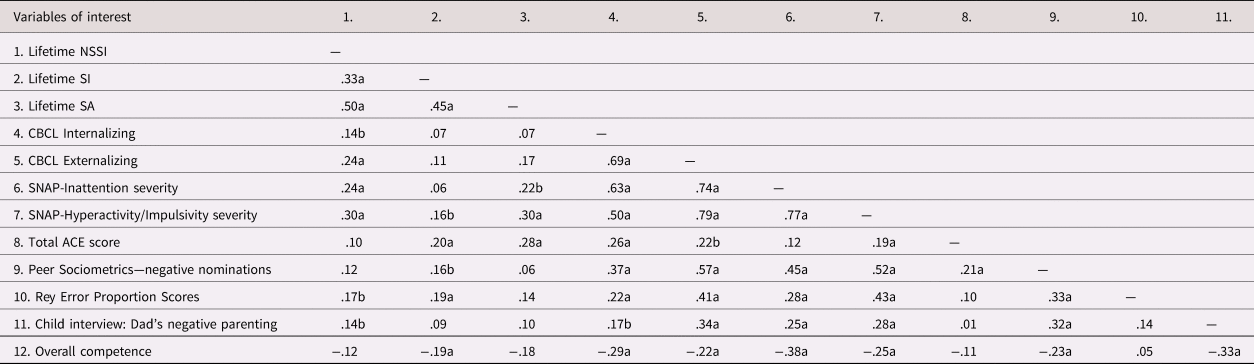
Table 1 presents the intercorrelations among study variables. As expected, lifetime NSSI, SI, and SA were significantly and moderately associated with one another. Wave 1 CBCL Externalizing T-score (r = .244, p < .01), CBCL Internalizing T-score (r = .135, p < .05), SNAP-Inattention severity (r = .243, p < .01), SNAP-Hyperactive/Impulsive severity (r = .297, p < .01), global executive functioning (r = .172, p < .05), and father's negative parenting (r = .164, p < .05) were all significantly correlated with lifetime NSSI. Similarly, Wave 1 SNAP-Hyperactive/Impulsive severity (r = .160, p < .05), adverse childhood experiences (r = .197, p < .01), negative peer nominations (r = .161, p < .05), global executive functioning (r = .186, p < .01), and perceived self-competence (r = −.186, p < .01) were all significantly correlated with lifetime SI. For lifetime SA, only SNAP-Inattention severity (r = .216, p < .05), SNAP-Hyperactive/Impulsive severity (r = .294, p < .01), and adverse childhood experiences (r = .284, p < .01) emerged as significant correlates.
Intercorrelations among all variables of interest

Note: NSSI: nonsuicidal self-injury; SI: suicide ideation; SA: suicide attempt; CBCL: Child Behavior Checklist; SNAP: Swanson, Nolan and Pelham Questionnaire; ACE: Adverse Childhood Experience.
a Correlation significant at .01 level.
b Correlation significant at .05 level.
Primary analyses (Table 2) revealed that 36.7% (n = 80) of the women in the entire sample had engaged in NSSI during their lifetimes, with significant group differences between the ADHD (46.5%, n = 61) and the comparison group (21.8%, n = 19; χ2[3, N = 200] = 13.52, p < .001, OR: 3.13, CI: 1.74, 6.15). In addition, significant subgroup differences emerged between the ADHD-C and ADHD-I subgroups (see Table 3) for lifetime NSSI: ADHD-C (n = 47; 51%) versus ADHD-I (n = 14; 29.8%); χ2[1, N = 131] = 5.05, p < .05, OR: 2.38, CI: 1.11, 5.09).
Criterion variable characteristics of overall sample, with contrasts between ADHD and comparison group

Note. NSSI: nonsuicidal self-injury; ns:not significant.
a ADHD Group versus Comparison Group. Significance: Chi-square statistic.
Contrasts between ADHD subgroups

Note: No significant group differences emerged across all criterion variables of interest between the ADHD-I and control group.
a ADHD-I versus ADHD-C. Significance for Chi-square statistic.
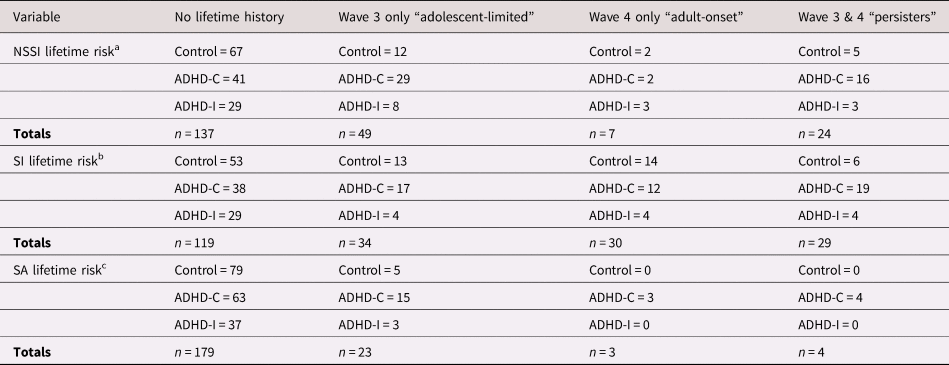
In terms of prevalence across development (see Table 4), we found that among the 80 participants with a presence of lifetime NSSI, most had engaged in this behavior by Wave 3 but did not continue between Waves 3 and 4 (62%; n = 49; “adolescent limited”). A small proportion began engagement in NSSI between Waves 3 and Wave 4 (8.8%, n = 7; “adult onset”), whereas one-third of the girls reporting a positive lifetime history of NSSI engaged in this behavior both before Wave 3 and between Waves 3 and Wave 4 (n = 24; “NSSI persisters”). It is noteworthy that 13.6% (n = 19) of participants with a childhood diagnosis of ADHD (n = 16 ADHD-C and n = 3 ADHD-I) were categorized as NSSI persisters, compared with 5.7% of comparison participants (n = 5; χ2[1, N = 217] = 3.98, p < .05, OR: 2.75, CI: .98, 7.67).
Criterion variable characteristics across developmental groups

a These ns are based on data available for n = 217 participants; n = 86 from the control group, n = 43 from the ADHD-I group, and n = 88 from the ADHD-C group.
b These ns are based on data available for n = 213 participants; n = 86 from the control group, n = 41 from the ADHD-I group, and n = 86 from the ADHD-C group.
c These ns are based on data available for n = 209 participants; n = 84 from the control group, n = 40 from the ADHD-I group, and n = 85 from the ADHD-C group.
Next, nearly half of our sample reported having SI during their lifetimes (43.7%, n = 93). Perhaps given such a high base rate of SI, we did not find a significant difference between the ADHD (47.2%, n = 60; ADHD-C n = 48, ADHD-I n = 12) and comparison groups (38.3%, n = 33), χ2 (3, N = 200) = 5.78, p > .05, OR: 1.44, CI: .82, 2.51. However, significant differences emerged between the ADHD-C (n = 48; 51.6%) and ADHD-I (n = 12; 25.5%) subgroups regarding lifetime SI, with higher rates in the former (see Table 3; χ2 (1, N = 127) = 7.85, p < .005, OR: 3.05, CI: 1.38, 6.77). Regarding SI prevalence across development, we found that among the 93 participants who engaged in lifetime SI, 37% engaged in SI prior to Wave 3 only (i.e., “adolescent limited”), 32% endorsed SI between Wave 3 and Wave 4 only (i.e., “adult onset”), and 31% endorsed SI at both Wave 3 and Wave 4 (i.e., “persisters;” see Table 4). We found that 16.4% (n = 23) of women with a childhood diagnosis of ADHD (ADHD-C = 19; ADHD-I = 4) were SI persisters, compared with 6.8% (n = 6) of comparison girls (ADHD-C = 19; ADHD-I = 4; χ2 (1, N = 212) = 5.27, p < .05, OR: 2.91, CI: 1.13, 7.49).
Finally, for SA, the lifetime prevalence in the entire sample was, as expected, lower than that for NSSI and SI (13.95%, n = 30). Significant group differences emerged between the ADHD (19.4%, n = 25; ADHD-C = 22, ADHD-I = 3) and comparison group (5.8%, n = 5); χ2 (3, N = 200) = 9.12, p < .05, OR: 3.89, CI: 1.43, 10.62), but no significant differences emerged between the ADHD-C and ADHD-I subgroups (p > .05; see Table 3). In terms of SA prevalence across development (see Table 4), 77% of girls attempting suicide had made attempts by Wave 3 (n = 23 of the 30 overall attempters). Of these, most belonged to the ADHD-C group (n = 15), three belonged to the ADHD-I subgroup, and five were comparisons. Only three girls attempted suicide between the Wave 3 and 4 assessments (i.e., “adolescent limited”), and four girls attempted suicide before Wave 3 and again between Wave 4 (i.e., “persisters”). All seven of them belonged to the ADHD-C group.
Predictors: Binary logistic regressions and Cohen d
For predictor analyses, binary logistic regressions assessed independent predictors of each of the three dichotomous outcomes (lifetime histories of NSSI, SI, and SA).
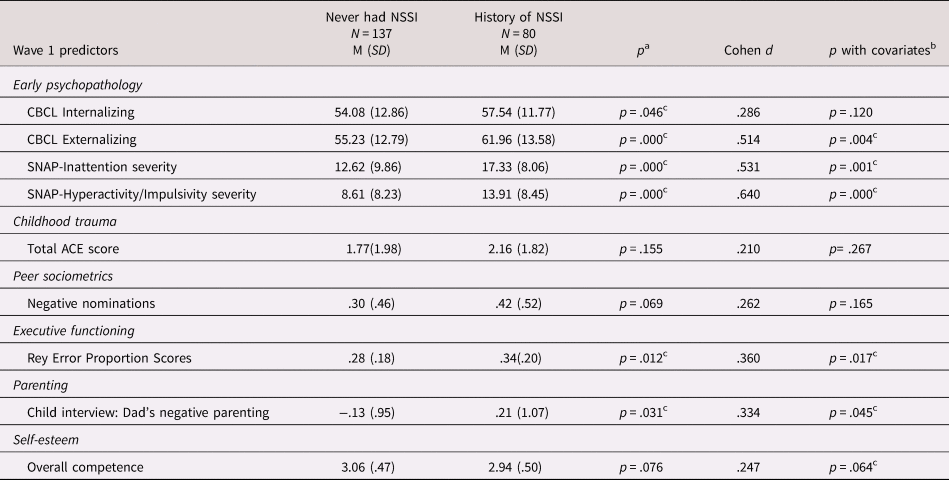
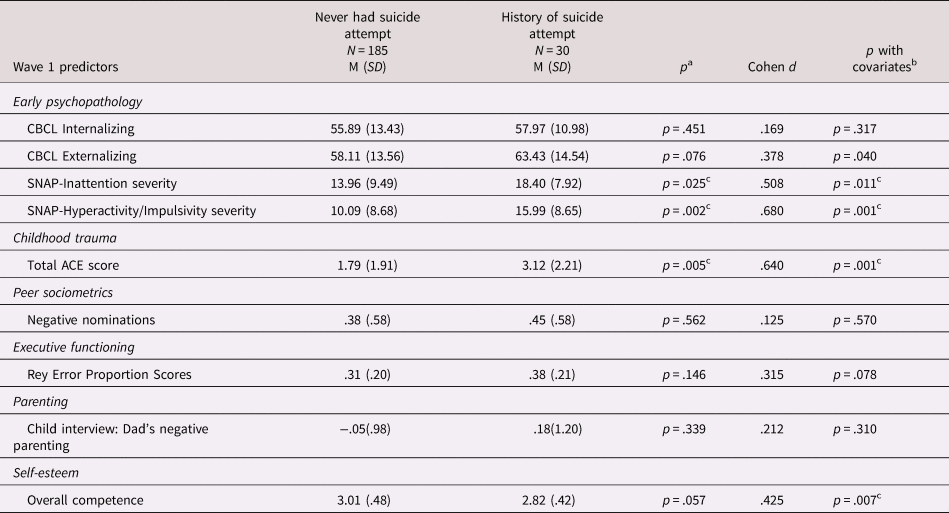
For NSSI, 11 cases with missing data on some variables were excluded from the analyses. After covarying baseline household income, mother's education, race/ethnicity, and participant age, SNAP Inattention symptom severity (p < .001; d = .53), SNAP Hyperactivity/Impulsivity symptom severity (p < .001; d = .64), CBCL Externalizing scores (p < .01; d = .51), global EF (p < .05; d = .36), and participant report of paternal negative parenting (p < .05; d = .33) predicted positive lifetime history of NSSI, with multiple comparison adjustment (see Table 5). Neither participant report of maternal negative parenting or parent's own rating of their own negative parenting was a significant predictor either here or for the other two self-harm criterion variables of SI and SA, all ps > .05.
Predictors of lifetime risk of NSSI

Note: NSSI: nonsuicidal self-injury; CBCL: Child Behavior Checklist; SNAP: Swanson, Nolan and Pelham Questionnaire; ACE: Adverse Childhood Experience.
a Independent samples t-test.
b Binary logistic regression; Covariates included: W1 household income, mother's education, child's race/ethnicity and child's age at baseline.
c Significant after correction for false discovery rate (Benjamini & Hochberg, Reference Benjamini and Hochberg1995).
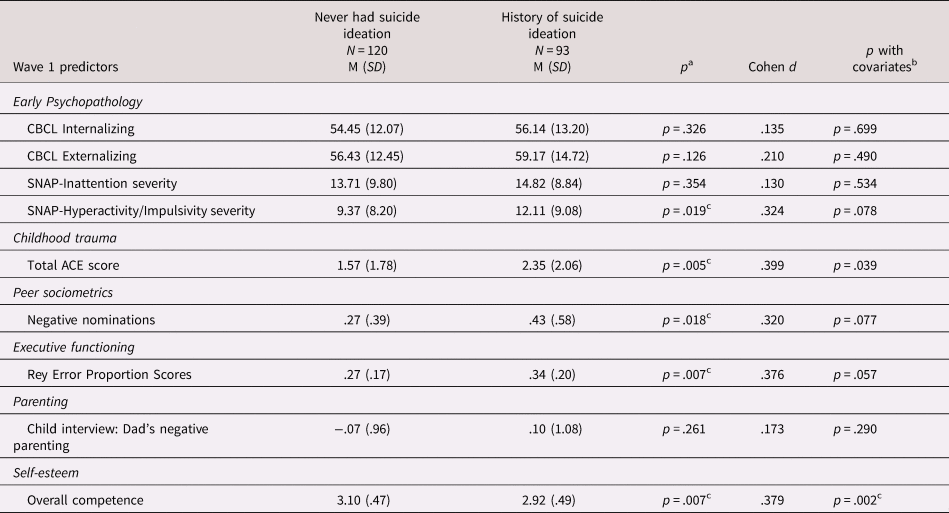
For lifetime SI, 15 cases were excluded owing to missing data for some of the variables. Perceived self-competence (p < .01; d = .39) was the sole significant independent predictor, with adjustment for covariates (see Table 6). Although adverse childhood experiences (p < .05; d = .40) was initially significant, this predictor did not survive our multiple-comparison adjustment.
Predictors of lifetime risk of suicide ideation

Note: NSSI: nonsuicidal self-injury; CBCL: Child Behavior Checklist; SNAP: Swanson, Nolan and Pelham Questionnaire; ACE: Adverse Childhood Experience.
a Independent samples t-test.
b Binary logistic regression; Covariates included: W1 household income, mother's education, child's race/ethnicity and child's age at baseline.
c Significant after correction for false discovery rate (Benjamini & Hochberg, Reference Benjamini and Hochberg1995).
Finally, for lifetime SA, we excluded 13 cases that had missing data. After inclusion of covariates and with multiple comparison adjustment, SNAP Inattention symptom severity (p < .05; d = .51), SNAP Hyperactivity/Impulsivity symptom severity (p < .001; d = .68), adverse childhood experiences (p < .001; d = .64), and perceived self-competence (p < .01; d = .43) were significant predictors (see Table 7).
Predictors of lifetime risk of suicide attempt

Note: NSSI: nonsuicidal self-injury; CBCL: Child Behavior Checklist; SNAP: Swanson, Nolan and Pelham Questionnaire; ACE: Adverse Childhood Experience.
a Independent samples t-test.
b Binary logistic regression; Covariates included: W1 household income, mother's education, child's race/ethnicity and child's age at baseline.
c Significant after correction for false discovery rate (Benjamini & Hochberg, Reference Benjamini and Hochberg1995).
ROC analysis
We conducted ROC analyses to ascertain interactive effects of predictors (i.e., in the attempt to discover moderators) and to enhance the clinical utility of our findings by determining thresholds or cut-points for predictors that differentiated who did and did not report self-harm during adolescence and early adulthood. We conducted separate models for each criterion variable and included all predictors of interest, allowing us to detect interactions even when main effects were not present in the binary logistic regressions.
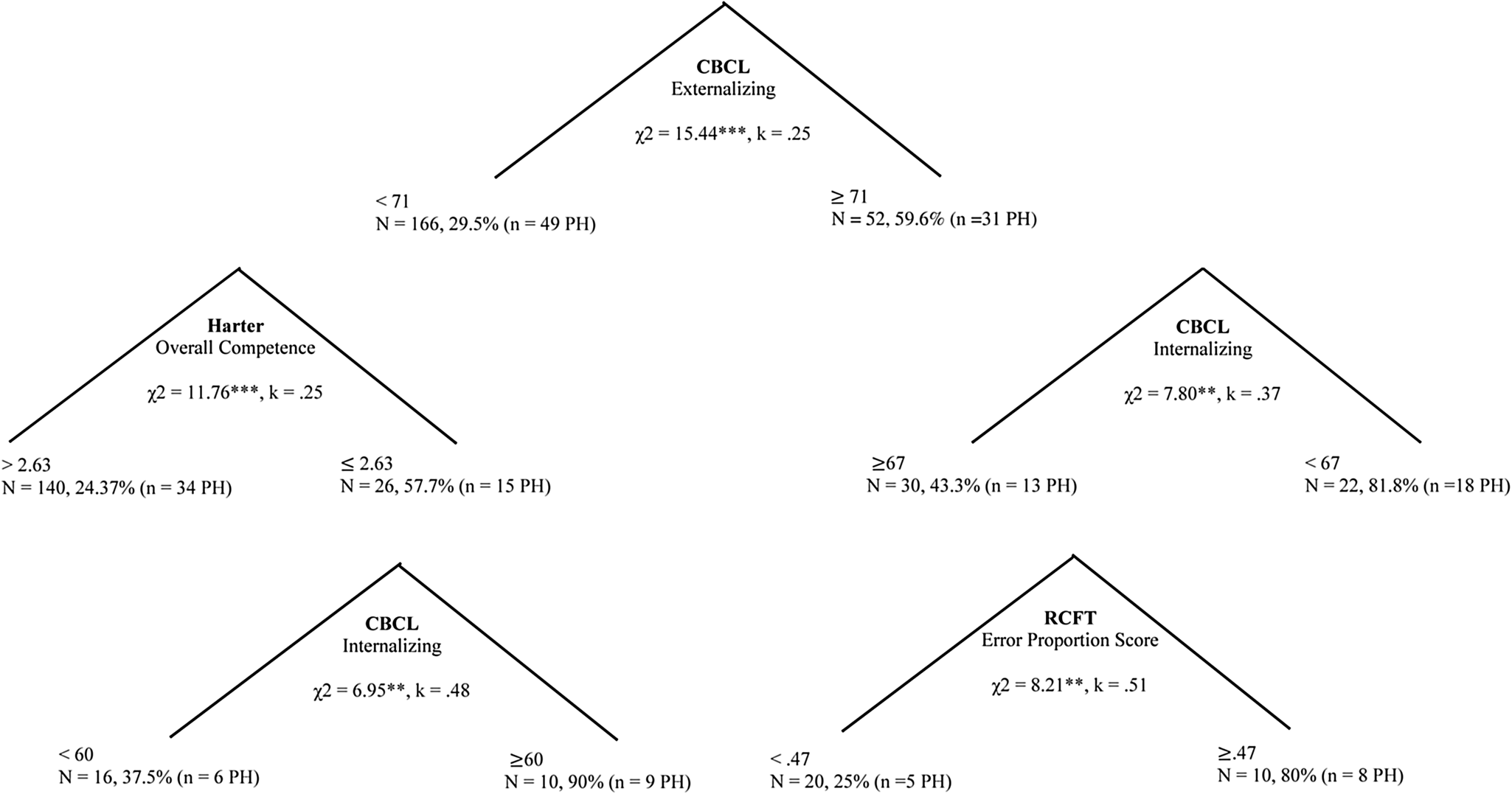
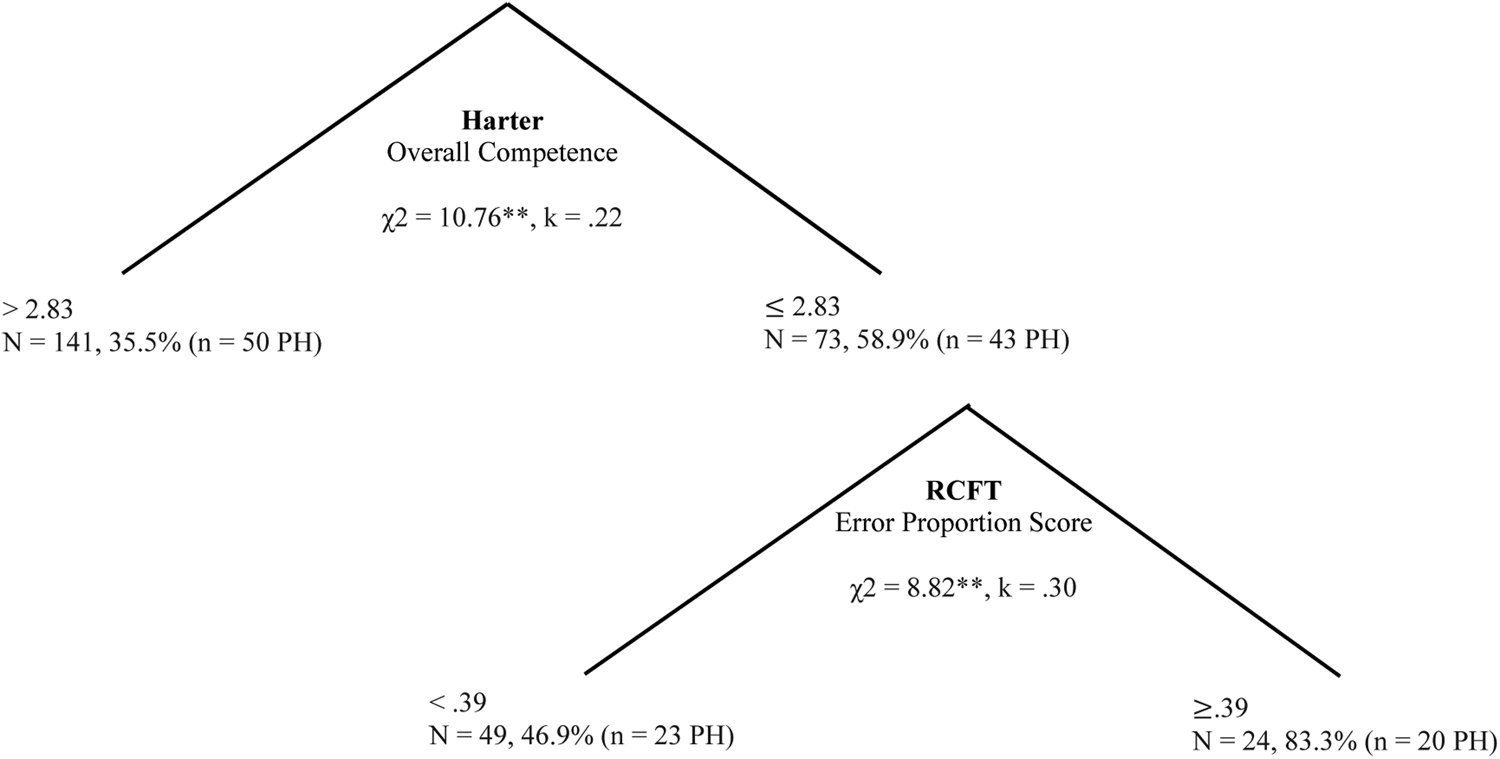
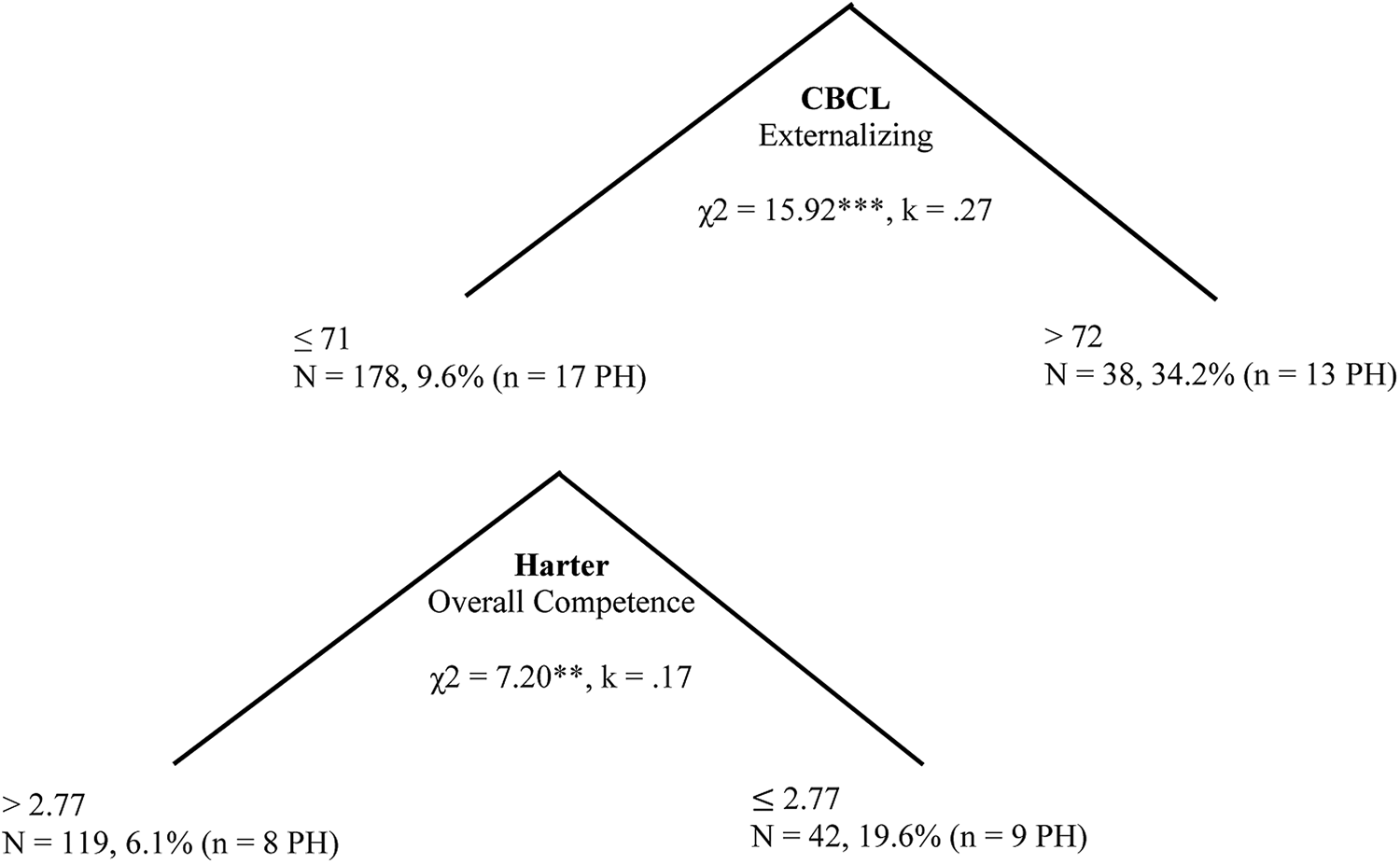
For NSSI, the parent-rated Externalizing symptoms score was a significant predictor, qualified by Internalizing symptoms and the executive functioning measure, such that girls with CBCL Externalizing T-scores greater than 71, CBCL Internalizing T-scores higher than 67, and poor executive functioning (i.e., ROCF EPS higher than .47) had a lifetime history of NSSI of 80% (see Figure 1). For SI, perceived self-competence was a predictor, moderated by poor EF, such that girls with perceived self-competence scores below 2.83 and ROCF EPSs greater than .39 had an 83.3% lifetime history of SI (see Figure 2). For SA, two different groups emerged, such that those participants with CBCL Externalizing T-scores higher than 72 had the highest positive history of SA (34.2%). The second group—with moderate positive histories of SA (19.6%)—included participants with CBCL Externalizing T-scores lower or equal to 72 and with low (i.e., overall score below 2.77) perceived self-competence scores (see Figure 3).
Predictors and moderators of NSSI lifetime risk. Notes: NSSI: nonsuicidal self-injury; CBCL: Child Behavior Checklist; RCFT: Rey Complex Figure Task; PH: positive history.

Predictors and moderators of suicide ideation lifetime Risk. Notes: RCFT: Rey Complex Figure Task; PH: positive history.

Predictors and moderators of suicide attempt lifetime risk. Notes: CBCL: Child Behavior Checklist; PH: positive history.

Discussion
We investigated a well-characterized longitudinal sample of girls with and without ADHD, with two major goals: (a) characterizing developmental patterns of three major forms of self-harm and (b) ascertaining childhood predictors and moderators of the lifetime self-harm measures. All analyses were performed separately for NSSI, SI, and SA. First, consistent with previous research, lifetime histories of NSSI and SA (but not the more prevalent SI) were significantly more common in participants with childhood ADHD than in comparison participants (see Chronis-Tuscano et al., Reference Chronis-Tuscano, Molina, Pelham, Applegate, Dahlke, Overmyer and Lahey2010). Rates of SI in our ADHD group were highly similar to others reported in the literature (see Fuller-Thomson, Lewis, & Agbeyaka, Reference Fuller-Thomson, Lewis and Agbeyaka2016), even though rates of SI were somewhat elevated in our comparison group compared with women in the general population (see meta-analysis of Mortier et al., Reference Mortier, Cuijpers, Kiekens, Auerbach, Demyttenaere, Green and Bruffaerts2018). The elevation of lifetime SI in our comparison group could be partially explained by their rates of internalizing symptoms, which were not at Wave 1 significantly different from those in the ADHD group. Regarding self-harm prevalence from adolescence into young adulthood, most participants with positive histories of lifetime NSSI and lifetime SA engaged in such behaviors in adolescence yet desisted by young adulthood, consistent with previous longitudinal findings that NSSI and SA peak in adolescence but subsequently decline (Plener et al., Reference Plener, Schumacher, Munz and Groschwitz2015). Furthermore, nearly 60% of the participants endorsing a positive history of NSSI by late adolescence (i.e., Wave 3) emanated from the ADHD-C subgroup, and all suicide attempters who persisted from adolescence into young adulthood came from the ADHD-C subgroup. Overall, adolescence is a period marked by high risk for self-harm in girls, and those with high rates of childhood impulsivity (reflected in an ADHD-C diagnosis) are at particularly increased risk for persistent self-harm (Swanson et al., Reference Swanson, Owens and Hinshaw2014; You & Leung, Reference You and Leung2012).
Predictor and moderator analyses revealed the following: (a) Lifetime NSSI was predicted by childhood inattention symptoms, hyperactivity/impulsivity symptoms, externalizing behaviors, poor EF, and child perceptions of father's negative parenting. ROC analyses revealed that parent-rated childhood externalizing symptoms predicted NSSI, qualified by internalizing, and EF measures, such that girls with childhood CBCL Externalizing and Internalizing T-scores in the clinical range who also had poor childhood EF (i.e., RCFT EPS higher than .47) displayed a particularly high lifetime history of NSSI (80%). (b) Lifetime SI, with a far higher base rate, was predicted only by low perceived self-competence. ROC analyses revealed that the optimal predictor of SI was low perceived self-competence, moderated by poor EF, such that girls with low perceived self-competence and ROCF EPSs greater than .39 had an 83% lifetime history of SI. (c) For lifetime SA, childhood inattention, and hyperactivity/impulsivity symptoms, as well as adverse childhood experiences and low perceived self-competence emerged as significant predictors. ROC analyses identified externalizing symptoms (T-score greater than 72) as the optimal predictor that was not further qualified by other variables. However, a second group emerged with a moderate level of externalizing symptoms (T-score equal to or below a score of 71, which is still considered clinically elevated), and low perceived self-competence.
Overall, findings regarding early childhood predictors and moderators of lifetime self-harm are largely consistent with those from previous investigations (e.g., DiPierro et al., Reference Dipierro, Sarno, Perego, Gallucci and Madeddu2012; Fliege et al., Reference Fliege, Lee, Grimm and Klapp2009; Gratz et al., Reference Gratz2006; McGee et al., Reference McGee, Williams and Nada-Raja2001; Shin et al., Reference Shin, Chung, Lim, Lee, Oh and Cho2009). For example, according to dominant theories of self-harm (Beauchaine et al., Reference Beauchaine, Hinshaw and Bridge2019; Crowell, Beauchaine, & Linehan, Reference Crowell, Beauchaine and Linehan2009), both dispositional and environmental factors predict and maintain NSSI, with supportive evidence supplied herein. Specifically, dispositional factors (i.e., early ADHD and externalizing symptom severity) plus environmental factors (perceptions of negative parenting by fathers) were associated with lifetime NSSI. Because participant ratings of mothers’ negative parenting did not significantly predict lifetime NSSI, we posit that that father–daughter relationships may be particularly salient. In fact, noninvalidating environments in childhood (characterized by negative parenting strategies; Muehlenkamp, Walsh, & McDade, Reference Muehlenkamp, Walsh and McDade2010)—and poor-quality father–child relationships (DiPierro et al., Reference Dipierro, Sarno, Perego, Gallucci and Madeddu2012)—are established in the literature as conferring risk for NSSI.
Our findings linking low perceived self-competence (synonymous with low self-esteem) with later SI were also in line with previous findings. Past longitudinal studies highlight that childhood low perceived self-competence predicts later suicide ideation (McGee & Williams, Reference McGee and Williams2000), even after statistically adjusting for childhood levels of depression and hopelessness (Bhar, Ghahramanlou-Holloway, Brown, & Beck, Reference Bhar, Ghahramanlou-Holloway, Brown and Beck2008). Still, previous findings regarding the predictive validity of low perceived self-competence to later self-harm have been mixed (see, for example, Claes, Houben, Vandereycken, Bijttebier, & Muehlenkamp, Reference Claes, Houben, Vandereycken, Bijttebier and Muehlenkamp2010; Grøholt et al., Reference Grøholt, Ekeberg, Wichstrøm and Haldorsen2000; Kingsbury, Hawton, Steinhardt, & James, Reference Kingsbury, Hawton, Steinhardt and James1999). Although depression has been reported as a significant predictor of later self-harm, not all adolescents diagnosed with depression endorse suicidal ideation, which suggests the presence of other factors. For example, a 21-year longitudinal study examining vulnerabilities associated with increased risk of SI revealed that low perceived self-competence contributed to vulnerability for later SI (Fergusson, Beautrais, & Horwood, Reference Fergusson, Beautrais and Horwood2003). These findings support that dispositional factors (i.e., perceived self-competence), primarily in early years of life, may elevate risk for later self-harm.
ach of the symptom dimensions of ADHD (i.e., inattention and hyperactivity/impulsivity) predicted lifetime SA, in combination with participant-reported childhood adversity and low perceived self-competence. These findings are consistent with past literature (DiPierro et al., 2012; Gratz et al., 2006; McGee et al., Reference McGee, Williams and Nada-Raja2001; Shin et al., Reference Shin, Chung, Lim, Lee, Oh and Cho2009). Although we expected that symptoms of ADHD would predict all criterion variables (i.e., NSSI, SI, and SA), significant prediction occurred for lifetime NSSI and SA only. This finding suggests that symptoms of ADHD confer risk for more severe and direct forms of self-harm than for the more frequently observed variable of SI—particularly for females (Cho et al., Reference Cho, Kim, Choi, Kim, Shin, Lee and Kim2008; Hinshaw et al., Reference Hinshaw, Owens, Zalecki, Huggins, Montenegro-Nevado, Schrodek and Swanson2012). One possible explanation is that girls with symptoms of both inattention and hyperactivity/impulsivity (ADHD-C presentation) may be likely to internalize negative feedback received in childhood, resulting in low perceived self-competence—and are also at increased risk of experiencing higher rates of maltreatment in childhood (see Briscoe-Smith & Hinshaw, Reference Briscoe-Smith and Hinshaw2006; Guendelman et al., Reference Guendelman, Owens, Galan, Gard and Hinshaw2016).
Although our predictor analyses support that both dispositional (i.e., early psychopathology, cognitive factors, perceived self-competence) and environmental factors (i.e., adverse childhood experiences, paternal negative parenting) predict lifetime self-harm independently (Beauchaine et al., Reference Beauchaine, Hinshaw and Bridge2019), our ROC analyses uncovered that dispositional factors did not interact with environmental factors to predict self-harm risk. Instead, our findings were in line with a previous study that concluded that dispositional factors, and not environmental factors, appeared to have a strong predictive influence on self-harm behaviors in adolescents (George, Reference George2017). Although environmental factors did not emerge as significant moderators in our study, they should not be discounted in future research and clinical interventions.
Clinical implications
Research with longitudinal and multi-informant methods aimed at elucidating early risk factors for later self-harm provide important information that could be implemented in suicide prevention campaigns. For example, ADHD symptoms in childhood (particularly those involving impulsivity) pose a high risk for self-harm in adolescence and young adulthood. Thus, whereas self-harm should be an assessment target, ADHD symptom rating scales do not typically include inquiries about self-harm, suggesting strongly that brief self-harm screeners should be included in evidence-based evaluations. Similarly, several studies point to family dysfunction, in particular negative paternal parenting behaviors, as a significant predictor of self-harm. One possible intervention strategy would be to make a concerted effort to obtain the input of the father into the assessment of ADHD when possible. Effective interventions should include fathers in ongoing treatment—for example, in parent training or multifamily group therapy (i.e., Dialectical Behavioral Therapy). Historically, fathers are often neglected or excluded from ongoing assessment and treatment of their child's psychological problems (Phares, Lopez, Fields, Kamboukos, & Duhig, Reference Phares, Lopez, Fields, Kamboukos and Duhig2005). A meta-analysis of father involvement in parent training found that interventions including both fathers and mothers yielded significantly more positive changes in their child's behavioral problems than those including mothers only (Lundahl, Tollefson, Risser, & Lovejoy, Reference Lundahl, Tollefson, Risser and Lovejoy2008). Additionally, protective factors require greater elucidation. For example, supportive parents, fair teachers, safe schools, and the presence of a close friend have been associated with low rates of suicide attempts among adolescents (Fleming, Merry, Robinson, Denny, & Watson, Reference Fleming, Merry, Robinson, Denny and Watson2007).
Limitations and Future Directions
These findings should be interpreted in light of several limitations. First, ours is an all-female sample; as such, no conclusions can be drawn with regard to predictors of self-harm in male samples. However, we note that when assessing risk for self-harm, other studies have not found significant gender differences (Klonsky, Oltmanns, & Turkheimer, Reference Klonsky, Oltmanns and Turkheimer2003; Stanley, Gameroff, Michalsen, & Mann, Reference Stanley, Gameroff, Michalsen and Mann2001). Still, additional investigations of males are needed, especially regarding multiple risk factors. Second, we assessed adverse childhood experiences retrospectively, which could have biased results. More specifically, we assessed childhood trauma with the ACE measure at Wave 4—and previous studies have suggested that when retrospectively assessing childhood trauma, women are likely to underestimate their ratings (Williams, Reference Williams1994). Third, given the small subsample of girls indicating self-harm by Wave 3 and between Waves 3 and 4, we were unable to assess predictors of the persistence of self-harm—an area in need of investigation. Fourth, our NSSI lifetime variable included low-severity behaviors (i.e., pick at scabs until they scar) along with more serious indicators (e.g., cutting, burning). Clarity as to the kinds of self-injurious behaviors operationalized as constituting NSSI is a priority. Fifth, our study included a measure of global executive functioning, which precluded our examination of how differing aspects of executive functioning (i.e., “hot” vs. “cold”) might be associated with later self-harm. Examination of hot versus cold executive functioning is an important future direction to consider, especially given more recent work pointing to differing cool executive functions among patients with a history of suicide attempts (Ho, Hsu, Lu, Gossop, & Chen, Reference Ho, Hsu, Lu, Gossop and Chen2018). Finally, we considered all risk factors independently in our regression analyses, and we repeated our analyses separately for the three criterion variables of NSSI, SI, and SA. Although we used a correction for multiple tests, we cannot rule out the possibility that Type I errors occurred. We emphasize, however, the effect sizes (e.g., ORs) of our findings, as opposed to statistical significance alone.
Overall, it is important to understand risk processes at a conceptual and theoretical level and to target adolescents at high risk for self-harm at a clinical level, especially because at-risk teens typically do not seek professional help either before or after a suicide attempt (Doyle, Treacy, & Sheridan, Reference Doyle, Treacy and Sheridan2015). In order to increase access to care for at-risk youth, upstream preventive efforts must first take priority. First, a better understanding of risk factors should facilitate the development of screening tools that can be used across settings. Second, a priority is understanding relevant mechanisms for the maintenance of self-harm, to inform prevention and treatment efforts. Third, future research should prioritize the interplay of baseline (childhood) predictors and moderators with subsequent risk and protective factors (e.g., during early adolescence), in order to provide optimal understanding and prediction of self-harm.
Acknowledgments
We would also like to thank the young women who have participated in our ongoing investigation, as well as our many dedicated graduate students, staff, and research assistants.
Financial support
This project was supported by a National Science Foundation Graduate Research Fellowship 2013172086, awarded to Jocelyn I. Meza; by National Institute of Mental Health Grant R01 MH45064, awarded to Stephen P. Hinshaw; and partially supported by T32 MH073517.