Arriving at the border
In the course of this essay my reflections unfold as a series of border explorations. Borders are among the most ontologically complex spaces, in music no less than in life. In this essay, therefore, I intentionally combine music and life, metaphorically as acts of passage, for it is at the borders that separate and join them that the analytical questions I pose here take shape. Both music and life are temporally bound, with points of arrival, transit, and transcendence. The borders of both music and life are difficult to understand as moments of being. Analytically, we know their beginnings and endings either before or after they have occurred, before or after they pass between states of selfness and otherness. The borders of music and life ask us to know the unknowable, and it is the ways in which they conjoin in knowing the unknowable that I broadly call aporia in this essay. It is at the aporia between the knowable and the unknowable that we enter some of the most complex border domains between music and silence, life and death, which make them all the more pressing as subjects for a music analysis that arrives at, crosses, and transcends the borders of knowing the unknowable.
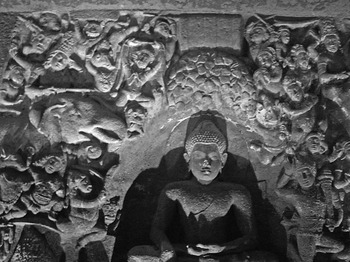
For the Buddha, the border between music and silence, life and death, shaped and took shape from the enlightenment he found in meditation and the contemplation of self. In the image reproduced as Figure 1, a depiction of the Buddha in the complex of caves carved into the hillsides near Aurangabad (cave 26 at Ajanta) in India's western Maharashtra state, the worshipper during the first millennium of the Common Era witnessed the remarkable depiction of the ‘assault and temptation of Mara-on’, shown beating the double-headed barrel drum above the Buddha meditating beneath a Bodhi tree at Bodh Gayā on the eve – at the temporal border – of his enlightenment, when he would achieve nirvana. Calling upon the earth to bear witness to his enlightenment by touching it with his right hand, the Buddha perceives only the silence all about him. The sonic frenzy that would fill the silence of enlightenment is pushed beyond the experience previously necessitated by the cycle of rebirth by the very enlightenment to which it is a correlative.Footnote 1 The drum, not unlike the double-headed barrel drum, pakhawaj, that accompanies sacred music in Maharashtra today, expresses as much sound as possible through its materiality, filling the sonic world that envelops the Buddha as a mortal.Footnote 2 The Buddha at this moment fails to hear the deafening sound, but passes instead across the border from its fullness into the emptiness of silence and nirvana. Music and silence form at a space that is represented as both: Death (massive drumming) and Enlightenment (beyond death, silence).
Buddha in Cave 26 at Ajanta, India: ‘Assault and Temptation of Mara-On’ (photograph by the author).

The borders between sound and silence become blurred in South Asian religion, philosophy, and music, so much so that beginnings and endings are often indistinguishable. The om (Sanskrit: to sound aloud) experienced as the sonic centre of sacred music emerges from the silence that is itself the fullness of all sound in the universe. That fullness is present wherever we are, but we perceive it when it begins to sound the musicality of the sacred itself and to re-sound the sacrality of the musical as sonic soteriology. Religion does not exist in a realm cordoned off from the arts in South Asia, surely not from music.Footnote 3 Creation – abstract and literal – results from self-agency, from what the earliest writings of Brahmanic philosophy, the Rg Veda (c12th century bce), witnessed in the commonality of existence and non-existence. That this commonality predated even the beginning of existence is made manifest in the ‘Creation Hymn’, or ‘Nasadiya’, of the Rg Veda (10.129).
1 There was neither non-existence nor existence then; there was neither the realm of space nor the sky which is beyond. What stirred? Where? In whose protection? Was there water, bottomlessly deep?
2 There was neither death nor immortality then. There was no distinguishing sign of night or day. That one breathed, windless, by its own impulse. Other than that there was nothing beyond. […]
7 Whence this creation has arisen – perhaps it formed itself, or perhaps it did not – the one looks down on it, in the highest heaven, only he knows – or perhaps he does not know.Footnote 4
Through the representational qualities of South Asian music – the narratives of rāga and rāga-mala paintings, the stories of kathak or bharata-natyam dance drama – empower music to act on the human physically and spiritually. There must be music in the representation of the Buddha at Bodh Gayā in order that he can attain enlightenment.
The interdependence of sound and silence, of course, is by no means unique to South Asian religions. It is a critical conceptual distinction in the Abrahamic faiths, for example, in the double meanings of samāc (Arabic: listening/hearing) in Islam, which in practice means that the Qur'an can be recited both aloud and silently. The audibility of the recited and sounded Qur'an, al-mushaf al-murattal, is thus known as qaraca, its perception and understanding by believers as samica, in which beauty and belief are immanent and coterminous.Footnote 5 The Hebrew shema embodies the same double set of meanings for Judaism. The word of God, therefore, is sounded within the believer, acting powerfully through its very silence.
In order to create an analytical approach for understanding ontological places of conjunction and meeting in music, I examine aporia in this essay as a border zone that facilitates arrival and departure. I describe aporia at borders functioning in three ways, drawing upon Jacques Derrida's writings on aporia and death, Apories: Mourir – s'attendre au ‘limites de la vérité’ (Aporias: Dying – Awaiting [One Another at] the ‘Limits of Truth’):Footnote 6 1) the first function of aporia is that of a line that separates, hence must be crossed; 2) aporia can represent a zone of difference, of overlapping, of fullness; and 3) aporia can describe an area of impossibility and unknowability, of silence and emptiness.
It should already be evident that the larger theological underpinnings of this essay are intentional, not least because of the ways in which music and silence form aporetic borders shared with life and death. As I prepared the earlier drafts of the essay, this was not my intent. Whereas the work I was doing on aporia was connected to questions of eschatology and soteriology, I was wary about extending them to music analysis. The case studies I explore in the pages that follow, as well as my larger project on the silence of music, nonetheless made the pull towards these questions unavoidable.Footnote 7 As I explored the possibilities of analysing aporia, the borders between music and silence, the passage between life and death, eros and thanatos, insisted upon intersecting.
Aporia – translation and analysis
To analyse aporia is to explore the border regions of music. Because of its different forms aporia requires that one understand and employ it in very deliberate ways, albeit in ways that open possibilities for understanding musical sound and silence, including particularly the ethnomusicological methods necessary for the cultural study of music.Footnote 8 All three of the case studies that follow incorporate performance and ethnography. These methods, though opening questions about the subjective, human relations between music and culture, are meant no less to engage the textual approaches employed by music analysts and theorists of Western music. My concern in this essay, however, is not to ‘analyse world music’, a disciplinary shift and development that has fruitfully brought many theorists and ethnomusicologists together by suggesting that the musical differences that separate world-music repertories and histories may not be as great as disciplinary methods have traditionally claimed.Footnote 9 Rather, I hope to use the analytical explorations upon which I embark here to seek a new philosophy of understanding the border territories and contact zones into which Western music analysis and ethnomusicology rarely enter. The disciplinary borders I explore are not those between Western art music and world music, or between music analysis and ethnomusicology. The cases of aporia to which I turn do not belong to world music any more than to any other kind of music. These aporias do not belong to Western reckonings of time and temporality in music, not least among them ‘twentieth-century music’, more than to any other kind of music. The contemporaneity and the modernness of these musics, nonetheless, have meaning for us because the borders, temporal and cultural, along which their subjectivities form are also our own.
How, then, do I intend to understand analysis in this broader sense? The approaches I gather for the present essay have their origins largely in my recent thinking on the philosophy of language. That thinking itself forms along an intellectual tradition that begins roughly with Johann Gottfried Herder's work in the late Enlightenment and more recently enters into Jacques Derrida's projects in the philosophy of language, not only, I should say, his work on deconstruction.Footnote 10 The philosophy of language contains innumerable concepts and metaphors for borders. Most consistently, however, it is the act and possibility of translation that draws the philosophy of language towards borders.
Translation provides a means whereby the borders between languages can be crossed. Simple enough, of course, but for a philosophy of language of the kind that emerges in the late eighteenth century, the issue shifts from a concern for translation as a means of representing the sameness of different languages to a process of arriving at the borders of radical difference, of incommensurability, between them.Footnote 11 Translation must reckon with the borders between languages – and meanings – in ways congruent with the three understandings of border I have already identified: border as a line of ending, finis, that cannot be crossed, when, for example, literal translation offers no parallels; border as a line that is crossed, that opens towards new meaning outside and beyond the original text, giving it even greater fullness; and border as an area of impossibility and loss, of the emptiness that lies outside of language.Footnote 12
In this essay I reflect upon music analysis also as a process of translation, poised at the borders between music and the meanings that lie beyond it. At a very basic, crude level, I refer here to music and the extra-musical, that is, the capacity to represent what music is and what it is not.Footnote 13 At other levels I refer to the borders between ‘musics’, that is, the plural territories that combine musical text and context in social and cultural figurations, such as musical identities and cultures. The real point of conjunction that concerns me here, nonetheless, is the way in which translation and analysis, negotiating borders as they do, are crucial to meaning and thought. We analyse music in order to translate its meanings into thought about music. Analysis provides a means of understanding difference through a language that aspires towards sameness in order to reconcile difference. Reconcilability is itself impossible, and this is why it draws us into the border regions where the analysis of aporia can take place. For Herder, Derrida, and others engaged with translation, the philosophy of language provided a means of looking for a way of extending analysis to aporia. And that, too, is the goal of the three case studies that follow.
Caesura and epic
For the first analytical odyssey I turn to epic, particularly to the living traditions of the Balkans, which nonetheless are connected by myth and history to traditions of epic translation that stretch across Europe and the Mediterranean to Africa and Asia.Footnote 14 I take as my point of analysis the caesura, the border of demarcation that realizes aporia in epic form and improvisation, in the syntax of epic texts and the heterophony of instrumental accompaniment. The fundamental analytical questions that aporia poses for the structure and transmission of epic coalesce around the caesura, which becomes the moment of their return and iteration in the extensive improvisations that traditionally characterize epic performance. The caesura thus forms the border between oral and written transmission. In performance it affords the intersection of vocal and instrumental melodies, or heterophony. As narrative it is the temporal domain cohabited by myth and history. Caesura charts the geographical landscape of in-betweenness, deeply embedded in the metaphors of epic repertories from regions of historical in-betweenness, such as the Mediterranean, one of the richest of all epic regions. It is in such regions that epic provides the vessel for translating vernacular voice into heightened text, or poesy. It is the moment of paradox at the borders between speech and music – the struggle between life and death.
In the twenty-first century epic persists as genre and practice, representing that struggle across the historical borderlands of southeastern Europe. The music of Balkan epic – vocal melodic line plus accompaniment on a bowed string instrument, the gusle (Slavic), lahutë (Albanian), or lăutar (Romanian) – grows from the stability provided by formulae and the artistic licence to create anew during each performance. Metaphorically speaking, the epic singer plays two roles at the same time, roles that are at once the same and different. The metaphor itself is expressed through the instrument, whose voice is distinct from that of the singer, just as it is the singer who gives voice to the instrument. Religious, regional, and linguistic distinctions within epic repertories notwithstanding, the representation, metaphorical and literal, of a bowed string instrument as a source for voice – with body, neck, and head, and the strings as vocal cords – affords a unity to the Balkans and the Mediterranean as musical regions, crossing the borders between religious and political ideologies with music.
The relationship of the singer to the envoiced instrument has become the locus classicus of heterophony, a musical texture in which two musical lines are understood to be the same – or rather to represent the same melody – but are played in slightly different ways at the same time.Footnote 15 Through heterophony the epic singer embodies selfness and otherness, the two voices of the singer's body and the instrument being played. Epic singing is improvisatory, thus every performance is distinctive and unique. No two epic singers perform in exactly the same way, and no two performances, even of the same tale or text, even utilizing the style of a specific school, are ever exactly the same. The heterophonous character of musical performance extends no less to the narrative, meaning that the epic's story is the sum of all performances and its history is open-ended, always given variant singings and readings.Footnote 16
To understand what constitutes stable elements it is necessary to turn first of all to the text itself, such as that in a transcribed performance of the Montenegrin American guslar Boro Roganović, with whom I have conducted fieldwork in Chicago for over twenty years. Roganović's performances most frequently utilize a poetic line consisting of ten syllables, described both as decasyllabic and deseterac. Roganović draws from a tradition common in the Mediterranean, which places a ‘word boundary’ after the fourth syllable in each line, thus meaning that the poet and guslar must terminate a word with the fourth syllable and begin a new phrase with the fifth. The line, or stich, contains a four-syllable hemistich followed by a six-syllable hemistich, always alternating. Modern editions and translations may even print epic texts with a space in the text itself, emphasizing the word boundary but also modernizing it.Footnote 17

The caesura serves the performer in oral tradition structurally and mnemonically, providing markers for the memory, ending and beginning at the border between what has passed and what will come. The caesura also serves written tradition, particularly as a space of transcription and translation as epics move from one historical moment and linguistic tradition to another. It is possible to chart the placement of the great Iberian epic, El Cid, from the moment it first appears in manuscript. As myth and history, the life of the Cid (Rodrigo Díaz) began to expand with epic proportions already in his own lifetime. He is an extraordinary epic figure because there are numerous chronicles about the Cid, and these both agree and disagree in their details and the variants they would form in the Cid epic. Historical evidence documents that Rodrigo Díaz was born in the village of Vivar near Burgos in c1043 ce and that he died in Valencia in 1099. Díaz's life and his deeds as a military leader for Castile metaphorically span the border between millennia. As real as his biography and historical achievements might have been, in epic the Cid emerged fully formed, translated and transformed into a symbol for a Europe that would emerge itself fully formed from the parts of late Antiquity and the religious diversity of the first millennium of the Common Era.
Oral transmission in multiple languages – not only different Spanish languages of the early Middle Ages but also Arabic and Hebrew – rapidly coalesced as literary tradition so that an extensive epic version of El Cid had already entered written tradition prior to 1157 ce, in other words, within little more than a half-century of Rodrigo Díaz's death. Called the Poema de Mio Cid, the first surviving versions already contained 3,700 lines, composed stichically, that is, line by line, with consciously reproduced epic formulae, above all, and the caesurae that sutured oral and written tradition together in hemistiches. Epic was on its way to becoming modern.
The caesura stood as a sentinel during the centuries of translating the Cid by combining linguistic versions as modern variants. History was layered upon history. For Johann Gottfried Herder, the caesura in Cid variants provided him with a means of translating the ballad-like strophes in Spanish and French editions to create the great epic of the Enlightenment, Der Cid, in German translation the single most profound influence on the modern understanding of epic and nation in the nineteenth century. The closing lines of the sixty-seventh canto of Herder's Cid, ‘The Battle of Valencia’, run as follows:

The dense presence of aporia at the caesura in epic song opens itself to different analytical possibilities. As difficult as it may seem to generate long performances that never violate the structure, the decasyllabic form permits the guslar, or epic singer, to link melody to poetic structure, generating manageable formulae that can be sustained over long stretches of text. The 4+6 syllabic structure in the text yields musical phrases, which, in turn, can undergird the metric patterns specific to regional styles and repertories. It is also common among guslari, for example Boro Roganović, to employ ten-syllable lines that are divided symmetrically around a word boundary between the first and second groups of five syllables (5+5), which often yield lines with four, rather than three, phrases.
An analysis of epic singing, therefore, provides a means of translating music's functions into a narrative architecture that is dependent on the epic longue durée itself. Representing the smallest unit to provide structural cohesion thus became the basis for further representing the epic form as timeless. This is the general principle of the oral-formulaic theory of Milman Parry and Albert Lord.Footnote 21 Through an analytical and ontological paradox these units – be they syllables, words, internal word boundaries and caesurae, or line breaks – become the templates for compositional and performative formulae. Formulae, minimally realized, become the model and motor for narrative, maximally realized. In the early twentieth century, linguists such as Roman Jakobson turned to the poetic qualities of epic, addressing the importance of the smallest unit and the network of internal structural borders. Epic, whether oral or written, lived because it possessed a sense of dynamic qualities:Footnote 22
1 Isosyllabism, or equal metric value for each note.
2 The caesura or ‘word boundary’ falls between the fourth and fifth words, and is rigidly observed by the singer.
3 Metric rhyme, or zeugma, connected the fourth and tenth syllables to the same words as the third and ninth syllables.
4 Even syllables provide anacrusis, odd syllables crusis, hence trochaic feet.
5 Open syllables at the ends of lines are preferable to closed syllables, creating a sense of overlap between lines.
Béla Bartók and members of the mid-twentieth-century school of Hungarian ethnomusicology, such as George Herzog, translated the temporal constituents of time to metre in music, asserting that it was time and its expandability that provided the necessary structural fit at the border between epic text and music.Footnote 23 Bruno Nettl, a student of Herzog, analysed the basic ‘metres’ of South Slavic epic by recognizing the two basic forms schematically represented in Figure 2.Footnote 24
Two main types of line in South Slavic epic (from Nettl, Folk and Traditional Music of the Western Continents, 98).

The aporetic borders within the poetic stich can and often do prescribe specific styles of instrumental accompaniment. Heterophony is capacious, expanding the possibilities and meanings of interaction. Sometimes the instrumental line is virtually the same as the vocal line, with moments of dissonance slight but strategically significant. There are other times when the instrumental line is little more than a drone, punctuating the vocal line to emphasize or embellish it. At still other moments in an epic performance the vocal and instrumental lines may alternate within the melody, displaying antiphony with call and response that expresses the dialogue that is so crucial to the ways in which epic form enters the boundaries between myth and history.
Khāli and temporal emptiness
The fundamental aporia in South Asian thought and experience forms in the spaces between fullness and emptiness. This aporetic presence contains both spatial and temporal dimensions, and indeed juxtaposes them, creating the necessary conditions for their coexistence, equilibrium, or harmony. The fullness of the universe is evident in its capacity to contain all that exists. The harmony of that fullness determines the sound of om, which further determines the sound of the primary pitch in South Asian music, the sām. Sām is the primary note of a rāga – the first note of Indian solfège, or sargam – sa-ri-ga-ma-pa-dha-ni-sa. It also marks moments of arrival and departure in the cycles of South Asian metre, tāla. When we hear sām, we experience the fullness of the universe at a moment in time. When we hear successive iterations of sām, we experience the fullness of the universe through history – for example, in the unbroken chanting of the Vedic hymns. Fullness, when achieved, realizes creation, and does so at the borders of music. The fullness of the aporetic moment of creation is understood as sacrifice in the earliest Brahmanic texts, the Rg Veda, recognizing thereby the ways in which beginning and ending, being born and dying, are one. The metaphors of creation richly realize musical metre in its continuous forms that reckon the temporality of life and death.
Creation
1 The sacrifice that is spread out with threads on all sides, drawn tight with a hundred and one divine acts, is woven by these fathers as they come near: ‘Weave forward, weave backward’, they say as they sit by the loom that is stretched tight.
2 The Man stretches the warp and draws the weft; the Man has spread it out upon this dome of the sky. These are the pegs, that are fastened in place; they made the melodies into the shuttles for weaving.
3 What was the original model, and what was the copy, and what was the connection between them? What was the butter, and what the enclosing wood? What was the metre, what was the invocation, and the chant, when all the gods sacrificed the god?
4 The Gayatri metre was the yoke-mate of Agni; Savitr joined with the Usni metre, and with the Anustubh metre was Soma that reverberates with the chants. The Brhati metre resonated in the voice of Brhaspati. […]
7 The ritual repetitions harmonized with the chants and with the metres; the seven divine sages harmonized with the original models. When the wise men looked back along the path of those who went before, they took up the reins like charioteers.Footnote 25
In Indian thought the fullness of sound cannot exist without emptiness. Fullness and emptiness coexist, though they are not codependent – in other words, bound through mutual forces in opposition or dialectic. In a sounded universe emptiness manifests itself through silence. In order to represent the sonic border zone in Indian music it is necessary to choose this reflexive and yet active syntax deliberately. In early Sanskrit texts emptiness is referred to quite literally as kala, which is today referred to in theories of temporality and metre as khāli. All are glossed as ‘empty’, but each has its own distinctive ways of realizing emptiness. And these distinctive ways are the reasons that spaces of aporia are opened. Condensing Lewis Rowell's extraordinary exegesis of the Natyashastra (circa beginning of the first millennium of the Common Era) and the eleventh-century commentary on the Natyashastra by Abhinivagupta, the notions of emptiness might be schematically summarized thus:
1 kalā=the division of time into units
2 kāla=the ongoing stream of time itself
3 laya=the interstices between separate units of time.Footnote 26
Like fullness, emptiness has both spatial and temporal dimensions. Abhinivagupta therefore explains that these three notions of time are cyclically bound through the different ways in which they describe the movement through time. It is therefore differences – the borders that separate and yet connect kalā, kāla, and laya – that create what the Natyashastra recognizes as the fabric of the cosmos, its equilibrium or sāmya.Footnote 27
As both metaphor and practice, the temporal borders between fullness and emptiness have multiple meanings. It is not exaggerating to say that these meanings assume many forms, not unlike avatars in South Asian religions. Bharata, the ‘author’ of the Natyashastra, makes the case for Shiva being the god used to represent time/tāla, for it is Shiva who dances, who is the master of dance (Nataraja).Footnote 28 Analytically, it is possible to say, following Martin Clayton and others, that tāla is a hierarchy with three temporal levels: 1) the smallest time unit is the mātrā; 2) the section containing additive units is the vibhāg; and 3) the complete cycle is the āvarta.Footnote 29 The tāla cycle contains the sum of its vibhāgs or mātrās, which, however, fill the cycle in different ways.
One of the ways in which these different temporal principles fulfil tāla is by opening the space for emptiness. Khāli simply means ‘empty’, and it is represented with a wave when one keeps tāl, symbolically representing movement only, with no articulation of sound.Footnote 30 We might see briefly how this looks with the seven-beat tāl, rupāk tāl, for which the beginning of the cycle itself is khāli:Footnote 31
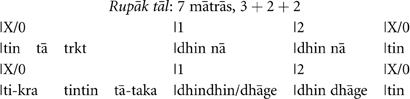
As we approach the aporia at the borders between fullness and emptiness, we encounter a space cohabited by both metaphor and structure. They are inseparable, as is, for example, the arrival and departure at sām, the anchoring note in rāga at the border of its union with tāla, where melody begins and ends. The beginning and the end of the temporal/melodic cycle are coterminous: with different meanings, they are nonetheless the same. They endow the aporia at the borders of the temporal cycle with its fullness because of their ontological emptiness.
The soteriology of modernism
It is critical to the larger questions of analysing aporia that are intended to unify this essay that the inseparability of metaphor and structure is not regionally, culturally, or historically specific. We witness such inseparability in Balkan epic song and in South Asian aesthetics of time, but it is also a condition of musics of the twentieth century. The arrival at borders is possible because of common ground, which aporia destabilizes, for instance, at the historical borders at the beginning and end of the century.
It is with this broader approach to aporia in mind that I turn towards a more specific area of my own research and performance, the music of the Holocaust and of the concentration camp.Footnote 32 I should like to reflect on one of the most remarkable musical realizations of life and death – of eros and thanatos – in modern music, Viktor Ullmann's 1944 setting as a melodrama of Rainer Maria Rilke's Die Weise von Liebe und Tod des Cornets Christoph Rilke (The Chronicle of Life and Death of the Standard-Bearer Christoph Rilke, 1899), one of the final works created in the concentration camps. The borders between life and death could not be clearer in this melodrama for speaker and piano (intended for full orchestra). Foreseeing his own imminent death, Ullmann composed a work that approached the end of life for another, the eponymous standard-bearer, Christoph Rilke.
Even the process of composing eschatologically is evident in the sketches themselves, now housed at the Paul Sacher Stiftung in Basel. Working from beginning to end, in other words, laying out one scene after the other and following the course of Rainer Maria Rilke's prose-poem, Ullmann clearly makes decisions that enable him to reach the final scenes with as much dispatch as possible. As the texture of leitmotifs becomes denser, so too do the techniques with which Ullmann calls them forth, allowing the early scenes to push the later scenes forward. Early in the manuscript sketches he fits the text to themes and leitmotifs carefully, but by the second part he begins writing them on the page, with a crayon rather than pen and pencil, proximate to the musical passages individual phrases might accompany.
The sketches come to their end in the late summer of 1944, or at the very beginning of autumn. The dedication, to Ullmann's sister Elly for her birthday on 27 September 1944, is the clearest external indication of the moment of conclusion towards which he was working, the border between sound and silence, death in the music itself.
During the years he spent in Terezín Viktor Ullmann forged a compositional process that remarkably wove the temporal everyday of the concentration camp into the sketches and scores he was producing. He did this figuratively and metaphorically, of course, but he also did so in the most literal sense possible. The typed final libretto by Peter Kien for the 1943 opera Der Kaiser von Atlantis (The Emperor of Atlantis), for example, appears on the reverse side – for Ullmann, the recto side – of completed camp registration forms, literal representations of the life and death of a real person.
The borders around which aporia coalesces are everywhere in these compositions created for the concentration-camp stage, articulated in increasingly intense ways, as if to realize the soteriology of modernism. In the scene in which the Cornet, the standard-bearer, finally moves into battle against the Ottoman empire in Eastern Europe during the 1660s, embracing the flag as his lover, he moves towards the ultimate love-death by crossing a temporal border in which music and silence converge, musically realizing, even passing through, the temporal aporia between eros and thanatos:
During the composition of Die Weise von Liebe und Tod des Cornets Christoph Rilke Ullmann's acute awareness of the end of time powerfully shaped the decisions he made about writing the score itself. That awareness led him to choose sonorities and motifs to represent time, but beyond such aesthetic decisions the awareness was coupled with decisions he made about inscribing time itself with modernist musical notation. Ullmann's decision to spell chords in certain ways, relying on triadic harmony but still pushing it to its borders, actually provided him with a vocabulary for marking the everyday – the border of death in the concentration camp – and then affording it with transcendent meaning that extends beyond aporia. In order to reach the end of the melodrama, metaphorically the end of life and allegorically the borders of time, Ullmann gathers motifs from earlier scenes and then juxtaposes them in the final scenes, especially in the finale. These motifs crowd in upon each other, intensifying the layers of dissonance and representing all three possibilities of aporia that I have traced through this essay: finis, fullness, and unknowability. In the sketches for the work Ullmann deliberately chooses not to respell them so that the harmonic writing might articulate a common temporal moment, a teleologically realized end of narrative time. By spelling the melodic and harmonic motifs as they were in earlier scenes (e.g. the literal quotations from Part 1 scene 5, which return at the beginning of the final scene, bars 3–17), Ullmann reaches the end of the work, giving way even to consonance, but he fails to name it as such by providing common spellings for consonant harmonic relations. The E♭ major at the end, therefore, might be analysed as a concluding resolution through consonance, but I should contend that its literal reference to the use of E♭ major in almost every scene in which mothers appear suggests a more complex way of perceiving dissonance, not least that evident in the final words of Rilke's text, ‘an old woman weeping’.
We witness this vocabulary throughout Die Weise in the consistent juxtaposition of two areas of harmonic texture, the first broadly consonant, the second not only dissonant in its reliance on quartal and quintal extensions of consonance, but actually marked in the score itself by the addition of accidentals that seemingly spurn the aporetic moment. The two textural areas are powerfully representational in the ways they instantiate time itself in the score. Consonant melodic and harmonic movement both represents the aporetic moment and realizes it. Dissonances, created through juxtapositions, say, of major, tertian harmonies, with ‘misspelt’ tritones, a favourite Ullmann technique, set time in motion, for example, in the ‘reiten’, or ‘riding’, motif that begins and ends Die Weise.
The multiple meanings that accrue along the borders of aporetic moments in Die Weise lend themselves to multiple analytical strategies. The melodrama reveals complex layers of passage between oral and literate meanings in the music, and in this way it is more like than unlike the epic and South Asian repertories previously examined in this essay. This is hardly surprising to me, I should say, because most analysis in ethnomusicology uses the borders between the oral and the literate as a point of analytical departure. It would be possible to work through the entire score of Die Weise to analyse the abundant cases of Ullmann's inscriptional choices, his musical marking of aporia and musical translation to realize transcendence.
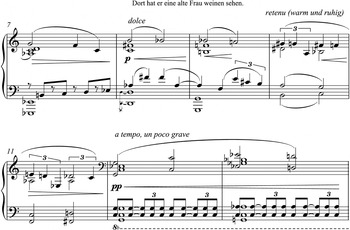
To represent this texture analytically, however, I turn to the point at which the texture of temporal marking is so thick with juxtaposition as to bring the listener to the moment of arrival at the end of time in the composition, the eighth and final scene of Part 2. It is in this movement that arrival and ending collapse into a single moment of timelessness (see Example 1). The juxtaposition of motifs and the contrast between sonorities spelt to represent consonance and those spelt to couple the aporetic with the transcendent is at its greatest, unfolding at a pace never greater than a few bars at a time. This is striking, for example, in the juxtaposed consonant and dissonant sonorities that provide a planed and parallel movement under the final passage of the Rilke text, ‘Dort hat er eine alte Frau weinen sehen’ (There he saw an old woman weeping).
Viktor Ullmann/Rainer Maria Rilke, Die Weise von Liebe und Tod des Cornets Christoph Rilke (1944), Part 2 scene 8, bars 7–13. © 1995 Schott Music, Mainz, Germany. Reproduced by permission. All rights reserved.

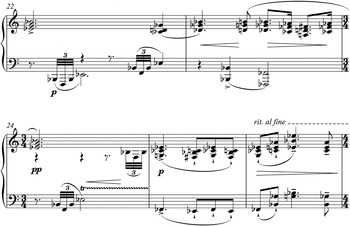
Moments later in the final scene we encounter another juxtaposition of the aporetic and the transcendent, when Ullmann takes motifs of pastness and spells them as parallel six-four chords in the treble, marking them in the bass with tritone movement from B♭ to F♭, which will lead to an area of marked dissonant harmonies, before yielding to the final cessation of time with a final, relatively consonant, stepwise cadence from an F minor seventh chord (ii7) to an E♭ major chord, utilizing the common tone E♭ (Example 2).
Ullmann/Rilke, Die Weise von Liebe und Tod des Cornets Christoph Rilke (1944), Part 2 scene 8, bars 22–6. © 1995 Schott Music, Mainz, Germany. Reproduced by permission. All rights reserved.

Using the language he had acquired as a composer at once traditional and modernist, Viktor Ullmann realizes the end of time by transcending it. He musically realizes the aporia at the end of his life and the beginning of his death as zones of difference, of overlapping, of fullness, and as an area of impossibility and unknowability, of silence and emptiness. Ullmann would die only weeks later, probably on 18 October 1944, upon arriving at Auschwitz.
Aporia and temporality
As I mustered analytical approaches from different cultures and historical moments for the case studies I chose for the present essay, I repeatedly questioned whether, or how, they would be appropriate for a journal dedicated to twentieth-century music. To what extent do they open towards analysis of the historically bounded world of the twentieth century, or the twenty-first, or simply the contemporary? The three case studies were both inside and outside of history since 1900. Without the history of recording, which took a particular turn of its own around 1900, the assumptions of field recording upon which I relied would not bear the same sense of ethnographic contemporaneity. Without the twentieth-century histories of fascism, colonialism, civil war, and genocide the case studies might seem unrelated to contemporary political and cultural contexts.
The historical implications of analysing music from the twentieth century and for reflecting on music and the ontological borders we find necessary or even helpful for understanding music are indeed very substantial. We need but begin with the temporal border signified by beginning in 1900, for which some historians might have substituted fin de siècle (the end of a century), others might have preferred Jahrhundertwende (the turn of a century), and still others might have displaced the boundary functions entirely to the frontiers of a ‘long nineteenth century’. These are historical borders of arrival, departure, and passage, the transition from the emptiness of historically bounded tonal systems, the fullness of an emancipated dissonance. They are borders that proliferate through clinging to the Western nation-state and its parsing of the world through historical acts, explicit in an equation of contemporary music with ‘post-45’ and Cold War developments.
The case studies analysed here transform the twentieth century into a border zone in ways that might seem unlike those assumed when we claim ‘twentieth-century music’ as our own because of its contemporaneity. They occupy the specific time of their performance, translating it from past to present. Boro Roganović, in the performance transcribed above, sang of the 1389 Battle of Kosovo in the post-1989 history of transgressed Balkan borders. The epic singers chronicling the battles that unified Castilean Spain against Andalusian Muslims charted the historical course of Europe's struggle with its Others across a millennium. Viktor Ullmann used a modernist vocabulary to translate death in war between Europe and the Ottoman empire in the 1660s to death in the Holocaust of the 1940s.
The three cases raise other criteria for the historical and music-historical meaning of the twentieth century as a subject for music analysis. The classicism of Hindustani music may have a two-millennium history with origins in the Natyashastra, but it is no less an invention of 1947 Indian statehood, and its forms serve one of the most widespread contemporary musics of the twenty-first century, Bollywood. My case studies translate the history of the twentieth century, literally and metaphorically.
My decision to claim these case studies as relevant for a journal devoted to twentieth-century music was therefore not simply a matter of ethnomusicological conceit about all musics being contemporary. If I explored border zones of difference, which reveal reconfigured moments of temporal – and historical – aporia, it was not to suggest that these were exceptional. Their very connection to music and silence, love and death, eros and thanatos, belies claims to exceptionalism. Border zones exist because, ultimately, there are multiple claims to them. The aporia towards which I have turned analytical thought in this essay are not simply the property of fourth-century Buddhist monks in western India, or twenty-first-century Montenegrin epic singers, or even those condemned to live and die in concentration camps, who chose music as a form of resistance.
All these aporia, and the many others we analyse to understand the twentieth century, lead us towards an ontology of analytical theories of translation and the radical difference sought by a post-Enlightenment anthropology. It is my belief – and conviction – that analysis enables us to enter the border zones opened by aporia together, not because of their sameness, but rather because of the very differences that connect them – and us.