Online Teaching in College Classes
College teachers are increasingly using instructional technology to
supplement or substitute for face-to-face instruction. The incentives
and arguments for doing so are many, including facilitation of higher
education for non-traditional students and changing student
demographics, skill building to improve student preparation for
workplaces that are likely to use computer technology, space
restrictions in universities with growing enrollment, the opportunities
that Internet classrooms provide for organizing and monitoring student
work and assignments, and so on. However, little is known about how
online instruction affects the learner. Online instruction is, in many
ways, fundamentally different from face-to-face instruction (see, for
example, Lee 2003; McCormack and Jones 1998; Palloff and
Pratt 1999). For instance, instructors are unlikely to simply
post their lecture notes online in the hope that the students will read,
take notes, memorize, and retain the information, which would be the
closest equivalent to a traditional lecture classroom.1
Obviously, most lecture courses will also contain
some discussion, question and answer time, etc. When referring
to “lecture class,” we refer to the lecture portion of
face-to-face classes.
Consequently, it cannot be
assumed that different instructional modes (such as lectures or online
instruction) necessarily have the same learner outcomes. This lack of
knowledge concerning the effects of online instruction on learner
outcomes also extends to the question of gender equality.
Many studies have confirmed the existence of a gender gap in face-to-face
classrooms, which is manifested in different ways. For example, male
students tend to dominate classroom discussions (see, for example, Diller et al. 1996; Drew and
Work 1998). Drew and Work (1) cite studies that show that the
way female college students are treated in the classroom often leads to
them “feeling unable to participate fully in the learning process.” In
contrast, few analyses have assessed the consequences the online
environment has on various aspects of gender equality. The existing
literature presents mixed results; some studies report a replication of
gender differences with males dominating and performing better, while
others find evidence for a shrinking gender gap (see Kramarae 2001, 39–41; Herring 1993; 1994; Savicki et al. 1996; Blum 1999; Hum 2002;
Wolfe 1999; 2000;
Gunn et al. 2003). It is frequently
assumed that the somewhat more anonymous nature of the online
environment has a democratizing and equalizing effect that extends to
gender, but some studies have also shown that established
gender-specific patterns of behavior are transferred to the online
context (see Kramarae 2001, 39–41). Barrett
and Lally (1999) analyze discussion postings
in a postgraduate setting and conclude that online discussion “may
reproduce gender differences in a learning community” (48). Pollock,
Hamann, and Wilson (2005), on the contrary,
find that online discussion groups in political science courses do not
replicate patterns of male dominance in discussions often found in the
traditional classroom, and that overall men and women display remarkably
small differences in discussion behavior especially when the gender
composition of the groups is relatively balanced. Herschel (1994, 219) examines gender differences in
brainstorming or idea-generation in the online environment, and finds a
remarkable degree of similarity between men and women “in access and
voice in the critical initial phase of a decision-making process.”
Despite the existing research on gender in online classes, though, we
know little about whether student enrollment and performance in courses
that are partially or entirely online is distinct for male and female
students.
To further our understanding of the effects of online teaching modules on
women's academic performance at college, we designed a reduced seat-time
(RST, taught half online and half in a traditional classroom) section
for the American National Government class, an introductory course that
fulfills a General Education Program (GEP) requirement. We evaluate
course selection, enrollment patterns, self-perceived computer literacy
and political attentiveness, and objective learner outcomes for both the
RST sections and a traditional face-to-face section to detect the effect
of gender. The results of this quasi-experimental design show that for
this course, all students did better overall in the partial online
environment than in the traditional classroom setting. This effect was
particularly pronounced for women.
Study Design
This study is based on a comparison of students in two sections of the
same course during the same semester. The test group is composed of
students who enrolled in the RST section of American National
Government. Students in this section attended lecture once a week and
completed online assignments and learning modules in lieu of a second
day of face-to-face instruction. We compared that group with a control
group, which comprised the students who enrolled in a non-RST section of
the same course. Students in the control group attended lecture twice a
week. The same instructor taught both sections—the test group and the
control group—and both groups were assigned the same textbook. Both
sections had identical in-class midterm and final exams, but the
students in the RST section also had to complete a series of online
assignments for credit. Thus, students in the RST section read slightly
more since some of the online modules required additional online
readings, but in turn, they had less lecture material to draw on. They
also engaged in online discussions and other online activities, such as
short essays. The online portion of the class required the students to
engage more in active learning behavior in order to obtain credit for
the assignments. Opportunities for active learning in the non-RST
section were provided through in-class discussions during class time;
however, participation in those discussions was voluntary and was not
linked to credit. There were no additional discussion sections outside
of the regular classtime.
Students had the choice to enroll in either format and instructors had no
control over the registration process.2
University policy did not permit the random assignment of
students to non-RST or RST sections of the course.
Students received information about the format of instruction through
the course schedule, which listed the traditional, face-to-face section
of the course as having two class meetings of one hour and fifteen
minutes per week. Similarly, the schedule informed the students that the
RST section met one day a week for one hour and fifteen minutes and
specified that “For above course: Web enhanced; reduced class time. WWW
access, browser & e-mail skills required.” The instructor was listed
identically for both sections. The traditional, face-to-face section
enrolled quickly and closed at capacity; in contrast, the RST section
retained open seats even after registration closed. We were interested
in assessing three areas: objective political knowledge and political
attentiveness as the two general goals of the class, and computer
literacy as a skill contributing to lifelong learning and future
employability. The evaluation of political knowledge, political
attentiveness, and computer literacy was conducted through identical
surveys administered to students during the first and last weeks of the
semester. Objective political knowledge was assessed through an 18-item
questionnaire.
3 One of the authors
compiled the survey questions, which were reviewed by colleagues
in the department. The questions were similar to standard
questions used in testbanks for American government textbooks.
The instructor had no input into creating the survey questions.
The survey is available upon request.
To avoid the
effects of potential instructor bias for either format, the instructor
had no access to the survey questions prior to their distribution in
class and the survey was distributed, administered, and analyzed by
someone other than the instructor. Thus, biasing the survey results of
either section through “teaching to the test” was not possible.
When Does Gender Matter?
We were interested in finding out what motivations and constraints shaped
student selection, and we wanted to identify the differences in
resources and experience that students may have brought with them to
each format. These variations in student background help to establish
benchmarks against which student outcomes may be assessed.
Initial enrollment data clearly pointed to at least one demographic
difference: Females were less likely than males to enroll in the
redesigned, RST format. In our study, 54% of the RST students were
female, compared to 60% of the non-RST students. Thus, aggregate
comparisons between formats may—or may not—be shaped by these different
gender compositions. When does gender matter?
By way of summary, we have divided pre-survey selection variables into
two general categories. The first category includes variables for which
the differences between non-RST and RST sections were larger than the
gender differences within each format. These variables appear to have
shaped format selection independently of gender, and they help to sketch
descriptive profiles of non-RST and RST students. The second category
includes variables for which differences between non-RST and RST
sections were smaller than the gender differences within format. These
variables become especially important for assessing the relative effects
of each format on learning outcomes for males and females. Table 1 presents information on the first class
of variables.
Format Selection Differences Not Related to Gender
What do these comparisons tell us about the motivations and backgrounds
of RST and non-RST students? Overall, students who enrolled in the
traditional, face-to-face section appeared to have done so because it
was their preferred choice and felt that section availability had not
been a problem. The reasons for their preference for this traditional
format varied and ranged from pragmatic (expected an “easier grade”) to
substantive (to “learn about American politics”). In addition, students
in the traditional section were less likely to have freshman standing.
They were also somewhat more likely to have had some previous experience
with online classes. About one third of the students registered for the
RST section, in contrast, felt that the section choice was constrained.
By and large, these motivational and attitudinal differences suggest a
more receptive and experienced student audience in the non-RST section
than in the RST format. Other studies have revealed that despite initial
differences between formats, students in the RST setting outperformed
their non-RST counterparts on several objective and attitudinal measures
of student outcomes (Pollock and Wilson
2002).
The present analysis takes aim at gender-dependent aspects of format
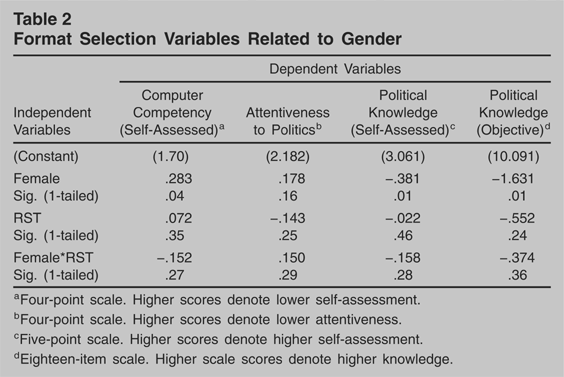
selection and student performance. Table 2
presents evidence for the importance of gender-related differences in
format selection. Measurements for each of four
competencies—self-assessed computer knowledge, attentiveness to
politics, self-assessed political knowledge, and objective political
knowledge—were regressed on gender (females coded 1), format (with RST
coded 1), plus a gender-format interaction term. With one exception
(attentiveness to politics), the female dummy alone achieves statistical
significance.
Format Selection Variables Related to Gender
Indeed, in terms of format selection, key technical skills and cognitive
resources were strongly related to gender. Female students in both
formats were far less likely than their male counterparts to consider
themselves competent with computers. Men professed somewhat higher
levels of attentiveness to politics and gave themselves significantly
higher assessments of current political knowledge. These assessments
were borne out in responses to the pre-survey knowledge questionnaire:
Regardless of format, males returned higher and similar scores; females
scored lower.
Clearly, females brought fewer skills and resources to both pedagogical
settings. But did males and females respond differently to the two
learning environments? If so, in what ways? We address these questions
in two parts. First, we examine scores for objective political knowledge
at the beginning and end of the semester. Second, we report changes in
self-assessed technical skills and political interest.
Objective Political Knowledge
How did men and women improve their objective knowledge in the two
instructional settings? Figure 1 illustrates
pre- and post-semester performance on the 18-item measure of political
knowledge, by format and gender, and shows how many questions each group
answered correctly.
Pre-semester and Post-semester Political Knowledge Scores, by
Format and Gender
Women knew less about politics at the beginning of the semester than men
did, regardless of the format. Even more so, women enrolled in the RST
section knew the least and scored by far the lowest prior to the start
of classes. All groups had increased their knowledge by the end of the
term, but not by the same amount. The traditional format shows
differential effects for males and females. Males gained a little (a 1
point increase), while females gained more (a 2 point increase), which
brought them to rough parity with males by the end of the term. Although
both of these increases are statistically significant, neither is
particularly striking. The RST format, though, shows no differential
effects between genders. The gains posted by males (a 2.8 point
increase) and females (a 3 point increase) are both large—and virtually
identical. Thus, controlling for initially large male-female
discrepancies in political knowledge, female students and male students
benefited in equal measure from the RST environment.
In absolute terms, RST females achieved post-semester survey equality
with non-RST students of either gender. That is, the highest increase in
learning was obtained by RST women, who increased their objective
knowledge score by a whole point more than women enrolled in the
traditional format.
Skills and Resources
The RST format had similar salutary effects, as well, on females'
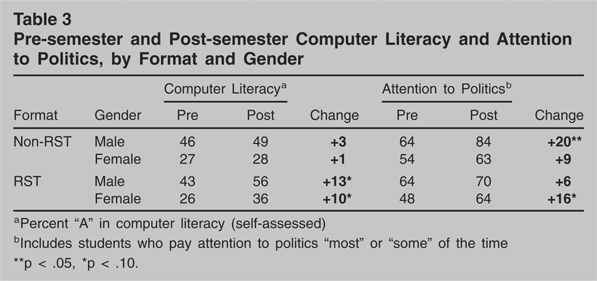
self-assessed technical skills and political interest. Table 3 reports pre- and post-semester survey
data on computer literacy and attention to politics. The changes in
computer literacy are especially noteworthy. The traditional section,
which did not require a working knowledge of the Internet, provides a
solid basis of comparison. The males and females in the non-RST section
began and ended the term with virtually the same level of competence.
For RST students, the gains were large and, again, very similar for men
and women. The percentage of males who assessed their literacy as an “A”
increased from 43% to 56%; females jumped from 26% to 36%. To be sure,
the absolute values of these percentages continued to display a sizable
gap, but the relative increases are hardly differentiated by student
gender—a 9 percentage point difference for women (comparing RST and
non-RST) compared to 10 percentage points for men. The patterns for
political attentiveness are interesting—if not as systematic as the
findings for objective knowledge and computer literacy. Even so, RST
females posted larger gains than non-RST females in attentiveness. We
observed a 16 percentage point increase for RST females versus a 9
percentage point increase for non-RST females, which is quite remarkable
considering that male students in the traditional section increased
their political attentiveness by a whopping 20 points compared to a 6
point increase in the RST section. Men seem to have been more inspired
to follow politics through traditional classroom instruction, which is
consistent with the literature pointing to gender differences in the
classroom. Women, on the other hand, developed more attentiveness when
the class was partially online.
Pre-semester and Post-semester Computer Literacy and Attention to
Politics, by Format and Gender
Discussion and Conclusion
Clearly, the introduction of partial or complete substitution of
classroom time with online learning has implications on students'
learning processes. Here, we have been particularly concerned with
gender differences in the classroom. For the American Government GEP
course, women appear to be less likely than men to choose a section that
is partially taught over the web, which might be related to their
self-perceived lower computer literacy. Our study shows that partial
online instruction has overall positive effects on learner outcomes for
both men and women compared with the traditional format. In particular,
it can increase both computer literacy and political attentiveness for
female students and can help narrow the gender gap in higher education.
Even if differences between men and women continue to exist, overall
female students enrolled in the RST section had a relatively higher
increase in their scores in objective knowledge, computer literacy, and
political attentiveness compared to women registered for the traditional
section. This is especially important in GEP courses, which students
generally take early on during their college education. Skill formation,
such as computer competency, during the first year(s) in college can
have long-term benefits for the students in other classes. The results
are also remarkable given that about one third of the students in the
RST section chose that format because it was the “only section
available” and may therefore have resented that particular learning
environment.
These results have been confirmed by other studies. For example, Moskal
and Dziuban (2003) have found that at the
University at Central Florida, and perhaps at many other institutions of
higher education, women enroll disproportionately in online courses.
Thus, if gender equality in education is considered a desirable goal, it
is pertinent to analyze in more detail how online instruction affects
women. According to existing studies, women benefit from online
instruction: when measured in terms of success (defined as a grade of A,
B, or C), women had a 85% success rate compared to 77% for men; in
comparison, the success rate for women in face-to-face courses was 84%
and 82% for men. In those courses that delivered the course contents
partially online and partially in the classroom, 91% of women succeeded
in contrast to 84% of men. Dziuban et al. (2003) found that between fall 1997 and fall 2000, women's
success rates were consistently higher than men's—between 5% and 12%
higher per semester. Women, then, are more likely to succeed than men in
courses that are at least partially delivered online. When comparing
withdrawal rates, a similar trend is evident: 6% of women withdraw from
online courses compared to 8% of men (this corresponds to 4% of women
and 5% of men in face-to-face courses) (Moskal and
Dziuban 2001). Our study contributes to this literature by
conducting a controlled comparison between traditional face-to-face and
RST sections of the same course and by looking at both substantive,
discipline-specific knowledge and skill building.
Finally, we want to make a more differentiated argument concerning the
effects of online teaching (whether partially or entirely online) for
skill building on the one hand and learner outcomes on the other. Gains
in computer literacy, a skill, can be obtained in any class that uses
some form of online instruction. If students are required to use a
computer in ways they had not previously, they will learn new skills,
independently of what the substance of their assignment is. Substantive
gains—such as political knowledge—however, are likely to be more closely
linked to the nature of the online assignments. Assignments that require
students to engage in active learning behavior (interactive activities,
discussion, writing, and critical reflection) are more likely to result
in increased knowledge, whether in an online or in-class environment,
than instruction that puts the student in a more passive role (see Hamann and Wilson 2003). Thus, we conclude, it
is not necessarily the online medium as such that is by nature
beneficial to the students. Rather, the online environment provides the
opportunity to engage a large number of students in active learning. The
opportunities for active learning in large classes provided by the
online environment is thus likely to be the cause of the observed
learner outcomes in political knowledge rather than the fact that
students used computers in and of itself.
Biographies
Bruce M. Wilson (Ph.D., Washington University) is associate professor of
political science at the University of Central Florida. His scholarship
of teaching and learning research has been published in PS: Politics
and Political Science and the Journal of Political Science
Education, among others. His research on Latin American
politics and judicial reform has been published in many journals
including Comparative Political Studies, Comparative
Politics, and the Journal of Latin American Studies.
He is currently editor of The Latin Americanist.
Philip H. Pollock, professor of political science at the University of
Central Florida, specializes in American public opinion, voting
behavior, and techniques of quantitative analysis. His recent
publications include a methods textbook (The Essentials of Political
Analysis) and accompanying workbook (An SPSS Companion to
Political Analysis), both by CQ Press. His Stata Companion
to Political Analysis, also by CQ Press, will appear in May
2006.
Kerstin Hamann (Ph.D., Washington University) is associate professor of
political science at the University of Central Florida. Her research on
West European politics has been published in journals such as
Comparative Political Studies, British Journal of
Industrial Relations, and Industrial Relations
Journal. Her research on teaching and learning has been published
in the Journal of Political Science Education, among others.
She currently serves as the vice chair of the APSA Undergraduate
Education section.