





Introduction
Repetitive transcranial magnetic stimulation (rTMS) is an established treatment for depressive disorders and is widely used in routine clinical practice (Chen et al., Reference Chen, Fukuda, Jiang, Leuchter, van Rooij, Widge, McDonald and Carpenter2025; Chu et al., Reference Chu, Li, Cheng, Jeng, Pan, Chen, Liang, Chang, Fujii, Kitahata and Noda2025a; Trapp et al., Reference Trapp, Purgianto, Taylor, Singh, Oberman, Mickey, Youssef, Solzbacher, Zebley, Cabrera, Conroy, Cristancho, Richards, Flood, Barbour, Blumberger, Taylor, Feifel and Reti2025). However, response and remission rates vary substantially across patients and treatment settings. Real-world studies have reported heterogeneous outcomes, partly reflecting differences in patient populations, stimulation protocols, treatment exposure, outcome instruments, and whether outcomes are assessed using patient-reported or clinician-rated measures (Matsuda et al., Reference Matsuda, Kito, Hiraki, Izuno, Yoshida, Nakamura, Kodaka, Yamazaki, Taruishi, Imazu, Kanazawa, Mekata, Moriyama, Wada, Nakajima, Sawada, Watanabe, Takahashi, Toi and Noda2024; Noda et al., Reference Noda, Osawa, Takeda, Fujii, Saijo, Kajiya, Takeishi, Moriyama, Saeki, Nakajima and Kitahata2025; Sackeim et al., Reference Sackeim, Aaronson, Carpenter, Hutton, Mina, Pages and West2020). Controlled studies have further demonstrated that specific protocols, such as bilateral theta-burst stimulation, can modulate both clinical symptoms and underlying immune or neuroimaging markers (Chou et al., Reference Chou, Lu, Tsai, Hsieh, Lai, Shityakov and Su2020). Identifying reliable predictors of rTMS outcomes therefore remains important for optimizing treatment delivery and improving clinical decision-making.
Existing evidence regarding predictors of rTMS response and remission varies. Although demographic, clinical, medication-related, and stimulation-related factors have been examined (Plevin et al., Reference Plevin, Thomas, Hahn, Clark and Chen2025), few predictors have shown reproducible associations across studies (Gonterman, Reference Gonterman2023; Trapp et al., Reference Trapp, Purgianto, Taylor, Singh, Oberman, Mickey, Youssef, Solzbacher, Zebley, Cabrera, Conroy, Cristancho, Richards, Flood, Barbour, Blumberger, Taylor, Feifel and Reti2025; Trevizol et al., Reference Trevizol, Downar, Vila-Rodriguez, Thorpe, Daskalakis and Blumberger2020). Much of the existing literature is based on single-site or single-country cohorts, clinical trials with selective eligibility criteria, or specialized and technically demanding intervention studies whose findings have limited generalizability. Recent predictive modeling and consensus work continues to emphasize that clinically reliable and generalizable predictors of response and remission remain elusive (Benster et al., Reference Benster, Weissman, Suprani, Toney, Afshar, Stapper, Tello, Stolz, Poorganji, Daskalakis, Appelbaum and Kohn2025; Nguyen et al., Reference Nguyen, Solanki, Thomas, Cerins, Hahn, Galletly, Fitzgerald and Chen2025; Trapp et al., Reference Trapp, Purgianto, Taylor, Singh, Oberman, Mickey, Youssef, Solzbacher, Zebley, Cabrera, Conroy, Cristancho, Richards, Flood, Barbour, Blumberger, Taylor, Feifel and Reti2025).
In this context, real-world registry studies can help address this gap by capturing the diversity of patients, treatment practices, and clinician decision-making in routine care (Blonde et al., Reference Blonde, Khunti, Harris, Meizinger and Skolnik2018). At the same time, registry datasets are inherently heterogeneous, with variability in outcome instruments, stimulation protocols, treatment dosing, reimbursement contexts, and missing-data patterns (Bouaziz et al., Reference Bouaziz, Laidi, Bulteau, Berjamin, Thomas, Moulier, Benadhira, Szekely, Poulet, Galvao, Guillin, Castillo, Sauvaget, Plaze, Januel, Brunelin and Rotharmel2023). Analyses of registry data therefore require prespecified outcome harmonization, appropriate missing-data handling, and sensitivity analyses to support clinically interpretable inference (Bell et al., Reference Bell, Floden, Rabe, Hudgens, Dhillon, Bray and Vardy2019).
In this study, we conducted a pooled multinational analysis of a real-world rTMS registry across six countries. We harmonized response and remission outcomes using a prespecified hierarchy of patient-reported and clinician-rated measures and evaluated predictors using a hierarchical modeling framework. The primary model examined core variables with minimal missingness; the secondary multiple-imputation (MI) model incorporated treatment-dose and medication variables with moderate missingness; and the exploratory MI model assessed additional clinical and sociodemographic variables with substantial missingness. Furthermore, to more rigorously evaluate the validity and robustness of the findings, we performed an additional sensitivity analysis in which clinical-trial data were excluded, restricting the sample to real-world registry data alone. These approaches aimed to identify reproducible predictors of rTMS response and remission while distinguishing confirmatory, secondary, and hypothesis-generating findings.
Methods and materials
Clinical registry
This retrospective observational study was conducted using clinical data collected from six countries: Taiwan (Taipei Veterans General Hospital, Tri-Service General Hospital, Blossom Clinic, Tainan Municipal An-Nan Hospital, and Kaohsiung Veterans General Hospital), Japan (Shinjuku-Yoyogi Mental Lab Clinic, Tokyo Yokohama TMS Clinic, Asahino-Oka Hospital, Kokoro Medical Clinic, and Momiji Mental Clinic), Singapore (Institute of Mental Health, National University Hospital, and Khoo Teck Puat Hospital), Australia (Epworth Camberwell, The Ramsay Clinic Adelaide and the Gold Coast University Hospital), Vietnam (Vinmec Times City International Hospital), and Canada (VieClinc and Centre for Addiction and Mental Health) between January 2017 and April 2026.
Patients had a clinician-documented diagnosis of a depressive disorder made by board-certified psychiatrists at each participating site as part of routine clinical care at their TMS centers. All patients had no absolute contraindications for TMS treatment in accordance with appropriate clinical practice. The study protocol for the International TMS Registry Project was approved through a centralized review by an independent external ethics committee (ITO Yoyogi Mental Clinic Ethics Review Board, Tokyo, Japan, approval number RKK319).
This study was conducted in accordance with the ethical guidelines of all participating country and institution, with appropriate approvals obtained from the respective research ethics committees (Kaohsiung Veterans General Hospital, Kaohsiung, Taiwan; approval number 25-CT6–14; Institute of Mental Health and Khoo Teck Puat Hospital, Singapore, which issued institutional approval for research using anonymized data). The dataset also incorporates treatment outcomes from a completed clinical trial that recruited individuals with depression from real-world referral sources (Chen et al., Reference Chen, Thomas, Kaewpijit, Miljevic, Hughes, Hahn, Kato, Gill, Clarke, Ng, Paterson, Giam, Sarma, Hoy, Galletly and Fitzgerald2021). Approval of contributing anonymized data to this study was granted by the Monash Health Human Research Ethics Committee (HREC; local reference: RES-19-0000-159E, Project ID: 55384, RNR Ref Number:2025–006). Although the study adhered to the principles of the Declaration of Helsinki, as it utilized de-identified or anonymized registry data in a retrospective observational design, the central ethics committee responsible for the unified review (Tokyo), together with the respective institutional ethics committees, determined that individual informed consent from each patient was not required and/or approved the use of an opt-out procedure, which was followed.
rTMS protocols
The selection of rTMS protocols (e.g. intermittent theta-burst stimulation (iTBS), 10 Hz or 1 Hz rTMS) was determined by institutional practice standards, equipment availability, and/or reimbursement conditions, or clinical trial protocols, where applicable. These specific selections and adjustments were determined by the attending physicians specializing in TMS treatment at each site, based on their professional judgment and tailored to the clinical presentation and preferences of individual patients in a naturalistic manner. The 5.5 cm rule (Chen et al., Reference Chen, Fukuda, Jiang, Leuchter, van Rooij, Widge, McDonald and Carpenter2025) or Beam F3 (Beam, Borckardt, Reeves, & George, Reference Beam, Borckardt, Reeves and George2009) methods were used to determine the target location. Where the Beam method was used, treatment coils were placed over the F3 electrode site when targeting the left dorsolateral prefrontal cortex (DLPFC) and the F4 electrode site for the right DLPFC. Stimulation intensity was set at 90%–120% of the resting motor threshold. In cases where individual patients were unable to tolerate stimulation at their target intensities, in keeping with typical practice their treatment was provided at lower, tolerable intensities. Because delivered intensity could be adjusted according to individual tolerability and was not consistently recorded at the patient or session level across sites, stimulation intensity could not be harmonized as an individual-level predictor for the regression analyses.
Clinical assessments
Clinical assessments were performed in patients with depression prior to initiation of a course of rTMS treatment (baseline) and after completion of rTMS treatment course (post-treatment). Treatment outcomes were assessed using both clinician-rated and patient-reported measures to capture complementary dimensions of symptom changes. Clinician-rated outcome measures included the 17-item Hamilton Depression Rating Scale (HAMD-17) (Hamilton, Reference Hamilton1960), the Montgomery–Åsberg Depression Rating Scale (MADRS) (Montgomery & Asberg, Reference Montgomery and Asberg1979), and the clinician version of the Quick Inventory of Depressive Symptomatology (QIDS-C) (Rush et al., Reference Rush, Trivedi, Ibrahim, Carmody, Arnow, Klein, Markowitz, Ninan, Kornstein, Manber, Thase, Kocsis and Keller2003). Patient-reported measures included the Beck Depression Inventory (BDI) -II (Beck, Steer, & Brown, Reference Beck, Steer and Brown1996), the self-report version of the Quick Inventory of Depressive Symptomatology (QIDS-SR) (Rush et al., Reference Rush, Trivedi, Ibrahim, Carmody, Arnow, Klein, Markowitz, Ninan, Kornstein, Manber, Thase, Kocsis and Keller2003), and the 9-item Patient Health Questionnaire (PHQ-9) (Kroenke, Spitzer, & Williams, Reference Kroenke, Spitzer and Williams2001). These clinician-rated assessments were administered by trained clinical psychologists or psychiatrists.
Treatment response was defined as ≥50% reduction in depressive symptom severity from baseline to post-treatment on each respective scale. Remission was operationalized using the established scale-specific cutoffs (Supplementary Table S1).
Primary outcomes and outcome ascertainment
The primary outcomes were defined as treatment response and treatment remission, each operationalized as a binary variable. Because outcome assessments were obtained using either patient-reported measures, clinician-rated measures, or both, we adopted a comprehensive outcome definition to maximize usable outcome information and ensure adequate statistical power. For each participant, patient-reported measures were used preferentially when available; if patient-reported measures were unavailable, clinician-rated measures were used. Using this hierarchy, we constructed the primary endpoints of overall response and overall remission to reduce outcome missingness while maintaining a prespecified and transparent ascertainment rule. This strategy was intended to capture clinically meaningful change even when only one type of assessment data was available. In addition, given cross-site heterogeneity in outcome instruments, treatment dosing, and missing-data patterns, we addressed between-site differences primarily through harmonized outcome definitions and a pre-specified pooled modeling strategy, supplemented by MI (White, Royston, & Wood, Reference White, Royston and Wood2011). To assess robustness to outcome-assessment type, response and remission were reconstructed separately using clinician-rated measures only and patient-reported measures only. The primary Model 1 analyses were then repeated for each rater-specific outcome using the same core adjustment set of age, sex, baseline depression severity, number of treatment sessions, stimulation protocol, and country. Among participants with both assessment types, agreement between clinician-rated and patient-reported outcome classifications was additionally evaluated using observed agreement and Cohen’s κ.
Handling of missing data
We first summarized missingness for all candidate predictors and outcomes, then organized predictors into a hierarchical modeling framework based on clinical relevance, missingness burden, and model stability. Variables with minimal missingness (< 5%) were included in the primary core model, variables with moderate missingness (5%–40%) were evaluated in a fully adjusted secondary MI model, and variables with substantial missingness (≥ 40%) were reserved for exploratory models.
Missing covariate data were handled according to each model’s analytic purpose. Model 1 was primarily analyzed using complete-case logistic regression because its predictors had minimal missingness; an MI sensitivity analysis using the same predictors was also performed. For Models 2 and 3, multiple imputation by chained equations (MICE) was used as the primary missing-data approach because several predictors had moderate to substantial missingness.
Missing covariate data were handled using MICE under a working missing-at-random (MAR) assumption (White et al., Reference White, Royston and Wood2011). MICE was implemented in R using the mice package (Van Buuren & Groothuis-Oudshoorn, Reference Van Buuren and Groothuis-Oudshoorn2011). Outcome variables were not imputed, although overall response and overall remission were included as predictors in the imputation models to preserve outcome–covariate associations and improve compatibility between the imputation and analysis models. Continuous variables were imputed using predictive mean matching, binary categorical variables using logistic regression, and multilevel categorical variables using polytomous logistic regression. For each imputation analysis, 50 imputed datasets were generated with 20 iterations. Logistic regression models were fitted within each imputed dataset, and estimates were pooled using Rubin’s rules.
For Model 2, which was the principal MI model, the adequacy of the imputation procedure was evaluated using trace plots and by comparing observed and imputed distributions overall and separately according to response and remission status. Missingness was summarized according to country, data source, and treatment outcome. Bias-reduced logistic regression models were used to examine predictors of missingness. Country and data source were evaluated separately because clinical-trial-derived observations were concentrated in Australia. Because a harmonized site-level identifier was unavailable, site-specific missingness could not be modeled directly. Robustness to departures from MAR was assessed using prespecified mild and strong delta-adjusted pattern-mixture analyses. Model 2 was treated as the principal model for the MNAR sensitivity analyses, whereas the corresponding Model 3 analyses were considered exploratory.
Model specification and covariate selection strategy
Multivariable logistic regression models were specified to evaluate predictors of overall response and overall remission, both coded as binary outcomes. Predictors were organized into three models according to clinical relevance, missingness burden, and model stability. Separate models were fitted for each outcome, and results were reported as adjusted odds ratios (aORs), 95% confidence intervals (CIs), and p values.
Candidate predictors were selected based on clinical plausibility, missingness burden, and model stability. Before model fitting, predictors were assessed for missingness, sparse data patterns, and multicollinearity using variance inflation factors (VIFs) and adjusted generalized variance inflation factors (GVIFs) for multilevel categorical variables. Stimulation target laterality was highly overlapping with stimulation protocol: HF-rTMS and iTBS were administered almost exclusively over the left DLPFC, LF-rTMS predominantly over the right DLPFC, and sequential protocols bilaterally. Because simultaneous inclusion of stimulation target laterality and stimulation protocol resulted in substantial multicollinearity, target laterality was excluded and stimulation protocol was retained. The final core adjustment set included age, sex, baseline severity, number of treatment sessions, stimulation protocol, and country.
Categorical variables were recoded into clinically interpretable categories before analysis. Female sex, Taiwan, high-frequency rTMS (HF-rTMS), medication non-use, substance non-use, and married status were used as reference categories, where applicable. Other stimulation protocol categories included low-frequency rTMS (LF-rTMS), iTBS, sequential bilateral rTMS, and sequential bilateral theta-burst stimulation. Baseline severity at treatment initiation was categorized as mild, moderate, or severe using established instrument-specific cutoffs for each depression rating scale (Supplementary Table S1). When multiple baseline severity scales were available for a patient, the more severe classification was retained to avoid underestimating baseline illness severity. Pulses per session were rescaled in units of 1,000 pulses to facilitate interpretation of the aORs.
Hierarchical regression models
Three hierarchical multivariable logistic regression models were prespecified according to clinical relevance, missingness burden, and the intended level of inference. Model 1 served as the primary core model, Model 2 as the fully adjusted secondary MI model, and Model 3 as an exploratory hypothesis-generating MI model.
Model 1: Primary core model
Model 1 was specified as the primary core model and included the final core adjustment set (Supplementary Table S2). Because all Model 1 predictors had minimal missingness (<5%), the primary Model 1 analysis was conducted using complete-case logistic regression, with separate models fitted for overall response and overall remission. The same complete-case sample was used for both outcomes. As a sensitivity analysis, MI logistic regression using the same predictor set was performed to assess robustness to missing-data handling. Logistic regression models were fitted within each imputed dataset, and estimates were pooled using Rubin’s rules.
Because a subset of data was derived from a completed clinical trial (Chen et al., Reference Chen, Thomas, Kaewpijit, Miljevic, Hughes, Hahn, Kato, Gill, Clarke, Ng, Paterson, Giam, Sarma, Hoy, Galletly and Fitzgerald2021) rather than routine clinical registry data, we conducted a secondary sensitivity analysis excluding clinical-trial-derived data from the primary core model to assess whether the primary findings were driven by study data-source heterogeneity.
Model 2: Fully adjusted secondary MI model
Model 2 was specified as a fully adjusted secondary MI model (Supplementary Table S2). It included all variables retained in Model 1 and additional treatment-dose and medication-related predictors with moderate missingness. Before fitting Model 2, collinearity diagnostics were repeated using the full Model 2 predictor set. All Model 2 predictors showed acceptable collinearity with adjusted GVIF values below 5; therefore, all predictors were retained in the final fully adjusted secondary model.
Because several predictors in Model 2 had moderate missingness, complete-case analysis was not employed as the primary analytic approach in this model. Instead, missing data were primarily handled using MICE. Logistic regression models for overall response and overall remission were fitted separately within each imputed dataset, and estimates were pooled using Rubin’s rules. Because medication variables were structurally unavailable for the clinical-trial-derived Australian observations, the Model 2 imputation and pooled regression analyses were repeated after excluding these participants as an additional sensitivity analysis.
Model 3: Exploratory extended MI model
Model 3 was specified as an exploratory extended MI model to evaluate additional clinical course, treatment-history, and psychosocial predictors beyond Models 1 and 2 (Supplementary Table S2). This model was intended to be hypothesis-generating rather than confirmatory because several candidate predictors had substantial missingness. The final candidate Model 3 predictor set included all predictors from Model 2 plus additional exploratory variables. Additional exploratory variables captured illness course, prior treatment history, substance use, marital status, illicit drug use, and suicide attempt history.
Because several exploratory predictors had high missingness and sparse categorical distributions, additional post-imputation checks were performed before fitting the final pooled logistic regression models. Each categorical predictor was examined across all imputed datasets to confirm that at least two levels were present. Any categorical predictor with fewer than two levels in any imputed dataset was excluded from the final pooled regression model to avoid non-estimable contrasts. The final Model 3 logistic regression models were then fitted separately for overall response and overall remission within each imputed dataset, and estimates were pooled using Rubin’s rules.
Statistical analysis
Descriptive statistics were used to summarize demographic, clinical, treatment-related, and medication-related characteristics. Continuous variables are presented as means and standard deviations or medians and interquartile ranges, as appropriate. Categorical variables are presented as frequencies and percentages.
Associations between candidate predictors and treatment outcomes were examined using binary logistic regression. Separate models were fitted for overall response and overall remission. All predictors were entered simultaneously within each prespecified model. For complete-case analyses, logistic regression models were fitted among patients with complete data for all variables included in the corresponding model. For MI analyses, logistic regression models were fitted within each imputed dataset, and parameter estimates were pooled using Rubin’s rules.
Results are reported as ORs or adjusted odds ratios (aORs), as appropriate, with 95% CIs and p values. Model 1 was considered the primary core model, with complete-case analysis as the primary analysis and MI as a secondary analysis. Model 2 was considered the fully adjusted secondary model, and Model 3 was considered an exploratory hypothesis-generating model. To further assess the robustness of our findings, we conducted sensitivity analyses excluding clinical-trial-derived observations. These included the primary Model 1 complete-case sensitivity analysis and a separate Model 2 MI sensitivity analysis prompted by the identification of structurally unavailable medication data in the Australian clinical-trial-derived cohort. For the rater-type sensitivity analyses, the primary Model 1 was repeated using clinician-rated and patient-reported response and remission outcomes separately. Because some country–outcome combinations contained sparse or zero event cells, mean bias-reduced logistic regression was used to obtain finite and stable estimates. Agreement between clinician-rated and patient-reported outcome classifications among participants with both assessment types was assessed using observed agreement and Cohen’s κ.
To further examine the protocol-related findings, we conducted post hoc analyses restricted to patients receiving HF-rTMS or iTBS. Demographic, clinical, treatment, and outcome characteristics were summarized by protocol, and protocol distributions were cross-tabulated by country. The association between country and protocol was quantified using Cramér’s V. Sequential logistic regression models were fitted using a common complete-case sample, beginning with an unadjusted model and subsequently adding age, sex, baseline severity, number of treatment sessions, and country.
Because Taiwan was the only country with adequate representation of both HF-rTMS and iTBS, additional Taiwan-restricted logistic regression analyses were conducted with adjustment for age, sex, baseline severity, and number of treatment sessions. Sensitivity analyses were also performed by treating baseline severity as a categorical variable and by excluding clinical-trial-derived observations. A country-by-protocol interaction was not estimated because several country–protocol combinations contained few or no observations.
For Model 3, interpretation emphasized effect sizes, confidence interval width, and model stability rather than statistical significance alone. All statistical tests were two-sided, and statistical significance was defined as p < 0.05. All analyses were conducted using R (RStudio version 2026.01.0 + 392).
Results
Workflow for extracting analyzable data from the registry
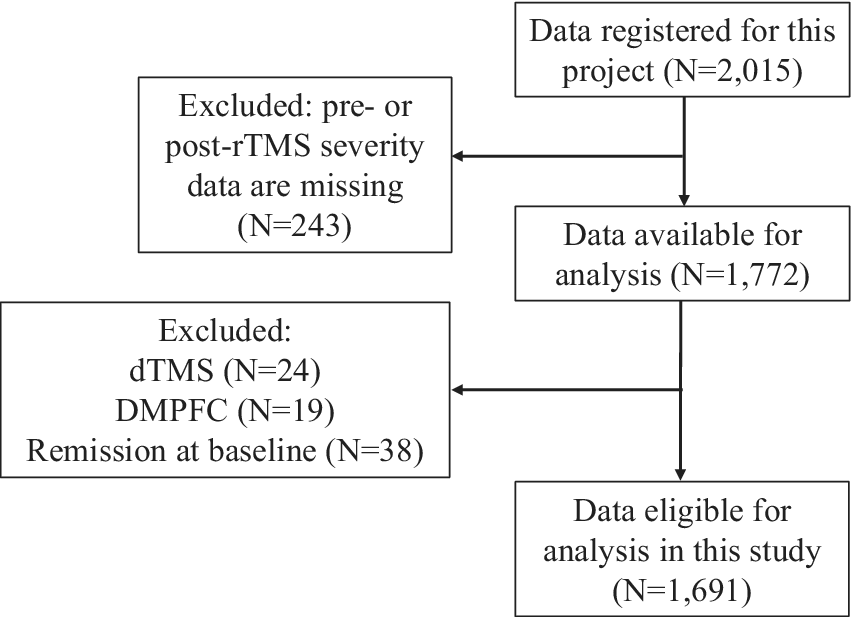
A total of 2,015 registry records were obtained and integrated from the participating sites. Of these, 243 cases with missing pre- or post-TMS depression severity data were excluded, leaving 1,772 cases with evaluable data. We further excluded 24 sets of treatment data with deep TMS treatments and 19 sets of data with rTMS applied to the dorsomedial prefrontal cortex (DMPFC). This was to maintain the DLPFC as the common, homogeneous stimulation target. For outcome analyses, an additional 38 patients who met remission criteria at baseline were excluded. The remaining 1,691 patients constituted the analytic sample for the response and remission outcomes (Figure 1).
Participant flow and analytic sample. Flow diagram showing the selection of the analytic sample from the initially received treatment records. Of 2,015 records received, 243 were excluded because pre- or post-rTMS symptom severity data were unavailable. Among the remaining 1,772 records with evaluable symptom data, 24 deep TMS treatments, 19 treatments targeting the dorsomedial prefrontal cortex, and 38 patients who met remission criteria at baseline were excluded. The final analyzed sample included 1,691 patients. DMPFC, dorsomedial prefrontal cortex; dTMS, deep transcranial magnetic stimulation; rTMS, repetitive transcranial magnetic stimulation.

Figure 1. Long description
The flowchart consists of three central boxes connected by downward arrows, with two side boxes connected by leftward arrows.
* At the top center, the first box is labeled Data registered for this project (N = 2,015).
* An arrow points down to the second central box, but a horizontal arrow branches left to an exclusion box labeled Excluded: pre- or post-r T M S severity data are missing (N = 243).
* The second central box is labeled Data available for analysis (N = 1,772).
* An arrow points down from the second box to the final box, but another horizontal arrow branches left to a second exclusion box. This box lists three criteria: Excluded: d T M S (N = 24), D M P F C (N = 19), and Remission at baseline (N = 38).
* The final box at the bottom center is labeled Data eligible for analysis in this study (N = 1,691).
Baseline demographic and clinical characteristics
A total of 1,691 patients were included in the descriptive cohort and were characterized in Table 1. Patients were primarily recruited from Taiwan (49.9%), followed by Australia (16.3%), Japan (14.6%), Singapore (13.0%), Canada (4.9%), and Vietnam (1.3%). Most patients were derived from real-world registry data (83.7%), while 16.3% were treatment outcome data from a clinical trial that used a naturalistic recruitment design (Chen et al., Reference Chen, Thomas, Kaewpijit, Miljevic, Hughes, Hahn, Kato, Gill, Clarke, Ng, Paterson, Giam, Sarma, Hoy, Galletly and Fitzgerald2021). The mean age was 40.8 years (SD = 16.8). Male patients accounted for 38.2% of the final dataset. Baseline depression severity was predominantly moderate to severe, with 11.4% classified as mild, 38.3% as moderate, and 50.3% as severe. Country-stratified distributions of demographic, data-source, treatment, and outcome characteristics are provided in Supplementary Table S3 to facilitate comparison across the contributing datasets.
Demographic, clinical, and treatment characteristics of included patients

Table 1. Long description
The table consists of four columns: Characteristic; Value, n (%), mean (S D), or median (I Q R); N available; and Missing, n (%).
* Country: Total 1,691 patients. Taiwan 844 (49.9%), Singapore 220 (13.0%), Australia 275 (16.3%), Japan 247 (14.6%), Vietnam 22 (1.3%), and Canada 83 (4.9%).
* Data source: Real-world registry 1,416 (83.7%) and Clinical trial-derived 275 (16.3%).
* Demographics: Mean age is 40.8 (S D 16.8). Male patients account for 645 (38.2%).
* Baseline severity: Mild 193 (11.4%), Moderate 647 (38.3%), and Severe 851 (50.3%).
* Outcomes: Overall response 738 (43.6%) and Overall remission 486 (28.7%).
* Treatment: Median total sessions is 21.0. Median pulses per session is 1,800.
* Protocols: H F-r T M S 493 (30.4%), L F-r T M S 109 (6.7%), i T B S 439 (27.1%), Sequential bilateral r T M S 356 (22.0%), and Sequential bilateral T B S 223 (13.8%).
* Medication use: Antidepressants 822 (73.9%), Benzodiazepines 602 (54.1%), Mood stabilizers 124 (11.8%), and Antipsychotics 461 (44.0%).
* Exploratory variables: Mean age of onset is 31.3. 307 (45.7%) are married. Mean number of M D Es is 2.9. Prior E C T history in 105 (13.9%). History of suicide attempt in 126 (19.4%).
Note: Continuous variables are presented as mean (SD) or median (IQR), as appropriate; categorical variables are presented as n (%).
DLPFC, dorsolateral prefrontal cortex, HF, high-frequency, iTBS, intermittent theta-burst stimulation, LF, low-frequency, rTMS, repetitive transcranial magnetic stimulation.
Treatment characteristics
Patients received a median of 21.0 treatment sessions (IQR, 20.0–30.0), and the median number of pulses per session was 1,800 (IQR, 1,200–3,000) (Table 1). With respect to stimulation protocol, HF-rTMS was used in 30.4% of patients, followed by iTBS (27.1%), sequential bilateral rTMS (22.0%), sequential bilateral TBS (13.8%), and LF-rTMS (6.7%). Among the datasets with available concomitant medication information, 73.9% were receiving antidepressants, 54.1% benzodiazepines, 11.8% mood stabilizers, and 44.0% antipsychotic medications. Country-stratified demographic, clinical, treatment, and outcome characteristics are presented in Supplementary Table S3. Compared with Taiwan, the Japanese cohort had a lower proportion of patients with severe baseline depression, received a greater median number of treatment sessions, and predominantly received iTBS. The Singapore cohort was younger and had a lower proportion of severe baseline depression than the Taiwan cohort but showed lower response and remission rates. Protocol distributions also differed substantially across countries.
Exploratory clinical variables showed substantial missingness. Among patients with available data, the mean age of onset was 31.3 years (SD = 15.4), the mean number of major depressive episodes was 2.9 (SD = 3.4), and the mean duration of the current depressive episode was 38.6 months (SD = 74.9). Prior electroconvulsive therapy (ECT) was reported in 13.9%, alcohol use in 13.5%, smoking in 11.7%, illicit drug use in 2.0%, and suicide attempt history in 19.4% of patients.
Results of primary core model and sensitivity analyses
Overall response was achieved in 43.6% of patients, and overall remission was achieved in 28.7%. In the primary complete-case Model 1, overall response and overall remission were modeled separately with simultaneous adjustment for age, sex, baseline severity, number of treatment sessions, stimulation protocol, and country. For overall response, a greater number of treatment sessions was associated with higher odds of response (aOR = 1.02 per additional session, 95% CI 1.01–1.03, p = 0.002), corresponding to approximately 22% higher odds per 10 additional sessions. Male sex was modestly associated with higher odds of response compared with female sex (aOR = 1.24, 95% CI 1.00–1.54, p = 0.046). Compared with Taiwan, Japan was associated with higher odds of response, whereas Singapore was associated with lower odds of response. Age, baseline severity, and stimulation protocol were not significantly associated with overall response in the primary complete-case model (Figure 2).
Primary complete-case logistic regression model for overall response and overall remission. Forest plot showing adjusted odds ratios and 95% confidence intervals from the primary complete-case logistic regression model. Separate models were fitted for overall response and overall remission, with simultaneous adjustment for age, baseline severity, number of treatment sessions, sex, stimulation protocol, and country. The vertical dashed line indicates an odds ratio of 1. Reference groups: Female, Taiwan, HF-rTMS, no medication or substance use, and married status; significant estimates are labeled. HF-rTMS, high-frequency repetitive transcranial magnetic stimulation; LF-rTMS, low-frequency repetitive transcranial magnetic stimulation; iTBS, intermittent theta-burst stimulation.

Figure 2. Long description
A two-panel forest plot with a shared Y-axis labeled Predictor and a shared X-axis labeled Odds ratio, log scale. A vertical dashed line at 1.0 indicates the null effect.
Left Panel: overall response.
- Number of sessions: a O R 1.02, 95 percent C I 1.01 to 1.03, p equals 0.002.
- Sex (Male vs Female): a O R 1.24, 95 percent C I 1.00 to 1.54, p equals 0.046.
- Country (Japan vs Taiwan): a O R 2.30, 95 percent C I 1.56 to 3.38, p less than 0.001.
- Country (Singapore vs Taiwan): a O R 0.39, 95 percent C I 0.25 to 0.61, p less than 0.001.
- Other predictors (Age, Baseline severity, various r T M S protocols, and other countries) show non-significant results crossing the 1.0 line.
Right Panel: overall remission.
- Baseline severity: a O R 0.33, 95 percent C I 0.28 to 0.40, p less than 0.001.
- Protocol (i T B S vs H F-r T M S): a O R 0.39, 95 percent C I 0.25 to 0.62, p less than 0.001.
- Country (Japan vs Taiwan): a O R 4.54, 95 percent C I 2.86 to 7.21, p less than 0.001.
- Country (Singapore vs Taiwan): a O R 0.10, 95 percent C I 0.05 to 0.21, p less than 0.001.
- Other predictors including Age, Sex, and remaining protocols/countries are non-significant.
For overall remission, greater baseline severity was strongly associated with lower odds of remission (aOR = 0.33, 95% CI 0.28–0.40, p < 0.001). Compared with HF-rTMS, iTBS was associated with lower odds of remission (aOR = 0.39, 95% CI 0.25–0.62, p < 0.001). Country-level differences were also observed: compared with Taiwan, Japan was associated with higher odds of remission, whereas Singapore was associated with lower odds of remission. Age, sex, number of treatment sessions, LF-rTMS, sequential bilateral rTMS, sequential bilateral TBS, and the country categories of Australia, Vietnam, and Canada were not significantly associated with different odds of achieving remission (Figure 2).
Sensitivity analyses supported the robustness of the primary Model 1 findings (Supplementary Table S4). MI results were broadly consistent with the complete-case analysis, particularly for baseline severity and iTBS in the remission model, number of treatment sessions in the response model, and country-level differences for Japan and Singapore. The association between male sex and overall response remained statistically significant and was nearly unchanged after MI (aOR = 1.23, 95% CI 1.00–1.52, p = 0.049) (Supplementary Figure S1). Excluding clinical-trial-derived patients did not materially change the main findings, suggesting that the primary results were not driven by study data-source heterogeneity (Supplementary Figure S2).
Rater-type sensitivity analyses included 1,047 patients with clinician-rated outcomes and 1,010 patients with patient-reported outcomes. The association between treatment sessions and response was similar in direction and magnitude for clinician-rated outcomes (aOR = 1.017, 95% CI 1.000–1.035, p = 0.051) and patient-reported outcomes (aOR = 1.020, 95% CI 1.004–1.037, p = 0.017). Greater baseline severity remained strongly associated with lower odds of remission in both the clinician-rated model (aOR = 0.361, 95% CI 0.282–0.463, p < 0.001) and the patient-reported model (aOR = 0.340, 95% CI 0.267–0.433, p < 0.001). However, the association between iTBS and remission differed according to outcome source: it was not significant for clinician-rated remission (aOR = 0.814, 95% CI 0.510–1.299, p = 0.387) but remained significant for patient-reported remission (aOR = 0.162, 95% CI 0.072–0.364, p < 0.001). Among 440 participants with both types of assessments, agreement was 86.6% for response (κ = 0.725) and 83.2% for remission (κ = 0.488) (Supplementary Table S5).
In post hoc protocol-specific analyses, patients receiving iTBS had higher crude response and remission rates than those receiving HF-rTMS (52.6% vs 38.1% and 34.6% vs 23.7%, respectively). iTBS was associated with higher crude odds of response (OR = 1.80, 95% CI 1.38–2.33, p < 0.001) and remission (OR = 1.69, 95% CI 1.27–2.25, p < 0.001). These associations remained positive after adjustment for age, sex, baseline severity, and number of treatment sessions. However, after further adjustment for country, iTBS was no longer associated with response (aOR = 1.04, 95% CI 0.71–1.53, p = 0.853), whereas its association with remission reversed direction (aOR = 0.35, 95% CI 0.21–0.59, p < 0.001). Protocol use was strongly associated with country (Cramér’s V = 0.71, p < 0.001), with limited overlap between HF-rTMS and iTBS in most countries (Supplementary Table S6).
Taiwan was the only country with adequate representation of both protocols. In the Taiwan-restricted analysis, iTBS was not associated with response after adjustment for age, sex, baseline severity, and number of treatment sessions (aOR = 1.11, 95% CI 0.72–1.71, p = 0.626), but remained associated with lower odds of remission (aOR = 0.38, 95% CI 0.20–0.71, p = 0.002). The results were similar when baseline severity was treated categorically and when clinical-trial-derived observations were excluded (Supplementary Table S6 and Supplementary Figure S3).
Results of secondary models of treatment response and remission
The fully adjusted secondary MI model in Model 2 incorporated the primary core covariates together with predictors showing moderate missingness (5%–40%), including pulses per session and medication variables (Supplementary Figure S4). For overall response, the association with the number of treatment sessions remained significant, with each additional session associated with higher odds of response (aOR = 1.02, 95% CI 1.01–1.03, p = 0.006). Protocol comparisons were not statistically significant. However, country-level differences persisted, with higher odds of response in Japan compared with Taiwan (aOR = 2.40, 95% CI 1.50–3.83, p < 0.001) and lower odds in Singapore compared with Taiwan (aOR = 0.61, 95% CI 0.41–0.90, p = 0.014). Among medication variables, antipsychotic use was associated with higher odds of response (aOR = 1.50, 95% CI 1.13–2.00, p = 0.005), whereas antidepressant, benzodiazepine, and mood stabilizer use were not significantly associated with response (Figure 3).
Fully adjusted secondary multiple-imputation model for overall response and overall remission. Forest plot showing adjusted odds ratios and 95% confidence intervals from the fully adjusted secondary multiple-imputation logistic regression model. Separate models were fitted for overall response and overall remission, with simultaneous adjustment for age, baseline severity, number of treatment sessions, pulses per session, sex, stimulation protocol, country, and medication use. Pulses per session were modeled per 1,000 pulses. The vertical dashed line indicates an odds ratio of 1. Reference groups: Female, Taiwan, HF-rTMS, no medication or substance use, and married status; significant estimates are labeled. BZD, benzodiazepine; HF-rTMS, high-frequency repetitive transcranial magnetic stimulation; LF-rTMS, low-frequency repetitive transcranial magnetic stimulation; MI, multiple imputation; iTBS, intermittent theta-burst stimulation.

Figure 3. Long description
A forest plot with two side-by-side panels titled overall response and overall remission. The Y-axis lists Predictors, and the X-axis represents Odds ratio on a log scale from 0.1 to 10.0. A vertical dashed line at 1.0 indicates no effect.
* Age: Points are centered on the reference line for both panels.
* Baseline severity: In overall remission, a significant decrease is shown with a O R of 0.34, 95 percent C I 0.28 to 0.42, p less than 0.001.
* Number of sessions: In overall response, a significant increase is shown with a O R of 1.02, 95 percent C I 1.01 to 1.03, p equals 0.006.
* Pulses per session, per 1000 pulses: Points are near the reference line.
* Male vs Female: Points are near the reference line.
* Protocol L F r T M S vs H F r T M S: Points are near the reference line.
* Protocol i T B S vs H F r T M S: In overall remission, a significant decrease is shown with a O R of 0.36, 95 percent C I 0.22 to 0.60, p less than 0.001.
* Protocol Sequential r T M S vs H F r T M S: Points are near the reference line.
* Protocol Sequential i T B S vs H F r T M S: Points are near the reference line.
* Country Japan vs Taiwan: Significant increases in both panels. Overall response a O R 2.40, 95 percent C I 1.50 to 3.83, p less than 0.001. Overall remission a O R 4.49, 95 percent C I 2.61 to 7.72, p less than 0.001.
* Country Singapore vs Taiwan: Significant decreases in both panels. Overall response a O R 0.61, 95 percent C I 0.41 to 0.90, p equals 0.014. Overall remission a O R 0.19, 95 percent C I 0.11 to 0.33, p less than 0.001.
* Country Australia, Vietnam, and Canada vs Taiwan: Points show wide confidence intervals crossing the reference line.
* Medication use (Antidepressant, B Z D, Mood stabilizer): Points are generally to the left of or on the reference line.
* Antipsychotic yes vs no: In overall response, a significant increase is shown with a O R of 1.50, 95 percent C I 1.13 to 2.00, p equals 0.005.
For overall remission, baseline severity remained strongly associated with lower odds of remission (aOR = 0.34, 95% CI 0.28–0.42, p < 0.001). Compared with HF-rTMS, iTBS was associated with lower odds of remission (aOR = 0.36, 95% CI 0.22–0.60, p < 0.001), while other protocol comparisons were not statistically significant. Country-level differences were again observed, with higher odds of remission in Japan relative to Taiwan (aOR = 4.49, 95% CI 2.61–7.72, p < 0.001) and lower odds in Singapore relative to Taiwan (aOR = 0.19, 95% CI 0.11–0.33, p < 0.001). Other clinical and medication-related covariates, including pulses per session, were not independently associated with remission. Overall, these findings support the robustness of the treatment-session effect for response and the baseline-severity effect for remission, while suggesting persistent country-level heterogeneity and limited independent contribution of most medication variables in the fully adjusted MI model (Figure 3).
Results of exploratory MI model
The exploratory MI model in Model 3 incorporated additional clinical and sociodemographic variables with substantial missingness (≥40%) (Supplementary Figure S5). For overall response, the association with the number of treatment sessions remained significant (aOR = 1.02, 95% CI 1.01–1.04, p = 0.004). Male sex was not significantly associated with response (aOR = 1.26, 95% CI 0.99–1.61, p = 0.058). Japan remained associated with higher odds of response compared with Taiwan (aOR = 2.60, 95% CI 1.51–4.47, p < 0.001). Unmarried status relative to married status was associated with lower odds of response (aOR = 0.61, 95% CI 0.43–0.87, p = 0.006). A longer current episode duration was also associated with slightly lower odds of response (aOR per month = 0.9973, 95% CI 0.9947–0.9999, p = 0.044). Mood stabilizer and antipsychotic use were not significantly associated with response. No protocol comparison was significantly associated with response (Supplementary Figure S6 and Supplementary Table S9).
For overall remission, baseline severity remained strongly associated with lower odds of remission (aOR = 0.34, 95% CI 0.27–0.42, p < 0.001). iTBS was associated with lower odds of remission compared with HF-rTMS (aOR = 0.40, 95% CI 0.23–0.70, p = 0.001). Japan was associated with higher odds of remission (aOR = 4.45, 95% CI 2.35–8.43, p < 0.001), whereas Singapore was associated with lower odds of remission (aOR = 0.22, 95% CI 0.11–0.45, p < 0.001), both relative to Taiwan. Mood stabilizer use was not significantly associated with remission (aOR = 0.60, 95% CI 0.34–1.05, p = 0.072). Prior ECT and suicide attempt history were not significantly associated with either response or remission. The remaining exploratory variables, including age at onset, number of major depressive episodes, alcohol use, smoking, and illicit drug use, were also not significantly associated with either outcome. Given the substantial missingness and multiple exploratory comparisons, the associations involving marital status and current episode duration should be considered hypothesis-generating.
Multiple-imputation diagnostics and missing-data sensitivity analyses
Trace plots showed adequate mixing across imputation chains and no sustained drift over the 20 iterations. Comparisons of observed and imputed values showed generally plausible and overlapping distributions, although larger differences were observed for selected variables with strongly country- or protocol-dependent missingness, particularly pulses per session and some medication variables (Supplementary Figures S7 and S8). Missingness varied substantially across countries and data sources. In country-adjusted predictors-of-missingness models, response and remission were not independently associated with missingness for most variables, although isolated associations were observed for current episode duration and prior ECT (Supplementary Table S8).
Across the prespecified delta-adjusted MNAR scenarios, the principal Model 2 estimates remained materially unchanged, including the association between the number of treatment sessions and response and the associations of baseline severity, iTBS, Japan, and Singapore with remission. In a further Model 2 MI sensitivity analysis excluding the 275 clinical-trial-derived Australian observations, 1,416 participants remained. Treatment sessions remained associated with response (aOR = 1.017, 95% CI 1.004–1.029, p = 0.008), while baseline severity (aOR = 0.374, 95% CI 0.306–0.458, p < 0.001), iTBS relative to HF-rTMS (aOR = 0.363, 95% CI 0.221–0.597, p < 0.001), Japan relative to Taiwan (aOR = 4.631, 95% CI 2.609–8.222, p < 0.001), and Singapore relative to Taiwan (aOR = 0.194, 95% CI 0.112–0.336, p < 0.001) remained associated with remission.
Summary of regression analyses
Across the primary, fully adjusted secondary, and exploratory models, several associations were consistent across analysis specifications (Table 2). A greater number of treatment sessions was robustly associated with higher odds of overall response, whereas baseline severity was consistently associated with substantially lower odds of overall remission. The association between iTBS and lower odds of remission relative to HF-rTMS was also reproduced across models. Country-level differences were persistent, particularly higher odds of both response and remission in Japan relative to Taiwan and lower odds of remission in Singapore relative to Taiwan. In contrast, medication-related and sociodemographic associations were less consistent and were observed mainly in the fully adjusted or exploratory models. Given the higher missingness of several variables included in Model 3, these latter findings should be interpreted as exploratory and hypothesis-generating. These cross-model patterns are summarized in Table 2, with complete model estimates provided in Supplementary Tables S4, S7, and S9.
Key adjusted associations across primary, secondary, and exploratory models

Table 2. Long description
The table consists of seven columns: Predictor, Model 1 response, Model 2 response, Model 3 response, Model 1 remission, Model 2 remission, and Model 3 remission.
* Number of sessions: a O R 1.02 across all response models (p values 0.002 to 0.006); N S for all remission models.
* Baseline severity: N S for all response models; a O R 0.33 to 0.34 for all remission models (p < 0.001).
* i T B S vs H F - r T M S: N S for all response models; a O R 0.36 to 0.40 for all remission models (p ≤ 0.001).
* Japan vs Taiwan: a O R 2.30 to 2.60 for response (p < 0.001); a O R 4.45 to 4.54 for remission (p < 0.001).
* Singapore vs Taiwan: a O R 0.39 to 0.61 for response (p < 0.014, N S in Model 3); a O R 0.10 to 0.22 for remission (p < 0.001).
* Male vs female: a O R 1.24 in Model 1 response (p = 0.046); N S in all other models.
* Antipsychotic use: a O R 1.50 in Model 2 response (p = 0.005); N S or Not included in others.
* Mood stabilizer use: N S or Not included across all models.
* Unmarried vs married: a O R 0.61 in Model 3 response (p = 0.006); N S or Not included in others.
* Current episode duration: a O R 0.9973 in Model 3 response (p = 0.044); N S or Not included in others.
N S indicates p ≥ 0.05. a O R stands for adjusted odds ratio.
Note: Values are adjusted odds ratios with p values. Model 1 was the primary complete-case core model. Model 2 was the fully adjusted secondary multiple-imputation model incorporating variables with moderate missingness. Model 3 was the exploratory multiple-imputation model additionally incorporating variables with substantial missingness. Only selected predictors showing consistent, clinically relevant, or exploratory associations are summarized; complete estimates are shown in Supplementary Tables S4, S7, and S9. NS indicates p ≥ 0.05. HF-rTMS, high-frequency repetitive transcranial magnetic stimulation; iTBS, intermittent theta-burst stimulation; MI, multiple imputation.
Discussion
In this multinational real-world cohort of 1,691 patients receiving rTMS for depression, the findings were as follows: First, a higher number of treatment sessions was consistently associated with increased odds of overall response across models. Second, baseline depression severity was the most robust correlate of overall remission, with greater baseline depression severity consistently associated with lower odds of remission across analytic specifications. Third, across Models 1–3, iTBS was associated with lower odds of remission relative to HF-rTMS, although this association differed across rater-specific outcome definitions. Fourth, country-level differences persisted after adjustment, with Japan showing higher odds of both response and remission and Singapore showing lower odds of remission relative to Taiwan. Finally, medication-related and sociodemographic findings were less consistent and mainly emerged in secondary or exploratory models. In the Model 3 analysis, unmarried status was associated with lower odds of overall response, whereas a longer current episode duration showed only a small association with lower odds of response that was not consistently statistically significant across the MNAR sensitivity scenarios. Medication-related associations were not statistically significant in Model 3. Given the substantial missingness of several Model 3 variables, these findings should be interpreted as exploratory and hypothesis-generating. Overall, treatment exposure and baseline severity appeared to be the most stable predictors of rTMS outcomes. In contrast, associations involving stimulation protocol, concomitant medications, demographic factors, and country were less stable or more context-dependent and require cautious interpretation.
The number of treatment sessions was the most consistent predictor of overall response. This finding aligns with large naturalistic registry evidence suggesting that clinical benefit increases with the number of rTMS treatment sessions (Hutton et al., Reference Hutton, Aaronson, Carpenter, Pages, Krantz, Lucas, Chen and Sackeim2023). It is also consistent with recent meta-analytic evidence indicating that the number of sessions, rather than pulses per session, may be more closely associated with antidepressant effect size (Oostra et al., Reference Oostra, Jazdzyk, Vis, Dalhuisen, Hoogendoorn, Planting, van Eijndhoven, van der Werf, van den Heuvel and van Exel2025; Yu et al., Reference Yu, Kao, Thompson, Brunoni, Hsu, Carvalho, Chu, Tseng, Tu, Yang, Su, Cheng, Hsu and Liang2024). However, this association should not be interpreted as a simple causal dose–response effect. In routine clinical practice, treatment duration is not randomly assigned; patients who showed partial improvement, delayed improvement, or insufficient early response may be offered longer treatment courses. Conversely, early remitters may discontinue after completing a standard course or may require fewer additional sessions. Therefore, the observed association between the number of sessions and response may reflect both a simple linear dose–response relationship, which assumes a homogeneous patient population, and the outcomes of real-world clinical practice, where clinicians engage in iterative, trial-and-error decision-making for a highly heterogeneous group of patients. This interpretation is consistent with prior work showing heterogeneity in response trajectories, including slower responders who may benefit from extended courses (Brian Chen et al., Reference Brian Chen, Chou, Tu, Brunoni, Su, Tseng, Liang, Lin, Carvalho, Hung, Hsu and Li2023; Kaster et al., Reference Kaster, Chen, Daskalakis, Hoy, Blumberger and Fitzgerald2020; McInnes et al., Reference McInnes, Olsen, Sullivan, Cooper, Wilson, Sonmez, Albott, Olson, Peterson, Rittberg, Herman, Bajzer, Nahas and Widge2024; Sackeim et al., Reference Sackeim, Aaronson, Carpenter, Hutton, Pages, Lucas and Chen2024). Notably, in the present study, session number was consistently associated with response but not remission, suggesting that additional sessions may increase the probability of clinically meaningful improvement without necessarily achieving illness remission.
Baseline symptom severity emerged as the most robust and consistent predictor of remission, while showing no meaningful association with overall response. This pattern is consistent with prior reports linking greater baseline severity to a lower likelihood of achieving remission following rTMS (Göke et al., Reference Göke, Trevizol, Ma, Mah, Rajji, Daskalakis, Downar, McClintock, Nestor, Noda, Mulsant and Blumberger2024; Mirman et al., Reference Mirman, Corlier, Wilson, Tadayonnejad, Marder, Pleman, Krantz, Wilke, Levitt, Ginder, Ojha, Daskalakis, Leuchter and Lee2022; Trevizol et al., Reference Trevizol, Downar, Vila-Rodriguez, Thorpe, Daskalakis and Blumberger2020). Conceptually, this dissociation is expected because remission is defined by an absolute symptom threshold: patients who begin treatment with more severe symptoms must achieve a larger absolute symptom reduction to cross the remission cutoff, whereas relative response definitions, such as ≥50% improvement, are less tightly coupled to baseline symptom level (de Zwart, Jeronimus, & de Jonge, Reference de Zwart, Jeronimus and de Jonge2019). Clinically, greater baseline severity may also serve as a proxy for broader illness burden, including chronicity, treatment resistance, psychiatric comorbidity (Chou et al., Reference Chou, Lin, Lu, Chang, Chu, Chang, Kishimoto, Sack and Su2021), and functional impairment, which may reduce the likelihood of reaching near-asymptomatic states even when clinically meaningful improvement occurs (McIntyre et al., Reference McIntyre, Alsuwaidan, Baune, Berk, Demyttenaere, Goldberg, Gorwood, Ho, Kasper, Kennedy, Ly-Uson, Mansur, McAllister-Williams, Murrough, Nemeroff, Nierenberg, Rosenblat, Sanacora, Schatzberg and Maj2023). Randomized sham-controlled neuroimaging work further suggests that theta-burst stimulation can modulate emotion-related neural processing in major depressive disorder, supporting a network-level mechanism for clinical improvement (Chou et al., Reference Chou, Tu, Chen, Lu, Tsai, Hsieh, Lai, Satyanarayanan and Su2023). From a neurobiological perspective, higher baseline severity may reflect more widespread or entrenched depression-related network dysfunction, potentially making complete symptom resolution less attainable within a standard course (20–30 sessions) of rTMS (Chu et al., Reference Chu, Lin, Huang, Chung, Park, Chang, Chang and Chang2025b; Kaiser, Andrews-Hanna, Wager, & Pizzagalli, Reference Kaiser, Andrews-Hanna, Wager and Pizzagalli2015). Thus, the severity–remission gradient observed here likely reflects both the numerical properties of remission thresholds and the clinical complexity associated with more severe depressive illness.
Demographic predictors showed modest and outcome-dependent associations. Age was not clearly associated with either overall response or overall remission across models, supporting the view that chronological age alone has limited utility as a standalone predictor of rTMS outcome. This is consistent with prior evidence showing mixed age effects across studies, including null associations, non-linear effects, and protocol- or coil-dependent differences (Kryatova, Seiner, Brown, & Siddiqi, Reference Kryatova, Seiner, Brown and Siddiqi2024; Leuchter et al., Reference Leuchter, Citrenbaum, Wilson, Tibbe, Jackson, Krantz, Wilke, Corlier, Strouse, Hoftman, Tadayonnejad, Koek, Slan, Ginder, Distler, Artin, Lee, Adelekun, Einstein and Leuchter2024; Trevizol et al., Reference Trevizol, Downar, Vila-Rodriguez, Thorpe, Daskalakis and Blumberger2020). Sex effects were also modest and should be interpreted cautiously. In contrast to some prior literature suggesting better rTMS outcomes among female patients at the study level (Senova, Cotovio, Pascual-Leone, & Oliveira-Maia, Reference Senova, Cotovio, Pascual-Leone and Oliveira-Maia2019; Trapp et al., Reference Trapp, Purgianto, Taylor, Singh, Oberman, Mickey, Youssef, Solzbacher, Zebley, Cabrera, Conroy, Cristancho, Richards, Flood, Barbour, Blumberger, Taylor, Feifel and Reti2025), male sex was associated with higher odds of overall response in the primary core model, but not with remission, and the response estimate was nearly unchanged and remained statistically significant after MI. However, the effect size was modest, and the association was not consistently observed in the more extensively adjusted Models 2 and 3. Therefore, sex should not be interpreted as a robust predictor of treatment outcome. The observed association may reflect residual confounding, country or site composition, treatment selection, or other unmeasured clinical factors rather than a reproducible biological effect. Overall, findings from this registry study indicate that treatment exposure and baseline symptom severity are more informative predictors of rTMS outcomes than demographic variables.
Protocol-related findings were outcome-specific. iTBS was associated with lower odds of remission relative to HF-rTMS, whereas protocol comparisons were not significantly associated with overall response. The marked change in the iTBS estimate after adjustment for country suggests that the apparent protocol association was strongly influenced by country-specific treatment allocation rather than by protocol alone. This pattern highlights the limited overlap of HF-rTMS and iTBS across countries and cautions against interpreting the pooled estimate as a direct comparison of intrinsic protocol efficacy. Nevertheless, these estimates should be interpreted cautiously. Protocol selection in real-world settings is influenced by institutional practice standards, reimbursement conditions, treatment availability, visit duration, and clinician preference, all of which may introduce confounding effects. In addition, rTMS protocols may differ not only in stimulation frequency or pattern but also in treatment duration, session structure, clinical workflow, and patient populations selected for each protocol. Country-level clustering did not fully explain the remission finding. In the Taiwan-restricted analysis, where both protocols were adequately represented, iTBS was not associated with response but remained associated with lower remission odds. This within-country finding suggests that country-level protocol clustering alone may not account for the observed association. However, treatment allocation remained non-randomized, and the available covariates may not have fully captured differences in continuous symptom burden, treatment resistance, referral pathways, patient selection, or site-specific protocol implementation. Therefore, residual confounding cannot be excluded, and the Taiwan-restricted estimate should not be interpreted as evidence of a causal disadvantage of iTBS.
Prior network meta-analytic and consensus evidence has generally suggested broadly overlapping efficacy across several rTMS protocols, with comparative advantages depending on study design, protocol implementation, and outcome definition (Mutz et al., Reference Mutz, Vipulananthan, Carter, Hurlemann, Fu and Young2019; Trapp et al., Reference Trapp, Purgianto, Taylor, Singh, Oberman, Mickey, Youssef, Solzbacher, Zebley, Cabrera, Conroy, Cristancho, Richards, Flood, Barbour, Blumberger, Taylor, Feifel and Reti2025). Moreover, randomized evidence has demonstrated the non-inferiority of iTBS to conventional 10-Hz rTMS under standardized treatment and assessment conditions (Blumberger et al., Reference Blumberger, Vila-Rodriguez, Thorpe, Feffer, Noda, Giacobbe, Knyahnytska, Kennedy, Lam, Daskalakis and Downar2018). In contrast, the present study examined harmonized binary outcomes across heterogeneous, non-randomized real-world datasets. Therefore, the lower adjusted remission odds should be interpreted as a context-dependent registry association rather than evidence of inferior intrinsic efficacy of iTBS. Rater-type sensitivity analyses supported the robustness of the treatment-session association with response and the baseline-severity association with remission. In contrast, the association between iTBS and remission was observed for patient-reported but not clinician-rated outcomes. Because outcome-assessment availability differed substantially across countries, this variation may reflect both outcome definition and country-dependent data availability, further supporting cautious interpretation of the protocol-related remission finding.
Country-level differences persisted across models, with higher odds of both response and remission in Japan and lower odds of remission in Singapore relative to Taiwan. Although direct cross-country comparisons of rTMS outcomes remain scarce, prior real-world registries from the United States, Japan, and France have reported heterogeneous response and remission rates, and a recent Taiwan–Japan comparative study suggested that predictors of TMS outcomes may differ across countries and practice settings (Bouaziz et al., Reference Bouaziz, Laidi, Bulteau, Berjamin, Thomas, Moulier, Benadhira, Szekely, Poulet, Galvao, Guillin, Castillo, Sauvaget, Plaze, Januel, Brunelin and Rotharmel2023; Chu et al., Reference Chu, Li, Cheng, Jeng, Pan, Chen, Liang, Chang, Fujii, Kitahata and Noda2025a; Imazu et al., Reference Imazu, Ikeda, Toi, Sano, Kanazawa, Shinosaki, Tsukuda, Kita, Kuroda and Takahashi2024; Matsuda et al., Reference Matsuda, Kito, Hiraki, Izuno, Yoshida, Nakamura, Kodaka, Yamazaki, Taruishi, Imazu, Kanazawa, Mekata, Moriyama, Wada, Nakajima, Sawada, Watanabe, Takahashi, Toi and Noda2024; Sackeim et al., Reference Sackeim, Aaronson, Carpenter, Hutton, Mina, Pages and West2020). Country-stratified analyses indicated that differences in baseline severity, treatment exposure, and protocol use may partly explain these associations, but the patterns were not consistent across countries. For example, a less severe case mix and greater treatment exposure may have contributed to the more favorable outcomes observed in Japan, whereas Singapore also had a comparatively less severe case mix but showed poorer outcomes. The country-level associations therefore cannot be fully explained by the measured demographic and treatment characteristics. Instead, country may serve as a proxy for unmeasured differences in referral pathways, treatment resistance, eligibility and reimbursement criteria, site-specific clinical practices, protocol implementation, treatment completion, and outcome ascertainment. Accordingly, the observed country effects should be interpreted as contextual markers of real-world practice variation, rather than as evidence of intrinsic differences in rTMS efficacy between countries.
Medication-related and sociodemographic associations were less stable than the core predictors and should be regarded as exploratory. Although concomitant antipsychotic use was associated with higher odds of overall response in Model 2, this association did not persist in the more extensive exploratory Model 3. In observational registry data, medication use may reflect illness complexity, comorbidity, treatment resistance, or prescribing practices rather than medication effects per se (Dahabreh & Bibbins-Domingo, Reference Dahabreh and Bibbins-Domingo2024). Although marital status may serve as an imperfect proxy for psychosocial support and functional impairment (Ishtiak-Ahmed et al., Reference Ishtiak-Ahmed, Christensen, Mortensen, Nierenberg and Gasse2024), these mechanisms could not be directly evaluated in the present dataset. The exploratory associations involving marital status and current episode duration should be interpreted cautiously because of substantial missingness, multiple comparisons, and the possibility of residual confounding. In particular, the small association involving current episode duration was not consistently statistically significant across the prespecified MNAR sensitivity scenarios. These findings require replication in cohorts with more complete and granular clinical and psychosocial information.
This study has several strengths. First, it was a large multinational real-world registry, capturing clinical heterogeneity across six countries and improving external validity beyond single-center or highly selected trial populations (Blonde et al., Reference Blonde, Khunti, Harris, Meizinger and Skolnik2018). Second, the analysis used harmonized overall response and remission endpoints based on a prespecified hierarchy of patient-reported and clinician-rated measures, thereby maximizing outcome ascertainment while maintaining a transparent outcome rule. Third, predictors were organized using a prespecified hierarchical analytical framework based on clinical relevance, missingness burden, and model stability. This approach allowed the primary model to remain parsimonious and interpretable while using MI to evaluate additional variables with moderate or substantial missingness (Van Buuren & Groothuis-Oudshoorn, Reference Van Buuren and Groothuis-Oudshoorn2011; White et al., Reference White, Royston and Wood2011). Fourth, sensitivity analyses supported the robustness of key primary findings, including the association between the number of sessions and response, the association between baseline severity and remission, and the persistence of selected country-level differences.
Several limitations should also be considered. First, the registry was retrospective and observational; therefore, causal inference cannot be established. Second, despite harmonized outcome definitions, the registry included multiple outcome instruments and both patient-reported and clinician-rated measures. Although the prespecified hierarchy improved outcome completeness, it may also introduce measurement heterogeneity and complicate comparison with studies using a single rating scale or rating modality. Third, although the convergence and distributional diagnostics, predictors-of-missingness analyses, delta-adjusted MNAR sensitivity analyses, and exclusion of the clinical-trial-derived Australian observations supported the robustness of the principal Model 2 findings, the MAR assumption cannot be empirically verified. Missingness varied substantially across countries and data sources, and harmonized site-level identifiers were unavailable. Residual site-specific or MNAR mechanisms therefore remain possible, particularly for Model 3 variables with substantial missingness. Fourth, actual delivered stimulation intensity was not consistently recorded at the patient or session level across sites, precluding evaluation of its independent association with treatment outcomes. Fifth, country-level findings may reflect unmeasured site-level differences and should not be interpreted as causal effects of country or healthcare system.
Conclusions
In this large multinational real-world registry cohort, the number of rTMS treatment sessions and baseline depression severity emerged as the most consistent correlates of treatment outcomes. Factors related to the stimulation protocol, country, concomitant medications, and participant sociodemographics were less stable or more context-dependent and should be interpreted cautiously. Future prospective studies with larger samples, standardized outcome measures, and harmonized clinical and protocol parameters are needed to identify robust and clinically actionable predictors of rTMS response and remission.
Supplementary material
The supplementary material for this article can be found at http://doi.org/10.1017/S0033291726105911.
Acknowledgments
We wish to extend our heartfelt gratitude to all contributors and to the patients who have supported this project throughout. The graphical abstract was prepared with assistance from generative AI (GPT-5.5 Thinking) for visual layout and design. All scientific content was provided, verified, and finalized by the authors, who take full responsibility for the accuracy of the figure.
Author contributions
Conceptualization: C.-S.C., Y.N.; Data curation: C.-S.C., C.R.J., G.C.-L.H., L.C., E.H.X.T., J.J.L., C.-T.L., Y.S., H.-A.C., C.-H.C., Y.H.T., N.T.N., N.V.G., T.S., P.C.T., D.R.D.J., R.Z., M.Y., D.M.B., Y.N.; Formal analysis: C.-S.C.; Methodology: C.-S.C., Y.N.; Investigation: C.-S.C., C.R.J., G.C.-L.H., G.-W.C., P.-Y.C., L.C., E.H.X.T., J.J.L., S.E.G., C.-T.L., C.-M.C., R.O., Y.T., Y.S., R.K., H.-A.C., C.-H.C., K.-P.S., Y.H.T., N.T.N., N.V.G., T.S., P.C.T., D.R.D.J., R.Z., M.Y., D.M.B., Y.N.; Supervision: Y.N.; Writing – original draft: C.-S.C.; Writing – review & editing: C.R.J., G.C.-L.H., G.-W.C., P.-Y.C., L.C., E.H.X.T., J.J.L., S.E.G., C.-T.L., C.-M.C., R.O., Y.T., Y.S., R.K., H.-A.C., C.-H.C., K.-P.S., Y.H.T., N.T.N., N.V.G., T.S., P.C.T., D.R.D.J., R.Z., M.Y., D.M.B., Y.N.
Funding statement
C.-S.C. received grants from the National Science and Technology Council, Taiwan (NSTC-114-2314-B-075B-007-MY3, NSTC-113-2314-B-075B-010, NSTC-112-2314-B-075B-006, and NSTC-111-2314-B-075B-002) and Kaohsiung Veterans General Hospital (KSVGH115-074, KSVGH115-076, and KSVGH114-117).
L.C. is supported by philanthropic funding from the Blue Sky Foundation and the Natwes Foundation, and by project funding from the Australian Government Department of Health and Aged Care.
D.M.B. receives research support from the CIHR, NIMH, Wellcome Trust, Brain Canada, and the Temerty Family through the CAMH Foundation and the Campbell Family Research Institute.
Y.N. has received Grants-in-Aid for Scientific Research (C) from the Japan Society for the Promotion of Science (JSPS) (26 K10450, 25 K10823, and 24 K10740).
Competing interests
D.M.B. has received research grant support and in-kind equipment support for an investigator-initiated study from BrainsWay Ltd.; served as the site principal investigator for three sponsor-initiated studies for BrainsWay Ltd.; received in-kind equipment support from MagVenture for investigator-initiated studies; received medication supplies for an investigator-initiated trial from Indivior; serves as a scientific advisor for Sooma Medical; and is an unpaid member of the Clinical Standards Committee of the Clinical TMS Society.
Y.N. has received equipment-in-kind support for investigator-initiated studies from MagVenture Inc., Inter-Reha Co., Ltd., Miyuki Giken Co., Ltd., and REMED Co., Ltd. All other authors declare no competing interests.
Ethical standards
The study protocol for the Asian International TMS Registry Project was approved through a centralized review by an independent external ethics committee (ITO Yoyogi Mental Clinic Ethics Review Board, Tokyo, Japan, approval number RKK319).
Consent to participate
The requirement for informed consent was waived because the study used de-identified data collected from existing medical records.
Consent for publication
Not applicable. No individually identifiable information is reported.


 Open access

