Introduction
Irritable bowel syndrome (IBS) is a chronic condition characterized by abdominal pain and bowel disturbance in the absence of structural bowel abnormalities. It is a common condition affecting 10–22% of the population (Hellier et al. Reference Hellier, Sanderson, Morris, Elias and De Caestecker2006). In the UK, approximately 240 000 primary-care consultations per year are new cases of IBS (Ehlin et al. Reference Ehlin, Montgomery, Ekbom, Pounder and Wakefield2006) and the economic costs of the illness in primary care are estimated to be well over £200 million pounds (Akehurst et al. Reference Akehurst, Brazier, Mathers, O'Keefe, Kaltenthaler, Morgan, Platts and Walters2002). IBS is also associated with considerable indirect costs having a significant impact on all aspects of quality of life (Akehurst et al. Reference Akehurst, Brazier, Mathers, O'Keefe, Kaltenthaler, Morgan, Platts and Walters2002; Dean et al. Reference Dean, Aguilar, Barghout, Kahler, Frech and Ofman2005).
There is no clear treatment approach for IBS. Drug treatments provide symptom relief for a small proportion of patients, but they have limited effects (Brandt et al. Reference Brandt, Bjorkman, Fennerty, Locke, Olden, Peterson, Quigley, Schoenfeld, Schuster and Talley2002). Treatment trials suggest that psychological therapies may be an effective way of managing IBS symptoms (Lackner et al. Reference Lackner, Mesmer, Morley, Dowzer and Hamilton2004). However, most of these trials have been conducted in specialist care with skilled therapists who are generally not available to the majority of patients. Current guidelines for gastrointestinal disorders state that more research is needed to facilitate home-based self-management for IBS patients in primary care (Hellier et al. Reference Hellier, Sanderson, Morris, Elias and De Caestecker2006).
Two recent randomized controlled trials (RCTs) have looked at psychological interventions for IBS in primary care. The first showed that nurse-led cognitive behavioural therapy (CBT) significantly reduced IBS-related disability up to 1 year follow-up (Kennedy et al. Reference Kennedy, Chalder, McCrone, Darnley, Knapp, Jones and Wessely2006). However, CBT in this format was not shown to be cost-effective and the drop-out rate was high (McCrone et al. Reference McCrone, Knapp, Kennedy, Darnley, Seed, Jones and Chalder2008). The second, a Manchester-based primary-care RCT, investigated the efficacy of a self-help intervention for IBS patients (Robinson et al. Reference Robinson, Lee, Kennedy, Middleton, Rogers, Thompson and Reeves2006). The results suggested that self-help information was very effective in reducing repeat medical consultations but had minimal effect on the severity or impact of symptoms.
The aim of the current study was to investigate the efficacy of a CBT-based self-management manual for the treatment of IBS. The self-help booklet in the Manchester trial was based on information that IBS patients felt was helpful for their illness such as diet, exercise, alternative treatments and relaxation therapy (Kennedy et al. Reference Kennedy, Robinson and Rogers2003). By contrast, our self-management approach was based on a cognitive behavioural empirical model of IBS (Spence & Moss-Morris, Reference Spence and Moss-Morris2007). The focus of the manual is on changing cognitive and behavioural responses to IBS symptoms, reducing stress and anxiety levels, and altering unhelpful beliefs associated with perfectionism. Although our manual includes cognitive behavioural techniques, they are presented in the form of self-management of a chronic condition rather than as a psychological therapy. In this way the manual may be more acceptable to patients than traditional CBT.
Our primary hypothesis was that patients undergoing the self-management programme in conjunction with treatment as usual (TAU) would report significant symptom relief up to 8 months after the start of the study (6 months post-treatment) when compared to a control group of patients receiving TAU in primary care. We also hypothesized that those in the self-management group would report a greater decrease in IBS-related disability and improvements in mood than those receiving TAU.
Method
This pilot RCT was approved by the Auckland Human Ethics Committee (AKX) and was registered with the Australian Clinical Trials Registry (ACTRN012605000286640).
Participants
Recruitment and screening
Participants were included in this trial if they: (a) met Rome I modified and/or Rome II criteria for IBS (Thompson et al. Reference Thompson, Creed, Drossman, Heaton and Mazzacca1992, Reference Thompson, Longstreth, Drossman, Heaton, Irvine and Muller-Lissner1999; Thompson, Reference Thompson1999), (b) were between the ages of 18 and 72 years, (c) could read and write English, and (d) were living within geographical proximity to the study centre. Rome I cases were determined using the modified option that requires both pain-related symptoms and the disturbed defecation criteria (Thompson et al. Reference Thompson, Creed, Drossman, Heaton and Mazzacca1992). Rome II cases were determined based on the presence of two or more abdominal pain-related symptoms present for 3 months or more (Thompson et al. Reference Thompson, Creed, Drossman, Heaton and Mazzacca1992, Reference Thompson, Longstreth, Drossman, Heaton, Irvine and Muller-Lissner1999; Thompson, Reference Thompson1999). The clinical usefulness of the distinctions made by the Rome I and II criteria is debatable (Boyce et al. Reference Boyce, Koloski and Talley2000; Saito et al. Reference Saito, Locke, Talley, Zinsmeister, Fett and Melton2000; Mearin et al. Reference Mearin, Badia, Balboa, Baro, Caldwell, Cucala, Diaz-Rubio, Fueyo, Ponce, Roset and Talley2001). Consequently, to gain the most representative group of IBS cases, we decided to include patients who met one or other definition. At the start of this study the Rome III criteria had not been published (Longstreth et al. Reference Longstreth, Thompson, Chey, Houghton, Mearin and Spiller2006).
Participants were excluded if they: (a) suffered from another medical condition that had the potential to affect their symptoms (e.g. coeliac disease, obstructive bowel pathology, inflammatory bowel disease), (b) had had bowel surgery that may have caused similar symptoms, or (c) had a current serious mental disorder such as a psychotic disorder or substance abuse problem.
Primary-care studies of IBS traditionally rely on physician or general practitioner (GP) referrals. However, many IBS patients presenting to GPs are not correctly diagnosed as having the illness (Thompson et al. Reference Thompson, Heaton, Smyth and Smyth2000). To avoid this bias, the majority of participants in the current study were recruited from an earlier primary-care study database of over 1000 patients, which investigated infectious predictors of IBS and chronic fatigue syndrome (Moss-Morris & Spence, Reference Moss-Morris and Spence2006). All patients at the end of this study who were identified by the researchers as meeting Rome I and/or II symptom criteria for IBS (regardless of whether or not the IBS was post-infection) were contacted to determine whether they would participate in the current study. Interested participants who met inclusion criteria received a 30-minute standard medical screening examination with a GP employed on the study. The protocol for the medical screening was based on published guidelines (Jones et al. Reference Jones, Boorman, Cann, Forbes, Gomborone, Heaton, Hungin, Kumar, Libby, Spiller, Read, Silk and Whorwell2000) and supervised by a consultant gastroenterologist with expertise in the diagnosis and treatment of IBS.
Ninety-three participants were invited to attend medical screening. Sixteen of these declined to participate. Of the 77 screened, 22 met various exclusions such as previous bowel surgery, obstructive bowel pathology, and substance abuse problems. One of the 55 who met the criteria withdrew from the study because of unforeseen commitments. As this fell short of the recruitment target, a further 10 participants were recruited through the GP involved in the screening process. The total sample included 64 patients who met Rome I or II criteria for IBS.
Randomization
The 64 participants were randomized into one of two conditions: the self-management programme in addition to TAU or TAU alone. Randomization occurred by placing the words ‘control’ or ‘treatment’ in 70 separate opaque envelopes. The envelopes were then ordered using computer-generated random numbers and sealed by an independent administrator. As each participant entered the study, a different administrator opened the next envelope and the participant was assigned to either the treatment or control group depending on the word printed within the envelope.
Treatments
TAU (control condition)
Participants randomized into this group received an IBS fact sheet after their diagnosis was confirmed. The fact sheet included an explanation of how IBS is diagnosed and reassurance that the complete range of tests had been conducted and that their history indicated no structural causes. It was also suggested that they should discuss further management with their GP.
The cognitive behavioural self-management programme
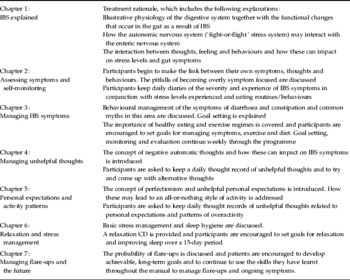
Participants in this group also received the fact sheet after the diagnostic work-up. In addition, they were provided with a comprehensive self-management manual developed specifically for this study that included the provision of information, real-life examples and weekly homework sheets that they were encouraged to complete. The programme was divided into seven chapters, one to be completed each week over a 7–8-week period. A summary of the content of each chapter is provided in Table 1. Some of the information in chapters 2, 3, 4 and 7 and some examples were drawn from a previous CBT trial manual (Kennedy et al. Reference Kennedy, Chalder, McCrone, Darnley, Knapp, Jones and Wessely2006).
Summary of the content of the irritable bowel syndrome (IBS) self-management manual

Participants also received a 1-hour face-to-face session with a health psychologist (R.M.-M.) at the beginning of the programme. The content of chapter 1 was covered in addition to an explanation on how to individualize the manual to their own personal difficulties. Participants also received two 1-hour therapy sessions by telephone scheduled midway and towards the end of the programme. These were intended to give the patient an opportunity to go through any queries they might have, to clarify the appropriateness of the goals set, and to work through some of the more complex aspects of the programme such as managing unhelpful thoughts.
Assessments
The assessments described below were administered at four time-points: baseline (pretreatment), post-treatment (2 months) and at 3 and 6 months post-treatment. All assessments were sent out and processed by a research assistant who was blind to treatment condition. If assessments were late in returning, a reminder letter was sent out, followed by a telephone call. Participants were asked to provide information at baseline only on their gender, duration of bowel symptoms, age, ethnicity, marital status and level of education.
Two primary outcomes were included. The first, the Subject's Global Assessment (SGA) of Relief (Muller-Lissner et al. Reference Muller-Lissner, Koch, Talley, Drossman, Rueegg, Dunger-Baldauf and Lefkowitz2003) is used frequently in treatment trials to identify IBS responders to therapy. Participants rate their relief from IBS symptoms on a scale of 1 to 5 ranging from ‘completely relieved’ to ‘worse’. Scores are dichotomized so that patients scoring from 1 to 3 are considered responders and those from 4 to 5 non-responders. Because IBS is a cyclical illness, responders in this trial were defined as those who scored between 1 and 3 at all three follow-up time-points. Patients who returned no follow-up questionnaires were rated as not relieved. Those who returned one or more questionnaires were considered responders if they had no ratings of 4 or 5 at any time-point.
The other primary outcome was the Irritable Bowel Syndrome Severity Scoring System (IBS-SSS; Francis et al. Reference Francis, Morris and Whorwell1997), which measure the severity of pain, distension, bowel dysfunction and quality of life/global well-being. A decrease of 50 points on this scale has been identified as a clinically significant change in symptom severity.
Secondary outcomes included the Work and Social Adjustment Scale (WSAS; Mundt et al. Reference Mundt, Marks, Shear and Greist2002) and the Hospital Anxiety and Depression Scale (HADS; Zigmond & Snaith, Reference Zigmond and Snaith1983) The WSAS is a measure of quality of life that addresses the degree to which a patient's illness impacts on work, personal relationships, home management, and social and leisure activities. The HADS is a commonly used self-report instrument for detecting depression and anxiety in patients with medical illnesses. The IBS-SS, WSAS and HADS were all used in a previous primary-care IBS CBT trial (Kennedy et al. Reference Kennedy, Chalder, McCrone, Darnley, Knapp, Jones and Wessely2006), which allowed the data from this trial to be compared with earlier work.
Acceptability of the self-management treatment was assessed using three questions where patients were asked to rate the overall effectiveness of the programme, the efficacy of the programme compared to other treatments they had tried, and whether they enjoyed the programme.
To assess engagement with and adherence to the self-management programme, participants were asked to return their homework sheets to one of the investigators not involved in the therapy (L.B.). The quantity of homework completed was then assessed by counting the sum of completed homework sheets. Scores on this variable ranged from 0 (‘no homework completed’) to 10 (‘all homework completed’).
Sample size
The sample size calculation was based on an effect size of 0.54 drawn from a study that compared the effectiveness of CBT to standard medical care for patients with medically unexplained symptoms (Speckens et al. Reference Speckens, van Hemert, Spinhoven, Hawton, Bolk and Rooijmans1995). With 80% power and an α level of 0.05, 27 participants were needed in each group to obtain a significant effect. To account for 20% attrition, recruitment was aimed at 33 participants per group, giving a total n of 66.
Statistical analysis
Statistical analyses were performed using SPSS version 14 (SPSS Inc., Chicago, IL, USA). Data screening showed that the assumptions of normality were satisfactory for the distributions of all of the variables, except the WSAS, and there were no obvious outliers. All treatment effect analyses were by intention-to-treat. For participants that dropped out, scores from the previous time-point were carried forward. Logistic regression was used to determine differences between groups on the dichotomous variables. A series of 2 (group)×4 (time) ANOVAs were used to determine whether there was a significant group by time interaction on the continuous primary and secondary outcome measures. Greenhouse–Geisser was used to determine significance as the sphericity tests were significant. Independent-sample t tests were conducted on change scores computed from the WSAS.
Results
Participant flow through the trial
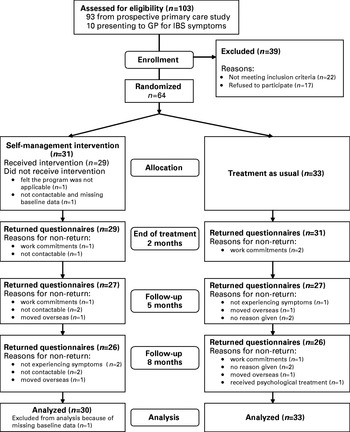
Fig. 1 shows the flow of participants through the trial and reasons for drop-out at each follow-up stage. Thirty-one patients were randomized to the self-management group and 33 to the TAU condition. One self-management participant did not complete most of the baseline questionnaire and could not be contacted for treatment sessions or follow-ups so had to be dropped from the analysis. A total of 29/30 participants completed the self-management programme, 60/64 (94%) participants completed post-treatment questionnaires, 54/64 (84%) completed the 3-month post-treatment follow-up and 52/63 (81%) the 6-month follow-up. Of the 14 participants who failed to return one or more questionnaires, only one self-management and one control group participant provided no follow-up data, seven returned one follow-up and five completed two of the follow-ups.
Flow of participants through the study.

Baseline patient characteristics
The mean age of the 63 participants was 39.5 (s.d.=16.8) years and 46 (73%) were women. The majority of the participants identified as white European (n=57; 93%), with three identifying as mixed ethnicity and one as Maori. Almost half of the participants (n=30) were university educated.
A total of 35 (56%) patients had received a diagnosis of IBS before entry into the trial. Twenty-two (35%) reported that their IBS symptoms started at the time of an acute infection, and had experienced IBS symptoms for 6–12 months. Some of the remaining patients found it difficult to report how long they had experienced IBS symptoms but those who did, reported symptoms ranging from 9 months to 16.7 years (mean=4.5, s.d.=4.43). The mean score for the IBS-SSS was 225.5 (s.d.=80.7), which is in the range for moderate symptoms. Thirty-nine (62%) patients reported that they experienced both diarrhoea and constipation, 18 (29%) just diarrhoea and five (8%) just constipation as part of their IBS. There were missing data on these variables for one patient. Levels of HADS depression were relatively low in the sample (mean=4.0, s.d.=3.1) but the mean HADS anxiety score was close to the case range for anxiety (mean=7.9, s.d.=4.2).
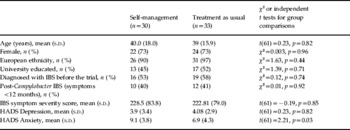
Table 2 shows that the groups were well matched on their demographic and baseline characteristics. The only difference between the groups was on the HADS anxiety scale, where the self-management group reported significantly higher levels of anxiety than the TAU group.
Baseline demographic and clinical characteristics across groups

IBS, Irritable bowel syndrome; HADS, the Hospital Anxiety and Depression Scale; s.d., standard deviation.
Patient health-care usage during the 2-month self-management period
To ascertain TAU usage during the trial treatment period, patients were asked to report at the end of treatment follow-up how often they visited their GP, specialist, or alternative health care practitioner (e.g. acupuncturist, homeopath) for their IBS symptoms. The majority of patients did not seek medical or alternative care during this time. In the self-management group only four (13.8%) reported seeing a GP compared to eight (26.3%) in the TAU control condition. With regard to specialist care, one patient in each group reported seeing a specialist for IBS symptoms (3.6% of self-management and 3.4% of controls). One self-management patient reported visiting an alternative health-care practitioner compared to four (13.7%) controls. Using the Mann–Whitney U test, there was no significant difference in total number of health visits across the two groups (z=−1.03, p=0.30).
Primary outcome data
Global rating of relief
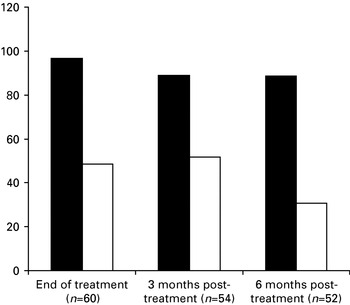
Fig. 2 gives the breakdown of the percentage of symptom relief reported by completers across groups at each follow-up point. Our definition of responders was those who rated symptom relief across all three follow-ups. Nine controls had some missing follow-up data. Based on our criteria (see Method), five of these were considered responders and four non-responders. Four self-management patients had some missing data, of whom two were non-responders and two responders. Using these data, 23 (76.7%) of the self-management group were treatment responders compared to seven (21.2%) of the TAU controls [odds ratio (OR) 12.2, 95% confidence interval (CI) 3.72–40.1)].
Percentage of patients rating symptom relief on the Subject's Global Assessment (SGA) of Relief at each follow-up point. ▪, Self-management group; □, Treatmemt-as-usual control group.

IBS-SSS
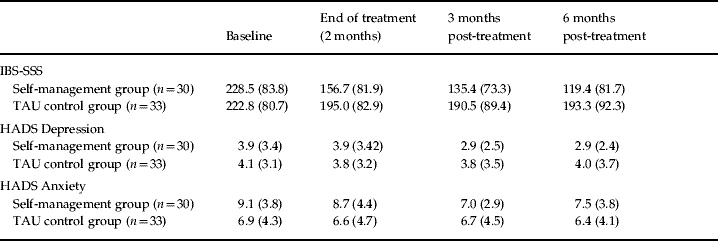
The self-management group showed substantial improvement in the severity of IBS symptoms from baseline to end of treatment and then continued to improve during the 6-month follow-up time period (see Table 3). There was a significant group by time interaction [F(2.6)=5.7, p=0.002]. The between-group parameter estimates showed that at the 3-month (t=−0.2.66, 95% CI −96.5 to −13.7, partial η2=0.10) and 6-month (t=−0.3.4; 95% CI −117.9 to −29.8, partial η2=0.15) post-treatment follow-ups, the self-management group had significantly lower IBS-SSS scores than the control group but the difference directly post-treatment was not significant (t=−0.1.8; 95% CI −79.9 to −3.2, η2=0.05).
IBS-SSS and HADS scores in the self-management and control groups across the trial period (intention-to-treat data)

IBS-SSS, Irritable Bowel Syndrome Severity Scoring System; HADS, Hospital Anxiety and Depression Scale; TAU, treatment as usual.
Values given are mean (standard deviation).
At 6 months post-treatment the mean change in IBS-SSS in the self-management group was 109, compared to 29.5 in the TAU group. Twenty-five (83%) of the self-management group showed a clinically significant change on the IBS-SSS (i.e. a change of 50 points) at 6 months post-treatment compared to 16 (49%) of the control group (OR 5.3, 95% CI 1.64–17.26).
Secondary outcomes
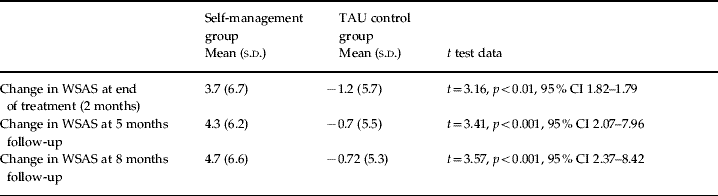
The data for the WSAS were skewed at all four time-points. The median score for the treatment group at baseline was also slightly higher than that of the control group (5.5 v. 4.0). Consequently, rather than using non-parametric analyses, which would not allow us to control for baseline, we created three change scores for the WSAS data by subtracting each of the follow-up points from the baseline score. Table 4 shows that, at each time-point, the self-management group showed significantly greater improvement in WSAS scores than the control group.
Independent-sample t tests across groups for change from baseline in WSAS at each follow-up period (intention-to-treat data)

WSAS, Work and Social Adjustment Scores; TAU, TAU, treatment as usual; s.d., standard deviation; CI, confidence interval.
The means scores for the HADS across the trial are presented in Table 3. The general linear models showed no group by time interaction for depression [F(2.36)=1.35, p=0.26] but there was a small interaction effect for anxiety [F(2.8)=14.92, p=0.05]. Between-group parameter estimates showed that there were no differences in anxiety scores between the groups at each of the time-points, but within-group analysis showed that the self-management group had a significant reduction in anxiety from baseline to 6 months post-treatment [t(29)=2.5, p=0.02] whereas the control group did not [t(32)=0.8, p=0.41].
Acceptability and adherence to treatment
At the end of treatment 24 out of the 30 (80%) participants in the self-management group returned their homework sheets. The mean score for the quantity completed was 6.94 (s.d.=2.66) out of a total of 10 sheets. Twenty-one (70%) participants rated the self-management treatment as much better or better than any other treatment they had received to date. Three (10%) said it was no different and 20% did not answer the question. Eighteen (60%) rated the treatment as highly or very effective and seven (23%) rated the treatment as effective. Four (13%) felt the treatment was not that effective but no participants rated the treatment as not at all effective. Finally, 27 (90%) said they had enjoyed the programme.
Discussion
This study shows that a structured CBT-based self-management manual together with three 1-hour therapy sessions (one face-to-face and two telephone sessions) provides significant and consistent relief from symptoms up to 6 months post-treatment when compared to TAU in primary care. The self-management programme also significantly improved IBS symptom severity and the degree to which the symptoms interfered with daily life.
However, the self-management treatment had no effect on depressed mood. This may have been because the levels of depression in this sample of IBS patients were very low. Anxiety levels were higher and the self-management group reported a significant reduction over the 8 months of the study in their levels of anxiety. There was no reduction in anxiety in the TAU group, but this may be an artefact of the self-management group reporting higher baseline anxiety.
The self-management approach seemed to be acceptable to patients. Only one dropped out of therapy. The majority reported that they felt the treatment was more effective than treatment they had received in the past. Almost all of the patients reported that they enjoyed the treatment and most adhered to the programme by completing homework sheets.
Potential limitations of the study
Limitations of this study include an absence of a therapy control condition for the self-management therapy sessions. However, as this intervention included limited therapy time, we thought it unlikely that sustained improvements could be related purely to a placebo or therapist effect. The fact that patients in the self-management programme showed ongoing improvement in both symptoms and IBS-related disability after therapy finished suggests that improvement was related to patients continuing to apply the strategies they had learnt. The mean change in IBS-SSS in the self-management group at the end of the treatment was 72 compared to a mean change of 109 at the 6-month follow-up, which is double the recommended cut-off for clinical improvement.
No fidelity check was carried out on the three treatment sessions. However, all patients received the same structured treatment manual and homework sheets to work through. There was also only one therapist, who was an expert in medically unexplained conditions, which may have encouraged patients to be more adherent to treatment. Finally, this was a pilot RCT, so the numbers in each group were small. Although these numbers were sufficient to show a significant treatment effect, it is more difficult to generalize the findings to the wider group of IBS patients. The patients in this trial had moderately severe IBS symptoms, but they were less disabled and depressed than cohorts of patients in previous trials. The sample was also highly educated and a percentage of patients had not previously sought treatment for their IBS. It is also worth noting that all patients in this trial were diagnosed according to either Rome 1 modified or Rome II criteria (Boyce et al. Reference Boyce, Koloski and Talley2000; Saito et al. Reference Saito, Locke, Talley, Zinsmeister, Fett and Melton2000). There are now Rome III criteria for diagnosing IBS (Longstreth et al. Reference Longstreth, Thompson, Chey, Houghton, Mearin and Spiller2006). However, it is likely that the majority of the patients would have met the new criteria as they all had had symptoms for more than 6 months.
Implications of the findings
The results from this trial differed from previous CBT trials in two key areas. Only one patient (3%) did not complete the treatment. Previous IBS studies suggest that drop-out rates from CBT can be as high 40% (Boyce et al. Reference Boyce, Talley, Balaam, Koloski and Truman2003; Drossman et al. Reference Drossman, Toner, Whitehead, Diamant, Dalton, Duncan, Emmott, Proffitt, Akman, Frusciante, Le, Meyer, Bradshaw, Mikula, Morris, Blackman, Hu, Jia, Li, Koch and Bangdiwala2003; Kennedy et al. Reference Kennedy, Jones, Darnley, Seed, Wessely and Chalder2005). This may be because traditional CBT requires a substantial time commitment from patients. The most common reasons for dropping out are being unable to take time off work or childcare commitments (Kennedy et al. Reference Kennedy, Jones, Darnley, Seed, Wessely and Chalder2005). Having fewer sessions and sessions on the telephone may make the therapy more widely available. In addition, presenting treatment as self-management of a chronic condition rather than as a psychological therapy may be more acceptable to IBS patients.
The treatment effects for symptom severity in this study are larger than those reported in many other CBT trials. This may be because of differences in the patient cohorts. In the London-based primary-care CBT trial (Kennedy et al. Reference Kennedy, Jones, Darnley, Seed, Wessely and Chalder2005), the mean WSAS score at baseline was 15 and the mean HADS depression score was around 7. In the current study, the median WSAS was 5 and the mean HADS depression score was 4. As our study did not rely on GP referral we may have accessed a cohort that seldom gets offered therapeutic intervention or perhaps even gets diagnosed. This is important, as our results suggest that treatment effects may be greater if patients are less disabled by their symptoms and less depressed. There is certainly evidence that depression in IBS is related to poorer treatment outcome (Blanchard, Reference Blanchard2001). This study indicates that early intervention and diagnosis may not only make treatment more effective but also prevent the illness becoming more chronic and refractory to treatment.
In conclusion, this study provides preliminary evidence that CBT-based self-management in the form of a structured manual and minimal therapist contact may be an effective and acceptable treatment for patients presenting with IBS in primary care. Future studies should assess the effectiveness of the intervention with a broader range of IBS patients and therapists, including nurse practitioners. This study included a relatively educated cohort of patients so the usability of the manual needs to be more broadly assessed. Comparing different dosages of therapy and the cost-effectiveness of these would also be beneficial.
Acknowledgements
We thank Professor C. Tasman Jones and Dr R. Williamson for their assistance in screening patients for the trial and Professor T. Chalder for advice on the manual. This study was funded by the University of Auckland Staff fund.
Declaration of Interest
None.