Introduction
Dizziness ranks among the most common medical complaints, affecting approximately 20–30 per cent of the general population at some time in their lives.Reference Kroenke and Price1–Reference Davis, Moorjani, Luxon, Furman, Martini and Stephens3 The incidence rises steadily with age, with the overall prevalence of balance problems at age 70 years reaching 36 per cent in women and 29 per cent in men. By 80–90 years of age, the corresponding rates are 51 per cent and 45 per cent. In Britain, 15 out of 1000 people each year consult their general practitioner in relation to ‘dizziness’.Reference Jayarajan and Rajenderkumar4
In secondary care, most of these patients have been managed by ENT doctors with the help of physiotherapists interested in vestibular rehabilitation. More than one appointment was often necessary for the treatment of dizzy patients. For example, after consultation with the ENT doctor, the patient would then see an audiologist for vestibular function tests and then a physiotherapist. With the introduction of an 18-week target from general practitioner referral to treatment, clinical departments around the country are exploring methods to decrease waiting times.5 In 2008, ENT UK promoted the use of ‘new models of care, which should be based on team delivery and use multiprofessional care pathways to ensure best possible patient care’.6 We thus aimed to create a ‘one-stop’ clinic in which assessment, diagnosis, treatment and therapies for a large proportion of patients presenting with balance and dizziness disorders could be delivered simultaneously. In London, Lee and colleagues have also adopted a specialist pathway for ‘dizzy’ patients referred to their ENT services, and have reduced waiting times for patients to be seen in their clinic. They have formed a team of specialist balance physiotherapists, audiologists and ENT consultants for assessing and treating the patients.Reference Lee, Jones, Corcoran, Premachandra and Morrison7
A recent local audit at our hospital showed that 40 per cent of referrals to the ENT department are for balance, dizziness and tinnitus problems and that 90 per cent of these referrals could potentially be seen in a joint audiology and physiotherapy balance clinic (unpublished data). We therefore aimed to introduce a service similar to that of Lee and colleagues to improve patient care and reduce waiting times. This article reviews the results of the service within the first year of practice.
Materials and methods
Original balance clinic model
The head of audiology services (TK) triaged all referrals into the ENT and Audiology Departments, and referrals for balance problems were directed to the multidisciplinary vestibular balance clinic. Funding for the dedicated multidisciplinary vestibular balance clinic at our hospital was initially secured in 2001, with approximately three new patients being seen per week. In these early clinics, three clinicians jointly assessed new patients: an ENT consultant with an interest in balance (THL), a senior physiotherapist (NM), and a senior audiological scientist who could perform vestibular function tests. It was soon apparent that few patients needed specialised vestibular function tests and therefore the audiological scientist was no longer required to be present at the balance clinics. Leong et al. have also reported that this model of service is inefficient when three dedicated clinicians are present at a clinic.Reference Leong, Barker and Bleach8 If patients required vestibular function tests, these were arranged at a later date. New patients, however, underwent a linked audiogram at an initial appointment at the Audiology Department whilst it was supporting the normal ENT clinics.
The rate of referrals rose steadily over time and, as physiotherapists became more knowledgeable about vestibular disorders, they became more actively involved in the first assessment process. The lead consultant provided support and tuition. Along with attendance at appropriate courses, this enabled the physiotherapists to gain the qualifications necessary to become specialist balance physiotherapists.
New balance clinic model
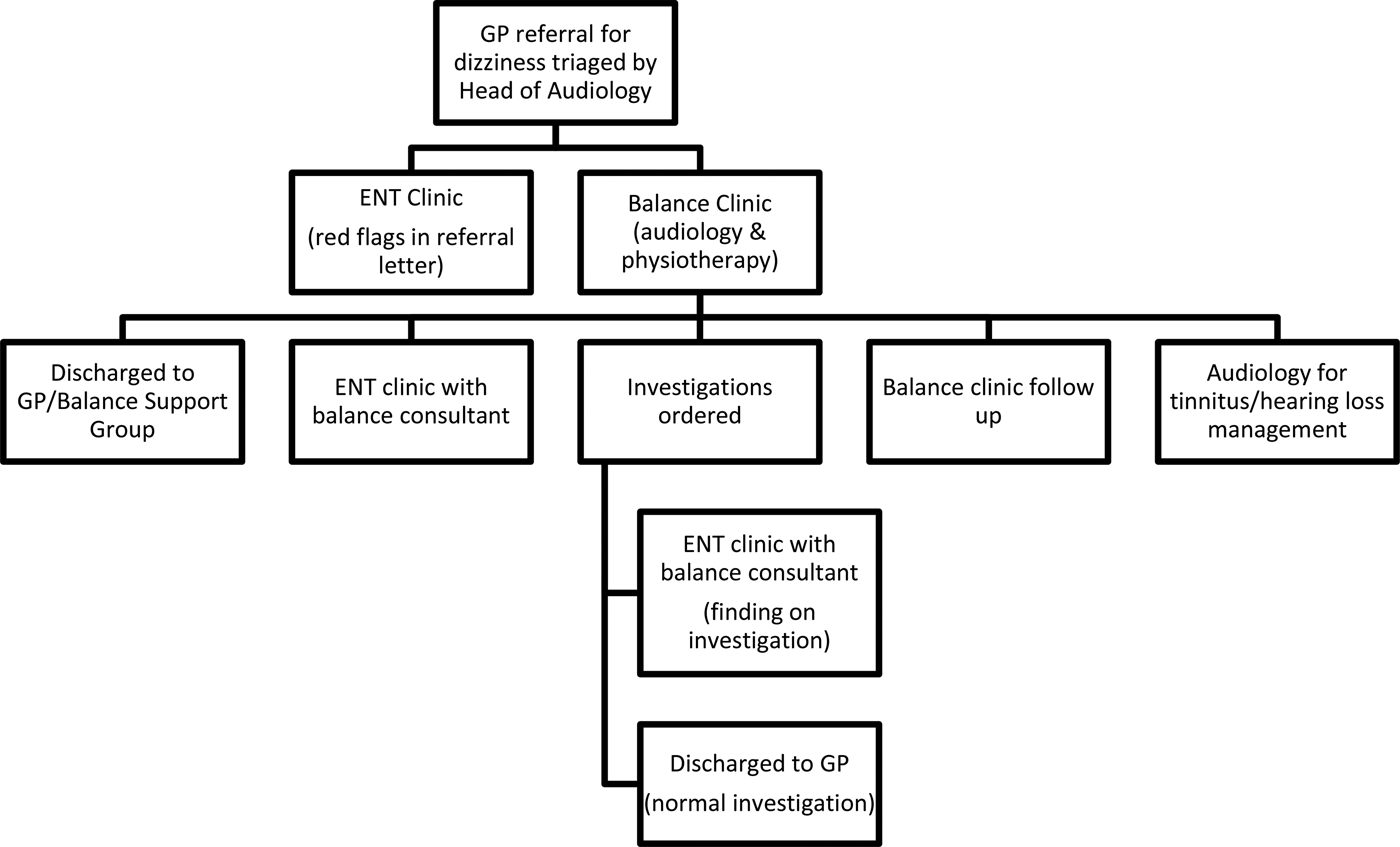
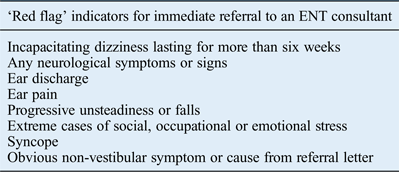
Our current patient pathway is summarised in Figure 1, and described in detail in the main text. Our current clinic template evolved over time, and in April 2011 the service was renamed the physiotherapy-led balance clinic. All patients, however, remained under the care of the lead ENT consultant (THL). The head of audiology continued to triage referrals and direct vestibular disorders to the balance clinic. Patients referred for tinnitus or presumed sensorineural hearing loss attended a separate audiology clinic. Therefore, no additional manpower was required to triage the referrals. Red flags that excluded assessment in the balance clinic are listed in Table I.
Flow chart showing the patient journey from referral

Red flags that exclude assessment in the balance clinic
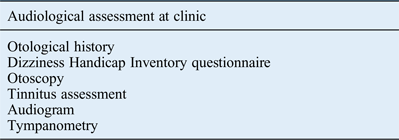
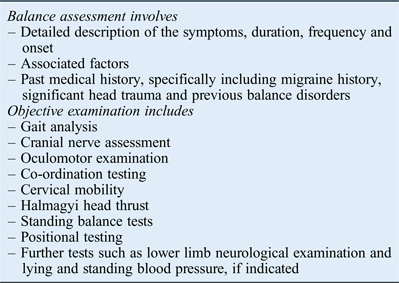
Two specialised balance physiotherapists (band 8) each cover two balance clinic sessions (i.e. a total of four sessions). Eight patients are seen per clinic (five new and three follow up) per 4-hour session, which includes time for paper work and discussion with the consultant, if necessary. Consultants with an interest in vestibular disorders run their usual clinic alongside the balance clinic. This allows good communication and a chance for the consultant to review the patient, if necessary. Patient appointments last for an hour: the first 30 minutes is allocated to an audiologist performing an audiological assessment (see Table II), followed by a 30-minute balance assessment by the physiotherapist (see Table III).
Audiological assessment checklist at balance clinic
Balance assessment format at clinic
At the end of each appointment, the audiologist completes a standardised template and formulates a management plan for any hearing loss or tinnitus. Advice is given on tinnitus and follow-up arrangements are made for hearing aid fitting and tinnitus therapy, as necessary.
Balance clinic outcomes
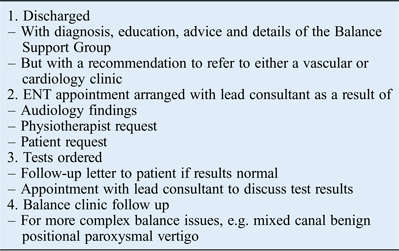
Findings are discussed with each patient (including an explanation of the likely diagnosis), a management plan is agreed and appropriate advice given. We have produced a range of patient information leaflets to back up education and advice about the main vestibular disorders. The physiotherapist then collates the audiological and balance findings into a single letter to the referrer, containing a working diagnosis, management and follow-up plan, if any. Table IV summarises the possible outcomes for a new patient.
Possible patient outcomes after balance clinic attendance
Those presenting with benign paroxysmal positional vertigo (BPPV) undergo the appropriate canal repositioning manoeuvre at the first assessment visit. Likewise, if vestibular rehabilitation exercises are necessary, the first stage is taught in the clinic and advice regarding self-progression is provided. A leaflet containing information pertinent to their condition is provided to each patient.
Consultant input
Following the initial assessment, a small percentage of patients need to be referred to an ENT consultant. An appointment with an ENT doctor may be made at the request of the audiologist or physiotherapist. Whilst this percentage is generally low (see results), physiotherapists have the opportunity at every clinic to discuss such cases with an ENT consultant with a specific interest in balance disorders. Abnormal test results also necessitate an ENT doctor referral.
Patient satisfaction questionnaire
Towards the latter half of the year, we decided to audit patient satisfaction with the service immediately after their initial visit to the balance clinic. After the appointment, questionnaires were given to 45 patients by the receptionist, and patients were asked to fill it in anonymously and place it in a box before leaving the department. Patients were asked to rate various aspects of the clinic visit on a visual analogue scale of 1 to 10.
Results
From August 2011 to January 2013 (18 months), a total of 214 new patients were deemed suitable for the balance clinic, of which 14 patients did not attend. The average age was 58 (median 54) years. The male to female ratio was 1:2.
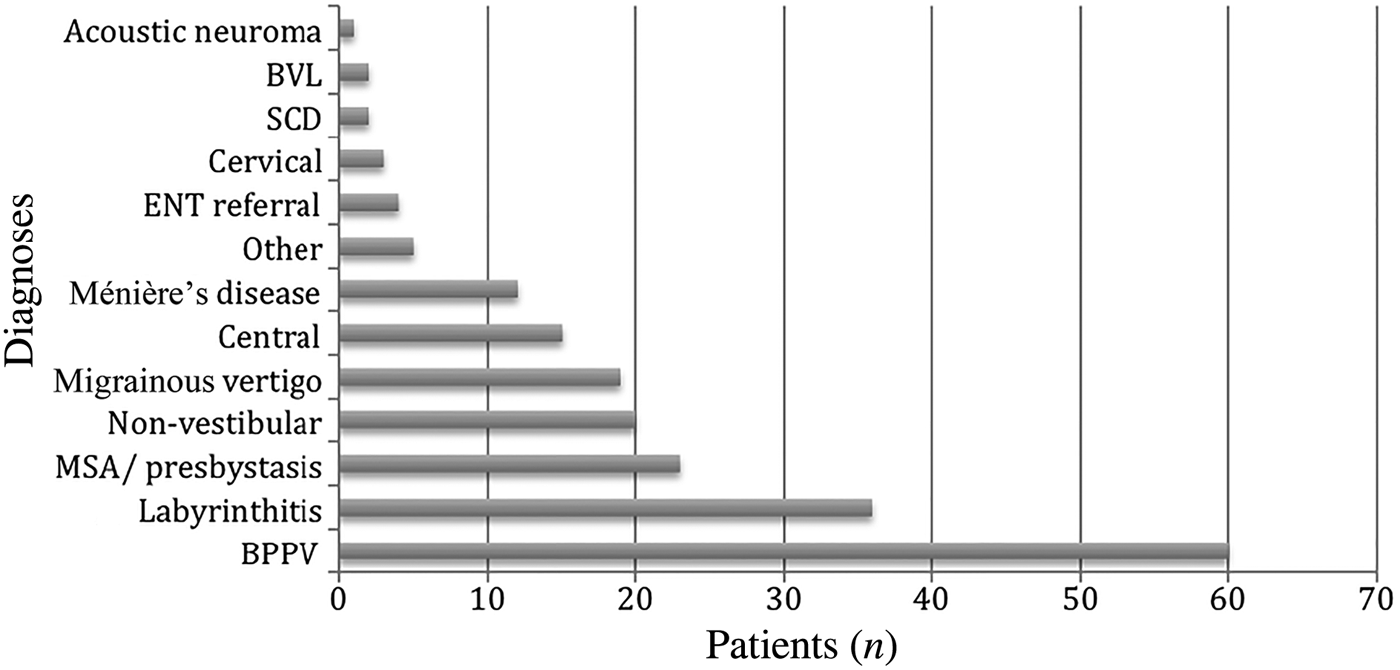
Figure 2 shows the diagnoses made after initial assessment at the balance clinic. Most patients were diagnosed with BPPV, and the next most common diagnosis was labyrinthitis. Multisensory imbalance was the third commonest diagnosis; this usually occurs in the elderly (the average age of such patients is 77 years). Central causes accounted for 15 (7 per cent) of the total diagnoses and included Arnold Chiari malformation, Parkinson's disease, alcoholism, post-subarachnoid haemorrhage and post-head injury.
Chart showing diagnoses made after attendance at balance clinic plus or minus investigations (200 patients). BPPV = benign paroxysmal positional vertigo; BVL = bilateral vestibular loss; MSA = multiple system atrophy; SCD = superior semicircular canal dehiscence
Of the 200 patients seen, only 22 investigations were requested (2 vestibular function tests, 3 computed tomography (CT) scans and 17 magnetic resonance imaging (MRI) scans). The MRI scans were mainly requested for asymmetrical sensorineural hearing loss: 11 of these were reported as normal; the remaining 6 revealed generalised cerebellar atrophy, stroke, a temporal lobe contusion post-head injury and 3 instances of small vessel ischaemia. Out of three CT scans requested to confirm superior semicircular canal dehiscence, one was positive for the pathology. Of the two vestibular function tests, one was inconclusive and the other confirmed unilateral vestibular hypofunction.
Figure 3 shows the outcomes for the 200 new patients. Of these, half (51 per cent) were treated and discharged after the initial visit, 27 per cent were followed up again and 22 per cent were referred to an ENT consultant for various audiological and vestibular reasons, uncertainty regarding the diagnosis, and patient wishes. In total, 78 per cent of patients were managed without referral to a separate ENT clinic. This was only requested if the ENT consultant required a separate clinic appointment to address issues such as conductive hearing loss.
Patient outcome following initial balance clinic visit. Total number of patients = 200
Patient satisfaction outcomes
Out of 45 patients, 41 (91 per cent) completed the questionnaires. Figure 4 illustrates the high overall level of satisfaction that patients reported after attending the balance clinic. Very few negative comments were made and these related to the time of day the appointment was made and the relative difficulty in finding the clinic.
Patient questionnaire (n = 41) satisfaction scores regarding various aspects of the consultation following the initial balance clinic visit. Scores from 1 (extremely low = unhappy) to 10 (extremely high = happy)
Since the start of the balance clinic, waiting times for patients with balance problems to be seen have dramatically reduced, despite a steady rate of referrals. Initially, a backlog of patients waiting to be seen (with nine-week waiting times) had to be cleared. Now, the waiting time from referral to appointment is less than three weeks.
Discussion
Balance clinics are common within many ENT departments, but a physiotherapist-led clinic is an emerging approach to treating such patients. It has obvious benefits when combined with an ENT doctor and audiology services because patients can be diagnosed and treated in a single visit. This improves patient flow through the system and leads to better patient satisfaction. Our balance clinics are physiotherapy led, and ENT consultant input is limited but nonetheless available at the clinic.
Our results demonstrate that this approach is highly suitable for assessing, diagnosing and managing a significant percentage of ENT referrals to a large teaching hospital related to balance and dizziness disorders. Our one-stop assessment clinic has diagnosed, treated and discharged half (51 per cent) of these patients in a single visit, with only a few needing referral for further tests. Only 2 vestibular function tests were requested for a cohort of 200 patients, which highlights our ethos in managing dizzy patients using histories, examinations and basic tests. To our knowledge, no untoward diagnoses were missed. Twenty-two per cent of patients were referred for a separate ENT clinic appointment and 27 per cent had further physiotherapy follow up. When the diagnosis was thought not to be related to the vestibular system, but instead to the cardiovascular, neurological or psychological system, the physiotherapist, after discussion with the ENT consultant, wrote to the general practitioner advising of an onward referral. This occurred for 10 patients with diagnoses mainly related to the cardiovascular system.
Results of the patient feedback questionnaires emphasised the high level of patient satisfaction in our model of care. Most patients rated the service they received the top score of 10. This may be partly because of the speed of appointment, but mainly reflects the thorough consultation process that takes place during the initial patient visit.
The new care pathway has resulted in a significant reduction in waiting times, despite a constant rate of referrals. This is mainly because fewer patients require follow up at the balance clinic and a many are being discharged with appropriate self-help advice. A Balance Support Group has been set up to provide additional assistance to patients after their discharge to the general practitioner. The support group was set up to offer further help to those with longer-term conditions, for example older patients with multisensory imbalance. The support group has now been running for over two years and is supported by a patient newsletter. We are currently setting up a dedicated website to provide education and patient stories related to balance and dizziness disorders. This new physiotherapy-led balance clinic, together with the audiology-led tinnitus clinic, won a national award in the ‘Rethinking the patient journey’ category at the UK National Advancing Healthcare Awards 2012.
Comparison with other studies
A recent study by Lee and colleagues, based in London, displayed similar patient demographics.Reference Lee, Jones, Corcoran, Premachandra and Morrison7 Interestingly, most referrals in their study came from other ENT consultants, whereas all of our referrals came from general practitioners. Unlike in the London model, we did not have separate assessment and vestibular rehabilitation clinics. Our specialist physiotherapists diagnosed and treated patients during the same clinic visit. If they were unsure of the diagnosis, discussion with an ENT consultant with an interest in balance took place at the time of the appointment. This removed the need for weekly review meetings with the consultant, as occurs in the London model. Approximately 10 per cent of patients were referred by the physiotherapist to an ENT consultant to be seen in a separate clinic, mainly as a result of abnormal imaging results, diagnosis uncertainty and patient wishes.
In 2008, Leong and colleagues published their experience of a pre-ENT clinic for dizzy patients.Reference Leong, Barker and Bleach8 Patients were initially seen in a ‘pre-ENT’ clinic by an audiologist, who seemed to perform vestibular testing on all patients and was also tasked with vestibular rehabilitation. If patients had obvious BPPV, they were treated with the Epley manoeuvre and did not have to attend the ENT clinic a few weeks later if they felt better. In our experience, most patients do not require vestibular testing, and training a physiotherapist (or audiologist) to make diagnoses other than BPPV is more efficient and avoids the need for further hospital attendance. We could discharge 51 per cent of patients after a single visit, whereas only 19 per cent of patients (all with BPPV) did not attend a further follow-up ENT clinic in the report by Leong et al.
• A multidisciplinary balance clinic benefits ‘dizzy’ patients
• Our one-stop physiotherapy-led balance clinic is a variation in this model
• It was set up to improve the management and experience of ‘dizzy’ patients referred to ENT
• It has reduced waiting times for treatment; 50 per cent of patients require just one hospital visit
• There is a high level of patient satisfaction with the balance clinic
• Clinician availability is key to appropriate management and patient flow through the system
Our one-stop clinic model has led to fewer hospital visits by patients, which contributed to the high level of patient satisfaction, as indicated by the feedback questionnaire. Our model has also dramatically reduced the number of secondary referrals to the physiotherapy department for balance rehabilitation. In the London model, 74 per cent of patients went on to have a separate physiotherapy rehabilitation appointment, which represents a duplication of visits.
Specialist balance physiotherapy support
There is an increasingly ageing population within the UK. Therefore, the prevalence of balance and dizziness disorders is likely to steadily increase. In the future, specialist physiotherapists with an interest in vestibular rehabilitation will be necessary in most ENT departments to treat dizzy patients in an appropriate and timely manner. There is now a special interest group, the Association of Chartered Physiotherapists Interested in Vestibular Rehabilitation (‘ACPIVR’) which offers support to those wishing to expand their knowledge of vestibular rehabilitation and advises on the various multidisciplinary courses run nationally throughout the year. The extra training and resources necessary to ensure that physiotherapists have the necessary skills to deliver such a service will, in the short term, require additional funding. This, we believe, will be more than rewarded in the long term with a more streamlined patient pathway.
Conclusion
We believe that the model of a balance clinic led by appropriately trained physiotherapists is transferable to other hospital departments. It has reduced waiting times for patients to be seen, has a high patient satisfaction score and is economically beneficial. Our balance clinic is based on a team delivery system and uses multiprofessional care pathways to ensure provision of the best possible patient care, as recommended by the Royal College of Physicians.9
Acknowledgements
We would like to thank the audiologist James Stibbards for his help in collating the questionnaire data.