Democracies are unique in their ability to channel societal conflicts into institutionalized patterns of political interaction. It is only in democratic systems that we can expect to find opposition forces that accept the legitimacy of the current government, have their rights guaranteed by law and hold seats in the legislature. Oppositions themselves are critical components of democratic systems of government, ensuring the proper functioning of democratic systems by holding governments accountable for their actions in office and providing voters with a viable alternative to those in power (Dahl Reference Dahl1966; Ionescu and de Madariaga Reference Ionescu1968). In established democracies, these important roles have been entrusted mainly to political parties, meaning that the nature and quality of representation that occurs through governments and oppositions depend almost entirely on parliamentary political parties.
The characteristics of parliamentary oppositions are intimately connected to the party system, to the point where the two are often equated. Discussions of institutionalized parliamentary oppositions invariably involve accounts of political parties, while extra-parliamentary opposition often appears to be equated with non-party forms of opposition (see, for instance, Blondel Reference Blondel1997). As demonstrated below, the distinction between party opposition and extra-parliamentary opposition is becoming less clear over time. Throughout the post-war era, the number of parties receiving votes in elections – hereafter referred to as the electoral party system – has increased significantly since the 1950s and 1960s in almost all of the established democracies examined here. In most cases the number of parties within the legislature – hereafter referred to as the legislative party system – has also increased. Since the distribution of electoral support among political parties plays a strong role in defining the type of opposition present in a democracy, it is likely that these increases in party system size have also changed the characteristics of parliamentary oppositions (Dahl Reference Dahl1966).
In this article I examine the consequences of increased party system fragmentation for oppositions, their respective governments and representation more generally, focusing on 18 established democracies. Any observer of democratic politics would expect a certain degree of fluidity and change as party systems adapt to shifts in the political environment, so that it is possible that the increases in fragmentation are entirely benign. However, two of the findings presented here suggest that there is reason to be concerned about the current and future state of parliamentary representation in established democracies. Firstly, an increasing proportion of votes now go to parties that do not receive (a proportionate share of) legislative representation. In fact, in some cases the discrepancy between seat and vote shares has grown large enough that levels of disproportionality in West and East European democracies look quite similar. In short, the effects of electoral systems on electoral behaviour appear to have weakened. Secondly, the fragmentation that does get translated into legislative representation manifests itself more readily as fragmentation among opposition – rather than governing – political parties. This suggests that the composition of governments may not be keeping up with current trends in electoral preferences and, in some cases, that governmental majorities have become smaller and more tenuous.
I begin by documenting changes in party system fragmentation in 18 established democracies, before moving on to examine how well the party composition of legislatures matches the support for parties in elections. The results of this analysis point to a growing disjuncture between electoral and legislative party systems, with electoral party systems growing at a faster pace than legislative party systems. I then examine changes that have occurred within the legislature, in terms of the fragmentation of governments and oppositions. Here, I find that parliamentary oppositions have generally become more fragmented than their respective governments. In the final sections I discuss potential causes and consequences of the growing disjuncture between electoral and legislative party systems, focusing on increases in sincere/expressive voting, discontent with major political parties, increases in the numbers of parties contesting elections, and spillover effects from other elections. Irrespective of their precise causes, these changes in party systems and democratic representation appear unlikely to reverse themselves in the near future.
Party System Fragmentation in Established Democracies
In one of the founding studies of political oppositions in established democracies, Dahl (Reference Dahl1966) lists six characteristics that capture the differences in patterns of oppositions: organizational cohesion or concentration, competitiveness, the site of the encounter between government and opposition, distinctiveness, goals and strategies. In more recent work, Jean Blondel (Reference Blondel1997) demonstrates how these six categories can be combined into two dimensions of political opposition: (1) organizational cohesion, which subsumes competitiveness and distinctiveness; and (2) the goals of the opposition, which subsumes the site of the encounter and strategies. The extent to which the opposition is cohesive or diffuse depends on both the number and the distribution of strength among political parties, which can be measured by the amount of each party's electoral appeal. Opposition cohesiveness can therefore be conceptualized and operationalized as fragmentation, where a highly fragmented opposition has low levels of cohesion, and a low level of fragmentation represents a high level of cohesion. It is this characteristic of oppositions that will be focused on here.Footnote 1
In the archetypical Westminster model, one-party control of government is matched by one-party control of the opposition. This scenario is often portrayed not only as representing one of the strongest and most cohesive forms of government and oppositions, but also as one of the strongest forms of party-in-government (Blondel Reference Blondel1997; Dahl Reference Dahl1966; Strøm Reference Strøm2002). In more fragmented party systems, the opposition is less concentrated and the distinction between governments and oppositions is less clear. When there are greater numbers of parties within the legislature, wholesale alternation in government becomes less likely and clarity of responsibility may decline (Lundell Reference Lundell2011; Mair Reference Mair1997; Powell and Whitten Reference Powell and Whitten1993). Additionally, legislative fragmentation can lead to higher numbers of parties within government, which can shorten the lifespan of the cabinet (see, for instance, Warwick Reference Warwick1994).
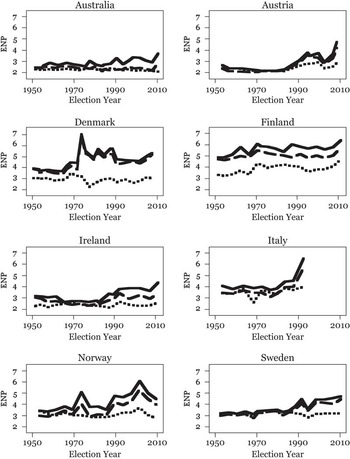
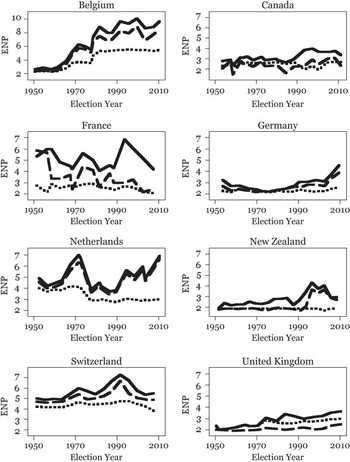
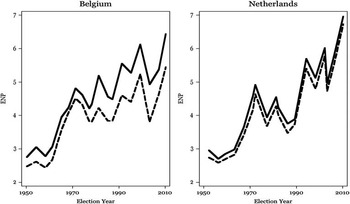
The Westminster model, as derived from the British political experience, has always had limited application to other systems. Electoral changes in established democracies have made this ideal type even less applicable over time and, at present, it fails to characterize the British coalition government. Figure 1 plots the effective number of parties (ENP) receiving votes (electoral party system size) and seats (legislative party system size) in 18 established democracies from 1950 to 2010. Focusing first on electoral party system size, there has been a clear trend towards increased fragmentation in almost all the countries considered. Country-specific regressions of the effective number of electoral parties on time produce statistically significant and positive coefficients on the time variable, supporting the significance of the observed trends.Footnote 2 Two countries appear to be exceptions. The French party system, as one of the more fluid and volatile party systems under consideration, has not experienced any consistent increases in electoral party system size. The other exception is the Dutch party system, where fragmentation plummeted after the merger of three denominational parties into the Christian Democratic Appeal (CDA) in 1977. The increases observed in Belgium may also be considered suspect due to the split of the country's major parties along linguistic lines in the 1970s. To examine the latter two cases, Figure 2 plots the effective number of parties in Belgium, treating the parties that split along linguistic lines as one unified party across the entire time period, and the effective number of parties in the Netherlands after treating the three denominational parties that merged into the Christian Democratic Appeal as one unified party. In both cases we observe increases in fragmentation over the post-war era that are statistically significant. Only France, then, presents a solid exception to this overall trend.
The Effective Number of Parties in Established Democracies, 1950–2011 Notes: Solid line: effective number of electoral parties; dashed line: effective number of legislative parties; dotted line: effective number of long-standing electoral parties. The effective number of parties summarizes the number of parties in a country by weighting each party by either vote share or seat share. Source: See Laasko and Taagepera (Reference Laasko and Taagepera1979). Data on party vote and seat shares are from Mackie and Rose (Reference Mackie and Rose1991), official election statistics websites and various issues of the European Journal of Political Research. The analysis of the Italian party system stops prior to 1994, when the entire party system was reconfigured.

(continued)

The Effective Number of Parties Combining Belgian Linguistic Parties and Dutch Christian Parties

An increase in the ENP may arise from two sources: (1) an equalization of the vote share between existing parties, so that all parties receive increasingly similar proportions of the vote; and (2) the entry and vote gains of new parties. To distinguish which of these sources has driven the observed increases in party system size, I have calculated the effective number of parties on the basis of only the vote shares of long-standing parties, where a long-standing party is defined as a party that contested an election in the 1950s and every election thereafter.Footnote 3Figure 1 also plots this calculation of the effective number of long-standing parties over time. Any increase in the effective number of long-standing parties signals an equalization of the vote share among existing parties, while the difference between the effective number of long-standing electoral parties and the total number of effective electoral parties will tell us the extent to which new parties have driven the increases. In all but a few cases, new parties appear to be the primary reason why party system size has increased. The entry of new parties appears to be almost the sole reason for the increases in Australia, Canada, Denmark, Ireland, the Netherlands, New Zealand, Sweden and Switzerland. In Belgium, a substantial portion of the increases in party system size can be explained by the entry of new parties, suggesting that the linguistic splits only accentuated fragmentation that occurred from new party entries. Equalization of long-standing party vote percentages appears to be the primary source of the increase in the United Kingdom (UK), and a strongly contributing factor to increases in Austria and Belgium. In the UK, this is due primarily to increases in the vote share of the Liberal Democrats and growing support for the regionally based Scottish Nationalist Party and Plaid Cymru. Overall, the trends suggest that the increases in the effective number of parties best represents an increase in the actual number of parties receiving substantial portions of the vote.
As is clear from Figure 1, increases in electoral party system size have not always been accurately reflected in the legislature. Electoral party system size has increased significantly almost everywhere, and legislative party system size has increased in a majority of countries; however, in Australia, Canada, Finland and Switzerland the increases occurring at the electoral level have not been translated into the legislature.Footnote 4
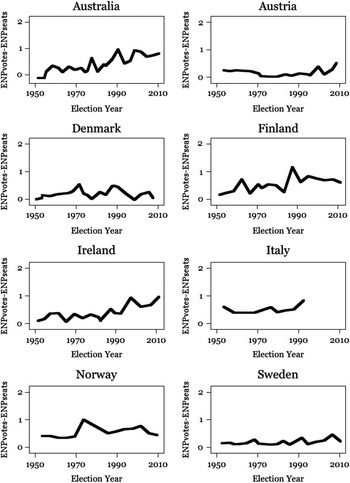
In a good number of countries there appears to be a growing gap between electoral and legislative party system size, particularly in countries such as Belgium and the UK. Figure 3 illustrates the discrepancies between electoral and legislative party system size by subtracting legislative party system size from electoral party system size and plotting this difference for each country. In most cases, there has been a clear and consistent increase in the gap between the number of parties receiving votes and the number receiving seats. In 11 of the 18 countries the increases in this gap over time are statistically significant: Australia, Belgium, Canada, Finland, France, Ireland, Italy, Luxembourg, Sweden, Switzerland and the UK. New Zealand's switch from a single-member-district plurality electoral system to a mixed-member proportional electoral system in the mid-1990s appears to have put an end to the growing gap between the electoral and legislative party system, while in Austria and Germany the gap appears to have increased only in recent decades.
Differences between Electoral and Legislative Party Systems in Established Democracies

(continued)

Electoral System Constraints on Party Systems
The gap between the number of parties receiving votes and the number receiving seats can largely be expected to be a result of the proportionality of the electoral system. The more proportional the vote-to-seat translation, the more we would expect to observe a legislative party system that was a direct reflection of the electoral party system, and the less likely it would be to observe a (growing) gap between the two. Thus, at first glance the growing gap in the more proportional systems such as Belgium, Finland, Luxembourg and Sweden may be more surprising than in the more disproportional systems of Australia, Canada and the UK. These trends, however, signify the failure of electoral rules to direct electoral behaviour. When viewed from this perspective, the growing gap in the single-member-district systems may actually be more surprising, since these electoral systems should exert the strongest effect on electoral behaviour.
All electoral systems are capable of excluding some parties from the legislature. Disproportionality can arise from any number of electoral system attributes, most notably district magnitude, thresholds for representation and the electoral formula used to translate votes into seats. Thus, we would expect to find some discrepancy between the numbers of parties receiving votes and those receiving seats. However, there is no reason to expect this discrepancy to grow over time, especially in countries that have not radically restricted entry into the legislature.Footnote 5 Our theories of how electoral systems structure behaviour, in fact, tell us exactly the opposite: that disproportionality should be kept to a minimum in stable democracies with institutionalized party systems.
Electoral systems constrain the size of the party system in two ways. Through the mechanical process of translating votes into seats, electoral systems often privilege large parties at the expense of small parties, which may not receive any representation in the legislature. The second way electoral systems constrain the size of the party system is through the strategic actions of voters and political elites who perceive the electoral system's mechanical effects and, as a result, direct their efforts in support of only the parties that stand a viable chance of winning seats in the legislature (Benoit Reference Benoit2002; Cox Reference Cox1997; Duverger Reference Duverger1963). Voters, aspiring candidates and party donors who care only about which party wins the election should desert sincerely preferred, but small non-viable parties in favour of their most preferred viable party.Footnote 6 In short, the strategic actions of voters and political elites should produce an electoral party system that closely resembles the legislative party system. This tendency for the number of parties receiving votes to be kept roughly in line with the number of parties receiving seats underlies what Taagepera and Shugart (Reference Taagepera and Shugart1989: 123) call the ‘law of conservation of disproportionality’. Although some proportion of political actors will always behave sincerely, the deviation between the electoral and legislative party system should be kept to a minimum through strategic behaviour. When short-term deviations from this relationship occur, perhaps when a new electoral rule is introduced, these deviations should dissipate over time as voters and parties gather information about the new rule and adjust their behaviour accordingly.
What we should observe, then, is a relationship between electoral and legislative party system size that is precisely the opposite of that depicted in Figure 3. If voters and political elites are strategically responsive to the mechanical effects of the electoral system, then we should expect to observe the gap between electoral and legislative party system size decrease or remain steady across time, but in no circumstance should it increase.
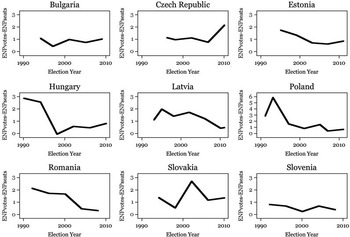
The relatively new democracies of Central and Eastern Europe present an interesting point of comparison here. Most European countries are now linked through membership of the European Union (EU) and increasingly exposed to similar political and economic environments, although the recent democratic transitions among Central and Eastern European countries separate them from the established democracies of Western Europe. If electoral institutions are functioning as we expect and acting as constraints on electoral behaviour, then the gap between electoral and legislative party system size should decline over time in these newer democracies. Figure 4 illustrates the trends in this gap for nine Central and Eastern European countries since the early 1990s. Despite the relatively short time frame and the reputation of Central and Eastern European democratic politics as being volatile, most of these nine countries do show the diminishing gap between electoral and legislative party system size that would be expected if electoral rules were acting as constraints on electoral behaviour. These trends make those found in the established democracies all the more striking. Although convergence between West and East European countries may be moderate, at best, with respect to many other political factors (see Casal Bértoa Reference Casal Bértoa2013), it appears that many of these countries have converged when it comes to the typical number of parties winning votes, but not seats, in elections. In the case of Central and Eastern European countries, this number has often declined to a difference of between 0.5 and 1.0, while in established democracies this number has increased to similar levels.
Differences between Electoral and Legislative Party Systems in Central and East European Democracies Source: Electoral returns for Central and Eastern European countries are from national election websites and statistical offices, various editions of the European Journal of Political Research, the database on Political Transformation and the Electoral Process in Post-Communist Europe, available at www2.essex.ac.uk/elect/database/database.asp, Election Resources on the Internet at www.electionresources.org and Adam Carr's Election Results Archive at http://psephos.adam-carr.net.

In previous research, I examined this relationship between electoral and legislative party system size and found that, for most years and most established democracies, legislative party system size did direct electoral party system size in ways we would expect: after accounting for short-term deviations, electoral and legislative party system size were in a long-term one-to-one relationship (Best Reference Best2010; 2012). However, in recent decades the relationship between electoral and legislative party system size appeared to break down completely in single-member-district electoral systems. I extend and update this analysis here, adding two additional countries – Luxembourg and Iceland – and five additional years of elections. The relationship between electoral and legislative party system size is modelled using the following error-correction model:Footnote 7
 $$\scale97%{{ \rDelta ENPvote{{s}_t}\, = \,{{\alpha }_0} + {{\alpha }_1}\,(ENPvote{{s}_{t - 1}}) + {{\beta }_0}\,(\rDelta ENPseat{{s}_t}) + {{\beta }_1}(ENPseat{{s}_{t - 1}}) + \,{\epsilon} $$
In the above equation, β0 will capture the immediate mechanical effects of the electoral system and tell us the extent to which the current electoral party system reflects the current legislative system. Under perfectly proportional electoral rules, we would expect this coefficient roughly to equal 1. In more disproportional systems, we can expect it to be between 0 and 1. The estimate of α1 will provide us with the rate of error correction. In this equation, the rate of error correction will tell us how quickly ENPvotes adjusts in response to any deviation from its relationship with ENPseats, by estimating the proportion of this deviation that is corrected per election. In substantive terms, the rate of error correction will tell us how quickly voters and political elites respond to any unexpected change in the numbers of parties receiving legislative representation through their strategic actions. The coefficient of greatest interest is β1. Dividing β1 by the rate of error correction (α1) produces an estimate of the long-run multiplier, which tells us the total long-term effect of a one-unit change in ENPseats on ENPvotes. If political actors are strategically responsive to the electoral system's mechanical effects, then – once we have accounted for the current difference between the electoral and legislative party system size (β0) – ENPvotes and ENPseats should be in a long-term, one-to-one, equilibrium relationship. In terms of the above error-correction model, this means that the total long-term effect calculated as β1/α1 should equal – or be statistically indistinguishable from – 1.
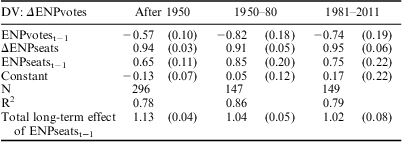
Table 1 presents the results of this error-correction model estimated for the 18 democracies for the entire time period (1950–2011) and broken down between the first half (1950–80) and second half (1981–2011) of the post-war era. All models were estimated with panel-corrected standard errors and country dummy variables (not reported). Most of the findings presented in Table 1 are in line with expectations, suggesting that electoral party system size does respond as expected to changes in legislative party system size. In the entire post-1950 time period, the coefficient on ΔENPvotest (β0) represents a near-proportional short-term relationship between electoral and legislative party system size, and the estimated rate of error correction (ENPvotest−1) suggests that a healthy 58 per cent of any deviation from the equilibrium relationship between ENPseats and ENPvotes is corrected in each election. However, the long-term relationship between ENPseats and ENPvotes looks over-responsive from the estimate of the long-run multiplier, which is statistically higher than the expected value of one. This suggests that, for every increase in one (effective) party in the legislature, ENPvotes will respond over the long run by increasing by 1.13 parties. This over-responsiveness disappears when the time period is broken in two halves, where the estimated long-run multiplier is statistically different from 0 and statistically indistinguishable from 1.
An Error-correction Model of Electoral and Legislative Party System Size in 18 Established Democracies
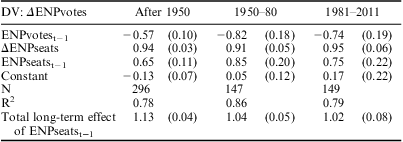
Notes: Table entries are OLS coefficients with panel-corrected standard errors in parentheses. Country-specific fixed effects were included in all models. Significance tests are two-tailed. p < 0.05, p < 0.10.
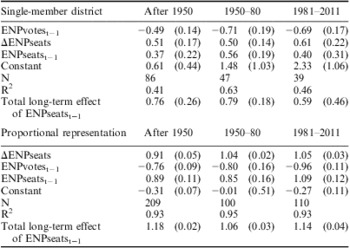
Table 2 presents the models separated by electoral system type. Here we observe quite different results for single-member-district and proportional representation systems. In single-member-district systems, we observe the expected effects for all variables in the post-1950 and 1950–80 time periods, where the total long-term effect of ENPseats on ENPvotes appears to be slightly under-responsive, but is statistically indistinguishable from 1, and the error-correction process corrects between 49 and 71 per cent of deviations per election. In the 1981–2011 period, however, there is no observed long-term relationship between legislative and electoral party system size. The estimated long-run multiplier of ENPseats is statistically indistinguishable from 0. What we appear to be observing is a complete breakdown of the relationship between the number of parties receiving votes and the number receiving legislative seats in single-member-district systems. The situation is different in proportional representation systems, where there is a long-term relationship between electoral and legislative party system size in all time periods. However, this relationship becomes over-responsive in the 1981–2011 period, where the estimated long-run multiplier is 1.14 and statistically different from 1, suggesting that electoral party system continues to grow above and beyond what the legislature accommodates.
The Relationship between Electoral and Legislative Party System Size by Electoral System Type

Notes: Table entries are OLS coefficients with panel-corrected standard errors in parentheses. Country-specific fixed effects were included in all models. The mixed-member-proportional systems in Germany and New Zealand are included in the proportional representation category. Significance tests are two-tailed. p < 0.05, p < 0.10.
These findings tell us that the relationship between electoral and legislative party systems has broken down in recent decades, but has done so in different ways across electoral system types. In single-member-district systems the relationship appears to have disappeared altogether, while in proportional representation systems the relationship appears over-responsive. In substantive terms, the increases we are observing in electoral party system size in these countries appear to have little to do with legislative representation. An increasing amount of political opposition in these systems is not only excluded from the legislature, but is strikingly undeterred by a lack of legislative representation. The growth in electoral fragmentation appears to be changing the shape of political opposition in established democracies by keeping higher proportions of parties outside of the legislature, particularly in single-member-district systems. The following section examines the different ways in which increases in party system fragmentation are changing the nature of representation inside the legislature in the form of governments and oppositions.
Fragmentation of Governments and Oppositions
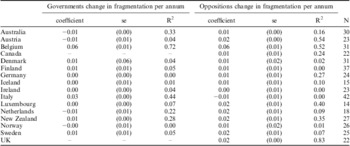
To examine whether governments and oppositions have been affected by fragmentation, Table 3 presents the results of regressions of the effective number of government and opposition parties (calculated using each party's government or opposition seat proportion), against time. Looking first at the composition of governments, it is quite clear that in most countries there has been no change in their level of fragmentation. Virtually all of the estimated coefficients for the time variable are equal to 0, with few exceptions. In Australia and the Netherlands, the coefficients are negative and significant, suggesting that government fragmentation has declined over time. In the Netherlands, this result is due to the merger of the three Christian parties into the Christian Democratic Appeal. In Australia, the result is not wholly surprising since legislative fragmentation generally has not increased. In Canada and the UK, the dominance of one-party governments makes any increase in fragmentation unlikely.Footnote 8 It is only in Belgium, where the party system split along linguistic lines, and Italy where we observe significant increases in government fragmentation.
Trends in Government and Opposition Fragmentation, 1950–2011

Notes: Table entries are coefficients obtained by individual country regressions where fragmentation of either the government or opposition is treated as the dependent variable and time (the date when the government took office) is treated as the independent variable. The estimated coefficient for Denmark becomes positive and significant with government-supporting parties treated as governing parties. I omit Switzerland from the analyses of governments and oppositions due to the collective and static nature of the government, and France due to its semi-presidential system and lack of party system fragmentation. Significance tests are two-tailed. p < 0.5, p < 0.1.
Source: Data on party compositions of governments and parliaments are from McDonald and Mendes (Reference McDonald and Mendes2002), and updated using various issues of the European Journal of Political Research.
The increases in party system fragmentation manifest themselves more clearly in the composition of oppositions, rather than governments. Half of the countries exhibit statistically significant and positive changes in opposition fragmentation over time, and in no country has opposition fragmentation declined. Interestingly, opposition fragmentation has increased in two of the countries where legislative fragmentation has not: Australia and Canada. From these results, it appears that the increases in legislative fragmentation have translated mainly into a fragmentation of the opposition. Stated differently: it suggests that a good number of the newer and smaller parties winning seats in the legislature do not typically participate in government.
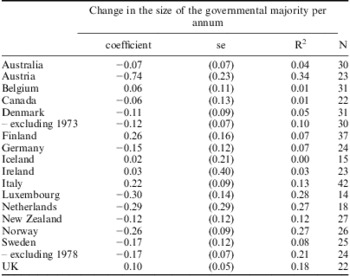
The analysis of government and legislative fragmentation weights parties according to the proportion of their seats in either government or opposition. Thus, it accounts only for the relative sizes of parties within governments or oppositions, not for the size of governments as a whole. Although government fragmentation has not increased, it is possible that the size of the governing majority (or, in some cases, minority) has changed over time. Table 4 displays the results of regressions of the size of the governmental majority (calculated as the percentage of legislative seats held by governing parties – 50) over time. In five countries there is a statistically significant and negative trend in the percentage of seats held by the government: Austria, Luxembourg, the Netherlands, New Zealand and Norway. A visual inspection of the data revealed a couple of outlying cases in Sweden and Denmark, both of which experienced very small governing minorities for short periods of time: Sweden in 1978 and Denmark in 1973. When these two governments are removed from the analyses, Sweden and Denmark also display significant and negative trends in the size of the governing majorities. Combining the results presented in Tables 3 and 4 shows that oppositions have become increasingly fragmented and/or larger vis-à-vis governments in 12 of the 16 countries considered.
Trends in the Size of Governmental Majorities, 1950–2001

Notes: Table entries are coefficients obtained by individual country regressions where the government's seat percentage – 50 – is treated as the dependent variable and time (the date when the government took office) is treated as the independent variable. Significance tests are two-tailed. p < 0.5, p < 0.1.
Causes and Consequences of Increased Fragmentation
In established democracies, the number of parties receiving votes has increased irrespective of the confines of electoral rules. Not all of these parties have received a proportionate share of representation in the legislature, and the number of parties excluded from the legislature has grown over time. Of those new parties that have received legislative representation, most have entered parliaments as part of the opposition, rather than the government. These findings are based on analyses that have addressed only numbers of parties in national elections to national legislatures. As such, they have paid little attention to a large number of other factors that inform the quality of democratic representation in established democracies, such as ideological platforms, issue positions and subnational or supranational levels of government. In short, they have not explored which parties have received votes (but not seats), which parties have entered into legislatures (but not governments) and the political context surrounding party fortunes. Despite these limitations of national, aggregate analyses, the results presented above are broadly indicative of two major trends in democratic representation in established democracies. Firstly, there are increasing numbers of parties that receive votes but do not receive (a proportionate share of) legislative seats. Secondly, those new parties that do manage to gain entry into national legislatures are more commonly opposition parties than governmental parties. The remainder of this section is devoted to exploring the potential reasons why electoral systems may no longer be constraining electoral behaviour and the implications of these trends for governments, oppositions and representation in established democracies.
Weakened Constraints on Electoral Behaviour
Why are voters increasingly likely to support parties that do not receive legislative representation? Our theories of electoral systems and electoral behaviour tell us that voters should support only those parties that stand a viable chance of winning legislative representation. This expectation is based upon two important assumptions: (1) that both voters and parties care only about which party wins the upcoming election; and (2) they have a good idea of which parties are likely to meet the threshold for legislative representation. If either of these assumptions fails to hold, we are likely to observe lower numbers of voters behaving strategically and higher numbers of parties receiving votes but not seats. If voters cast a purely expressive ballot with no regard for the likely losers or winners of the election, or if they are unable to determine the electoral viability of parties, then the relationship between electoral systems and voting behaviour will weaken.
One of the most discussed aspects of voting behaviour in recent decades has been the decline of traditional party linkages, such as partisanship and traditional social cleavage structures (see, for instance, Best Reference Best2011; Dalton et al. Reference Beck and Flanagan1984; Franklin et al. Reference Franklin, Mackie and Valen1992; de Graaf et al. 2001; Knutsen Reference Knutsen2006; see also Stubager Reference Stubager2013). A de-aligned electorate may serve as an important precondition for a decline in strategic voting, since loosening party ties provide room for other factors to affect voting behaviour. Work by Dalton (Reference Dalton1984, Reference Dalton2007) suggests that voters in established democracies have become ‘cognitively mobilized’ as a result of higher levels of education and political knowledge and are therefore more likely to cast ballots based on their own consideration of the available options, rather than rely on partisan shortcuts. Voters with higher levels of knowledge may be more likely to know about minor parties and may therefore be more likely to support these parties in elections (Bowler and Lanoue Reference Bowler and Lanoue1992). More highly educated voters may be even more inclined to support minor parties if they also know more about the shortcomings of major party policies.Footnote 9 However, while a de-aligned and cognitively mobilized electorate may provide the right opportunity to observe increases in expressive voting, it cannot explain why voters might choose to behave in a more expressive manner.
Insight into this question may be better provided by changes in the policy and/or issue preferences of voters and parties. As party alignments have deteriorated in established democracies, traditional patterns of political competition based on, for example, social class and religion have also shown signs of decay, and political competition now commonly includes political issues such as environmentalism, multiculturalism, immigration, nationalism and European integration.Footnote 10 While mainstream parties have adopted some of these issues into their platforms (see, for instance, Meguid Reference Meguid2005), smaller and newer parties – primarily green and radical right-wing populist parties – have been the parties primarily associated with the promotion of these new issues. Smaller and newer parties are, of course, those most likely to receive a higher proportion of votes than they do legislative seats. Furthermore, the analysis of party system fragmentation presented above suggests that support for new political parties has driven most of the observed changes in party system size. This is especially likely to be the case in countries where major parties have failed to address the issues promoted by green and radical right-wing populist parties.
According to the expected effects of electoral systems previously discussed, we expect strategic voters to cast a ballot for the most preferred major party instead of a more preferred but non-viable smaller party. But what if there is no preferred major party? Changes in the ideological nature of political competition may mean that mainstream and smaller parties are emphasizing very different sets of issues, so that a voter predisposed to support a minor party because of its position on European integration, for example, has no comparable major party alternative. A lack of acceptable major party alternatives on a particular issue may provide the proper motivation to voters to cast expressive rather than strategic ballots (with reference to the EU, see de Vries and Hobolt Reference de Vries and Hobolt2012). These voters may also have longer-term goals of seeing their party enter the legislature in the future, or to encourage major parties to adopt some of the policy positions of their preferred minor party (Indridason Reference Indridason2012).
A different form of expressive voting may manifest itself as protest voting, which results from some kind of discontent with the political system, the current government or mainstream political parties. Such voting is usually not understood as being rooted in policy preferences; rather, it is aimed to punish or send a message to mainstream politicians. Smaller and more radical parties are often the recipients of protest votes (for example, Denemark and Bowler Reference Denemark and Bowler2002). It is doubtful that the prospects of legislative representation matter much – if at all – to those casting protest ballots. As discontent with mainstream parties and politicians has grown over time, the incidence of protest voting may have grown along with it (Dalton Reference Dalton2004).
Increases in the Numbers of Parties
The effects of electoral institutions on electoral behaviour are equally, if not more, important when it comes to the behaviour of political parties. The actions of political parties can make it difficult for even the most strategically minded voter to cast a strategic ballot. When more than two political parties compete in an electoral district, voters may have difficulty in figuring out which among these parties are the most electorally viable (Blais and Turgeon Reference Blais and Turgeon2004; Merolla and Stephenson Reference Merolla and Stephenson2007). Impaired voter coordination driven by increases in the numbers of parties contesting elections could easily produce the growing gap between electoral and legislative party system size found above. But why would growing numbers of parties be contesting elections? Although there are many potential answers to this question, there are two that characterize political developments in almost all established democracies over the post-war era: the introduction and expansion of state subventions and the increasing salience of other levels of elections.
State subventions are public funds that are provided to political parties according to some kind of criteria, typically vote or seat proportions, and are one of the most obvious changes in electoral law to have occurred over the post-war era (Biezen Reference van Biezen2004, Reference van Biezen2010). On the one hand, the provision of public funds is thought to result in the ‘cartelization’ of the party system, since the provision of funds is sometimes exclusive and benefits only major parties (Katz and Mair Reference Katz and Mair1995). However, a significant number of studies find that the introduction of state subventions does little to preserve the status of major parties and in some cases does exactly the opposite (Detterbeck Reference Detterbeck2005; Pierre et al. Reference Pierre, Svå´sand and Widfeldt2000; Scarrow Reference Scarrow2006). For example, the German Greens and the Canadian Quebec Party (Parti Québecois) were able to use state subventions to their own benefit (Nassmacher Reference Nassmacher1989; Paltiel Reference Paltiel1989). Subventions with payout thresholds lower than the electoral threshold are particularly likely to increase electoral, but not necessarily legislative, party system size (Scarrow Reference Scarrow2006) since anti-system parties, single-issue parties or even issue lobbies or individuals may be able to take advantage of them.
Regional or European-level elections may provide similar benefits to small and nationally uncompetitive parties, particularly where the electoral system is more proportional than at the national level, such as UK elections to the European Parliament. A small party that stands little chance of gaining representation in the national legislature may have better luck in either regional elections or elections to the European Parliament, where incentives to behave strategically are weaker and small parties tend to fare better. For instance, the British National Party was able to capture two seats in the 2009 European Parliamentary elections, despite its inability to win representation in the national parliament, and the nationally small United Kingdom Independence Party (UKIP) amassed an impressive 13 seats in the European Parliament. An enterprising small party may use success at other levels of elections to gain momentum and support for national elections, and a small party organized to compete in other elections may find it relatively costless to contest the national election too. Furthermore, party campaigns at the regional or European level may ‘spillover’ to affect the results of national elections (Bechtel Reference Bechtel2012). Increasing awareness of these smaller parties may fuel support for them even in national elections.
Implications for Political Oppositions and Representation
The growing disjuncture between electoral and legislative party system size calls into question the distinction between party representation inside parliaments and alternative forms of extra-parliamentary opposition. What we are observing is a growth in support for political parties that are, in essence, extra-parliamentary. Parties that do not receive legislative representation do not neatly fit into working concepts of democratic oppositions: they may be formally organized oppositions, but do not necessarily provide a viable alternative to governmental parties.
Not all new parties have been excluded from the legislature. In all but a few cases, fragmentation has increased within the legislature as well, although typically to a lesser extent. In the most basic sense, this means that most of the countries here are moving further away from a Westminster opposition model with a one-party dominant opposition, and closer to a consensus model that includes multiple political parties (Helms Reference Helms2004). This suggests that we may be less likely to observe wholesale alternation in government and more likely to observe instances of partial alternation. To the extent that partial alternation in government blurs the distinctions between government and opposition parliamentary parties, accountability may become more difficult.
In terms of Blondel's first dimension of opposition characteristics (1997), countries have moved towards less cohesive and more fragmented oppositional structures. Fragmented oppositions are less likely to act as viable alternatives to the government in power, as they do not represent a cohesive set of political interests. Fragmented oppositions may also face more difficulties in holding governments accountable for their actions in office. Depending on the extent to which opposition parties must compete with one another, they may have incentives to focus some of their attention on other opposition parties rather than the government. Although there have been few changes in the cohesiveness of governments, there are some signs that legislative fragmentation is leading to governments with smaller majorities or even minority status. Thus, the overall picture is one of a growing and increasingly fragmented opposition, against a smaller and relatively cohesive government.
Overall, governments appear to have remained relatively immune from changes in the electoral realm. Whether the increase in fragmentation has brought with it any changes in ideological diversity is an open question. However, it is worth noting that if this fragmentation has been associated with an increase in ideological diversity, this diversity may be better reflected in the composition of oppositions rather than governments. In other words, governments appear to be less representative of the changes occurring in the electoral realm than their respective oppositions. The findings presented here can only suggest that increased fragmentation may pose challenges for the representational functions of governments and oppositions in established democracies. While dissatisfaction with the current government may drive support for extra-parliamentary parties, this growth in support may further fuel citizen discontent. Unless major parties manage to recapture the support lost to these alternative parties, it is a trend unlikely to abate. Notably, the levels of citizen discontent generated by recent political events such as the lingering effects of the financial and eurozone crises do not bode well for the future of public support for major political parties. This is especially the case in Greece, as well as in other countries that have been hit particularly hard by the financial crisis, where public concern over the handling of the crisis by major political parties appears at times to fuel support for other, often extreme, political parties. Since the economic crisis occurred against a political backdrop of diminishing support for major parties, its effect may be to exacerbate further the changes we have observed in governments and oppositions.