Introduction
By Australian standards, Philips Australia, the local subsidiary of Dutch multinational enterprise (MNE) Philips Electronics, during the 1930s had established significant production operations for radio and communications equipment, as well as incandescent lamps in Australia. Footnote 1 Together with local rival Amalgamated Wireless Australia (AWA), it produced key components such as radio receiver valves for a rapidly growing domestic industry of radio set producers. Footnote 2 The company experienced a major threat of nationalization as enemy property during the war in 1942 and 1943, and its reputation in the electronics industry and in Australian markets was tainted by rumors and innuendo. Footnote 3
The Australian government refrained from putting Philips Australia under the management of the Comptroller of Enemy Property, because the capacity of the Philips works in Australia was required to produce radio valves and communications equipment that was needed during the war effort. Nevertheless, for the company, the turnaround was slow. When Australia prepared for postwar economic development in 1944, and war-related austerity gave way for expanding domestic markets in the late-1940s, the company still faced an uphill battle to clear its tarnished reputation in a business environment in which foreign investment was dominated by Anglo-American MNEs. Nevertheless, by the mid-1960s, the company was one of the largest foreign-owned industrial companies in Australia. It had a leading role in the country’s electronics industry, and pursued ambitions to lead the regional operations of Philips Electronics in the Asia-Pacific region. Footnote 4
The purpose of this article is to analyze the strategic responses of the company to overcome the adversity it faced during the war years, build a strong reputation and role in the Australian electronics industry, and thus turn adversity into opportunity. The article relates to several other historical studies that analyzed how MNEs and their subsidiaries responded to potential threats from particularly economic nationalism in newly decolonized countries after World War II. Footnote 5 Even though Australia did not go through a process of formal decolonization, the common element of these studies is pertinent to this article, because these studies essentially found that successful firms developed flexible, interactive, and dynamic responses in order to manage the risks and opportunities they perceived in host countries.
The next section introduces the parent company, Philips Electronics, and its relations with its Australian subsidiary. The third section sketches Australia’s business environment, particularly the high tariffs and industrial protection that impacted company behavior. The fourth section discusses the various ways in which Philips Australia sought to “embed” itself in the Australian business environment. The fifth section explains that this policy of “embedding” was, nevertheless, insufficient to protect the company when the institutional foundations of Australia’s business environment changed in the 1970s.
International Structure and Strategy of Philips, 1890s–1970s
The Philips MNE was established in the Netherlands in 1891 to produce electric incandescent lamps. It started to internationalize its operations during World War I, and it also expanded its operations through diversification. In the 1920s, Philips dispensed with its foreign agents and established fully owned sales companies around the world in order to exercise greater control over the international marketing of its products. It commenced production of radio valves for the growing global market for radio receivers, followed by diversification into radio receivers; during the 1930s, it moved into the production of a growing range of electrical products, including telegraph and telephone equipment, welding tools, and production of X-ray tubes.
In response to the impact of the 1929 international crisis, countries used trade barriers to foster local production. Such trade barriers forced Philips to decentralize production through the establishment of manufacturing plants in a growing number of countries. Footnote 6 Consequently, Philips’s foreign subsidiaries expanded their activities in increasingly insulated national business environments. The growth of subsidiaries was often dependent on the personal initiative and local connections that their individual managing directors (MDs) maintained. This model of international expansion through foreign subsidiaries that were firmly embedded in host countries continued after World War II. The expansion was supported by further diversification of products, including electric shavers, vacuum cleaners, records and record players, TV sets, tape recorders, pharmaceuticals, and medical systems, to name a few. Philips considered its structure to be a “federation” of relatively autonomous “national organisations” and product divisions, of which there were thirteen in 1954. Footnote 7
Since the 1930s, commercial power in Philips was decentralized and vested in the national organizations that each carried responsibility for sales and profits. The product divisions in the Netherlands looked after the development of new technologies and products. The MDs largely decided which products would be sold and produced in host countries, and also which international exchanges of semi-manufactured products would take place. This structure suited the international expansion of Philips in the 1950s and 1960s. Trade restrictions forced a large MNE like Philips to replicate production facilities in different countries and to produce products in relatively small production plants for local markets to suit local tastes, even though new technology came from the product divisions located in the Netherlands. Philips called this “local-for-local” production, which was how many European multinational enterprises commonly structured their international operations. Footnote 8
This arrangement worked well during the 1950s and 1960s, when Philips expanded rapidly in terms of employment, assets, sales, product diversification, and subsidiaries in a growing number of countries. However, by the late 1960s, it experienced a range of difficulties that were related to the process of trade liberalization in a growing number of countries, starting with the European Economic Community. Footnote 9 This process was supported by growing multilateral commitments to lower trade barriers under the General Agreement on Tariffs and Trade, which during the 1970s enhanced market access for Philips’ competitors, particularly Japanese companies. Philips’s profitability decreased to a mediocre average of 2.4 percent in the 1970s. In response, the firm sought to “tilt the matrix” in order to reduce the autonomy of national organizations in favor of the product divisions, with greater control by the board in setting the firm’s global strategy. Footnote 10 This was a gradual process, as MDs of national organizations found ways to resist. The process was not completed until the late 1980s.
Australia’s Business Environment, 1940s–1970s
Australia emerged from the global crisis of the 1930s and World War II with a significantly expanded manufacturing sector, and with a greater acceptance of government policy aimed at fostering manufacturing industries for the purpose of diversifying the economy and reducing dependence on primary exports. Footnote 11 Trade policy in the form of high import tariffs was part and parcel of that strategy.
Protective trade policy had been in place since Australia became a federation in 1901. Australia’s government had increased trade protection since the 1920s, particularly during the 1930s in response to the impact of the crisis after 1929. Footnote 12 Increasing protection during the interwar years contributed to a significant increase of foreign direct investment in manufacturing industry, albeit mainly by UK- and US-based companies. Footnote 13 Philips was the only continental European firm to commit FDI to the production of electrical and electric consumer goods in Australia, starting in 1933.
Trade protection was stepped up a notch in the 1950s, when Australian authorities used foreign exchange controls; until 1960 there were also quantitative import restrictions and import licenses to foster domestic production. Increasing prosperity during the postwar years, as well as a large inflow of migrants from Europe, implied a rapid expansion of markets for manufactured products. This expansion largely benefited manufacturing firms in Australia. Most increased their production capacity and diversified their operations. The number of companies and total sales in the sector producing electrical equipment and electronics, including a growing range of household goods, expanded significantly. The high levels of protection allowed a relatively large number of firms to vie for market share in the small Australian market. By the early 1970s, markets for radio and TV sets were saturated and further market growth was in line with population growth and the rate of replacement, including replacement of black and white with color televisions (CTVs) after 1975.
The growing manufacturing sector employed increasing numbers of people, but the cost of trade protection was borne by Australian end-users of manufactured products, including consumers. Australian firms became increasingly inward-looking and technological development in Australia’s manufacturing industry lagged behind international best practice. Footnote 14 In addition, the prospect of losing access to the UK market after the United Kingdom entered the European Community, and the opportunity to build new markets for Australian primary commodity exports to Japan (in return for increasing access of Japanese exports in Australian markets), added momentum to growing domestic calls for a review of trade policy, despite opposition from associations of manufacturing companies. Footnote 15
Nevertheless, the Australian government deciding in July 1973 to start tariff reductions took many by surprise. Footnote 16 As a consequence of lower trade barriers, Australian manufacturers lost competitiveness, and manufacturing output decreased starting in 1973–1974. Footnote 17 Companies closed plants, and the share of manufacturing in GDP and employment declined. Unlike the automotive industry, Australia’s electronics industry was not exempted from this process.
Overcoming Adversity and Growing Rapidly: Philips Australia, 1950s–1960s
Since the 1920s, support for inward-looking industrialization policies was widely shared in Australian society. Governments led by politicians of different persuasions supported trade protection, as did trade unions and business and industry associations. It was understood that protection came at a price in the form of higher domestic prices than would be the case if products could be imported. By the 1950s, the generally accepted reasons to sustain trade protection were that in an economy that depended highly on exports of primary commodities, trade protection redistributed income and secured high living standards, prevented a deterioration of the terms of trade, and led to what were seen as “external economies” that promoted economic growth. Footnote 18 Ongoing support for the tariff was brought out by regular inquiries by the Tariff Board. It was also generally understood that the small Australian market could sustain only a small number of firms in industries that depended on economies of scale. This contributed to the high degree of concentration of production in those industries, as well as a degree of collusion between companies that was generally regarded as “normal business behaviour.” Footnote 19
MNEs that were able to operate in this club-like atmosphere were generally of British and American origin. Footnote 20 British MNEs may have found it easy to do so, because the Australian business environment had many similarities to that in the United Kingdom. They also benefited from the favorable tariff on imports from members of the British Commonwealth, particularly the United Kingdom, as per the 1932 Ottawa Agreement. American MNEs most likely overcame any disadvantages on the basis of their ownership-specific advantages, particularly the superior technology of production and products.
A relatively small number of continental European MNEs established subsidiaries in Australia. One was Philips, which in 1926 established the fully owned subsidiary Philips Lamps (Australasia) Ltd., in line with the company’s global strategy. The subsidiary company imported Philips products from the Netherlands. Footnote 21 It started local production of radio sets in 1933, radio valves in 1937, and it gradually diversified into the production of other componentry and communications equipment, particularly during World War II. It also had operational responsibility for a factory producing incandescent lamps. This joint venture involved the Philips parent company and other major international producers, and had a near-monopoly in the Australian lamps market. Footnote 22
Based on rumors that were spread in 1939 by executives of Australian firm AWA, the company’s major competitor in the radio valve industry, the Australian secret service started to suspect Philips Australia of being a hotbed of German spies. Footnote 23 These allegations remained unproven, and the company escaped nationalization under the Trading with the Enemy Act 1939. However, it missed out on government orders for communications equipment for the armed forces. The newly appointed MD, Frank N. Leddy, set out to mend relations with government agencies in 1942. Footnote 24 The company received orders to supply the armed forces, particularly in 1944, but nonlight operations remained loss-making.
When the company’s financial performance and the Australian war effort took a positive turn in 1944, Leddy started planning its future. Together with the visiting MD of parent company Philips, Othon M. E. Loupart, he met with politicians, senior public servants, and industry representatives in August 1944 to discuss how the company could contribute to Australia’s postwar employment program. Footnote 25
One senior official was Samuel O. Jones, the head of the Directorate of Radio and Signal Supplies in the Commonwealth Department of Munitions, with whom Leddy had regular interactions during 1943 and 1944. In July 1944, Jones had submitted an influential report on the further development of the communications engineering industry in Australia after the war. He foresaw significant growth of civilian radio production, and made a case for continued trade protection in support of further development of the communications equipment industry in Australia. Footnote 26 By early 1945, this became the government’s view of the postwar industry. It seems very likely that Leddy and Jones shared this vision, because in May 1945 Jones accepted the position of chief engineer at Philips Australia. He was confident that the global Philips Company would make its resources available “to contribute to the technological development of Australia.” Footnote 27
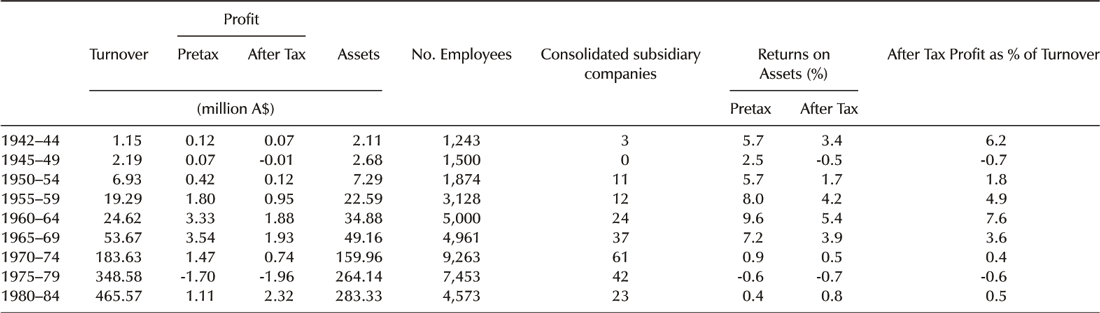
In August 1945, Jones and Leddy traveled to the Netherlands to discuss the expansion of the company’s activities in Australia, in particular the opportunity to amalgamate and expand the production capacity of the company into a single factory, rather than several small factories scattered throughout Sydney. There was a significant backlog in civilian demand for radio sets. As the Australian government continued trade protection to create job opportunities and encourage migration to the country, Philips Australia was expected to expand quickly. Table 1 shows that this was indeed the case. For example, employment more than tripled from the late 1940s into the 1960s.
Expansion, Consolidation, and Performance of Philips Australia, 1942–1984
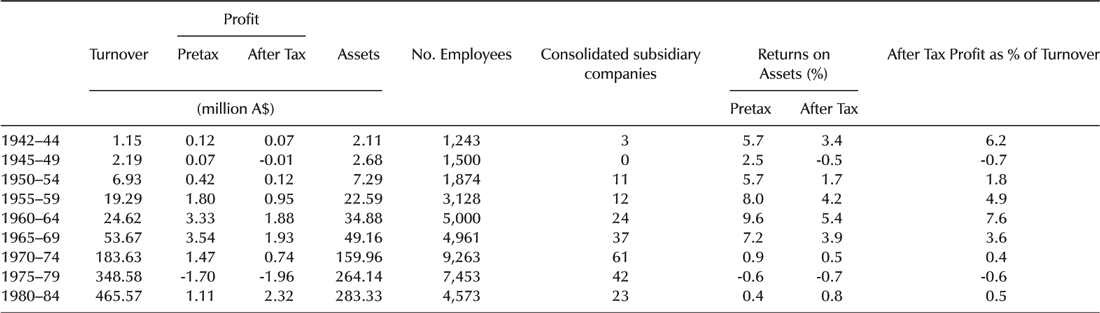
Five-year averages. No data available for 1952 and 1953, and 1950–54 is a three-year average. No account is taken of changes in the configuration of the company, nor changes in the accounting definitions. Employment for 1945–49 and 1960–64 are rough estimates. Increase to 1970–74 was due to the 1970 acquisition of Electronic Industries Ltd. Sources: Van der Eng, “Managing Political Imperatives,” 659; Philips Australia annual reports (1951, 1955-1985).
Building Good Relations with Politicians
The search for a new factory building turned into a major opportunity for Leddy to mend bridges with the Australian Labor government. Unable to find a suitable site in Sydney in 1945, he seized the opportunity to purchase obsolete munitions factory facilities in Hendon (South Australia) from the Secondary Industries Commission in the Ministry of Post-war Reconstruction. Footnote 28 The commission informed him that it was keen to see the communications equipment industry move away from the congested and strategically vulnerable Sydney area.
This opportunity coincided with the government of South Australia, particularly its Premier Thomas Playford, seeking to diversify the state’s economy by offering incentives to manufacturing companies willing to establish themselves in the State. Footnote 29 Consequently, the State government paid A£45,000 to the company, or one-third of the estimated cost of the transfer from Sydney to Adelaide.
Leddy was keen to seize this opportunity in order to shed the stigma of the company, having been told that the purchase would put the company “in the favour of the Federal Government, achieve an adequate share of Government work.” Footnote 30 Following negotiations in 1945, Philips Australia purchased the factory complex in 1946. It was expected to bring together the various Sydney factories and to employ two thousand people. Footnote 31
Playford opened the factory in 1947 in a blaze of publicity. However, Philips Australia soon discovered that the purchase was less fortuitous than it had publicly declared. Despite the benefit of securing a single site, the 1,400-kilometer distance between Adelaide and Sydney impeded communications between the production and commercial operations of the company. It also turned out that Philips Australia had paid too much for the factory. Leddy had significantly underestimated the cost, the duration, and the loss of production involved in the move from Sydney to Adelaide, which contributed to the losses the company recorded during 1947–48 and 1948–49. Footnote 32 An investigation by the Commonwealth Treasury found that, in hindsight, the move to Hendon had not been in the best interest of the company. Footnote 33 Philips Australia put its case to the governments of South Australia and the Commonwealth and received an ex-gratia government payment of A£45,000 in 1950. However, an increase in government contracts had not materialized by 1949. By 1952 the company still had not received the defense orders it had expected, and Leddy had to ask Playford to support his approach to the Commonwealth government in this matter. Footnote 34
In 1945–1946, Leddy found it difficult to convince the Philips parent company in the Netherlands of the “intangible” merits of the purchase of the Hendon facilities, with which he meant the social capital Philips Australia would generate by purchasing redundant assets from the Commonwealth government and by contributing to the regional development of Australia by moving to Adelaide. He believed in 1949 that they had been achieved and that Philips Australia had overcome the “political difficulties” of the 1940s. Footnote 35 It is difficult to substantiate the benefits that the company had generated, but it seems likely that they existed.
One benefit was that wages in South Australia were lower than elsewhere in the country due to Playford’s government compensating lower wages in the State with relatively good public facilities, low-cost housing, and price controls on consumer items. Footnote 36 Lower labor costs partly helped Philips Australia to offset the cost of supplying the main markets in the eastern states from Hendon. This so-called Playford Strategy also contributed to relatively stable industrial relations in South Australia. In addition, the State became the most industrialized in the country, which meant that Adelaide was a hub of companies that could supply goods and services that the Hendon factory required.
Leddy soon found himself on first-name terms with Playford, indicative of a congenial relationship. Footnote 37 For example, in support of Leddy’s quest for defense orders, in 1952 Playford approached Prime Minister Robert Menzies, who subsequently raised the issue with the Minister for Defense Orders, who in turn met with Leddy to pursue the case. Footnote 38 However, Playford was not a pushover. For example, when Leddy could not get the South Australian government to agree to a transfer of some land from the neighboring State railway yard in Hendon 1955, Playford professed that he could not intervene. Nevertheless, when Leddy threatened four years later that Philips would consider leaving Hendon, Playford approached the railway commissioner, who agreed to settle the issue. Footnote 39
At the Commonwealth level, Leddy found himself on good terms with the government when Liberal Party leader Menzies was prime minister from 1949 to 1966. The good relations between Philips and Menzies dated back to 1936, when then Attorney General Menzies visited the Philips parent company in Eindhoven, most likely to encourage the company to establish a radio valve factory in Australia, which was opened a year later. Footnote 40 Leddy maintained good relations with Menzies and other politicians, Footnote 41 and in particular with John McEwen, who was the long-time minister of Trade from 1949 to 1971. In 1962 Leddy invited McEwen to visit Eindhoven, and as he explained to Philips CEO Frits Philips: “On behalf of our Industry I have had some important dealings with him in the past [1959], one of which resulted in a protective tariff being placed on imported transistor receivers which saved our day against Japanese competition.” Footnote 42 The relevance of good political relations to the company’s operations manifested itself in several ways, which are discussed below. They benefited the rapid expansion of the company and contributed to Leddy being nominated for an OBE in 1958 and 1961 by Liberal Party stalwarts. Footnote 43
Expansion in the 1950s and 1960s
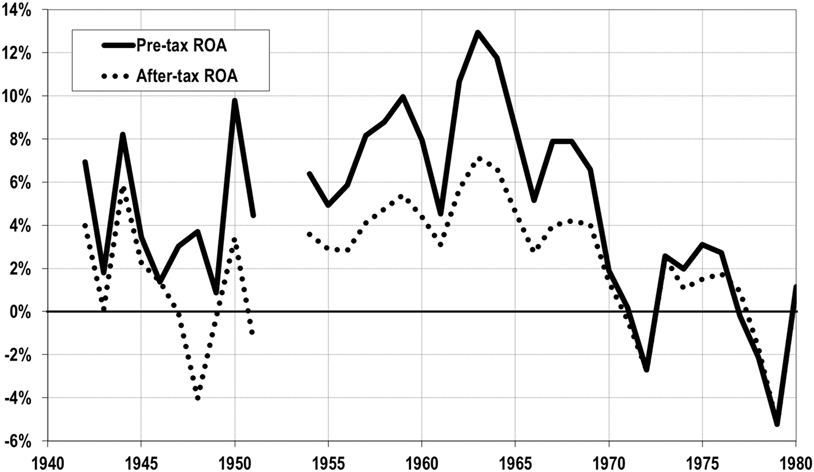
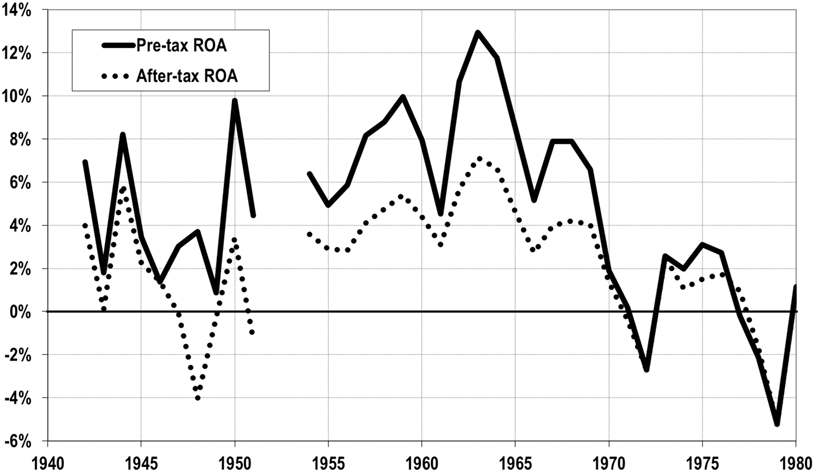
Leddy presided over a rapid expansion of employment at the company, from around one thousand employees in 1942 to five thousand by the early 1960s, while pretax profits were on average a healthy 8 percent during the 1950s and 1960s (Figure 1). Meeting the rapidly growing postwar demand in Australia for a diverse range of products was a major challenge in the context of shortages of labor, raw materials, and key components. Particularly when Philips Australia considered the production of television sets in the lead-up to the start of regular broadcasts in Australia in 1956, the main difficulty was sourcing of components, particularly valves and cathode ray tubes (CRTs; that is, TV picture tubes). Footnote 44 Importing was difficult due to tariffs, distance, and an international shortage of components. Glass manufacturers around the world either did not have the technology to produce the tubes or, if they did, were booked with orders from other television set producers. Footnote 45
Returns on assets of Philips Australia, 1942–80.
No data available for 1952–53. Sources: Van der Eng, “Managing Political Imperatives,” 659; Philips Australia annual reports (1951, 1955–1985).
The strategic solution was for Philips Australia to manufacture as many parts and components by itself in Australia rather than rely on imports. However, the conditions were that this had to be technically possible on the basis of the production technology that the company could import from the parent company in the Netherlands, and that trade protection would make the relatively small production volume in Australia economically feasible. Tariffs for components were subject to several Tariff Board inquiries, particularly radio and TV equipment (1959), CRTs (1960), capacitors (1962), TV receiver components (1963), transistors (1964), and TV receivers, channel tuners, and yokes (1967). In response to the Tariff Board’s recommendations, the Department of Trade revised tariffs. For example, in October 1960 the tariff on CRTs was revised down to A₤6 for British preferential imports and to A₤6 plus 12.5 percent for general imports. Footnote 46 In October 1967 the tariffs for channel tuners and deflection yokes were set at 30 percent for British preferential imports and at 45 percent for general imports. Footnote 47
To take advantage of the tariff protection, Philips Australia had to invest in component production and expand its production capacity, particularly in Hendon, as well as invest in the design and production of a range of products that were uniquely Australian. Consequently, production at the Hendon plant increased and diversified. It produced components such as radio and television valves in its so-called Miniwatt division, but also CRT coils, tuners, ferrites, aerials, electric motors, fans, condensers, and so on; and, among other items, metal and plastic moldings, radio and television cabinets as well as parts such as chassis mountings and even washers, screws, nuts, and bolts. This section later became the Electronics Components and Materials division (Elcoma). Footnote 48 Starting in 1959 it also produced semiconductors such as transistors and diodes.
The Hendon plant also produced a growing number of final consumer products such as radios (car, sets, portable), radio-gramophones, shavers, record players, and a variety of TV sets. It also produced customized industrial-, scientific-, and defense-related equipment, particularly communication equipment and television broadcasting equipment. In 1958 the facilities for customized production were amalgamated into the separate Telecommunication Company of Australia Pty Ltd., also located in Hendon. By the early 1960s, Philips itself produced around 95 percent of the value of radio and television receivers in Australia. The Hendon plant doubled its six acres of factory floor space in 1946 to 12.5 acres in 1964. Footnote 49
Philips Australia also diversified through acquisitions of related companies. For example, in 1951 it purchased Mullard Australia Pty Ltd., a sales company of radios and valves; Steane’s Sound Systems Pty Ltd., a sales company of amplifiers and sound systems; Associated Radio Finance Pty, a finance company; and Kriesler Australasia Pty Ltd. In 1951 it had six subsidiaries, rising to thirteen in 1958, and thirty-eight by 1965. Many of these companies produced related products, such as electric-blanket producer E. A. Hopkinson Pty Ltd.; Philips-Stanford Pty Ltd., which produced and imported medical X-ray equipment; and Lenora Glass Industries Pty Ltd., which produced light fittings for industrial and office buildings. Some subsidiaries were a consequence of the diversification of the parent company, such as Philips Roxane (Australia) Pty Ltd., which imported and distributed pharmaceuticals and pesticides from Philips Roxane (later Philips Duphar) in the Netherlands. Other subsidiaries were forward integration, such as the 50 percent share the company took in Melbourne-based electrical appliance retailer Eric Anderson in 1967. Footnote 50 In all, Philips Australia embedded itself in Australia’s business system through this significant diversification of activities.
A major expansion was the 1970 acquisition of Electronic Industries Ltd. (EIL), a large and diversified industrial conglomerate in Melbourne. EIL produced electronic products under the Astor brand, especially radios, television sets, and large appliances, including washing machines, refrigerators, freezers, and laundry dryers, but also cassette players, clock radios, and records. EIL also had a range of noncore companies, including electrical retailers and producers of, among other things, furniture, mattresses, vending machines, bicycles, and machine tools. Footnote 51 The main reasons for the acquisition were that EIL was a major customer for the componentry that Philips Australia produced in Hendon, and that it was a subsidiary of Pye of Cambridge Ltd., which the Philips parent company had acquired in 1967. When EIL suffered significant losses in 1969, Philips decided that Philips Australia would have to absorb these.
Localization of Senior Management and Strategic Board Appointments
One of the reasons Philips Australia had been investigated by the Australian secret service during World War II was related to the fact that almost all senior company executives had Dutch or other continental European nationalities. As part of a 1942 agreement with the Australian government, MD Leddy had to change that, but labor shortages did not allow him to replace Europeans with Australian nationals in senior executive functions until 1945. Jones was the first appointment, becoming the company’s technical director in 1951. A further key appointment was Geoffrey Wilfrid Bottrill as chief accountant (later finance director) and the promotion of Everard Walter Burnett and William J. R. Gluth to commercial managers. The factory managers in Hendon and Newcastle remained Dutch nationals because of their manufacturing experience in Philips factories in the Netherlands, but by 1951 only four of the two thousand employees on the payroll were Dutch nationals. Footnote 52
From 1926 until 1949, the board of the company comprised the MD (Philips required that this position be filled by a Dutch national through the 1990s), two representatives of Warburton Franki Ltd. and Lawrence & Hanson Electrical Pty Ltd. (the main distributors of Philips products in Australia), and a senior partner of Sly & Russell (the company’s legal representatives). Board membership did not increase to six until 1949, and it varied between seven and eleven members from 1950 to 1980. The expansion allowed Leddy and his successors to make strategic board appointments. Board members were selected not only on the basis of their experience in the communications and electronics industries but also on the basis of political connections. Among the very influential board members of Philips Australia were:
-
• Sir Samuel O. Jones (board member 1949–1961), an engineer who started his career in the late 1930s in the Postmaster General’s department, was quickly promoted during the war to occupy an influential position in the communications and electronics industry as the head of the Directorate of Radio and Signal Supplies in the Commonwealth Department of Munitions, before coming to Philips in 1945 with an extensive network of contacts in the electronics industry and in relevant government agencies (see above). Footnote 53
-
• Sir John Madsen (board member 1949–1962) was professor of Electrical Engineering at the University of Sydney until 1949. His biographer notes that he “foresaw the rapid growth of the communications industry and fostered it by providing in Australia a solid background of relevant research.” Footnote 54 After retirement, Madsen remained influential in communications engineering as an advisor to the Commonwealth Scientific and Industrial Research Organisation. Footnote 55
-
• Sir Denzil Macarthur Onslow (board member 1958–1975) was a decorated career army officer, who in 1958 was the highest-ranking officer in the Citizen Military Forces in Australia. Footnote 56 He had long-term contacts in the Liberal Party, and had various business interests in Sydney.
-
• Sir Frank F. A. Meere (board member 1962–1975) worked at the Import Licensing Branch of the Department of Trade and Customs in the 1940s, and knew Leddy in that capacity. He had been comptroller-general of Customs and head of the Department of Customs and Excise. After retirement in 1960, he became head of the Special Advisory Authority (SAA) on tariffs to Trade Minister McEwen. Meere’s motto for Australian manufacturing was: “You make it and I’ll protect it.” Footnote 57 Until its abolition in 1974, the SAA’s purpose was to neuter the Tariff Board’s recommendations on manufacturing tariffs in favor of protection. Leddy considered Meere’s SAA appointment a key reason for his board membership and an indication of “the esteem in which he [is] held in Government circles.” Footnote 58
-
• Sir Wilfred Alan Westerman (board member 1977–1984) had been at the Department of Trade since 1949, last as its secretary. Like Meere, Westerman was closely associated with McEwen. He was “hard-line on tariffs” and “staunchly convinced of the part preferences had played in Australia’s development. This led him to be unyielding in his opposition to their progressive abolition.” Footnote 59 Westerman was executive chairman and later chairman of the Australian Industry Development Corporation from 1970 to 1983.
The board minutes of the 1960s and 1970s indicate that board members were occasionally involved in lobbying politicians at State and Commonwealth levels in Australia in the interest of Philips Australia, whenever the need for such action arose. Footnote 60
As part of the localization strategy, the board supported Leddy’s initiative in 1960 for Philips Australia to become a listed public company. Footnote 61 Leddy intended to create a holding company structure that would bring together Philips Australia’s interests in a growing number of local subsidiaries. Footnote 62 In broad terms, Leddy also considered this an appropriate change for the purpose of building social capital in the host country. However, local part-ownership was then against the principles of the parent company, which insisted on full control. This only changed in 1970, following a share swap with shareholders in EIL, a public company. About 25 percent of shares in Philips Australia shares were subsequently traded on the local stock exchange.
Creating a Positive Public Profile: Publicity and Support for National Events
The 1950s and 1960s were a period of significant growth for the company. Due to the war, there was a backlog in demand for radio receivers, and in 1956 a new market for TV receivers opened up. However, there was also a growing market for other consumer electronic and electrical goods and for professional electronic equipment. To nurture its relations with stakeholders and customers, the company created an amalgam of ways to interact with them and enhance its embeddedness in Australia’s society and business environment.
Apart from regular advertising campaigns in newspapers and magazines, the company also communicated with wholesalers and retailers through specialist journals, such as Philips Sales Bulletin and Philips Sales Promoter, which contained details of new Philips products in Australia. Where possible, it sought publicity through the media to draw attention to new products that came onto the market and to reinforce the improved reputation of the company. Some examples include:
-
• Philips delivered lighting for national events, such as international cricket matches at the Melbourne Cricket Ground in 1954, Footnote 63 the lighting of Philips main office in Sydney on the occasion of the Queen’s visit to Australia in 1954, Footnote 64 the lighting for the 1956 Olympic Stadium in Melbourne, and the Sydney Harbour Bridge.
-
• Leddy was an avid gardener, and in 1954 he arranged the delivery of tulip and hyacinth bulbs for the gardens of Parliament House in Canberra. Footnote 65
-
• The company used other newsworthy occasions to draw attention, for example, donations to charities such as travel scholarships in 1948 and a donation of £5000 to assist the Commonwealth government in shipbuilding in 1951, as well as the delivery of new X-ray equipment to hospitals.
-
• Some advertising campaigns reinforced the good reputation of the Philips brand name, for example, “How Philips research is changing your life,” in 1960, Footnote 66 and “Why does the name Philips crop up so often,” in 1963. Footnote 67
Executives of Philips Australia also played a role in public debate and were regarded as authorities in the field of electronics and communications. For example, they were involved in discussions leading up to the introduction of television in Australia in 1956. Discussions on this had started in the 1940s, particularly with the introduction of the 1948 Broadcasting Act. In 1952 Leddy sought to urge the government to make an announcement, arguing that television manufacturers were ready to plan production and extoling the international experience of Philips with television. Footnote 68 A year later, in 1953, Jones submitted evidence on behalf of Philips Australia to the Royal Commission on Television, which explained the views of the company on the establishment of television broadcasting in Australia. Footnote 69
Prime Minister Menzies announced the introduction of television in 1954. The plan was to have television in place in time for the 1956 Melbourne Olympic Games. Philips Australia was consulted in planning the start of television broadcasting in Australia, establishing the technical standards and producing the television broadcasting equipment and television receivers. The company planned expansion of production capacity at Hendon, using the latest design advances from Philips companies in Europe and North America. Footnote 70 Broadcasting started in mid-1956, in time for the Olympics in November 1956.
This publicity reinforced the Philips brand name in Australia, as well as the public’s association of the brand name with quality products. Philips products were generally more expensive than those of competitors in order to support that impression. In reality, the company had but a modest market share in final products, such as radios and televisions. The reason was that the income of the company depended largely on the sales of semi-manufactured components to other makers of radio and television sets—of which there were many in the relatively small Australian market—rather than final products. Sales of valves and later of transistors and integrated circuits (ICs), as well as TV tubes, transformers, TV tuners, and other components, together with incandescent lamps, underpinned the company’s financial performance, generating around 70 percent of the profits of Philips Australia in the 1960s. Footnote 71
Role in Australian Business and Society
Leddy played a leading role in industry associations. For example, he chaired the Electronic & Allied Industries Division of the Chamber of Manufactures in NSW. As the company expanded, Leddy’s seniority in the electronics and communications industries increased. Together with executives of the company’s main competitors—AWA in Sydney (particularly AWA Chairman Sir Ernest Fisk and AWA Secretary Sir Lionel G. A. Hooke), and EIL in Melbourne (specifically its chairman and MD Sir Arthur G. Warner)—Leddy was a leading figure in the industry. This helped the company maintained good relations with State and Commonwealth governments as well as industry associations. Footnote 72 An indication of his status in the industry is that industry journal Mingay’s Electrical Weekly gave him a sixty-four-page salute when Leddy departed Australia for Italy in June 1962.
In many ways, Leddy personified the commitment of Philips to the host country. Nevertheless, he remained fully aware of the potentially precarious position of the company in Australia, as it was largely dependent on trade protection for its existence in its current form. It was clear to Leddy that Philips Australia had to build ownership-specific advantages, based on firm-specific technological capabilities. By 1949 he had already appointed board member Madsen to improve the scientific and research side of the company’s activities in Hendon. Footnote 73 He persisted with that goal using opportunities in public addresses to stress the need for Australian firms to engage in research and development (R&D). Footnote 74 He drove Philips Australia to establish R&D facilities in Hendon, which he also used to cement cordial relations with Prime Minister Menzies. In 1959 Menzies visited Philips in the Netherlands. The same year, he opened the A£400,000 new mass-production semiconductor factory at Hendon to produce transistors and diodes, and he laid the foundation stone for the company’s research center in Adelaide, promptly named the R. G. Menzies Research Laboratory. Footnote 75 The laboratory had eight employees—physicists, chemists, and engineers—and was the result of Leddy’s sincere interest in fostering R&D in Australia.
Leddy frequently expressed his opinion in public that Australian companies had to do more to build their R&D capabilities in order to sustain further industrial development, reduce Australia’s dependence on imported technology, improve business education in order to nurture new generations of business people, and encourage export production by manufacturers. This was a welcome message in the early 1960s, when Australia experienced foreign exchange shortages. Apart from cutting imports, the government encouraged firms to consider ways to increase exports. Until then, the opportunities for Philips Australia to produce for export had been limited. Partly it was because its products lacked international competitiveness, but mainly it was because the parent company expected it to restrict any exports that competed directly with exports from the Netherlands.
Leddy used a call by the Australian government in 1962 to start discussions on the future role of Philips Australia in the global operations of the MNE. In effect, he argued that Philips Australia would have to invest more in R&D in order to develop the technological capabilities that would allow it to become a hub for the MNE’s activities in the Pacific, if not the wider Asia-Pacific region. Footnote 76 However, he could not pursue this intention further because the parent company required him to take control of the Philips operations in Italy. In his farewell speech, Leddy explicitly urged the electrical equipment industry in Australia not to be complacent about tariffs and to invest in R&D with the aim of building export capabilities. Footnote 77
Leddy’s vision tied in with Australia’s industry policy in the 1960s, which supported manufacturing companies to develop new technological capabilities. Since 1967, the government has maintained incentive schemes to foster R&D in Australia. Major recipients included local companies in the “electric and electronic apparatus” sector such as Radio Corporation and Philips Electrical (both Philips subsidiaries), Ericsson, and Pye. Footnote 78 Subsequently, the Menzies laboratory focused on IC research in projects that were half-funded by the government and half-funded by Philips Australia. Footnote 79 Nevertheless, R&D by foreign-owned firms in Australia remained, on the whole, limited. Footnote 80 Locally and foreign-owned firms mainly relied on licensing arrangements with foreign patent holders to acquire new technology. Their export ambitions may also have been curtailed by export franchise arrangements that allowed them to access technology overseas but were conditional on restrictions on export ambitions. Footnote 81
Philips Australia lacked continuity in leadership during the rest of the 1960s, with three MDs in quick succession: Pieter C. Vink (1962–1964), Adriaan J. W. van Agt (1965–1969), and Herman D. Huyer (1969–1980). Nevertheless, the company made a serious effort to seek technological upgrading of its products through R&D in order to become a hub for the MNE’s operations in the Asia-Pacific region. Some exports occurred, such as the delivery of specialized communications equipment to Singapore and Malaysia in 1968, and exports of VHF and FM mobile radiotelephones to Hong Kong, Singapore, Malaysia, New Guinea, and Taiwan. Footnote 82 However, a major obstacle to exporting was that the parent company had to give Philips Australia permission for exports of items that would compete directly with its exports from the Netherlands. Footnote 83 The semiconductor research at Hendon was focused on the development and production of specific advanced ICs that Australia’s armed forces required. Footnote 84 This research contributed to the decision in 1966 to establish an IC production facility in Hendon. Footnote 85 The plant started in 1970, producing advanced ICs for the Commonwealth Department of Supply, and was expected to become the hub of technological innovation for the company. New MD Huyer reported that year that the opening of the IC factory had made “a good impression” in Canberra, the seat of Australia’s federal government. Footnote 86
The Limits of Political Influence, 1970s
Nevertheless, the company’s aspirations in the 1960s did not reach fruition. In the 1970s, it was not able to capitalize on the social capital it had accumulated for the purpose of influencing the changes that unfolded in Australia’s business environment and/or create new opportunities for itself. Four main issues prevented this.
First, the aftermath of the amalgamation with EIL was very complicated. Huyer sought to establish clarity on the structure and the policies of the amalgamated company, as well as on the responsibilities of all subsidiary firms. Footnote 87 In all, the number of subsidiary companies doubled in 1970 to a very unwieldy seventy-four, which the company arranged in a multidivisional structure. Footnote 88 However, Huyer soon discovered that many of these former EIL companies were not viable. This contributed to Philips Australia’s first loss in 1972 (see Figure 1). It took several years to identify, restructure, or close or sell the unviable companies; sell surplus assets such as buildings, warehouses, machine tools, and land; and reduce duplication of the activities across remaining companies through amalgamations. The problem repeated itself after the Philips parent company required Philips Australia to absorb the Pye group of companies in Australia from 1975 through 1977.
Second, while Philips Australia, its board, and MDs remained on good terms with the 1966–1972 Liberal–Country coalition governments that succeeded Menzies, it did not have the same rapport with the Labor government of Gough Whitlam that was voted into office in December 1972. While signs of macroeconomic instability had announced themselves earlier, problems of industrial unrest, rising wages and inflation, and significant institutional change occurred during the 1973–1975 Whitlam years. A major issue for the company was the increasing competition for electrical and electronic goods from imported products in Australian markets after the new government embraced a program of reform of trade and industry policies, starting with the widely unexpected 25 percent tariff reduction in July 1973.
The effective rate of protection varied across products in the electrical and electronic goods sector. For 1972 and 1973, the Tariff Board found effective rates of protection for CRTs of 240 percent, radios of 300 percent, and electronic components of 130 percent. Footnote 89 On average, the effective rate of protection for “appliances and electrical equipment” was 49 percent in 1968–69, which decreased to 22 percent in 1977–78. Footnote 90 This reduction came at a time when Japanese producers of electronic and electrical equipment had significantly improved the international competitiveness of their products. Footnote 91 Japanese products were not necessarily cheaper, but they were of better quality than Australian-made products, and they came with better servicing and marketing. They also contained the latest technologies, which Philips Australia could not develop and apply on short notice. Consequently, imported Japanese products captured significant market share in the late 1970s. While Philips products withstood increased competition due to the Philips brand reputation, the more important problem was that other Australian television set producers reduced their orders for componentry, such as CRTs from Philips, at a time when the company experienced rising labor costs.
Third, domestic TV producers were hoping for a one-off opportunity to improve their balance sheets when in 1972 the Australian government decided to introduce CTV broadcasts, starting in March 1975. With the support of senior management and the board of Philips Australia, MD Huyer was vocal from the outset in articulating the industry’s view in Canberra, and later in the Australian media, that producers would only invest in CTV production in Australia, and that Philips would only invest in the production of CTV picture tubes, if the government guaranteed adequate tariff protection. Footnote 92 This triggered a 1973 Tariff Board inquiry into higher tariffs for CTVs and components. However, the change of government in December 1972 changed the parameters. From 1970 to 1972, Huyer had come to know Whitlam as an opposition leader, only to realize that Whitlam “did not have the faintest idea of economics and business. Moreover, he did not trust any advice given to him.” Footnote 93 In other words, Huyer had no traction in Labor circles.
Preempting the Tariff Board’s report, Huyer sought to force the government’s hand by announcing in April 1973 that Philips Australia would commit to CTV production and create new employment to be able to meet the March 1975 deadline. Footnote 94 Instead, a year later it became clear that the company’s social capital had depreciated significantly. Its April 1974 board meeting clarified that the Tariff Board was due to recommend a zero tariff on imported electronics components and a 35 percent tariff on imported CTVs, and that the government was due to follow this advice. Philips faced firing three thousand people and closing the Hendon plant as black-and-white TV production would be phased out, and radios and components would have to be imported. Footnote 95 Following the public announcement of the decision in July 1974, Huyer argued publicly that the entire Australian electronics industry would be in danger of collapse due to the government’s acceptance of the tariff reductions on TVs and components. Footnote 96 He predicted that TV manufacturers would use imported parts, and that twelve thousand employees would be retrenched during the next eighteen months. He also announced that Philips Australia would start closing down its Hendon operations. The Labor premier of South Australia, Don Dunstan, spoke on behalf of the company in an effort to stem the tide of job losses in his state, but his arguments fell on deaf ears in Canberra. Footnote 97
In the years that followed, Philips Australia restructured by selling many of its noncore local subsidiaries, scaling down production operations, and dismissing 1,850 workers until most of the Hendon plant was effectively closed by 1979. The company did commence production of CTVs in its Clayton plant in Melbourne. This was a relatively new factory that EIL had built in 1969 for monochrome TV assembly. However, this plant used CTV tubes and componentry imported from overseas Philips plants. It was successful in capturing a significant share in Australia’s CTV market and its sales revenues increased. Nevertheless, increased Japanese competition drastically reduced its profit margins on CTV sales. Footnote 98
Fourth, Philips Australia received limited guidance from its parent company in handling the difficulties in which it found itself. In the 1960s and 1970s, 60–65 percent of the parent company’s global turnover was in Western Europe, where it was absorbed by the need to defend its market position in the context of the process of European integration. Its strategy focused on a painful and involved process of consolidating production facilities across Europe and taking commercial decisions away from national organizations and placing them in the hands of the company’s product divisions. Footnote 99
The restructuring of the parent company’s operations in Europe resulted in a haphazard global strategy that left nothing of the earlier intentions to encourage Philips Australia to become the hub of the company’s operations in the Asia-Pacific region. The plan for Australia to become the company’s focus for regional IC production was thwarted by the decision by the relevant product division in the parent company to concentrate IC production in Europe and Taiwan. Consequently, Philips Australia closed the Menzies Research Laboratory and most of its IC factory in Hendon. Without mass production of such advanced technology, its options became limited. At the same time, the parent company fostered the development of supply centers in Asia, starting with Taiwan (1966), Hong Kong (1969), and Singapore (1970); Philips Australia was expected to order supplies from those subsidiaries.
Thus, it became clear during the 1970s that the social capital that Philips Australia had accumulated starting in the mid-1940s to overcome the issues it experienced in 1943–1944 had depreciated due to a series of developments that the company found nearly impossible to influence. MD Huyer and the company board had little traction in Labor Party circles or with Australia’s emboldened labor unions. Its main competitor in the Australian electronics industry, AWA, endured exactly the same problems, even though this company was actually partly government-owned. Footnote 100 Like Philips Australia, AWA also concluded that the only remaining option was to further restructure activities by divesting unviable subsidiary companies, closing production operations, and focusing on the sales of imported products. Employment in Philips Australia decreased quickly, from 18,500 immediately after the amalgamation with EIL in 1970; to 5,500 in 1980; to 2,900 in 1990, when 75 percent of employment in the firm was in sales rather than production.
Conclusion
This article has demonstrated that Philips Australia employed a range of strategies to mitigate and overcome the difficult situation it experienced in 1943–1944. The company actively sought to “embed” itself in the local business environment for that purpose. It also engaged in the development of ownership-specific advantages as well as political activities through lobbying from the 1940s through the 1960s. Ownership-specific advantages took the form of leveraging technology from the parent company for the purpose of producing componentry for domestic producers of final electronic goods, to the extent that its production operations were indispensable for the growing electronics industry in the 1950s and 1960s.
At the same time, the firm actively accumulated social capital in several ways. It built and maintained strong relations in the domestic electronics industry and in politics at state and Commonwealth levels to influence discussions on the direction of policies impacting on the industry. Philips Australia also localized senior management, maximized local procurement and local manufacturing, took a leading role in industry associations, and used marketing tools to build a strong brand and a positive public profile in Australia. The strategy helped to minimize risk and maximize commercial opportunities for the firm.
Developments during the 1970s made it clear that this strategy of pursuing “national embeddedness” was very context-dependent, particularly on the context of trade protection and political connections with the parties and politicians that sustained this policy. As soon as a new government started to change many of the rules that defined Australia’s business environment, Philips Australia experienced that the social capital it had accumulated during the 1950s and 1960s depreciated significantly. The company was unable to use what social capital was left to prevent or influence these policy changes. In the face of increasing competition from Japanese electronics firms, Philips Australia had to restructure and downsize its manufacturing operations in Australia. Despite increasing reliance on imports and efforts to specialize production on high-value added products, Philips Australia saw its profitability and market share decrease.
On the other hand, main domestic competitor AWA had exactly the same experience, even though it was partly government-owned. Hence, the “embedding” strategy of Philips Australia had been so successful that, by the early 1970s, there was very little that distinguished the company from its main local competitor, except its ownership structure. The MD may have been a Dutch national, but middle and higher management staff were Australians; the company served local clients; most of the value of the company’s intermediary and final products was produced in Australia; and customers often believed that Philips was a local brand.