Significant outcomes
∙ The T-carriers of BDNF rs61888800 had a more favourable temperament change on the NS dimension towards recovery than did the GG carriers.
∙ For NRG1 rs3924999, the GG genotype showed a more favourable change in RD than the A-carriers.
Limitations
∙ Small study sample, lack of replication sample, relatively short follow-up time and single-nucleotide polymorphism (SNP) analyses are the limitations of the present study.
Introduction
The diagnosis of major depression (MDD) has been defined as a cluster of specific symptoms, including among others depressed mood, anhedonia and lack of energy, but the clinical features of an individual patient are heterogeneous and therefore prediction of treatment response is challenging. There is a need for biological markers as outcome measures, because currently used depression measures are based on reporting of clinical symptoms, while each measure has its limitations and therefore measuring outcome lacks accuracy.
Temperament patterns can be observed since early infancy and have been associated with thickness of cortex in infants (Reference Schwartz, Kunwar and Greve1). Brain-derived neurotrophic factor (BDNF) is a protein involved in the proliferation, differentiation and survival of neuronal cells and in the regulation of synaptic plasticity and connectivity in the adult brain, and BDNF has been associated with personality traits, temperament and depression (Reference Post2,Reference Kazantseva, Gaysina and Kutlumbetova3). BDNF also has a possible role in regulating interactions between neurons and microglia (Reference Maletic, Robinson, Oakes, Iyengar, Ball and Russell4). Neuregulin-1 (NRG1) is a neurotrophic factor that has been associated with treatment response to serotonin selective antidepressive agents in MDD and with the risk of major depression (Reference Biernacka, Sangkuhl and Jenkins5,Reference Wen, Chen and Khan6). NRG1 has been found to induce activation in tropomyosin-related kinase B, which is a receptor of BDNF, and the receptor has been found to mediate neural plasticity and is also reportedly involved in the mechanisms of action of antidepressive drugs (Reference Castren and Rantamaki7). Both NRG1 and BDNF induce myelination in the central nervous system by oligodendrocytes through increasing N-methyl-d-aspartate receptor currents (Reference Lundgaard, Luzhynskaya and Stockley8). We wanted to investigate the association between both neurotrophic factors BDNF and NRG1 and temperament in presence of major depressive disorder.
Temperament has in general been defined as the innate part of the human personality as opposed to learned features (Reference Cloninger, Svrakic and Przybeck9). Cloninger developed a psychobiological personality model describing four dimensions of temperament, namely harm avoidance (HA), novelty seeking (NS), reward dependence (RD) and persistence (P). The temperament dimensions in Cloninger’s model are suggested to present different dimensions of automatic neural responses possibly associated with specific monoaminergic activity (Reference Cloninger10).
According to a meta-analysis patients with major depressive disorder have been shown to have higher score in HA and lower scorers in the other three temperament dimensions (Reference Zaninotto, Solmi, Toffanin, Veronese, Cloninger and Correll11). More specifically, the HA score level has showed to be inversely associated with euthymia in depressive disorder (Reference Zaninotto, Solmi, Toffanin, Veronese, Cloninger and Correll11). The relationship between temperament and depression has been supported in a number of studies as an association with the risk of depression, risk of recurrence and impact on treatment response (Reference Zaninotto, Solmi, Toffanin, Veronese, Cloninger and Correll11–Reference Teraishi, Hori and Sasayama20). According to many studies the temperamental changes during recovery from depression include a marked decrease in HA and to some extent an increase in RD (Reference Kampman and Poutanen13).
Since the temperamental traits during depressive state can be regarded as a result of abnormal neuronal processing, this abnormality could be a consequence of a genetic vulnerability in the genes involved in neural regeneration mechanisms. Several SNPs in BDNF gene have been associated with antidepressant response (Reference Licinio, Dong and Wong21). The BDNF gene has been suggested to have an important role in the pathogenesis of depression, and moreover in neurogenesis and synaptogenesis during antidepressant drug treatment (Reference Castren and Rantamaki7,Reference Castren and Kojima22). The rs11030103 has been associated with major depression (Reference Licinio, Dong and Wong21), but in other studies no association was found (Reference Illi, Viikki and Poutanen23,Reference Pae, Chiesa and Porcelli24). In another study rs11030103 of BDNF, but not rs61888800, was found to be associated with a change in MADRS score among patients receiving electroconvulsive therapy (Reference Viikki, Jarventausta and Leinonen25). The rs11030101 of BDNF has been reported to be associated with depression and the rs61888800 of BDNF with better response to antidepressant treatment (Reference Licinio, Dong and Wong21), although other studies did not support this finding (Reference Illi, Viikki and Poutanen23,Reference Colle, Deflesselle and Martin26). NRG1 has been found to have an important function in neurodevelopment, neurotransmission and synaptic plasticity (Reference Mei and Xiong27). In a large case–control study, rs 3924999 and several other NRG1 SNPs and haplotypes have been associated with the risk of major depression, bipolar disorder and schizophrenia (Reference Wen, Chen and Khan6). The rs6994992 of NRG1 has been associated to depression symptom severity, psychotic symptom patterns and alcohol use disorders (Reference Bousman, Potiriadis, Everall and Gunn28,Reference Vaht, Laas, Kiive, Parik, Veidebaum and Harro29).
Studies exploring associations between temperament and genetic variations in BDNF or NRG1 in major depression are so far rare. Mandelli et al. in a sample of 86 bipolar spectrum depressed patients reported both BDNF haplotype of SNPS rs6265 and rs11030104 (A–C) and higher HA score to be associated with poorer 6-month treatment response, but HA scores were not associated with these BDNF genotypes (Reference Mandelli, Mazza and Martinotti30). In a meta-analysis NRG1 was found to potentially affect selective serotonin reuptake inhibitor (SSRI) treatment and NRG1 has been suggested to be a biomarker for depression (Reference Biernacka, Sangkuhl and Jenkins5).
We investigated the separate effects of and possible interactions between functional polymorphisms BDNF rs11030101, BDNF rs61888800, NRG1 rs3924999 and NRG1 rs6994992 polymorphisms on changes in temperament dimension scores (HA, NS, RD, P) assessed by the Temperament and Character Inventory (TCI) in a clinical sample of subjects with major depression, who received SSRI-treatment for a period of 6 weeks.
Methods
Study subjects and clinical intervention
The study population consisted of 98 Finnish individuals 19–72 years of age [41 males and 57 females, mean age (SD) 40.5 (14.1) years]. All subjects were patients in secondary outpatient services in Pirkanmaa Hospital District, Finland (total catchment population ~300 000). The inclusion criteria were: (1) current episode of major depressive disorder according to Diagnostic and Statistical Manual of Mental Disorders, 4th Edition (DSM-IV) criteria and (2) a Montgomery–Åsberg Depression Rating Scale (MADRS) (Reference Montgomery and Asberg31) score of at least 20. The doses of the study medication were adjusted according to the clinical response, which was checked during a visit after 3 weeks of treatment. Medication adherence was self-monitored by keeping a paper-and-pencil medication diary. We considered an adherence rate of at least 80% as adequate treatment. Each patient was interviewed by clinical researchers, who were all experienced psychiatrists before the initial assessment for the study. In the initial assessment the DSM checklist for the MDD was fulfilled for each patient. Major somatic diseases, with medications potentially causing depression, bipolar disorder, schizophrenia, severe personality disorders or disorders related to substance abuse were considered as exclusion criterion. Patients treated for previous depressive episodes had to be free from antidepressants for the past 3 months, and mood stabilising or antipsychotic medications were not allowed. Anxiolytics and hypnotics in minor doses were permitted at the early stage of the study. Most of the patients (n=80, 81%) had no history of previous depressive episodes versus patients with previous depressive episodes (n=18, 18.4%).
The TCI is a questionnaire developed to distinguish the four dimensions (Reference Cloninger, Svrakic and Przybeck9). For assessment of temperament dimensions all study subjects completed the 107-item TCI temperament questionnaire (version IX) in the presence of clinical researcher and MADRS interview was performed at the initial assessment of the study and after 6 weeks of follow-up. For 6 weeks the patients received SSRI medication, citalopram, fluoxetine or paroxetine (the three most frequently prescribed SSRIs in Finland at the time the study). Citalopram was used by 51 patients (52.0%), fluoxetine was by 35 patients (35.7%) and paroxetine by 12 patients (12.2%). Out of 57 females 26 (45.6%) were using citalopram, 22 (38.6%) fluoxetine and nine paroxetine (15.8%). Out of all males 25 (61%) were using citalopram, 13 (31.7%) fluoxetine and three (7.3%) paroxetine. The treatment response was determined as at least 50% MADRS score reduction. All subjects gave written informed consent and the local ethics committee approved the study protocol.
DNA extraction and BDNF rs11030101, BDNF rs61888800, NRG1 rs3924999 and NRG1 rs6994992 genotyping
Genomic DNA was extracted from peripheral blood leucocytes using the QIAamp DNA Blood Minikit and automated biorobot M48 extraction (Qiagen, Hilden, Germany). BDNF gene alterations rs11030101 and rs61888800 were genotyped using Taqman SNP Genotyping Assays C___1751785_10 and C__89097203_10, respectively, and the ABI Prism 7900HT Sequence Detection System (Applied Biosystems, Foster City, CA, USA). A total of 10 random samples were run as duplicates. No discrepancies were found.
Statistical methods
MADRS baseline and endpoint scores were compared between the studied genotypes by using analysis of variance (ANOVA). For exploratory analysis, Pearson’s correlations between BDNF and NRG1 genotypes and scores for changes in temperament dimensions from baseline to 6 weeks were calculated to select the temperament dimensions for the general linear univariate model (GLM). T-test was used in the calculation of mean differences between temperament score changes between the BDNF and NRG1 genotype groups. GLM models were used to predict NS and RD change. These models were adjusted for age, gender and MADRS score change, and BDNF and NRG1 genotypes were used as explanatory variables.
Results
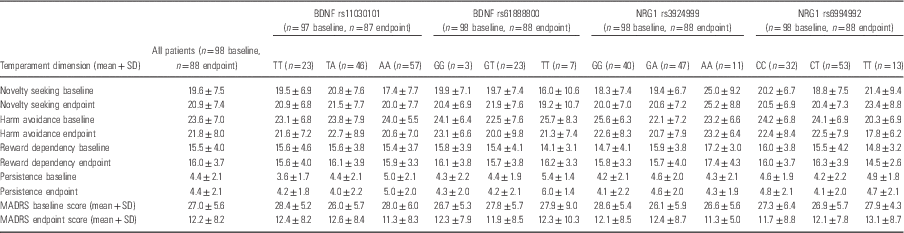
The genotype distributions of both BDNF and NRG1 SNPs according to temperament dimensions and MADRS scores at baseline and endpoint are presented in Table 1. At 6 weeks 88 patients completed the TCI questionnaire and 87 the MADRS interview. BDNF rs11030101 genotyping failed in one patient. There were no significant differences in MADRS baseline or endpoint scores between any of the study genotypes (ANOVA). MADRS baseline or endpoint scores did not show significant correlations with temperament change scores, except for ΔHA (r=0.36, p=0.001) at endpoint.
The genotype distributions of both brain-derived neurotrophic factor (BDNF) and neuregulin-1 (NRG1) single-nucleotide polymorphisms according to temperament dimensions and Montgomery–Åsberg Depression Rating Scale (MADRS) scores at baseline and endpoint.

The correlation between BDNF rs61888800 T-carrying status and change in NS scores from baseline to 6 weeks was significant (r=0.23, p=0.034). A negative significant correlation was found between NRG1 rs3924999 A-carrier status and RD change (r=−0.29, p=0.005).
Mean comparisons between corresponding temperament dimensions and genotypes revealed significant differences between NS change and BDNF rs61888800 T-carrying status (mean difference: GG 0.30, GT/TT 2.47, p=0.022, t-test) and between RD change and NRG1 rs3924999 A-carrying status (mean difference: GG 1.21, GA/AA -0.33, p=0.003), but not between baseline or 6-week NS score and BDNF genotype, or RD baseline or 6-week score and NRG1 genotype.
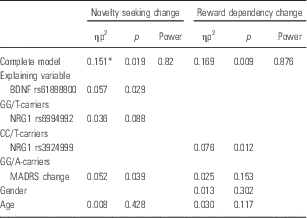
In GLM for NS and RD change age, gender, MADRS score change and BDNF or NRG1 genotypes were used as explanatory variables. The best fitting models for NS change comprised BDNF rs61888800 T-carrying status, age and MADRS score change (model 1). This model explained 11.8% of the variance of the NS change (ηp2=0.118) and when NRG1 T-carrying status was added to the model (model 2), it explained 15.1% of NS change (ηp2=0.151). For RD change the best fitting models included NRG1 rs3924999 A-carrying status, age and MADRS score change (model 1). This model explained 14.9% of the variance of RD change (ηp2=0.149) and when gender was added to the model (model 2), it explained 16.9% (ηp2=0.169) of the RD change. The results of the GLM models are presented in Table 2.
Results of the two analysis of covariance models, in which temperament dimension changes (endpoint-baseline) of novelty seeking and reward dependence were used as target variables and BDNF rs61888800 and NRG1rs6994992 or NRG rs3924999 genotypes as factors and Montgomery–Åsberg Depression Rating Scale (MADRS) score change and age as covariates

* Model 2: Including both BDNF rs61888800 GG/T-carriers and NRG1 rs6994992 CC/T-carriers.
Discussion
In this study we explored changes in temperament dimension scores at the acute stage of depression during 6-week treatment with SSRI. We also analysed the levels of depressive symptoms before and after acute phase treatment between the BDNF and NRG1 genotypes. We found the T-carriers of BDNF rs61888800 to show an increase in NS score. The outcome measured with MADRS score change also had an effect on this difference in the multivariate analysis. In addition, patients with GG genotype in NRG1 rs3924999 showed an increase in RD score during treatment, but the A-carriers did not show a similar change. For this difference the outcome did not have any effect in the multivariate analysis. We neither found any genotype effects in baseline or endpoint depression severity.
There are so far no studies on the relationship between NS change and BDNF genotypes. HA levels were not associated with the present BDNF or NRG1 genotypes. Earlier studies have reported somewhat contradictory results on the relationship between HA, BDNF genotypes or serum concentrates. Kim et al. found BDNF Val/Val genotype of Val66Met polymorphism to be associated with higher HA after negative life stressors in a community sample (Reference Kim, Cho and Jang32), whereas Minelli et al. found Met-carriers of BDNF Val66Met genotype to have higher BDNF serum levels (Reference Minelli, Zanardini and Bonvicini33). In a study on healthy Caucasian subjects the Met/Met genotype of BDNF Val66Met polymorphism was associated with higher scores on Harm Avoidance subscales HA1 (anticipatory worry) and HA2 (uncertainty) (Reference Montag, Basten, Stelzel, Fiebach and Reuter34), and in another study on healthy subjects the same genotype was associated with low HA total scores (Reference Hunnerkopf, Strobel, Gutknecht, Brocke and Lesch35). A meta-analysis including 607 patients showed no association between BDNF Val66Met and HA (Reference Frustaci, Pozzi, Gianfagna, Manzoli and Boccia36).
For the RD it is noteworthy that the changes in RD during recovery from depression have been found to be small in magnitude. During major depression, increase in RD scores has been reported (Reference Kampman and Poutanen13), and in general sample studies there are findings of low RD being associated with risk of depression (Reference Cloninger10,Reference Grucza, Przybeck and Cloninger37), and also with risk of suicide attempts (Reference Jylha, Rosenstrom and Mantere18). It is possible that the negative findings related to depression state-dependency of RD are associated with (1) the small magnitude of the change and (2) different onset time of change in different patients. According to the present finding, the patients with NRG1 rs3924999 GG genotype could represent a subpopulation with a relatively rapid recovery from the depressive state-dependent changes in RD and the A-allele carriers may refer to prolonged trait-related changes. Verifying this hypothesis requires replication of the analysis in a larger sample and with a longer follow-up. The subscales RD2–RD4 are all related to social sensitivity, and the low RD score in depression could reflect the anhedonic state and result in impaired ability in social functioning. In animal models NRG1 has been reported to be associated with amygdala activation (Reference Shamir, Kwon and Karavanova38).
BDNF and NRG1 genotypes may be associated with alterations in the brain neurotransmission system during recovery from depression. The increase in NS scores among the T-carriers of BDNF rs61888800 during the 6 weeks of treatment with SSRIs can be viewed as an expected change, because NS scores usually decrease during depressive state. Among GG genotype of BDNF rs61888800 there seems to be a delay in recovery from depressive trait as measured by NS. However, over 6 weeks there were no differences in absolute response between these genotypes.
There is evidence from earlier research of lower NS and RD scores during depressive state (Reference Zaninotto, Solmi, Toffanin, Veronese, Cloninger and Correll11) and of an increase of NS scores during recovery (Reference Nemes and Cozman39). According to the present results, we could assume that the T-carriers of BDNF rs61888800 undergo a more favourable temperament change towards recovery when compared with GG carriers, who showed no change in NS scores. For NRG1 rs3924999, GG genotype had a more favourable change to RD than the A-carriers. The same result was obtained for both BDNF and NRG1 genotypes using multivariate analysis considering confounding factors age and gender and treatment response in the model. Age and gender did not have any effect on the results of the multivariate analysis. According to Cloninger, temperament dimensions tend to be relatively stable throughout the life span, although some studies, for example Brändström et al., have found associations between age, gender, NS scores as well as RD scores in general population (Reference Brandstrom, Richter and Przybeck40).
The possible functional mechanism underlying the results may be differences in expression in brain of the genes studied. T-carriers of BDNF rs6188880 have been found to have lower expression of BDNF in frontal cortex and higher expression in cerebellum, and there is an increasing trend for the T-allele expression in putamen. No difference has been found in the expression of NRG1 rs3924999 between different brain regions (41). The interplay between 5-HTTLPR and BDNF has been found to contribute for the risk of major depressive disorder especially in presence of stressful life events (Reference Gutiérrez, Bellón and Rivera42). We have earlier showed the SERT ss-allele to associate with higher Persistence (P) scores in depression (Reference Andre, Kampman and Illi43). However, in the present study, our primary aim was to explore the possible interactions between BDNF and NRG1.
All patients included had an MDD episode of at least moderate severity. The dosage and adherence to antidepressant medication were monitored during the follow-up period. The ethnic background of the sample was homogenous. We chose the observation period of 6 weeks in order to better detect a possible change in temperament profile as in general acute phase SSRI medication trials should last at least 4–6 weeks (Reference Sadock, Sadock and Ruiz44). Due to the small sample size there is a risk of both type 1 and type 2 errors. The current results should be considered as preliminary, and need to be replicated in other samples.
According to the present results, both BDNF and NRG1 are associated with temperament traits during depression and may influence recovery from clinical depression.
Acknowledgements
Authors’ Contribution: Drs. Kampman, Illi and Leinonen were responsible for the study design planning. Drs. Setälä-Soikkeli, Viikki, Kampman, Illi and Leinonen participated in patient recruitment. Drs. Mononen and Lehtimäki planned and performed the genotyping. Drs. Andre and Kampman performed the statistical analyses and prepared the first draft of the manuscript. All authors commented and accepted the final manuscript.
Financial Support
The study was financially supported by the Academy of Finland: Grants 286284 (T.L.), the Competitive State Research Financing of the Expert Responsibility Area of Tampere University Hospital (grants for E.L., O.K. and T.L.); and the Signe and Ane Gyllenberg Foundation (T.L.).
Conflicts of Interest
None.
Ethical Standards
The authors assert that all procedures contributing to this work comply with the ethical standards of the relevant national and institutional committees on human experimentation and with the Helsinki Declaration of 1975, as revised in 2008.