Implications
Current knowledge of the specific mineral requirements of goats during pregnancy is limited, and to our knowledge, our study is the first to study mineral requirements for maintenance during pregnancy in goats. Therefore, the findings of this study will enable the diet formulation for pregnant goats based on the requirements on any day of the gestation period from day 50 onwards. These results should be of interest for researchers, members of the dairy industry and government agencies, as they show the potential to reduce production cost of goats through the formulation of more precise diets.
Introduction
Minerals are essential for the proper functioning of animal metabolism. An individual’s mineral requirements vary by age, physiological state, level of production and species (Suttle, Reference Silanikove2010; Gomes et al., Reference Fritz and Schenk2011; Teixeira et al., Reference Suttle2013). Most nutritional requirement guidelines establish net mineral requirements for goats during pregnancy that depend on the number of fetuses and stage of pregnancy. Moreover, the recommendations only consider the last-third of pregnancy, when the fetus’ growth rate is greatest (Agricultural and Food Research Council (AFRC), 1998; Commonwealth Scientific and Industrial Research Organization, Reference Castagnino, Härter, Rivera, Lima, Silva, Biagioli, Resende and Teixeira2007; National Research Council (NRC), 2007).
Current knowledge of the specific mineral requirements of goats during pregnancy is limited. Existing recommendations are based only on the body composition of kids at birth (Meschy, Reference Mc Coard, Sales, Wards, Sciascia, Oliver, Koolaard and Linden2000; NRC, 2007); they thus neglect the variation in fetus growth rate and the mineral demands of the placenta, uterus, fetal fluids and mammary gland. Although the AFRC’s recommendations for pregnant goats considered the gravid uterus (AFRC, 1998), they were calculated using data for ewes and cattle. In addition, the net mineral requirements for goat maintenance are adapted mainly from sheep. How these requirements vary with the physiological state of goats is unknown.
The NRC (2007) recognizes differences in the mineral requirements of goats depending on biotype (i.e. meat, dairy, indigenous); however, variation in net mineral requirements across breeds of a common biotype has not been studied. The world’s largest dairy herd consists of Saanen breed goats, whereas in some countries, Oberhasli goats are one of the main breeds (Irano et al., Reference Härter, Castagnino, Rivera, Lima, Silva, Mendonça, Bonfim, Liesegang, St-Pierre and Teixeira2012). Given that environmental adaptation can affect metabolism, nutritional requirements could be different in breeds adapted to different environmental conditions (NRC, 2007; Wiseman and Mahan, Reference Van Soest2010).
The hypothesis of our study was that both, net macromineral requirements for pregnancy and net macromineral requirements for maintenance during pregnancy of dairy goats are affected by days of pregnancy (DOP), litter size and animal breed. The objective of this study was to determine the net requirements of Ca, P, Mg, Na and K for pregnancy and maintenance throughout pregnancy in goats of Saanen and Oberhasli breeds carrying single and twins.
Material and methods
Two experiments were conducted to estimate the net mineral requirements of dairy goats for pregnancy and for maintenance during pregnancy. Humane animal care and handling procedures were performed according to guidelines set by the Committee on Ethical Animal Welfare (CBEA) of the Faculty of Agricultural and Veterinary Sciences, São Paulo State University at Jaboticabal. The project was approved by CBEA under protocol number 026167-07.
Goats were mated either during natural estrus or after inducing estrus (during the seasonal anestrus) using a hormone regimen recommended by Van der Westhuysen (Reference Teixeira, Resende, Silva, Silva Sobrinho, Härter and Sader1979) and Ritar et al. (Reference Resende, Costa, Rodrigues, Espeschit and Queiroz1984). Once estrus was confirmed, females were individually exposed to a male for natural mating. All females were mated to the same male according to the breed. After mating, goats were placed in individual stalls equipped with a feeder and water. At 35 days post mating, transrectal ultrasonography was performed to confirm pregnancy and to determine litter size.
Experiment 1: net mineral requirements for pregnancy
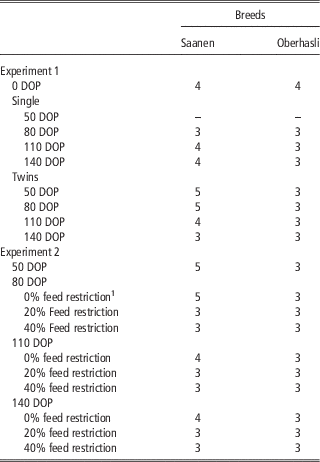
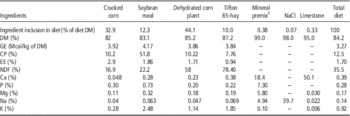
Net mineral requirements for pregnancy were determined by measuring the deposition of minerals in the pregnancy products: the gravid uterus (fetuses+fetal fluid+uterine tissue with the placenta and placentomes) and the mammary gland. We used 57 dairy goats in their third or fourth parturition, of which 32 were Saanen goats with initial BW of 50.6±1.11 kg (Table 1). The remaining 25 were Oberhasli goats with initial BW of 44.0±1.28 kg. In total, 49 goats were then randomly assigned treatments based on their breed (Oberhasli and Saanen), litter size (single or twin) and DOP at slaughter (50, 80, 110 and 140 days) in a completely randomized design with a 2×2×4 factorial arrangement of treatments. There were few single pregnancies in both breeds, so we could not allocate any doe pregnant with a single fetus to the 50-day pregnancy group. In addtion, eight non-pregnant goats were slaughtered at the beginning of the experiment (four of each breed) to measure the mineral composition of the uterus and mammary gland on mating day (Supplementary Table S1). All goats were fed a similar diet ad libitum throughout the experiment. The diet (Table 2) was formulated to meet the nutritional requirements of pregnant goats as defined by the NRC (2007). Animals were fed twice daily, at 0730 h and 1700 h, with a target refusal rate of 15%.
Number of animals used per treatment (breed, litter size, days of pregnancy (DOP) and feed restriction) in Experiments 1 and 2

1 The amount of feed offered daily to animals subjected to 20% and 40% feed restriction was based on the amount of feed consumed on the previous day by goats fed ad libitum (0% feed restriction).
Chemical composition of the ingredients in the experimental feed, expressed on a dry matter (DM) basis

GE=gross energy; EE=ether extract; Ca=Calcium; P=phosphorus; Mg=magnesium; Na=sodium; K=potassium.
1 Premix contained (per kg): 90 g of Cl, 30 g of S, 1.35 mg of Zn, 340 mg of Cu, 940 mg of Mn, 1.06 mg of Fe, 3 mg of Co, 16 mg of I, 10 mg of Se, maximum of 730 mg of F.
Goats were slaughtered when they reached their assigned day of pregnancy (i.e. 50, 80, 110 or 140 days). Body weight was measured immediately before slaughter and without any fasting. The slaughter procedure involved stunning the animal with a pneumatic pistol followed by exsanguination by cutting the jugular veins and carotid arteries. Upon cessation of vital signs, the gravid uterus and mammary gland were removed. The gravid uterus was separated into uterus (uterus+placenta+placentomes), fetuses and fetal fluid. These were immediately weighed, packaged and frozen at −12°C. The gastrointestinal tract (GIT) was weighed before and after emptying and flushing with water to determine empty BW (EBW), which was calculated as the BW at slaughter minus the weight of the contents of the GIT, bladder and gallbladder. The uterus, fetuses and mammary gland were subsequently ground, homogenized and sampled for further chemical analyses. Except for fetal fluid, samples were freeze-dried for 72 h. Once dry, the mammary gland samples were defatted (fat extraction using petroleum ether in a Soxhlet extraction apparatus) before mineral analyses. Fetal fluid was analyzed in the liquid samples without prior processing.
Chemical analyses
Samples of feed (15 samples collected throughout the experiment) and orts were dried in a forced-air oven at 55°C for 72 h. The DM and fat content of feed ingredients and orts were determined following Association of Official Analytical Chemists (AOAC) procedures (1990methods numbers 930.15 and 920.39, respectively). Feed ingredients were analyzed for ash (complete combustion at 600°C for 6 h; AOAC, 1990, method number 924.05), CP (via Dumas combustion using a LECO FP-528LC, LECO Corp., St. Joseph, MI, USA; Etheridge et al., Reference Costa, Resende, Rodrigues, Espechit and Queiroz1998), ether extract (based on weight loss of the dry sample upon extraction with petroleum ether for 3 h in a Soxhlet extraction apparatus) and NDF with amylase and without sulfite (Robertson and Van Soest, Reference Ritar, Maxwell and Salamon1981). Gross energy of feed was determined using a calorimetric bomb (Parr Instrument Co., Moline, IL, USA).
Before measuring mineral content, samples were subjected to a perchloric–nitric acid digestion (AOAC, 1990, method number 935.13). Ca and Mg levels were determined by atomic absorption spectrometry using SpectrAA 220FS, Varian, Melbourne, Victoria, Australia (AOAC, 1990, method number 935.13), Na and K levels were determined by atomic emission (Fritz and Schenk, Reference Forbes1979) and P content was determined by colorimetric analysis (AOAC, 1990; method number 965.17).
Statistical analysis
The mineral content of the fetuses, fetal fluid, uterus and mammary gland were analyzed as mixed effects models with breed (1 df), DOP (3 df), litter size (1 df) and interactions as fixed effects and a residual error as a random effect (Supplementary Tables S1 and S2). Analyses were conducted using the SAS MIXED procedure (version 9.2; SAS Institute Inc., Cary, NC, USA). A likelihood test indicated heterogeneous residual variances of the differences between litter size and DOP. Therefore, residual variances across litter size and DOP sub-classes were modeled using the GROUP command option in the REPEATED statement. Graphical analysis of the residuals showed that the assumptions of the model were upheld. Statistical significance was set at P⩽0.05.
To determine net mineral accretion, we fit the exponential model (Equation (1)) to the total mineral content of pregnancy products from mating day to 140 DOP. An estimate of the mineral requirements (g/day) was then obtained from the differentiation of Equation (1). The mineral content of the pregnancy products was analyzed using the %NLINMIX macro of SAS (v 9.4; SAS Institute Inc.). Fixed effects in the model were breed, litter size and DOP. Random effects were the individual animal and residual errors. Mineral content on mating day was considered the same for both litter sizes. The residual variance was modeled using the power-of-the-mean variance function to obtain homogeneity (Littell et al., Reference Lindstrom and Bates2006). Restricted maximum likelihood was used for estimation. The model was fit using a linearization around EBLUPs, which is based on the parameter estimation procedure of Lindstrom and Bates (Reference Liesegang, Risteli and Wanner1990). Parameters for each treatment (breed×litter size) were included in the MODEL statement and compared using the CONTRAST statement. Differences between parameters were considered significant at P<0.05. To permit comparison of our results with those in the literature, we also analyzed fetus weights and fetus compositions with the exponential model. The fetus weight at birth was considered equivalent to that observed at 150 DOP.
 $$y_{{ijk}} \, {\equals}\, W_{0} e^{{kt_{{ijk}} }} {\plus}{\epsilon}_{{ijk}} $$
in which y
ijk
is the total mineral content (g) observed at time t for the i
th observation of the j
th litter size and k
th breed, i=1, … , n
ij
; j=1, 2; k=1, 2; W
0 is the mineral content (g) at the beginning of pregnancy; k=rate of mineral deposition (g/day); t
ijk
the DOP when mineral content was measured (days); ɛ
ijk
the residual error
 $\,\sim \!N\,(0,\,\sigma _{e}^{2} )$
.
The net mineral requirements were obtained by differentiation of the final model obtained after the comparison of net mineral accretion between breed, litter size and DOP.
Experiment 2: net minerals requirements for maintenance
An experiment was conducted to estimate the maintenance requirements of pregnant goats carrying twins at 80, 110 and 140 DOP. We evaluated only goats with twins because a previous study found that conceptus-free maternal body (CFM, considered as pregnant goat body disregarding the gravid uterus and mammary gland) metabolism does not change with litter size (Härter et al., Reference Gomes, Oliveira-Pascoa, Teixeira, de Medeiros, Resende, Yañez and Ferreira2015). A total of 66 pregnant females were used (eight baseline pregnant females plus 58 pair-fed pregnant females (Table 1)). The study was arranged in a randomized block design with a 2×3×3 factorial scheme including breed (Oberhasli or Saanen), DOP (80, 110 and 140 days) and feed restriction (ad libitum, 20% and 40% feed restriction). Feed restriction started on day 35 of pregnancy, when litter size was determined by sonography, and continued until slaughter. In total, 58 pregnant goats (31 Saanen (initial BW of 52.4±1.71 kg) and 27 Oberhasli (initial BW of 45.1±1.14 kg)) with similar BW were randomly divided into three groups according to slaughter age. Each group was then divided into three blocks with six animals each (three of each breed). Each goat in a block was subjected to a different feeding regime. Animals without feed restriction were fed ad libitum, with the feed amount was adjusted to allow 15% orts. The amount of feed offered daily to animals subjected to 20% and 40% feed restriction was based on the amount of feed consumed on the previous day by goats fed ad libitum. Goats were pair-fed, whereby feed restriction was defined within each block group by the intake of the animal fed ad libitum. The diet was the same used in the Experiment 1 (Table 2).
The goats were slaughtered at 80, 110 or 140 DOP. Another eight pregnant goats (baseline animals) were slaughtered at 50 DOP to estimate initial body composition and to calculate mineral retention from 50 to 80, 110 and 140 DOP, using comparative slaughter methodology based on Lofgreen and Garrett (1968) and Rattray et al. (1974). Goats slaughtered at 50 DOP were thus considered the reference for animals slaughtered at 80, 110 and 140 DOP. The procedures adopted for slaughter, sampling and analyses of the samples of body, feed and leftovers were applied as described for Experiment 1.
Calculations and statistical analyses
The net maintenance requirements were estimated by regressing the daily intake of a mineral (mg/kg of live BW (LBW)) against the daily retention of the mineral (mg) in the CFM relative to live goat BW (mg/kg LBW). The net requirement for maintenance was estimated as the mineral losses when mineral intake was set to 0 (inverse of the intercept of the regression). Mineral retention in the CFM was estimated as a difference between the mineral content (total amount of mineral, mg) in goats slaughtered at 80, 110 and 140 DOP and the mineral content at the beginning of pregnancy (50 DOP, based on the mineral composition of the baseline animals). The CFM weight (CFMBW, pregnant goat BW (kg) discounted the sum of the weights of gravid uterus and mammary gland) at the beginning of pregnancy (CFMBW50) was estimated by regression against LBW when they were at 50 DOP (LBW50). The mineral composition (mg/kg CFMBW50) at the beginning of pregnancy (50 DOP) was estimated by regression against estimated CFMBW50. When the regression was not significant, we used the average mineral composition of the baseline goats. Statistical significance was declared at P<0.05.
Maintenance mineral requirements were analyzed as mixed models considering the block as a random effect and DOP (2 df) and breed (1 df) as fixed effects. When DOP and breed were significant, the intercepts and slopes were compared using the CONTRAST statement of the MIXED procedure. The slopes and intercepts of each equation were estimated using the ESTIMATE statement of the MIXED procedure in SAS. Unless otherwise indicated, P<0.05 was considered statistically significant.
Results
Experiment 1: net mineral requirements for pregnancy
The mineral content of the uterus and mammary gland from non-pregnant goats were similar in the two breeds (Supplementary Table S1). All mineral contents increased in pregnancy products as pregnancy progressed (P<0.01), with the exception of Ca in the mammary gland (Supplementary Table S2). The mineral contents (total amount of mineral in grams) were greater in twin fetuses (P<0.01). In twin pregnancies, only Na was greater in fetal fluid, whereas P, Na and K were greater in the uterus (P<0.05; Supplementary Table S2).
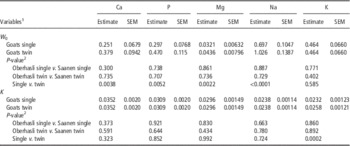
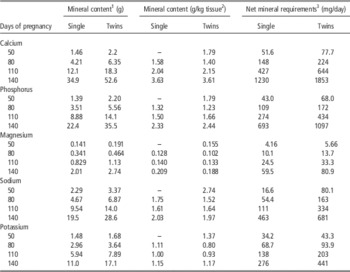
Although Ca, P (P<0.01) and Mg (P<0.05) content were different in fetuses of the two breeds (Supplementary Table S2), estimates of W 0 and k were similar (Table 3). With the exception of K, W 0 differed by litter size (P<0.01; Table 3). Conversely, estimates of k were similar for the different litter sizes. For K, W 0 was similar for different litter sizes, whereas k differed (P<0.01). Consequently, the net requirements of Ca, P, Mg, Na and K were greater in goats carrying twins (Table 4). Throughout pregnancy, the net requirements of Ca, P, Mg and Na were, on average, 33%, 36%, 26% and 32% greater in goats carrying twins than those with a single fetus, respectively. From 50 to 140 DOP, the net requirement of K for pregnancy in mothers with twins was 21% to 37% greater than that of mothers with single pregnancies (Table 4).
Parameters to predict mineral content and net mineral accretion of pregnancy products from goats carrying single and twin fetuses at 50 to 140 days of pregnancy (Experiment 1)

1
W
0 and k are the exponential parameters in
 $y{\equals}W_{0} {\rm e}^{{kt}} $
, where W
0 is the mineral content (g) at the beginning of pregnancy; k=constant rate of mineral deposition (g/day); t=day of pregnancy).
2 P-value of the contrasts tested for the intercept (W 0) and slope (k).
Estimated mineral content of pregnancy products (gravid uterus+mammary gland) and net mineral requirements for pregnancy of dairy goats carrying single and twin fetuses throughout pregnancy (Experiment 1)

1 Mineral content of pregnancy products estimated using the equations are presented in Table 3.
2 Average fresh weight of pregnant uterus+mammary gland at 50 days of pregnancy (DOP) was 1.23 kg for twins, at 80 DOP was 2.67 kg and 4.53 kg, at 110 DOP was 5.94 kg and 8.52 kg, and at 140 DOP was 9.60 kg and 14.5 kg for single and twins, respectively. Breed was not significant (P>0.05; Supplementary Table S2).
3 The net mineral requirements were obtained by differentiation of the final models presented in Table 3.
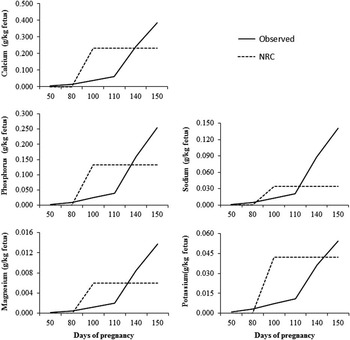
To compare our results with existing feeding systems we estimated mineral accretion as a proportion of fetus weight at birth (mg/kg fetus; Figure 1). The net daily accretion in the last 50 DOP, from 100 to 150 days, ranged from 34.5 to 384 mg of Ca/kg fetus, 24.7 to 254 mg of P/kg of fetus, 1.27 to 13.7 mg of Mg/kg fetus, 13.0 to 141 mg of Na/kg fetus and 7.30 to 54.3 mg of K/kg fetus.
Net daily mineral accretion in fetuses as a proportion of fetus weight at birth. Results from this study are compared with those reported by the National Research Council (NRC).

Experiment 2: net mineral requirements for maintenance
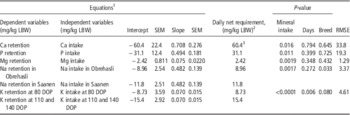
There was no effect of breed on the baseline equations. The equations used to predict CFM composition based on results from baseline animals are presented at Table 5. There was no effect of breed or DOP on the net maintenance requirements of Ca, P or Mg (Table 6). Conversely, the maintenance requirement for Na during pregnancy was greater in Saanen goats than Oberhasli goats (P<0.05). The K requirement for maintenance changed as pregnancy progressed, increasing significantly at 140 DOP (P<0.01).
Equations obtained from baseline data (goats at 50 days of pregnancy) to estimate mineral retention during pregnancy (Experiment 2)

1 LBW50=live goat BW (kg); CFMBW50=maternal BW (pregnant goat BW (kg) discounted the sum of the weights of gravid uterus and mammary gland) at 50 days of pregnancy.
Daily net mineral maintenance requirements of Saanen and Oberhasli goats throughout pregnancy estimated by regressing the daily intake of a mineral (mg/kg of live BW (LBW)) against the daily retention of the mineral (mg) in the conceptus-free maternal body relative to live goat BW (mg/kg LBW) (Experiment 2)

1 Equations for calcium (Ca), phosphorus (P) and magnesium (Mg) retention were the same for both breeds and for days of pregnancy (DOP); equations for sodium (Na) were similar between DOP but different between breeds; equations for potassium (K) were similar between breeds but different between DOP.
2 LBW=live goat BW (kg).
3 The net requirement for maintenance was estimated as the mineral losses when mineral intake was set to zero (inverse of the intercept of the regression).
Discussion
The net mineral requirements of goats carrying twins were greater than those carrying a single fetus. These results are in agreement with current feeding systems, which recommend mineral requirements during pregnancy according to litter size (AFRC 1998; NRC, 2007). The need for more minerals arises from the demands of the fetus and, although each fetus in a twin pregnancy grows less than a single one, together the twin fetuses require more nutrients. Moreover, during twin pregnancies, there is intrauterine competition for physical space and nutrients that increases in the late gestational period (Jainudeen and Hafez, Reference Irano, Bignardi, Rey, Teixeira and Albuquerque2000; McCoard et al., Reference Mattison, Blann and Malek2013). At the same time, the DMI of the pregnant female is suppressed by hormonal changes and rumen compression (Forbes, Reference Etheridge, Pesti and Foster1971), decreasing the maximum potential growth of each fetus.
Our estimates of the net requirements of Ca, P, Na, Mg and K during pregnancy were different from those recommended by the NRC (2007), because the values increased as pregnancy progressed. The NRC (2007) recommendations for pregnant goats are based solely on fetus composition at birth. Applying these recommendations requires the assumption that the mineral accretion rate is constant (e.g., 0.230 g of Ca, 0.132 g of P, 0.006 g of Mg, 0.034 g of Na and 0.042 g of K/day per kg of fetus weight at birth). Herein, we developed a model that accounted for mineral fetal composition throughout pregnancy, contributing to the understanding of mineral requirements throughout gestation. Our results clearly show that mineral accretion rates increase over the course of pregnancy. Although our observations were only made up to 140 DOP (which is very close to the birth day), our data indicate that the NRC both overestimates and underestimates net mineral requirements up to the last 50 DOP. In addition, the AFRC’s (1998) recommended requirements for Ca, P and Mg during pregnancy are considerably higher than those found in this study. The AFRC provides only limited information about Na and K requirements.
The feeding systems like NRC (2007) and AFRC (1998) do not account for all pregnancy products in their estimates of a pregnant goat’s mineral requirements. It is true that the fetus accounts for the majority of the mineral demands during pregnancy. However, other pregnancy products have small but important mineral requirements in early and mid-gestation. The minerals play a role in the preparation of uterus for fetal development and of the mammary gland for lactation (Härter et al., Reference Gomes, Oliveira-Pascoa, Teixeira, de Medeiros, Resende, Yañez and Ferreira2015). Thus, we strongly recommend that estimates of the mineral requirements of pregnant goats consider the products of conception (i.e. uterus, fetal fluid and mammary gland), as adopted for dairy cattle (NRC, Reference Meschy2001).
There is limited information on the macromineral requirements during pregnancy in goats, making comparison of our results with the literature difficult. In a study with pregnant native goats (Resende et al., Reference Nelson and Cox1999; Costa et al., 2003), mineral contents and accretion patterns in the gravid uterus and mammary gland were different than those observed in this study. In addition, the Ca composition of fetuses measured in this study at 140 DOP is lower than that reported by the NRC (2007) in newborn fetuses (11.5 g/kg fetal weight). These differences highlight the need for more studies of goat mineral requirements for different production purposes.
To our knowledge, our study is the first to determine the net mineral requirements for maintenance of dairy goats throughout pregnancy. The net Ca and P requirements for maintenance found in this study (60.4 and 31.1 mg/kg LBW, respectively) are greater than those reported by the feeding systems (20 mg Ca/kg BW and 30 mg P/kg BW, NRC, 2007; 17.6 mg Ca/kg BW and 20.5 mg P/kg BW, AFRC, 1998). These findings derive from increased Ca and P requirements for maintenance during pregnancy. The maintenance requirements of feeding systems are based on adult animals, but they do not consider changes in maintenance demands depending on physiological state. Many physiological changes take place in the maternal body during pregnancy to ensure fetal development and colostrum production. These changes may modify the maternal mineral requirements for maintenance.
During pregnancy, Ca is involved in numerous physiological processes, including bone Ca resorption during late pregnancy, increased blood volume and adaptations in respiratory and cardiovascular systems (Mattison et al., Reference Littell, Milliken, Stroup, Wolfinger and Schabenberger1991; Liesegang et al., Reference Jainudeen and Hafez2007). Furthermore, the concentration of fibrinogen and other coagulants increases during the pregnancy (Carlin and Alfirevic, Reference Carlin and Alfirevic2008), which can contribute to an increase of Ca demand due to its participation in these processes (Suttle, Reference Silanikove2010). Energetic demands during pregnancy are high and the maternal body mobilizes its energy reserves to meet the needs of the pregnant uterus, especially in the last DOP (Bell and Ehrhardt Reference Bell and Ehrhardt2000; Castagnino et al., Reference Castagnino, Härter, Rivera, Lima, Silva, Biagioli, Resende and Teixeira2015). This primarily involves gluconeogenesis, which is energetically expensive (Nelson and Cox, 2002). Thus, as the energy demand increases, there could be a concomitant increase in the demand for P to ensure sufficient ATP supply to support maternal metabolism. Furthermore, K participates in the insulin action in the cells (Suttle, Reference Silanikove2010). As blood insulin level increases, helping tissues to capture nutrients in the bloodstream and transfer them to the cells, it may be related to the increase of energy demand by pregnancy and goat metabolism, then the increase of K requirements for maintenance during pregnancy is expected.
The net requirements for maintenance of Mg and Na (for Saanen) during pregnancy found in this study (2.42 mg Mg/kg LBW and 11.8 mg Mg/kg LBW) were close to those documented in the feeding systems (3.5 mg Mg/kg BW; 15 mg Na/kg BW; AFRC, 1998; NRC, 2007). Conversely, the observed net K requirement were lower than that adopted by the NRC (38 mg K/kg BW; 2007).
Species, age, sex, biotype and adaptation to environmental conditions can affect the mineral requirements for maintenance (Silanikove, Reference Robertson and Van Soest2000; NRC, 2007). Most dietary recommendations for goats are based on studies conducted in temperate climates, and they are adapted from data obtained in sheep (AFRC, 1998; Meschy, Reference Mc Coard, Sales, Wards, Sciascia, Oliver, Koolaard and Linden2000). However, there are differences in the metabolism of sheep and goats (Van Soest, Reference Wilkens, Breves and Schröder1994; Wilkens et al., Reference Van der Westhuysen2014), which may explain the discrepancies between the mineral requirements found in this study and those reported in the literature (AFRC, 1998; NRC, 2007).
The greater net Na maintenance requirements we observed in Saanen goats may be related to the feed intake capacity of this breed. A previous study reported that Saanen goats take in more dry matter and Na per unit of metabolic BW than Oberhasli goats, but that excretion rates in feces and urine were similar (Härter et al., Reference Gomes, Oliveira-Pascoa, Teixeira, de Medeiros, Resende, Yañez and Ferreira2015). Na and K are required for nutrient absorption in the GIT and for maintaining the acid–base balance in the body (Suttle, Reference Silanikove2010). Because Saanen goats consume more dry matter than Oberhasli goats, they require more Na and K for absorption. However, we did not found differences between breeds for K requirements for maintenance during pregnancy. Furthermore, there is still limited information in the literature explaining these breed-specific differences. Further studies of the variation in the nutrient requirements and metabolism of different goat breeds are required to elucidate the mechanisms that can be involved in such species-specific differences.
Conclusion
The net mineral requirements of pregnant goats increase throughout pregnancy and are greater in mothers carrying twins than in those carrying single fetuses. Saanen goats require more Na for maintenance during pregnancy than Oberhasli goats. In addition, the K maintenance requirements increase as pregnancy progress. The findings of this study will guide the formulation of diets that meet the mineral requirements of pregnant goats throughout pregnancy, and thus reduce the production cost of dairy goats.
Acknowledgments
The authors thank the São Paulo Research Foundation (FAPESP) for providing financial support (grants #2009/10125-0, #2007/58239-8 and #2013/04758-5).
Supplementary Material
To view supplementary material for this article, please visit https:/doi.org/10.1017/S1751731117000258