Introduction
Gamma-Glutamyltransferase (serum GGT) is an enzyme involved in transport of amino acids and peptides in cells. Besides being a marker of alcohol abuse and liver disease (Whitfield, Reference Whitfield2001), GGT is an established marker related to an increased risk for several cardiovascular diseases (Dhingra et al., Reference Dhingra, Gona, Wang, Fox, D'agostino and Vasan2010; Kunutsor et al., Reference Kunutsor, Apekey and Khan2014) and change in cardiometabolics (Kunutsor et al., Reference Kunutsor, Apekey and Seddoh2015). Compromised vascular supply is often found to be associated with cognitive impairment in older ages (Debette et al., Reference Debette2011). The negative effect of GGT on vascular health is suggested to reflect a potential involvement of this enzyme in oxidative stress (Koenig and Seneff, Reference Koenig and Seneff2015) which have a significant role in the pathogenesis of neurodegeneration and cognitive impairment (Bennett et al., Reference Bennett, Grant and Aldred2009).
Studies support links between levels of serum GGT and dementia, this applies both to levels of serum GGT in midlife (Kunutsor and Laukkanen, Reference Kunutsor and Laukkanen2016) and later in life (Yavuz et al., Reference Yavuz2008). To our knowledge, no study has yet examined the potential associations between GGT, cognitive decline in late life. In the present study we therefore wanted to test this hypothesis by contrasting two models of cognitive change. First, we examine the effect of GGT in models of change based on time in study. Next, we contrast this with a time to death model. In both models, we control for heart diseases, cerebrovascular lesions, diabetes, hypertension, alcohol abuse, and liver disease, all previously found be related to GGT.
Our rationale for proposing this modeling approach is based on previous findings of terminal decline trajectories in cognitive performance, i.e. decline in cognitive abilities is indicative of an increased mortality risk many years before the actual death occasion (Kleemeier, Reference Kleemeier1962). Attenuation in cognitive performance close to death has been found in several longitudinal studies in which the onset of accelerated cognitive decline is related to time to death (see among others: Wilson et al., Reference Wilson, Segawa, Buchman, Boyle, Hizel and Bennett2012). Studies also show that modeling cognitive change as time to death provides a better account for individual change, compared with chronological age or age-based time metrics (see among others: Gerstorf et al., Reference Gerstorf, Ram, Lindenberger and Smith2013).
Another methodological concern is that cognitive change trajectories in later life are comprised by the selection effect of mortality-related drop-out. The select sample of survivors, perform better and show less cognitive decline in comparison to non-survivors (see among others: Riegel and Riegel, Reference Riegel and Riegel1972). The actual and true variability in the general population is therefore not captured unless mortality-related selection is accounted for. The mortality-related selection effects can be estimated for in time to death models, i.e. in models where cognitive performance and change is conditioned on the remaining survival across time of measurements (Wilson et al., Reference Wilson, Segawa, Buchman, Boyle, Hizel and Bennett2012; Gerstorf et al., Reference Gerstorf, Ram, Lindenberger and Smith2013).
The aim of the present study is to examine potential associations between GGT and change in cognitive performance by contrasting two models of cognitive change, i.e. an age based model and a model based on time to death. The present study also aims to, in separate analyses; examine the potential association between GGT and dementia in later life.
Methods
Participants
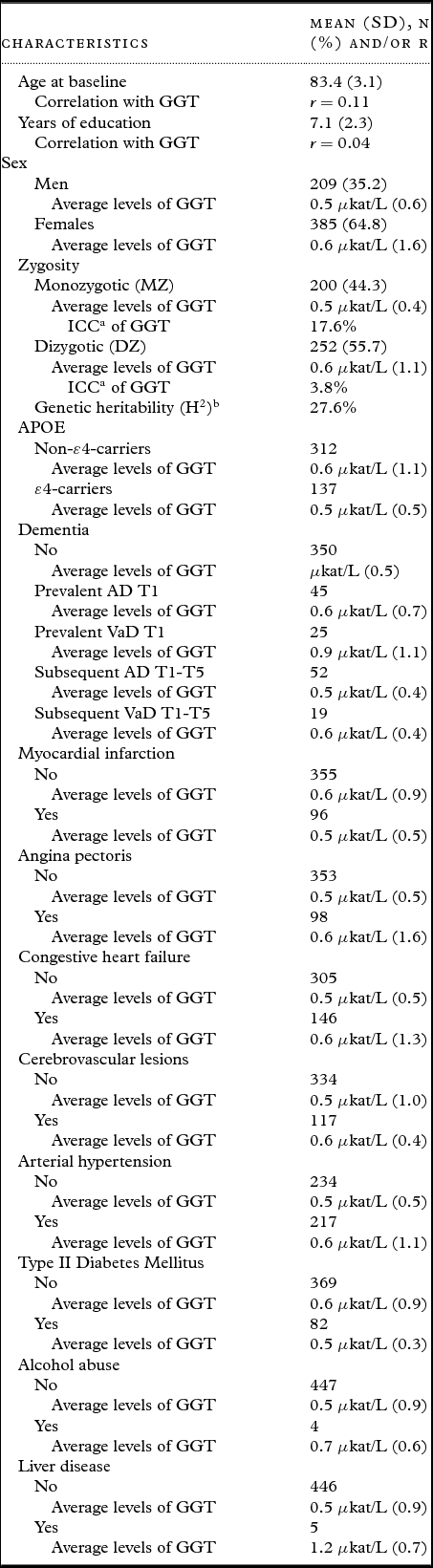
Data was drawn from the OCTO Twin Study (McClearn et al., Reference McClearn1997) including a Swedish population-based twin sample, aged 80 years and older, born in 1893–1913, where both twins were alive at inclusion (N = 702 individuals/351 pairs). Ethical approval for the OCTO Twin Study was provided by the Ethical Committee at the Karolinska Institute, Stockholm, Sweden (Dnr. 89:98, 98–380) and by the Swedish Twin Registry. Participants were examined five times at two year intervals in between 1991–2002. All examinations were conducted by registered nurses in the participant's place of residency with a broad-based bio-behavioral test battery. Each test session took about 3.5–4 hours, including rest periods. Individuals with missing information on GGT (n = 126) were excluded in the present analyses. Information about time of death was obtained from the Swedish Census Register. After exclusions, 452 participants remained (Table 1 for background characteristics) for the analyses measuring cognitive change. To specifically test potential links between GGT and dementia, we analyzed GGT in the context of ever being demented and for the risk of developing dementia over the study period. In the first analyses, we included all individuals who received a diagnosis of either Alzheimer´s disease or vascular dementia, i.e. both prevalent cases at baseline and incident cases at follow-ups (nt otal = 492). In the analyses examine GGT and the risk of developing dementia over the study period we excluded the prevalent cases (n total = 452).
Background characteristics and their relation to GGT

a ICC refers to intra-class correlations which represent the estimate of similarity within MZ and DZ-pairs; bRefers to broad sense heritability given Falconer´s formula: Hb2 = 2(rmz - rdz).
Gamma-Glutamyltransferase (GGT)
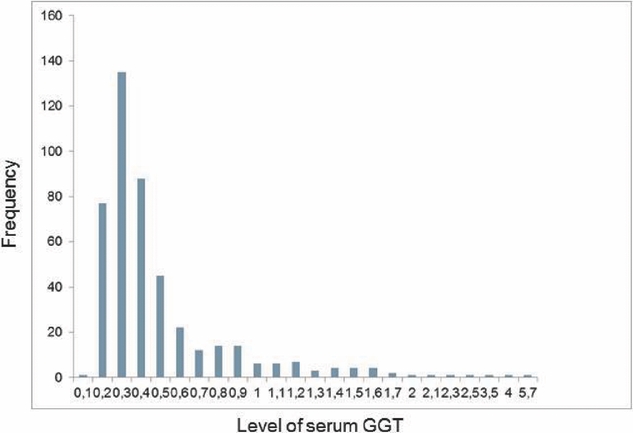
Blood was obtained by venipuncture in the subject´s place of residence. The sampling was performed in the morning, usually with the subjects in a sitting position. After one to three hours at room temperature, the tubes (vacutainer, gel tubes, Beckton & Dickinson) were centrifuged at 1,200 g for ten minutes and the serum kept for analyses. The transport time before freezing was one or two days, which is found to be acceptable time limit (Berg et al., Reference Berg, Estborn and Tryding1981). Samples were stored at – 80˚ C for a period of six years. Analyses of the blood samples were performed in 2001. GGT was analyzed using routine methods with an AXON analyzer (Bayer). See Figure 1 for an overview of GGT values and distribution.
Distribution of serum GGT levels.

Cognitive measures
We administered eight tests to measure multiple cognitive domains representing motor- and perceptual speed, reasoning and spatial ability, semantic and episodic long-term memory, which allowed us to also compute an overall cognitive composite score.
Motor- and perceptual speed: A modified version of the speeded Digit-Symbol Substitution Test (Wechsler, Reference Wechsler1945) was used which measures motor speed and accuracy. The participant is given a list of symbols associated with digits from 1 to 9 and is asked to fill in the blanks with the symbols that correspond to each number. The test score is the total number of correct sequential matching of digits to symbols in a 90 sec interval.
Spatial ability: Block Design requires reproduction of a pattern shown on a set of cards using red and white blocks and has a maximum score of 42 (Dureman and Sälde, Reference Dureman and Sälde1959).
Reasoning: The Figure Logic task requires the person to identify one figure out of five in a row that is different in concept from the rest. Maximum score is 30 (Dureman and Sälde, Reference Dureman and Sälde1959).
Semantic memory: The Information test measures general knowledge and is a modified version (Jonson and Molander, Reference Jonson and Molander1964) of the Wechsler Adult Intelligence Scale, WAIS (Wechsler, Reference Wechsler1945). Maximum score is 44 points. The Synonyms test requires the participant to find a synonym to match a target word; the task taps knowledge of verbal ability and is a part of the Dureman–Sälde battery (Dureman and Sälde, Reference Dureman and Sälde1959).
Episodic memory: Memory-in-Reality (MIR) Test first requires the naming of ten common real-life objects shown to the subject. The subjects are then instructed to place these objects in the different rooms of a three-dimensional model of an apartment, according to their own preferences. Thirty minutes later they are asked to recall the objects followed by a recognition task for the objects not recalled. Subjects are then asked to place the objects in the same locations as they did previously – the relocation test. The maximum score in each subtest is ten (Johansson, 1988/Reference Johansson1989). The present study only used the free recall subtest.
Prose Recall is a Swedish prose recall task similar to the prose passages in the Wechsler Memory Test (WMS) (Wechsler, Reference Wechsler1945). To maintain attention during presentation of the story, it was designed to be brief (100 words) and to have a humorous point. Subjects are asked to recall the story after presentation. Responses are coded for the amount of information recalled in a manner similar to the WMS. The maximum score is 16.
Thurstone's Picture Memory is a non-verbal, long-term memory test (Thurstone and Thurstone, Reference Thurstone and Thurstone1949) in which subjects are shown 28 pictures and then asked for recognition of these among others distractors. The pictures were enlarged from the original version to minimize any possible visual problems. The maximum score is 28.
Global cognition: a composite score derived from the eight tests was constructed by factor scores using regression scores of each factor at each measurement occasion.
Dementia
Participants with indications of dementia were routinely taken to a consensus conference with a physician, nurse, and neuropsychologist. Dementia diagnoses were first considered in accordance with DSM-III-R criteria (American Psychiatric association, 1987). Alzheimer's disease was assigned following the NINCDS-ADRDA criteria (McKhann et al., Reference McKhann, Drachman, Folstein, Katzman, Price and Stadlan1984) and vascular dementia following the NINDS-AIREN criteria (Roman et al., Reference Roman1993).
Covariates previously identified for a relationship with GGT
GGT is previously shown to be associated with multiple health conditions. Among those, we were able in the present study to control for alcohol abuse, liver disease, and various cardiovascular- and cardiometabolics diseases; more specifically for myocardial infarction, congestive heart failure, angina pectoris, cerebrovascular lesions, arterial hypertension, and type 2 diabetes mellitus. Information concerning diseases was drawn from medical records, death certificates, self-reports, and registration of medication use. The information from the above sources was coded in a uniformed format according to ICD-10 (International Statistical Classification of Diseases and Health Problems, 1992) and an expert multi-based diagnosis (EMBD) was determined for each individual on a lifetime basis, taking into account available information from all three sources of information (Nilsson et al., Reference Nilsson, Johansson, Berg, Karlsson and McClearn2002).
Other covariates related to cognitive function
APOE: The two APOE markers (rs429358 and rs7412) were genotyped separately using Illumina GoldenGate assays. The APOE haplotype was determined by PCR amplification of a 227-bp fragment of the APOE gene containing two polymorphic sites (rs7412 and rs429358) that account for the three alleles: ɛ2, ɛ3, and ɛ4. APOE was coded as non-ɛ4 carriers (0) and ɛ4 carriers (1).
Chronological age at first measurement occasion, sex and education were included in the analyses. Education attainment was defined in terms of the total number of years of education. The educational level in our sample is low, but typical for a Swedish cohort born in the late 1,800 and early 1,900.
Statistical analyses
We standardized all cognitive test scores on baseline distribution and they were then transformed to a T distribution with M = 50 and SD = 10. The association between levels of serum GGT, levels of performance, and rates of cognitive change were then modeled using two time structures, first time in study and next time to death. The analyses were performed after accounting for age, sex, education, alcohol abuse, liver disease, hypertension, diabetes, myocardial infarction, angina pectoris, congestive heart failure, and cerebrovascular lesions (Table 2).
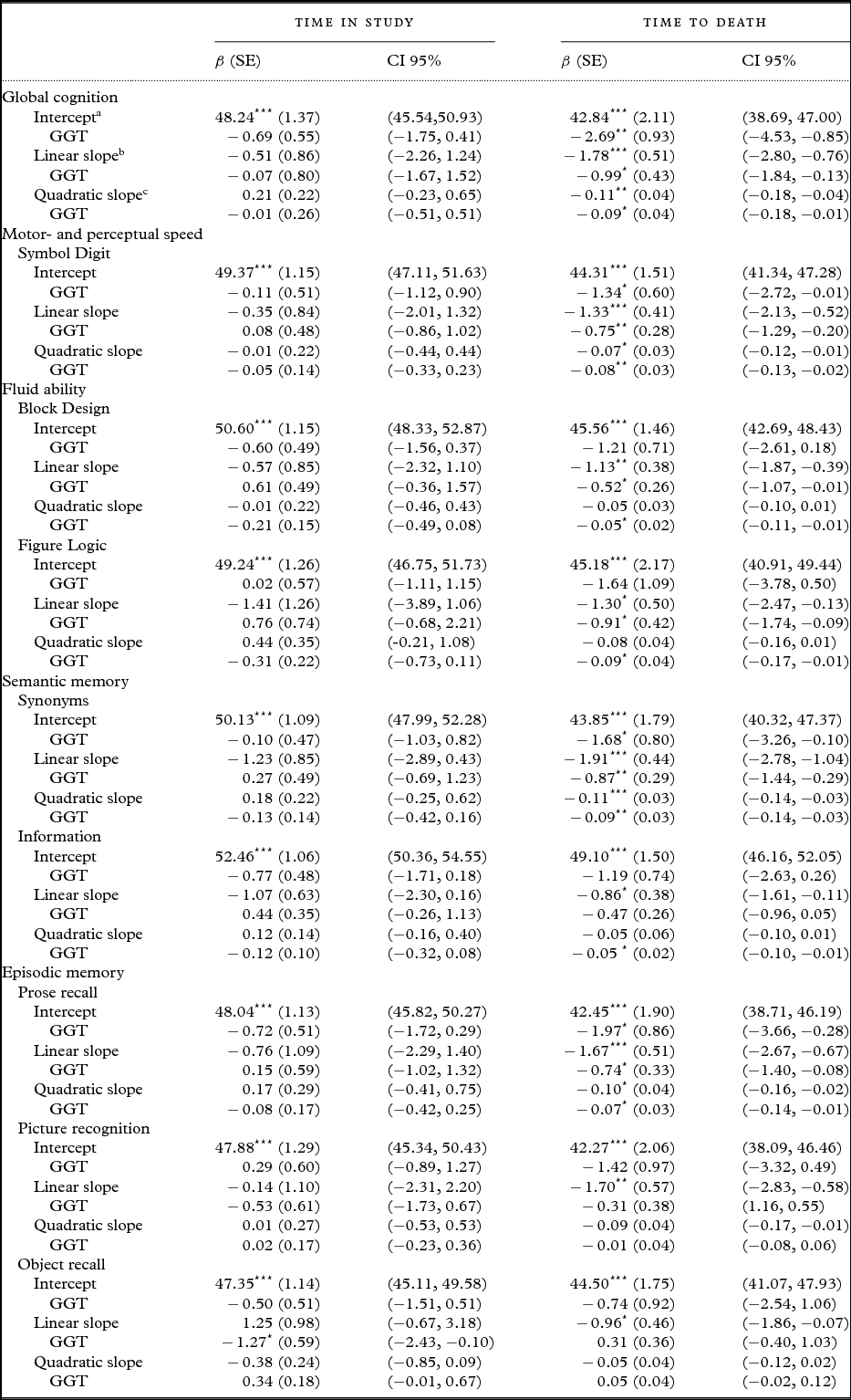
Estimated effects of serum GGT on cognitive functioning over time in study and time to death

Note: Age at first measurement occasion, education, sex, alcohol abuse, liver disease, type 2 diabetes mellitus, hypertension, myocardial infarction, angina pectoris, congestive heart failure, and cerebrovascular lesions were included as level two covariates in to the model. aReflects average performance at study entry (in the model based on time in study) and prior to death (in the model based on time to death); bReflects average linear rate of change over the study period (in the model based on time in study) and prior to death (in the model based on time to death); cReflects change in rate of change (i.e. accelerated change) over the study period (in the model based on time in study) and prior to death (in the model based on time to death).
More specifically, we analyzed individual differences in levels and rates of cognitive change using three level multilevel models (MLM) with repeated measure (i.e. time) nested within individuals nested within twin-pair. Thus, we estimate for the fact that individuals tend to be more alike over time within, than between each other and that they tend to be more alike within than between twin-pairs. We specified other estimates as level two covariates (i.e. GGT, myocardial infarction, congestive heart failure, angina pectoris cerebrovascular lesions, arterial hypertension, type 2 diabetes mellitus, alcohol abuse, liver disease, age at first measurement occasion, sex, and education) and used a restricted information maximum likelihood method to estimate the parameters. Level of serum GGT, age at first measurement occasion and education were grand mean centered. The reference values were set for being a man and no indications of myocardial infarction, congestive heart failure, angina pectoris, cerebrovascular lesions, arterial hypertension, type 2 diabetes mellitus, liver disease, and alcohol abuse. To examine the potential association between levels of serum GGT and dementia outcomes we used χ2, OR, and analysis of variance (ANOVA). The analyses were conducted using IBM SPSS Statistics 22.
Results
In Table 2, we first report on serum GGT in relation to level and change in cognitive performance as a function of time in study, followed by the results revealed on the associations with cognitive change in relation to distance from death. Finally, we report on the association between GGT and dementia outcomes.
GGT and level and change cognitive performance
As seen in Table 2 there were no significant associations at baseline between GGT and cognitive performance in any of the tests (i.e. see intercept under the heading time in study in Table 2). Higher levels of serum GGT were, however, significantly associated with steeper decline in MIR recall (i.e. see linear slope under the heading time in study in Table 2), in which each unit increase in GGT levels above average was related with 102% steeper decline over the study period. No other significant effects were observed (Table 2).
GGT, level and change in cognitive performance prior to death
Higher levels of GGT were significantly associated with lower performance levels in Global cognition, Symbol Digit, Synonyms, and Prose recall tests (i.e. see intercept under the heading time to death in Table 2). For each unit increase in serum GGT levels, the performance score prior to death in these tests were estimated to be 0.13 (Symbol Digit) – 0.27 (Global cognition) SD lower performance. Higher levels of serum GGT were significantly associated with steeper decline and accelerated decline in all tests except for picture recognition and object recall (i.e. see linear – and quadratic slope under the heading time to death in Table 2).
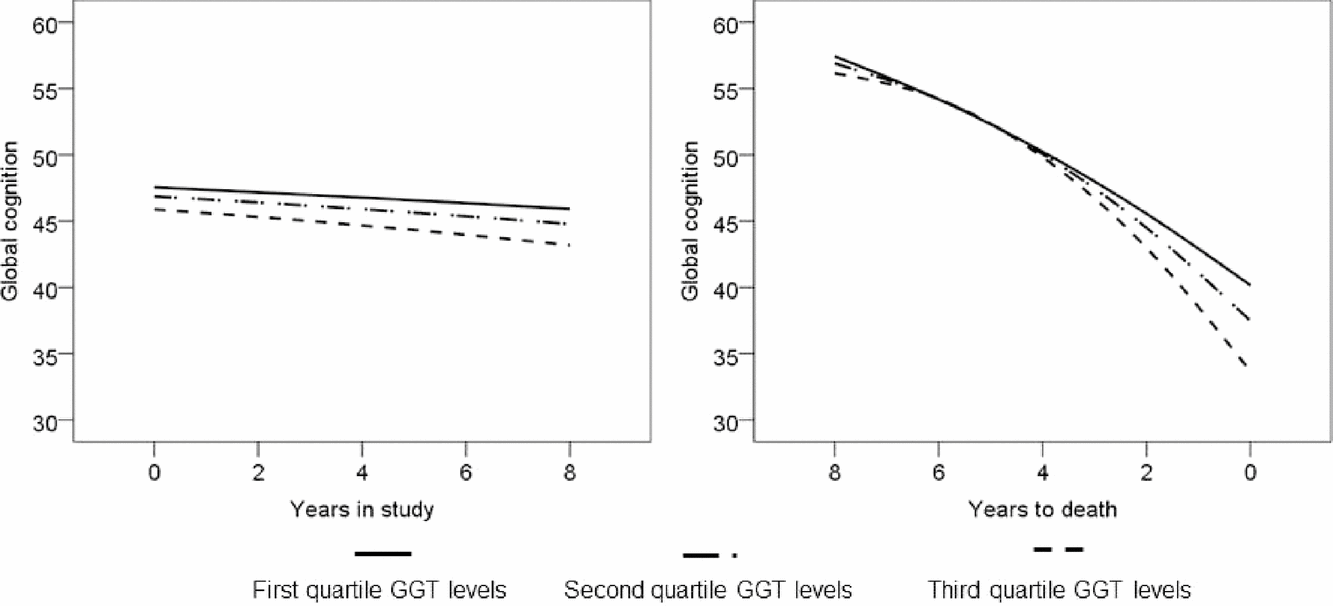
A visual inspection of data in Figure 2 demonstrate that in Global cognition, each unit increase in serum GGT levels were related with 56% steeper and 82% more accelerated decline. Further, the figure indicates that the differences seem to emerge about four years before death.
Examples of estimated mean trajectories of change in cognitive performance as a function of time in study and time to death and by levels of serum GGT.

Given the skewness in the distribution of GGT levels (Figure 1); we also treated GGT both as a log transformed continuous variable and a dichotomous variable (i.e. low vs. high levels of serum GGT). These control analyses, however, produced similar results showing that higher levels of serum GGT were associated with a steeper and more accelerated cognitive decline prior to death.
GGT in relation to prevalence and incidence dementia
Analyses of the association between serum GGT and dementia, including both prevalent cases at baseline and later incident cases (between T1–T5) showed that a diagnosis of VaD was associated with higher GGT levels F (2,488) = 3.45; p = 0.032; partial-η2 = 0.014. A post-hoc test (Bonferroni) showed that individuals with VaD (M = 0.73 μkat/L) had significantly higher levels of GGT than the non-demented (M = 0.50 μkat/L). There were no significant differences between individuals with AD (M = 0.57 μkat/L) and others.
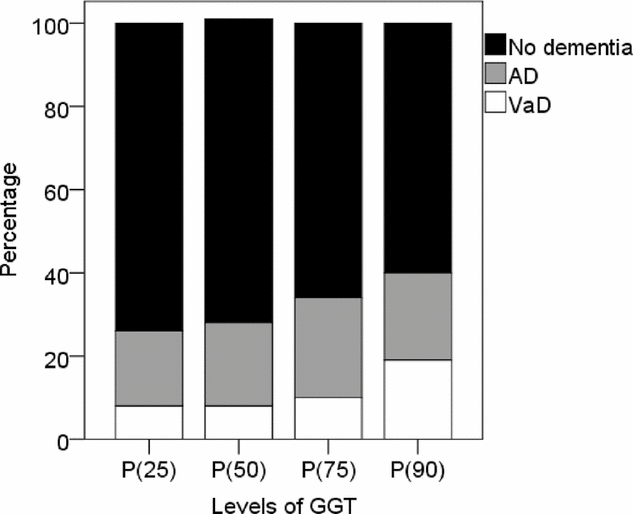
A further inspection on the association between GGT and dementia shows a trend in which the proportion of demented individuals increases with each quartile of the GGT distribution. The proportion was 26% in Q1 and 34% in Q3 of serum GGT levels. Among those at the 90% percentile as many as 40% were in fact diagnosed with dementia (Figure 3).
Proportion of dementia across GGT levels.

A comparison between those below and above the 90% percentile for GGT revealed a significant difference regarding the proportion of demented individuals (χ2 (1) = 4.43; p = 0.035). The prevalence among those at the upper 90% percentile GGT level were significantly higher, OR = 1.81 (1.04, 3.17). There were no significant differences in the proportion of AD cases among those above and below 90% percentile of GGT levels. However, among the VaD cases, 8% were below the 90% percentile of GGT in comparison to 19% of the individuals at the upper 90% percentile of GGT levels, χ2 (2) = 9.19; p = 0.010 (Figure 3).
Next, we tested if levels of serum GGT were related to the risk of developing dementia over the study period., i.e. we excluded individuals who already at first measurement occasion were diagnosed with dementia. These analyses of incident cases showed no differences between individuals who received a diagnosis of AD (M = 0.50 μkat/L), VaD (M = 0.55 μkat/L) and those who remained non-demented over the study period (M = 0.50 μkat/L) on levels of serum GGT (p > 0.05).
Finally, we tested for interaction effects between GGT and APOE on dementia status. These analyses provided no evidence for a mediating role of the ɛ4 allele in the observed association between GGT and dementia (p > 0.05).
Discussion
The aim of the present study was to explore the role of serum GGT as a biomarker for cognitive change and dementia in a Swedish population-based study of oldest old individuals.
Our main finding was that of small effects and no clear associations between serum levels of GGT, levels, and rates of change in cognitive performance in the age-based model. But, when differences in subsequent survival were taken into account in the time to death model it became evident that higher levels of serum GGT are related to lower cognitive performance and to a steeper and more accelerated decline prior to death (i.e. terminal decline). This was observed for overall cognitive performance (i.e. Global cognition; differences between models in Global cognition is illustrated in Figure 2) and the same trend was confirmed across cognitive domains.
Notably, our results indicate that serum levels of GGT are not solely associated to specific cognitive domains; instead it is pervasive and affects cognitive performance and change in general. We also found associations between levels of serum GGT and dementia. This association was especially evident between higher levels of GGT in individuals who already at baseline had received a diagnosis of VaD (Table 1). However, when we examined the effect of GGT for the risk of developing dementia over the study period, we found no differences between incident AD cases, VaD cases, and those who remained non-demented over the study period.
It is suggested that higher levels of serum GGT in both midlife and in later life are associated with an increased risk for developing dementia later in life (Yavuz et al., Reference Yavuz2008; Kunutsor and Laukkanen, Reference Kunutsor and Laukkanen2016). The recommendation from both these studies was that further research was needed to validate the findings. In this respect, our study certainly indicates that higher levels of serum GGT are related to dementia in later life. We found proportionally more individuals at the upper quartiles of serum GGT who were diagnosed with dementia. Interestingly, Kunutsor and Laukkanen (Reference Kunutsor and Laukkanen2016) and Yavuz et al. (Reference Yavuz2008) reported that high levels of serum GGT is a risk factor for Alzheimer´s disease. In contrast, our results rather support that the link between GGT and dementia is more apparent in those diagnosed with vascular dementia when entering the study. It is well known that vascular pathologies are related to the neurodegeneration and the plaque formations that often later become manifest in compromised cognition and clinical dementia. A possible explanation for the link between levels of serum GGT and prevalent VaD is derived from numerous studies suggesting GGT as a biomarker for several cardiovascular and cardiometabolic diseases (Dhingra et al., Reference Dhingra, Gona, Wang, Fox, D'agostino and Vasan2010; Kunutsor et al., Reference Kunutsor, Apekey and Khan2014; Kunutsor et al., Reference Kunutsor, Apekey and Seddoh2015) related to health in general and consequently of vital importance for cognitive functioning in later life (Debette et al., Reference Debette2011). We found no evidence for any longitudinal associations between cognitive change, GGT and vascular pathologies, such as myocardial infarction, angina pectoris, congestive heart failure, cerebrovascular lesions, and type 2 Diabetes and arterial hypertension. However, our findings of a link between GGT and vascular dementia indicate that it is possible that serum GGT might be an informative biomarker of this association. Our small sample size, however, prevent us from drawing any firm inferences on this association. Further research is needed to examine the underlying mechanisms for a potential link between levels of serum GGT and dementia.
Another possible explanation for the association between GGT and compromised cognitive health is due to the involvement of GGT in oxidative stress (Yavuz et al., Reference Yavuz2008; Koenig and Seneff, Reference Koenig and Seneff2015). It is suggested that serum GGT have a detrimental role, triggering a pro-oxidant action within the atherosclerotic plaque (Emdin et al., Reference Emdin, Pompella and Paolicchi2005), which partly contributes to the development of neurodegeneration and cognitive decline (Kapasi and Schneider, Reference Kapasi and Schneider2016). Even if the complex pathogenesis of age-related cognitive decline needs to be further clarified, there is growing evidence that oxidative stress has a significant role for cognitive impairment (Bennett et al., Reference Bennett, Grant and Aldred2009) which further strengthens the risk that levels of serum GGT are related to cognition in later in life.
Our findings provide further knowledge and insights regarding age-related cognitive decline. The potential aspect of the findings is that lowering the levels of GGT could decrease the risk of cognitive decline. Research suggests that factors that, among others, contribute to lowering GGT levels are healthier diet (Lee, Steffen and Jacobs, Reference Lee, Steffen and Jacobs2004), physical activity (Whitfield, Reference Whitfield2001), and weight loss (Nilssen, Forde and Brenn, Reference Nilssen, Forde and Brenn1990; Salvaggio et al., Reference Salvaggio, Periti, Miano, Tavanelli and Marzorati1991). These are all lifestyle and behavioral factors, possible to influence over the life course, which further strengthen current ideas that we can reduce the risk of cognitive decline later in life.
There are obvious limitations that must be considered. Some are related to the restricted sample size, but the major concern relates to the fact that we lack of information on GGT levels earlier in life. That prevents us from drawing firm conclusions regarding causality. We can only note that individuals with higher GGT levels on average demonstrate a more accelerated decline prior to death, and vice versa.
Our study has some strength, especially the opportunity to model cognitive change trajectories conditioned on mortality status and genetic resemblance, across a broad battery covering several cognitive domains over multiple waves in a population-based sample. Our broad-sense heritability estimate indicated that 27.6% of the variation in GGT is accounted for by genetic influences, which is considered as relatively low compared with previous studies suggesting heritability estimates of 50–60% (Whitefield et al., Reference Whitfield, Zhu, Nestler, Heath and Martin2002).
We also accounted for the role of the APOE ɛ4 allele as a possible mediator on the association between GGT and dementia. The APOE ɛ4 is a major genetic risk factor for AD (Ward et al., Reference Ward2012) and CVD (Schilling et al., Reference Schilling2013) and it is likely that the association between APOE ε4 and CVD could be partly contributing to the relationship between APOE ε4 and AD (Schilling et al., Reference Schilling2013). Notably, our data did not reveal any indications for the assumption that the ɛ4 allele mediates the association between GGT and cognitive decline in later life.
To our knowledge this is the first population-based longitudinal study to report on the association between serum GGT and cognitive health in late life, using a broad battery covering several cognitive domains in combination with information on dementia diagnoses, in which differences in subsequent mortality also are taken into account. Further research is, however, needed to validate the findings and to further examine the role of GGT as a biomarker of age-related cognitive decline and dementia.
In sum, our study indicated that higher serum GGT levels are linked to decline in cognitive performance prior to death and vascular dementia.
Conflict of interest
None.
Description of authors´ roles
Marcus Praetorius Björk was responsible for the statistical design of the study and for carrying out the statistical analysis and wrote the paper. Boo Johansson is PI for the OCTO-Twin study (which data was drawn from) and assisted with writing the article.
Acknowledgments
The National Institute on Ageing (NIA: AG 08861) of the National Institutes of Health provided a grant for the OCTO Twin study. The authors are supported by grants from the Swedish Brainpower, the Swedish Research Council for Health, Working Life, and Welfare (Epilife FAS centre and AGECAP 2013e2300).