INTRODUCTION
One of the most pervasive, seemingly irreversible and devastating impacts of human activity on natural ecosystems is that of introduction of non-indigenous species. In the past few decades there has been a rapid increase in the number of reports of introductions of non-indigenous ascidians (NIAs) into many parts of the world (Lambert & Lambert, Reference Lambert and Lambert1998, Reference Lambert and Lambert2003; Coles et al., Reference Coles, DeFelice, Eldredge and Carlton1999; Lambert, Reference Lambert2002). Ascidians (phylum: Chordata: sub-phylum: Tunicata) are sessile marine filter feeders with a short lived non-feeding motile larva (Berrill, Reference Berrill1950; Millar, Reference Millar1971). There are several possible modes of introductions into new regions by NIAs: (1) in ballast water, as the ascidian larvae are able to postpone settlement and survive for several days (Marshall et al., Reference Marshall, Pechenik and Keough2003); (2) in sea chests (Coutts et al., Reference Coutts, Moore and Hewitt2003; Coutts & Dodgshun, Reference Coutts and Dodgshun2007); (3) on the hulls of barges, pleasure craft and other boats; and (4) as epifauna on shells and shellfish transported between mariculture operations (Lambert, Reference Lambert2002). Hence, first records of appearance of the NIAs are usually from harbours and marinas where the species flourish on artificial surfaces probably due to the fewer species present and thus lower competition for space. Moreover, the harbour ecosystem, with its protected and eutrophic waters, is an ideal habitat for sessile suspension-feeders such as ascidians (Lambert & Lambert, Reference Lambert and Lambert1998; Lambert, Reference Lambert2002; Mastrototaro et al., Reference Mastrototaro, Petrocelli, Cecere and Matarrese2004). Most of the non-indigenous species are able to tolerate wide fluctuations in temperature, salinity and pollution (Sims, Reference Sims1984; Naranjo et al., Reference Naranjo, Caraballo and Garcìa-Gómez1996; Nomaguchi et al., Reference Nomaguchi, Nishijima, Minowa, Hashimoto, Haraguchi, Amemiya and Fujisawa1997; Stachowicz et al., Reference Stachowicz, Terwin, Whitlatch and Osman2002; reviewed in Lambert, Reference Lambert2005). In addition, NIAs have a rapid growth rate, a usually short life span of a few months, reach sexual maturity when only a few weeks old, and produce large numbers of short-lived non-feeding planktonic larvae (Lambert, Reference Lambert, Sawada, Yokosawa and Lambert2001, Reference Lambert2002). These characters, combined with the lack of significant predators, make the ascidians very successful invaders and result in the establishment of huge populations that can significantly change the benthic community of a region (Castilla et al., Reference Castilla, Lagos and Cerda2004; Valentine et al., Reference Valentine, Collie, Reid, Asch, Guida and Blackwood2007; Bullard et al., Reference Bullard, Lambert, Carman, Byrnes, Whitlatch, Ruiz, Miller, Harris, Valentine, Collie, Pederson, McNaught, Cohen, Asch, Dijkstra and Heinonen2007; Dijkstra et al., Reference Dijkstra, Sherman and Harris2007a) and economically affect commercially important activities, such as fishing and aquaculture (Bourque et al., Reference Bourque, Davidson, MacNair, Arsenault, LeBlanc, Landry and Miron2007).
Since the opening of the Suez Canal in 1869, more than 200 Red Sea species of algae, invertebrates and fish have dispersed through the canal to the Mediterranean coasts (lessepsian migration, Por, Reference Por1978; also referred to as erythrean invasion, Galil, Reference Galil2000). But while introductions of taxa such as molluscs and fish have been studied extensively (Safriel & Ritte, Reference Safriel, Ritte, Karlin and Nevo1986; Spanier & Galil, Reference Spanier and Galil1991; Barash & Denin, Reference Barash and Danin1992; Lotan et al., Reference Lotan, Fine and Ben-Hillel1994; Golani, Reference Golani1998; Galil, Reference Galil2000), little is known on lessepsian migration of ascidians. Recently, an overview of the metazoan alien biota recorded from the Mediterranean coast of Israel (Galil, Reference Galil2007) indicated that of the 296 alien species listed, 284 have been introduced through the Suez Canal. Nevertheless, only two ascidian species (Herdmania momus and Phallusia nigra) appear in the list of alien species reported from the coastal waters of Israel and as the editor indicates this group needs ‘critical reevaluation’ (Galil, Reference Galil2007).
The current study provides a review of the available literature concerning NIAs along the Mediterranean coast of Israel and an updated list based on extensive field surveys in the region during the past few years.
MATERIALS AND METHODS
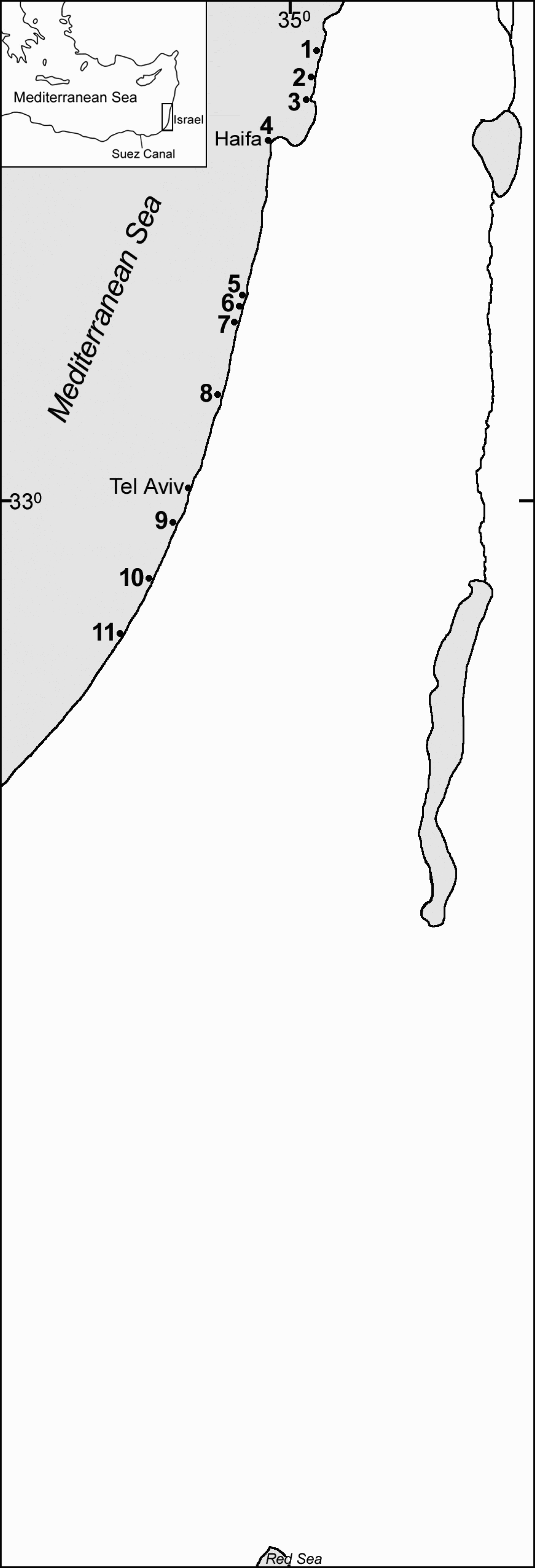
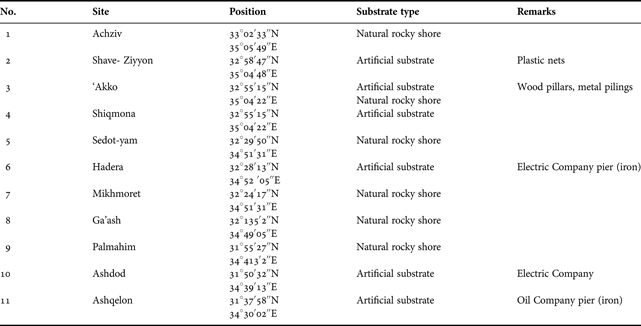
Ascidian samples were collected from eleven sites along the Israeli Mediterranean coast using SCUBA and snorkelling (Figure 1; Table 1). Upon sampling, the ascidians were narcotized with menthol crystals in a closed jar in order to prevent evaporation of the menthol. Only after the samples were fully relaxed (determined by inserting a sharp probe into an open siphon and getting no response), the samples were transferred to a jar with seawater/formalin fixative after rinsing the menthol crystals from the animals' body. The fixative was prepared according to the following formula for 1 l of fixative use: 100 ml of full-strength formaldehyde, 850 ml of seawater, and 50 ml of distilled water. One gram of sodium borate was added to the mixture and the solution was then mixed with a magnetic stirrer. In order to allow DNA analysis a small portion of each sample was directly preserved in absolute ethanol.
Map of the investigated area with the location of sampling sites.

The sites surveyed along the Mediterranean coast of Israel, GPS position, and substrate type.

Dissections were stained with haemalum and mounted on permanent slides. Taxonomic identification was carried out using authoritative keys and texts (e.g. Van Name, Reference Van Name1921, Reference Van Name1931, Reference Van Name1945; Kott, Reference Kott1985, Reference Kott1990, Reference Kott1992, Reference Kott2001; Monniot et al., Reference Monniot, Monniot and Laboute1991; Monniot & Monniot, Reference Monniot and Monniot2001). The entire collection is part of the National Collections of Natural History at Tel Aviv University, Israel (specimens beginning with AS). In addition, other preserved material available from museum collections in Israel was studied (specimens beginning with NS).
RESULTS
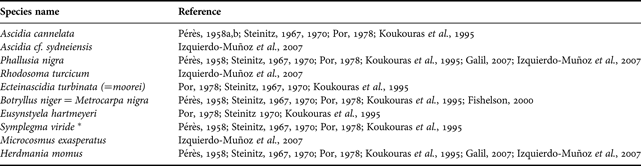
A survey of the available preserved material from the National Collections of Natural History at Tel Aviv University, Israel, combined with the number of non-indigenous species described from the Israeli coasts in the literature, results in an estimation of ten non-indigenous species from the Mediterranean coast of Israel (Table 2). However, the current study provides a list of seven suspected non-indigenous species that are currently found along the Mediterranean coast of Israel: Ecteinascidia thurstoni, Ascidia cannelata, Phallusia nigra, Rhodosoma turcicum, Symplegma brakenhielmi, Microcosmus exasperatus and Herdmania momus.
Literature review of non-indigenous ascidians from the Mediterranean coast of Israel.

*, possible misidentification of S. brakenhielmi (see text).
FAMILY PEROPHORIDAE
Material examined: AS25263–AS25266, AS25275, compared to NS 8362 (Ras Sudar, Gulf of Suez 25 October 1971 identified by C. Monniot, Figure 2a).
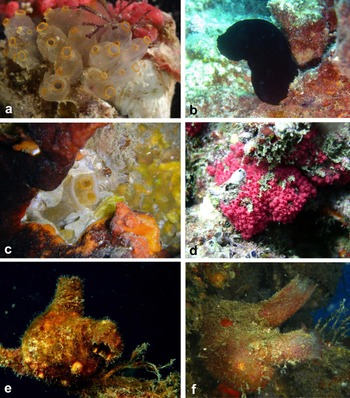
(a) Ecteinascidia thurstoni; (b) Phallusia nigra; (c) Rhodosoma turcicum; (d) Symplegma brakenhielmi; (e) Microcosmus exasperatus; (f) Herdmania momus.

Literature for identification: Kott, Reference Kott1985.
External appearance: colonies of small rounded zooids joined by stolons from the postero-ventral part of the body. The test is thin and glassy with a distinct yellow-orange ring around the rim of the apertures.
Distribution along the Mediterranean coast of Israel: found on both artificial and natural substrate at shallow depth (<5 m) along the northern shores of Israel (Achziv and ‘Akko). It is usually present during the summer months and gradually disappears during autumn. Colonies with larvae were found in July (AS25265) and September (AS25275). The larvae are present in the right peribranchial cavity. The samples were compared with E. thurstoni collected in Ras Sudar, Gulf of Suez 1971 (NS 8362). Ecteinascidia thurstoni has recently been reported along the Red Sea, Gulf of Suez and Port Said on the Mediterranean coast of Egypt (Gab-Alla, Reference Gab-Alla2008).
FAMILY ASCIDIIDAE
Material examined: AS25296–AS25300, AS25306 and compared with AS25229 (Gulf of Aqaba, identified by F. Monniot).
Literature for identification: Oken, 1820; Pérès, Reference Pérès1958b.
External appearance: solitary species with a transparent-gelatinous tunic. The body is oval with siphons parallel and darker than the rest of the tunic. One side of the body is completely attached to the substrate.
Distribution along the Mediterranean coast of Israel: found on both artificial (Hadera) and natural substrate (Achziv, Mikhmoret and Palmahim) up to 15 m depth. All samples were found with gonads.
Material examined: AS25289–AS25295; Figure 2b.
Literature for identification: Van Name, Reference Van Name1921.
External appearance: individuals are easily recognized by the shiny black dark-blue tunic and smooth surface. The body is oval with elongated siphons separated by a third to half the body length. Specimens can reach 10 cm in length.
Distribution along the Mediterranean coast of Israel: widely distributed at all sites and common in shallow to 30 m depth overgrowing both natural and artificial substrates. All samples were found with well developed gonads.
FAMILY CORELLIDAE
Material examined: AS25267–AS25274, and compared with AS25233 from the Gulf of Aqaba identified by F. Monniot, Figure 2c.
Literature for identification: Kott, Reference Kott1985.
External appearance: this species is characterized by the remarkable horizontal fold of the body that acts as a lid over the apertures. It is operated by the highly adapted body musculature. Individuals are upright, oval in section, slightly laterally flattened. The test is firm, gelatinous and translucent. Individuals are up to 5 cm high and 2 cm wide. Well developed gonads appeared in samples taken in December 2004 (AS25271), March (AS25272) and September 2005 (AS25273), and November 2007 (AS25274).
Distribution along the Mediterranean coast of Israel: although this species is generally rare due to its cryptic nature, it may be found all along the Mediterranean coast of Israel from Ashqelon in the south to Achziv in the north on both artificial and natural substrates.
FAMILY STYELIDAE
Material examined: AS25251, AS25252, AS25259–AS25262, NS 15430, 15449 (Symplegma viride Haifa bay 13 February 1975 identified by R.H Millar) Figure 2d.
Literature for identification: Monniot & Monniot, Reference Monniot and Monniot1997, 2001; Kott, Reference Kott2004.
External appearance: red colonies about 5 cm in diameter. The zooids are embedded in a common tunic, with the two very short siphons opening for each zooid creating a beehive appearance.
Distribution along the Mediterranean coast of Israel: common on artificial substrate at the Electric Company pier at Hadera and on wood pillars in ‘Akko and also in the natural environment at shallow depth (<5 m) along the northern shores of Israel (Achziv) and in the south (Palmahim). Colonies with larvae were found in June (AS25259, AS25260). The larva is characterized by its one sense organ and three papillae (Kott, Reference Kott1985). The samples were compared with S. viride collected in Haifa bay 1975 (NS 15430, 15449) and found both corresponding to the morphological description of S. brakenhielmi (Monniot & Monniot, Reference Monniot and Monniot1997). Therefore, the previous records of S. viride (Table 2) may be a misidentification of S. brakenhielmi. It was previously reported from the Lebanon coast (Bitar & Kouli-Bitar, Reference Bitar and Kouli-Bitar2001) and the Levantine coast of Turkey (Çinar et al., Reference Çinar, Bilecengolu, Öztürk and Can2006).
FAMILY PYURIDAE
Material examined: AS25237 (identified by X. Turon) AS25301–AS25306, Figure 2e.
Literature for identification: Kott, Reference Kott1985; Turon et al., Reference Turon, Nishikawa and Rius2007.
External appearance: solitary globular species with long siphons and leathery bright orange tunic with a few encrustations around the base. Characterized by unique siphonal spines.
Distribution along the Mediterranean coast of Israel: typical to artificial substrates, forming dense aggregations at the Electric Company pier at Hadera, Shiqmona and ‘Akko. May also be found in the natural reef in Mikhmoret and Achziv. Samples containing well-developed gonads were found throughout the year.
Material examined: AS25276–AS25286, AS25455 and compared with AS25253 (Gulf of Aqaba), Figure 2f.
Literature for identification: Nishikawa, Reference Nishikawa2002.
External appearance: individuals are almost spherical with cylindrical or trumpet-shaped siphons that are lined with red-pink and white bands in living specimens. The test is smooth, rosy-peach in colour. The siphons are turned away from each other.
Distribution along the Mediterranean coast of Israel: extensive field surveys reveal that H. momus on the Mediterranean coast of Israel is restricted to artificial substrates (sites number shavey tsion, shikmona, hadera) and only few individuals were found on the natural rocky substrate (AS25455). A previous study revealed that the H. momus Mediterranean population reproduces twice a year, when the water temperature conditions are similar to those measured in the Red Sea (~May and November; Shenkar & Loya, Reference Shenkar and Loya2008).
DISCUSSION
The current study is the first attempt to compile an up-to-date species list of the non-indigenous ascidians (NIAs) found along the Mediterranean coasts of Israel. Seven species from five families were currently identified. These include: Ecteinascidia thurstoni, Ascidia cannelata, Phallusia nigra, Rhodosoma turcicum, Symplegma brakenhielmi, Microcosmus exasperatus and Herdmania momus. This list corresponds to studies of NIAs elsewhere in the Mediterranean Sea (Streftaris et al., Reference Streftaris, Zenetos and Papathanassiou2005; Çinar et al., Reference Çinar, Bilecengolu, Öztürk and Can2006; Izquierdo-Muñoz et al., Reference Izquierdo-Muñoz, Diaz-Valdés and Ramos-Esplá2007; Turon et al., Reference Turon, Nishikawa and Rius2007), and partly corresponds to Por's (1978) original description of ‘lessepsian ascidians’ (based on Pérès, Reference Pérès1958a, Reference Pérèsb). Only those species listed as ‘High probability lessepsian migrants’ (P. nigra, H. momus, A. cannelata and S. brakenhielmi probably misidentified as S. viride) were also recently collected.
Interestingly, the solitary species H. momus and M. exasperatus were recorded from the Mediterranean coast mainly on artificial substrates, which supports the hypothesis that NIAs thrive on artificial substrates but often fail to establish communities on natural substrates (Lambert, Reference Lambert2002). Records of M. exasperatus in the Mediterranean have been recently revised by Turon et al. (Reference Turon, Nishikawa and Rius2007), revealing a very restricted distribution in the eastern Mediterranean of this species, suggesting that it may be also considered as a lessepsian migrant. Microcosmus exasperatus was recorded in the Mediterranean only from the coasts of Lebanon and Tunisia and has been found in Suez and the Gulf of Aden (Monniot, Reference Monniot2002). Herdmania momus most likely has also been introduced through the Suez Canal (originally suggested by Por, Reference Por1978, but later claimed by Koukouras et al., Reference Koukouras, Voultsiadou-Koukoura, Kevrekidis and Vafidis1995 as a tropical cosmopolitan species), since it was found along the Mediterranean coast only on artificial substrates (Shenkar & Loya, Reference Shenkar and Loya2008), it has an Indo-Pacific origin (Kott, Reference Kott2002), it is recorded through the Suez Canal (Ghobashy & Adbel Messeih, Reference Ghobashy and Adbel Messeih1991), and so far has been recorded in the Mediterranean only from the Levant basin (Nishikawa, Reference Nishikawa2002). Ascidia cannelata should also be considered as a lessepsian species according to these criteria (Koukouras et al., Reference Koukouras, Voultsiadou-Koukoura, Kevrekidis and Vafidis1995) although it may be found in the natural environment as well.
Although both Phallusia nigra and Rhodosoma turcicum have been originally described from the Red Sea (Savigny, Reference Savigny1816), it is difficult to determine if they have been introduced to the Mediterranean via the Suez Canal due to their wide distribution in the Mediterranean and the Atlantic Ocean (Van Name, Reference Van Name1921, Reference Van Name1945; Kott, Reference Kott1985).
The current study provides the first record of the colonial ascidian Ecteinascidia thurstoni in the Mediterranean. There is a high probability that this species has been introduced through the Suez Canal since it is recorded from the Red Sea and along the Suez Canal (Gab-Alla, Reference Gab-Alla2008). Similarly to what was found in the other locations, along the Mediterranean coast of Israel it is found only during the spring–autumn months when seawater temperatures are above 22°C (N. Shenkar, personal observations). Another non-indigenous colonial species found during the study is Symplegma brakenhielmi. This species is known from the Indian Ocean (Monniot & Monniot, Reference Monniot and Monniot1997) and is distributed worldwide in warmer seas, especially in harbours where it grows on man-made structures (Lambert & Lambert, Reference Lambert and Lambert1998). In the Levantine basin it was reported from the Lebanon coast (Bitar & Bitar-Kouli, Reference Bitar and Bitar-Kouli1995), Turkey (Çinar et al., Reference Çinar, Bilecengolu, Öztürk and Can2006) and Israel (Izquierdo-Muñoz et al., Reference Izquierdo-Muñoz, Diaz-Valdés and Ramos-Esplá2007; Shenkar, Reference Shenkar2008). The fact that only two non-indigenous species are colonial species is intriguing. Since in solitary ascidians fertilization and larval development usually occur in the water column (in contrast to colonial species which are brooders), it is possible that they have a higher potential for dispersal to more distant locations. Nevertheless, it has been suggested that several colonial species have been introduced worldwide by hull fouling and aquaculture (Lambert, Reference Lambert2002; Dijkstra et al., Reference Dijkstra, Harris and Westerman2007b).
Increased recreational sailing and the proliferation of marinas and artificial marine structures in recent decades, provide additional sites for colonization of NIAs, even those with low dispersal abilities (Wasson et al., Reference Wasson, Zabinc, Bedinger, Diaz and Pearse2001). The accumulating evidence for the negative impact of NIAs on local species and habitats (Cohen et al., Reference Cohen, Harris, Bingham, Carlton, Chapman, Lambert, Lambert, Ljubenkov, Murray, Rao, Reardon and Schwindt2005; Blum et al., Reference Blum, Chang, Liljesthröm, Schenk, Steinberg and Ruiz2007; Dijkstra et al., Reference Dijkstra, Sherman and Harris2007a; Lambert, Reference Lambert2007) raises the necessity for long-term studies that will combine regular monitoring of natural versus artificial habitats, and the use of molecular genetic tools that will allow the identification of sources, patterns of dispersal, and degree of gene flow with local forms.
ACKNOWLEDGEMENTS
We are grateful to R. Segal, O. Bornstein, Y. Zeldman, O. Barneah and N. Sokolover for their technical support in the field, to A. Gur for his kind assistance and photography, to E. Kramarsky-Winter and V. Wexler for editorial assistance, to G. Lambert for revising the manuscript, and to F. Monniot and X. Turon for their assistance with taxonomic identification. We would like to thank the Israeli Ministry of Science Culture & Sport for supporting the National Collections of Natural History at Tel Aviv University as a biodiversity, environment, and agriculture research knowledge centre. N.S. would like to thank the JNF-Rieger Foundation for their financial support. This research was supported by the VATAT post doctorate fellowship to N.S. and by the Israel Science Foundation (ISF) and the Raynor Chair for Environmental Conservation Research to Y.L.