Introduction
On top of integrating information in language comprehension, language users actively predict what kind of input is coming next (Altmann & Mirković, Reference Altmann and Mirković2009; Kuperberg & Jaeger, Reference Kuperberg and Jaeger2016; Pickering & Garrod, Reference Pickering and Garrod2013). Studies investigating prediction in L2 speakers, however, suggest that predictive processing in adult L2 speakers may be more limited (for review, Bovolenta & Marsden, Reference Bovolenta and Marsden2021; Kaan & Grüter, Reference Kaan, Grüter, Kaan and Grüter2021).
One factor that may constrain L2 predictive processing is competing information from the L1 (for review, see Foucart, Reference Foucart, Kaan and Grüter2021). Considering that L2 speakers activate both L1 and L2 information when processing their L2 (see Dijkstra et al., Reference Dijkstra, Grainger and van Heuven1999), cross-linguistic differences may impede or slow down predictions during L2 processing. For instance, in van Bergen and Flecken (Reference van Bergen and Flecken2017), advanced L2 learners of Dutch with different L1 backgrounds (German, English, and French) use semantic information encoded in placement verbs differently depending on their L1s to anticipate the type of upcoming referent. In Dutch and German, placement verbs specify whether an object is in a standing or in a lying position (e.g., Dutch and German: “zetten” and “stellen” “put.STAND”; “leggen” and “legen” “put.LIE”). In English and French, however, one general placement verb is used, and thus the position of an object remains underspecified (e.g., English: “put”, French: “mettre”). Participants heard descriptions of visual displays containing one object (e.g., a bottle) in a standing or in a lying position. Similar to Dutch natives, L1 German learners of L2 Dutch launched anticipatory eye movements toward the object matching the positional information encoded in the placement verb immediately upon hearing the verb. In contrast, L1 English and L1 French learners of L2 Dutch failed to generate differential predictions based on the semantic information encoded in placement verbs. Similarly, adult L2 learners whose L1 does not realize grammatical gender on nouns (e.g., English) tend to use gender-marked articles less for predicting an upcoming noun than learners whose L1s also have grammatical gender (e.g., Dussias et al., Reference Dussias, Valdés Kroff, Guzzardo Tamargo and Gerfen2013; Hopp, Reference Hopp2013; Hopp & Lemmerth, Reference Hopp and Lemmerth2018). These findings suggest that L1 differences constrain the prediction of upcoming referents. Such effects have been interpreted to indicate that L1-L2 differences lead to lower accessibility of L2-specific information in the L2 (e.g., Kaan, Reference Kaan2014) or that they reduce the utility of L2 cues for prediction (e.g., Grüter & Rohde, Reference Grüter and Rohde2021; Kaan & Grüter, Reference Kaan, Grüter, Kaan and Grüter2021). In these cases, L2 learners may use a predictive cue less strongly (e.g., Hopp, Reference Hopp2013, for gender; Frenck-Mestre et al., Reference Frenck-Mestre, Kim, Choo, Ghio, Herschensohn and Koh2019, for case) or use more coarse-grained semantic cues for prediction (e.g., Hopp, Reference Hopp2015a, for verb semantics; Grüter et al., Reference Grüter, Lau and Ling2020, for classifiers).
Beyond referent identification, however, it remains an open question whether cross-linguistic differences affect structural predictions. In this study, we investigate cross-linguistic differences in how L2 learners use verb-selectional restrictions on argument order for structural predictions of word order alternations. Reading studies suggest that L2 learners use so-called verb biases—that is, probabilistic information about the type of complements verbs preferentially occur with—during L2 sentence processing. For instance, when reading temporary object-subject ambiguities in sentences like “The CIA director confirmed/admitted the rumor could mean a security leak,” they have greater difficulty recovering from an initial erroneous direct-object analysis of the postverbal noun phrase when the sentence contains a verb that is biased toward co-occuring with a direct object (“confirmed”) compared with a sentential-complement bias verb (“admitted”; Dussias & Cramer-Scaltz, Reference Dussias and Cramer-Scaltz2008). These findings have been interpreted as indicating that direct-object bias verbs generate stronger expectations for a direct-object complement than sentential-complement bias verbs and thus, in turn, trigger stronger garden-path effects when they turn out to be followed by an embedded sentential complement. Some studies also show that differences in L1-L2 word order (subject-object-verb vs. subject-verb-object) may affect L2 learners’ ability to use verb bias incrementally (Lee et al., Reference Lee, Lu and Garnsey2013; Şafak & Hopp, Reference Şafak and Hopp2022). Learners whose L1 places the verb at the end of the clause may be less able to recruit verb-based information for prediction in an L2 in which the verb precedes its complements. However, as these studies measure reading-time differences after the verbs have been encountered, they leave open whether L2 readers actively predict the type of complements or whether complements matching the verbs’ biases are easier to integrate into an unfolding parse reactively (for discussion, Pickering & Gambi, Reference Pickering and Gambi2018).
Using visual world eye-tracking, this study directly investigates the predictive use of verb information governing syntactic alternations. To address the scope of how L2 learners predict during sentence comprehension, we study degrees of prediction according to different types of verb-selectional constraints—that is, categorical and gradient constraints on the argument structure of English ditransitive verbs taking either a double object or a prepositional object as complements—and in two groups of L2 English learners whose L1s differ in word order.
L2 Acquisition and Processing of the English Dative Alternation
Ditransitive verbs may allow their internal arguments to alternate between the PO-dative frame [ _ NPTHEME PPRECIPIENT] and the DO-dative frame [ _ NPRECIPIENT NPTHEME] as in (1), a syntactic phenomenon that is traditionally called the dative alternation (Levin, Reference Levin1993).
-
(1)
-
a. The man will send/pay the money to the woman. (PO-construction)
-
b. The man will send/pay the woman the money. (DO-construction)
-
In English, many ditransitive verbs such as “send” and “pay” participate in the dative alternation, yet these alternating verbs exhibit preferences as to which dative frame they occur in more frequently (Bresnan et al., Reference Bresnan, Cueni, Nikitina, Baayen, Bouma, Krämer and Zwarts2007; Gries, Reference Gries2003). For instance, alternating PO-bias verbs like “send” occur more often in the PO-dative frame (1a), whereas alternating DO-bias verbs like “pay” tend to occur more frequently in the DO-dative frame (1b) than the PO-dative frame (1a).
Not all ditransitive verbs participate in the dative alternation. Nonalternating verbs such as “donate” license only the PO-dative frame and, thus, are categorically restricted to PO-dative constructions (2).
-
(2)
-
a. The man will donate the money to the woman. (PO-construction)
-
b. *The man will donate the woman the money. (DO-construction)
-
The dative alternation in English has been extensively investigated in the L2 acquisition literature, in part because L2 learners cannot easily determine which ditransitive verbs allow alternating syntactic constructions from the input (Yang & Montrul, Reference Yang and Montrul2017). Two common findings have emerged from studies of the comprehension and production of the dative alternation in English with learners across different proficiency levels and different L1 backgrounds (French: Mazurkewich, Reference Mazurkewich1984; Japanese and Chinese: Inagaki, Reference Inagaki1997; Polish and German: Callies & Szczesniak, Reference Callies, Szczesniak, Walter and Grommes2008). First, L2 learners reliably distinguish between nonalternating and alternating verbs. Second, L2 learners have a general preference for PO-dative constructions for alternating verbs, as reflected by higher acceptability and/or higher use of PO-datives in comparison with DO-datives.
Moreover, Jäschke and Plag (Reference Jäschke and Plag2016) found that advanced L1 German learners’ dative choices in a sentence rating study, although characterized by an overall PO preference, were affected by syntactic and discourse constraints (i.e., factors like syntactic complexity, definiteness, and animacy of theme and recipient). These findings suggest that L2 learners also become sensitive to probabilistic constraints on the dative alternation. In a similar vein, research on structural priming suggests that L2 learners have a strong preference for PO- over DO-datives; however, after encountering DO primes in the L1 (Kootstra & Doedens, Reference Kootstra and Doedens2016) or the L2 (Kaan & Chun, Reference Kaan and Chun2018), L2 learners produce more DO targets in the L2. In doing so, they are sensitive to the L2 verb biases in that they produce more DO targets for verbs that preferentially take DO complements in the L2 (Kootstra & Doedens, Reference Kootstra and Doedens2016; for L1 verb bias effects, see Salamoura & Williams, Reference Salamoura and Williams2006). Taken together, rating and priming studies suggest a certain degree of sensitivity among advanced L2 learners to categorical and gradient verb-selectional preferences.
Fewer studies have examined whether L1 and L2 speakers use these categorical and gradient preferences of ditransitive verbs to make predictions about the order of the following complements. For L1 speakers of English, Scheepers et al. (Reference Scheepers, Williams, Mohr, Arai and van Gompel2007) explored whether native English speakers use verbs’ categorical selectional restrictions on the dative alternation to generate predictions during real-time sentence comprehension. In a visual world eye-tracking experiment, participants listened to sentences such as (3) while looking at visual displays with an agent referent (“the businessman”), a theme referent (“the money”), and a recipient referent (“the nun”).
-
(3) The businessman will donate/give the money to the nun.
Participants launched more looks to the theme referent upon hearing a nonalternating (relative to alternating) verb, demonstrating that native English speakers exploit categorical properties of ditransitive verbs rapidly to build predictions about the upcoming complement.
L1 speakers also immediately recruit gradient selectional restrictions. In Tily et al. (Reference Tily, Hemforth, Arnon, Shuval, Snider and Wasow2008), participants were presented with spoken sentences in which both the biases of alternating verbs (PO-bias vs. DO-bias) and the type of complement constructions (PO-dative vs. DO-dative) were manipulated. For verbs with PO biases (e.g., “take”), participants showed earlier looks to the theme referent—that is, the first complement in PO constructions—and DO-bias verbs (e.g., “serve”) triggered earlier looks to the recipient referent the first complement in DO constructions.
For L2 learners, Wolk et al. (Reference Wolk, Wolfer, Baumann, Hemforth, Konieczny, Carlson, Hölscher and Shipley2011) built on the study by Tily et al. (Reference Tily, Hemforth, Arnon, Shuval, Snider and Wasow2008) and tested two groups of higher and lower proficiency German-speaking learners of L2 English. For PO constructions, both higher and lower proficiency L1 German learners initiated earlier looks to the theme referent when encountering PO-bias versus DO-bias verbs. For DO constructions, the higher proficiency learners made earlier looks to the recipient referent following DO-bias versus PO-bias verbs. However, the lower proficiency learners showed a general tendency to look at the recipient referent, irrespective of the biases of the verbs. Wolk et al. (Reference Wolk, Wolfer, Baumann, Hemforth, Konieczny, Carlson, Hölscher and Shipley2011) argued that L1 German learners at lower levels of proficiency might have been influenced by the prevalent word order in their L1 (i.e., the Recipient>Theme order), leading to a general expectation for a recipient, rather than a theme, in the first postverbal argument position. Accordingly, lower proficiency learners might have ignored verb bias information when their expectation corresponded to the order of referents they encountered in the L2—that is, when processing DO constructions—but made use of such information when their expectation was incompatible with the actual realization in the L2—that is, when processing PO constructions. However, the conclusion that L1 word order affects prediction of complement order is circumstantial because it does not rest on a comparison with an L2 group that has a different L1.
Comparing groups of L1 German and L1 Turkish L2 learners of English, the present study investigates the effects of categorical and gradient selectional restrictions on the dative alternation and the role of word order differences between the L1 and the L2 in the predictive L2 processing of complements of ditransitive verbs.
The Present Study
Building on Scheepers et al. (Reference Scheepers, Williams, Mohr, Arai and van Gompel2007) and Tily et al. (Reference Tily, Hemforth, Arnon, Shuval, Snider and Wasow2008), we designed a visual world eye-tracking experiment that examined the use of both categorical and gradient selectional information encoded in ditransitive verbs. We employed three groups of ditransitive verbs: nonalternating verbs that are limited to the PO-dative construction (e.g., “describe”), alternating PO-bias verbs that permit the dative alternation but occur more frequently in the PO-dative construction (e.g., “sell”), and alternating DO-bias verbs more frequently used in the DO-dative construction (e.g., “tell”). In a visual world eye-tracking study, we examine eye movements to the referents corresponding to the complement noun phrases as participants listen to the sentences.
Research questions and hypotheses
Our first research question is:
RQ1: Do adult L2 learners generate predictions on the basis of categorical and gradient verb-selectional information in sentence processing?
Predictions about verb complementation must be learned from the L2 input. Learners can induce the PO preference of nonalternating verbs as a categorical selectional constraint from the input by virtue of the exclusive occurrence of these verbs with prepositional objects. Nonalternating verbs should give rise to stronger expectations for an upcoming PO-dative structure (the Theme>Recipient order) than alternating verbs, which can occur with either object. As a result, listeners are expected to show earlier eye movements toward the theme entity in the display immediately after a nonalternating verb compared with an alternating verb.
For alternating verbs, alternating PO-bias verbs should also generate stronger expectations for an upcoming PO-dative structure than alternating DO-bias verbs, and vice versa. However, learners need to derive these gradient selectional preferences of verbs from biases of complementation preference by tracking the probabilistic distribution of the complementation preferences of individual verbs in the input through accumulated language experience of their usage patterns. These patterns may vary across contexts and speakers (Gries, Reference Gries2003). We thus expect learners to make more robust predictions for nonalternating verbs than for alternating verbs.
Our second research question is:
RQ2: Do differences in L1 word order modulate verb-based predictions?
Against the background of previous studies suggesting that L1 word order can affect the use of verb biases in reading (Lee et al., Reference Lee, Lu and Garnsey2013; Şafak & Hopp, Reference Şafak and Hopp2022), we expect that the use of verb-selectional information to anticipate upcoming complements will be different among L1 German learners and L1 Turkish learners.
Dative constructions in L1 German and L1 Turkish
In the present study, we test L1-German– and L1-Turkish–L2-English learners because this language pairing allows for investigating the potential role of L1 differences in the L2 processing of English dative constructions. German and Turkish dative constructions differ in two respects: their word order and the presence or absence of PO constructions.
In German, like in English, finite verbs typically precede their complements in main clauses, whereas verbs appear clause-finally in Turkish. Consequently, using verb-selectional information as a predictive cue may be stronger for L1 German learners compared with L1 Turkish learners.
Turkish also differs from German and English in not having the PO construction. However, like German, it allows for both Recipient>Theme and Theme>Recipient orders as per scrambling (e.g., Kornfilt, Reference Kornfilt and Karimi2003). In a sentence completion study by Şafak (Reference Şafak2022), L1 Turkish speakers completed dative sentence fragments in Turkish more often with the Theme>Recipient (DO-IO) order than the Recipient>Theme (IO-DO) order. Hence, the preferred word order in Turkish corresponds to the PO construction in English.
In light of these differences between German and Turkish, we expect L1 German learners to show greater or more nuanced predictive processing than L1 Turkish learners. Such differences should manifest in terms of either the onset of prediction or the strength of prediction.
Participants
Seventy-two L2 learners of English participated in the study. Thirty-six participants had German as their L1, and 36 participants were L1 Turkish speakers. All were students of English at German and Turkish universities at the time of testing, respectively.
In addition, a group of 19 native speakers of English took part in the study. All were students of English at a British university at the time of testing, and they were strongly dominant in English as per self-report. Note that we included a native group not to compare our L2 learners’ performance with that of native speakers but rather to assess whether our experimental manipulations had the intended effects. All participants had normal or corrected-to-normal vision and provided informed consent prior to taking part in the study.
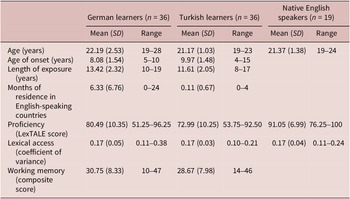
Table 1 summarizes the participants’ characteristics and lists the findings from individual differences tasks that we conducted to match the participant groups on background factors that had been shown to affect predictive (L2) sentence processing—that is, proficiency (Wolk et al., Reference Wolk, Wolfer, Baumann, Hemforth, Konieczny, Carlson, Hölscher and Shipley2011), lexical access (Hopp, Reference Hopp2013) and working memory (Ito et al., Reference Ito, Corley and Pickering2018). Due to time limitations, the native speakers only completed the proficiency and the lexical automaticity tasks.
Participant information and results from individual differences tasks

For English proficiency, all participants completed the Lexical Test for Advanced Learners of English (LexTALE), a standardized vocabulary task requiring participants to make a lexical decision without any time limitation (Lemhöfer & Broersma, Reference Lemhöfer and Broersma2012). LexTALE was implemented in E-Prime, Version 2.0 (Schneider et al., Reference Schneider, Eschman and Zuccolotto2002). Both L2 groups attained mean scores corresponding to the B2 level (upper intermediate) in the Common European Framework of Reference for Languages, yet the L1 Turkish group scored statistically lower on the LexTALE than the L1 German group, t (70) = 3.09, p = .003.
For lexical processing, all participants completed the lexical decision task used by Hopp (Reference Hopp2014), which was run in E-Prime 2.0 (Schneider et al., Reference Schneider, Eschman and Zuccolotto2002). An independent samples t test indicated that the German and Turkish participants did not differ significantly in their lexical automaticity scores, t (70) = 0.03, p = .97. This demonstrated that both learner groups were matched in terms of automaticity in lexical access.
For working memory, we used the English-language reading-span task designed by Ariji et al. (Reference Ariji, Omaki, Tatsuta and Slezak2003) as described in (Hopp, Reference Hopp2014). An independent samples t test did not yield any significant difference between the German and Turkish participants, t (70) = 1.08, p = .28, suggesting that the two learner groups were comparable with respect to their working memory capacity.
Materials and Procedure
Visual world eye-tracking study
Materials
For the visual world eye-tracking experiment, we created 36 experimental items in three conditions as in (4–6).
-
(4) Nonalternating verbs
-
a. The student will describe the picture to the teacher. (PO-construction)
-
b. The nun will donate the food to the beggar. (PO-construction)
-
-
(5) Alternating PO-bias verbs
-
c. The singer will sell the guitar to the teenager. (PO-construction)
-
d. The singer will sell the teenager the guitar. (DO-construction)
-
-
(6) Alternating DO-bias verbs
-
e. The grandmother will tell the story to the children. (PO-construction)
-
f. The grandmother will tell the children the story. (DO-construction)
-
All sentences comprised an animate subject noun phrase, the modal verb “will,” a ditransitive verb, and two complements, including an inanimate theme and an animate recipient. All subjects, themes, and recipients were preceded by the definite article “the,” which ensured that definiteness could not be used as a cue in predicting verbs’ upcoming argument structure (see Bresnan et al., Reference Bresnan, Cueni, Nikitina, Baayen, Bouma, Krämer and Zwarts2007). The verbs were selected based on two sentence-completion tasks as norming studies.
The first norming study was administered to 67 native English speakers who did not participate in the main eye-tracking experiment. Participants were presented with 50 experimental sentence fragments consisting of a subject noun phrase (“the singer”), the modal verb “will,” and one of 50 ditransitive verbs (“sell”). For each sentence fragment, two complement noun phrases (“the guitar” and “the teenager”) were provided in parentheses. The participants completed each sentence fragment by using the noun phrases given in parentheses. The sentence completions for each verb were coded as either “DO-dative,” “PO-dative,” or “other” (i.e., incomplete or nondative structures), and the percentages of the total number of responses in each category were computed. Verbs were classified as alternating if the responses in both the DO-dative and in the PO-dative categories were higher than 5% and as nonalternating if the responses in one of the categories were lower than 5%. Verbs that were frequently used with “other” types of structures were removed from further consideration. Verbs were classified as DO-bias if they were more frequently used with a DO-dative structure than with a PO-dative structure and if the difference between the DO-dative and PO-dative categories was greater than 15% (see Garnsey et al., Reference Garnsey, Pearlmutter, Myers and Lotocky1997). The reverse procedure was followed to classify verbs as PO-bias. Nineteen out of the 50 English ditransitive verbs were classified as nonalternating PO-bias verbs, and the other 31 were categorized as alternating (PO-bias: n = 25; DO-bias: n = 6).
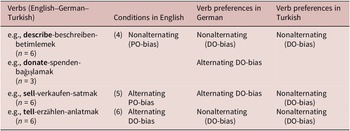
To establish the selectional restrictions of the L1 translation equivalents in German, 67 native German speakers who did not take part in the main experiment completed the second norming study. Applying the same classification as in the English norming study, we found that, of the 19 English nonalternating PO-bias verbs, 14 were nonalternating DO-bias in German, four were alternating DO-bias, and the remaining one was alternating PO-bias. Fifteen of the 25 English alternating PO-bias verbs were alternating DO-bias in German, whereas the remaining 10 were nonalternating DO-bias. In addition, the six verbs categorized as alternating DO-bias in English were classified as nonalternating DO-bias in German. We did not conduct a third norming study to determine categorical and gradient properties of the Turkish translation equivalents of the 50 English verbs, as Turkish verbs only allow DO structures in dative constructions (Kornfilt, Reference Kornfilt and Karimi2003). Taking into account differences in L1-L2 verb-selectional restrictions, we used 21 English ditransitive verbs in the eye-tracking study. To balance out differences between the verb biases of the translation equivalents of English nonalternating verbs, we constructed two sets of nonalternating verbs in English—namely, one set of verbs that was nonalternating in both English and German (“describe”) and one set that was nonalternating in English but alternating in German (“donate”; see Table 2). To include the same number of nonalternating and alternating verbs, the three donate-type nonalternating PO-bias verbs were used twice but with different subjects and complements.
Properties of the 21 ditransitive verbs used in the eye-tracking experiment

This design led to 36 experimental items in three pairs of 12 sentences each, as in (4–6). Nonalternating verbs were used only in the PO construction (4), whereas alternating verbs occurred in both PO and DO constructions with different sets of subjects and complements (5 and 6). A full list of the experimental sentences is available in the Supplementary Materials.
For each item, a visual display was created using commercially available ClipArt packages, as illustrated in Figure 1. Each display depicted three entities—that is, a subject entity (“the singer”), a theme entity (“the guitar”), and a recipient entity (“the teenager”). The three entities were arranged in a triangular fashion and counterbalanced.
Visual display for the sentences (5a and b)

Procedure
Each of the 12 alternating verbs appeared with two different sets of arguments, once in the PO-dative and in the DO-dative constructions. The sentences were distributed over two lists according to a Latin square design so that each alternating verb occurred twice per list—with different arguments and in different dative constructions. All sentences were spoken by a male native speaker of American English at a slow to moderate pace, ranging from 1.67 to 2.75 syllables per second, and recorded using the sound editing package Audacity, version 2.1.3 (Audacityteam, 2017). To avoid subtle auditory differences between the two lists, we applied cross-splicing to the PO- and DO-construction versions of the alternating-verb sentences, generating two lists in which the region preceding the complements (“the singer will sell”) was spliced from the DO sentences and two lists in which the same region was spliced from the PO sentences to counterbalance any potential differences. Additionally, the 12 items with nonalternating verbs were included in each list. In all, each of the four lists encompassed 36 experimental items.
These experimental items were combined with 48 additional filler items that comprised prepositional verbs or transitive verbs taking direct objects. All experimental and filler items were presented in a pseudorandomized order, with no more than two consecutive occurrences of the same type of experimental and filler items.
Participants were seated at a distance of approximately 70 cm from a 22-in. (~55.9 cm) computer screen. The visual displays were presented to participants with a resolution of 1680 ×1050 pixels. The spoken sentences were presented via two loudspeakers. The presentation of the spoken sentences started after a 500-ms preview, and the visual displays remained visible for 2,000 ms after sentence offset. To assess whether participants listened to the sentences attentively, a quarter of all experimental and filler items was followed by a written prompt that required participants to verbally describe the previous visual display. The experiment began with instructions and a practice session of four items. Participants’ eye movements were recorded by a binocular SMI RED eye tracker at 60 Hz. Following the practice session, the eye tracker was calibrated with a 9-point calibration grid for both eyes. The calibration procedure was repeated when visual acuity fell below 0.5 degrees. Participants completed the entire experiment in 15–25 min.
Off-line acceptability judgment task
Following the visual world eye-tracking experiment, an off-line acceptability judgment task was conducted to assess participants’ knowledge of the English dative alternation. In a 3 × 2 factorial design, we created 42 critical sentences by crossing the factors verb type (nonalternating PO-bias, alternating PO-bias, or alternating DO-bias) and sentence type (PO-construction or DO-construction). Each of the 21 English ditransitive verbs used in the eye-tracking study was presented both in PO-construction and in DO-construction sentences but with different arguments. Thirty-three sentences, which were taken from the main study (4–6), were grammatical, and nine newly created sentences were ungrammatical DO constructions with nonalternating verbs.
We added 16 fillers, half of which were grammatically well formed and the other half ungrammatical, thus yielding a total of 58 sentences. Two lists were created counterbalancing sentence type.
The task was administered in a paper-and-pencil questionnaire format, and participants were instructed to read each sentence carefully and to rate its acceptability on a 5-point Likert-type scale ranging from 1 (completely unacceptable) to 5 (completely acceptable) without any time limitation.
Results
We focus on the results of the L2 learners, as our research questions concern the use of categorical and gradient verb information in L2 processing (RQ.1) and L1 differences between different L2 groups (RQ.2). We analyze the results of the native speakers separately as a baseline to validate that the task is effective in eliciting preferences in prediction, yet we do not undertake direct L1-L2 comparisons, as this study is not concerned with the question of native-like L2 processing.
Off-line acceptability judgments
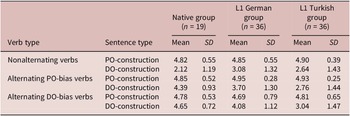
We first present the results from the judgment task. The mean acceptability judgment scores are listed in Table 3 (see the Supplementary Materials for the frequency distribution of judgment ratings per group).
Mean acceptability judgment scores and standard deviations by group

Note. A score of 1 stands for “completely unacceptable” and 5 for “completely acceptable.”
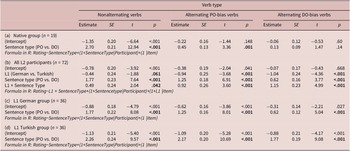
For each verb type, we ran a linear mixed-effects model (Baayen et al., Reference Baayen, Davidson and Bates2008) including sentence type (PO-construction [+0.5] vs. DO-construction [-0.5]) as deviation-coded fixed effects, random intercepts for participants and items, and sentence type as by-participant random slope. The model analyses were conducted separately for the native group and, to address RQ.2 about L1 effects, the group of L2 learners with the factor L1 (German vs. Turkish) as a fixed effect. Following Barr et al. (Reference Barr, Levy, Scheepers and Tily2013), all models were fitted with a maximal random-effects structure.
As seen in Table 4, the native speakers made a difference in judgments for nonalternating verbs and for alternating PO-bias verbs yet did not show a bias for alternating DO-bias verbs. In contrast, the L2 group as a whole displayed a PO bias for all types of verbs. Further, significant interactions of L1 and sentence type were observed for the L2 group. For both L1 German and L1 Turkish learners, follow-up analyses revealed that all types of verbs received higher acceptability ratings in PO constructions than in DO constructions. However, the acceptability difference between DO-dative and PO-dative constructions tended to be larger for the L1 Turkish learners (d = 1.95, CI = 1.83–2.07) than for the L1 German learners (d = 1.26, CI = 1.15–1.37), as shown by the nonoverlapping confidence intervals.
Acceptability judgment results by group and verb type

Note. SE = standard error. Levels of sentence type are +0.5 for PO and -0.5 for DO.
Eye movements during listening
Comprehension accuracy in the descriptions of the visual display was high overall, at 98% (SD = 5.1) for the native speakers, 92% (SD = 11.3) for the L1 German participants, and 89% (SD = 10.1) for the L1 Turkish participants, suggesting that all participants attentively listened to the sentences.
In the analysis software BeGaze (Version 3.7), we created three equal-sized areas of interest for the experimental items around the respective pictures (610 × 459 pixels each), labeled the subject, the theme, or the recipient. Following Wolk et al. (Reference Wolk, Wolfer, Baumann, Hemforth, Konieczny, Carlson, Hölscher and Shipley2011), we analyzed looks to the theme out of looks to all areas of interest following the mean onset of the verb (VERB), the first complement (COMPL1), and the second complement (COMPL2) in three planned comparisons.
All analysis windows were shifted forward 200 ms, as it takes approximately 200 ms to initiate and implement an eye movement (Matin et al., Reference Matin, Shao and Boff1993).
We made the following comparisons in the analysis. First, to establish whether participants made use of categorical verb information for complement selection, we compared nonalternating verbs (e.g., “describe” and “donate” in [4]) to the combined set of alternating verbs (e.g., “sell” in [5a] and “tell” in [6a]; categorical comparison). Second, to see whether gradient verb information affected the looks to the theme entity, comparisons were run for PO constructions between alternating PO-bias (e.g., “sell” in [5a]) and DO-bias verbs (e.g., “tell” in [6a]; gradient comparison [PO]). Additionally, for DO constructions, we compared the verbs (e.g., “sell” vs. “tell”) between (5b) and (6b)—gradient comparison (DO).
We carried out growth curve analyses (Mirman, Reference Mirman2014), using linear mixed-effects models (Baayen et al., Reference Baayen, Davidson and Bates2008) and the lmer() function of R’s lme4 package (Bates & Sarkar, Reference Bates and Sarkar2007), on the empirical logit of fixations to the theme entity per 50-ms time bin with the make_time_sequence_data() function of R’s eyetrackingR package (Dink & Ferguson, Reference Dink and Ferguson2015). All models contained the factors verb type and time including the first-order (linear), second-order (quadratic), and third-order (cubic) polynomial time terms as fixed effects; random intercepts for participants and items; and random slopes of the factor time for both participants and items.Footnote 1 We used higher order polynomials to detect nonlinear effects in the gaze data, as visual inspection of the gaze data shows that looks do not continuously increase to a referent but change in slope over the different time windows. The categorical fixed effects were sum-coded and centered. We initially estimated models with a maximal random-effects structure. However, as these models failed to converge, we simplified the random-effects structures by including only the random slope for time.
Models were computed separately for the native speakers and all L2 learners, where we added L1 (German vs. Turkish) as a fixed effect to address RQ.2. All omnibus analyses revealed significant interactions between verb type and L1 and between verb type, L1, and time in all temporal regions of interest. Therefore, we subsequently analyzed the L2 data separately by L1 in order to capture the full processing patterns of the L1-German–L2-English and L1-Turkish–L2-English learners.
Because our hypotheses focused on the predictive use of verb subcategorization information, we focus on main effects of and interactions with verb type in the analyses presented below. Following Tily et al. (Reference Tily, Hemforth, Arnon, Shuval, Snider and Wasow2008), we interpret effects of verb type in COMPL1 as reflecting prediction, even though listeners may begin to integrate information about the first complement in this temporal region. Crucially, such partial integration of the first complement is the same across conditions so that differences between conditions likely reflect different expectations regarding the complement order. Thus, we refer to effects observed as beginning before or in COMPL1 as reflecting predictive use of verb bias and effects that arise only later as reflecting delayed uses of verb bias.
Categorical comparison
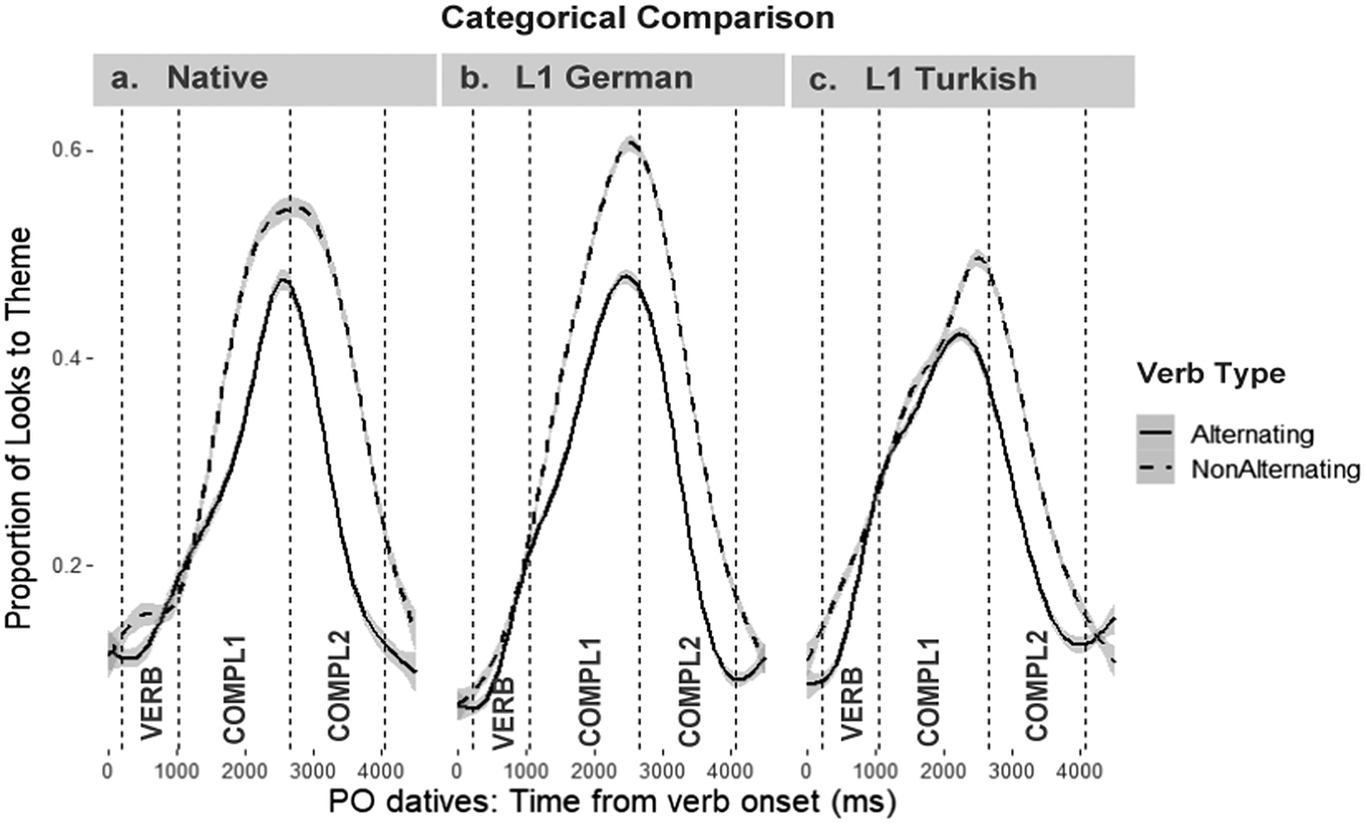
Figure 2 plots looks to the theme argument in the PO constructions with nonalternating (dashed line) versus alternating (solid line) verbs for each group for the verb segment and the two complement segments. The mean durations of these segments were 831 ms (SD = 254 ms) for the VERB, 1,629 ms (SD = 168 ms) for the COMPL1, and 1,398 ms (SD = 151 ms) for the COMPL2.
Fixation proportions to the theme in PO constructions with nonalternating versus alternating verbs by group. The vertical dotted lines indicate the VERB, COMPL1, and COMPL2 temporal regions.

Visual inspection of the gaze data suggests that the native speakers (Figure 2a) launched more fixations to the theme entity for the dative constructions with nonalternating verbs in the COMPL1 region. The L1 German learners (Figure 2b) showed a comparable pattern, whereas the L1 Turkish learners (Figure 2c) demonstrated fewer and delayed fixations to the theme argument for nonalternating over alternating verbs.
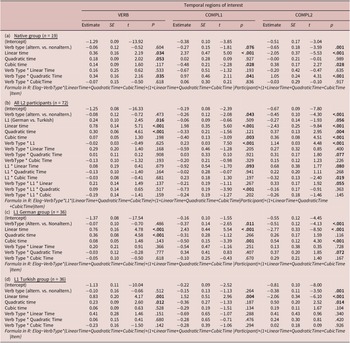
Table 5 presents the results of the categorical comparison by group. For the natives, the main effect of verb type approached significance in the COMPL1 region and reached significance in the COMPL2 region. There was a significant interaction of verb type and quadratic time in all three regions, indicating that the natives exhibited changes of looks over time for nonalternating relative to alternating verbs.
Linear mixed-effects models performed for the categorical comparison by group

Note. SE = standard error. Levels of verb type are +0.5 for alternating and -0.5 for nonalternating.
For the L2 group, there were interactions between L1 and verb type in the COMPL1 and the COMPL2 regions, as well as higher order interactions with time.
Subsequent models by L1 showed a main effect of verb type in the COMPL1 and the COMPL2 regions for the L1 German group.Footnote 2 In addition, the interaction between verb type and quadratic time was marginally significant in COMPL2. Finally, the L1 Turkish group did not show any effects of or interactions with verb type in the COMPL1 region and only a main effect of verb type in COMPL2 without any further interactions.
Gradient comparison (PO)
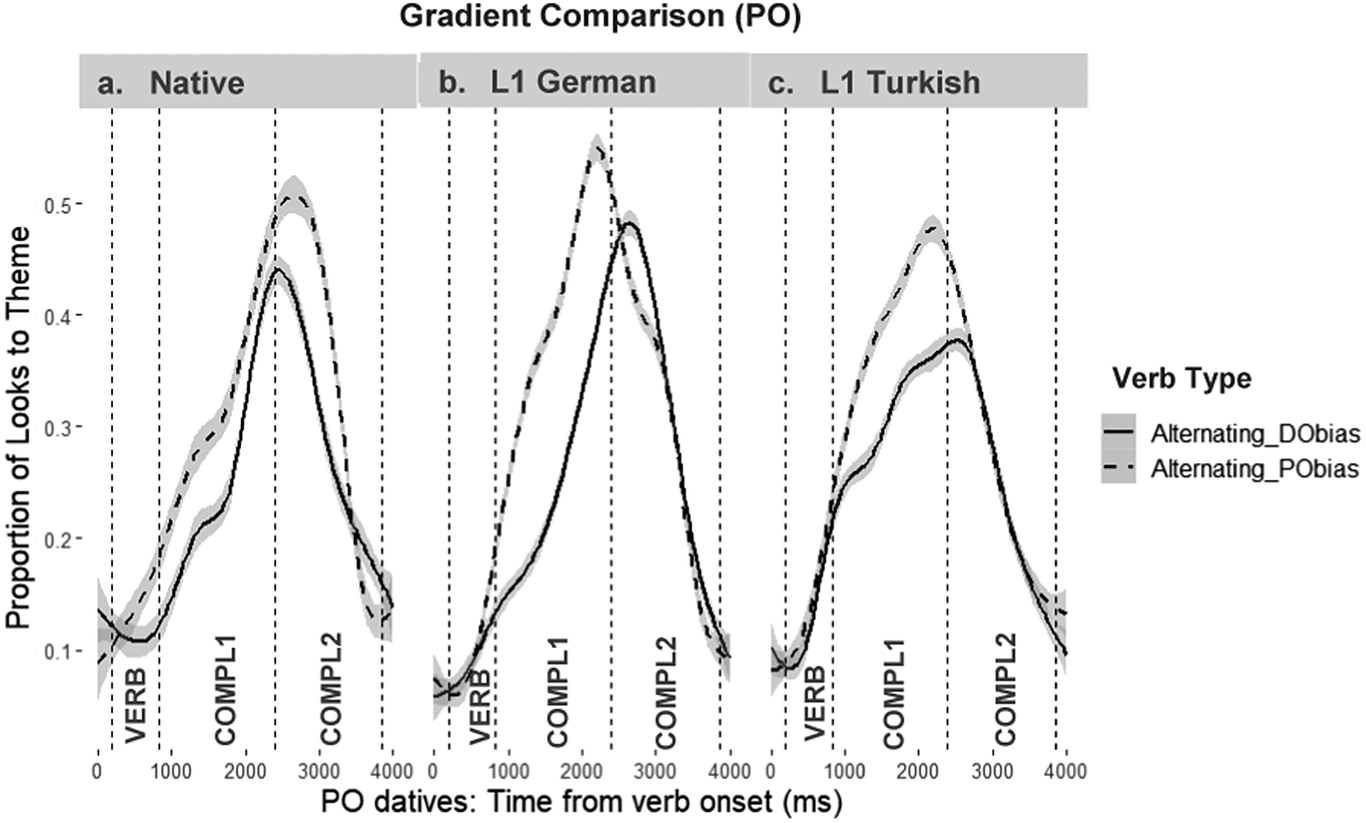
Figure 3 shows looks to the theme in the PO constructions with alternating PO-bias (dashed line) relative to alternating DO-bias (solid line) verbs for each participant group and each segment. The mean durations of segments were 625 ms (SD = 112 ms) for the VERB, 1,568 ms (SD = 173 ms) for the COMPL1, and 1,461 ms (SD = 177 ms) for the COMPL2.
Fixation proportions to the theme in PO constructions with alternating PO-bias versus alternating DO-bias verbs by group. The vertical dotted lines represent the VERB, COMPL1, and COMPL2 temporal regions, respectively.

For the native speakers (Figure 3a), the gaze plots suggest that alternating PO-bias verbs elicited more fixations to the theme entity in all three regions than did alternating DO-bias verbs. Similarly, both L1 German (Figure 3b) and L1 Turkish learners (Figure 3c) showed more looks to the theme entity for alternating PO-bias relative to alternating DO-bias verbs in the COMPL1 region, yet the L1 Turkish group had overall fewer looks to the referents.
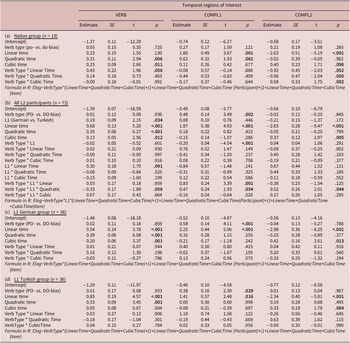
As seen in Table 6, native speakers demonstrated a trend toward an interaction of verb type and linear time in the VERB and the COMPL2 regions. In the COMPL2 region, there was also a significant interaction of verb type and quadratic time, reflecting an initial increase and then a steep decrease in looks to the theme for alternating PO-bias versus alternating DO-bias verbs, and a marginally significant interaction of verb type and cubic time.
Linear mixed-effects models performed for the gradient comparison (PO) by group

Note. SE = standard error. Levels of verb type are +0.5 for PO-bias and -0.5 for DO-bias.
For the L2 groups, there was a significant interaction between L1 and verb type in the COMPL1 region and higher order interactions including L1 and verb type in both COMPL1 and COMPL2 regions. The L1 German and L1 Turkish learners both showed main effects of verb type in COMPL1, with alternating PO-bias verbs eliciting more looks to the theme than alternating DO-bias verbs. There were no further interactions between verb type and time.
Gradient comparison (DO)
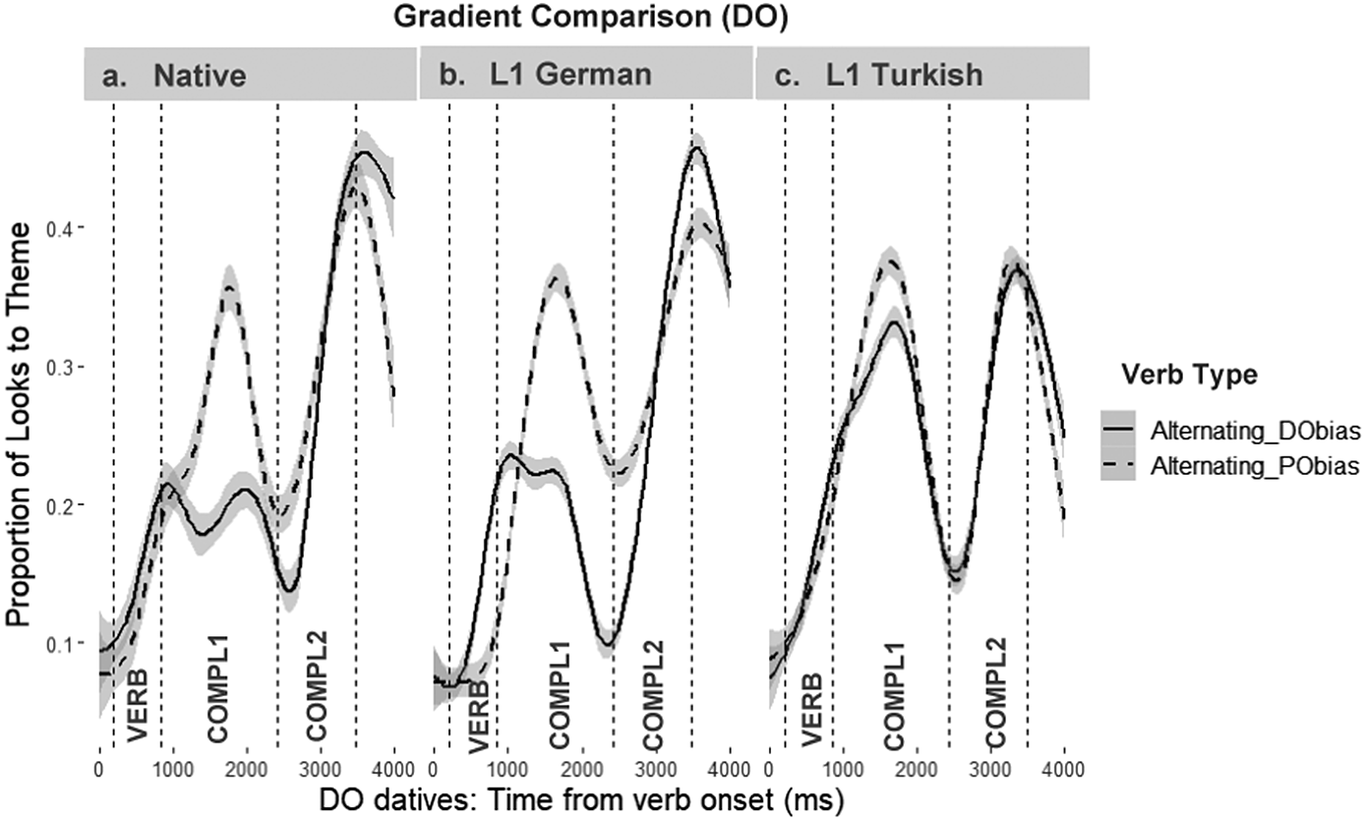
Figure 4 displays looks to the theme entity in the DO constructions with alternating PO-bias (dashed line) versus alternating DO-bias (solid line) verbs for each group. Note that, unlike for the earlier comparisons, the first complement in the DO structure is the recipient, not the theme. The mean durations of segments were 648 ms (SD = 136 ms) for the VERB, 1,580 ms (SD = 186 ms) for the COMPL1, and 1,058 ms (SD = 175 ms) for the COMPL2.
Fixation proportions to the theme in DO constructions with alternating PO-bias versus alternating DO-bias verbs by group. The vertical dotted lines mark the VERB, COMPL1, and COMPL2 temporal regions, respectively.

The gaze data suggest that native speakers (Figure 4a) made more fixations to the theme for the dative constructions with alternating PO-bias relative to alternating DO-bias verbs in the COMPL1 region. This fixation pattern was also observed in the L1 German learners (Figure 4b). In contrast, the L1 Turkish learners (Figure 4c) showed largely similar fixations to the theme following alternating PO-bias and alternating DO-bias verbs in the COMPL1 region.
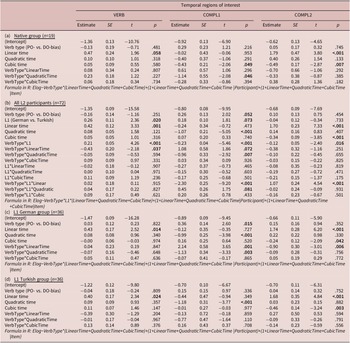
Table 7 shows the results of the gradient comparison (DO) run for each group. The native speakers showed a significant interaction of verb type and quadratic time in the COMPL1 region.
Linear mixed-effects models performed for the gradient comparison (DO) by group

Note. SE = standard error. Levels of Verb Type are +0.5 for PO-bias and -0.5 for DO-bias.
For the L2 groups, there were significant interactions between L1 and verb type in all regions, as well as higher order interactions in the COMPL1 and the COMPL2 regions. In COMPL1, the L1 German learners exhibited an interaction of verb type and linear and quadratic time as well as a significant main effect of verb type. Further, they showed an interaction of verb type and linear time in COMPL2, suggesting that alternating DO-bias (relative to alternating PO-bias) verbs yielded a steeper increase in the proportion of looks to the theme. For the L1 Turkish learners, however, there were no main effects or interactions with the factor verb type.
All in all, the consistent interactions between verb type and L1 demonstrated that the two L2 groups behaved differently in all comparisons. The L1 German group made predictive use of categorical (nonalternating vs. alternating) and gradient (PO-bias vs. DO-bias) verb information in the processing of the English dative alternation. In these respects, the L1 German group patterned similarly to the native speakers. However, the L1 Turkish group exhibited different processing patterns in the categorical comparison and in the gradient comparison (DO), although it showed qualitatively similar patterns in the gradient comparison (PO).
Discussion
This study investigated whether L2 learners rely on categorical and gradient verb-selectional information of the dative alternation in English to generate predictions in sentence processing (RQ1) and whether differences in L1 word order modulate the reliance on verb-selectional information in L2 predictive processing (RQ2).
As for RQ1, the results indicated that L1 German learners made more looks to the theme entity in the visual display when they heard a nonalternating versus an alternating verb. Similarly, they were sensitive to gradient verb preferences in PO and DO constructions. Thus, L1 German learners immediately recruited categorical (nonalternating vs. alternating) and gradient (PO-bias vs. DO-bias) verb information to predict the order of the subsequent arguments—namely, whether the verb is followed by a PO-dative (the Theme>Recipient order) or a DO-dative construction (the Recipient>Theme order).
The finding that L1 German learners could immediately use categorical and gradient verb information for prediction corroborates the results of Wolk et al. (Reference Wolk, Wolfer, Baumann, Hemforth, Konieczny, Carlson, Hölscher and Shipley2011), who observed target-like sensitivity to verb-selectional preferences in highly proficient L1 German learners of L2 English. This study adds robust evidence of prediction in the context of nonalternating verbs. The findings that adult L2 learners can reliably use L2 verb biases for prediction indicate that adult L2 learners make predictions about syntactic structure as a consequence of probabilistic verb biases.
Our native speakers, like L1 German learners, made use of categorical and gradient selectional information on ditransitive verbs to predict upcoming argument structure (see also Scheepers et al., Reference Scheepers, Williams, Mohr, Arai and van Gompel2007). The results also showed that some of the critical effects approached but did not reach statistical significance for the native group—likely due to power issues. However, we note that these marginal effects do not affect the main conclusions of our study about the predictive nature of L2 sentence comprehension.
As for RQ2 about cross-linguistic differences, the results for L1 Turkish learners were partially different from those of the L1 German learners, as seen in the interactions with L1 group. In the categorical comparison, L1 Turkish learners made a difference between nonalternating and alternating verbs in that they showed more looks to the theme entity after hearing nonalternating verbs, yet this difference reached statistical significance only after they had heard the first postverbal complement. This suggests that L1 Turkish learners were sensitive to categorical verb information but did not recruit such information as early as L1 German learners. In the gradient comparison (PO), L1 Turkish learners performed similarly to native speakers and L1 German learners in that they showed more anticipatory eye movements toward the theme entity upon hearing PO-bias verbs. In contrast, in the gradient comparison (DO), L1 Turkish learners did not show any difference between alternating PO-bias and DO-bias verbs. This contrast indicates that L1 Turkish learners’ use of gradient verb information as a predictive cue depended on whether the alternating verb appeared in a PO-dative or a DO-dative construction. The finding that L1 Turkish learners, despite being sensitive to categorical and gradient verb information in principle, generated predictions to a lesser extent than L1 German learners lends support to approaches that argue that L2 learners’ predictive abilities may be systematically modulated by L1-L2 differences (e.g., Kaan, Reference Kaan2014; Kaan & Grüter, Reference Kaan, Grüter, Kaan and Grüter2021). To ensure that the L1 Turkish group’s distinct processing patterns were not caused by its relatively lower proficiency level, we took a subset of the L1 Turkish group (n = 28) with a mean LexTALE score of 76.92 (SD = 7.81) whose proficiency level was comparable to that of the L1 German group, t (62) = 2.09, p = .134; subsequently, we reran the linear mixed-effects models for the categorical comparison and for the gradient comparison (DO). The L1 Turkish subgroup demonstrated the same processing patterns as the whole L1 Turkish group, confirming that differences between the L1 German and L1 Turkish groups do not relate to differences in proficiency but are due to L1 differences.Footnote 3
Turkish differs from German in terms of both the absence of a PO dative and the word order in main clauses. Despite the lack of PO datives, Turkish, like German, allows for argument reordering in the DO construction so that both Recipient>Theme and Theme>Recipient orders are available in Turkish. Thus, the lower degrees of prediction among L1 Turkish speakers cannot be directly related to the absence of word order optionality with complements of ditransitive verbs in Turkish. Instead, we suggest that L1 Turkish learners might have demonstrated attenuated effects of prediction due to differences in L1-L2 word order. In both German and English, verbs typically appear before their complements, so that listeners can use verb-based information to make predictions about an upcoming complement. In Turkish, however, it is not possible to make such verb-based predictions due to the categorical verb-final structure of Turkish. Thus, we propose that the difference in word order between L1 Turkish and L2 English may explain why L1 Turkish learners, unlike their L1 German counterparts, had difficulty integrating verb-selectional information to predict upcoming argument structure.
Critically, L1 Turkish learners did not exhibit a general reduction in their ability to generate predictions based on verb-selectional information. Instead, they showed different strengths of prediction in the PO construction, which suggests that they regard the PO frame [ _ NPTHEME PPRECIPIENT] as the default complementation pattern in English, as also seen in their off-line judgement preferences.
One possibility is that this default pattern reflects an L1-driven processing strategy. In Turkish, listeners can use case marking to anticipate upcoming arguments because case markers unambiguously correspond to the semantic roles of verb arguments (e.g., accusative case for the theme, dative case for the recipient). Seeing that Turkish speakers use case marking for predicting argument order from early on (Özge et al., Reference Özge, Küntay and Snedeker2019), Turkish-speaking learners might have overrelied on the PO-dative construction in English by analogy, as the preposition to overtly marks the recipient. Moreover, the PO construction in English encodes the Theme>Recipient order that is preferred in Turkish.
Another possibility is that L1 Turkish learners adopt the PO frame as a general unmarked default option (e.g., Mazurkewich, Reference Mazurkewich1984) but—unlike L1 German learners—do not then overcome the use of a default because the L1 reinforces its use in the L2. Either way, the L1 seems to reduce the ability to use verb biases for prediction in the L2.
These findings are compatible with an interpretation in the context of utility frameworks that propose that prediction differs in its utility function depending, among other things, on how informative and reliable a cue is for prediction (e.g., Henry et al., Reference Henry, Jackson and Hopp2017; Kaan & Grüter, Reference Kaan, Grüter, Kaan and Grüter2021; Kuperberg & Jaeger, Reference Kuperberg and Jaeger2016). Because verbs cannot be predictive for their complements in L1 Turkish, their low utility function in the L1 may restrict the degree of their use for prediction in the L2 (e.g., Grüter & Rohde, Reference Grüter and Rohde2021). Instead of foregoing prediction altogether, L1 Turkish learners appear to use a different, less fine-grained cue for prediction, in this case a blanket PO preference. Their commitment to the PO template is stronger the stronger the categorical or gradient bias of the verb is to appear in the PO construction. Conversely, when verbs are used in the DO construction, looks to the nontarget theme referent are universally high irrespective of verb-bias differences.
In all, the present study illustrates that L2 learners can use fine-grained lexical properties—that is, verb subcategorization information, for prediction: Its findings add to predictive processing studies on the use of verbal semantic information for referent identification (e.g., Dijkgraaf et al., Reference Dijkgraaf, Hartsuiker and Duyck2017; Ito et al., Reference Ito, Corley and Pickering2018) as well as reading studies where L2 learners have been found to be sensitive to categorical and gradient selectional properties of verbs in the resolution of temporary syntactic ambiguities (e.g., verb transitivity: Hopp, Reference Hopp2015b; verb bias: Lee et al., Reference Lee, Lu and Garnsey2013; Şafak & Hopp, Reference Şafak and Hopp2022). This study also adduces evidence of L1 effects in predictive L2 processing. Crucially, it suggests that variation in L2 learners’ ability to generate verb-based predictions does not necessarily reflect representational transfer effects—that is, effects of L1-L2 differences in verb-selectional preferences (as in van Bergen & Flecken, Reference van Bergen and Flecken2017)—but may be due to processing difficulties arising from L1-L2 differences in word order that curtail the utility of using verbs for prediction. To corroborate this finding, future research should seek to determine the scope and degree of L1 effects in predictive L2 sentence processing.
Acknowledgments
We would like to thank Bilal Kırkıcı and Christina Schelletter for their dedicated support of our data collection at their respective universities. We also extend our thanks to three anonymous reviewers and the Associate Editor for Studies in Second Language Acquisition for their constructive comments, which helped us to improve the manuscript. All remaining shortcomings are our responsibility.
Data availability statement
We made our stimuli sentences, data, and analysis code available at https://osf.io/z83kq/?view_only=b1448790ccc743db933c576d5b2e83f8.
Supplementary material
The supplementary material for this article can be found at http://doi.org/10.1017/S0272263123000256.
Competing interest
The authors declare none.