





Introduction
Low-cardiac-output syndrome arises in the postoperative period when there is a clinically significant imbalance between systemic oxygen delivery and tissue oxygen consumption. Reference Tandon, Bhattacharya and Morca1 Among infants and children undergoing repair or palliation of CHD, low cardiac output syndrome has been documented in 24–71% of procedures, with the incidence varying according to the diagnostic criteria applied. Reference Parr, Blackstone and Kirklin2–Reference Aslan, Yıldızdaş and Göçen8 Up to one half of early postoperative deaths in CHD are attributed to low cardiac output syndrome, Reference Ma, Gauvreau and Allan9 yet a universally accepted definition is still lacking: a recent review identified 262 distinct sets of diagnostic criteria published before 2020. Reference Schoonen, van Klei, van Wolfswinkel and van Loon10 In routine practice, clinicians monitor several indicators that consistently feature in most definitions of low cardiac output syndrome, including a reduced invasively measured cardiac index; elevated serum lactate; widened arterio-venous oxygen difference; a greater core-to-peripheral temperature gradient; oliguria/acute kidney injury; and increasing requirements for vasoactive or inotropic medications as reflected by the vasoactive-inotropic score; each of these variables is tracked throughout the first 72 h after surgery. Reference Tandon, Bhattacharya and Morca1–Reference Wernovsky, Wypij and Jonas3,Reference Hickok, Spaeder and Berger6,Reference Aslan, Yıldızdaş and Göçen8,Reference Schoonen, van Klei, van Wolfswinkel and van Loon10
To optimise postoperative management, monitoring, and staffing, it is critical to identify patients at elevated risk of low cardiac output syndrome and to obtain this estimate immediately after surgery. While the literature consistently links low cardiac output syndrome with patient-level and operative factors—such as younger age, lower preoperative oxygen saturation, bidirectional shunting, longer cardiopulmonary bypass, and residual postoperative shunt—large-scale assessments of preoperative scoring systems are sparse, and most studies do not provide a risk estimate usable at ICU arrival. Reference Song, Dang and Dong11–Reference Claessens, Jansen and Breur17
In this study, we present the findings of a statistical analysis that integrates preoperative and intraoperative variables (available by OR exit/early paediatric cardiac intensive care unit arrival) to estimate the risk of developing low cardiac output syndrome during the early postoperative intensive care period, using the Paediatric Cardiac Critical Care Consortium registry definition to standardise the outcome. By providing an interpretable, parsimonious risk estimate before overt haemodynamic deterioration, the model is intended to support early postoperative triage and resource planning (e.g., staffing intensity and monitoring escalation), facilitate timely clinical intervention, and serve as a scalable framework for future dynamic updating with early postoperative physiology.
Method
Design setting
This retrospective observational study received approval from the Cleveland Clinic Institutional Review Board (IRB #20-390). All procedures were conducted in accordance with the ethical standards of the responsible institutional and/or regional review committees and with the principles of the 1975 Declaration of Helsinki.
Participants
Children ≤ 18 years of age who were admitted to the paediatric cardiac intensive care unit at Cleveland Clinic Children’s after cardiothoracic surgery for CHD between February 2023 and November 2024 were enrolled in this study. Patients older than 18 years were excluded from study. Patients were excluded only if required data elements could not be retrieved from the electronic medical record and/or the Paediatric Cardiac Critical Care Consortium registry for model development. Analyses were performed using complete cases after excluding patients with non-retrievable data; no imputation was performed. Reporting followed the STROBE (Strengthening the Reporting of Observational Studies in Epidemiology) guideline (Supplementary Table 1). Reference von Elm, Altman and Egger18
Data source and measurements
Clinical and perioperative data were obtained retrospectively from the institutional electronic medical record (EPIC Systems, Verona, WI) and the Paediatric Cardiac Critical Care Consortium registry database. Laboratory values, haemodynamic parameters, and echocardiographic findings were extracted from routinely recorded clinical documentation. Data accuracy was verified by two independent investigators through cross-checking random samples of entries against the source charts.
Variables
Patient characteristics included chronological age, operative weight, prematurity, documented genetic anomalies, single-ventricle physiology, the presence of a bidirectional shunt on echocardiography, preoperative endotracheal intubation, and preoperative vasoactive/inotropic support; together, these variables reflected preoperative physiological status.
In the operative and postoperative periods, procedural complexity was classified as high risk for the Risk Adjustment for Congenital Heart Surgery (RACHS-1) scores >3 and Society of Thoracic Surgeons-European Association for Cardio-Thoracic Surgery (STAT) categories >2. Procedure-specific metrics comprised total cardiopulmonary bypass duration, aortic cross-clamp time, and circulatory-arrest time, as well as the number of prior cardiac operations and whether a heart transplant was performed. Intraoperative transesophageal or epicardial echocardiography findings of residual shunt or lesion and the decision to leave the sternum open postoperatively (delayed sternal closure) were also recorded. Variables for the multivariable analysis were selected based on the univariate results.
In this study, low cardiac output syndrome was defined according to the Paediatric Cardiac Critical Care Consortium registry criteria: Reference Tandon, Bhattacharya and Morca1,Reference Gaies, Pasquali and Donohue5 (1) a vasoactive-inotropic score >15 at any time; (2) a threefold increase in vasoactive-inotropic score within any 48-hour interval, including postoperative escalation of support, with the resultant vasoactive-inotropic score ≥10; (3) an arteriovenous oxygen (AVO2) difference >40% measured invasively or by near-infrared spectroscopy; or (4) documentation of low cardiac output syndrome in a physician note. Paediatric Cardiac Critical Care Consortium prospectively records the earliest qualifying time point for each case.
Statistical analysis
All eligible patients meeting inclusion criteria during the study period were included using a consecutive sampling approach to minimise selection bias. Continuous variables are summarised as mean ± SD or median (IQR) according to distribution, and categorical variables as counts. Normality was assessed using the Shapiro–Wilk test (α = 0.05); the null hypothesis of normality was retained when p > 0.05. Group comparisons were performed with the χ2 or Fisher exact test for categorical data, the Student t-test for normally distributed continuous data, and the Wilcoxon rank-sum test for non-normal data. Propensity-score distributions between low cardiac output syndrome and non-low cardiac output syndrome were compared using a shift plot and the Mann–Whitney U test. The shift plot computes a shift function for two (in)dependent groups using the robust Harrell–Davis quantile estimator with bias-corrected bootstrap confidence intervals. Reference Rousselet and Pernet19 Univariate screening for candidate predictors of low cardiac output syndrome employed point-biserial, tetrachoric, polychoric, or Spearman correlations, with variables retained for multivariable modelling when p < 0.10 and each category represented ≥5 % of the cohort. Independent associations with low cardiac output syndrome were then examined with a multivariable logistic-regression model; non-significant terms (p > 0.05) were sequentially removed by backward elimination. Model discrimination is reported with adjusted pseudo-R 2 (AOR) and odds ratios with 95 % confidence intervals. All tests were two-sided, and a p-value < 0.05 denoted statistical significance. Analyses were performed in Stata 17 (StataCorp, College Station, TX, and SAS 9.3©). Multicollinearity among candidate predictors was assessed via pairwise Spearman correlations and variance inflation factors; all variance inflation factors for predictors retained in the trimmed model were below 2.5 (Supplementary Table S2).
Results
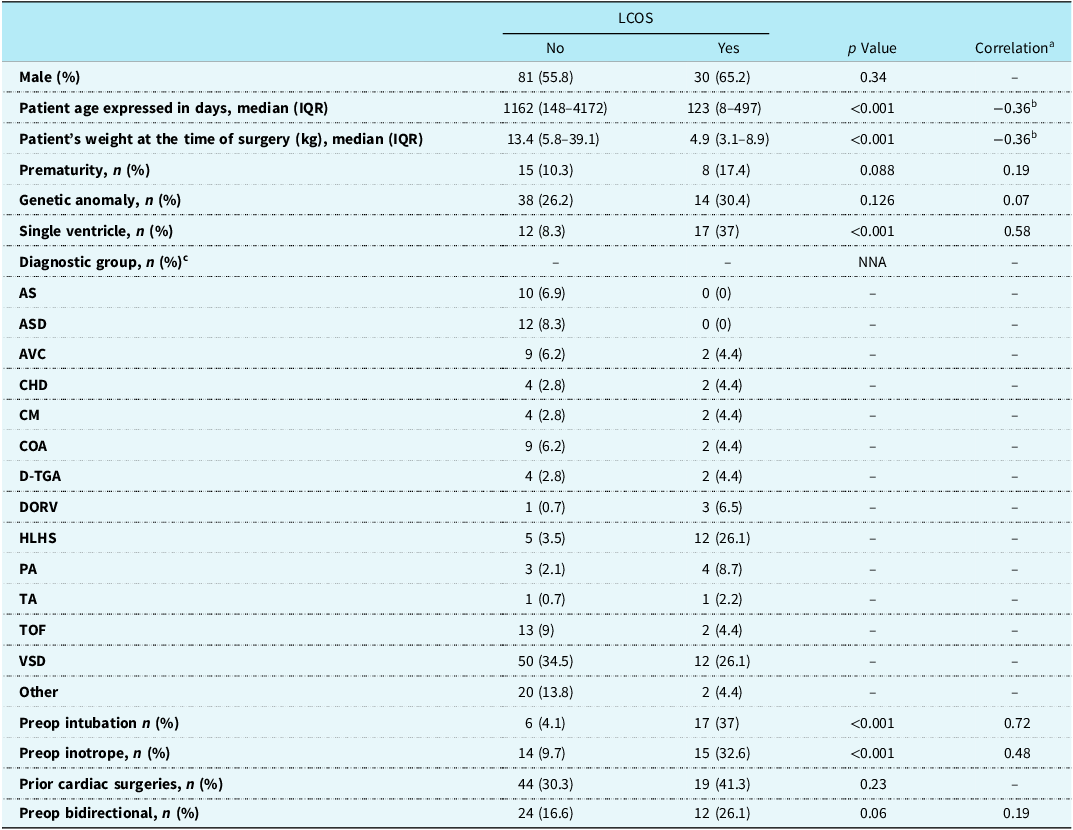
Between February 2023 and November 2024, 191 patients (80 female) admitted to the paediatric cardiac intensive care unit who met the study criteria were included; their demographic and baseline clinical characteristics are shown in Table 1. According to the Paediatric Cardiac Critical Care Consortium registry, 46 of these 191 patients (24%) developed low cardiac output syndrome. Children who developed low cardiac output syndrome were younger at surgery (123 days [8–497] versus 1162 [148–4172], p < 0.001) and had lower weight at time of cardiac surgery (4.9 kg [3.1–8.9] versus 13.4 kg [5.8–39.1], p < 0.001). Single-ventricle physiology was more common (37% versus 8.3%, p < 0.001), as were preoperative intubation (37% versus 4.1%, p < 0.001) and preoperative inotrope use (32.6% versus 9.7%, p < 0.001). Prematurity (17.4% versus 10.3%), genetic anomalies (30.4% versus 26.2%), prior cardiac surgery (41.3% versus 30.3%), and male sex (65.2% versus 55.8%) did not distinguish the groups at a statistically significant level (all p > 0.05). Diagnostic patterns suggested enrichment of hypoplastic left heart syndrome (26.1% versus 3.5%) and double-outlet right ventricle ( (6.5% versus 0.7%) in low cardiac output syndrome, with no low cardiac output syndrome cases among aortic valve stenosis or atrial septal defect; ventricular septal defect remained common in both groups (26.1% versus 34.5%). Preoperative bidirectional shunt was somewhat more frequent in low cardiac output syndrome (26.1% versus 16.6%).
Demographic and preoperative characteristics by LCOS status

a Tetrachoric Correlations unless otherwise specified.
b Point-Biseral Correlation.
c No comparison statistics were run. AS = aortic valve stenosis; ASD = atrial septal defect; CoA = coarctation of the aorta; D-TGA = dextro-transposition of the great arteries; DORV = double-outlet right ventricle; HLHS = hypoplastic left heart syndrome; IAA = interrupted aortic arch; PA = pulmonary atresia; TOF = tetralogy of Fallot; TA = tricuspid-valve atresia; VSD = ventricular septal defect; IQR = interquartile range.
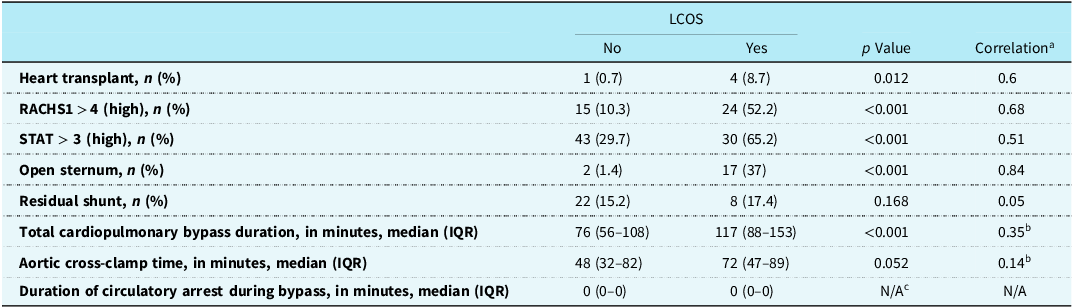
Operative and intraoperative features also diverged between groups. Heart transplantation was more frequent in low cardiac output syndrome (8.7% versus 0.7%). High-risk procedure categories were over-represented (RACHS-1 > 4: 52.2% versus 10.3%; STAT>3: 65.2% versus 29.7%). Open sternum postoperatively was notably more common (37% versus 1.4%), while residual shunt rates were similar (17.4% versus 15.2%). Procedural durations are reported as mean minutes ± SD and were longer in low cardiac output syndrome: cardiopulmonary bypass 122.2 ± 51.0 versus 82.5 ± 41.9, aortic cross-clamp 67.7 ± 43.2 versus 56.2 ± 36.6, and circulatory arrest 4.6 ± 10.7 versus 0.1 ± 1.25. See Table 2.
Operative and immediate postoperative characteristics by LCOS status

a Tetrachoric Correlations unless otherwise specified.
b Point-Biseral Correlation.
c 90% of both groups had zero duration.
There were 6 deaths (3.1%) in our cohort. Thirty-three patients (17.2%) experienced at least one major complication. Seven patients (3.6%) sustained a cardiopulmonary arrest, and 2 (1.0%) progressed to brain death. Seven patients (3.7%) required extracorporeal life support, including 2 (1.0%) initiated as extracorporeal cardiopulmonary resuscitation. Extracorporeal life support use was concentrated in the low cardiac output syndrome group (5/46, 10.9%) compared with the non-low cardiac output syndrome group (2/145, 1.4%; Fisher exact p = 0.010); both extracorporeal cardiopulmonary resuscitation initiations occurred among low cardiac output syndrome patients (2/46, 4.3% versus 0/145; Fisher exact p = 0.057). Among the 46 low cardiac output syndrome events, the median time from paediatric cardiac intensive care unit admission to the first qualifying Paediatric Cardiac Critical Care Consortium criterion was 13 hours (IQR 8–21); all events occurred within the first 48 postoperative hours. Twenty-two patients (11.5%) developed a clinically significant arrhythmia necessitating treatment. Three patients (1.6%) developed renal dysfunction requiring continuous renal replacement treatment . Ten patients (5.2%) developed sepsis. Twenty-six patients (13.6%) required a prolonged duration of mechanical ventilation; the overall MV duration was a median of 63 hours [IQR 13–171]. The median paediatric cardiac intensive care unit length of stay was 2 days [IQR 1–9], and the median hospital length of stay was 6 days [IQR 3.0–20.5].
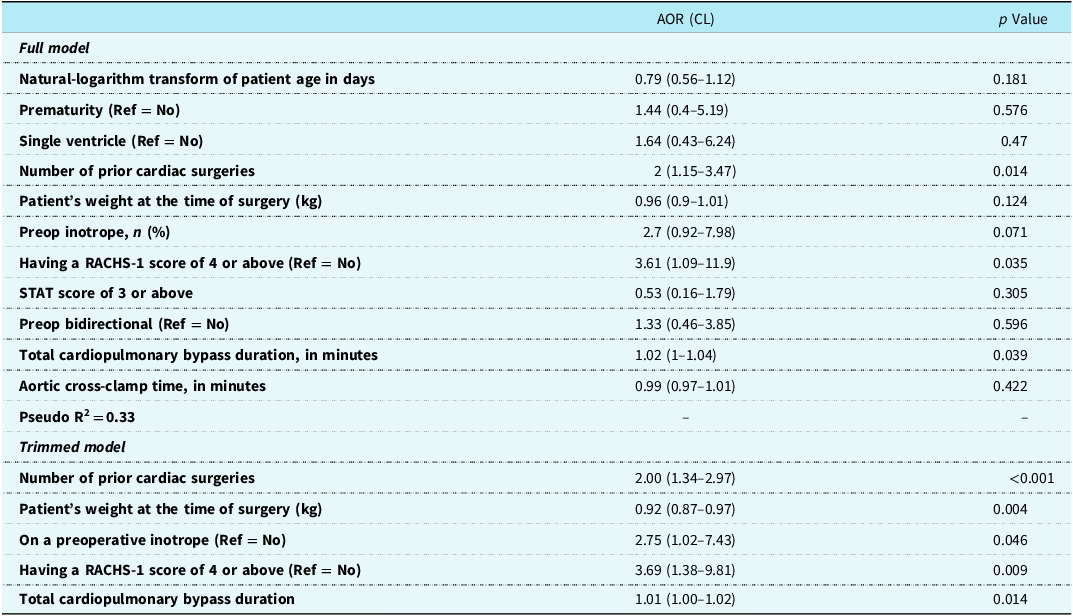
All covariates associated with low cardiac output syndrome at p < 0.10 in univariate analyses and present in ≥5% of patients were entered into a logistic regression; the full model (pseudo-R2 = 0.33) and the backward-selected trimmed model are summarised in Table 3. In the trimmed model, markers of operative complexity and preoperative instability independently increased low cardiac output syndrome risk, whereas higher operative weight was protective. Each additional prior cardiac surgery doubled the odds of low cardiac output syndrome (AOR 2.00, 95% confidence intervals1.34–2.97); procedures with RACHS-1 ≥4 carried ∼3.7-fold higher odds (AOR 3.69, 1.38–9.81); preoperative inotrope use was associated with higher odds (AOR 2.75, 1.02–7.43); and longer CPB duration conferred incremental risk (AOR 1.01 per minute, 1.00–1.02). Each additional kilogram at surgery was associated with lower odds (AOR 0.92, 0.87–0.97). Model performance was good (AUROC 0.879; PRAUC 0.706), accuracy 0.817, positive predictive value 0.657, recall 0.50, F1 0.568, and negative predictive value 0.853, indicating strong discrimination with moderate sensitivity.
Multivariable model predicting low cardiac output syndrome

Multivariable logistic regression models predicting low cardiac output syndrome (LCOS). The Full model includes all candidate predictors meeting inclusion criteria, while the Trimmed model presents the most parsimonious set of independent predictors. Significant variables in the final model included number of prior cardiac surgeries, lower body weight, preoperative inotrope use, higher RACHS-1 category, and longer cardiopulmonary bypass duration. The final regression equation was: logit(p) = −2.45 + 0.69 × (Number of Prior Surgeries) − 0.04 × (Weight at Surgery) + 1.01 × (Preop Inotrope) + 1.30 × (RACHS−1 ≥ 4) + 0.013 × (CPB Time).
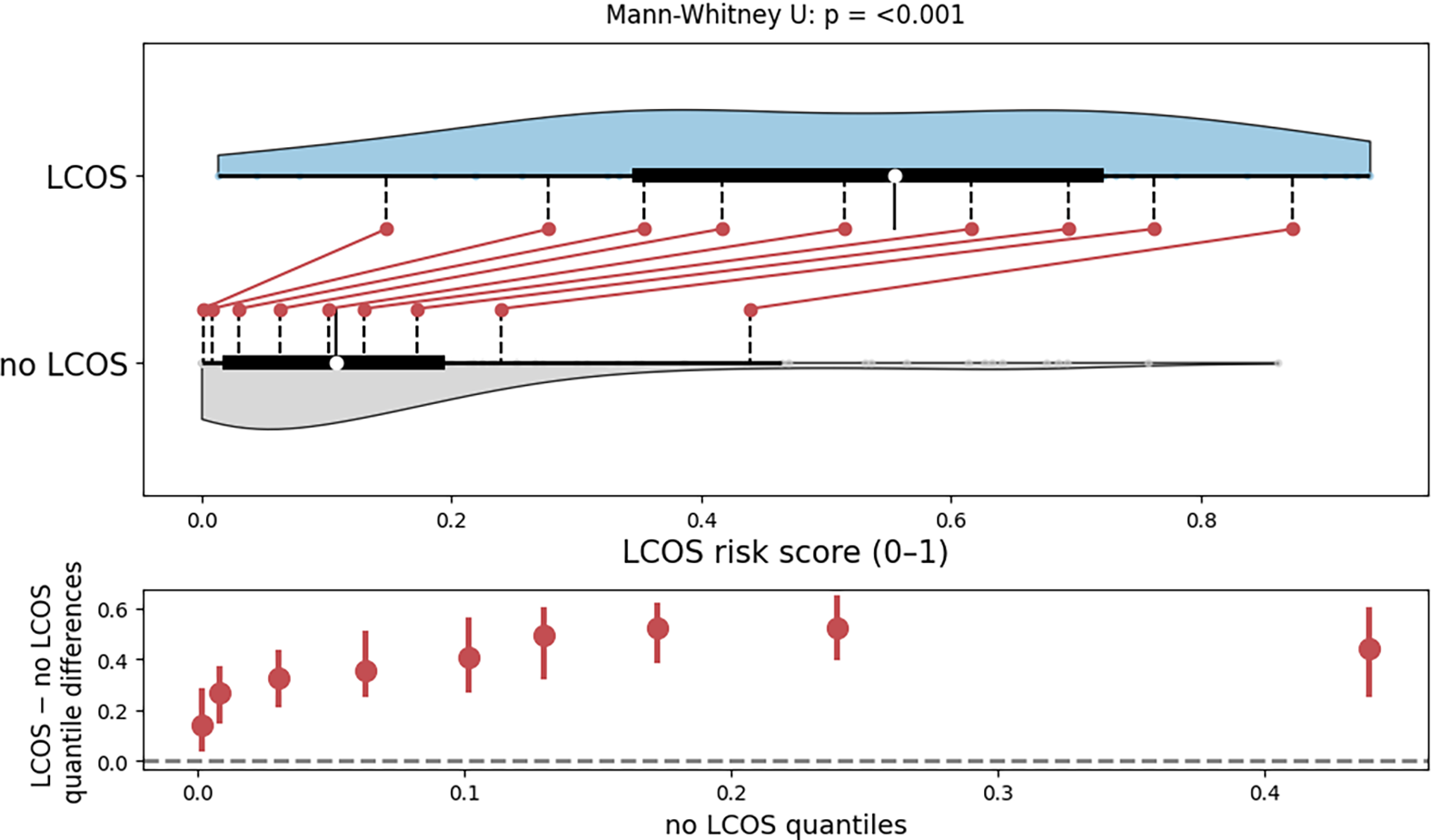
When the trimmed model’s predicted probabilities were used as propensity scores, the low cardiac output syndrome distribution conformed to normality (p = 0.14), whereas the non‑low cardiac output syndrome distribution deviated significantly from normality (p < 0.001) and was left-skewed toward lower scores. Quantile-wise differences were systematic between groups (Mann–Whitney U p < 0.001); details are presented in the shift plot in Figure 1 (see Figure 1).
The top panel shows propensity-score distributions for LCOS (blue) and no LCOS (grey) with median and interquartile range [IQR, black bars], whiskers (black lines), and decile-matched quantiles (red lines, estimated using the Harrell–Davis quantile estimator); the bottom panel displays LCOS–no LCOS quantile differences (dots) with bootstrap 95% confidence intervals (error bars), where values are expressed in arbitrary units (a.u.) to indicate model-derived risk scores without intrinsic physical units.

Figure 1. Long description
A two-panel shift plot compares the model-derived LCOS risk score (a propensity score, 0 to 1) between groups. The top panel shows two distributions: patients who developed LCOS (blue, upper) and patients who did not (no LCOS, gray, lower), each marked with an IQR bar, whiskers, and a white median dot. The LCOS median (about 0.55) lies right of the no-LCOS median (about 0.10); no-LCOS scores cluster at the low end while LCOS scores span a broader, higher range. Red lines link decile-matched quantiles (Harrell-Davis estimator) and all slope upward toward LCOS. A Mann-Whitney U test gives p less than 0.001. The bottom panel is the shift function: it plots the LCOS minus no-LCOS quantile difference (about 0 to 0.6) against no-LCOS quantiles (0 to about 0.45), each red dot with a bootstrap 95 percent confidence interval. All differences are positive and lie above the dashed zero line, rising from about 0.15 to 0.5, so separation persists across quantiles and is largest at higher ones.
Discussion
In a cohort of 191 postoperative CHD patients, low cardiac output syndrome occurred in 24% (46/191), at the lower bound of the ≈9–71% incidence reported in prior paediatric series using heterogeneous definitions. Reference Tandon, Bhattacharya and Morca1,Reference Song, Dang and Dong11 Patients who developed low cardiac output syndrome were younger, had lower weight, more often required preoperative intubation/inotropes, and had higher operative complexity (RACHS-1 ≥ 4 and longer CPB). In multivariable analysis, prior surgeries, RACHS-1 ≥ 4, preoperative inotrope use, and longer CPB independently increased low cardiac output syndrome risk, whereas greater operative weight was protective. The trimmed model achieved good discrimination (AUROC 0.879; PRAUC 0.706). Propensity scores were approximately normal in the low cardiac output syndrome group (Shapiro–Wilk p = 0.14) but left-skewed among non-low cardiac output syndrome (p < 0.001), indicating that while low scores help rule out low cardiac output syndrome, some patients with low propensity still developed low cardiac output syndrome. This skewed distribution of low cardiac output syndrome risk is a key finding of our study.
Concordance with prior literature and novelty
In prior paediatric series, low cardiac output syndrome has been observed in nearly half of patients following congenital heart surgery and remains the leading cause of postoperative mortality in children. Reference Song, Dang and Dong11 A key contribution of our study is endpoint standardisation: low cardiac output syndrome was defined using Paediatric Cardiac Critical Care Consortium registry criteria, which improves comparability across studies and facilitates adoption in Paediatric Cardiac Critical Care Consortium-aligned settings. Our cohort’s 24% incidence is broadly comparable and underscores the clinical burden. Importantly, our model is intended for use at OR exit/early paediatric cardiac intensive care unit arrival—before low cardiac output syndrome is typically recognised at the bedside—thereby supporting early triage and resource planning. In practice, higher-risk strata can prompt earlier escalation of surveillance (e.g., higher-frequency haemodynamic reassessment, earlier lactate/echo review, and consideration of advanced monitoring) and inform bedside staffing intensity during the first postoperative hours. Prior published work identified risk factors of low cardiac output syndrome, including preoperative haemodynamic reserve and surgical history, including inotrope requirement, intubated status, and previous operations, consistent with our findings that preoperative inotropes and previous surgeries track with higher low-cardiac-output-syndrome risk. Reference Du, Chen and Song12,Reference Wang, Fu and Bai13,Reference Drennan, Burge and Szyld15 While these predictors are not novel in direction, we translate them into a parsimonious and interpretable risk estimate using variables that are routinely available at OR exit (prior operations, operative weight, preoperative inotrope use, RACHS category, and CPB time), enabling automated calculation at paediatric cardiac intensive care unit arrival without additional testing and supporting straightforward EHR implementation. In infant-focused studies, longer aortic cross-clamp time and lower body weight are independent predictors. Reference Zou, Yu and Wang20 In our model, higher operative weight was protective, and a time-related intraoperative load (longer CPB) conferred incremental risk, aligning with that pattern. These observations complement evidence that low cardiac output syndrome severity captured at the bedside (e.g., low cardiac output syndrome score) relates strongly to morbidity and paediatric cardiac intensive care unit resource utilisation, Reference Ulate, Yanay and Jeffries21 and they reinforce the value of combining preoperative/intraoperative features with early postoperative dynamics in risk stratification. To enhance clinical usability, we reported triage-relevant performance metrics, and our distributional analysis (Figure 1) further clarifies rule-out utility alongside residual risk—motivating future dynamic updating with early postoperative physiology rather than implying low cardiac output syndrome is fully captured by static factors. Notably, postoperative multimodal physiology is not required for the model to be clinically useful at paediatric cardiac intensive care unit arrival; rather, it represents a complementary second layer for dynamic updating of residual risk. This rationale is supported by our prior neonatal work, where supervised ML models incorporating hourly postoperative clinical and laboratory data during the first 48 postoperative hours achieved strong forecasting performance for low cardiac output syndrome across short-term horizons, illustrating the incremental value of time-varying physiology beyond static predictors. Reference Baloglu, Wang and Marino22 The concentration of postoperative mechanical circulatory support within the low cardiac output syndrome group provides external face validity for the Paediatric Cardiac Critical Care Consortium low cardiac output syndrome phenotype as a marker of severe circulatory failure in our cohort, despite the therapy-dependent nature of its underlying definition.
Preoperative profile
Our finding that preoperative inotrope requirement and preoperative endotracheal intubation independently predict low cardiac output syndrome is consistent with the broader literature that treats preoperative instability as a bedside proxy for limited circulatory reserve and heightened postoperative risk. Reference Du, Chen and Song12,Reference Wang, Fu and Bai13,Reference Drennan, Burge and Szyld15 In large paediatric cohorts and meta-analyses, younger age and lower operative weight repeatedly emerge as core risk factors, Reference Du, Chen and Song12,Reference Wang, Fu and Bai13 which matches our model’s observation that higher weight is protective. The presence of syndromes highlights compounding pulmonary comorbidities that can worsen haemodynamics and complicate management. Reference Delany, Gaydos and Romeo23,Reference Yamaguchi, Tomonari and Utsunomiya24 Overall, our findings are consistent with prior paediatric reports, reinforcing their relevance to contemporary clinical experience. Reference Du, Chen and Song12,Reference Wang, Fu and Bai13,Reference Drennan, Burge and Szyld15,Reference Delany, Gaydos and Romeo23
Intra and postoperative profile
Surgical complexity, captured by longer CPB duration and higher RACHS/STAT, likely amplifies circulatory stress and the inflammatory cascade, predisposing to low cardiac output syndrome; these associations are consistently documented across paediatric studies and a recent meta-analysis. Reference Du, Chen and Song12,Reference Wang, Fu and Bai13 The classic postoperative time course described by Wernovsky (cardiac index nadir ∼9–12 h after surgery) contextualises why low cardiac output syndrome often declares itself hours after the OR when reperfusion injury and vasoplegia peak. Reference Wernovsky, Wypij and Jonas3 The observed temporal concentration of low cardiac output syndrome onset aligns closely with this trajectory and supports the use of preoperative and intraoperative variables as proximate predictors for the events captured in our cohort. Targeted pharmacologic prevention has biological plausibility but risk remains concentrated in high-complexity cases. Reference Hoffman, Wernovsky and Atz14 Markers of severity used in practice, such as low cardiac output syndrome score and VIS, track morbidity and resource utilisation, Reference Ulate, Yanay and Jeffries21 whereas certain single physiologic readouts may be insufficiently specific for new organ injury. Reference Claessens, Jansen and Breur17 Consistent with our cohort (higher “open sternum” rates in low cardiac output syndrome), delayed sternal closure is typically deployed for haemodynamic instability and is associated with greater morbidity. Reference Hurtado-Sierra, Calderón-Colmenero and Curi-Curi16 Beyond the OR, fluid overload is a powerful and modifiable risk factor linked to mortality/morbidity in paediatric cardiac surgery. Reference Lex, Tóth and Czobor25 Looking ahead, converging evidence argues for continuous, multimodal monitoring and analytics-assisted early warning: non-invasive cardiac output monitoring in CHD and emerging machine-learning models illustrate how integrating pre/intra/postoperative signals (including lactate and blood-pressure dynamics) can improve discrimination and timeliness of low cardiac output syndrome detection. Reference Tandon, Bhattacharya and Morca1,Reference Hong, Xu and Ge26,Reference Abbasi, Li and Dekle27
Interpreting physiological markers
Interpreting physiological markers for impending low cardiac output syndrome remains difficult because there is still no uniform definition and single variables perform inconsistently across settings. Reference Alten and Gaies28 Recent reviews emphasise the ongoing lack of consensus definitions, complicating comparisons and surveillance strategies, and argue for multimodal assessment instead of reliance on any single metric. Reference Schoonen, van Klei, van Wolfswinkel and van Loon10 In practice, scores derived from vasoactive support correlate with adverse outcomes after paediatric cardiac surgery, but they are therapy-dependent surrogates rather than direct measures of oxygen delivery. Reference Butts, Scheurer and Atz4,Reference Alten and Gaies28,Reference Gaies, Jeffries and Niebler29,Reference Koponen, Karttunen and Musialowicz30 Ulate and colleagues proposed the low cardiac output syndrome score to fold clinical signs (e.g., tachycardia, oliguria, toe temperature, near-infrared spectroscopy, and lactate) together with pharmacologic support; in their infant cohort, cumulative low cardiac output syndrome score discriminated composite morbidity well (AUC ≈ 0.83), yet the construct still leaned heavily on treatment intensity and lacked concurrent validation against direct cardiac output or oxygen-delivery measurements. Reference Ulate, Yanay and Jeffries21 For example, postoperative cerebral near-infrared spectroscopy, while useful for trend monitoring, has not consistently predicted adverse outcomes, underscoring the limitations of relying on any single physiologic marker for low cardiac output syndrome risk stratification. Reference Claessens, Jansen and Breur17 Taken together, these data support our approach: multivariable, integrative prediction that combines preoperative and intraoperative risk factors with early postoperative physiology offers a more robust path to actionable low cardiac output syndrome risk stratification than reliance on any single marker alone. Reference Schoonen, van Klei, van Wolfswinkel and van Loon10
Building on this rationale, integrated real-time analytics can fuse multiple physiological and laboratory streams to estimate risk states (e.g., inadequate oxygen delivery) continuously. Model-based indices computed every few seconds from routinely available inputs have been shown to track the probability of dangerously low venous saturation and to correlate with lactate and adverse events; external validations report strong discrimination for detecting low SvO2 even when some inputs are missing. Reference Abbas, Hussain and Shahbaz31,Reference Holman, Baronov and McMurray32 In parallel, paediatrics has seen a broader shift from single-signal monitoring to proactive risk surveillance: collaborative, low-tech prevention bundles in cardiac ICUs achieved ∼30% reductions in risk-adjusted in-hospital cardiac arrest that were sustained across centres, while machine learning models using routine electronic health record data can flag arrest risk hours in advance. Reference Alten, Cooper and Klugman33–Reference Kenet, Pemmaraju and Ghate35 Taking these together, this evidence supports our rationale for multivariable prediction: combining preoperative and intraoperative risk factors with early postoperative physiology is more likely to surface actionable low cardiac output syndrome risk than any single marker alone. Reference Singh, Villaescusa and da Cruz36
Propensity-score distributions and clinical implications
Using the trimmed model’s predicted probabilities as propensity scores, we observed a left-skewed distribution among non-low-cardiac-output-syndrome patients, whereas the low-cardiac-output-syndrome distribution did not deviate from normality (Shapiro–Wilk p = 0.14). As shown in Figure 1 (top panel), non-low cardiac output syndrome patients cluster near the lowest propensity scores, whereas low cardiac output syndrome patients span a broader and generally higher range of scores. Quantile-wise contrasts via a shift function confirmed systematic between-group differences (Mann–Whitney U p < 0.001; see Figure 1). In Figure 1, the red connectors link decile-matched quantiles between groups, and the lower panel (shift function) summarises low cardiac output syndrome–no low cardiac output syndrome differences across the score distribution with confidence intervals, illustrating that separation persists across quantiles and is most pronounced toward higher quantiles. Clinically, a heavy concentration of very low scores in non-low cardiac output syndrome supports strong rule-out performance (reflected in our high negative predictive value), while the presence of low cardiac output syndrome cases even at lower propensities highlights residual risk that static pre/intra-operative models cannot fully capture, consistent with low cardiac output syndrome as a multifactorial, time-evolving syndrome and with meta-analytic evidence that risk reflects disease severity plus intra- and postoperative factors. Reference Wang, Fu and Bai13,Reference Alten, Cooper and Blinder37 This overlap—low cardiac output syndrome events occurring despite lower propensities—helps reconcile strong rule-out performance with incomplete separation between groups. These patterns argue for dynamic updating with early postoperative physiology. Contemporary, model-based indices that continuously estimate the probability of inadequate oxygen delivery (e.g., probability that mixed/central venous saturation falls below a threshold) have shown correlation with measured venous saturations and provide second-to-second risk signals suitable for integration with pre-/intra-operative features. Reference Ulate, Yanay and Jeffries21,Reference Loomba, Villarreal and Flores38 In parallel, system-level prevention work demonstrates that proactive surveillance frameworks can reduce serious events in cardiac ICUs, underscoring the value of moving from single-marker monitoring to integrated, real-time risk surveillance. Reference Alten, Cooper and Klugman33
Limitations
This study has several limitations. First, it represents a single-centre, retrospective analysis, which may limit generalisability and introduce spectrum or case-mix effects. Second, although the vasoactive-inotropic score and physician documentation are widely accepted components of the Paediatric Cardiac Critical Care Consortium low cardiac output syndrome definition, these measures reflect therapy delivered rather than therapy needed; institutional choice of inotropic agent, threshold for escalation, and timing of weaning vary across centres and providers and may introduce phenotype misclassification in either direction. The model presented here is therefore calibrated to current practice patterns at our institution and may require recalibration prior to deployment in centres with different vasoactive thresholds or weaning protocols. Third, although we included a broad range of preoperative and intraoperative variables, by design, postoperative physiological streams (e.g., continuous haemodynamics and lactate kinetics) and direct measures of cardiac output were not incorporated, restricting the model’s ability to capture dynamic recalibration. Finally, the modest sample size and number of low cardiac output syndrome events may constrain statistical power, particularly for multivariable modelling, and external validation in larger, multicentre cohorts will be required to confirm generalisability and calibration.
Applications and future work
Our findings support clinical use of the low cardiac output syndrome risk–scoring model for (i) rapid risk stratification at OR exit/early paediatric cardiac intensive care unit arrival, (ii) resource planning in higher-risk cases (e.g., closer nurse/physician surveillance and earlier access to advanced monitoring), and (iii) triggering haemodynamic-optimisation bundles so that patients likely to develop low cardiac output syndrome receive earlier support. Looking ahead, generalisability and time-aware recalibration are essential. We recommend (1) multicentre, prospective external validation with predefined decision thresholds; and (2) dynamic updating of the pre- and intraoperative model using continuous postoperative high-fidelity physiologic data (arterial waveform features, ECG, urine output, and lactate kinetics). Reference Loomba, Sourour and Flores39 This integration is feasible and clinically relevant: single postoperative signals can be insufficient on their own (e.g., cerebral near-infrared spectroscopy not independently associated with new brain injury in infants with critical CHD), whereas model-based, real-time indices that estimate the probability of inadequate oxygen delivery show good discrimination and correlate with venous saturations. In parallel, non-invasive cardiac-output monitoring in CHD continues to broaden the physiologic data available for continuous risk recalibration. As part of an ongoing prospective initiative within the Cleveland Clinic Children’s Center for Artificial Intelligence (C4AI), the model is being prepared for silent deployment within the institutional electronic health record system, with prospective evaluation of calibration and temporal drift; subsequent integration as clinical decision support, in which exceedance of a prespecified high-risk threshold would trigger a tiered surveillance bundle; and a quality improvement evaluation comparing pre- and post-implementation periods planned. Each stage of this stepwise approach is contingent on formal prospective validation and institutional ethics approval. Subsequent iterations of the model will incorporate direct haemodynamic indices (e.g., cardiac index and central venous oxygen saturation) and harmonised multicentre low cardiac output syndrome phenotype definitions in order to reduce reliance on therapy-driven surrogates.
Conclusion
Among children undergoing surgery for CHD, our model based on pre- and intraoperative variables demonstrated strong discriminatory ability and highlighted clinically plausible predictors of low cardiac output syndrome, including greater surgical complexity, preoperative instability, and longer CPB time, while higher operative weight was protective. These results support early risk stratification at OR exit/paediatric cardiac intensive care unit arrival and targeted resource allocation, while motivating prospective multicentre validation and dynamic updating with continuous postoperative physiology. The pattern and effect directions align with contemporary syntheses of low cardiac output syndrome risk in paediatric populations, reinforcing the model’s face validity and potential for bedside utility while showing unexpected distribution of low cardiac output syndrome incidence across preoperative, operative, and immediately postoperative risk factors.
Supplementary material
The supplementary material for this article can be found at https://doi.org/10.1017/S1047951126113833.
Data availability statement
All data produced in the present study are available upon reasonable request to the authors.
Acknowledgements
None.
Author contributions
Conceptualisation was contributed by Izzet Turkalp Akbasli, MD; Orkun Baloglu, MD; and Animesh Tandon, MD, MS. Methodology was developed by Izzet Turkalp Akbasli, MD and Amy Cassedy, PhD. Formal analysis was conducted by Amy Cassedy, PhD and Izzet Turkalp Akbasli, MD. Software development was performed by Amy Cassedy, PhD, Izzet Turkalp Akbasli, MD, and Gulnur Bora. Validation was carried out by Izzet Turkalp Akbasli, MD. Investigation was undertaken by Orkun Baloglu, MD, Animesh Tandon, MD, MS, and Izzet Turkalp Akbasli, MD. Resource acquisition was managed by Bradley S. Marino, MD, MPP, MSCE, MBA, Samir Q. Latifi, MBBS, and Anirudha Das. Supervision was provided by Orkun Baloglu, MD, and Animesh Tandon, MD, MS. Data curation was handled by Nikhil Madugula, Sarah Dickey, Sherry Du, and Gabriel Nemer. Visualisation was produced by Izzet Turkalp Akbasli, MD. Project administration was jointly coordinated by Animesh Tandon, MD, MS, and Orkun Baloglu, MD. The original draft was written by Izzet Turkalp Akbasli, MD, and Amy Cassedy, PhD, with co-writing by Orkun Baloglu, MD, and Animesh Tandon, MD, MS. Writing – review and editing were contributed by Catherine K. Allan, Bradley S. Marino, MD, MPP, MSCE, MBA, Samir Q. Latifi, MBBS, Hani Najm, MD, Anirudha Das, Raquel Norel, PhD, and Nick Barra.
Financial support
I.T.A., O.B., S.Q.L., B.S.M., and A.T. are supported by the Cleveland Clinic Children’s Center for Artificial Intelligence (C4AI). All authors are supported by the Cleveland Clinic–IBM Discovery Accelerator (SOW50) and Johnson Family Innovation Fund. A.T. and O.B. also report support from the Advanced Research Projects Agency for Health (ARPA-H), award D25AC00206.
Competing interests
Author A.T. reports consulting relationships with Siemens Healthineers. Author A.T. reports stock in AMZN; GOOGL; NVDA. NB and KN are an employee of IBM.
Ethical standard
The protocol was approved by the Cleveland Clinic Institutional Review Board (IRB #20-390)
Consent to participate
The requirement for informed consent was waived due to the study’s retrospective nature and minimal associated risk to patients.
Consent to publish
Not applicable.


 Open access

