Introduction
The concept of a Galactic Habitable Zone (GHZ) was introduced by Gonzalez et al. (Reference Gonzalez, Brownlee and Ward2001) to extend the concept of the habitable zone around a star to the Milky Way galaxy. They defined the GHZ as the region in the Milky Way where an Earth-like planet could retain liquid water on its surface and provide a long-term habitat for animal-like aerobic life. There was further discussion of the concept of a GHZ as applied to the Milky Way galaxy by Peña-Cabrera & Durand-Manterola (Reference Peña-Cabrera and Durand-Manterola2004), Lineweaver et al. (Reference Lineweaver, Fenner and Gibson2004), Ćirković (Reference Ćirković, Knezevic and Milani2005), Sundin (Reference Sundin2006) and Prantzos (Reference Prantzos2008). The only discussion of a GHZ in other galaxies was by Sundin (Reference Sundin2006), who considered the GHZ in barred galaxies in general and in the bar of the Milky Way galaxy in particular.
There is a key difference between the habitable zone around a star and the habitable zone of a galaxy. The habitable zone around a star assumes an Earth-sized planet is present and determines the surface temperature on that planet. The questions of planet formation, per se, do not influence the size or location of the habitable zone. However, for the GHZ, the definition is quite different and the process of planet formation is a key part, indeed the key part, of the habitable zone. The radiation environment is also considered to indicate habitability for complex life for a long period of time (Lineweaver et al. Reference Lineweaver, Fenner and Gibson2004). The consideration of time is somewhat problematic since the only scale we have for how long life takes to evolve is based on the particular history of life on Earth. Of course, we do not know if the timescale for evolution in Earth history is typical of other worlds; evolutionary timescales may have been much shorter as suggested by McKay (Reference McKay and Doyle1996).
In Gonzalez et al. (Reference Gonzalez, Brownlee and Ward2001) and in the subsequent papers listed above, the probability of planet formation is assumed to scale with the metallicity (all elements heavier than H and He) of the stars. A possible correlation between metallicity of a star and the presence of planets was suggested by Gonzalez (Reference Gonzalez1997). This correlation has been confirmed (e.g. Santos et al. Reference Santos, Israelian and Mayor2004; Fischer & Valenti Reference Fischer and Valenti2005; Ramírez et al. Reference Ramírez2010; Schlaufman & Laughlin Reference Schlaufman and Laughlin2011), although there have been some debate over the possibility that the correlation is due to pollution of the star's atmosphere by planetary accretion (e.g. Pasquini et al. Reference Pasquini2007). For low mass stars with small-radius exoplanets, which are of most interest here, the recent Kepler results indicate a true genetic relationship between stellar metallicity and the presence of planets (Schlaufman & Laughlin Reference Schlaufman and Laughlin2011). It is important to note that the correlation between stellar metallicity and the presence of planets has been established for large planets – as these are the ones most readily detectable with present methods. Thus, it is an unproven extrapolation that the same correlation extends down to Earth size planets. However, it is thought that Jupiter size planets are formed by gas accretion onto a rocky core (e.g. Bodenheimer et al. Reference Bodenheimer1980). The formation of that rocky core may be similar to the formation mode of Earth-sized planets and depend on the content of refractory elements. Thus, we expect that the correlation between stellar metallicity and the presence of planets will extend to Earth-sized planets as well.
With the caveats mentioned above, we believe that the discovery of many planets around nearby stars allows us to statistically relate planet formation to stellar metallicity and provides a basis for extrapolating the possibility of planet formation to other regions of our galaxy and to other galaxies.
In this paper, we compare the metallicity distribution of the nearby stars with the metallicity distribution of the nearby stars with planets to show the correlation between metallicity and planet formation. We then compare these two distributions to the metallicity of the outer stars in two elliptical galaxies, M87 and M32.
Nearby stars and extrasolar planet host stars
The key factor in defining the GHZ is the probability of planet formation determined by the observation of stellar metallicity. Stellar metallicity is an indication of the total concentration of elements heavier than He. Unlike stellar mass, radius and temperature, metallicity depends directly on the history of the material that goes into forming a star. Heavy elements are produced in stellar interiors and in supernovae. They are then distributed by events such as solar winds, supernovae, polar jets, planetary nebula and star formation. Thus, the concentration of metals in stars depends on generations of prior stars. First generation stars would have low metallicity, whereas stars that form from material that has been through many generations of previous stars would have a high metallicity. Metallicity is important for planet formation because in the hot protoplanetary disc surrounding a star, the formation of protoplanetary bodies (small planetesimals) depends exclusively on high atomic weight elements since the protoplanetary masses are too small to retain hydrogen or helium. Earth-like planets are composed virtually entirely of compounds that are high in atomic number, Z (silicates) or bound to a high Z atom (H2O). Thus, it is reasonable that the metallicity should correlate with planet formation.
Gonzalez et al. (Reference Gonzalez, Brownlee and Ward2001) have noted that the cosmic abundance of the elements heavier than boron scale with iron, which has many easily measured absorption lines in the spectra of Sun-like stars, and therefore, the term ‘metallicity’ of a star is often expressed in terms of its iron abundance ratio to hydrogen, [Fe/H]. The ratio [Fe/H] is defined as

where the bracket denotes the number density abundance of elements enclosed. The units are in dex, 1/10 of a factor of 10 and [Fe/H]=0 corresponds to our Sun. Positive values of[Fe/H] indicate higher than solar values, and negative values indicate lower than solar values. Following this approach, we use [Fe/H] as an indicator of metallicity.
We have obtained [Fe/H] values of 100 nearby stars that are uniformly distributed in the torus 6–9 kpc from the galactic centre (Ibukiyama and Arimoto Reference Ibukiyama and Arimoto2002, Ibukiyama Reference Ibukiyama2004) and [Fe/H] values of 100 stars with planets using the VizieR database service at the Centre de Données Astronomiques de Strasbourg (vizier.u-strasbg.fr/viz-bin/VizieR). For additional information on candidate objects, such as distance and apparent dimensions, we used NASA/IPAC (National Aeronautics and Space Administration/Infrared Processing and Analysis Center) Extragalactic Database (NED) (http://ned.ipac.caltech.edu).
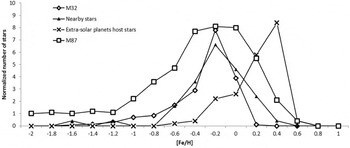
Figure 1 shows the distribution of [Fe/H] of the nearby stars, and for stars that have planets. The results have been normalized so that the highest value of each distribution is roughly similar. Several important points emerge from this comparison. First, the distribution of [Fe/H] of nearby stars peaks at the metallicity slightly less than solar, −0.2 dex. Although the [Fe/H] of extrasolar planet host stars peaks at a [Fe/H] value well above the solar value, +0.4 dex, thus, the Sun maybe a typical star, but it is not a typical planet-hosting star (Ramírez et al. Reference Ramírez2010). It may be that we are lucky to be here. We can use the [Fe/H] distribution of stars with planets to gage the habitability of other galaxies for which [Fe/H] distribution are known.
The metallicity distribution of stars is shown. The triangles represent the metallicity distribution of nearby stars, x's represent the metallicity distribution of extrasolar planets hosts stars, squares represent metallicity distribution of M87, and diamonds represent metallicity distribution of M32.

Elliptical galaxies
Elliptical galaxies are of interest here because they represent a completely different morphology than the Milky Way. For our study, we have chosen two particular elliptical galaxies because one is an active galaxy whereas the other is a non-active galaxy. M87 is a supergiant massive galaxy with an Active Galactic Nuclei (AGN) and a Super Massive Black Hole (SMBH). AGN are believed to be powered by an accreting SMBH in the centre of a galaxy and are characterized by non-thermal emission extending from radio to high energy gamma-rays, which comes from an accretion disc and from two relativistic jets that are launched close the SMBH (Barkov et al. Reference Barkov, Aharonian and Bosch-Ramon2010). Stellar material near the jet would be blown out by the jet. Therefore, habitability must form in a region away from where the radiation is least likely to affect the stars. M32 is a compact dwarf elliptical galaxy, a satellite of Andromeda galaxy, M31, with low luminosity (Castelli et al. Reference Castelli2008), and its stellar population is younger and more metal-rich at the centre (Castelli et al. Reference Castelli2008 and references therein).
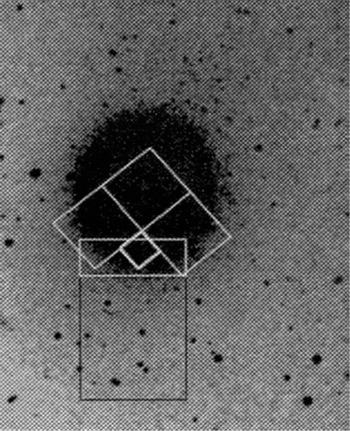
Figure 1 also shows the metallicity distribution of the stars in the outer layers of M87 and M32. The metallicity distribution of M87 has been given with respect to stellar mass, where we have transformed the mass statistics into star-number with the assumption that the stellar luminosity functions do not depend strongly on metallicity (Forte et al. Reference Forte, Faifer and Geisler2007). Figures 2 and 3 show the region of M87 and M32 from which this data was presented. We can see from this figure of M87 that it contains a considerable number of stars that have the metallicity values consistent with planet formation. In fact, the distribution of M87 is more favourable for planet formation than the distribution of nearby stars. The peak of the metallicity histogram occurs at [Fe/H]≈−0.2 and there are a number of stars with as high metallicity as [Fe/H]≈+0.4. M32, in contrast, shows the metallicity distribution less favourable for planetary formation than the nearby stars, where the [Fe/H] peaks at −0.2 ex and extends to a much lower [Fe/H]. But still has a considerable fraction of stars with the metallicity at solar value or slightly below.
Forte et al. (Reference Forte, Faifer and Geisler2007) present the metallicity of M87 where the data are selected from elliptical galactocentric radii between 10 and 15 kpc. The inner region from this radius is affected by the galaxy halo brightness, while, further out in the galactocentric radius, the background level increases and the effective areal coverage of the image decreases.

M32. Grillmair et al. (Reference Grillmair1996) present the data of the region extending from 1 to 2′ (white heavy square line) almost due south of the centre of M32. Black outline indicates frame examined by Freedman (Reference Freedman1989), which measures 2.1 by 3.4′ arcsec.

We note that the adopted metallicity distributions characterize not individual stars (which are unresolved at such distances) but clusters of stars. We assume that the metallicity values reflect the individual starts. This assumption is approximately valid for the Milky Way, but it is not certain whether it holds also in other galaxies.
Discussion and conclusion
In this paper, we have focused on metallicity as the key factor in the determination of a GHZ in another galaxy. Previous discussions have included time, supernovae radiation, impacts and stellar orbits as important factors (Gonzalez et al. Reference Gonzalez, Brownlee and Ward2001). Although these factors may be relevant at some level for the discussion of planets with complex life we believe that they are not essential requirements for microbial life. We explain our reasoning here.
Time
It is sometimes assumed that the development of life requires habitable conditions for 3.5 billion years. This is, of course, the time that has elapsed between the origin of life and the emergence of technological civilization on Earth. However, if we are interested in life itself, including microbial life, then the timescale is much shorter. The earliest indication of life on Earth may be the carbon isotope record at 3.8 Gyr ago (Schidlowski Reference Schidlowski1988; Mojzsis et al. Reference Mojzsis1996), and clear evidence of microbial life is present at 3.4 Gyr ago (e.g. Tice & Lowe Reference Tice and Lowe2004). Thus, the origin of life occurred within 100–500 Myr after the formation of Earth, at ∼3.9 Gyr ago. Moreover, in a review of this question, Lazcano & Miller (Reference Lazcano and Miller1994) suggested that, ‘in spite of the many uncertainties involved in the estimates of time for life to arise and evolve to cyanobacteria, we see no compelling reason to assume that this process, from the beginning of the primitive soup to cyanobacteria, took more than 10 million years’. However, Orgel (Reference Orgel1998) criticized this statement on the grounds that no relevant data exists: ‘Attempts to circumvent this essential difficulty are based on misunderstandings of the nature of the problem’. Although the problem remains unsolvable with the current data, clearly the timescale for the origin of life is potentially much shorter than the timescale for stellar evolution. Thus, we conclude that for intelligent complex life, timescales in many billions of years may be required, while for microbial life the timescales may be much shorter.
Radiation
The same distinction between complex life and microbial life applies to radiation. Complex life forms are sensitive to ionizing radiation and changes in atmospheric chemistry that might result. However, microbial life forms, e.g. Deinococcus radiodurans, can withstand high doses of radiation and are more flexible in terms of atmospheric composition. Furthermore, microbial life in subsurface environments would be effectively shielded from space radiation. Thus, while a high level of radiation from nearby supernovae may be inimical to complex life, it would not extinguish microbial life.
Impacts
Large impacts after the accretion phase of the Earth have played a role in the evolution of life on Earth. However, these only have affected large complex life forms. There is no indication that microbial life has suffered from impact events (e.g. Cockell Reference Cockell2006).
Stellar orbits
Stellar orbits have been considered a key factor for habitability due to the possibility of a star moving into an area with higher radiation. Furthermore, stellar orbits in spiral galaxies and elliptical galaxies may be quite different. However, as discussed above, radiation is an issue primarily of interest for the development of complex life.
The distinction between the complex life and microbial life is an important one. As reviewed by Ward & Brownlee (Reference Ward and Brownlee2000), planets that satisfy the criteria for habitability for complex life may be quite rare. However, for microbial life, conditions may be much easier to obtain. Thus, we conclude that in considering GHZs for microbial life, only the presence of planets, and thus indirectly, stellar metallicity, is essential.
We have compared the metallicity distribution of nearby stars that have planets to the metallicity distribution of outer layers of elliptical galaxies, M87 and M32. From this comparison, we conclude that the stars in these elliptical galaxies are likely to have planetary systems and could be expected to have the same percentage of Earth-like habitable planets as those in the neighbourhood of the Sun.
Acknowledgements
We thank David Willson and Heather D. Smith for useful discussions. We thank two anonymous reviewers for their comments, which greatly improved the paper.