

Introduction
Lepidopteran stemborers, the African rice gall midge (AfRGM) (Orseolia oryzivora H. & G.), and diopsid flies (Diopsis spp.) are the key insect pests of rice in Burkina Faso (Dakouo et al., Reference Dakouo, Nacro and Sié1988, Reference Dakouo, Nacro, Post and Traore1989, Reference Dakouo, Nacro and Bacyé1991; Ba et al., Reference Ba, Dakouo, Nacro and Karamage2008). The major stemborers include the African white stemborer, Maliarpha separatella Rag., the African pink stemborer, Sesamia calamistis Hamp., the African striped stemborer, Chilo zacconius Bleszynski and Chilo diffusilineus (J. de Joannis). These insect pests constitute a recurring problem in the Kou Valley with recorded yield losses as high as 40% (Dakouo et al., Reference Dakouo, Nacro and Bacyé1991; Ba et al., Reference Ba, Dakouo, Nacro and Ouédraogo2004). They are difficult to control with the common insecticides employed in Burkina Faso because, by feeding inside the stem of the rice plant, their larvae are protected. Resistance is not offered among rice varieties adapted to the region. The cultural control methods (such as early planting and better management of organic and inorganic fertilizers) have been investigated (Dakouo et al., Reference Dakouo, Nacro and Sié1988), but these measures are inadequate to prevent yield losses, and constitute just one component in a necessarily comprehensive integrated pest management (IPM) strategy that is yet to be developed and implemented.
Few studies are available on the natural enemies associated with rice stemborers in Burkina Faso. In a study associated with rice-feeding insect pests in West Africa, Heinrichs and Barrion (Reference Heinrichs, Barrion and Hettel2004) found that as many as 101 parasitoid species were associated with rice stemborers in the sub-region. In Burkina Faso, two hymenopteran parasitoids, the gregarious parasitoid, Platygaster diplosisae (Hymenoptera: Platygasteridae) and the solitary parasitoid, Aprostocetus procerae (Hymenoptera: Eulophidae), were found to be associated with O. oryzivora (Dakouo et al., Reference Dakouo, Nacro and Sié1988; Ba et al., Reference Ba, Dakouo, Nacro and Ouédraogo2004; Nacro and Nénon, Reference Nacro and Nénon2008, Reference Nacro and Nénon2009). In the present study, we conducted a survey to determine (i) the stemborer species and the extent of their damage to rice, and (ii) to assess the prevalence and relative importance of paraistoids associated with these insect pests. These results are an essential prerequisite for the development and implementation of the comprehensive IPM programme for stemborer control in this region of Burkina Faso.
Materials and methods
Study zone
This study was carried out in commercial irrigated rice (Oryza sativa) fields in the Kou Valley (4°22’ W longitude, 11°22’ N latitude and altitude 300 m.a.s.l.) about 30 km northwest from Bobo-Dioulasso, western Burkina Faso. Sampled farmers cultivated improved varieties that included TS2, FKR 62N, FKR 19, Chinoitché, and Samagrin, mostly of 90–120 days duration. Approximately 1200 ha are subject to full water control. The climate is the Sudan–Sahel type, characterized by a monomodal rainy season from May to October and a dry season from November to April. During this study, the average minimum temperature ranged from 12°C in January to 24.4°C in May. The lowest average temperature was 31°C; the highest, recorded in March, was 39.8°C. The minimum relative humidity (57%) was recorded in June; the maximum relative humidity ranged from 65% in January to 94% in September. The cumulative rainfall was 953 mm in 75 days.
Sampling procedures
A total of 48 commercial rice fields were surveyed in 2014 over three transplanting periods: (1) 10–20 February (P1); (2) 10–19 March (P2); and (3) after 19 March (P3). Transplanting ended around 15th April. Within a given transplanting period, commercial fields were randomly selected. Fields with an area of 1 ha were subjected to the normal cultural practices (varieties, weeding, etc.). In each surveyed field, and for each transplanting period, 20 deadhearts were sampled during the vegetative phase of the rice plant, or 20 whiteheads during the reproductive phase, and were removed at 7-day intervals from 21 days after transplanting (DAT) to 84 DAT.
At weekly intervals from 24 June to 24 July, during the off-season when ratoons serve as alternative hosts for stemborers, 125 deadhearts and whiteheads were randomly sampled from ratoons in harvested fields all round the rice scheme. Another set of 125 deadhearts and whiteheads was sampled weekly on other alternative wild hosts that included Oryza longistaminata L. and Rottboellia cochinchinensis L., along irrigation canals, dikes, weirs, fallows and pools from 24 June to 24 July. All sampled plants were dissected in the laboratory; and the numbers of stemborers and their associated parasitoids and the stage of maturity of each of them recorded.
Four fields were randomly selected in each transplanting period within the 48 sampled fields. Four pitfall traps were set at each side in each selected field, which gave a total of 48 traps for this study. Each trap consisted of an empty box 20 cm in diameter. One of the two openings of each box was entirely removed. The box was buried in a dike in the rice field so that only one opening could be seen. Arthropods were collected on Tuesday every week from 21 to 84 DAT.
Arthropods were also sampled with a sweep net, which was an oval net of 70 cm in diameter. A thin piece of wood (60 cm in length) was attached and allowed the net to be used with a sweeping motion. Sampling was conducted once every week between 19.00 and 20.00 h. Twenty sweepings were made along one of the two diagonals in each field. Specimens collected in the net were sorted in the laboratory and identified using Heinrichs and Barrion's key (Reference Heinrichs, Barrion and Hettel2004).
Rearing of premature stages of parasitized stemborers
Immature stages of parasitized stemborers were reared in the laboratory. Specimens were kept in cylindrical rearing boxes, diameter 40 cm and height 10 cm under ambient temperatures from 30 to 35°C. A piece of wet cotton was placed in each rearing box to keep a high relative humidity inside. The adult parasitoids that emerged from the immature stages of the stemborers were collected and identified to species when possible, using Heinrichs and Barrion's key (Reference Heinrichs, Barrion and Hettel2004). Specimens unidentified at the laboratory level were sent to the International Institute of Tropical Agriculture in Cotonou, Bénin, for identification.
Parasitism evaluation and analysis
The percentage of stemborer parasitism was calculated as follows:
Percentage of parasitized larvae = (number of parasitized larvae)/(total number of larvae × 100);
Percentage of parasitized pupae = (number of parasitized pupae)/(total number of pupae × 100).
Cumulative parasitism was the sum of larval and pupal parasitism.
Data collected in the field were analysed using XLSTAT 7.5.2 (Addinsoft Sarl, 40 rue Damaremont, 75018 Paris, France) and SAS 9.1 (SAS Institute Inc. 100 SAS Campus Drive Cary, NC 27513-2414 USA). Differences among means were determined using ANOVA and Student–Newman–Keuls test (P< 0.05).
Results
Three stemborer genera were identified, Chilo (Lepidoptera: Pyralidae), Maliarpha (Lepidoptera: Pyralidae) and Sesamia (Lepidoptera: Noctuidae). The individuals of the genus Chilo were the most numerous with an average of 41.4% of the pre-imaginal population in P2 followed by Maliarpha (1.1%) and Sesamia (0%).
Parasitoids associated with rice stemborers
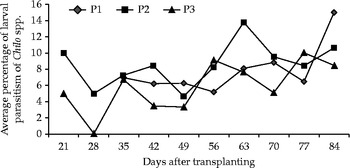
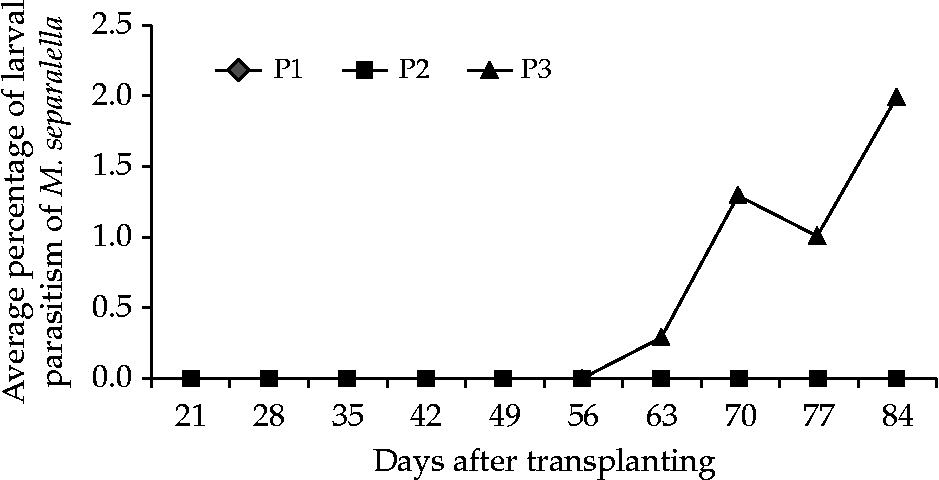
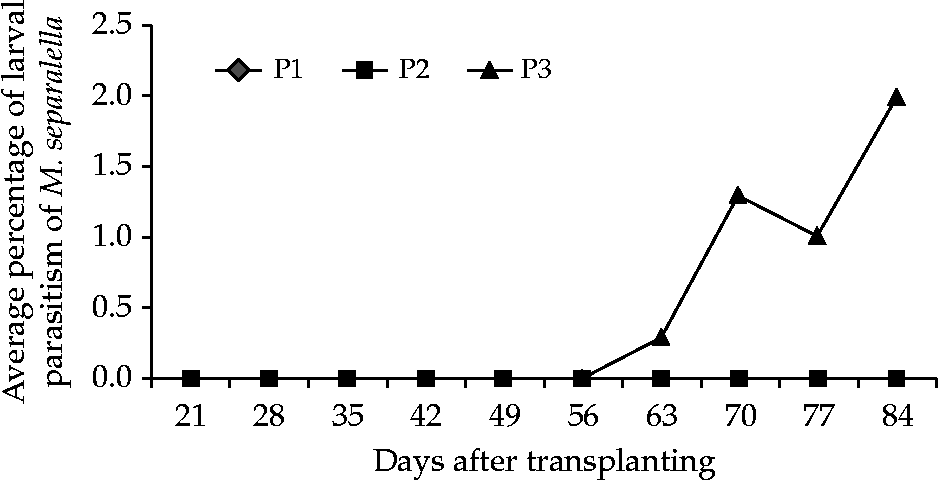
Chilo spp. and M. separatella were particularly affected by larval parasitism. Parasitoids were observed in Chilo spp. for two of the three transplanting periods at similar frequencies (Fig. 1). The level of parasitism in P3 was lower than in the two other transplanting periods from 21 to 56 DAT. No statistical differences in the parasitism associated with Chilo spp. at 5% level were detected among transplanting periods; however, the highest level (15%) was observed in P1 at 84 DAT and in P2 at 63 DAT (Fig. 1). The parasitized larvae of M. separatella were observed for the first time only in P3 and at 56 DAT (Fig. 2). The level of parasitism did not exceed 2% during the period of observation.
Average percentage of larval parasitism at indicated days after transplanting of Chilo spp. according to transplanting period (P1, P2 and P3), 2014 dry cropping season, Kou valley, Burkina Faso.

Average percentage of larval parasitism at indicated days after transplanting of Maliarpha separatella according to transplanting period (P1, P2 and P3), 2014 dry cropping season, Kou valley, Burkina Faso.
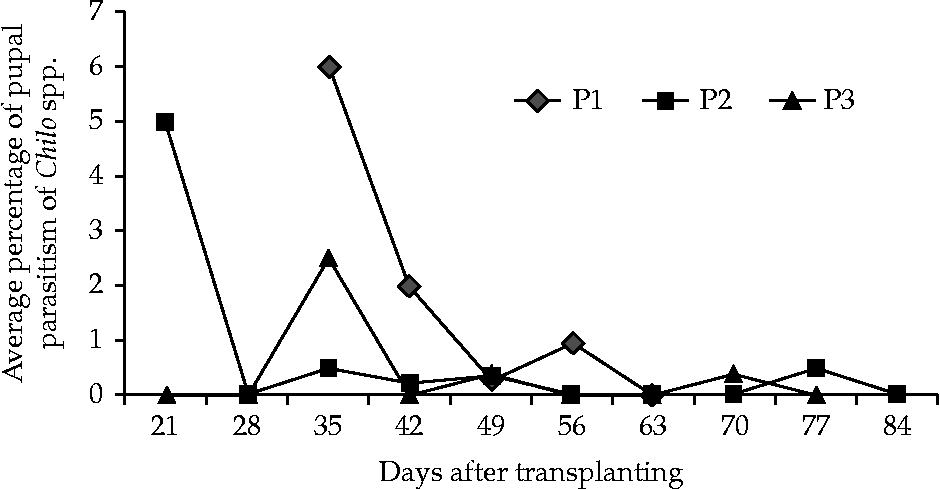
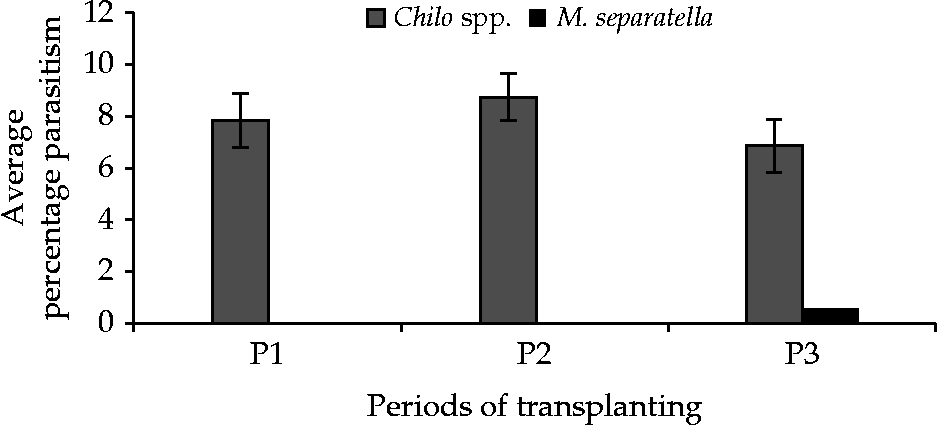
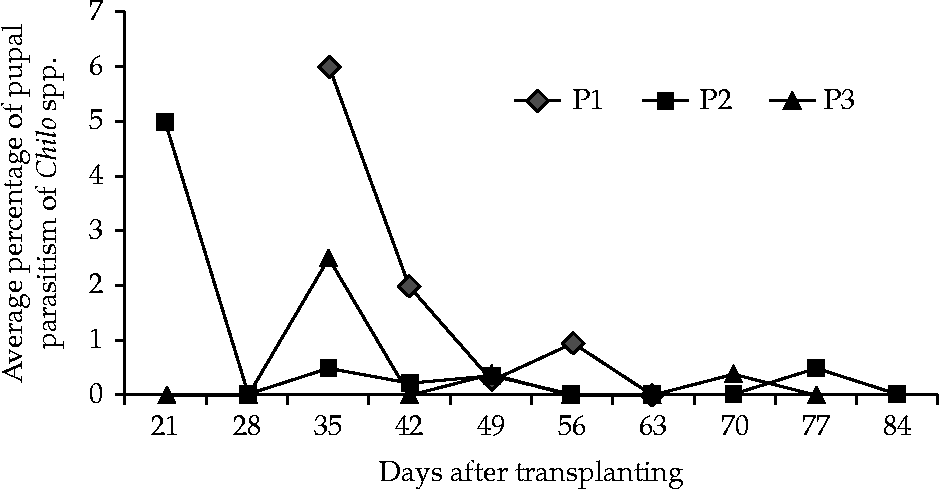
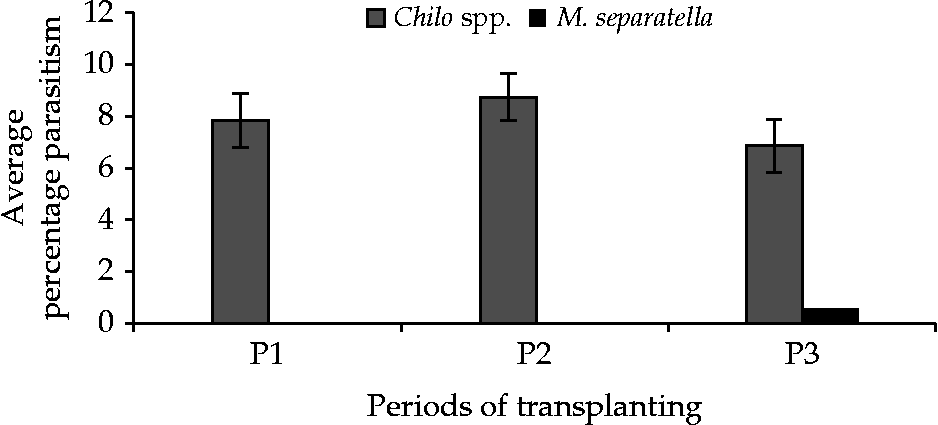
Among pupae sampled, only those of Chilo spp. were parasitized. This parasitism was higher than 5% between 21 and 42 DAT for P1 and P2 (Fig. 3). Significant differences between treatments were observed in the P1 and P2 treatments, but not in P3 treatment. The highest average percentage of cumulative parasitism of Chilo spp. (8.75%) was observed in P2, followed by P1 (7.79%) and P3 (6.82%); larval parasitism lower than 1% in M. separatella was found only in P3 (Fig. 4).
Average percentage of pupal parasitism at indicated days after transplanting of Chilo spp. according to rice transplanting period (P1, P2 and P3), 2014 dry cropping season, Kou valley, Burkina Faso.
Average percentage of parasitism (caught by sweep net) associated with immature stages of rice stemborers according to the transplanting period, 2014 dry cropping season, Kou valley, Burkina Faso. Means followed by the same letter are not significantly different at 5% level when submitted to the Student–Newman–Keuls test. On average, 7.93% of immature stages of Chilo spp. were parasitized but only 0.14% of M. separatella larvae were parasitized.
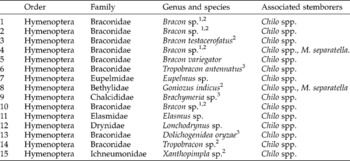
Parasitoids included those attacking the larval and larval-pupal stages. Fifteen species from nine genera were identified, including seven families of the order Hymenoptera (Table 1). The most numerous species (60%) belonged to the Braconidae family. Other families were represented by only one species (6.6% each). Larval parasitoids associated with Chilo spp. were more abundant than those associated with M. separatella. These stemborers shared only two larvo-pupal parasitoids, Bracon testacerofatus (Hymenoptera: Braconidae) and Goniozus indicus (Hymenoptera: Bethylidae) (Table 1).
Larval parasitoids associated with rice stemborers, 2014 dry cropping season, Kou Valley, Burkina Faso

Two larvo-pupal parasitoid species of Chilo spp. were identified. These were Goniozus indicus (Hymenoptera: Bethylidae) and Bracon testacerofatus (Hymenoptera: Braconidae).
1 The species belongs to the same genus.
2 Gregarious parasitoids.
3 Solitary parasitoids.
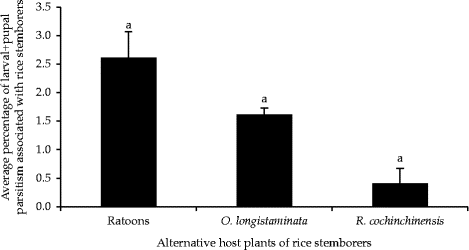
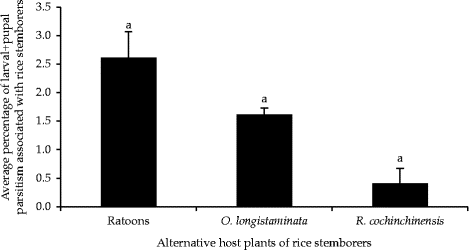
Parasitism was observed on larvae and pupae of Chilo spp. sampled from all alternative host plants. Larvae of M. separatella were parasitized only on Rottboellia cochinchinensis at a very low level of 0.2% (Fig. 5). There were no significant differences at 5% level (P>0.05) among alternative host plants in terms of numbers of parasitized stemborers, and the highest average level of parasitism was observed on rice ratoons (2.6%) followed by the wild rice varieties, O. longistaminata (1.60%) and R. cochinchinensis (0.4%).
Average percentage of larval+pupal parasitism associated with rice stemborers on Oryza sativa ratoons, Oryza longistaminata and Rottboellia cochinchinensis, 2014 dry cropping season, Kou valley, Burkina Faso. Means followed by the same letter are not significantly different at 5% probability level according to Student–Newman–Keuls test.
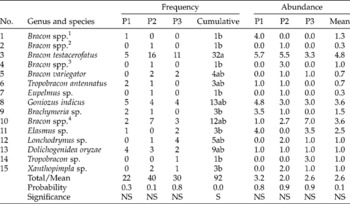
The share of parasitism attributed to different parasitoids occurred in relation to their frequency (Table 2). Goniozus indicus and B. testacerofatus were the most common larval parasitoids in P1. In P2, the most frequently occurring were B. testacerofatus and Bracon sp.4 (see Table 2). According to our results, B. testacerofatus, G. indicus and Lonchodrynus sp. appeared to be the most frequent parasitoids.
Frequency and abundance of larval parasitoids according to transplanting periods, 2014 dry cropping season, Kou valley, Burkina Faso

NS, Not significant; S, significant.
1–4 Different species of the same genus.
The frequency of the parasitoids represented by those that emerged from a stemborer in the laboratory was similar to the frequency of those collected in the field by the sweepnet. Parasitoids that emerged most frequently in the laboratory were the same that were most frequently caught in the rice field and in similar proportions. In P1, G. indicus, B. testacerofatus and Dolichogenidea oryzae were the most frequent species but differences among species were not statistically significant (P= 0.1681). Conversely, in P2, B. testacerofatus was observed 16 times followed by Bracon spp.4 (7) and G. indicus (4) (Table 2). The same trend was observed in P3 where the levels were slightly lower than in P2; and frequency of B. testacerofatus was highest (11) followed by Bracon sp. (4). Larval parasitoids were more frequent in P2 (40) than in P3 (30) and P1 (22). Bracon testacerofatus was observed a total of 32 times. Other parasitoids, including G. indicus (13), Bracon sp. (12) and D. oryzae (9), were far less numerous (Table 2).
Gregarious parasitoids included a mean number of 2.6 individuals from emergence/catching. This mean was 1 to 2 times lower than the number of individuals observed with the most abundant parasitoids. Some parasitoids were 4 to 5 times more abundant than others (Table 2).
The larval parasitoid, B. testacerofatus, was the most frequent and the most abundant species followed by G. indicus and Bracon sp. The parasitoid populations were more abundant in P1 but less frequent in P2 and P3.
Predators associated with stemborers
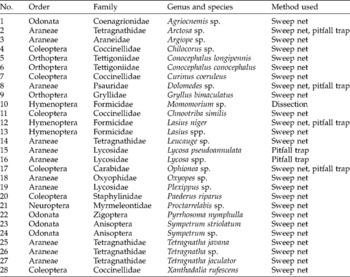
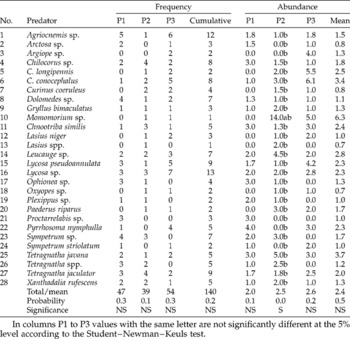
The predator species in Kou Valley were more taxonomically diverse than the parasitoids. The 28 predator species had representatives from 2 classes (Insecta and Arachnida), 6 orders, 22 genera and 15 families (Table 3). The majority were spiders caught either by the sweepnet or by pitfall traps (Tables 3 and 4). The Lycosa genus was the most frequent among the spiders caught with the sweepnet (Table 4). The Tetragnathidae had the highest number of species (15.85%) followed by the Coccinellidae (14.28%), the Lycosidae (10.7%) and the Formicidae (10.7%).
Predators associated with rice stemborers, 2014 dry cropping season, Kou Valley, Burkina Faso, and method of collection

Frequency and abundance of predators as collected by sweep net according to transplanting periods, 2014 dry cropping season, Kou Valley, Burkina Faso

NS, not significant; S, significant.
In columns P1 to P3 values with the same letter are not significantly different at the 5% level according to the Student–Newman–Keuls test.
A relatively low frequency of predatory arthropods was observed in the study area, on any of the transplanting periods.
Discussion
The complex of natural enemies, parasitoids and predators associated with rice stemborers in the Kou Valley, was quite diverse. All 15 parasitoid species were hymenopteran and all associated with Chilo spp., the most numerous stemborers in the study area. Only two parasitoids were also found to be associated with M. separatella. Ghahari et al. (Reference Ghahari, Hayat, Tabari, Ostovan and Imani2008) reported similar results in Iran where they found 37 parasitoid species (including eight families) all belonging to the Hymenoptera and Diptera orders. Boivin (Reference Boivin2001), in a review paper on parasitoids associated with insect pests, reported that most of the studied parasitoids belong to these two orders.
The predators were more diverse than the parasitoids but less numerous. They were found in six orders belonging to two classes that included 15 families, 22 genera, and 28 species. The families most represented were Tetragnathidae and Lycosidae. These are part of the major predator group commonly called spiders that were 40% of all collected arthropod species. The results did not permit a direct association between predators and stemborers. Predators also prey on numerous other arthropods besides stemborers. Some egg-predators (including Conocephalus longipenis, Conocephalus conocephalus, Gryllus bimaculatus and Chnootriba similis) were identified. Pathak and Khan (Reference Pathak and Khan1994) demonstrated that egg-predators were able to significantly reduce the larval populations of stemborers in the Philippines. Several reports have been published stressing the important role of predators (such as spiders) in agroecosystems (Shepard et al., Reference Shepard, Barrion and Litsinger1987; Yu and Byers, Reference Yu and Byers1993; Boivin, Reference Boivin2001; Heinrichs and Barrion, Reference Heinrichs, Barrion and Hettel2004).
The analysis of the average percentage of parasitism associated with Chilo spp. revealed that the maximum level was reached at 84 DAT, i.e. 3 weeks after the peaks observed in the immature populations of the insect pest, and suggests that the parasitoids are specialized and act on their hosts depending on their density. Nacro et al. (Reference Nacro, Dakouo and Heinrichs1995) reported similar results when they studied parasitism associated with the AfRGM, O. oryzivora Harris & Gagné. The parasitism associated with stemborers on alternative hosts was significant. Also, Otieno et al. (Reference Otieno, Le Rü, Ong'amo, Dupas, Calatayud, Makobe, Ochora and Silvain2006) reported similar results in Kenya. Parasitoids are able to locate their hosts even when the density of these insect pests is low (Yu and Byers, Reference Yu and Byers1993; Boivin, Reference Boivin2001).
Conclusion
The spatio-temporal sampling showed that B. testacerofatus, G. indicus, D. oryzae, and Bracon sp. were well established in irrigated rice production in the Kou Valley and were likely to be responsible for significant parasitism of stemborers in farmers' fields. Leucauge sp., Agroicnemis sp., L. pseudoannulata and Lycosa spp. were the endemic predators in this rice scheme but their real impact could not be assessed in this study. Further studies are necessary to broaden the scope of sampling methods over arthropods in the rice ecosystem, to develop a more comprehensive portrait of those associated with rice stemborers; for example, by using a D-Vac trap. No egg-parasitoid was found in the field. Understanding the impact of both parasitoids and predators on the stemborer population will permit the future development of a sustainable management system for these important natural enemies. We recommend removing and destroying deadhearts and whiteheads to reduce the incidence of stemborers in rice fields. We also recommend the preservation of the holes found on the bounds of rice fields that constitute a habitat for some spider species. Natural enemies of rice stemborers can be better preserved with a sound use of pesticides. The intensive training in IPM offered to Kou Valley rice growers several years ago ought to be repeated.
Acknowledgements
The authors thank Dr Ibrahima Ouédraogo, Head of the Rice Research Programme at INERA, Burkina Faso, for providing the funding for this study. Our sincere thanks to Dr Denis Gaudet from Agriculture Canada and Dr Michelle Gorman, entomologist and IPM consultant, for carefully reviewing the manuscript. Dr Goergen, IITA Cotonou, identified some of the arthropods listed in this text. Finally, the authors express their sincere gratitude to MM. Youssouf Traoré, Raymond Kiénou, Adama Sanou, Hervé Bama, Karim Nébié and Gafar Sanou for their assistance in the field or in data analysis.