1. Introduction
Economic historians face the challenge of discerning plausible causal structures from a variety of empirical evidence collected from manifold sources. Over the recent past, some economists have taken an interest in the role of institutions as central to the quest for understanding the past. In the literature, these claimed causal factors take various forms – the rule of law, honest elections, strong property rights, colonial rule by ‘good’ countries versus ‘bad’ ones, and impartial judges. It has even been claimed that institutions can be turned on and off at will – at which point individual behaviors are assumed quickly to switch back and forth, depending.
Our immediate interest is a recent effort to re-write modern German history using several elaborate econometric specifications. The empirical work of interest is the paper by Acemoglu et al. (Reference Acemoglou, Cantoni, Johnson and Robinson2011) (hereinafter ACJR) on the French ‘treatment’ in a small part of Germany in the early years of the 19th century. These authors argue that the claimed beneficial effects of French occupation on German industrialization and GDP growth were quite accidental. The French ‘treatment’ had two central purposes. First, there was the defensive motivation – to hold their enemies (Austria, Prussia, and England) at bay. Second, the French move to the east had an ideological purpose – to export modern (Enlightenment) ideas to a geographic space that was considered to be ‘naturally French’ yet remained in the firm grip of pre-modern institutions. There was, evidently, an urgent need to destroy the Holy Roman Empire and ‘. . .the grip of the aristocracy, oligarchy, and the clergy on political and economic power (Acemoglu et al., Reference Acemoglou, Cantoni, Johnson and Robinson2011, p. 3287)’. As a result, institutional arrangements in the French-annexed territories on the left bank of the river Rhine – and in the adjacent newly created French-controlled satellite states – were transformed and the non-occupied provinces within Germany (considered the ‘control’) then launched so-called ‘defensive’ reforms to bring their institutional arrangements into harmony with the territories under direct French control. We see here an example of an alleged ‘horizontal transmission’ of institutions across space.
The authors claim to have discovered ‘. . .a strong association between institutional reforms and French invasion (or control) (Acemoglu et al., Reference Acemoglou, Cantoni, Johnson and Robinson2011, p. 3287)’. The ACJR research calls attention to two empirical questions: (1) was the very brief duration of French occupation in a distinct minority of German territory, a plausible cause of the degradation in the grip of the aristocracy, the oligarchy, and the church?; and (2) was degradation of the aristocracy, the oligarchy, and the clergy in the early part of the 19th century plausibly causal with respect to industrialization and urbanization that began in Germany 50 years off into the future? Unlike the alleged horizontal transmission of new institutions mentioned above, we now encounter a different form of transmission. In this case, it appears that new institutions waited the better part of 50 years before producing their claimed beneficial effects.
These matters are central to the econometric strategy deployed by ACJR to distinguish between the ‘imposed’ institutional reforms at the hands of the occupying French, and the defensive reforms undertaken in other polities that escaped direct control. These authors conclude:
. . .the effects of French invasion worked through the institutions that they imposed in the occupied parts of Germany. Overall, our results show no evidence that the reforms imposed by the French had negative economic consequences. On the contrary, evidence from a variety of different empirical strategies shows that they had positive effects (Acemoglu et al., Reference Acemoglou, Cantoni, Johnson and Robinson2011, p. 3287).
Our purpose here is to show that the ‘variety of different empirical strategies’ deployed by these authors does not yield credible support for their flawed theoretical model and its econometric counterpart.
We first challenge the exact dates – and the empirical (legal and behavioral) coherence – of the four reforms that constitute the independent variable (years of reform) in the ACJR model.Footnote 1 Once the four institutional reforms are correctly dated and properly understood, we show that they fail to support a claim of ‘big-bang’ institutional change. A larger issue is the flawed econometric model underpinning their identification strategy. Neither the horizontal nor temporal effects of the French treatment offer a credible account of German industrialization that began around 1850.
Finally, we show that this failure then opens the way for a straightforward and theoretically tractable model of economic change in 19th century Germany that is consistent with prevailing accounts of German industrialization. There is no need to re-write German history.
2. The problematic French treatment
We share a commitment to understanding the role of institutions in economic history. But some institutional changes make direct contact with essential economic processes, while other institutional changes have only an indirect bearing on matters of commercial concern. Clarity in this regard is essential if plausible explanations of economic change are to be produced by empirical research (Nelson and Sampat, Reference Nelson and Sampat2001). The central aspect of our challenge to ACJR concerns the dating (vintages) of institutional change in Germany under the claimed influence of the French. This challenge highlights the important distinction between the two distinct categories of institutions: (1) durable customs and habituated patterns of interaction; and (2) legal parameters that are the conscious creation of political leaders in a continual quest to create – and then update as conditions warrant – the formal (codified) structure of authoritative rules that constitute behavioral incentives and sanctions (Bromley, Reference Bromley2006). The first category of institutions will often be referred to as ‘informal’. The paper by ACJR is not concerned with these durable behavioral attributes for the simple reason that customs and habits are not amenable to imposed alteration by foreign invaders – especially when those invaders remain for a very short period.
Rather, the ACJR paper concerns the second category of institutions – the legal (codified) parameters that carry the weight of collective authority. Notice that these legal parameters are collective rules that define socially acceptable individual and group behavior, and that this legal scaffolding necessarily constitutes sets of dual expectations. Following Commons, we regard institutions as indicating what:
. . .individuals must or must not do (compulsion or duty), what they may do without interference from other individuals (privilege or liberty), what they can do with the aid of collective power (capacity or right), and what they cannot expect the collective power to do in their behalf (incapacity or liability) (Commons, Reference Commons1924, p. 6).
It must be clear, therefore, that when ACJR write of imposed institutional reforms in the French treatment area – and subsequent ‘defensive’ reforms in the control areas – they can only have in mind this constellation of ‘dualities’ (right – duty; privilege – liability); (Bromley, Reference Bromley1989, Reference Bromley2006; Hohfeld, 1913, 1917). With this clarification as to the content of institutions, it must now be clear that simply turning on and off – imposing and then rescinding and then re-instating – these legal relations is a more challenging proposition than seems apparent from reading ACJR's account of Napoleon in Germany.
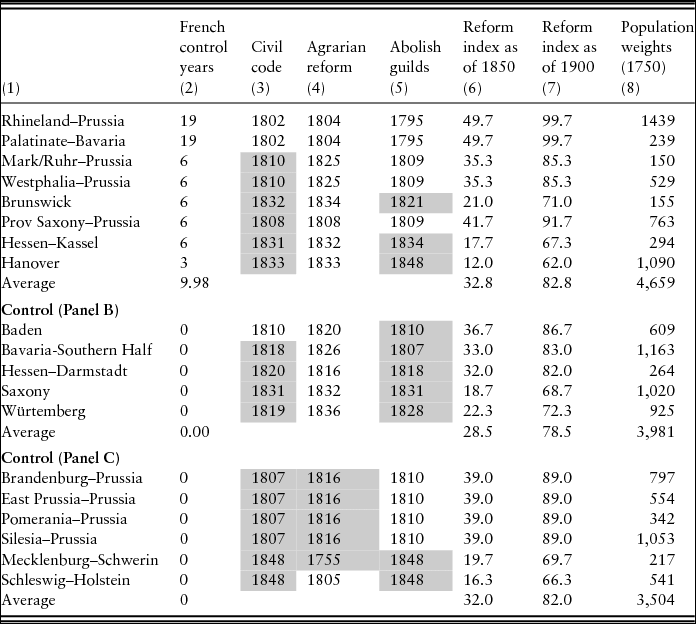
The conceptual core of the ACJR theoretical apparatus concerning institutional change is found in four specific reforms that the authors claim were imposed in the eight (of 19) territories annexed or controlled by France beginning in the early years of the 19th century. Table 1 reproduces the territories (polities) used by ACJR in their econometric models.Footnote 2 The eight occupied territories contained, in 1750, approximately 38 percent of the total German population. But the French ‘treatment’ across these eight polities varied considerably. Two polities (Rhineland and Palatinate) – containing only 14 percent of the population of these ‘treated’ parts of Germany – were occupied for a period of 19 years. However, in contrast to this heavy presence, the vast majority of the ‘occupied’ population – the remaining 86 percent – resided in the other five polities that were occupied for 6 years, and Hanover that was occupied for a mere 3 years. In other words, only 5 percent (14 percent of 38 percent) of the German population was exposed to direct French occupation for more than 6 years. For the vast majority of Germans the French were an absent or ephemeral factor in daily life.
Correct data on relevant institutional reformsa
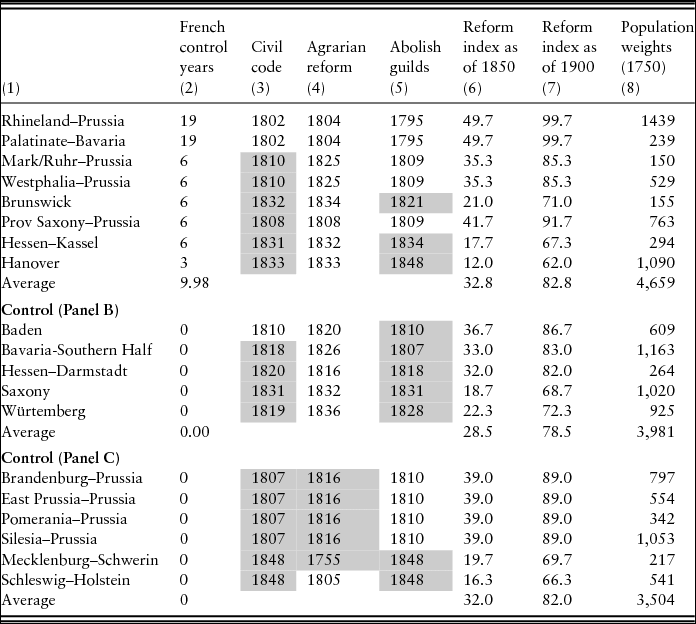
Shaded dates differ from those claimed by ACJR in Table 1.
aSee on-line Appendix (Supplemental Material) for elaboration of our construction of Table 1.
The causal agent in the ACJR theory of German industrialization is their ‘reform index’. This alleged causal agent was derived by simply adding up the total number of years prior to 1850 that each of the four reforms is claimed by the authors to have been in effect, and then dividing this total number of years by four.
There are three territories of interest: (1) occupied areas receiving the French treatment; (2) ‘control’ (unoccupied) areas west of the River Elbe; and (3) ‘control’ (unoccupied) areas east of the River Elbe. These two control polities are claimed to have introduced ‘defensive’ institutional reforms long after those same reforms had been imposed – and then reversed – in the treated areas. The four institutional changes claimed to be causal of German industrialization after 1850 are: (1) abolition of privilege-based law and the imposition of the Civil Code;Footnote 3 (2) abolition of serfdom; (3) agrarian reforms to abolish shared rights in land; and (4) abolition of the guilds.
The econometric strategy of ACJR is driven by their desire to show the profound impact of Napoleon in the occupied territories, and then the defensive institutional reforms – alleged horizontal transmission – undertaken in the two non-occupied regions of Germany. This approach is designed to support their hypothesis that ‘big-bang’ reforms in small areas of large territories can, over time, pay nice dividends.
3. Varieties of institutional reformFootnote 4
There are two problems at the core of the ACJR ‘reform index’: (1) the exact dates at which those reforms are claimed to have been adopted (their vintage); and (2) the nature and content of those institutional reforms.
To start with the most obvious problem, consider the claimed vintage of the abolition of serfdom – either brought about by Napoleon in the occupied territories or defensively eliminated as a result of the so-called French treatment. ACJR date this reform from as early as 1783 in Baden, to as late as 1832 in Saxony. Surprisingly, the authors then admit that serfdom had ceased to exist throughout Germany prior to the arrival of Napoleon. Why would ACJR assign dates of attribution for an institutional regime that the French had no role in abolishing? Eliminating serfdom's demise from the ACJR model leaves only three institutional reforms that might be attributed to the French: (1) the imposition of the civil code to replace the privilege-based legal order of the Ancien Régime; (2) agrarian reforms; and (3) abolition of the guilds. The problem with these remaining institutional reforms is that ACJR very often assign vintages that are at odds with accepted German historiography. Therefore, in Table 1 we provide corrected dates for 31 of the 57 observations that were incorrectly assigned (dated) by the authors.Footnote 5
First, notice that there are only three (not four) reforms that can be attributed to the French – the Civil Code (column 3), agrarian reform (column 4), and abolition of the guilds (column 5). ACJR date the imposition of the Civil Code (abolition of the Ancien Regime) in Westphalia as occurring in 1810 and lasting until 1815 when it was reversed. According to ACJR, this institutional change did not reappear until 1900. Summing the years in which these three reforms are alleged to have been in place in Westphalia yields a reform index (the row sum) of 24.7 (5 years for 1810–1815 of the Civil Code, plus 25 years for agrarian reforms, plus 41 years for abolition of the guilds). The sum of these three durations is 71 years, and when divided by 3 yields a reform index for Westphalia of 23.7. Table 1 of ACJR (see on-line materials) shows a reform index of 28.5 for Westphalia because they incorrectly considered the abolition of serfdom as a discrete reform even if it was only a minor and inseparable part of the entire agrarian reform package to abolish the manorial system. Indeed, during the centuries before Napoleon, serfdom in Westphalia had been relaxed to such an extent that, practically speaking, it had ceased to exist.Footnote 6 That 42 years of ‘credit’ to the French treatment, when added to our sum of 71, and then divided by four not three, yields the ACJR reform index of 28.25 for Westphalia.
Our corrections to this flawed historical accounting reveal that the Civil Code was introduced in Westphalia in 1810 and was never ‘turned off’. In fact, Prussia never returned to the economic and legal Ancien Régime after 1815. This change yields 40 (not 5) years of legal reforms that affected the economic realm in the same way as did the Civil Code. With this correction, we see that the reform index for Westphalia is 106/3 = 35.3 (that is, 40+25+41 = 106/3). Similar modifications occur for all of the shaded entries in Table 1.
Rectifying those mistakes serves to change the average reform index for Panel A by just 0.4 years in 1850 (from 32.41 to 32.8). However, in the two control polities, ACJR assigned very late reform dates (or short-duration dates as in Westphalia and others). These artificially late dates of institutional reform (or suspended reforms) is based on – indeed necessitated by – their theoretical model suggesting that the French treatment in the occupied territories brought rather immediate institutional change that was then only reluctantly and belatedly adopted throughout the other 11 ‘untreated’ polities. This is the so-called horizontal transmission process discussed above. We say it is ‘necessitated by’ the ACJR theory because their conceptual model is one of direct treatment (imposed reforms) and then ‘defensive’ catch-up reforms elsewhere. ACJR call such reforms ‘defensive’ as if to suggest they were only reluctantly and incompletely adopted out of fear that if local leaders did not quickly impose specific reforms the French would then invade and do it for them.
Consider now the corrected vintages for the two control regions – West Elbe and East Elbe. For Panel B (the West Elbe control), the corrected dates indicate that institutional reforms occurred much earlier than claimed by ACJR, thereby increase the average reform index from 16.31 to 28.5 – an increase of 75 percent. Our corrections to the flawed ACJR historical accounting mean that these five polities undertook institutional reforms much earlier – averaging 12 years earlier – than recorded by ACJR. We see here a rather curious horizontal transmission process at work, and a similar process at work in Panel C (east of the Elbe). Here, our corrected dates increase the claimed ‘reform index’ from 25.1 to 32.0 – a jump of approximately 28 percent.
In other words, the two control regions, containing over 60 percent of the total German population, and lacking the occupation and imposition suffered by the eight treated polities, turn out – once correct reform dates are recorded – to have an average reform index that closely approximates the reform index for the treated polities. In other words, the three institutional reforms under consideration here had the same duration in which to do their alleged good work in the two control regions as compared to the eight polities receiving the imposed French treatment. Recall the core theoretical proposition of ACJR which holds that the imposed reforms in the eight occupied polities occurred much earlier and in a more radical way – thus clearing out the obstacles to growth erected and sustained by the traditional oligarchs. The non-occupied territories, still ruled by these oligarchs, were unable to carry out the necessary reforms. In the ACJR model, defensive reforms meant delayed and attenuated reforms – with long-term negative consequences for industrialization. When the correct dates are applied, there is nothing left of the alleged horizontal transmission hypothesis.Footnote 7
The more substantive part of our challenge to the ACJR story concerns the empirical content of the specific reforms under consideration here. Specifically, we question the implied behavioral implications of a suite of institutional change imposed by a foreign power that enters a large and complex political space. Moreover, when that occupying power then abandons the greater part of that polity – in this case after a mere 3–6 years – it cannot be a surprise if those new institutions (laws) turn out to be of dubious instrumentality for enduring behavioral change. Institutional change is not like a light switch that is flipped on, and then off – and then on again, or off again. New institutions (rules/laws) can indeed be issued, overturned, and then re-issued at will. However, the crucial behavioral question – are those quick changes dispositive for human behavior – must also be part of credible econometric analyses. It also bears mention that formal institutions – laws – that are enacted, and then overturned or rescinded (or re-enacted) are not correctly classified as ‘informal’ institutions. Such institutional jiggering is a sign of political and legal incoherence. The so-called ‘informal’ institutions – durable and habituated patterns of interaction – carry on while the formal rules of a society become irrelevancies.
We now turn to a brief discussion of the three institutional reforms alleged to be central to the influence of the French treatment.
The civil code
The imposition of the French civil code meant that the privilege-based order of the Ancien Régime would no longer constitute the source of the law. The evidence suggests that Napoleon rather quickly lost interest in this particular institutional imposition. In fact, by 1810 Napoleon was satisfied if his demands for more troops were punctually met by his German allies. An official enquiry of the Rheinbund states about the further introduction and enforcement of the Civil Code was rebuffed by Napoleon indicating that the Code did not ‘fit’ Germany. Further efforts to adapt existing legislation to the Code in the Rheinbund states thus came to a halt (Fehrenbach, Reference Fehrenbach1997, p. 54). In fact, there was an escape clause that allowed the aristocracy to reintroduce the seigniorial system through legislation. Under German conditions, the revolutionary Civil Code could be used to redefine seigniorial privileges as acquired private property indistinguishable from ordinary capitalist land rent. Ironically, to stabilize his Empire by satisfying the demands of the old and new Napoleonic aristocracy, it was Napoleon himself who pushed the ‘seigniorial counter revolution’ which preserved the seigniorial system in southwest Germany until the revolution of 1848.
There were three closely connected processes at work. First, there was legal equality between so-called noble and non-noble individuals. Second, there emerged uniform enforcement of the rule of law regardless of one's ‘station’ in life. Third, the legal system began to address a capitalist-based system of unfettered markets – especially with respect to land and labor. Of course different institutional reforms can have similar impacts on industrialization and economic growth. For instance, unfettered factor markets, economic freedom, and the ‘rule of law’ can be established by introduction of the Civil Code. However, in Germany, the same effect was realized by the Prussian Oktoberedikt of 1807, and the parallel reforms in other German states – most importantly Bavaria. Another means were new constitutions establishing the rule of law and abolishing (noble) privileges that were introduced in the south German states around 1820. The third means was the establishment of the German Customs Union – the Deutsche Zollverein – in 1834 (Keller and Shieu, Reference Keller and Shiue2013). This legislation rendered all pre-modern regulations of factor and commodity markets irrelevant. The revolution of 1848 abolished the last legal remnants of the privilege-based society of the Ancien Régime and fully established the rule of law throughout the entirety of Germany
Therefore, the assignment by ACJR of 1900 as the date of the introduction of a civil code in most German states ignores the much earlier adoption of a suite of institutional innovations establishing economic freedoms and a uniform rule of law. As a matter of historical accuracy, the most important and decisive institutional reforms had already taken place by the middle of the 19th century. The 1900 vintage used by ACJR reflects the fact that Germany was a federal state and all members of the federation had to agree to the new federal code. But, as above, it had been adopted rather earlier in all jurisdictions. In fact, most German states had introduced modern business and banking laws, and deregulation of mining and financial markets, five decades before the nation-wide adoption of basic principles of economic freedom.
Ironically, in the French controlled German satellite states there was no adjustment of German institutions to the revolutionary Code. Rather, it was the other way around – the seigniorial system was incorporated into the Civil Code (Fehrenbach, Reference Fehrenbach1983). The conservative interpretation of the Code, refined in the French state of Westphalia, was swiftly accepted by the ruling nobility in all Rheinbund states (Berding, Reference Berding1973). Following Napoleon's defeat in 1815, the newly founded Deutsche Bund (German Confederation), a loose confederation of all German states, acknowledged these seigniorial agreements in article 14 of the German Federal Act. Indeed, it required several massive peasant rebellions to end this institutional blockade that had been created by Napoleon (Dipper, Reference Dipper, Ullmann and Zimmermann1996a; Fehrenbach, Reference Fehrenbach1983, Reference Fehrenbach2008; Wehler, Reference Wehler1987).
Perhaps the most important reason why French reforms did not have any lasting impact on Rhenish agricultural development is that even under the old regime, emerging commercialization, growing market orientation, and the gradual individualization of agriculture had advanced very far – farther perhaps than in any other German region – by the time of the French ‘treatment’.Footnote 8 During the 18th century, the seigniorial system had been nearly abolished, or else peasant duties had been transformed into a pure land rent (Rentengrundherrschaft). In most parts of the Rhineland, peasants had been granted nearly full property rights in their farms long before the Napoleonic reforms. Moreover, in some Rhenish regions, manorial lords had become ‘agrarian capitalists’ even before the revolution by transforming all of their seigniorial tenancies into short-term leases.
These early changes fail to support the image of any pre-capitalist institutional rigidity of pre-revolutionary German agriculture in the Rhineland much in need of ‘modernizing’ French reforms. Indeed, these indigenous institutional changes suggest quite the opposite. The seigniorial system had been undergoing gradual disintegration for a rather long time (Dipper, Reference Dipper1980; Grüne, Reference Grüne2011; Konersmann, Reference Konersmann2001, Reference Konersmann and Glück-Christmann2002, Reference Konersmann2004, Reference Konersmann2006; Kopsidis and Lorenzen-Schmidt, Reference Kopsidis, Lorenzen-Schmidt, Van Molle and Segers2013; Mahlerwein, Reference Mahlerwein2001; Schultheis-Friebe, Reference Schultheis-Friebe1969; Weidmann, Reference Weidmann1968). The Archbishop of Mainz had abolished the last remnants of serfdom in 1787 – two years before the French revolution (Blanning, Reference Blanning1974; Fehrenbach, Reference Fehrenbach2008). Actually, Napoleon's policy prevented abolition of the seigniorial system in the French-controlled model states and the other Rheinbund states comprising most of Germany west of the river Elbe and east of the river Rhine prior to 1815. This Napoleonic deterrent persisted until the revolution of 1848 in most of south- and southwest Germany.
With this historical clarification, it is curious for ACJR to imply that once the French had imposed their new institutional arrangements the Rhineland was soon ‘. . .transformed from an oligarchy-dominated area to one open to new businesses and new entrants. Similar reforms were also systematically introduced into the German satellite kingdoms, such as the Kingdom of Westphalia, and the Grand Duchy of Berg (Acemoglu et al., Reference Acemoglou, Cantoni, Johnson and Robinson2011, p. 3290)’. Moreover, the authors allege that Napoléon was deeply committed to the revolutionary reforms and considered his grip on power to be dependent on abolishing the ‘. . .political control of the elite, feudal privileges, and introducing equality before the law (Acemoglu et al., Reference Acemoglou, Cantoni, Johnson and Robinson2011, p. 3290). This claim finds little support among scholars of German history.
Agrarian reforms
Two points must be kept in mind when assessing the sharp conflicts surrounding legislation to abolish the seigniorial system: (1) it is not possible to differentiate between obligations pertaining to the ‘person’ of the subservient peasant and obligations pertaining to the land because the personal status of a peasant – which in the worst case was serfdom (Leibeigenschaft) – depended on the legal status of the land she or he cultivated; and (2) under the seigniorial system, the property rights of dependent German peasants differed substantially between simple tenancy for years without any property rights in the land – or weak ownership rights (lassitisches Recht) – and nearly full peasant property rights. In many cases, this included the right of free hereditary ownership and sale (Erbzinsrecht). Even east of the river Elbe, most dependent peasants had strong ownership rights in their farms by the end of the 18th century.
The reforms changed a number of agrarian institutions (Agrarverfassung). The seigniorial system was characterized by shared property in land between lords and peasants (lordly dominium directum or direct ownership, and peasant dominium utile or proprietary possession). The dominance of shared property rights defined the essential difference between a seigniorial system and a capitalist system of land tenure based on undivided private property. In only a very few German regions did ownership mean full private property rights for the manorial landlords. Instead, the distribution of property rights varied considerably between manorial landlords and peasants. These variations in turn determined rents and labor services rendered by the peasants to the lords. Furthermore, the feudal rent was not based on the profitability of farming but reflected the regionally differentiated balance of power between landlords and peasants. The feudal rent could include rents in kind, rents in money, or rents in terms of labor obligations. Moreover, the legal status of a parcel of land – demesne or villein land – determined the degree of personal freedom of a peasant, as well as the quality of the peasant's property rights in the land being cultivated. The freedom of a peasant to leave ranged between full freedom and the obligation to remain in the lord's territory (Schollenpflichtigkeit).
Prussian reformers considered agrarian reforms aimed at abolishing the manorial system, and deregulation of industrial production, as the two essential elements of a comprehensive rural development strategy for the backward heartland (Altpreußen) east of the Elbe (Vogel, Reference Vogel1983). The reformers saw rural manufacturing and economic growth as the key to broad-based development (Vogel, Reference Vogel1983). Prussian reformers were the first in history to embrace a multi-sectoral strategy of rural development – an approach that was well-suited to rural Prussia where three quarters of the population – land-poor sub-peasants – barely survived in a region devoid of non-agricultural employment (Vogel, Reference Vogel1983).
The Prussian reforms emerged from the understanding that towns and rural areas in the Prussian east were poor (compared to the West) because the existing mercantilist system restricted rural growth. Prussian reformers grasped the idea that an expanding domestic market required improved rural incomes and that this would then break the cycle and create positive feedbacks in which both rural and urban growth would become closely linked and mutually re-enforcing. Prussian reformers rejected the idea that the growth of one sector could only be achieved at the expense of the other (Harnisch, Reference Harnisch1976, Reference Harnisch1978; Vogel, Reference Vogel1983).Footnote 9 As early as 1800, full peasants had become a minority in the purely agrarian regions east of the Elbe. Rural industries were completely lacking and so it was essential to provide employment opportunities in rural areas to make use of the abundant underemployed rural labor (Dipper, Reference Dipper1996b; Kocka, Reference Kocka1990; Peters, Reference Peters1970).
Abolish guilds
By the end of the 18th century, guilds throughout Germany had lost their ability to organize and control industrial production, and to prevent the rise of new types of firms – except for traditional artisan shops. They may not have been formally abolished, but their operational component was very much weakened. In addition, unlike the industrial western provinces, the tax system of the agrarian east Elbian regions – which comprised the Prussian rump state after 1807 – enforced the concentration of industrial production in small towns.
The Peace of Tilsit (July 9, 1807), followed by the Oktoberedikt of October 9, 1807, paved the way in Prussia for full freedom of enterprise, especially several laws between October 1810 and September 1811 bringing the abolition of: (1) all exclusive privileges to carry out a business. This included the complete disempowerment of guilds (Zunftverfassung) and the revocation of countless royal monopolies for certain manufactures, enterprises, and merchants; and (2) all requirements to use only certain commercial enterprises (seigniorial lords’ mills and inns), or the obligation to buy and sell at particular markets. A simple trade certificate was now sufficient to start a business (Ziekow, Reference Ziekow1992). Only in Prussia – very far-removed from the influence of the French – was there unconditional freedom of enterprise for urban and rural areas (Vogel, Reference Vogel1983).Footnote 10
In addition, the government's Fabriksystem upheld license requirements for any industrial enterprise outside of the guild system. Manufacturers who managed to obtain a valuable license often acquired monopoly rights and other preferential treatment. It is no surprise that established industrialists, the beneficiaries of this mercantilist ‘industrial policy’, did not support economic freedom – including free trade (Rohrscheidt, Reference Rohrscheidt1898; Schmoller, Reference Schmoller and Schmoller1898; Vogel, Reference Vogel1983; Ziekow, Reference Ziekow1992). The economic reforms of 1810–11 not only accelerated the demise of urban guilds, the reforms also upset socio-economic relations within the heartland of the Prussian monarchy: (1) the close nexus between the military/tax system and the distorted division of labor between urban and rural areas was destroyed. Regional specialization came to be determined by market forces; and (2) mercantilist regulation and governmental control of industrial production was abolished to foster a more competitive domestic market.
It was not until after the revolution of 1848 that we find evidence of fundamental institutional reforms to abolish obstacles to the expansion of a market-based industrial economy. This is especially true for capital markets and public finances. In early 19th century Germany labor was quite abundant, while industrial capital was exceedingly scarce. These circumstances undermined the significance of early liberal reforms (Tilly, Reference Tilly1966a, Reference Tilly1966b, Reference Tilly and Tilly1980, Reference Tilly1990). Additionally, it must be kept in mind that between 1815 and 1914, virtually all important commercial institutional change – deregulation of capital markets and mining, the introduction of central banks, modern business laws, and trade liberalization – brought about institutional convergence (in today's European Community it would be called ‘harmonization’) throughout Germany.
Summary
The foregoing discussion highlights two important issues in historical research on institutions and institutional change. The first problem is to identify the exact date at which a particular institutional change becomes dispositive for human behavior. That is, the mere passage of a new law in a polity with limited communication and enforcement mechanisms does not immediately translate into altered behaviors. Moreover, institutional change throughout the German territories had always been a continual process of experimentation and revision. Economies are always in the process of becoming, and the essential role of institutions is in both reflecting and parameterizing that becoming. In 18th and 19th century, Germany – and thus in the absence of a powerful centralizing state–localities (including regions and ‘kingdoms’) were semi-autonomous polities responding to local as opposed to ‘national’ exigencies. Very often, formal (codified) acknowledgement of institutional change came after new habits of interaction had ‘settled down’ after having demonstrated survival value.
The second problem in dating institutional change, and then attributing plausible behavioral responses, is the intricate connectivity of all customary and legal relations. The institutional architecture of a nation – state cannot be ‘carved at the joints’. Where, exactly, does the dissipation of the privilege-based legal order of the Ancien Régime – and its putative replacement by a far-reaching civil code – stand as a distinct institutional reform from a gradual relaxation of seigniorial relations and the historic burdens and reciprocated privileges of serfdom? When is official abolition of urban guilds really effective, and how does one separate those effects from other institutional reforms?Footnote 11
These difficult empirical problems doom efforts such as those of ACJR to identify four separate institutional changes, and then to anchor those changes in a particular polity at a specific time. But more serious problems loom for both the ACJR theoretical model – imposed and then ‘defensive’ institutional change – and their econometric strategies predicated on that model. First, we have already shown that institutional changes in the 11 non-treated polities of Germany generally occurred at the same time – and thus had the same time to effect change – as was the case in the polities subjected to French occupation. Our corrected vintages in the two control regions have the effect of increasing the reform indices in the two control regions – and in several polities these reforms in the control region occurred before reforms in the treated region. To stress the point, some polities in the control regions show earlier and more durable institutional changes than do polities in the ‘treatment’ region. This result runs counter to the ACJR theoretical model.
The more serious flaw in the ACJR econometric model, however, concerns the very notion of implied causality between the vintage of a particular institutional change and altered behaviors capable of producing industrialization and urbanization nearly one-half century off into the future. Notice that it would make no difference to the ACJR econometric model if the events coded at specific times by us or by ACJR – rather than depicting particular institutional changes – had been the declaration of three new public holidays taking effect in each polity. On this view, it should be obvious that the ACJR model would be unable to distinguish between the sudden announcement of these particular holidays – or one of their three institutional reforms. Would it follow that the establishment of three public holidays at different dates in the 19 polities was implicated in boosting industrialization beginning in 1850? In the absence of a clear causal model, the ACJR claims of causality are illusory.
4. Confronting the ACJR econometric model
Consider now the econometric model at the heart of the ACJR theoretical approach. They deploy a standard two-stage least-squares model of the form:
 \begin{equation}
Y_{it} = \alpha _i + \delta _t + \beta X_{it} + \varepsilon _{it}\end{equation}
where Yit is the dependent variable (urbrate), αi and δt are fixed effects and time effects, respectively, Xit is the treatment variable of interest (yearsref), and εit is an error term. Given usual concerns of potential correlation between Xit and εit, the first-stage regression is
 \begin{equation}
X_{it} = \gamma _i + \kappa _t + \rho Z_{it} + \upsilon _{it}\end{equation}
where Zit is the instrument (fpresenceXpost1800Xtrend) and υit is an error term that is uncorrelated with Xit.
Notice that the ACJR model includes data for the years 1700, 1750, 1800, 1850, 1875, and 1900. The values of the treatment variable Xit are zero for the first two periods, and the instrument Zit takes a value of zero for the first three periods (i.e., X i, 1700 = X i, 1750 = Z i, 1700 = Z i, 1750 = Z i, 1800 = 0). Therefore, the variables are given no weight in the calculation of ρ and β for these years (Angrist and Pischke, Reference Angrist and Pischke2009). Here, Zit is being used to identify the exogenous impact of XitonYit so the analysis can be limited to years where the variable contains useful information in a first-stage regression for the 2SLS estimation. These are the years 1850, 1875, and 1900.
More serious concerns arise upon examining alternate specifications for the ACJR model. To understand the gravity of this problem, consider a more flexible specification for the first-stage regression:
 \begin{equation}
\begin{array}{l}
X_{it} = \gamma _i + \kappa _t + \rho _{fpresence = 0} \times D_{fpresence = 0} \times trend \\
\quad \quad \quad \quad \quad \quad + \rho _{fpresence = 3} \times D_{fpresence = 3} \times trend \\
\quad \quad \quad \quad \quad \quad + \rho _{fpresence = 6} \times D_{fpresence = 6} \times trend \\
\quad\quad \quad \quad \quad \quad + \rho _{fpresence = 19} \times D_{fpresence = 19} \times trend + \upsilon _{it} \\
\end{array}\end{equation}
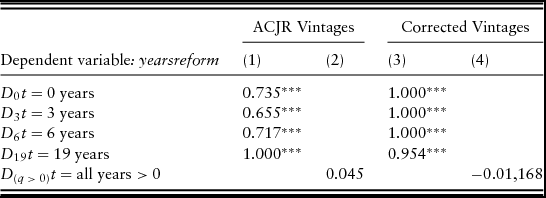
where D fpresence = q is a dummy variable indicating that polity i was occupied for fpresence = q years, q ∈ {0, 3, 6, 19}. This specification is similar to the ACJR model, but allows for a separate trend for each value taken by fpresence rather than interacting fpresence with the trend. That is, we allow for a separate time trend for each value of fpresence, allowing for the possibility that not all types of occupation are the same. Given this specification, longer duration of occupation by the French should be reflected in a higher value of ρq. These trend results are shown in Table 2.
Four models of years of French presence and years of reform
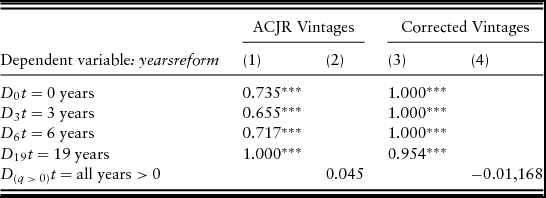
*, **, *** indicates significance at the 10%, 5%, and 1% levels, respectively. All regressions include time and polity dummy variables. For the four models see Table 2a–2d in the on-line Appendix.
Model 1 in the table shows the results from estimating coefficients for years of French presence as affecting the claimed driver of institutional reform in the ACJR model – years of reform. We see in Model 1 that the 11 control polities, where fpresence = 0 (for whom fpresenceXpost1800Xtrend is always equal to zero) tend to have a larger rate of increase in yearsreform (0.735) than do treated polities with 3 or 6 years of occupation, but a lower rate of increase than the two polities with 19 years of occupation. Notice that Model 2 in Table 2 indicates that a trend showing any duration of French occupation generates a relationship between occupation (French presence) and years of reform that is statistically insignificant.
Moreover, notice in the ACJR vintage model (their Table 1 in the on-line material) that for 8 of the 11 unoccupied polities, the reform index was larger than for the occupied polity of Hanover [yearsreform|fpresence = ....0 > yearsreform|fpresence = 3], while the opposite holds for the other 3 unoccupied polities. A comparison of unoccupied polities and polities with 6 years of occupation shows a similar lack of consistency.Footnote 12
Now consider Models 3 and 4 depicting identical regressions using our corrected vintages from Table 1. Notice that Model 3 has identical trends (coefficients) for fpresence = 0, 3, and 6 years, but now the coefficient (trend) for fpresence = 19 years is lower than it is for the other 3 groups. The results for Model 4 still show the coefficient for ‘occupied vs. unoccupied’ being insignificant, but the sign has switched to negative. With the corrected vintages, fpresence >0 is associated with lower trends for years of reform. Neither Model 2 nor Model 4 is significant so we should not make too much of these differences. But the results suggest that the ACJR econometric model – even with our corrected vintages – yields inconsistent results.
These inconsistencies are obviously problematic for the ACJR identification strategy. The results are problematic because Xit is an ordered treatment intensity variable and therefore the instrument for Xit must meet several requirements if β is to be given a causal interpretation. One obvious requirement is monotonicity. That is, if Zit > Zjs, then (a)Xit > Xjs or (b)Xit < Xjs∀i, j, s, t (Angrist and Krueger, Reference Angrist, Krueger, Ashenfelter and Card1999). This implies that in order to identify the causal impact of treatment intensity (duration of institutional change, or years of reform) without additional conditions, monotonicity requires that higher values of the instrument – years of French presence – will always result in either higher or lower values of the treatment variable (years of reform). Notice that in the absence of this restriction, the potential presence of polities for whom the instrument (French presence) is associated with both increased and decreased treatment (reform index), respectively – for a given value of Zit – means that the impact of the treatment cannot be identified. This lack of consistency – causal coherence – in the effect of ZitonXit means that the estimate of β in the second stage regression cannot be reliably specified. In other words, there is no consistent connection of the instrument (French presence) to the treatment variable (years of reform).
The failure of monotonicity means that some polities experience more years of reform – they are early reformers – with longer French occupation, yet others, with the same French presence, are late reformers. Such contradictory results are not surprising. Intuitively, particular polities will react differently to foreign occupation depending on the specific circumstances.
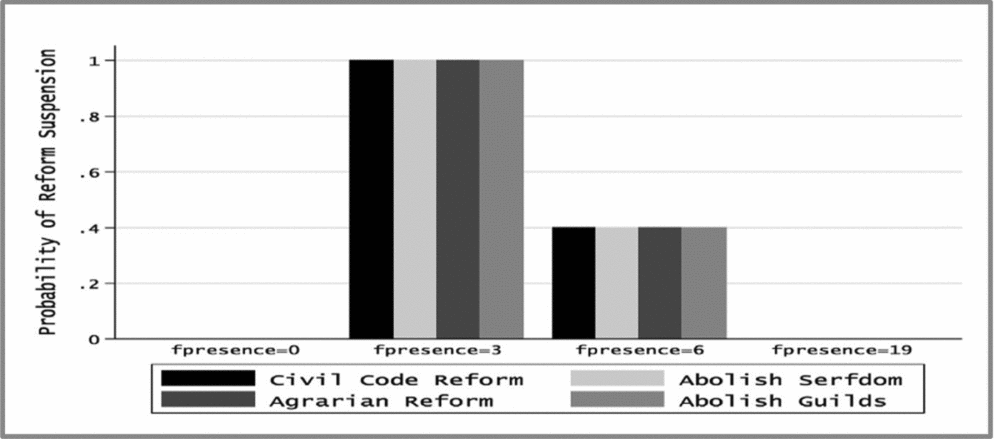
We see yet another manifestation of inconsistency in the ACJR approach when we focus attention on the reversion of institutional change. In Figure 1, we show the probability of reform suspension conditioned on the number of years of occupation. Notice that polities with 0 or 19 years of occupation never suspend reforms, while polities with 3 or 6 years of occupation have a positive probability of suspending all types of reforms. Once again, the instrument (French presence) is not a consistent – reliable – indicator of the treatment (years of reform). As a result, the ACJR econometric model – even when the corrected reform vintages are incorporated – does not reflect the impact of French occupation on German industrialization and urbanization. Rather, the sort of vintage model on display here simply captures the random impact of common yet unobservable characteristics for polities sharing a given value of fpresence (the instrument).
Probability of suspended reforms, given French Presence.

The above econometric detail should be sufficient to alert historians and others interested in institutional economics that the ‘variety of different empirical strategies’ on offer by ACJR serve to obscure the dubious efficacy of the French in Germany. It is now time to offer a plausible explanation of German industrialization.
5. Reconsidering economic change in Germany
A credible account of German industrialization and urbanization cannot emerge from the theoretical and econometric models advanced by ACJR. In fact, any account that ignores coal mining and smelting will miss the mark. In introducing coal as plausibly explanatory of industrialization, we are acknowledging the long-held consensus of virtually every historian of Germany's industrial emergence.Footnote 13 It is coal, and not the claimed institutional reforms of the French, that did the necessary work beginning in 1850. But some may wish to suggest that Napoleon deserves credit for German coal mining – that is, that coal mining is endogenous. To address these issues, we must consider the institutional milieu in which the emerging German coal industry was embedded.
The institutional setting
We start by noting that only two regions of Germany show any activity associated with coal before 1840. The first of these is in Zwickau (Kingdom of Saxony), while the other is in the Ruhr basin around Dortmund (Westphalia).
Secondly, given the primitive condition of transportation networks, the localized production of coal – its mining – had to surpass a certain threshold in order for it to be moved by barge to urban areas where labor was available for large-scale industrial uses. In fact, the literature on the emergence of the Ruhr industrial area prior to the 1840s makes clear that early coal mining did not contribute to urbanization but rather served to magnify the density of the rural population in a growing number of scattered settlements occupied by small peasant miners (Bergmannskötter). These rural mining enclaves were situated between the small towns prevalent in the Ruhr area at that time (Bronny and Dege, Reference Bronny, Dege, Köllmann, Korte, Petzina and Weber1990, pp. 102–104). In fact, throughout the 18th century, coal mining in the Ruhr was mostly a secondary activity for peasants seeking extra cash to supplement meager agricultural incomes (Kuske, Reference Kuske1949, pp. 113–118). Towns in the Ruhr basin did not expand beyond their medieval core until the 1840s, while the density of the rural population increased dramatically.
In the 1840s, Essen and Dortmund comprised the largest towns in the Ruhr basin numbering 6,000 and 7,000 inhabitants, respectively (Fischer, Reference Fischer1972, p. 161). The negligible urbanization impact of early coal mining was further reinforced by the fact that at the end of the 18th century, and in the early years of the 19th century, most mined coal from the region was simply exported down the rivers Lippe and Rhine, thereby offering little impetus to the emergence of domestic industry. Data for 1787–88 indicate that two thirds of the Ruhr area's coal production was exported to the Rhineland and the Netherlands (Kuske, Reference Kuske1949, p. 116).
By the early 1840s, things began to change. First, the advent of railroads created an immediate need for coal power. Then, the gradual emergence of steel production – obviously related to the emergence of the railroads – induced a long-lasting and stable need for coal. It is now well accepted that in order to reduce transport costs, both mining and smelting had to be concentrated in regions with easy access to coal (Krieger-Boden, Reference Krieger-Boden1995; Weber, Reference Weber1922). Agglomeration economies explain the emergence of the Ruhr area into one of Europe's major industrial belts – easy access to large coal deposits determined the regional pattern of German industrialization after 1840 (Fremdling, Reference Fremdling1985; Holtfrerich, Reference Holtfrerich1973; Tilly, Reference Tilly1990, Reference Tilly, Sylla and Toniolo1991). However, coal suitable for coking – a necessity for the emergence of a steel industry – was only available in deeper layers. Therefore, it was not until after 1830 – with English technical assistance – that a breakthrough beyond heavy clay into deeper coal seams became possible in Germany. This technical breakthrough, unattached to Napoleon, in turn fueled the mutually reinforcing expansion of both coal production and steel in the Ruhr basin (Fischer, Reference Fischer1972, p. 164).
These geological and technological aspects of early coal mining serve to minimize any possible endogeneity of coal mining and Napoleon. An additional deterrent arises in the realization that throughout Germany, as in the rest of Europe, all mineral deposits were owned by the state. Government mining authorities not only supervised coal mining, they actively controlled the sector. It was not until after 1850, with the introduction of a new Prussian mining law in 1865, that the strict control of coal mining was abolished. Similar reforms occurred all over Germany during that time (Fischer, Reference Fischer1972, pp. 139–178). In summary, there is no credible evidence that the date of the emergence of coal mining, and its subsequent development, might be endogenous in any model of urbanization brought about by industrialization.
Figure 2 reminds us that coal mining can only get started and prevail over time – regardless of prevailing institutional arrangements – where Mother Nature has randomly laid down thick veins of carbon residue.Footnote 14 Only three polities would become, by 1900, major coal-producing polities – Mark, Rhineland, and Silesia, two of which were in the occupied polities.Footnote 15
Thickness of coal beds in Germany, 1910.
Modeling economic change in GermanyFootnote 16
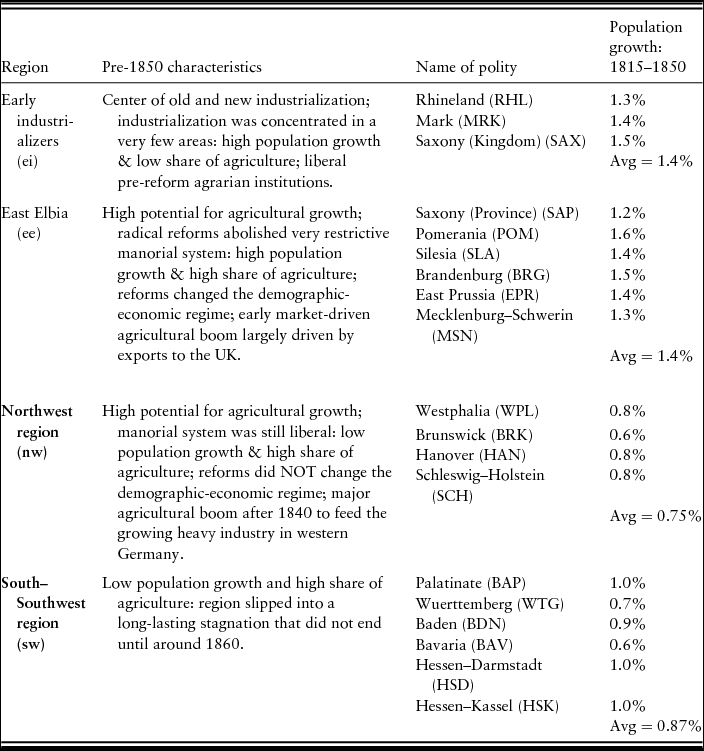
The development of a more comprehensive model of economic change in Germany, of which heavy industry is but a localized part, requires that we move away from the three regions at the core of the ACJR model. Those specific regions were required by the ‘treatment➔ defensive reforms’ model of the ACJR approach. We need to focus instead on four generally accepted economic regions of Germany during the 19th century (Table 3).
Four economic groupings
Source: own calculations, and from Krause (1980 [2007]), Hohorst (Reference Hohorst1978 [2006]), Nitsch and Gudermann (Reference Nitsch and Gudermann2009 [2012]), and Frank (Reference Frank1994 [2010]).
The economic regions depicted in Table 3 reveal several important considerations leading up to the beginning of German industrialization (1845–50). In 1815, there was a new German Confederation (Deutsche Bund) – a loose confederation of all German states. The German Customs Union (Deutsche Zollverein) was established in 1834. And of course the revolution of 1848 finally cemented the new institutional and economic relations in place. By this latter date, we see in Table 3 that demographic expansion had become significantly stronger in east Elbia and the polities of Rhineland, Mark, and the Kingdom of Saxony than was the case in the remaining polities. There was more robust population growth – either by natural causes or incipient in-migration – in these nine polities than elsewhere in Germany.
These demographic changes were being driven by regional differences in the first-stage dynamics of economic development. In other words, there had been an ongoing process of: (1) a gradual commercialization and market orientation of agriculture – early agrarian capitalism; and (2) a gradual expansion of proto-industrial activities that induced some increase in birth rates, accompanied by increased internal migration. That is, new income opportunities for the lower classes resulted in a gradual demographic expansion as well as some geographic mobility. The data suggest that newly empowered workers often moved across polity boundaries.
By 1849–50, the share of the agricultural labor force (avg_shagremp) throughout the various polities reflected the nature and extent of on-going structural transformations away from reliance on agriculture in several of the polities – a continuing process that had been occurring over the previous two–three decades. This was particularly pronounced, as we see in Figure 3, in Rhineland, Mark, and the Kingdom of Saxony (ei). This economic ‘head start’ was then transmitted forward beginning around 1850 – precisely at the time that coal mining emerged as a major employment activity.Footnote 17 Accompanying these regionally differentiated transformations, several important changes across the German economy were altering the economic landscape at the regional (polity) level (Figure 3).Footnote 18
Regional transitions in employment and urbanization (percentages on vertical axis).
In the three polities comprising ‘early industrializers’ (Rhineland, Mark, and the Kingdom of Saxony), the labor force in 1850 was equally divided between agricultural employment (avg_shagremp) and industrial employment (avg_shindemp). It is also noteworthy that in the early industrializers we see industrialization without serious urbanization (avg_urbrate). We also see that by 1900, the share of the workforce in agriculture in the early industrializers was approximately one-half the rate in the other three groups of polities. It is also plain that by 1900 the earlier industrializers were the only polities in which the share of workers in agriculture was less than those in industry, and this by a factor of 1/3. Regions whose industrial development was well advanced at the eve of the French Revolution, and which were well endowed with coal, easily became the early industrializers and thus comprised the leading regions of German industrialization. Nothing speaks in the direction of any impact of French occupation on German urbanization and industrialization.
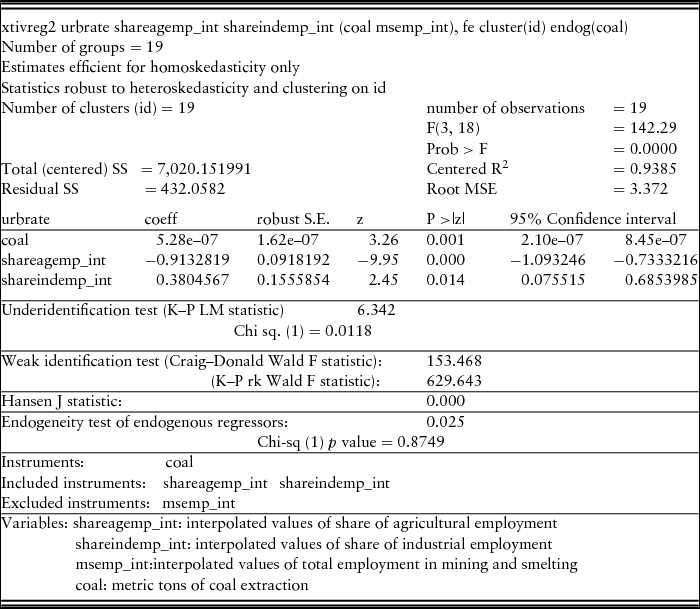
These substantive pre-conditions of economic change must be considered in a model seeking to account for German industrialization. In addition to acknowledging the role of coal, we introduce a fixed-effects panel regression with urbanization rate as the dependent variable, and with total coal production, the share of total workforce in industrial employment, and the share of total workforce in agricultural employment (in each polity). The results are shown in Table 4.
Fixed-effects two-stage model of German urbanization, 1850–1900
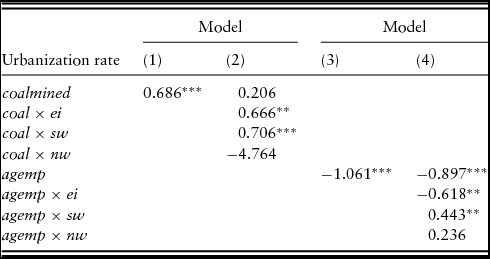
In Table 5, we show the results of four fixed-effects models that exclude the share of workers in industry – the least significant variable in the above model – and focus just on regional variations associated with coal production and agricultural employment.Footnote 19 Model 1 concerns the average effect of coal production across all 19 polities. Model 2 shows the regional implications of coal mining, with ee being the excluded region. Model 3 shows the average effect of the share of agricultural employment on urbanization rates across all 19 polities, while Model 4 shows the regional implications for urbanization rates as affected by the share of agricultural employment in each region. As above, East Elbia (ee) is the excluded region.
Four models of urbanization, coal production (metric tons), and agricultural employment as a share of total employment (1850–1900)a
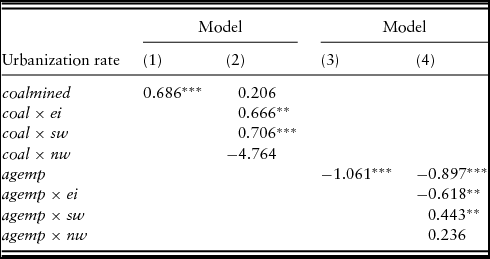
*, **, *** indicates significance at the 10%, 5%, and 1% levels, respectively. All regressions include time and polity dummy variables. The regional group ee is the excluded dummy and the coefficients for coal and agemp standing alone are the coefficients for that excluded group (ee). For the four models see Table 5a–5d in the on-line Appendix.
aSee the on-line Appendix for detailed output tables for each of these models.
In Models (1) and (2), we see results from a regression of the urbanization rate on the quantity (metric tons) of coal mined. Model (1) includes a single coefficient on coal, while Model (2) includes interactions between coal and dummy variables indicating assignment to one of the four regional groups in Table 3. This specification allows for heterogeneity in the impact of coal production on urbanization. Model 1 indicates a positive relationship between coal and the urbanization rate. Model 2 offers regional specificity as to where coal had an impact on urbanization. Results indicate coal production had a statistically significant impact on urbanization for polities in the early industrializer (ei) and southwest (sw) group; for ei polities, an increase of 1 million metric tons of coal mined was associated with an 0.872 (that is, 0.206 + 0.666) percentage point increase in the urbanization rate, while for polities in the sw group a similar increase was associated with a 0.912 (that is, 0.206 + 0.706) percentage point increase in the urbanization rate.
In Models 3 and 4, we report the results from regressions of the urbanization rate on an alternate indicator of industrialization – the share of total labor employed in agriculture. Model 3 indicates that, unsurprisingly, a decline in agricultural employment was associated with an increase in the urbanization rate. Model 4 indicates the negative relationship between agricultural employment, with the relationship being strongest for the early industrializers (ei) (0.897 + 0.618 = 1.515) and the East Elbia (ee) group (0.897). Unsurprisingly, the negative relationship between agricultural employment and the urbanization rate is weakest for the southwest group, where economic growth came relatively late, and reliance on agriculture remained quite strong.
6. Economic history as prescription
Acemoglu, et al. suggest that their work offers convincing evidence that specific areas of Germany subjected to ‘radical institutional reforms’ at the hands of Napoleon enjoyed rapid and regionally differentiated industrialization after 1850. Our re-estimation of the ACJR model – corrected for their flawed reform vintages – shows nothing of the sort. More seriously, their use of instruments to identify the coefficients in their econometric model is flawed. The incorrect historical evidence adduced by ACJR, comprising the empirical core of a flawed econometric model, offers nothing that should cause historians of German industrialization to change their mind.
If one believes that urbanization is a plausible proxy for industrialization, we offer a straightforward model of German urbanization consisting of three explanatory variables: (1) the share of employment in agriculture; (2) the share of employment engaged in industry; and (3) coal extraction. We believe our account will find resonance with economic historians.
Our concerns for the credibility of the ACJR project are heightened by the claimed implication for ‘radical institutional change’. The authors summarize their work by arguing:
In this light, our findings support the centrality of institutional differences for comparative economic development. . .the results are inconsistent with the view that externally imposed, radical, and ‘big-bang’ style reforms can never be successful. On the contrary, the evidence supports our hypothesis that the institutions of the Ancien Régime . . .impeded prosperity, and that the radical institutional reforms that removed these barriers paved the way for industrialization and economic growth (Acemoglu et al., Reference Acemoglou, Cantoni, Johnson and Robinson2011, p. 3304).
They then speculate why radical institutional reforms ‘worked’ in this case, and so very often fail to work elsewhere. Their answer, by now familiar, is that these reforms were much more sweeping and radical than is the normal case – that is why ACJR refer to them as ‘big-bang’ reforms. Sensing the dangers that lay down this path, the authors quickly retreat into a call for more research. Had they not prevaricated, they might well have ended up appearing to support invasions of various ‘failed states’ in order to make them exemplars of democracy and prosperity.
There seem to be two messages in the ACJR paper – one message is aimed at economic historians, while the other message is aimed at those devoted to bringing economic development to languishing and dysfunctional economies. We opened by applauding the increased interest in institutions as important for understanding economic history. But we cautioned that clarity in that research program demanded precision in understanding the meaning and empirical content of ‘institutions’. Unfortunately, the field of institutional economics remains conceptually entropic. Recall that entropy refers to dissipated thermal energy that is unavailable to do work. Entropy is the degree of disorder or randomness in the system. It would be difficult indeed to find a more fitting metaphor for the conceptual mélange associated with the term ‘institutions’. Coherent research on the role of institutions in economic history will be impossible in the absence of conceptual clarity concerning the precise meaning of institutions, and their role in economic change (Bromley, Reference Bromley1989, Reference Bromley2006).
The second message of the ACJR project is more problematic. Indeed, it is potentially dangerous because it moves beyond description – ‘here is why country X did (or did not) develop during the 19th century’ – and enters the fraught realm of prescription. We have already seen that ACJR, with a few caveats, are willing to propose that ‘radical institutional change’ just might be the sine qua non for countries now languishing under the suffocating influence of certain malevolent protectors of some Ancien Regime. In fact, the now-discredited ‘Washington Consensus’ was precisely this brand of imposed radical institutional reform. The record of success with such imposed institutions is not encouraging (Bromley and Anderson, Reference Bromley and Anderson2012; Rodrik, Reference Rodrik2006). It is not difficult to understand why. The list of desired – even ‘necessary’ – institutions lacks causal structure. We see in those reforms nothing but induction at work: ‘Become like us (institutionally) in the industrialized world and then you too shall be rich’. The descriptive and prescriptive elements of the ACJR approach come together when, with more careful specification of the empirical foundations of their model, and revising their problematic econometric strategies, it is apparent that their theoretical and empirical analysis lacks credibility. Prescriptions about the beneficial effects of imposed institutional change, when predicated on flawed analysis, are deeply problematic.
Acknowledgement
We are indebted to Christopher Kanter for assistance with Stata and econometrics issues. Peter Temin, Ulrich Pfister, Clemens Zimmermann, and Joachim von Braun have offered several helpful suggestions. The comments of anonymous reviewers have been valuable in helping us to refine our argument. Daniel Bromley is grateful to the Alexander von Humboldt Foundation, and the Reimar Lüst Prize, for financial support.