INTRODUCTION
In one of the most comprehensive reviews of group research, Cohen and Bailey (Reference Cohen and Bailey1997) proposed that the field should move away from the traditional input-process-output model (McGrath, Reference McGrath1984) and instead adopt a team effectiveness framework that advocates for proactive intervention at the group and organizational level. More specifically, the authors called for seriously taking group as a social entity and treating ‘group psychological traits’ as ‘real group-level phenomena’ because these traits not only have direct effects on outcomes but also have indirect effects through shaping internal and external processes (Cohen & Bailey, Reference Cohen and Bailey1997: 224). Although recent decades of research has greatly expanded the inventory of group-level psychological constructs such as group ethical culture (Schaubroeck et al., Reference Schaubroeck, Hannah, Avolio, Kozlowski, Lord, Treviño, Dimotakis and Peng2012; Treviño, Butterfield, & McCabe, Reference Treviño, Butterfield and McCabe1998), group climate (Anderson & West, Reference Anderson and West1998; Schneider & Reichers, Reference Schneider and Reichers1983), group safety climate (Zohar, Reference Zohar2000), group conflict (task and relationship) (Jehn, Reference Jehn1995), group knowledge sharing (Jackson, Chuang, Harden, & Jiang, Reference Jackson, Chuang, Harden, Jiang and Martocchio2006; Jiang & Chen, in press), group information elaboration (van Knippenberg, De Dreu, & Homan, Reference van Knippenberg, De Dreu and Homan2004), and group efficacy (Gibson, Reference Gibson1999) there remains a gap in the literature. First, most of the group psychological traits have been developed based on observations of group dynamics in Western organizations. Constructs developed from business organizations from emergent economies such as China would shed light on what organizations and groups can do in enhancing group effectiveness. Secondly, with the proliferation of group-level constructs, there is a need to explore how these constructs relate to each other to influence various group outcomes. For example, in organizational justice research, distributive, procedural, and interactive justice climates have all been found to influence team performance and team helping behavior (e.g., Erdogan & Bauer, Reference Erdogan and Bauer2010; Liao & Rupp, Reference Liao and Rupp2005; Naumann & Bennett, Reference Naumann and Bennett2000). However, given that justice climates reflect shared perceptions of fairness-related organizational norms and practices, it might be theoretically more productive to identify more proximate group constructs that mediate between organizational climates and group outcomes. Lastly, the increase and diversity of group-level constructs call for overarching theoretical perspectives that can guide the specifications of the inter-construct relationships as well as the integration of different perspectives.
The present study explores how justice climates within Chinese management teams affect team task performance and helping behavior through the mediation of group harmony. We seek to contribute to group effectiveness literature in the following ways. To begin with, although social harmony is one of the most important cultural values in China and many Asian societies (Bond & Hwang, Reference Bond and Hwang1986; Triandis, Reference Triandis1995) it has rarely been studied in the mainstream Western management literatures (Chen, Ünal, Leung, & Xin, Reference Chen, Ünal, Leung and Xin2016; Leung & Brew, Reference Leung, Brew, Wyer, Chiu and Hong2009). Developed based on the Confucian and Daoist concepts of social harmony, group harmony is conceived as a multi-dimensional construct that captures cognitive, affective, and behavioral aspects of intragroup relationship and has been found to affect innovative performance of Chinese top management teams beyond group cohesion (Chen et al., Reference Chen, Ünal, Leung and Xin2016). To further consolidate and advance research on group harmony there is a great need to empirically replicate the preliminary studies and to broaden the existing research from effects of group harmony to the conditions that help foster harmonious relationships in groups. The present research is the first attempt to examine the antecedents of group harmony and additionally to replicate and extend research on its effect on important group-level outcomes.
Our second contribution lies in comprehensively exploring the effects of distributive, procedural, and interactional justice climates. The growing literature on justice climates has conceptualized organizational justice as a collective or group-level construct as opposed to the earlier studies that examined justice as an individual-level phenomenon. The justice climate research, however, has focused mostly on procedural justice climate (e.g., Cole, Carter, & Zhang, 2013; Colquitt, Noe, & Jackson, Reference Colquitt, Noe and Jackson2002; Lin, Tang, Li, Wu, & Lin, Reference Lin, Tang, Li, Wu and Lin2007; Naumann & Bennett, 2002), with some attention to interactional justice climate (e.g., Rupp & Cropanzano, Reference Rupp and Cropanzano2002), while distributive justice climate being mostly neglected except a few studies (e.g., Ambrose, Schminke, & Mayer, 2013; Erdogan & Bauer, Reference Erdogan and Bauer2010; Whitman, Carpenter, Horner, & Bernerth, Reference Whitman, Carpenter, Horner and Bernerth2012). Moreover, more research is needed that explores the relative impact of the distributive, procedural, and interactional justice climates on different types of group-level variables (e.g., process vs. outcome; agent-directed vs. system-directed) (Whitman et al., Reference Whitman, Carpenter, Horner and Bernerth2012). Our research studied all three types of justice climates simultaneously to explore their relative importance in influencing social relationship quality and team effectiveness.
Finally, in theorizing about the relationships among justice climates, group harmony, and team performance we appeal to the group-value theory of justice (Lind & Earley, Reference Lind and Earley1992; Lind & Tyler, Reference Lind and Tyler1988; Tyler & Blader, Reference Tyler and Blader2003). According to the group-value theory, justice is fundamentally a socially oriented construct in that justice standards and practices of a group (organization or society) represents the core value of the group as a whole and signify group members’ relative social standing (in terms of respect and dignity) within the group. As we elaborate later, the group-value theory is consistent with group harmony in its recognition of the importance of balancing the values and needs of the group and the individual members. Accordingly, this study explores whether the effect of organizational justice climate on team performance and helping behaviors is indirect, namely, through the more proximal construct of group harmony. Although researchers have posited that the effect of justice climate on group-level outcomes occurs via improving within group relationships such as group ‘affective tone’ (George, Reference George1990; Neumann & Bennett, 2002) and positive intragroup exchange relationships (Ambrose et al., 2013; Cole et al., 2013; Colquitt et al., Reference Colquitt, Noe and Jackson2002), very few studies have identified and tested specific mediating mechanisms. For example, Lin et al. (Reference Lin, Tang, Li, Wu and Lin2007) showed the mediating effect of group-level cooperative norm on the relationship between procedural justice climate and individual helping behavior. This study is the first attempt to test whether justice climates have an indirect effect on team effectiveness through group harmony. By applying the group value theory on group harmony we seek to integrate Eastern and Western perspectives on one hand and the justice climates and group harmony research on the other.
THEORETICAL BACKGROUND AND HYPOTHESES
Group Harmony
Group harmony refers to the relational concord among members of a group. Specifically, it refers to the degree to which group members experience positive affect, attribute benign motives to other members who express different views, and balance behaviors seeking individual autonomy and group unity (Chen et al., Reference Chen, Ünal, Leung and Xin2016). Group harmony is related to, yet different from, similar constructs of group cohesiveness and social integration. Group cohesiveness focused on the attraction of group members to the group and resistance to leave it (Seashore, Reference Seashore1954); however, it does not capture the different aspects of relationships among group members. Furthermore, group cohesiveness is criticized for emphasizing group homogeneity and thus increase the risk of groupthink (Janis, Reference Janis1972; Simsek, Veiga, Lubatkin, & Dino, Reference Simsek, Veiga, Lubatkin and Dino2005). Social integration, on the other hand, builds on group cohesiveness and was conceived to have the capacity of integrating various dimensions of intragroup relationships (O'Reilly, Caldwell, & Barnett, Reference O'Reilly, Caldwell and Barnett1989; Simsek et al., Reference Simsek, Veiga, Lubatkin and Dino2005), especially for exploring behavioral integration of top management teams (Hambrick, Reference Hambrick, Staw and Cummings1994). Research, however, is needed to develop a coherent multi-dimensional construct and a measurement for exploring social integration. Group harmony fills the gap in the literature as it is composed of affective, cognitive, and behavioral dimensions for capturing a group's ambient positive relationship and it explicitly considers heterogeneity and the balance of differences within the group (Chen et al., Reference Chen, Ünal, Leung and Xin2016 for more detailed discussion). Group harmony has been found to be positively related to team innovative performance and team organizational citizenship behavior above and beyond related group constructs such as group cohesion, psychological safety, and conflict avoidance (Chen et al., Reference Chen, Ünal, Leung and Xin2016). The current study, in addition to replicating and extending research on the consequences of group harmony, seeks to explore justice climates as important antecedents of group harmony and test the effect of group harmony on key group outcomes.
Justice Climates as Antecedents of Group Harmony
The organizational justice literature has demonstrated that individuals do not form fairness judgments solely based on the outcomes they receive (i.e., distributive justice) (Adams, Reference Adams1965; Deutsch, Reference Deutsch1985), but also evaluate fairness of decision-making procedures (Levanthal, Reference Leventhal, Gergen, Greenberg and Willis1980; Thibaut & Walker, 1975) and the fairness of interpersonal treatment by the authority figures in the enactment of these procedures (Bies & Moag, Reference Bies and Moag1986). A meta-analysis by Colquitt et al. (Reference Colquitt, Conlon, Wesson, Porter and Ng2001) has shown that all three forms of justice are associated with a variety of job attitudes and organizational behaviors.
The vast majority of the research investigated organizational justice as an individual level phenomenon (Colquitt et al., Reference Colquitt, Noe and Jackson2002; Mossholder, Bennett, & Martin, Reference Mossholder, Bennett and Martin1998; Naumann & Bennett, Reference Naumann and Bennett2000). This dominance of the individual perspective in justice research has been challenged on two fronts. First, based on social information processing theory (Salancik & Pfeffer, Reference Salancik and Pfeffer1978) and attraction-selection-attrition perspective (Schneider, Reference Schneider1987), scholars have argued that social interaction and self-selection processes may turn individual level phenomenon into collective (Chan, Reference Chan1998; Klein, Dansereau, & Hall, Reference Klein, Dansereau and Hall1994). For instance, group members continuously seek easily accessible and interpretable fairness cues and exchange and evaluate this information to collectively make sense of the justice-related events they experience in the workplace, creating collective justice perceptions (Lind, Reference Lind, Greenberg and Cropanzano2001; Weick, Reference Weick1995). Moreover, when managers violate principles of justice, such as impartiality and respect towards particular individual members, it may also be interpreted as unfair treatment of the entire group and further strengthen shared justice perceptions. The similar notion of justice contagion also predicts that individuals’ cognitions and feelings about their justice-related experiences will spread to the people around them through exchange of information as well as their affective response to the justice-related events (Degoey, Reference Degoey2000). Conforming these predictions Gonzales-Roma and colleagues (Reference González-Romá, Peiró and Tordera2002) have found that social interactions among unit members and unit leader behaviors increase climate strength. Therefore, exploring higher-level group or organizational justice climates, namely, collectively shared justice perceptions (Colquitt et al., Reference Colquitt, Noe and Jackson2002; Liao & Rupp, Reference Liao and Rupp2005; Mossholder, Bennett, & Martin, Reference Mossholder, Bennett and Martin1998; Naumann & Bennett, Reference Naumann and Bennett2000), would provide new insights about group processes and outcomes above and beyond perceptions of justice at the individual level.
A second, more critical challenge comes from the group-value theory (Lind & Earley, Reference Lind and Earley1992; Lind & Tyler, Reference Lind and Tyler1988; Tyler & Blader, Reference Tyler and Blader2003). These authors contend that social behavior is largely affected by social norms and relationships. Accordingly, social justice is fundamentally a collective, relational construct and the traditional theory of social exchange is limited in explaining group processes. Specifically, it is argued that people rarely make justice judgments based primarily or solely on self-interest based calculations of material outcomes. Instead, they are often group oriented in that their justice standards are often consistent with the core values of the reference group and they value groups that afford them ‘full-fledged’ and ‘full-status’ memberships (Lind & Earley, Reference Lind and Earley1992: 232). Lind and Earley (Reference Lind and Earley1992) emphasized that people of all cultures desire to belong to groups that treat them fairly. For example, despite their difference in the basic level of group orientation, people from individualist and collectivist cultures tend to be more group oriented when they perceive their environment to be fair but more self-oriented when they perceive it to be unfair. Relating this point to the present study, we contend that the universal desire for justice in terms of outcome distribution, procedure, and interpersonal sensitivity suggests that fair environments (e.g., climates) help foster group psychological traits that would promote pro-social attitudes and behaviors and facilitate harmonious inter-member relationships (Naumann & Bennett, Reference Naumann and Bennett2000), which in turn affect group effectiveness. In the following we theorize on how justice climates are positively associated with group harmony.
When contemplating on the effects of distributive, procedural, and interactional justice climates on group harmony, we focus on how higher versus lower levels of justice climate would stimulate different mindsets and orientations in dealing with intragroup relations. As argued by Tyler and Blader (Reference Tyler and Blader2003), people value justice for both instrumental and relational reasons. The instrumental mindset focuses on obtaining optimal material outcomes for the self through exchange relationship with others, whereas the relational mindset focuses on belonging and contributing to groups that represent one's core values and respecting human dignity. Relating justice motives to general social behavior, Lind and Earley (Reference Lind and Earley1992) categorize social cognition and behavior into self-oriented and group-oriented, with the former focusing on one's own needs and interests and the latter on needs and interests of the group or other group members.
The overall argument for the positive effects across the justice climates is that a higher level of shared justice perception stimulates a relational mindset and group-oriented interactional processes within groups. People in higher justice climates generally feel that things are going well because important group values and norms are followed and that all members are doing their part in contributing to the group effectiveness. As a result, group members in higher justice climates are more likely to be group- and other-oriented when facing conflict of preferences and interests, which helps promote group harmony. In contrast, an unjust group environment would stimulate an instrumental mindset and self-oriented social and cognitive processes because group members feel it necessary that they look out for their self-interest by engaging in self-oriented political activities. As a result, intragroup relationship becomes factional and disharmonious (Leung, Koch, & Lu, Reference Leung, Koch and Lu2002).
We now consider the effect of each justice climate on group harmony separately. First, we consider the effect of distributive justice climate. At the individual level, being engaged in groups may be motivated by an instrumental relationship where individuals receive material resources in exchange for devoting their skills, time, and effort to the wellbeing of the group (Emerson, Reference Emerson1976; Kelley & Thibaut, Reference Kelley and Thibaut1978). When individuals perceive fairness (e.g., equity) (Deutsch, Reference Deutsch1985; Levanthal, Reference Leventhal, Thibaut, Spence and Carsa1976) in such an exchange relationship they would be more willing to reciprocate by contributing to the group. However, distributive justice climate goes beyond self-group exchange to concerns of fair allocation of rewards and resources among all group members. Distributive justice climate therefore supplements relational reasons with instrumental ones for the improvement of intragroup social relationships. A shared perception among members that the group's distributive norm is fair suggests that compensation and rewards are allocated according to the criteria endorsed by the group members. For instance, although traditional Confucianism and pre-reform socialism promoted egalitarian allocation of material resources within collective units, economic reform and growth in China has led to the legitimacy of differential rewards allocation based on merit or performance (Chen, 1995; He, Chen, & Zhang, Reference He, Chen and Zhang2004). Although the present study does not explore the effects of specific allocation principles, it nevertheless proposes that as long as the group's distributive norm is perceived as fair, the relational and the pro-group orientation will be triggered, which in turn leads to group harmony. In contrast, groups with a lower level of distributive justice climate are likely to have experienced unfair outcomes based on arbitrary allocation rules such as personal guanxi or rules that group members do not endorse. The low distributive climate thus will lead to the pursuance of self and factional interests (Leung et al., Reference Leung, Koch and Lu2002), undermining group harmony. In summary, distributive justice climate (DJC) can enhance group harmony by means of removing bases for negative emotions, attributions, and behaviors and fostering positive, prosocial emotions, attributions, and behaviors. This argument is consistent with the Confucian belief that perceived fairness in the distribution of basic means of livelihood is the foundation to build a harmonious society (Chen et al., Reference Chen, Ünal, Leung and Xin2016; Leung et al., Reference Leung, Koch and Lu2002).
Given that fair outcomes often emerge from fair procedures, procedural justice climate (PJC) is also expected to affect group harmony (Levanthal, Reference Leventhal, Thibaut, Spence and Carsa1976; Thibaut & Walker, 1975). More importantly, fair procedures signify the full status that a group accords to its members triggering relational and group-oriented attitudes, decisions, and behaviors. When procedural justice climate is high, group members share perceptions that there are opportunities for group members to participate in important decisions that affect their work performance and rewards, that decision-making is transparent and impartial, and members have channels to appeal decisions that they consider unfair. Greater member participation in decision-making results in decisions that are not only perceived as more fair but also give a sense of empowerment and recognition to the group members (Tyler & Blader, Reference Tyler and Blader2003). Transparent and impartial processes, as well as channels to appeal decisions to correct possible mistakes, would signal that the authorities are not discriminating or favoring anyone, signaling that all members are valued, protected, and that same rules are being applied consistently to all (Erdogan & Bauer, Reference Erdogan and Bauer2010). In contrast, a low procedure justice climate indicates that members are deprived of all the above fair procedures and processes, which would trigger the instrumental mindset and the self-oriented means for protecting one's self-interest in competition with other group members or the group as a whole. As a result, a strong justice climate would generate positive affect among group members, increase benign attribution of team members’ motives for expressing divergent views, and encourage members to balance individual needs with those of other group members and the group as a whole. In contrast, a low level of procedural justice climate would lead to negative emotions, attribution of malicious intentions, and self-interest seeking.
Because organizational policies and procedures are often enacted by authority figures, interactive justice climate (IJC) is expected to positively influence group harmony as well (Tyler & Blader, Reference Tyler and Blader2003; Whitman et al., Reference Whitman, Carpenter, Horner and Bernerth2012). Interactive justice displayed by a group leader offers signals to group members about the value ascribed to them and provides cues that group members use to evaluate self-worth (Tyler, Rasinsky, & Spodick, Reference Tyler, Rasinski and Spodick1985). For instance, respectful treatment by authority figures contributes to people's positive self-image and feelings of well-being (Hogg & Terry, Reference Hogg and Terry2000). Higher interactive justice climate is therefore more likely to trigger a relational mindset in interacting with both the group and the group leader, and stimulates group oriented attitudes and behaviors such as trust in and cooperation with authority figures. For example, in higher interactional justice climate, group members develop stronger organization-based self-esteem. Furthermore, IJC can ‘trickle-down’ to improve intragroup relationship quality due to group members viewing the leader as a role model in their behaviors towards each other (Brown, Treviño, & Harrison, Reference Brown, Treviño and Harrison2005; Mayer, Kuenzi, Greenbaum, Bardes, & Salvador, Reference Mayer, Kuenzi, Greenbaum, Bardes and Salvador2009; Schaubroeck et al., Reference Schaubroeck, Hannah, Avolio, Kozlowski, Lord, Treviño, Dimotakis and Peng2012). In a stronger interactional justice climate, individuals are therefore more likely to develop positive feelings towards each other (e.g., feeling of safety) and different opinions and criticisms would not be attributed to malign intentions such as undermining the status of other group members.
In summary of the above discussion, stronger distributive, procedural, and interactional justice climates are expected to respectively contribute to group harmony by constraining and balancing a self-oriented, instrumental mindset with a group oriented relational mindset. Such a mindset encourages positive interactions among group members and between the leader and members, which then leads to group harmony in terms of inter-member positive emotions, attributions of benign motives to differences and disagreements surfaced in participative group decision making, and balancing individual and collective needs in daily interactions.
Previous research provided indirect evidence in support of these predictions. As examples, Erdogan and Bauer (Reference Erdogan and Bauer2010) found that both distributive and procedural justice climates (DJC and PJC, respectively) promote satisfaction with coworker relations. Similarly, Naumann, and Bennett (Reference Naumann and Bennett2000) found that PJC is positively related to helping coworkers. Liao and Rupp (Reference Liao and Rupp2005) have found that both PJC and IJC influence employees’ work attitudes and behaviors towards other group members. Accordingly, we propose:
Hypothesis 1. Distributive (a), procedural (b), and interactional justice climates (c) will be positively associated with group harmony.
Relative Impact of Three Types of Justice Climates on Group Harmony
In addition to Hypothesis 1 about the positive effect of all three types of justice climates, we compare their relative predictive power. The relative importance of justice types in predicting outcome variables has long been debated in the justice literature. Previous research has identified some important factors that affect the relative strength of the three type of justice: referenced outcomes (e.g., person/unit versus system or agent versus system references) (Bies & Moag, Reference Bies and Moag1986; McFarlin & Sweeney, Reference McFarlin and Sweeney1992), cultural context (Chinese vs. Western) (Brockner et al., Reference Brockner, Ackerman, Greenberg, Gelfand, Francesco, Chen and Shapiro2001; Guo & Giacobbe-Miller, Reference Guo and Giacobbe-Miller2012; Leung, Smith, Wang, & Sun, Reference Leung, Smith, Wang and Sun1996), and outcome favorability (e.g., Brockner, Konovsky, Cooper-Schneider, Folger, Martin, & Bies, Reference Brockner, Konovsky, Cooper-Schneider, Folger, Martin and Bies1994; Brockner & Wisenfeld, Reference Brockner and Wiesenfeld1996). Pertinent to the current research are the first two factors because we are concerned with group-level analysis (person/unit versus system and agent versus system) in Chinese business organizations (as opposed to Western contexts). Outcome favorability is outside the scope of the current study.
Reference contingency
Although Leventhal (Reference Leventhal, Gergen, Greenberg and Willis1980) proposed that in general distributive justice concerns dominate people's judgment of fairness, other researchers argued for a contingency perspective. Specifically, the person/unit vs. system model proposes that distributive justice would exert greater influence on person-referenced outcomes (e.g., pay or job satisfaction) (McFarlin & Sweeney, Reference McFarlin and Sweeney1992) and unit-referenced outcomes (e.g., group productivity) (Whitman et al., Reference Whitman, Carpenter, Horner and Bernerth2012), whereas procedural justice will exert greater influence on system-referenced outcomes such as organizational commitment and withdrawal. The reason behind this distinction is that procedure justice captures the judgment of and reactions to the system properties, whereas distribution justice captures the fairness assessment of exchanges between the person/unit and the organization. The agent/unit versus system model, on the other hand, proposed that interactional justice would have a greater impact on agent directed outcomes such as trust in leader and cooperation with the authority figures or unit-directed outcomes such as group cohesiveness, whereas the procedural justice would have greater impact on system referenced outcomes (Bies & Moag, Reference Bies and Moag1986; McFarlin & Sweeney, Reference McFarlin and Sweeney1992; Whitman et al., Reference Whitman, Carpenter, Horner and Bernerth2012).
Although researchers with different perspectives found supportive evidence for their respective arguments, the results of the meta-analysis by Whitman et al. (Reference Whitman, Carpenter, Horner and Bernerth2012) provided partial support for the propositions of the person/unit versus system reference contingency model as well as the agent/unit versus system reference model. The meta-analysis found that distributive justice climate is most strongly related to group-level performance outcomes (e.g., productivity) and interactional justice climate, as expected, had a stronger effect on agent-directed and unit-level process variables (e.g., group cohesion, supervisor directed OCB). Although these findings are similar to the findings of the meta-analysis conducted at the individual level by Colquitt et al. (Reference Colquitt, Conlon, Wesson, Porter and Ng2001), contrary to the predictions, the relationship between procedural justice climate and group-level attitudes (e.g., organizational commitment, satisfaction) was the weakest among the three justice climates. Based on these results, interactional justice climate is expected to exert a greater influence on group harmony given group harmony is a unit-level process variable that captures interpersonal relationship quality among group members. With regard to the relative effect of distributive and procedural justice climates, given the finding of the meta-analysis that procedural justice climate has the weakest effect on all group-level outcomes we expect distributive justice climate to be more strongly related to group harmony (Whitman et al., Reference Whitman, Carpenter, Horner and Bernerth2012).
Cultural contingency
Although the role of referents have provided theoretical insights and empirical evidence, research on the effect of culture is also informative in determining the importance of distributive versus procedural justice in predicting group harmony. In the cross-cultural research on justice it has been found that in high power distance cultures, such as China, organizational members have greater acceptance of managers making reward allocation decisions without seeking the participation of their subordinates (Bond & Hwang, Reference Bond and Hwang1986; Fields, Pang, & Chiu, Reference Fields, Pang and Chiu2000). Consistently, Brockner et al. (Reference Brockner, Ackerman, Greenberg, Gelfand, Francesco, Chen and Shapiro2001) found that the tendency to react unfavorably to lower levels of procedural injustice was weaker for people from China than those from the US and Germany, cultures with lower power distance. The above cross-cultural research regarding the importance of procedural justice suggests that PJC may not be as potent as DJC.
Regarding the relative effect of interactional and procedural justice, there is preliminary research evidence from studies conducted in Chinese context that procedural justice may be less potent than interactional justice as well. Guo and Giacobbe-Miller (Reference Guo and Giacobbe-Miller2012) found that, when both interaction and procedural justice are considered together, evaluation of outcomes was positively associated with interactional justice but not with procedural justice. The authors explain the differential effect by appealing to Chinese culture being high in relational collectivism (or guanxi) and high in power distance.
Based on the above research and considering the cultural effect of power distance, there are reasons to believe that PJC is less salient and impactful than either DJC and IJC. However, the relative impact of DJC compared to that of IJC is hard to predict. On one hand, traditionally, and the economic reform in recent decades highlight the importance of financial wealth in Chinese conceptions of well-being (Redding, 1990), which means that DJC should have a strong effect on relationship quality in China. On the other hand, in view of the importance of personal guanxi and face in Chinese culture (Chen, Chen, & Huang, Reference Chen, Chen and Huang2013; Hwang, Reference Hwang1998), IJC should also be a very important determinant of relationship quality. However, if we consider the nature of the dependent variable (namely group harmony) and the sample that we study we contend that IJC may have an edge over DJC. To the extent that reward allocation criteria are mostly determined by policies stipulated at the company rather than at the group-level, whereas interactional justice is at the very discretion of the team leader and the group, we expect that as a relational construct, group harmony will be more directly related to IJC than to DJC. Furthermore, our sample consisted of upper level management teams, with members who were among the most highly paid in Chinese business organizations (approximately 1.5 to 2 million Chinese Yuan / 225,000 to 300,000 US dollars annually according to Financial Times Global MBA Ranking 2015 data). For these team members, it is arguably possible that differences in status are more salient and important than compensation disparity (which is relatively restricted to start with). Due to these considerations, we lean towards hypothesizing a greater impact of IJC than DJC on group harmony. In summary of above reasoning, we propose:
Hypothesis 2. Justice climates are differentially positively associated with group harmony such that a) interactional justice climate will have the strongest association, b) procedural justice climate will have the weakest association, and c) distributive justice climate will fall in between.
Effects of Group Harmony on Team Task Performance and Helping Behavior
There are some straightforward reasons why group harmony is associated with team performance and helping behavior in teams. First, positive affect arising from group harmony has been found to increase individual and group productive and pro-social behaviors (Barsade, Reference Barsade2002; Forgas, Reference Forgas1990; George & Bettenhausen, Reference George and Bettenhausen1990) whereas relationship conflict and disharmony have negative effects on team performance (Chua, Reference Chua2013; Cohen & Bailey, Reference Cohen and Bailey1997; De Dreu & Weingart, Reference De Dreu and Weingart2003; Shaw et al., Reference Shaw, Zhu, Duffy, Scott, Shih and Susanto2011). Furthermore, research on trust suggests that positive relationships allow group members to focus attention on value-producing activities (Mayer & Gavin, Reference Mayer and Gavin2005; Simons & Peterson, Reference Simons and Peterson2000). Benign motives attribution aspect of group harmony signals benevolence and trust among group members, which would encourage them to voice their thoughts in decision making, and to share information and knowledge for implementing decisions. Third, balancing the needs of the individual members with the collective interest of the group should encourage members to take a long term, synergistic view of individual-collective relationship, facilitating collaboration in both task and social behaviors. Previous group research provided supportive evidence. For example, Chang and Bordia's (Reference Chang and Bordia2001) longitudinal study showed that social cohesion affects both group viability, i.e. capability to work together, and objective team task performance. More directly, group harmony has been found to be related to group innovative performance and group OCB (Chen et al., Reference Chen, Ünal, Leung and Xin2016). Accordingly, we propose:
Hypothesis 3. Group harmony will be positively associated with a) team task performance and b) team helping behavior.
Mediating Effects of Group Harmony
In proposing the positive effect of the three types of justice climates on group harmony we also noted that perceived justice at the individual level positively affects task performance and OCB. Specifically, distributive justice, procedural justice, and interactive justice have all been found to have weak to moderate positive correlations with individual job performance and OCBOs and OCBIs (see Colquitt et al., Reference Colquitt, Conlon, Wesson, Porter and Ng2001). More recent research on justice climates also showed a positive effect on team performance and behavioral outcomes (e.g., Ambrose et al., 2013; Cole et al., 2013; Colquitt et al., Reference Colquitt, Noe and Jackson2002; Erdogan & Bauer, Reference Erdogan and Bauer2010; Liao & Rupp, Reference Liao and Rupp2005; Lin et al., Reference Lin, Tang, Li, Wu and Lin2007; Naumann & Bennett, 2002; Rupp & Cropanzano, Reference Rupp and Cropanzano2002). Based on the group-value theory of justice and taking into account the contextual factors of Chinese culture and economic development as well as previous findings at the individual and group-levels, we propose that group justice climates enhance group effectiveness by means of fostering group harmony and such mediating effect also accounts for the differential effect of the three types of justice climates on team performance and team helping. Specifically, we propose:
Hypothesis 4. Group harmony will mediate the relationship between a) DJC, b) PJC, and c) IJC, and team task performance.
Hypothesis 5. Group harmony will mediate the relationship between a) DJC, b) PJC, and c) IJC, and team helping behavior.
METHOD
Sample and Procedures
Data were collected from full time managers attending EMBA classes at a business school in People's Republic of China (90% response rate) in a two-wave survey with 12 weeks apart to reduce the potential influence of common source bias. The ideal procedure would require a three-wave data collection process consistent with the theoretical relationships hypothesized in the study (i.e., justice variables in Wave 1, group harmony in Wave 2, and behavioral outcomes in Wave 3). However, a three-wave design would impose too much of a burden on the upper managers and potentially reduce the participation rate. The concern for attrition was even more serious considering the need for a sufficient sample size to test the group-level relationships, which required at least three members per group in all waves. With these considerations we employed a two-wave data collection procedure in which group harmony was measured in Wave 1 and the rest of variables were all measured in Wave 2, which included distributive, procedural and interactional justice climates and demographic background information. We will acknowledge the limitation of this procedure and report how we addressed the issue in Discussion. The managers (group leaders) reached out to those under their direct supervision to solicit participation in the study. Survey questionnaires were sent to the subordinates directly from the research team and the leaders did not have access to subordinates’ answers, which were directly returned to the research team. The group leaders provided information about team task performance and team helping behavior for each group.
We discarded groups with fewer than three members or with a response rate of less than two thirds (67%), which resulted in 477 managers comprising 106 upper level management teams. Average group size was 4.50 (s.d. = 1.56, median = 4.00), ranging between three to nine members. Thirty-eight of the groups consisted of three members, 24 groups had four members, 16 groups had five, 18 had six, three of them had seven, five of them had eight members, and the final two groups had nine members.
Of the team leaders, 44.30% were executive managers, and 55.70% were senior managers. The average age was 40.56 (s.d. = 4.67) and tenure was 10.01 years (s.d. = 5.30); 82.10% were male; 12.30% had college degrees, 54.70% bachelors, and 33.00%, graduate degrees. Of the team members, 15.60% were executive managers, 52.00% senior managers, and 32.40% divisional managers. Ten point fourteen percent (10.14%) were in the strategy department, 12.86% in finance/accounting, 13.59% in HR/PR, 21.74% in marketing, 8.33% in R&D, 19.38% in operations, and the rest (13.95%) in other departments. The average age was 36.31 (s.d. = 6.39) and organizational tenure was 6.44 years (s.d.= 5.19); 59.75% were male; 18.20% had high school degrees, 53.50%, college degrees, 25.20%, bachelors, and 3.10%, graduate degrees.
Measures
All constructs were measured on Likert-type scales ranging from 1 to 7 (e.g., 1 = ‘never,’ 7 = ‘always’).
Group harmony
We used the 14 item-scale (α = 0.96) developed by Chen et al. (Reference Chen, Ünal, Leung and Xin2016) to measure group harmony along three dimensions. Sample items are ‘have feeling of safety and security’ (positive affect), ‘when group members are direct and candid with each other, other members consider them to be genuinely concerned for others’ welfare’ (benign attribution of motives), and ‘have individual personalities but willing to compromise for the group's wellbeing’ (balancing individual autonomy and group unity).
Team task performance
Five items (α = 0.86) developed with reference to Welbourne, Johnson, and Erez (Reference Welbourne, Johnson and Erez1998) measured team task performance. A sample item is ‘Team complete tasks in time’.
Team helping behavior
We used six items (α = 0.84) developed by Farh, Zhong, and Organ (Reference Farh, Zhong and Organ2004) to measure coworker helping. The items loaded on two factors; three items measuring work-related helping behaviors (e.g., ‘Willing to provide assistance when members are overloaded with work’) and the other three measuring outside-work helping behaviors (e.g., ‘Willing to give consolation and support when there are difficulties in a member's family’).
Distributive justice climate
Four items (α = 0.97) developed by Colquitt (Reference Colquitt2001) measured DJC. A sample item is ‘Group members’ outcomes reflect the effort they put into their work’.
Procedural justice climate
We measured PJC using six items (α = 0.86) validated by Colquitt (Reference Colquitt2001). A sample item is ‘Have group members been able to express their views and feelings during these procedures’?
Interactional justice climate
Eight items (α = 0.93) adopted from Colquitt (Reference Colquitt2001) measured IJC (e.g., ‘Group leader treated group members with respect’).
Controls
We controlled for group size, average education, and gender diversity (Blau, Reference Blau1977; Jackson et al., 1991) at the group-level analyses.
RESULTS
Aggregation of the Data
Consistent with the previous research our conceptualization follows the referent-shift consensus model (Chan, Reference Chan1998) and thus captures how an individual believes group members have been treated, rather than him or herself (e.g., ‘Group leader treated group members with respect’) and requires a sufficient degree of within-group agreement. Similarly, group harmony captures the quality of group members’ relationship (e.g., ‘Group members express different opinions but willing to cooperate at tasks’) as opposed to the quality of individual's personal relationships with others. Also note that this definition does not refer to the degree to which justice is deemed important, as used for other constructs such as innovative climate (Eisenbeiss, Knippenberg, & Boerner, Reference Eisenbeiss, van Knippenberg and Boerner2008), but rather it reflects perceptions about the level of justice climate.
To determine whether the aggregation of individual level scores to group-level is justified we calculated the r wg (James, Demaree, & Wolf, Reference James, Demaree and Wolf1984) as well as ICC(1) and ICC(2) statistics. The r wg values were generally high. The average r wg value for group harmony equaled 0.86 (median = 0.90), for DJC was 0.67 (median = 0.72), for PJC was 0.81 (median = 0.84), and for IJC was 0.79 (median = 0.86).
One-way analyses of variance tests were all significant (p < 0.05) indicating significant team effects. The ICC(1) and ICC(2) values were as follows: 0.16 and 0.46 for group harmony, 0.08 and 0.28 for DJC, 0.11 and 0.36 for PJC, 0.06 and 0.23 for IJC. The ICC(1) values were all within the recommended range of 0.05 and 0.20. The reliability of the group means (ICC[2]), on the other hand, were relatively low but these values are not uncommon for small groups (Bliese, Reference Bliese, Klein and Kozlowski2000) and similar values have been reported in the literature (e.g., Mayer et al., Reference Mayer, Kuenzi, Greenbaum, Bardes and Salvador2009; Schaubroeck et al., Reference Schaubroeck, Hannah, Avolio, Kozlowski, Lord, Treviño, Dimotakis and Peng2012; Scott & Judge, Reference Scott and Judge2009). Based on these values we aggregated the individual level scores to group-level and used them in the group-level analyses.
Confirmatory Factor Analyses
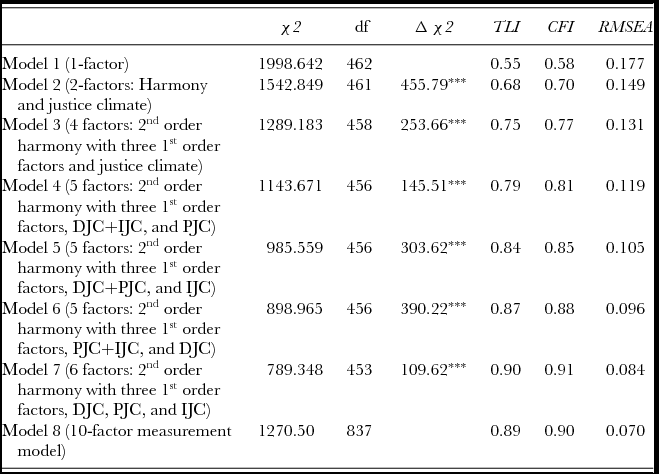
We first run the 10-factor measurement model that included the dependent variables of team performance and 2nd order OCB with its two 1st order sub-dimensions, 2nd order group harmony with its three 1st order sub-dimensions of positive affect, attribution of benign motives, and balancing, and three justice climate variables of DJC, PJC, and IJC. Modification indices indicated that covariance between the uniqueness (i.e., residual errors) in two pairs of items in the IJC scale and a pair of item in the team performance scale needed to be relaxed in the model. ‘Measurement residual covariances represent systematic rather than random measurement error in item responses’ and high degree of overlap in item content can increase residual covariances (Byrne, Reference Byrne2013). A closer look at the items indicated that although worded differently, these items highly overlap and essentially ask almost the same question (e.g., ‘treated group members in polite manner vs. with dignity’; ‘provided thorough vs. reasonable explanations regarding the procedures’, and ‘control costs vs. accomplish tasks within budget’). Consistent with the recommendations and practices in the field we therefore allowed covariation between their uniqueness (Byrne, Reference Byrne2013; Leung et al., Reference Leung, Brew, Zhang and Zhang2011). The CFA results indicate a good fit of the model (χ2 (720) = 1086.03, p = 0.00, n = 106, TLI = 0.89, CFI = 0.90, RMSEA = 0.07). All items loaded highly on their respective factors (between 0.82 and 0.95). The three 1st order factors also loaded highly on the 2nd order latent group harmony construct (positive affect = 0.88; attribution of benign motives = 0.90; balancing = 0.89).
Despite the time-lagged data collection method employed in this study because justice climates and group harmony are self-reports, there is a threat of common method variance (CMV). Moreover, although previous literature has established that justice variables are distinct constructs despite their high correlations (e.g., McFarlin & Sweeney, Reference McFarlin and Sweeney1992), we would like to demonstrate their distinctiveness in the current study. We first run a Harmon one-factor test (Model 1) where all justice and harmony indicators loaded on a single factor. If this single-factor model fits the data well this would indicate that common method is a serious issue for this study (Andrews & Kacmar, Reference Andrews and Kacmar2001; McFarlin & Sweeney, Reference McFarlin and Sweeney1992; Podsakoff & Organ, Reference Podsakoff and Organ1986). In Model 2, justice and harmony items were set to load on two distinct factors. In the third model (Model 3), harmony was included as a 2nd order construct with its three 1st order factors. Model 4–6 combined two justice climate scales in a single factor while leaving the third separate. The last model (Model 7) consisted of three separate justice factors and 2nd order harmony with three 1st order factors, as conceptualized in this study.
As can be seen from Table 1 the fit of the single-factor model was poor, indicating that common method bias did not have prevalent effect in this study (McFarlin & Sweeney, Reference McFarlin and Sweeney1992; Podsokoff & Organ, Reference Podsakoff and Organ1986). Moreover, the results indicated a substantial improvement in the chi-square, Tucker-Lewis Index (TLI), Comparative Fit Index (CFI), and root mean square error of approximation (RMSEA) of Model 7 over the other models which provided support that for this study justice climate variables and group harmony can be best understood as distinct yet related constructs.
Results of confirmatory factor analysis

Notes: DJC = Distributive justice climate; PJC = Procedural justice climate; IJC = Interactional justice climate.
Δχ2 are all significant at p < 0.001.
Although the Harmon one-factor test indicated that CMV was not a strong influence in this study, we further evaluated the possible effects of CMV by using a latent marker variable (Podsakoff, MacKenzie, & Podsakoff, Reference Podsakoff, MacKenzie and Podsakoff2012; Siemsen, Roth, & Oliveira, Reference Siemsen, Roth and Oliveira2010; Williams, Hartman, & Cavazotte, Reference Williams, Hartman and Cavazotte2010). We chose conflict avoidance, a behavioral tendency to avoid engagement in solving interpersonal conflicts (Rahim, Reference Rahim1983), as the marker variable. Leung and colleagues argued that ‘. . . if harmony is conceptualized as a desire to establish a long-term, mutually beneficial relationship, then it should promote the active handling of a conflict for arriving at a mutually acceptable settlement, not avoidance. . .’ and thus conflict avoidance reflects superficial rather than genuine harmony. (Leung, 1997; Leung et al., Reference Leung, Brew, Zhang and Zhang2011: 796). Consistently, previous research found no significant correlation between conflict avoidance and harmony enhancement (Leung et al., Reference Leung, Brew, Zhang and Zhang2011) or group harmony (Chen et al., Reference Chen, Ünal, Leung and Xin2016) and yet it was susceptible to CMV in this study (Williams et al., Reference Williams, Hartman and Cavazotte2010). Conflict avoidance was measured in six items (α = .84) developed by Rahim (Reference Rahim1983). We created a baseline model where the marker variable item loadings and error variances were fixed at values obtained from an initial CFA and the correlations between the substantive variables and the marker variable were forced to be zero. The chi-square difference between the baseline model and a constrained model that had additional factor loadings from the marker variable to each of the items in the model (Model-C) was not significant (χ2diff (1) = 0.01, ns), indicating that CMV was not present in this study. We also compared Model-C with a model where correlation between justice variables and harmony were fixed at values obtained in the Baseline Model. The nonsignificant chi-square test (χ2diff (6) = 0.00, ns) indicated that the CMV did not significantly bias the parameter estimates (Williams et al., Reference Williams, Hartman and Cavazotte2010).
Descriptive Statistics
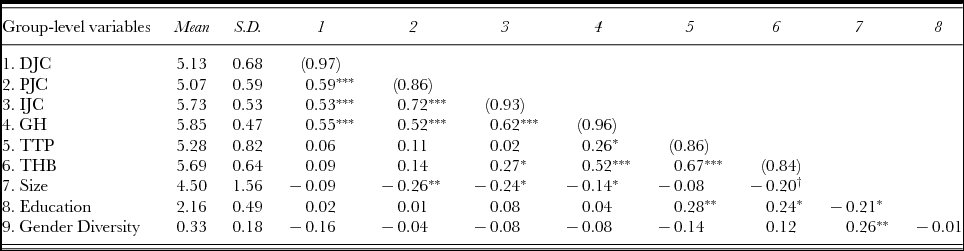
Group harmony was positively correlated with team task performance (r = 0.26, p < 0.05), group helping behavior (r = 0.52, p = 0.00), distributive justice climate (r = 0.55, p = 0.00), procedural justice climate (r = 0.52, p = 0.00) and interactional justice climate (r = 0.62, p = 0.00). The three justice climates were positively correlated with each other (r = 0.53 to 0.72). The means, standard deviations, coefficient alphas and correlations are presented in Table 2.
Means, standard deviations, coefficient alphas, and correlations

Notes: n = 106. Reliability coefficients (alphas) are on the diagonal. DJC = Distributive justice climate; PJC = Procedural justice climate; IJC = Interactional justice climate; GH = Group harmony; TTP = Team task performance; THB = Team helping behavior
† p < 0.10; * p < 0.05; ** p < 0.01; *** p < 0.001.
Tests of Hypotheses
We test the proposed model via structural equation models (SEMs) in Mplus version 8 (Muthén & Muthén, 2017). All controls were included in the models.
The effect of justice climates on harmony
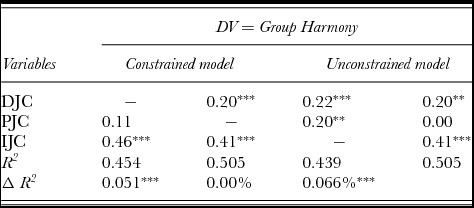
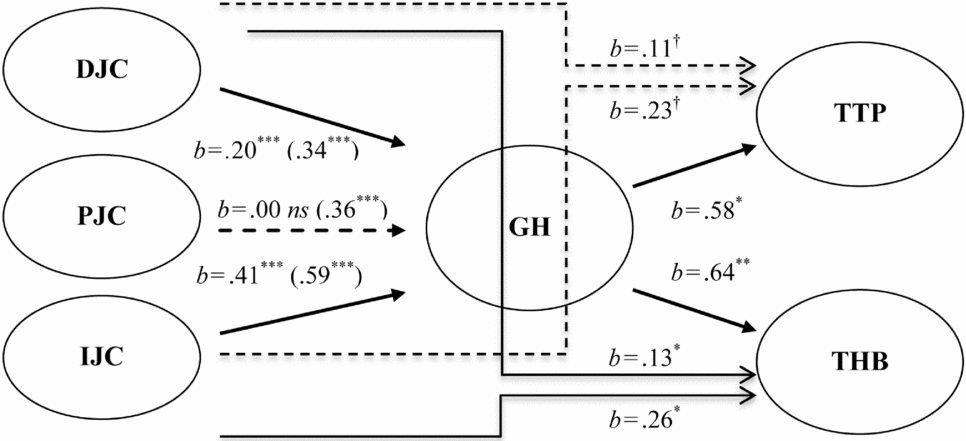
We performed three separate SEMs to test the effect of each justice climate on group harmony (Hypothesis 1). In each model we included only the path from one of the justice climate variables to harmony while setting the other two paths to zero. The results showed that distributive (b = 0.34, p = 0.00), procedural (b = 0.36, p = 0.00), and interactional justice climates (b = 0.59, p = 0.00) were all positively associated with group harmony when they were separately included in the SEM model. However, when all justice climates were included simultaneously as predictors of group harmony in the model DJC (b = 0.20, p = 0.00) and IJC (b = 0.41, p = 0.00) had significant positive effect on group harmony whereas PJC did not (b = 0.00, ns). These results supported Hypotheses 1a and 1c but not Hypothesis 1b.
Hypothesis 2 predicted that interactional justice to exert the strongest effect on group harmony whereas procedural justice climate to have the weakest effect. The above analysis provided preliminary evidence that PJC has the weakest effect on group harmony. To further explore the relative predictive power of three types of justice climates on group harmony, we freely estimated the paths from all three justice climate variables on harmony in the model and compared the regression R 2 of this unconstrained model with a constrained model where one of the paths from the three justice climates were set to zero. When added to the model after the other two justice climate variables, DJC explained 5.10% (b = 0.20, p < 0.01) and IJC explained 6.60% (b = 0.41, p = 0.00) additional variance whereas the effect of PJC did not reach significance (b = 0.00, ns). Results are presented in Table 3.
SEM results and incremental improvement in R 2 for three types of justice climates

Notes: n = 106 groups. b values are based on SEMs performed in Mplus
DJC = Distributive justice climate; PJC = Procedural justice climate; IJC = Interactional justice climate.
Controls are included in the regressions.
To determine whether the differences we found in the above regarding the effects of the three justice climates were statistically significant, we performed a series of chi square tests. The model where paths from the three justice climates to group harmony were freely estimated was used as the baseline model and compared with alternative nested models that included additional constraints. In a series of pairwise comparisons we set the path from two justice climates to group harmony to be equal (i.e., constrained model) and compared it with the baseline model. If the models differ significantly this would be an evidence that the two justice climate variables differentially predict group harmony, otherwise it would indicate the equivalence of effects. When the effect of DJC was compared with PJC and IJC (i.e., the paths are constrained to be equal vs. freely estimated) the chi square difference tests were not significant, indicating that the effect of DJC was neither significantly weaker than IJC nor stronger than PJC. However, the effect of IJC on group harmony was significantly stronger than PJC (χ2diff (1) = 4.27, p < 0.05).
The above analyses provided evidence that IJC explains more variance than PJC. However, because the results did not show a significant difference between IJC and DJC we conclude that Hypothesis 2 is only partially supported.
The results of SEM showed, as expected, that group harmony had a positive effect on team task performance (b = 0.58, p < 0.05) and group helping behavior (b = 0.64, p < 0.01), supporting Hypotheses 3a and 3b.
Mediating Effects of Group Harmony
We tested the indirect effects of justice climates on the dependent variables of team task performance and team helping behavior through group harmony by employing the recommended analytical procedures via Mplus (Preacher, Zyphur, & Zhang, Reference Preacher, Zyphur and Zhang2010; Zhao, Lynch, & Chen, Reference Zhao, Lynch and Chen2010).
Recall that significant direct relationships between three forms of justice climates and group harmony, as well as group harmony and task performance and group helping were found (Hypothesis 1 and 3). The analysis showed that none of the three justice climates had a direct effect on the outcome variables of task performance and team helping. However, DJC (b = 0.13, p < 0.05) and IJC (b = 0.26, p < 0.05) had a positive significant indirect effect on team helping behavior and a positive marginally significant effect on team task performance (b = 0.11, p < 0.10 for DJC; b = 0.23, p < 0.10 for IJC). Because the direct effects of DJC and IJC on helping were not significant, but the indirect effects were significant, we conclude that there is a significant indirect relationship between DJC and team helping behavior, and between IJC and team helping behavior, mediated by group harmony (Kenny et al., 1998; Preacher & Hayes, Reference Preacher and Hayes2004; Zhao et al., Reference Zhao, Lynch and Chen2010). Based on these results we concluded that Hypotheses 4a and 4c are partially supported, Hypotheses 5a and 5c are supported, whereas Hypotheses 4b and 5b are not supported. Summary of the findings is presented in Figure 1.
Summary of the findings

Test of the Reverse Causal Model
Although theoretically it is more reasonable to treat justice climate variables as antecedents of group harmony, it is also possible to argue for a reverse causal association between justice climates and group harmony, namely, that group harmony enhances justice climates, especially when data on group harmony were collected prior to data on justice climates.
To rule out this possibility we compared our hypothesized model (Three Justice climates → Group harmony → Team task performance & Team helping behavior) with a reverse causal model (Group harmony → Three Justice climates → Team task performance & Team helping behavior). Because these two models were non-nested we used Akaike's information criterion (AIC) and other model fit indices to evaluate the relative fit of the hypothesized model compared to alternative reverse causal model (Byrne, Reference Byrne2013) (i.e., smaller AIC values indicate better fit). The hypothesized model (χ2 (948) = 1428.43, p = 0.00, n = 106, TLI = 0.879, CFI = 0.889, RMSEA = 0.069, SRMR = 0.064, AIC = 6472.18) fit the data better than the alternative model (χ2 (951) = 1470.78, p = 0.00, n = 106, TLI = 0.870, CFI = 0.880, RMSEA = 0.072, SRMR = 0.082, AIC = 6508.222). In sum, we conclude that the hypothesized model represents the association between justice climate and group harmony better than the alternative reverse causal model.
DISCUSSION
Group harmony has been found to positively affect group innovative performance and group OCB in previous research. The current research sought to replicate the preliminary results of group harmony research. Furthermore, we extended the research to antecedents of group harmony. The results of our study are encouraging, as by and large our hypotheses have been supported. All three types of justice climates on their own were found to be positively associated group harmony. When co-present, however, DJC and IJC were significantly associated with group harmony, whereas procedural justice dropped out of significance. The effect of IJC on group harmony was also found to be stronger than that of procedural justice. Regarding its effects, group harmony was found to be positively associated with not only team task performance but also team helping.
Theoretical Implications
The current research made important contributions to research on group dynamics on one hand and organizational justice on the other. Regarding group harmony, having been totally neglected in Western organization and management research, our research has demonstrated its powerful role as a key determinant of group-level in-role and extra-role performance. Furthermore, our research has demonstrated group harmony as a key mediator through which other organizational and managerial factors influence group effectiveness. Although exerting no direct effects on team performance and helping behavior, various justice climates nevertheless positively contributed to these group outcomes through their impact on group harmony. Our research on group harmony therefore fills a serious gap and opens up new research regarding the role of intragroup social relationships.
The positive effect of justice climates on group harmony highlights the important role of organizational practices and leadership behaviors in creating fair climates that foster harmonious relationships among upper level managers and other work teams in organizations. For instance, fair allocation of organizational resources and respectful treatment of employees are important leader and organizational factors that can facilitate high quality relationships in management and other teams in organizations. Our research also contributes to justice climate research. First, we added to the emerging research on how justice climates affect group-level processes and outcomes. Second, while preliminary, our results shed light on the differential effects of different types of justice climates on group harmony, team performance, and team helping. Results indicate that management teams from Chinese organizations are most sensitive to interactional justice by the team leader, which is consistent with Chinese culture's emphasis on personalized relationship (or guanxi) (Chen et al., Reference Chen, Chen and Huang2013). It suggests that Chinese organizations still rely more on personal leadership skills than institutional procedures in regulating social relationships. For this reason we expect that the results of this study would generalize into groups and teams at lower organizational levels.
The effect of DJC is intriguing. Although it explained 6.80% more variance than procedural justice, the difference was not statistically significant (neither was the effect of DJC significantly different than the 7.80% explained by IJC). One possible reason for the insignificance was that our sample size did not provide enough statistical power. The other was that the upper level managers in the current study were generally paid well and thus were more concerned about respectful treatment than pay. If that is the case it is possible that issues of pay would be more salient for groups at lower organizational level, making issues of distributive justice more salient and impactful. Future research could test this possibility on work groups composed of middle and lower level employees. In any case, the findings of the current research point to the need for a more fine-grained theory about the relative importance of different types of justice and justice climates in affecting group processes and outcomes in Chinese organizations.
Practical Implications
Research on group harmony, its antecedents, and outcomes has important practical implications. The prominent role of interactional justice climate suggests that leadership and interpersonal skills are key in promoting group harmony in Chinese organizations. Chinese managers need to realize IJC requires respectful treatment of all team members as opposed to differential personal guanxi with some members. Differential guanxi is likely to generate resentment and animosity among group members thereby reducing group harmony. When IJC is strong in a group it may enhance the effect of DJC and PJC or compensate for the lack of them. Nevertheless, interactional justice has its downsides in that overreliance on it may impede the development of PJC or DJC. In the long run, as China and Chinese organizations are moving toward the rule of law, concerted efforts are needed to promote procedural justice to sustain long-term group harmony and unleash the talent of teams and individuals.
Limitations and Future Research Directions
This study has some limitations. First, as acknowledged in the Methods section, although a three-wave procedure was more appropriate for testing the mediating relationships, out of concern for attrition of participating managers, we employed a two-wave time-lagged procedure for data collection. Further, we measured group harmony in Wave 1 and both the antecedent and outcome variables together in Wave 2. Although this procedure separated group harmony from both its antecedents and outcomes, it did not place antecedents (justice climates) before the mediator (group harmony). Therefore, our procedure was appropriate for testing the effects of group harmony, however, it raises questions regarding reverse causality between justice climates and group harmony. We addressed this issue in two ways. Theoretically we contend that justice climates are relatively stable and that justice climates are more likely to be the antecedents of group harmony than vice versa. Empirically, we conducted analyses comparing the hypothesized model (Three Justice climates → Group harmony → Team task performance & Team helping behavior) with the alternative reverse causal model (Group harmony → Three Justice climates → Team task performance & Team helping behavior). The results supported the theoretical contention that justice climates are more likely to be the antecedents of group harmony as opposed to the other way around. These conceptual and statistical steps, while somewhat reducing the concern for reverse causality, are limited in ruling it out. Future studies could address this issue by measuring justice climates prior to group harmony with a time-lagged design, by splitting groups to report antecedents and group harmony, and or by experiments to establish the causal effect of justice climates.
The second limitation of the study lies in measuring justice climates and group harmony through the perceptions of the respondents, which raises concerns about common method variance (CMV). The Harmon one-factor and latent marker variable tests showed that CMV was not a significant factor and did not seem to have biased the findings. Thirdly, group leaders subjectively evaluated the team task performance. Objective performance measures would be more desirable. Lastly, the findings about the relative importance of the three types of justice may be unique to upper-level managerial teams or due to the Chinese social and cultural contexts. Work teams at different organizational levels and with greater demographic heterogeneity in Western as well as Chinese organizations may present opportunities and challenges for generalizing our findings.
In view of the above limitations, replication studies are greatly needed to further test the validity of group harmony and its relationship with justice climates on one hand and team performance on the other. Even more importantly, exploring other antecedents of group harmony and their contingent factors can make meaningful contributions. For example group demographic diversity in terms of ethnicity, gender, and age, or personal incongruence may initially have a negative effect on group harmony but such negative effect may be moderated by shared goals, values, and collective visions of the group members as well as group interdependence. Interestingly, although group harmony is the focal construct in the present study and our objective is to understand its antecedents and consequences, it could be fruitful to study group harmony as a moderating variable in the group dynamics research. As an ambient group construct, group harmony could be an important social (contextual) factor that influences the relationships among group-level constructs, between the group and the organization, and the group and the individual members. For instance, the level of group harmony may reduce the negative effects of some dimensions of group diversity on group processes (e.g., task conflict) and outcomes (group learning and OCB).
CONCLUSION
As one of the first studies that explore antecedents and consequences of group harmony, we found that although each type of justice climate was positively associated with group harmony on its own, when all three types were simultaneously present, procedural justice climate had the weakest effect on upper-level management team group harmony in Chinese business organizations. Moreover, group harmony had a positive effect on team task performance and team helping behavior. The research has important theoretical and practical implications regarding group effectiveness on one hand and organizational justice on the other.