


Introduction
Until recently, the Ottoman jurist, theologian, mystic and pietist Aḥmad al-Rūmī al-Āqḥiṣārī (d. 1040/1631) was virtually unknown to the academic community. He was first introduced by Y. Michot, whose critical edition and translation of the Risāleh-i dukhāniyyeh (Epistle on Tobacco) Footnote 1 brought to light al-Āqhiṣārī's rigorist, pietistic approach to religion and his expertise in jurisprudence. Why a scholar of such standing has been ignored in Ottoman studies is intriguing. In al-Āqḥiṣārī's case, what probably decided his fate was the association of his ideas with the Qāḍīzādelis, a group of scholars and activists who, by the 17th century, had gained notoriety in Ottoman Turkey for their ultra-conservative approach to Islam. They enjoyed significant influence in the first half of the 17th century in the imperial capital, Istanbul, and through their royal patrons they were able to impose on Ottoman society their programme of religious reform.
The Qāḍīzādelis remain an understudied phenomenon in Ottoman history. Other than Madeline Zilfi's published volume, and three unpublished doctoral theses, there are to date few detailed studies available on the movement.Footnote 2 Most surveys tend to repeat views on the Qāḍīzādelis found in Ottoman accounts written by bourgeois eye-witnesses. Contemporaneous accounts largely held the group to be an unsophisticated mob of pietists who were arrogant and power hungry. This same trope is found in modern studies with little modification. In the main, Qāḍīzādeli doctrines continue to be presented as obscurantist and the movement is seen as either proto-fundamentalist or proto-Wahhābī.Footnote 3 I have challenged such representations of the Qāḍīzādelis elsewhere, primarily by a close reading of texts associated with the movement.Footnote 4 The present paper focuses on another concern, namely the intellectual origins of the Qāḍīzādeli position on innovation (bidʿa).
Aḥmad al-Rūmī al-Āqḥiṣārī's Majālis al-abrār wa masālik al-akhyār wa maḥāyiq al-bidaʿ wa maqāmiʿ al-ashrār (The Assemblies of the Pious and the Paths of the Excellent, The Obliteration of Innovations and the Curbing of the Wicked), a commentary on one hundred ḥadīths collected in Maṣābīḥ al-Sunna (The Lamps of the Tradition) of Abū Muḥammad Ḥuṣayn b. Masʿūd al-Baghawī (d. 515/1122)Footnote 5 , is an ideal point of departure for such an inquiry. A veritable manifesto for religious reform, the author aimed to bring the religious doctrines and ritual practices of his fellow Ottomans into line with a specific understanding of orthodoxy shared by him and his Qāḍīzādeli comrades. The text sheds light on why the reformers were so zealous in their opposition to innovation. Perhaps more interestingly, the text also betrays the historical influences upon its author, notably that of Taqī al-Dīn Aḥmad b. Taymiyya (d. 728/1328), a link which has been ardently disavowed by some in Ibn Taymiyya studies.Footnote 6
The Man and the Text
Despite the large number of works which al-Āqḥiṣārī authored, the impressive number of copies of these still extant in manuscript form and the high regard with which the Majālis al-abrār was held by 19th century Indian revivalists of Deoband such as Muftī Kifāyatullāh Dehlawī (d. 1371/1952),Footnote 7 we know surprisingly little about his life. Al-Āqḥiṣārī was born in Cyprus to a Christian family before being taken away as a child after the Ottoman conquest of the island between 977/1570–981/1573 and converted to Islam.Footnote 8 Initially sent to join the Devşirme for a religious education, al-Āqḥiṣārī went on to become a Ḥanafī scholar, gaining fluency in Arabic, Turkish and Persian. Al-Āqḥiṣārī spent most of his life, once having arrived on mainland Turkey, in Āqḥiṣār, Western Anatolia. Unfortunately, apart from these meagre details, we know little else about this Ottoman scholar; it is for good reason, therefore, that he has been described as “the forgotten puritan of Ottoman Islam”.Footnote 9
Y. Michot has urged that al-Āqḥiṣārī be read in the context of the reformist milieu of his time. This is since al-Aqḥiṣārī's oeuvre, particularly his writings on Sufism, clearly bears the mark of Ibn Qayyim al-Jawziyya (d. 751/1350) and, to a lesser extent, though no less significantly, Aḥmad b. Taymiyya (d. 728/1328). Al-Āqḥiṣārī can be located therefore in the company of other Ottoman revivalists such as Birgivī and Qāḍīzāḍe whose works also bear the same mark. Furthermore, as Michot has shown, there is a strikingly large collection of manuscripts in which the texts of Birgivī's Vasiyyet-Nāmeh, the Epistle - Risāleh of Qāḍīzāde Meḥmed (d. 1145/1635) and al-Āqḥiṣārī's Creed - Risāleh fī l-ʿaqā’id (or Risāleh, or Vasiyyet-Nāmeh) are bound together, as a sacred trilogy. This suggests that in the minds of some, the religious weltanschauungen of these three scholars were both convergent and of equal import.Footnote 10 Michot is of the view – one supported by this author – that if introduced to the academic community, al-Āqḥiṣārī's Majālis and other works could reveal much about puritanical reform in the Ottoman 17th century and shed light on the dynamics of Muslim revivalism in other parts of the Islamic world.Footnote 11
Majālis al-abrār is al-Āqḥiṣārī's magnum opus and subsumes many of the questions and interests which he treats in shorter epistles. The text was probably composed during the years immediately preceding, or corresponding to, the Ottoman imperial ban on tobacco, proclaimed by Murād IV after the great fire of Istanbul in 1043/1633 and certainly no earlier than 1025/1616. This conclusion is based on the fact that the Majālis draws heavily from Kitāb naṣīḥat al-ikhwān bi-ijtināb al-dukhān – The Book Recommending to the Brothers to Keep Away from Tobacco, a treatise authored by the Mālikī shaykh Ibrāhīm al-Laqānī (d. 1041/1631) in 1025/1616.Footnote 12
A Scholastic in the Ḥanafī-Māturīdī Tradition
Al-Āqḥiṣārī's fundamental doctrinal outlook, in keeping with most members of the Ottoman learned establishment, was consistent with the Māturīdī school.Footnote 13 In the first three chapters of the Majālis, he states the importance of correct doctrine as a precursor to embarking upon the spiritual path. It is in these chapters that he cites several classical kalām-theological arguments to prove central Islamic dogmata. His Risāleh, which is primarily concerned with doctrinal questions, also betrays a fundamentally Māturīdī theological framework.Footnote 14
In the second session of the Majālis, al-Āqḥiṣārī is forthright about his view on the place of kalām within Islamic epistemology as well as its utility for travellers on the spiritual path:
The path to knowing God, the Exalted, is reached via two routes: the first is the route of the People of Reason and Argumentation (Ahl al-naẓar wa l-istidlāl) and the second is the route of the People of Spiritual Exercise and Exertion (Ahl al-riyāḍa wa l-mujāhada). As for those travelling on the route of the People of Reason and Argumentation, when they hold to a religion (milla) from the religions of the Prophets then they are [to be considered] dialecticians (mutakallimūn). If not, then they are [to be considered] peripatetic philosophers (ḥukamāʾ mashshā’ūn). [The latter group] are not [considered to be] from the people of religion. As for those travelling on the path of riyāḍa and mujāhada, if their spiritual exertion is in agreement with the Sharīʿa, then they are the [to be considered] law-abiding Sufis (al-Ṣufiyyat al-mutasharriʿūn); if not, then they are [to be considered] Illuminationist Philosophers (Ḥukamā’ Ishtirāqiyyūn), who are a group from among the Philosophers who have chosen the method of Plato vis-a-vis intuition (kashf) and contemplation (ʿiyān). They are also not from the people of religion.
This said, each path is made up of two groups. Those believers (al-muʾmin) who know God (al-ʿārif bi-llāh), are only two from these groups: the first are People of Reason and Argumentation and the second are the People of Witness and Contemplation (Ahl al-Mushāhada wa l-ʿiyān). This is since if their knowledge of Him, the Exalted, is obviated by way of rational proofs (dalīl ʿaqlī) and revealed proofs (dalīl naqlī), then they are from the people of external knowledge and demonstration (ahl al-ʿilm al-ẓāhir wa l-burhān); if their knowledge of Him, the Exalted, is by way of witnessing with inner-sight (ʿayn al-baṣīra), then they are from the people of internal knowledge and contemplation. The attainment (ḥāṣil) of the first path is the perfection of speculative power (quwwa naẓariyya) and ascension through its stations; the attainment of the second path is the perfection of practical power (quwwa ʿamaliyya) and ascension through its levels. This is the real miracle (karāma ḥaqīqiyya) which manifests at the hands of the Friends of God (walī Allāh).Footnote 15
Kalām is therefore considered by al-Āqḥiṣārī one of only two authentic and acceptable paths to gnosis. Elsewhere in the Majālis, he speaks about the need for the science of kalām to “establish and defend the correct creed (al-iʿtiqād al-ṣaḥīḥ), differentiating it from heretical beliefs”.Footnote 16 Though he accepts one who has arrived at a belief in God through blind acceptance (taqlīd) as a believer (muʾmin), he warns that ignorance of the proofs of the mutakallimūn, which have been formulated to prove the validity of set dogmata (masāʾil iʿtiqādiyya), is a sin.Footnote 17 He takes this view to an extreme when he asserts in his Risāla fi l-taqlīd that, “[Such a person] is left to the will of God: if He wishes, he will forgive him and cause him to enter Heaven without punishment; if He wishes, however, He will punish him in a measure commensurate with the sin, after which he will cause him to enter Heaven”.Footnote 18
On questions relating to jurisprudence, al-Āqḥiṣārī cites many of the best-known Ḥanafī jurisprudential treatises, commentaries and glosses, such as al-Hidāya of Burhān al-Dīn al-Marghinānī (6th/12th c.)Footnote 19 and the Ikhtiyār of ʿAbd Allāh b. Maḥmūd b. Mawdūd al-Mawṣilī (d. 683/1284).Footnote 20 Sporadically, he cites the positions of other schools but this is when he wishes to highlight the agreement between other schools and his own on the legal opinions in question or because he disagrees with the position adopted by the Ḥanafī school. But it is on the question of religious innovation, bidʿa, that al-Āqḥiṣārī makes his most striking use of foreign schools, drawing in particular from the works of Ibn Taymiyya, Ḥanbalī jurist, and Ibn al-Ḥājj and al-Ṭurṭūshī, two representatives of the Mālikī school.
The Majālis and the Anti-Bidʿa Literature
Al-Āqḥiṣārī's Majālis al-abrār should be seen as both a work which stands within a long tradition of writings on bidʿa and one of several texts from the 16th and 17th centuries connected with the Qāḍīzādeli movement.Footnote 21 Among Ottoman contributors to the anti-bidʿa literature was Birgivī, who presented his conceptualisation in al-Ṭarīqat al-muḥammadiyya and Qāḍīzāde, who wrote Qāmiʿat al-bidʿa Nāṣirat al-Sunna Dāmighāt al-mubtadaʿa Footnote 22 and the Risāleh.Footnote 23 The latter also wrote a chapter on the subject in his Irshād al-ʿuqūl.Footnote 24 Works within this tradition are known as the ‘treatises against innovation’ (kutub al-bidaʿ), a genre which became independent of the ḥadīth literature as early as the 3rd Islamic century.Footnote 25 In order to locate al-Āqḥiṣārī more precisely within this tradition and in order to identify his intellectual source, it is useful to begin with a survey of the variant ways in which the term bidʿa has been categorised. This is since al-Āqḥiṣārī, rather unusually for a scholar of his time, did not see any justification for a typology of bidʿa.
Writing on bidʿa can be found in several Islamic literary genres including jurisprudence (fiqh), heresiography (al-milal wa l-niḥal), the professions of faith (ʿaqāʾid), treatises on “enjoining public good” (ḥisba) and fatwa collections. The following are some of the most well-known works on the subject:
-
1) The Mālikī Abū ʿAbd Allāh Muḥammad b. Waḍḍāḥ al-Qurṭubī (d. 286/900), Kitāb al-bidaʿ;
-
2) The Mālikī Abū Bakr Muḥammad b. al-Walīd b. Randaqa al-Ṭurṭūshī (d. 519/1126), Kitāb al-ḥawādith wa-l-bidaʿ;
-
3) The Ḥanbalī Abū l-Faraj ʿAbd al-Raḥmān b. ʿAlī Ibn al-Jawzī (d. 596/1200), Talbīs Iblīs;
-
4) The Ḥanbalī Abū ʿAbd Allāh Muḥammad b. ʿAbd al-Wāḥid al-Maqdisī (d. 642/1245), Ittibāʿ al-sunan wa ijtināb al-bidaʿ;
-
5) The Shāfiʿī Abū Shāma, Ab l-Qāsim ʿAbd al-Raḥmān b. Ismāʿīl (d. c. 666/1268);
-
6) The Ḥanbalī Aḥmād b. Taymiyya (d. 728/1328), Kitāb iqtiḍāʾ al-Ṣirāṭ al-mustaqīm, mukhālafat aṣḥāb al-jaḥīm;
-
7) The Mālikī Abū ʿAbd Allāh Muḥammad b. Muḥammad Ibn al-Ḥājj al-ʿAbdarī al-Fāsī (d. 736/1336);
-
8) The Mālikī Abū Isḥāq Ibrāhīm b. Mūsā al-Lakhmī al-Shāṭibī (d. 789/1388), Kitāb al-Iʿtiṣām;
-
9) The Ḥanafī Ṣāfī l-Dīn Idrīs b. Baydakīn b. ʿAbd Allāh al-Turkmānī (8th-9th/14th-15th century), al-Lumaʿ fi-l-ḥawādith wa-l-bidaʿ;
-
10) The Mālikī Abū l-‘Abbās Aḥmad b. Aḥmad al-Burnūsī Zarrūq al-Fāsī (d. 899/1494), ʿUddat al-murīd al-ṣādiq/al-Bidaʿ wa-l-ḥawādith;
-
11) The Shāfiʿī Abū l-Faḍl ʿAbd al-Raḥmān b. Abū Bakr al-Suyūṭī (d. 910/1505), al-Amr bi-l-ittibāʿ wa-l-nahy ʿan al-ibtidāʿ.Footnote 26
All of the above mentioned works, with the important exceptions of the Talbīs and the Iqtiḍāʾ, divide bidʿa into at least two types. The following table, reproduced from V. Rispler with several additions of my own, shows the various ways that scholars have classified bidʿa.Footnote 27
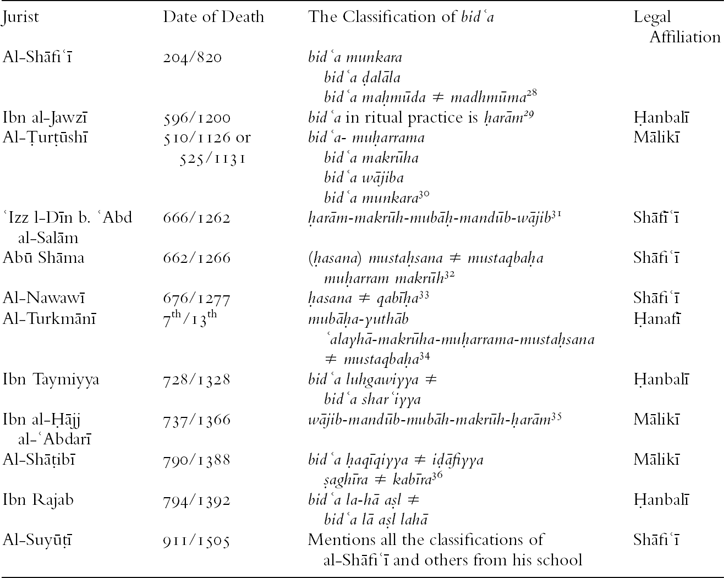
Al-Shāfiʿī is widely considered to be the first Muslim scholar to have written a complete treatise on uṣūl al-fiqh Footnote 37 and is also likely to have been the earliest to formulate a justification for dividing bidʿa into two types – the objectionable (madhmūm) and the unobjectionable (ghayr madhmūm).Footnote 38 Others considered bidʿa to be of more categories than two, for example the Shāfiʿī jurist al-ʿIzz b. ʿAbd al-Salām (d. 660/1262),Footnote 39 who formulated a five-fold typology replicating the better-known five-fold typology of legal norms.Footnote 40 Ibn ‘Abd al-Salām's typology was accepted widely by later Shāfiʿī jurists as well as by scholars of other madhhabs, such as the Ḥanafī jurist al-Turkmānī.Footnote 41
Ibn al-Jawzī and Ibn Taymiyya, both Ḥanbalī jurists, completely rejected the notion that bidʿa in matters of religion might be conceived of positively. This said, and despite the influence that these two scholars had on the Ḥanbalī school,Footnote 42 they did not represent the Ḥanbalī school in toto as has been claimed.Footnote 43 Ibn Rajab (d. 794/1392) is one such Ḥanbalī theologian who adopted an alternative position, made clear in his Jāmiʿ al-ʿulūm wa l-ḥikam, a commentary on al-Nawawī's compilation of forty ḥadīth. For Ibn Rajab, newly invented religious practices are acceptable with the proviso that they have a “basis” (aṣl) in religion: “The ḥadīth [whoever invents something in our affair which is not from it, it shall be shall be rejected] makes an explicit (manṭūq) statement, namely that every [innovative] action which is not validated by the Law (sharʿ) is rejected; [there] is an implicit (mafhūm) statement, namely that every [innovative] action which does have a source (aṣl) in the religion is not rejected”.Footnote 44 The truth is that the positions of Ibn al-Jawzī and Ibn Taymiyya on bidʿa were radically different to most, if not all, jurists and theologians of the classical period.
Theoretical Dimensions of the Bidʿa Debate
Too often the philosophical underpinnings of the anti-bidʿa position are overlooked in the scholarly literature. Yet an inquiry into this is central to understanding how Muslim jurists employ the term in legal discourse. The assumption that bidʿa in Muslim jurisprudential usage encompasses all kinds of innovation, both religious and customary, finds no correspondence in the legal literature.Footnote 45 Furthermore, various hypotheses have been put forward to explain the preoccupation that jurists had with bidʿa. These include the desire to monopolise the transmission of sacred knowledge, the protection of the authority of the ʿulamāʾ and the deep fear of the widespread public transmission of the word of God.Footnote 46 Though these may account for some instances, they cannot do so for all since clearly not every scholar was motivated by shrewd political motivations.
Perhaps the most useful source to ascertain a more nuanced understanding of the anti-bidʿa position is Iqtidāʾ al-ṣirāṭ al-mustaqīm (Adhering to the Straight Path) of Ibn Taymiyya. Written by a scholar unsurpassed in his ability to articulate the theological bases underpinning the prohibition of “inventing religion”, the Iqtidāʾ fits neatly within the anti-bidʿa corpus. This said, it is clearly distinguished by the analytical depth to which its author probed the subject. M. Umar Memon says,
What is remarkable is that in the scaffolding of this theoretical structure Ibn Taymiyya strained all the resources of his imaginative mind. He not only employed the traditional sources of knowledge such as the Koran and Sunna but also fully exploited another less orthodox avenue of cognizance, viz., logic, reason. More than once he ingeniously shows how these practices, and arguments upholding them, cannot be sustained in the light of reason.Footnote 47
Memon does not elaborate upon his observation lending the opportunity here to reflect on the arguments proffered by Ibn Taymiyya to justify his condemnation of bidʿa and, by extension, an opportunity to speculate on why later scholar-activists such as al-Āqḥiṣārī had such reverence for Ibn Taymiyya's work.
Ibn Taymiyya opined that people invent ritual practices and participate in them because they are incapable of finding spiritual contentment in adhering solely to the Qur’ān and the Sunna, and/or because they are too arrogant to submit themselves to the divine command.Footnote 48 For Ibn Taymiyya, it is a malady of the heart that steers a person to innovate in religion. He explains this in terms of the three social classes: amīrs, ʿulamāʾ and the simple-pious. Each is driven to inaugurate newly invented religious practices because of their own failure to adhere to the precepts of the divine law. The innovations of the amīrs include the “cruel laws” which they promulgate, such as the non-Sharʿī fines and taxes; these stem from their neglect to “enjoin the good and forbid the evil”. If they demanded only what was legally sanctioned and, thereafter, distributed it in accordance with divine law, seeking thereby to consolidate God's religion rather than themselves – if they exacted punishments on the elite as well as the less fortunate, seeking to instil in people thereby a mindful awareness of God – they would have had no need to expropriate the wealth of their people.Footnote 49 As for the ʿulamāʾ, had they adhered to the Qur’an and the Sunna, they would have found all that they need of useful knowledge. They would not have fallen into the errors of the theologians or the speculations of the jurists, each of whom are led from one unreliable judgment to another.Footnote 50 As for the simple-pious, had they worshipped their Lord through the words and deeds which He revealed to them, they would have reached the spiritual stations to which they aspire. They would not have been compelled to replace the recitation of the Qur’ān with listening to musical instruments or to substitute Prophetic invocations with invented litanies.Footnote 51
Ibn Taymiyya accepted that some of those who indulge in innovated religious practices can experience spiritual benefits. He saw this as inevitable because, for him, every innovation is an extension of a valid religious practice, such as meditation, fasting or prayer. Some innovations may even result from erroneous juristic interpretations (ijtihād) of Scripture. According to Ibn Taymiyya, people who innovate in religion because of an ijtihād will be rewarded for those aspects of the new act that have a legally valid foundation and forgiven for those elements which might be considered in the strict sense bidʿa.Footnote 52 Lest he be accused of sanctioning the invention of religion, Ibn Taymiyya remarks that the “good” elements that make up any act that is bidʿa are outweighed by the “evil” elements (al-ithm akbar min al-naf‘)Footnote 53 ; any act in which the evil is preponderant over the good is ipso facto prohibited by the Sharīʿa. Assessment of the harms and benefits of any single act requires a perceptive mind and a solid foundation in religious knowledge; as such, the masses are entreated by Ibn Taymiyya to cling stubbornly to the Qur’an and the Sunna rather than draw close to bidʿa.Footnote 54
Ibn Taymiyya puts forward interesting rational arguments alongside scriptural proofs to support his view that innovations are harmful. Some of these are applicable to all innovations, others are more specific. He points out that innovations are “derivates of disbelief” (mushtaqq min al-kufr): each one in some way directs people away from the worship of God alone and from following the Sunna.Footnote 55 Every newly invented religious practice supplants a sanctioned rite of worship. If bidʿa is allowed to proliferate without curtailment, the result will be the complete corruption and distortion of Islam which, according to Ibn Taymiyya, has been the fate of Christianity and Judaism.Footnote 56
Since many religious practices which are considered bidʿa are not pure inventions but often the adaptation and integration of foreign rites into Islam, Ibn Taymiyya occupies himself in the Iqtidāʾ with the concept of assimilation and imitation (al-tashabbuh wa l-taqlīd). He opines that the idea of dissimilarity or differentiation of the believer from the non-believer is one of the central objectives of revelation. This rationalisation is unique in Muslim jurisprudential theory. In the following passage Ibn Taymiyya explains the theoretical basis for one of the most controversial debates in Islamic law:
It is in accordance with wisdom that God legislated for the Prophet such deeds and tenets as would clearly differ from those of the God-displeasing and gone-astray. He enjoined the Prophet to differ from them in his way of life, even though to many their harm was not evident, and that for a number of reasons some of which are:
-
1. Participation in conduct breeds homogeneity and resemblance in the participants, which leads to accord in morals and deeds. And this is evident. Thus, for instance, one who dons himself in the vesture of the learned feels a certain affinity with them, or, for instance, one who wears the outfit of the fighting soldiers finds in himself an affinity with the latter's character, and unless an obstacle comes in his way his nature conforms to that character.
-
2. Difference in conduct brings out dissimilarity and separation which has the effect of fending off divine wrath and prevents going astray. Conversely, it would incline man towards those who enjoy divine guidance and pleasure. Thus, indeed, the God-drawn difference will stand out clearly between His host of those in bliss and His unhappy enemies. The more man's inner life is perfect and the more he understands Islam, true Islam – not mere outward parading as a Muslim, nor blindly following mere traditional beliefs as a whole – the greater is his urge to differ both internally and externally from the Jews and Christians, and the stronger is his urge to keep his distance from their characteristics.
-
3. Finally, a common way of life promotes social interaction to an extent that distinction between the right-guided on the one hand and the God-displeasing and gone-astray on the other vanishes. There may be further reasons involved in divine wisdom.Footnote 57
It can be seen clearly that in Ibn Taymiyya's estimation bidʿa is a corrupting force that threatens the very foundations of Islam. This deeper philosophical appraisal of bidʿa can also be found in the works of the Ottoman reformers, particularly Birgivī and al-Āqḥiṣārī. For the former, the root cause of dogmatic heresies and innovations in religious practice is the attempt to satisfy egoistical desire;Footnote 58 this is clearly taymiyyan. In the Iqtidā’, Ibn Taymiyya describes the arrogance of those who struggle to subjugate themselves to the precepts of the Qur’an and the Sunna, as well as the spiritual weakness in people, which ultimately hinders them from finding contentment in the religion delivered by the Prophet. Akin to Ibn Taymiyya, Birgivī considers that the evil of abandoning a legally established ritual is less destructive to one's religion than the evil which accompanies the invention of new ritual practices. This is since a proliferation of the latter ultimately results in the corruption of the religion.Footnote 59
In al-Āqḥiṣārī's view, the innovator (mubtadiʿ) has a problem: his failure to recognise the perfection of the religion delivered by the Prophet. This failure drives him to inaugurate new practices, in the belief that Islam is yet incomplete:
Bidʿa is more evil than sinning since the person who enacts a bidʿa considers that the Prophet has been somehow deficient, though he may claim that he is extolling the Prophet by enacting it. This is since he claims that the bidʿa he has inaugurated is better than the Sunna and more correct. He challenges God and His Messenger by deeming good that which the Law (sharʿ) despises and prohibits, namely the invention of religion. God has legislated for His worshippers acts of worship which are sufficient for them and has perfected for them their religion, completing His favour upon them. He informs in His noble Book: “This day I have perfected your religion for you, completing My favour upon you”. Hence [the maxim], “augmenting the already perfected [renders it] deficient”. To do so is tantamount to having an extra finger. It is an established matter in legal theory (ʿilm al-uṣūl) that the righteous deed is known from the evil deed by recourse to the Law rather than to the intellect.Footnote 60
In this passage al-Āqḥiṣārī reiterates the idea that innovation is more harmful than open disobedience: the first eventually becomes integrated within the religion through habit and custom whereas the second remains a sin and therefore an act which people will seek to abandon eventually. These are yet again Taymiyyan ideas that are not original to al-Āqḥiṣārī.
Taymiyyan Influences in the Majālis
Ibn Taymiyya is far more thorough in his treatment of bidʿa than Ibn al-Jawzī. He is, in general, much more interested in treating the effects of innovation, and goes some way to describing specific forms which they can take. He speaks of bidʿa in almost every major piece of writing; even a cursory database search for the term in the Majmūʿ al-fatāwā is indicative of this – the number of separate occurrences exceed two-hundred and thirty.Footnote 61 The two key works of Ibn Taymiyya on bidʿa, which he himself made frequent reference to throughout his writings, are the Iqtiḍāʾ ṣirāṭ al-mustaqīm (Adhering to the Straight Path) and Qā‘idat al-sunna wa l-bidʿa (The Formula [Distinguishing] the Sunna from Innovation).Footnote 62 It is in the first of these treatises where one is confronted with a very interesting continuum of ideas linking the Anatolian al-Āqḥiṣārī to Ibn Taymiyya.
A comparison of the Iqtidāʾ with the survey of bidʿa found in the eighteenth Majlis leaves little room for doubt that Ibn Taymiyya is al-Āqḥiṣārī's chief source. The following pages will demonstrate where al-Āqḥiṣārī draws from Ibn Taymiyya, whether verbatim or in paraphrase. The excerpts selected are polemical in nature, largely responses to a would-be opponent claiming that customary religious practices should be deemed virtuous innovations when they receive popular acceptance. Ibn Taymiyya and al-Āqḥiṣārī reject the idea that popular acceptance is a benchmark for what is sound or unsound religious practice. Their counter-arguments begin with the same two Prophetic traditions:
“To proceed: indeed the best of speech is the Book of God, the Exalted, and the best of guidance is the guidance of Muḥammad and the worst of affairs are its inventions: every invention is an innovation, and every innovation is a misguidance”. This tradition [of the Prophet], reported in the authenticated [hadīths] of the Maṣābīḥ, was narrated by Jābir, God be pleased with him. In another tradition, narrated by ʿIrbāḍ b. Sāriya, [the Prophet], upon him be peace, said, “Whoever amongst you lives after me shall see much discord; so you should cling to my way and the way of the Rightly-guided caliphs. Cling to it and hold on to it with your molars. Beware of matters invented, since every invention is an innovation, and every innovation is a misguidance”.Footnote 63
Both scholars are keen that the ḥadīths which apparently prohibit the invention of new religious practices supersede conflicting prophetic traditions which appear to support religious innovations.Footnote 64 The principal argument advanced by both scholars, included in the inter-textual comparison below, may be summarised as follows: if there is to be gained any benefit from newly invented religious practices, then their utility must be attested to by the Qur’an or the Sunna. When there is a supporting proof from these sources, then the innovation has a legal basis which justifies it; in such a case it is superfluous to treat it as a religious innovation as it is already conceived of in the Qur’an and the Sunna. In this way, Ibn Taymiyya and al-Āqḥiṣārī hope to protect the ḥadiths which prohibit innovations. Below Ibn Taymiyya's Iqtidā‘ is presented on the left and al-Āqḥiṣārī's Majālis on the opposite side. The Arabic text precedes the English translation.
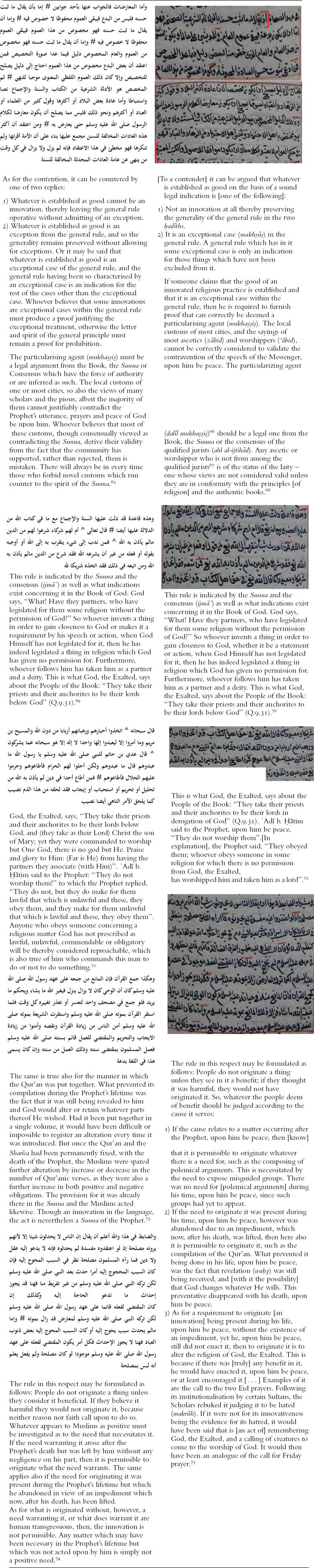
Footnote 65, Footnote 66, Footnote 67, Footnote 68, Footnote 69, Footnote 70, Footnote 71, Footnote 72, Footnote 73, Footnote 74, Footnote 75
The correlation between the two works above is striking but it would be premature to conclude that al-Āqḥiṣārī's source is Ibn Taymiyya before first eliminating Ibn Qayyim al-Jawziyya as a possible source. This is since the theology and ethics of Ibn Taymiyya are re-expressed and elaborated in the work of Ibn al-Qayyim’. Describing Ibn al-Qayyim's broader intellectual outlook, Bell says, “Throughout the evolution of [Ibn al-Qayyim’s] thought the fundamental theological positions remain the same, faithfully reflecting the doctrine of his teacher. It is, for the most, only the style and the scope of his writings which set them apart from the compositions of Ibn Taymiyya”.Footnote 76 Furthermore, there is no doubting that al-Āqḥiṣārī draws heavily from Ibn al-Qayyim elsewhere in the Majālis, particularly in the early sections relating to Sufism.Footnote 77 Following an index and database search, however, it is clear that none of the passages cited above are to be found in any of the twenty-four major works of Ibn al-Qayyim.Footnote 78
It is plain from the comparison above that, for the most part, al-Āqḥiṣārī's treatment of bidʿa is consistent with Ibn Taymiyya’s. Al-Āqḥiṣārī, however, rarely quotes verbatim from the Iqtidāʾ. He mostly paraphrases his source text, which is perhaps understandable since Ibn Taymiyya's survey is rather prolix and frequently written in an abstruse manner. In doing so, al-Āqḥiṣārī demonstrates his deep understanding of Ibn Taymiyya's thought. Furthermore, he performs the task expertly, making additions and subtractions to the text, altering the architecture and arrangement of points at will. It is because of this that it is no straightforward task to identify the specific places where al-Āqḥiṣārī refers directly to the Iqtidāʾ.
What's in a Name?
Al-Āqḥiṣārī's omission of Ibn Taymiyya's name from the Majālis is interesting and might even be seen as deceitful given the extent to which he draws from the Damascene's Iqtida. Yet there are several possibilities as to why such an omission may be justified: the first is the position of Ibn Taymiyya on the visitation of graves for the purposes of intercession, a view which was rejected by many Ottoman ʿulamāʾ. Kātib Çelebi in his discussion on shrines in the Mīzān al-ḥaqq mentioned Ibn Taymiyya's view on the subject:
Ibn Taymiya went so far as to forbid visiting even the tomb of the noblest Prophet himself. It was he who said, “The fact that Umar, when it was desired to pray for rain, would not appeal at the tomb of the Prophet, but sought instead the mediation of ‘Abbas, is proof that it is best to seek the mediation of the living”. His extremism in several matters of this kind caused him to fall foul of the ulama in Egypt and Syria; they subjected him to many inquisitions and brought him to trial before the Sultan of Egypt. The public were divided, both sides numerous broadsheets. Ibn Kathir and Ibn Qayyim were his disciples; in their writings they deal exhaustively with these inquisitions. His opponents declared Ibn Taymiyya an infidel and eventually imprisoned him.Footnote 79
It was also circulating in Ottoman Turkey well in advance of al-Āqḥiṣārī's time that Ibn Taymiyya faced unyielding opposition for his harsh views on this issue and on the question of intercession (tawassul). Sivāsī for one, in his Durar al-ʿaqā’id, seems to exploit this fact in his own defence of intercession and the visitation of graves for the purpose of deriving benefit from the deceased. He mentions Ibn Taymiyya's position on visiting graves and the fact that he was subsequently excommunicated by the scholars of Egypt for it. Sivāsī is unambiguous about his feelings towards Ibn Taymiyya: by denouncing the practice as un-Islamic, Ibn Taymiyya had gone astray and therefore deserved the harsh criticism of his peers. It was only after ‘careful investigation’ that the ʿulamāʾ of his time reached the conclusion that Ibn Taymiyya must be killed; and it was only because the Damascene had sought pardon from his peers, and repented to God, that he managed to escape execution.Footnote 80 Despite the problems relating to the historical value of Sivāsī's narrative – Ibn Taymiyya was not threatened with death, and neither do we have any record of him recanting his views – what we are confronted with is likely to be the version circulating within the ‘Ilmiyye. Despite the inaccuracies of this account, there was probably here sufficient reason for al-Āqḥiṣārī to steer clear of mentioning the shaykh al-Islam.
Other possibilities exist, of course. Surely any scholar invoking Ibn Taymiyya's name would have been seen to be making a political statement. Ibn Taymiyya apparently preached a theology of liberation which sought to “free man from the worship of slaves and return him to the worship of the Creator of slaves” (min ʿibādat al-‘ibād ilā ʿibādat rabb al-ʿibād)”. This landed him in trouble with the authorities time and again. M. Umar Memon says: “[The authorities] could not put up with Ibn Taimiya's polemical zeal and having realised that [his] dream of recasting Muslim society in the image of its Salaf – a dream which was perfectly embodied and chalked out to the last minute details in his Kitāb as-siyāsa al-sharʿiyya fī iṣlāḥ ar-rāʿī wa l-raʿiyya – was out of keeping with the historical evolution and reality of Islam's political life, brought him to his last trial in which the privilege of giving fatwas was withdrawn from him and he was imprisoned in the Citadel at Damascus where 26 months later he died”.Footnote 81 Therefore, any scholar ostensibly seeking to revive the Damascene's thought might be suspected of stirring up anti-establishment sentiments, of propagating a revivalist doctrine to challenge the position of the Sultan and his ʿulamāʾ. Yet another reason may lie in Ibn Taymiyya's style of writing. In his legal and theological writings, he frequently offended the proclivities of other Muslims. In fact some of his theological views which resulted in his imprisonment are not even easily reconciled with the theological beliefs of Birgivī and al-Āqḥiṣārī, both of whom, as faithful Māturīdīs, would have struggled to accept Ibn Taymiyya's condemnation of their brethren in doctrine. Ibn Qayyim al-Jawziyya is, on the other hand, mentioned explicitly by al-Āqḥiṣārī, as is his work the Ighātha. The following text shows this, the translation of which is: ‘Ibn Qayyim says in his Ighātha, quoting his shaykh. . .’ (qāla Ibn al-Qayyim fī Ighāthatihi naqlan ʿan shaykhihi):

It is impossible to arrive at a conclusive view on why al-Āqḥiṣārī thought it unacceptable to mention Ibn Taymiyya, particularly as he has no qualms about citing Ibn al-Qayyim. Presumably, the name of the student did not carry the same negative theological and political connotations as the name of his shaykh. Perhaps also the approach taken by Ibn al-Qayyim when writing on Sufism, which by his own admission borrowed the nomenclature of traditional Sufism, might have made his writings more acceptable to the delicate Ottoman palate, which already had a proclivity for the spiritual systems developed by Ibn ʿArabi and the other Rūmī, Jalāl al-Dīn.Footnote 82
Conclusion
This investigation of bidʿa in the thought of al-Āqḥiṣārī has been revealing. Firstly, the influence of Ibn Taymiyya upon 17th century Ottoman revivalism can finally be asserted conclusively. The omission of Ibn Taymiyya's name from the texts of the period is what led to scepticism among some academics of such a link. Al-Āqḥiṣārī's use of Iqtidāʾ al-Ṣirāṭ al-mustaqīm, revealed by the close comparative study, is therefore a first important step towards assuaging this scepticism. Furthermore, this study has demonstrated that the ideas of Ibn Taymiyya are more deeply embedded in al-Āqḥiṣārī's work than previously assumed: in particular, the philosophical arguments of Ibn Taymiyya against bidʿa can be seen repeated, albeit in a more refined way, in the Majālis al-abrār.
Whilst it is significant that al-Āqḥiṣārī, along with his fellow Qāḍīzādelis, drew inspiration from Ibn Taymiyya and Ibn al-Qayyim, it is important to realise that the nature and extent of the influence was limited. Whereas al-Āqḥiṣārī clearly shared with Ibn Taymiyya and Ibn al-Qayyim their outlook on innovation and their opposition to various religious practices, particularly of certain elements within the Sufi community, it is clear that on dogmatic questions al-Āqḥiṣārī could not have been any further on the theological spectrum. As a case in point, they held very different views on dialectical theology (kalām). We have already was an advocate of Māturīdī theology; he was also a staunch defender of kalām. This is in stark contrast to both Ibn Taymiyya and his erstwhile student, neither of whom concealed their disdain for kalām-theology. Whilst for the Ashʿarīs and Māturīdīs kalām was seen as synonymous with the principles of religion (uṣūl al-dīn), Ibn Taymiyya held that the philosophical proofs of the mutakallimūn were redundant in the face of the Qur’an and Sunna, which provide superior and sufficient rational proofs for the key tenets of belief.
These [principles] which [the mutakallimūn] call the principles of religion are in reality not part of the principles of religion that God prescribed for his servants. . .When it is understood that what is called ‘principles of religion’ in the usage of those who employ this term, consists of indeterminacy and ambiguity caused by equivocal coinage and technical terms (li mā fī-hā min al-ishtirāk bi-ḥasab al-awḍāʿ wa l-istiḥālat), it becomes evident that the principles of religion accepted by God, His Messenger, and His believers, are that which was transmitted from the Prophet.Footnote 83
Ibn Taymiyya says elsewhere, and with all severity, that the so-called principles of religion (uṣūl al-dīn) as described in the works of the mutakallimūn are more aptly called the “principles of Satanic religion”.Footnote 84 Whilst he does not call either the Ashʿarīs or the Māturīdīs outright heretics simply for their advocacy of kalām-theology – indeed, he allows belief to be predicated on kalām arguments for those whose natural dispositions (fiṭra) have become corrupted and so have no alternative but to establish belief in God through philosophical argumentsFootnote 85 - one doubts whether al-Āqḥiṣārī would have found his latitude in any way compensatory. It remains intriguing that notwithstanding these significant differences in doctrine al-Āqḥiṣārī and his Qāḍīzādeli comrades were not in any way deterred from adopting the views of Ibn Taymiyya on the question of bidʿa.


