INTRODUCTION
Acute psychiatric treatment is challenging. Decisions have to be made under pressure from patients, relatives and often the police to start treatment. Initial judgments often have to be made with little information other than the frail communication and behaviour of the patient. If the patients come from a cultural setting other than the local one, both obvious and subtle differences in behaviour may be misinterpreted. Low literacy status may impinge on cognition and tests including cognitive tasks. This has been shown in elderly African Americans when compared with elderly White Americans exhibiting racial differences in cognitive performance (Morgan et al., Reference Morgan, Marsiske and Whitfield2008). Furthermore, reliable information from relatives may be lacking. All available sources for diagnostic information must thus be utilized, including tests which may enhance the empirical expertise of the acute care clinicians. Although initial diagnostic assessment may be difficult, patients admitted to an acute psychiatric department stay for a mean of 10 days. During this time, when the patients are not preoccupied with ward program and have recovered somewhat from the initial confusion, free time to collaborate in testing should be available. Especially in patients with difficulties with oral communication, written and pictorial screening tools may be useful in reducing mis-diagnosis. Patients with post traumatic stress were shown to have diverse clusters of symptoms according to their ethnicity in a US study (Santos et al., Reference Santos, Russo, Aisenberg, Uehara, Ghesquiere and Zatzick2008). These difference extended to depressive and dissociative symptoms. Swinson et al. (1992) studied patients admitted to emergency rooms in Toronto with panic attack. The diagnosis was confirmed with the Structured Clinical Interview for DSM-III (SCID). Patients receiving exposure instruction thereafter improved more than patients given reassurance. Gastao et al. (2009) successfully used the Hospital Anxiety and Depression Scale (HADS) to indicate which patients in a chest pain emergency unit had anxiety and/or depression in need of psychiatric support. Patients with both cardiac disease and anxiety, and those with only an anxiety condition, received targeted treatment, reducing unnecessary hospital days.
The mental health status of immigrants has been an ongoing topic of research in Norway (Iversen & Morken, Reference Iversen and Morken2003). Immigrants have the same frequency of referrals to an acute psychiatric facility as ethnic Norwegians, although the diagnostic pattern and degree of substance abuse differs, as shown in a former study (Berg & Johnsen, Reference Berg and Johnsen2004). A systematic review of all papers 1990–2004 covering ethnicity and mental health indicated that the definition and operationalization of ethnic groups vary, and comparisons would be of little value for clinical settings (Møllersen & Holte, Reference Møllersen and Holte2008).
Saravay et al. (1991) investigated the relationship between psychological comorbidity and length of stay in a group of 424 patients admitted to a general hospital. They used several psychometric tests (Mini Mental Status, Hopkins Symptom Checklist-90, Zung depression inventory) and found that psychiatric comorbidity increased length of stay. But the study material was not the result of routine use of psychometric tests. Both clinical judgments and computerized reading of psychometric tests have their pitfalls (Lichtenberger, Reference Lichtenberger2006). Many clinicians seem to rely only on the former alternative.
A search of Pub Med using the following search items: psychometric tests, emergency psychiatry or acute psychiatry on a routine basis, did not disclose any articles. The articles found showed project based use of certain tests in medical emergency departments. There was also a near to complete paucity of articles covering the use of psychometric tests according to ethnicity.
The aim of this study was to investigate whether psychometric tests were used, as seen from the computerized medical records, and also whether being an immigrant patient changed the testing pattern.
MATERIAL AND METHODS
All patients admitted to an acute psychiatric department during 2008 (N = 1168) were scrutinized as shown in the hospital computerized medical records. These records have a sub-item indicating the use of specified psychometric tests. This paper is based on these registrations. Ethnicity was manually checked by one of the authors (JB). Resident days for each patient's stay runs from 0, indicating that the patient was dismissed on the same day he/she was remitted.
The immigrants included in this study were all first generation immigrants. The official standard for immigrant classification in Norway defines first generation immigrants as those who are born abroad and whose parents (both) are also born abroad (Bjertnæs, Reference Bjertnæs2000). Ethnic Norwegians were defined as persons born in Norway to parents both being Norwegians. Non-Western immigrants were persons born to indigenous parents from Asia, Africa, Turkey and from the former Soviet Asian republics. Western immigrants were likewise defined as persons born to parents from Europe, including Ukraine and Belarus, America, Australia and New Zealand.
The material has been extracted as part of the internal facility quality enhancement audit, and an ethics committee approval did not apply.
Differences between groups were tested with non-parametric and parametric tests according to the distribution of the variables. Level of significance was set at p = 0.05 if not stated otherwise.
RESULTS
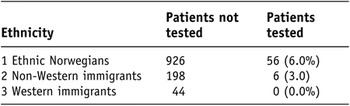
The number of patients, on whom psychometric tests were used, was low (see Table 1). Six percent of ethnic Norwegians were tested, and three percent of the non-Western immigrants. None of the Western immigrants were tested. The difference between the ethnic Norwegians and the immigrants was significant with a Mann Whitney test resulting in Z = −3.05 and p = 0.002.
Number of tests performed according to ethnic background of all patients admitted to an acute psychiatric department in 2008, N = 1168

Mean number of resident days was higher among those tested, 11.7 (SD = 11.2) versus 7.4 (SD = 10.4) days, t = 2.97 and p = 0.004. There was no significant difference in length of stay among those tested between ethnic Norwegians and non-Western immigrants, 11.4 versus 11.7. None of the Western immigrants were tested. The patients tested were also older than those not tested. Mean age was 43.0 (SD = 14.4) versus 38.8 (SD = 12.1). The difference was significant at the level of t = 2.65 and p = 0.03.
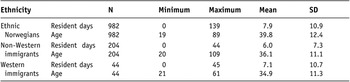
Number of resident days differed according to ethnicity (see Table 2). Ethnic Norwegians had the longest mean stay, 7.9 (SD = 10.9) days, whereas non-Western immigrants had the lowest 6.0 (SD = 7.3) days and Western immigrants an intermediate mean stay of 7.1 (SD = 10.7) days. The difference in resident days between all immigrants and ethnic Norwegians was significant with Z = −2.232 and p = 0.026. There was no such difference between Western and non-Western immigrants or between ethnic Norwegians and Western immigrants; Z = −0.057 and p = 0.95.
Number of resident days and mean age for patients admitted to an acute psychiatry department according to ethnicity

Mean age was 39.8 (SD = 12.4) 36.1 (SD =11.1) and 34.9 (SD = 11.3) for ethnic Norwegians, non-Western immigrants and Western immigrants, respectively. The difference between the two first categories was significant with t = 4.3 and p = 0.001, and between first and third with t = 2.8 and p = 0.008. There was no significant difference between the immigrant groups.
DISCUSSION
The present study results were unexpected on two fronts: the overall level of use and the demographic analysis of use.
Firstly, psychometric tests which purportedly increase diagnostic rigor, were used in far less than ten percent of patients. No studies have been found through Pub Med searches that report the use of psychometric tests on a routine basis in acute psychiatry departments, and we cannot judge whether our results from such a small sample would be mirrored elsewhere. On the other hand, comparisons have been made between clinical diagnosis in acute care wards and structured interviews with SCID (Strakowski et al., Reference Strakowski and Hawkins1997). The study showed that fewer than half the cases were in agreement and even less in non-White patients. This corroborates the purported added value of using such tests in the acute ward, and especially for immigrant patients. Special units, for instance for young psychotic patients, do employ a battery of tests to certify a diagnosis of schizophrenia (Larsen et al., Reference Larsen, Johannessen and Opjordsmoen1998; Larsen et al., Reference Larsen and McGlashan2001). The infrequent use of psychometric tests may hinge on one of the following factors:
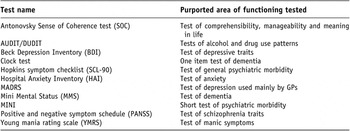
• Psychiatrists and doctors in training in psychiatry are unfamiliar with the tests. This may be remedied fairly quickly as there are a number of useful questionnaires which the patient himself may fill in. Some examples are mentioned in Table 3.
• Psychologists are not employed in acute departments, or if so, do not want to perform tests. Some psychologists deplore being asked ‘only to test patients’ with often elaborate tests such as MMPI, SCID and Rorschack. Some tests require authorization and have a price tag for the institution.
• The relative short stay of some patients. A quarter of the patients referred to our department are dismissed within 1–2 days, or the condition of the patient does not permit testing. Those who were tested had a longer stay in the present study.
• The responsible psychiatrist claimed to know the patient so well that further differential diagnostic considerations are deemed superfluous. A post-hoc finding was that in such cases no testing was performed on earlier admissions either.
• The tests are deemed not to give any more information than the clinical interview and ward observations. This is a short sighted view which is in contrast to the value given to tests in the scientific literature.
List of tests used in this study

The last point deserves some elaboration. Psychometric tests are thought to give added value above clinical judgments, although it might be important who helps the patient in filling in questionnaires (Beals et al., Reference Beals and Novins2004; Webster et al., Reference Webster and Hall2006; Antonovsky, Reference Antonovsky1993). This added value may also be quantitatively compared between clinicians and used for national and even cross cultural comparisons. But as far as we know, the usefulness of employing psychometric tests on a routine basis has not been shown in a randomized controlled study. In many studies were the usefulness of psychometric tests is in focus, the authors seem to presuppose that their use has an inherent value (Strakowski et al., Reference Strakowski and Hawkins1997; Gastao et al., Reference Gastao and Soares-Filho2009). On the other hand, lack of correspondence between clinician-rated and patient-rated functioning has been studied (Moritz et al., Reference Moritz, Ferahli and Nabar2004). Diagnostic ideology is drifting over time, and psychiatrists moving from one place to another report differences in diagnostic clarity. Therefore, it is tempting to argue that the use of psychometric tests might be used as a check of both diagnostic drifting and local treatment bias.
The second unexpected result was that a difference or discrimination of immigrants could be shown regarding level of testing, even at the low level of testing in the present study. The use of psychometric tests in different languages is a challenging task, which could reduce the probability of employing tests in languages other than the native Norwegian. Many tests do not exist in all the needed languages. Ad hoc translation of test questions by an interpreter could reduce the validity of the test. Also in the acute setting and with immigrants, all the usual problems of pyschometric testing occur. The predictive value of the test may be inadequate, especially after non-controlled translations. Some tests are not culturally neutral, as for instance AUDIT is deemed to be. But the clinical interview performed by one clinician is also culturally coloured, even when patient and health professional have a similar background.
The computerized medical records of our hospital do not reveal the use of psychometric tests not scanned in by office clerks in the allotted sub-item. Thus some tests may have been missed. We had no way of checking the magnitude of this error, except by reading through all the files. Spot checking of a smaller number of files (20) did not reveal reporting of tests in the running text of the files not also filed in the sub-item.
Diagnostic accuracy in the acute setting is not always sufficient. A patient may arrive with a clinical picture indicating a schizoaffective disorder, an affective disorder or a borderline personality disorder, all or some contaminated with substance abuse. Tests such as AUDIT, DUDIT, SCID or Personality Disorder Questionnaire may contribute to a better and quicker treatment decision. An initial clinical assessment may thus be augmented with separately gathered information independent of the individual clinician and her experience. Prodromal symptoms in young schizophrenics have been shown to be better evaluated using specifically developed questionnaires (Larsen, Johannessen et al., Reference Larsen, Johannessen and Opjordsmoen1998).
Whether the use of psychometric tests improves treatment, is still an unsettled question. The study of Saravay et al. (1991) showed that depression and anxiety increased resident days, maybe as a sign of inefficient treatment resulting from a prolongation of a necessary diagnostic decision. Ehring et al. (2007) showed that not all psychometric tests for future posttraumatic stress disorder have a reasonable predictive value, although the use of the best tests improved the diagnostic accuracy. In a study of suicide attempters with and without borderline personality disorder, Berk et al. (2007) showed that the patients with borderline personality disorder displayed greater severity of overall psychopathology, depression, hopelessness and poorer social problem solving skills. Furthermore, the intent to die or lethality associated with the suicide attempt at admission to the acute clinic, was not different. These findings were based on using eight different tests on arrival at the acute ward. In a study from Toronto the authors explored the usefulness of clinical rating scales in the assessment of suicidal risk in an urban hospital, similar to the one in the present study (Cochrane-Brink et al., Reference Cochrane-Brink, Lofchy and Sakinofsky2000). On the basis of their findings they did not recommend the use of any of six different scales prior to admission, as they did not predict suicide in individual patients. For instance, hopelessness may not be an ideal indicator of suicide risk in the emergency setting because it is a predictor of suicide in the long term, i.e. more than a year. This fact was demonstrated by Beck et al. (1990) with their Hopelessness Scale. From a sample of 1958 outpatients, 16 of 17 eventually committing suicide had a cut-off score of 9 or above on this special test. Similar results have been demonstrated in a group of substance abusers exposed to the Antonovsky Sense of Coherence test (Andersen & Berg, Reference Andersen and Berg2001; Berg & Andersen, Reference Berg and Andersen2001). Even though these tests are not predictive of suicide in the emergency setting, they may be regarded as warning signs for the future follow up and rehabilitation of the patients, and they have been evaluated in different cultural and ethnic groups.
Whether psychometric tests could improve diagnostic assessments in acute psychiatry, and how this should be promoted, merits further research. It raises a range of pyschometric challenges to apply such tests to immigrant patients. If not addressed, these technical problems with tests would increase the rate of mis-diagnosis where tests are employed. The paucity of tests applied in our department is probably not well founded, but rather the result of the feeling of always having too much to do.