In 2014 68,000 Central American children surged across the US border—more than double the previous year's number. These children were fleeing crime and gang violence in their home countries. Yet violence had affected Central America for years and, in some countries, had even subsided.Footnote 1 In 2015, more than a million migrants braved the Mediterranean Sea to seek asylum in Europe. The flow greatly outpaced prior years' numbers. As in Central America, violence in Syria was not new. The civil war started in 2011. Given persistent conditions of violence and poverty, how do migrants decide when to go?
We examine the timing of migration decisions. Although a large literature exists on where people migrate, less is understood about when they leave. To the extent academics focus on the timing of outflows, they look at how changes in violence affect flowsFootnote 2 or use mass flows as exogenous instruments to test the effects of immigration.Footnote 3 But many migrations involve sharp increases in outflows without violent “sparks.” Other scholars focus on how social networks accelerate the pace of flows.Footnote 4 However, migrants from nonviolent countries and regions—disconnected from social networks—often leave at the same time as those from more violent regions, leading to the perception of a coordinated migrant wave.
We argue that underlying conditions of poverty and/or violence lead those thinking about migration (“potential migrants”) to invest in information. Because potential migrants seek information about migration opportunities, they are attuned to changes in the political opportunities provided by both sending and receiving countries, which can spark large outflows. Thus, small changes in policy and political environments can alter decisions about when to migrate.
Studying how migrant waves form is extremely difficult. Migration data are scant, especially at the individual level. As with studies of social movements, identifying which changes in political opportunity structures lead to waves is a challenge. Instead of testing our argument using cross-national data on migrant flows, we focus on the micro-level processes that drive the timing of migration decisions and can aggregate into waves. Specifically, we examine (1) whether potential migrants invest in information about migration opportunities and how widespread that knowledge is and (2) whether changes in the political environment affect when potential migrants want to leave.
We examine these decisions in the critical case of the migrant wave to Europe in 2015. Europe experienced its largest influx of migrants since World War II starting in 2014, with a substantial spike in September 2015. To understand this spike, we conducted an original survey and embedded experiment of Syrians and Iraqis both in major transit countries (Turkey and Jordan) and their home countries. Although many migrants faced acute threats that forced them to leave Syria and Iraq, their secondary migration choices to Europe are harder to explain through violence alone. We find that conditions of violence and poverty are associated with migrants learning more about the political environment. In a survey experiment and focus groups, migrants respond to perceived changes in the political opportunities to settle in Europe. We also find that migrants search for information around major policy events.
These findings suggest that violence has both direct effects—pushing some individuals to leave their home country—and indirect effects—leading others to invest in information about their future options. Migrant waves then can form when attentive individuals respond to changes in the policy environment through seemingly coordinated decisions about when to migrate. In this way, migrant waves are analogous to “hot money” flows in international capital markets.Footnote 5 Investors are knowledgeable and move their money in response to political events. This responsiveness creates swings in capital flows, sometimes when underlying fundamentals seem unchanged.
Understanding the timing of migration is important because of its political consequences. Hostile political reactions to immigrants are most likely when communities undergo sudden influxes.Footnote 6 Indeed, rapid increases in exposure to Syrian refugees are associated with stronger support for far-right parties in Greece.Footnote 7 The fact that migrants respond to policy shifts in receiving countries can add fodder to right-wing interpretations of migrants as opportunistic. We emphasize a more nuanced interpretation in which violence creates circumstances in which migrants pay attention to the political environment and respond rationally to information.
Puzzle
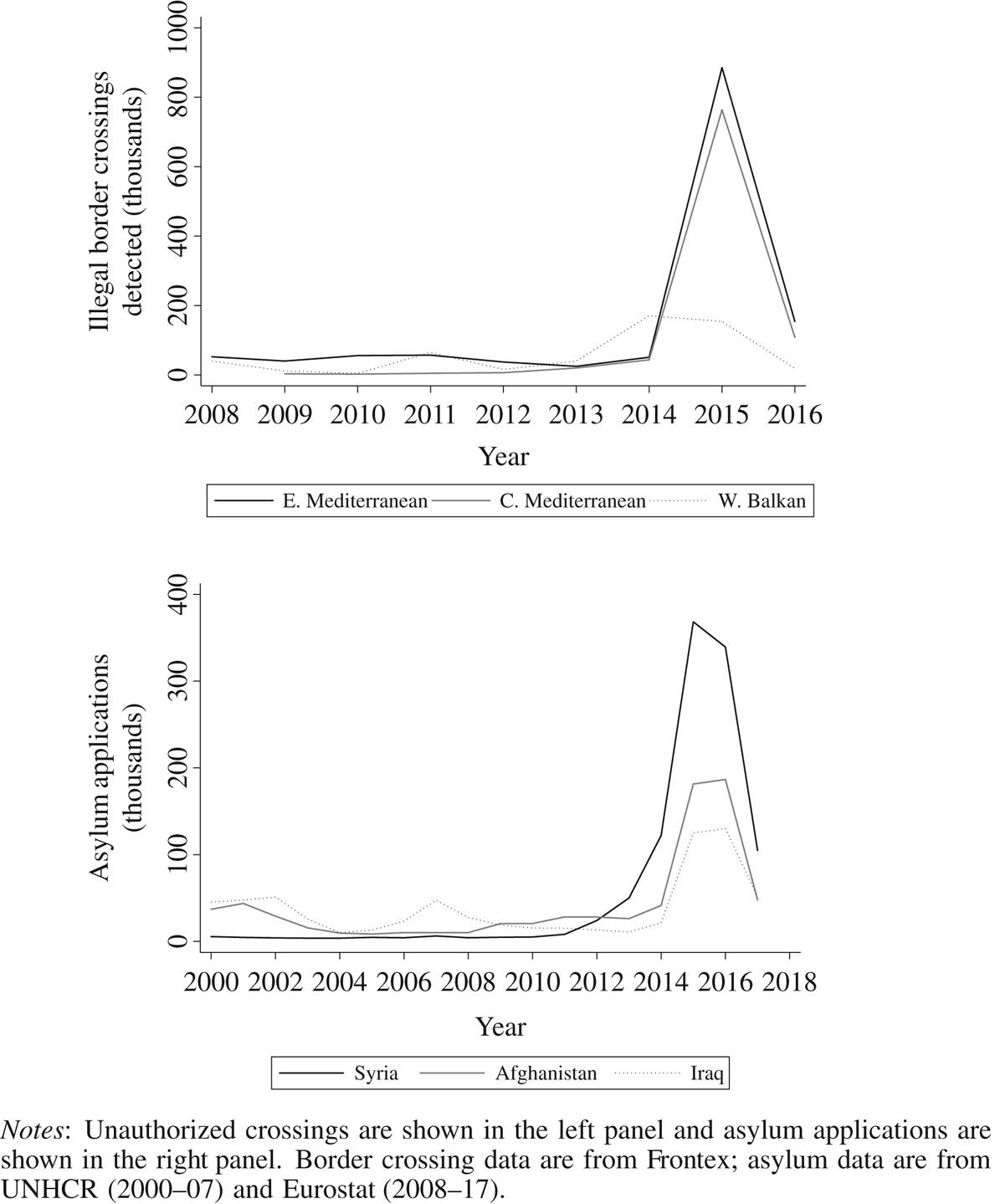
In 2015, more than a million migrants crossed into Europe. The sudden uptick exemplifies a migrant wave, meaning an elevated level of migration to the same receiving country or region occurring in a narrow period of time. We use the encompassing term migrant wave to include both events normally classified as refugee crises, as with Syrians, and those that are not, as with Central American minors. Waves stand out from historical trends: they involve a temporary boost, which then returns to the preexisting trend. Figure 1 visualizes a wave: the left panel shows the number of unauthorized entries into Europe between 2008 and 2016 and the right displays asylum applications from Afghanistan, Syria, and Iraq to Europe from 2000 to 2017. Asylum data are harder to interpret because of lags in filing; nonetheless they reveal an increase in migrant flows in 2015. Crossings and applications then drop off in 2016 and 2017, respectively.
The European migrant wave

Migration decisions are usually modeled through push and pull factors with transaction costs.Footnote 8 When examining the timing of migrant outflows, most accounts focus on a change in push factors, including violence, human rights violations, and economic conditions.Footnote 9 Escalating threats drive the timing of migration choices.
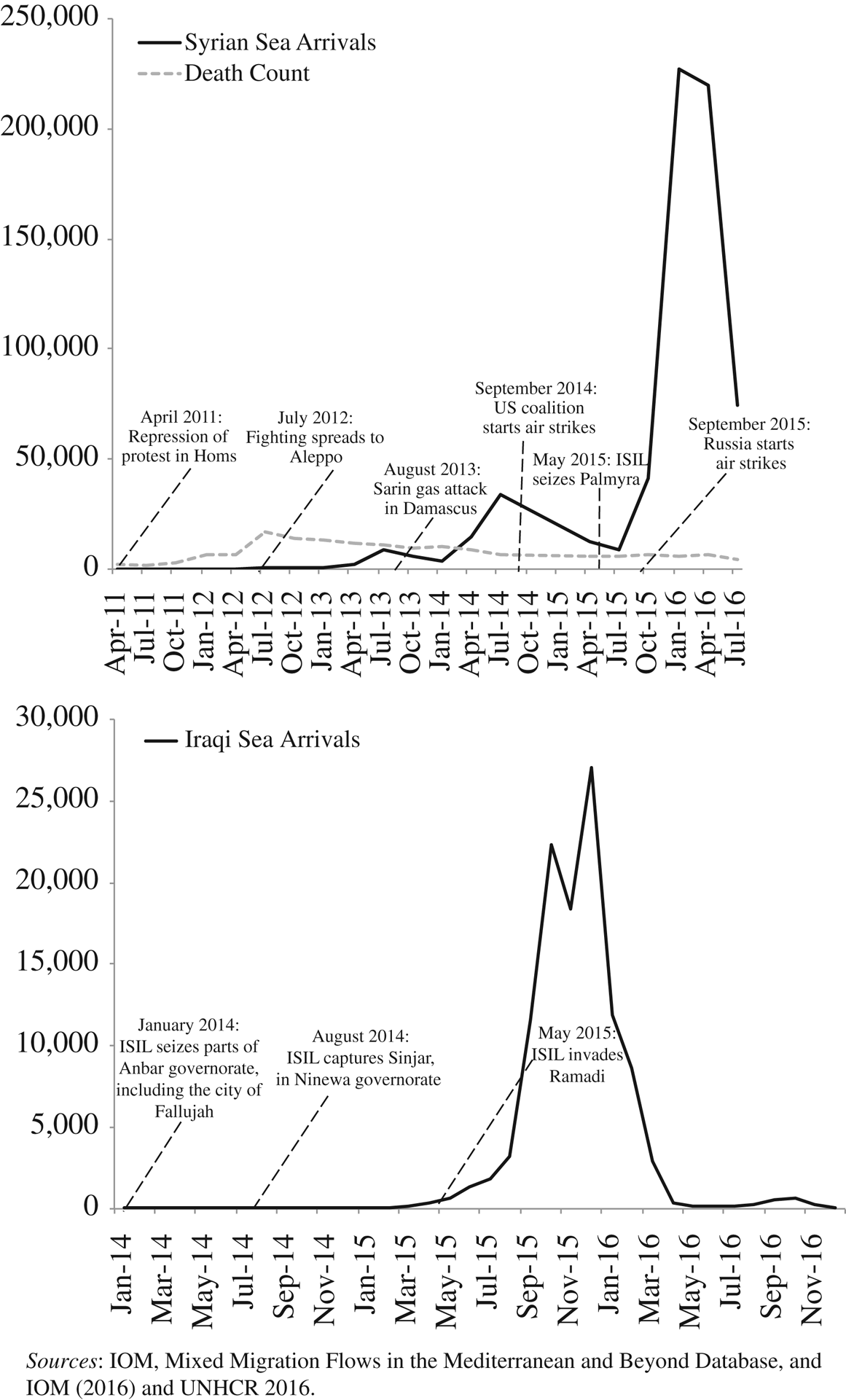
Nevertheless, several anomalies emerge. First, while violence and economic deprivation are important background conditions in migration, changes often are surprisingly absent.Footnote 10 For instance, there were no notable increases in violence (as measured by national homicides) in Central America before unaccompanied child migrants came to the US in large numbers in 2012.Footnote 11 Likewise, no clear escalations in the Syrian civil war or conflict in Iraq can be found to explain the 2015 wave. To see this, the top panel of Figure 2 plots the flow of Syrians entering Europe by sea from the start of the civil war in April 2011 through July 2016 and the United Nations High Commissioner for Refugees’ (UNHCR) monthly death count, the best proxy for violence in Syria. The bottom panel repeats the exercise for Iraq. Data on deaths in Iraq are unavailable so we follow the International Organization for Migration (IOM) to identify important violent events.Footnote 12 No particular violent event preceded the migrant wave.
The limited explanatory power of violence in Syria and Iraq

Second, theories focused on violence struggle to explain patterns of secondary migration, meaning decisions to move beyond a safe location. Violence cannot explain why Iraqi or Syrian migrants chose to leave Turkey, Lebanon, and Jordan en masse to reach Europe in 2015 but not earlier. Similar questions about why migrants suddenly leave intermediate destinations have been raised in other contexts like SomaliaFootnote 13 and El Salvador.Footnote 14
Third, migrant waves often attract individuals from less violent areas. At the peak of the wave, just 44 percent of the migrants arriving to Europe by the Mediterranean route were from Syria. The wave attracted migrants from countries with long-standing, largely unchanged conflicts and economic conditions, such as Afghanistan, Albania, Pakistan, and Kosovo.Footnote 15 Germany and Austria even launched advertising campaigns in Afghanistan to stop Afghans from migrating.Footnote 16 Analogously, while most child migrants came from very violent municipalities in Central America, some of the least violent municipalities like western Guatemala and northern El Salvador also sent large numbers.Footnote 17
Finally, equally important questions exist about how waves end. The main routes to Europe experienced a lull in 2017, despite continuing violence in Iraq and Syria. If violence and deprivation alone drive migration, outflows should continue. The timing of migration decisions thus presents an empirical puzzle.
Argument and Alternatives
Like many models of migration, we focus on individual-level decisions and consider their macro-level implications. We explain the timing of migration decisions as a two-stage process. First, push factors lead individuals to invest in information about migration. Stronger push factors lead to greater information investments because the decision to migrate is more pressing. Second, because potential migrants seek information, they pay attention to political opportunities, for example, a formal policy opening or an informal signal that increases the likelihood that migrants will be able to stay in their desired host country. In stressing that politics and policy affect migrants’ decisions, we build on Fitzgerald, Leblang, and TeetsFootnote 18 and Neumayer.Footnote 19 Yet this work focuses on relatively slow-moving variables like citizenship and welfare regimes that cannot explain sudden waves.
Waves are most likely to form when the change in political opportunities is substantial, the number of potential migrants is large, or both. Usually, changes in migration opportunities are incrementalFootnote 20 and the number of people who both want to and are organized to migrate in the near term is small. However, conditions of violence, as in Syria or El Salvador, or deprivation, as in Venezuela, result in large populations attentive to the politics of migration. Changes in the political opportunity structure—even relatively small changes—can unleash a wave given a sizable, informed population. Alternatively, large political changes can produce waves as even those with more limited information learn of the opportunity. In the case of the European migrant wave, we suggest violence caused many people to invest in information (rather than a large change in policy).
Waves may end when a political opportunity closes. Large influxes often provoke political backlashes and policy changes to make migration more difficult. Waves, however, do not necessarily have sharp endings. They can see a “second surge” as migrants rush to enter before opportunities close. This dynamic is similar to international capital flows: investors make high-stakes decisions and therefore acquire information about where to place their money. Political conditions can send money flying out of a market,Footnote 21 as even sophisticated investors rely on rumorsFootnote 22 and heuristicsFootnote 23 to make decisions.
In addition to stimulus models, there are two main alternative explanations: herds and social networks. A simple “herd” occurs when individuals mimic each other so that the likelihood of a given behavior increases as more individuals engage in it. GranovetterFootnote 24 and Epstein and GangFootnote 25 include migration as an example of herd behavior. Similarly, Cole and Kehoe model financial crises and sunspots as a result of the coordination issues in which lenders sometimes blindly follow one another.Footnote 26 A simple herd model predicts that when more people migrate, others follow.
Bayesian herd models add nuance. A small group receives an information signal and changes their behavior. Others observing the behavior then update their beliefs, even when they do not receive the same signal, and change their behavior.Footnote 27 In the context of migration, individuals see a large outflow and update their views on some aspect of the migratory process, perhaps concluding that conditions in their home country are deteriorating and/or receiving countries are accommodating. This updated view leads them to decide to migrate.
Another explanation focuses on social networks. Once a critical mass of individuals migrate, they can provide information and support to their friends and family, reducing the costs of migration. These models, however, predict “snowballs”Footnote 28 rather than waves in which migration accelerates with no clear end.
Both alternative explanations predict that only a limited number of people have information. We instead suggest that substantial numbers of migrants invest in information and act directly on informational signals.Footnote 29 To adjudicate between our argument and alternatives, we look at the distribution of information in the population, as well as the plausibility that migrants time their moves in response to political conditions.
Research Design
The ideal empirical approach would use longitudinal survey data to observe how individuals react to changes in violence, the number of migrants, and the policy environment. Unfortunately, panel data are unavailable and challenging to collect from a population experiencing violence and crossing borders. We instead surveyed Syrians and Iraqis at different points of the migration path—at home, during internal displacement, and in transit countries.Footnote 30 We complement the survey evidence with, first, focus groups and interviews with Syrian refugees in Istanbul in 2017 and, second, with Internet search data.
We administered our face-to-face survey to Syrians and Iraqis living in Syria, Iraq, Turkey, and Jordan. Our sample focused on individuals making decisions about leaving their permanent homes and additional moves from Turkey and Jordan or relatively safe areas of Syria and Iraq. We fielded the survey in summer 2016. The survey included questions about respondents’ policy knowledge, desires to migrate, social networks, experiences of violence, and demographic characteristics (see Appendix D). An independent survey firm with gender-balanced teams of Syrian and Iraqi enumerators administered the survey to 1,431 respondents in Arabic on smartphones.
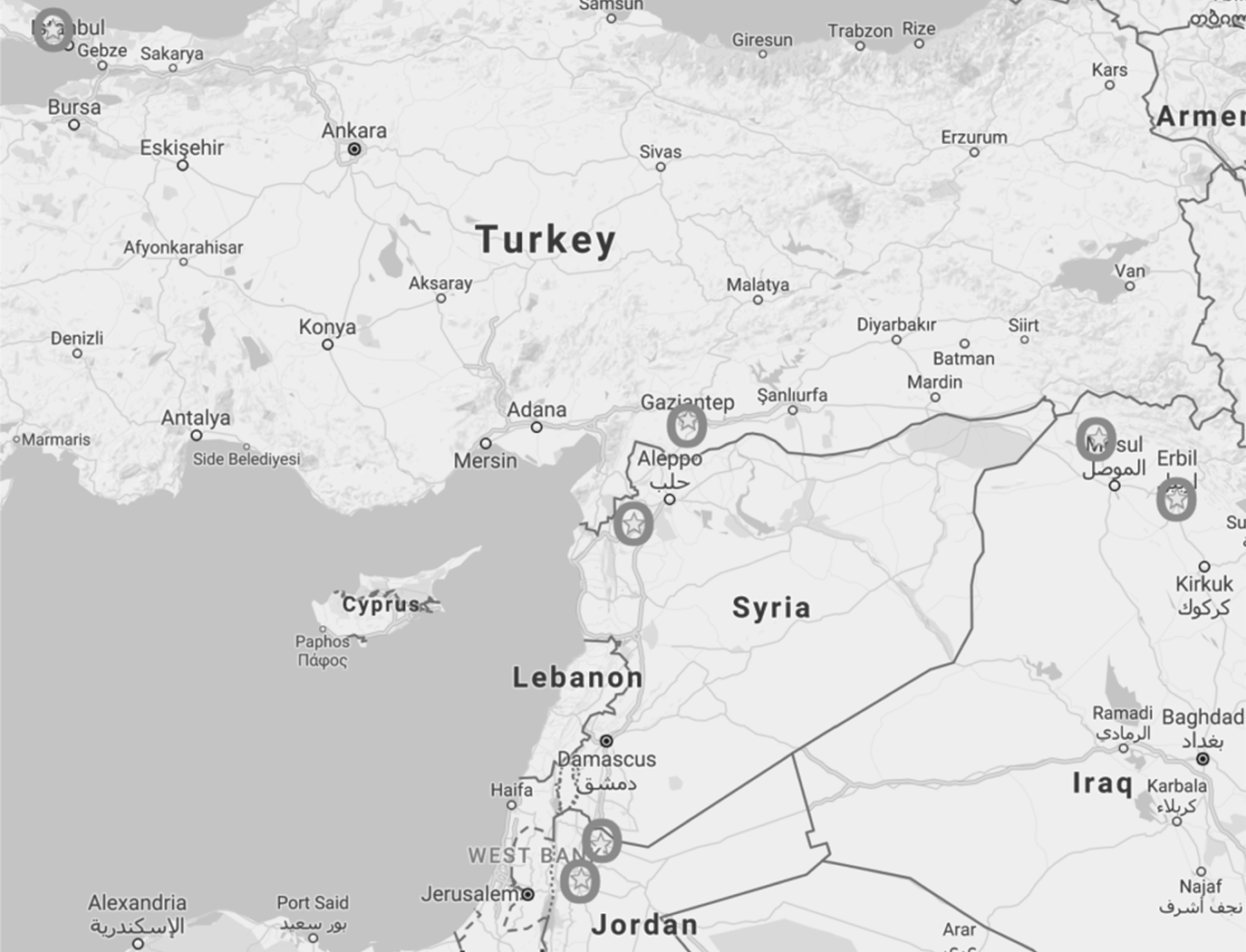
Constructing a representative sample of migrants in transit and displaced peoples is not feasible. We instead constructed a high-quality convenience sample by randomly sampling migrants. We chose locations where we were likely to find many Syrian and Iraqi migrants in the case of Turkey and Jordan, and locations that had substantial internally displaced populations and safe access in Syria and Iraq. These included Gaziantep and Istanbul, Turkey; Amman and Mafraq, Jordan; Duhok, Iraq; and al-Atareb and Idlib, Syria (see Figure 3).Footnote 31
Map of survey sites

To select respondents, enumerators used two strategies. In Syria and Iraq, they conducted household surveys, randomizing the first house and then following a skip rule of every fifth unit. Because it is harder to find migrant households in Turkey and Jordan, survey teams rotated among a dozen sites where migrants gather, using a skip rule (every tenth migrant they met at the site) to create a more representative sample.
Our survey is not representative of the entire migrant population and does not include migrants in camps. However, it does offer a high-quality convenience sample in a complex, violent environment. Reassuringly, our sample is similar in demographics to the UNHCR statistics (Appendix B). We surveyed only outside of refugee or internally displaced people (IDP) camps because discussions with experts suggested that this would be an advantage in locating migrants considering secondary moves to Europe. It means that our sample may be better off financially and more able to respond to migration opportunities than the underlying population. We also use data on whether our respondents had spent time in camps to probe the ways that knowledge might be acquired in camp environments (and find no significant differences).
There is no “smoking gun” in this study. We instead examine four observable implications of our argument and probe alternative explanations. We expect:
H1 Respondents affected by violence, economic deprivation, or closer to making a move should be knowledgeable about the broader policy environment and international politics.
H2 Information on political opportunities in a survey experiment should lead potential migrants to make or accelerate their plans to migrate.
H3 In focus groups, potential migrants should interpret others’ choices about when to move to Europe in terms of political opportunities.
H4 Real shifts in the political environment should increase Internet searches to seek migration information.
Results
Survey: Observational Data on Political Knowledge
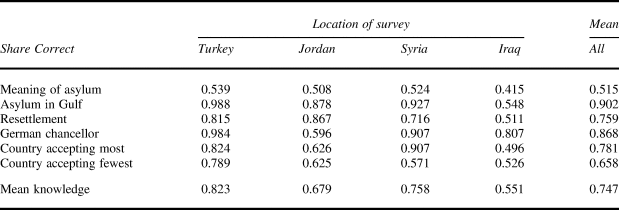
To test our first hypothesis, we asked closed-choice questions to gauge understanding of the concepts and politics surrounding migration to Europe. Table 1 summarizes the level of knowledge by country. First, we asked respondents to choose the meaning of asylum. This question was the most difficult—roughly half correctly answered the question. Second, we asked which of the countries in the Gulf Cooperative Council offered asylum. Respondents did extremely well on the question, with 90 percent selecting the correct answer of “none.” Third, respondents selected which nationals can be resettled under the EU Relocation program. Three-quarters of respondents correctly identified the groups (Syrians and Iraqis) included in the deal. Next we asked respondents to name the leader (chancellor) of Germany. Shockingly, 87 percent of respondents said Angela Merkel. To put this in perspective, only 68 percent of Iraqis and 41 percent of Jordanians could correctly name their own foreign minister.Footnote 32 Finally, we asked respondents to select which European countries had agreed to accept the most and fewest migrants. More than three-quarters of respondents said that Germany had agreed to accept the most, the correct answer. We accepted Hungary and, in the wake of Brexit, the UK as reasonable responses for the fewest.
Political knowledge

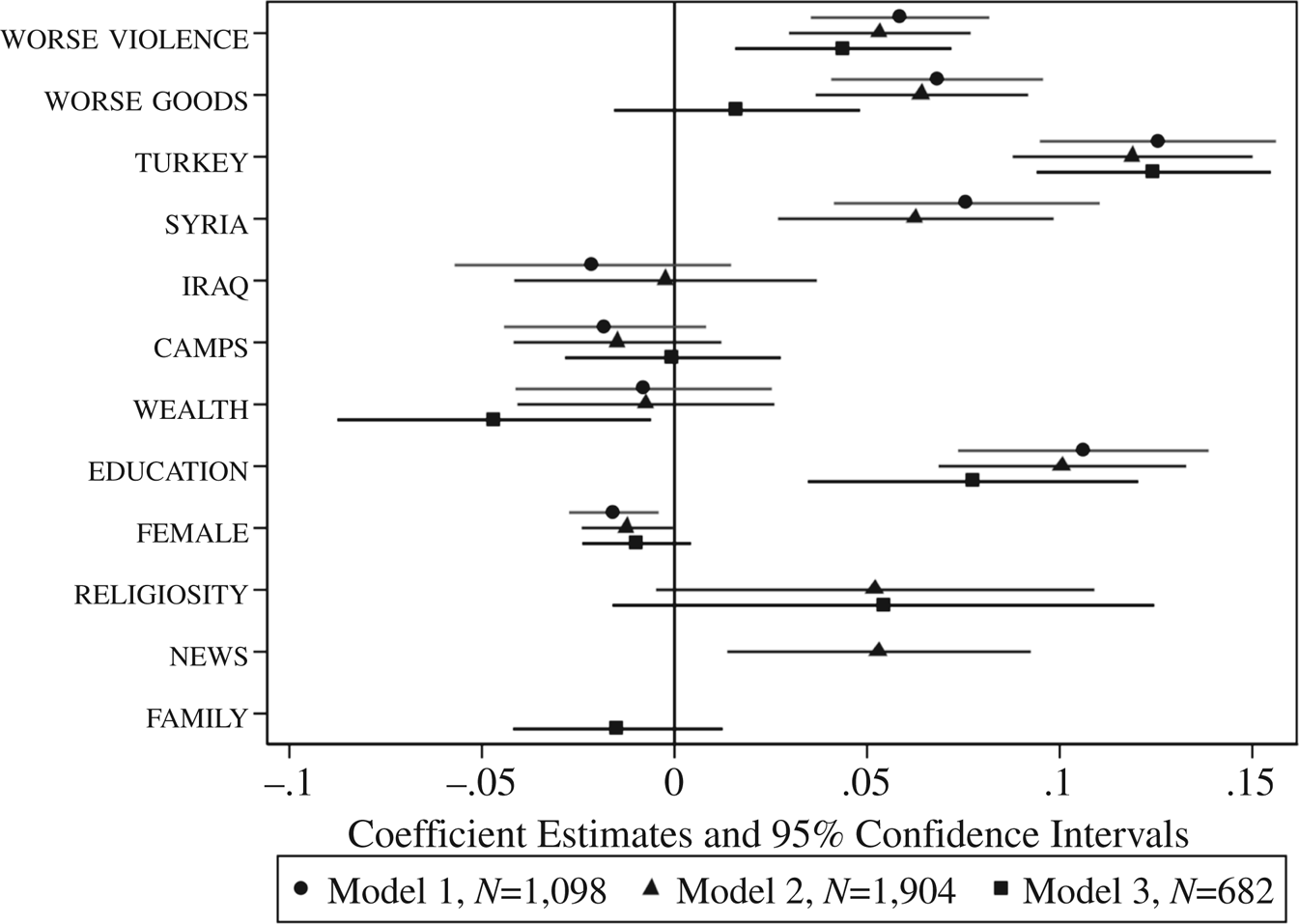
We suggest that violence and deprivation motivate information acquisition. Given the absence of panel data, we probe whether individuals exposed to higher levels of violence or deprivation possess more political knowledge, all else equal. We use an OLS regression, with the average score on the six knowledge indicators as the dependent variable. Model 1, the base model, tests whether experiences of worsening violence and economic conditions are significant predictors of political knowledge. We measure how violence (worse violence) and access to an index of goods (food, water, electricity, etc.; worse goods) in respondents’ surroundings changed in the previous year (or the year prior to migrating for those in Turkey and Jordan).Footnote 33
We also expect that individuals who are geographically closer to Europe are more knowledgeable because secondary migration choices are more salient. Most migrants attempted to cross the Mediterranean from Turkey so we expect migrants in Turkey to be the most knowledgable. Individuals in Jordan, followed by Syria, and, then finally, Iraq, should be less knowledgeable since more steps are involved to reach Europe. Syrians are likely to be more knowledgeable than Iraqis overall since they generally have been exposed to more violence. We include indicator variables for each site location, with Jordan as the base category.
It is possible that individuals acquire additional information in refugee camps. We include an indicator variable for whether individuals reported spending time in a refugee camp (camps).
As control variables, we include a wealth measure based on a principal component analysis (PCA) of current assets (wealth).Footnote 34 We also include the level of education (education) and gender because women tend to be excluded from political discussions (female).
An alternative view is that political knowledge varies most with social networks and political engagement, rather than violence. Model 2 therefore includes measures for information sources, namely religious networks and news media. Although our sample is overwhelmingly (92 percent) Sunni Muslim, respondents differ in their religiosity (religiosity). We also measured how often individuals follow the news via radio, television, newspapers, social media, and smugglers (news). If social networks drive political information, then having a family member in Europe (family) should be associated with greater knowledge. About half of respondents had a first or second-line family member in Europe. Due to a programming issue, this question was asked in only Turkey and Jordan so is included in a separate model (model 3).
Figure 4 displays the results.Footnote 35 All independent variables are rescaled from 0 to 1 so the coefficients can be interpreted as the expected change in average political knowledge from shifting a covariate from its lowest to highest level. Consistent with our theory, individuals who face worse violence and economic conditions invest in political information. Going from no change in violence to substantially worsening violence is associated with an eight-percentage-point increase in political knowledge. Individuals in Turkey are the most knowledgable, consistent with the idea that individuals also learn more about policy when they are closer to making choices based on it. Individuals in Syria also are very knowledgable. This result could reflect the extreme levels of violence in Syria or differences in the sample. Because we were confined to survey in safe areas, our Syrian sample comes from rebel-held areas where political engagement has been high.
Correlates of political knowledge

Turning to the other variables, spending time in camps has no relationship with political knowledge. Going from primary education to a university degree is associated with an eleven-percentage-point increase in knowledge. But there is no relationship between wealth and knowledge. Religious networks and following the news are associated with greater knowledge.
Surprisingly, given the importance of social networks to migration, having a family member in Europe has no association with political knowledge. It is possible that family networks play a limited role in spreading political knowledge, but still matter for more specialized or contextual information. Alternatively, the limited effects of direct-line family may indicate the importance of social media. As one community leader put it, “Today Syrians are so active on social media, you can find information about immigration to any country in WhatsApp and Facebook groups.”Footnote 36
Reverse causation is a concern. Individuals who know more may overstate their exposure to violence and deprivation to strengthen their asylum claims. If so, the incentives to overstate exposure should be greatest for respondents who believed that the survey was administered by the government or a humanitarian agency.Footnote 37 But believing that American researchers conducted the survey has no relationship with stated exposure to violence, though it is associated with reporting more stable access to basic goods and services prior to leaving.Footnote 38 It therefore is plausible that respondents shaped their reporting of goods access in the hopes of gaining charity. While we cannot rule out that more knowledgeable individuals simply reported more violence to bolster their asylum claims, the evidence is less consistent with this interpretation.
Survey: Experiment on Political Opportunities
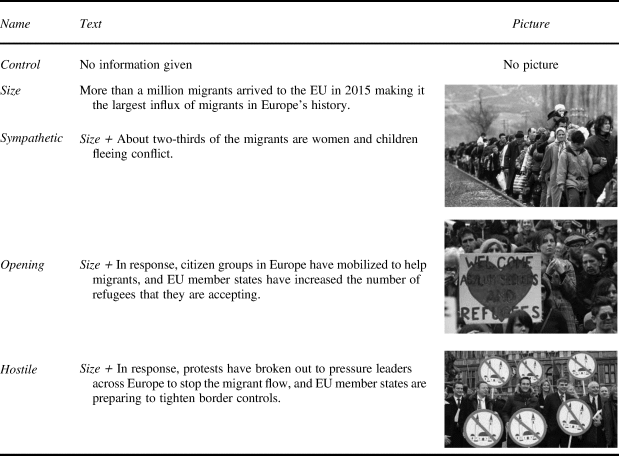
We now turn to our experiment. We cannot manipulate the policy environment in Europe and felt that it would be unethical to provide treatments with a strong chance of changing real migration behavior. We designed an emphasis framing (or priming) experiment to highlight the salience of different aspects of the migration environment, using information similar to what migrants receive in everyday life. Table 2 shows the four treatments and the pictures that accompanied them.Footnote 39
Experimental treatments

Note: Size and Sympathetic use the same image.
Our first treatment tested herd-migration models. We presented information about the size of the migrant flow to Europe in 2015 and a picture of large numbers of migrants (size). All subsequent treatments included this size information, as well as additional details. A second treatment made salient the sympathetic nature of the flow by stressing that the majority of refugees are women and children (sympathetic). We strengthened this treatment and emphasized that two-thirds of Syrian refugees are women or children. This is true, but ignores that 54 percent of those who made the trip to Europe in 2015 were men. Third, we tested our political opportunities argument by making salient the sympathetic aspects of European policy toward migrants (opening). We highlight the general environment, which is likely a weaker test of our argument than a change in policy, because we were concerned about the ethics of providing specific policy information that could change behavior. Our final treatment emphasizes growing hostility (hostile).
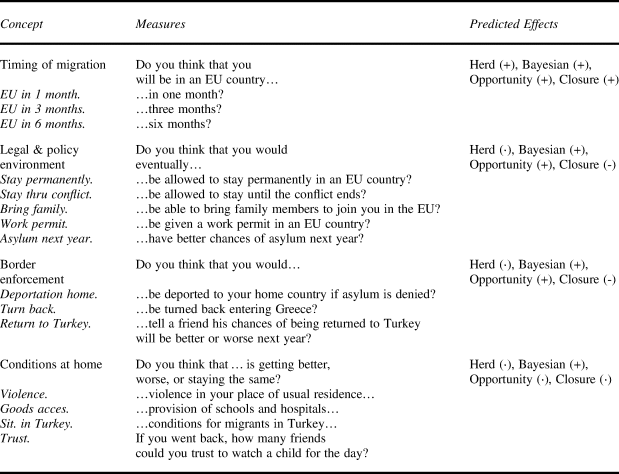
After providing each respondent with no information or one of the treatments, we designed multiple survey items to capture the following broad outcomes: (1) timing of migration, whether and when respondents expect to migrate and be in the EU; (2) legal and policy environment, whether it was becoming more open or restrictive; (3) border enforcement, whether the chances of deportation were changing; and (4) conditions at home, whether violence and public goods access at home were deteriorating.
Table 3 summarizes the outcome concepts, survey measures, and predictions of each theory. A simple herd model implies that size information should increase plans to migrate soon as individuals imitate others. In contrast, if respondents are Bayesian updating, then respondents should plan to move to Europe sooner because the size treatment leads them to think that conditions in their home country are deteriorating or that conditions in Europe (either border enforcement or the policy environment) are improving. The sympathetic treatment serves as an additional test of Bayesian models because their migration should provide a stronger signal about conditions.
Predicted treatment effects by theory

Notes: Signs indicate the hypothesized direction of the effect of the treatment; (⋅) is no prediction.
If our political opportunity argument is correct, then the open treatment should lead respondents to expect to be in the EU sooner. They also should think that the legal and policy environment is improving and border enforcement is decreasing. Our predictions about political closures are less clear. Information about a hostile environment may deter migrants, leading them not to plan to move to the EU and to perceive deteriorations in the policy and border environment. However, it also could lead respondents to perceive a last chance to migrate. In this case, respondents would plan to go to the EU yet still think that policies and border enforcement were worsening.
Framing or priming experiments work either by making some aspect momentarily available or by increasing the weight that respondents place on a given consideration in their decision process. Such treatments are less likely to work on more informed respondents who already have a frame in mind or strong opinions to counter opposing frames. Both of these issues likely occurred.
The experiment did not have statistically significant effects for the full sample (Appendix A, Table A8). As noted, our sample was very knowledgeable, weakening our treatments. Additionally, fewer respondents than expected actually wanted to migrate to Europe—less than 10 percent of respondents in Syria, 38 percent in Turkey, 32 percent in Jordan, and 41 percent in Iraq—and likely had arguments to counter our treatments. We therefore focus on the smaller portion of respondents who scored less well on our knowledge index (N=578), as anticipated in our pre-analysis plan.Footnote 40 We have balance on pretreatment covariates in both the full- and low-knowledge samples (Appendix A Tables A4–A5).
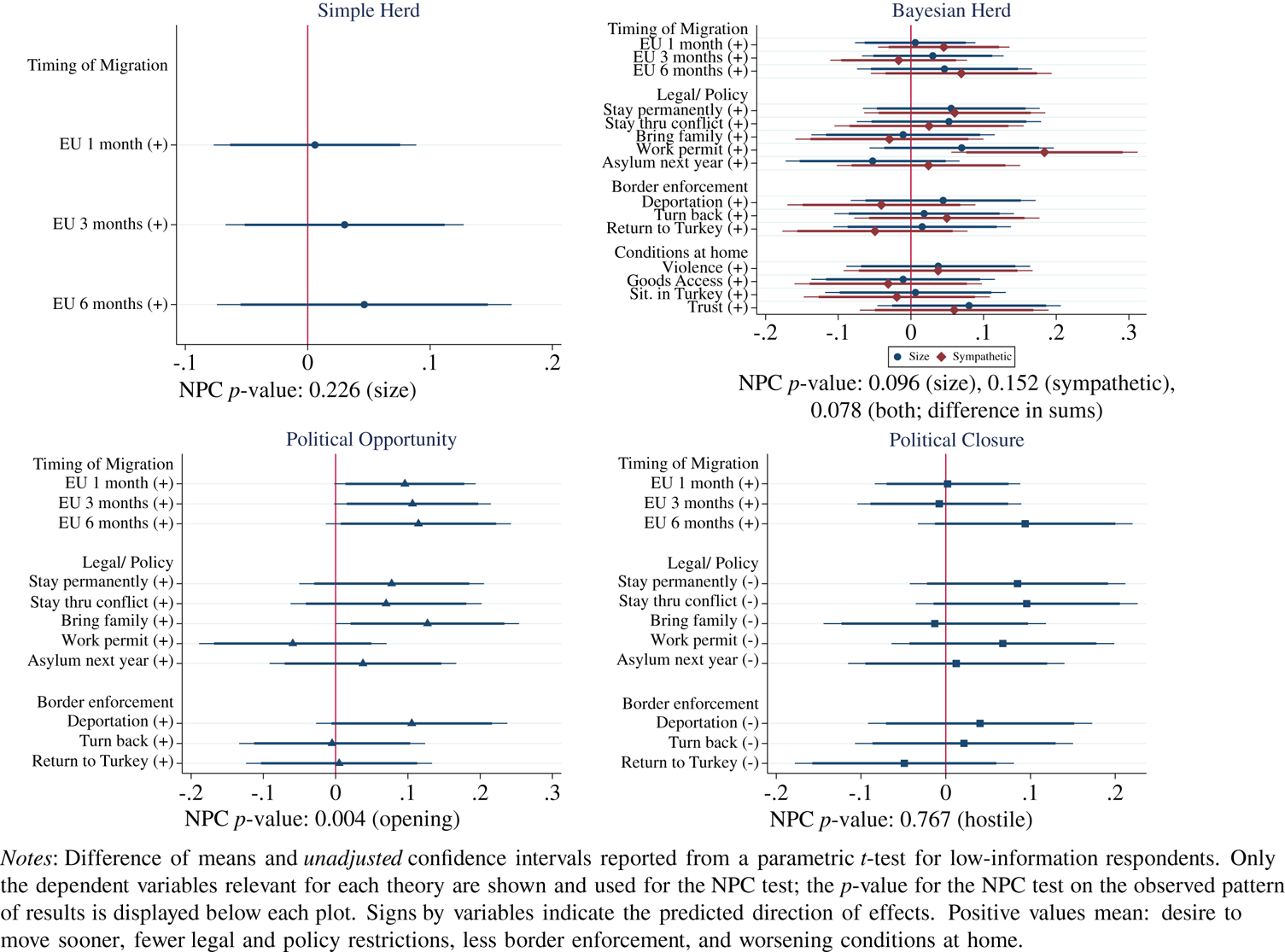
Figure 5 presents the difference in means for each treatment and the unadjusted 95 and 90 percent confidence intervals from a parametric t-test. We display results for only the outcomes on which we had theoretical predictions. To account for multiple hypothesis testing, we analyze the results using nonparametric combination (NPC).Footnote 41 NPC considers the probability of observing the predicted pattern of results. Below each graph in Figure 5 is the p-value for the NPC test on the difference in means.Footnote 42 So, for our political opportunity theory, this means observing that the differences in means are positive for the opening treatment on all question items related to timing, the legal and policy environment, and border enforcement. This procedure takes advantage of the fact that observing multiple predicted effects is less likely to happen by chance than observing a positive difference in means on any particular question.
Difference in means on theoretically relevant dependent variables

The pattern of results is consistent with our political opportunity argument and statistically significant under NPC testing, but the treatment effects for individual items are weak. For less knowledgeable respondents, the treatment effects are in the hypothesized direction for eight out of the eleven items but only statistically significant (unadjusted p-values) at the 10 percent level or lower for four items (see Figure 5). The combined results support our argument; the adjusted p-value for the NPC combined test statistic is 0.005 and several robustness checks show similar results.Footnote 43
In contrast, there is little support for the simple herd model. The size treatment did not accelerate plans to migrate (NPC test statistic p-value: 0.246).Footnote 44 There is some more support for the Bayesian herd model. Figure 5 shows that the treatment effects largely are in the hypothesized directions but rarely reach statistical significance. Testing for the pattern of responses, the p-values associated with the combined NPC test statistic are not significant for the size treatment (0.115) or the sympathetic treatment (0.158), but are just significant at the 10 percent level if we combine both (0.093). Our data thus lend less support to Bayesian herd models than a political opening argument. Nonetheless, given the small sample size and the fact that the pattern of results goes in the right direction, Bayesian herd models merit further research.
Finally, we find little evidence for the hostile treatment. Most effects are incorrectly signed and close to zero and the NPC p-value is insignificant (0.790). It could be the case that a hostile environment truly has no effect or that our respondents already anticipated it. It also is plausible that hostility has heterogeneous effects, deterring some while leading to last-minute surges among others. Future research may probe these competing effects with larger samples.
Qualitative Support for the Experimental Results
In terms of their primary migration decisions, most Syrians and Iraqis said they moved following substantial violence and in haste.Footnote 45 But explanations for secondary decisions to reach Europe centered on the policy environment: the most common explanation was that “EU countries were willing to accept more migrants” (54 percent). Far fewer respondents supported herd or social network interpretations that “it became easier to live in Europe once friends and family had left” (13 percent).
To better understand these results, we conducted focus groups and interviews in Istanbul.Footnote 46 Focus groups were split by age and gender, with five to seven participants in each.Footnote 47 We also conducted in-depth interviews with local Syrian community leaders.
Changes in European policy again were the most common explanation for why migrants moved to Europe in 2015. One respondent captured a common idea that the wave started because of the “statements of Angela Merkel—she welcomed the refugees. Also, governments made it easy at that time to go to Europe; they closed their eyes on the refugees’ movement.”Footnote 48 Another community leader explained: “It was all the facilities that Europe gave at that time, especially in Germany where they were welcoming refugees and people needed a safe place to go to, so they went.”Footnote 49 This was echoed by another community leader, “Europe doesn't usually facilitate immigration procedures. However, the procedures are easy for Syrians now, which made people from Afghanistan, for example, claim to be Syrians.”Footnote 50
Others spoke of the importance of a welcoming atmosphere in which receiving countries recognized the difficulty of the Syrian situation. As one community leader explained, “Syrian people wouldn't go [to Europe] if they did not feel that they are accepted. They were saying that they are accepting us in the media, especially Arabic ones, and [journalists] interviewed people saying ‘we found home and everything is ready,’ and that was encouraging other people to go there.”Footnote 51 Thus, migrants themselves attributed the timing of the migration to policy changes and a welcoming atmosphere in Europe.
Scaling Up: Policy Changes and Information Searches
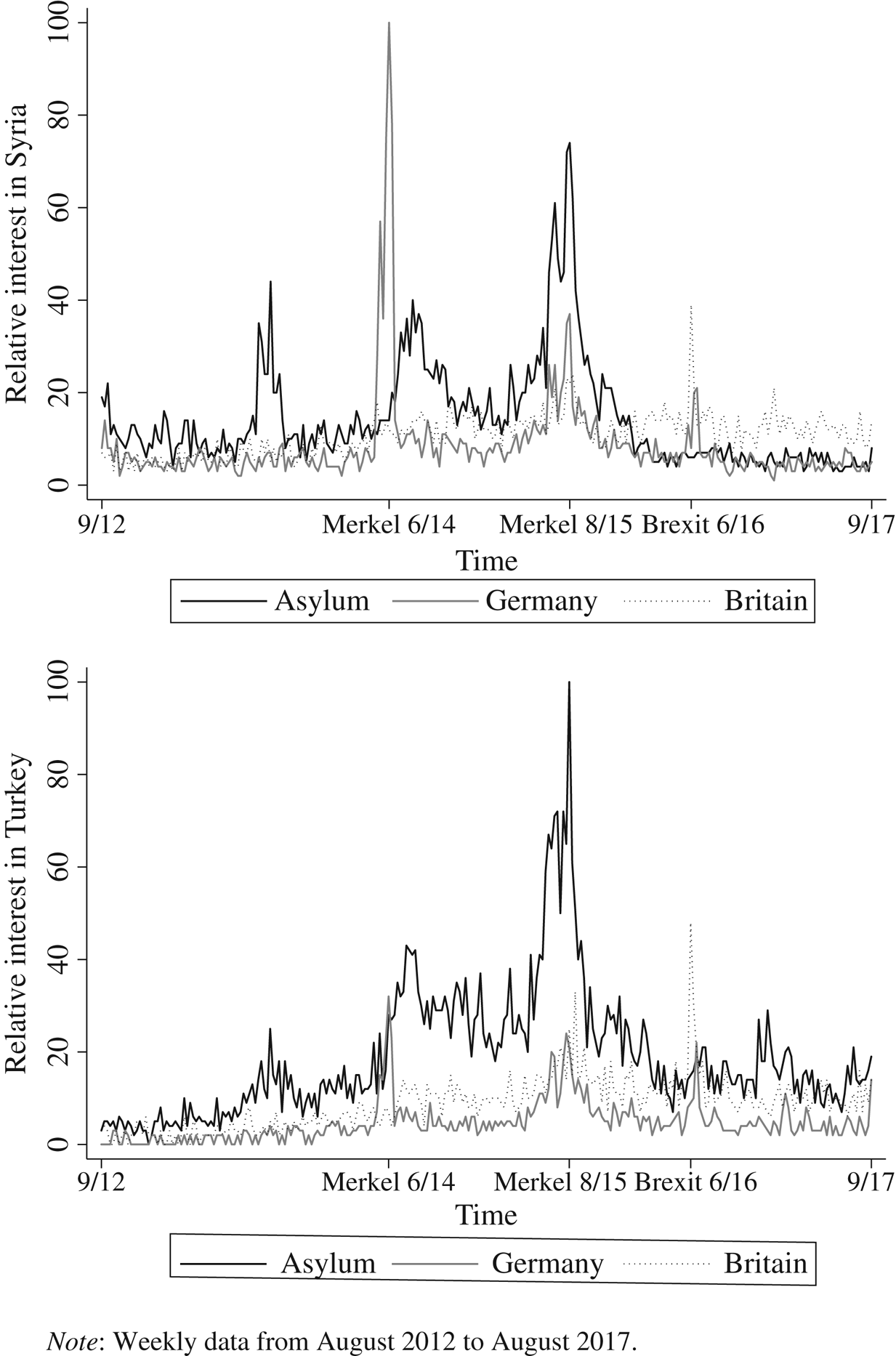
As a final test, we turn to Internet search data. We predict that information seeking should increase around political opportunities. These effects should be strongest in countries affected by violence and poverty, but we also expect to see “opportunistic joiners,” or individuals following these political cues in countries less affected by violence.
One challenge is to specify what constitutes a political opportunity. We focus on two events that were likely salient to potential migrants. First, the German government announced that it would take in 10,000 Syrian refugees in June 2014.Footnote 52 Second, Merkel announced that migrants could apply for asylum in Germany even if they entered through another EU member state in August 2015. More broadly, her mantra “we can do this” (Wir schaffen das) suggested a welcoming attitude.
To test whether information acquisition increased around these political openings, we analyze Google search data.Footnote 53 In our survey, 43 percent of respondents use the Internet as their most frequent news source. Google Trends provides information on relative interest in a topic in a given country. A value of 100 represents peak popularity, whereas a value of 50 shows that the term is half as popular.
We examine whether searches for “asylum” and “Germany” conducted in Arabic in Syria and Turkey increased around Germany's announcements. We compare them to searches for “Britain,” which we expect generated less interest in the same period (Figure 6).Footnote 54 In Syria and Turkey, we see an increase in interest in asylum around the time of key speeches. The June 2014 announcement only increased interest in Germany. The August 2015 speech prompted some increased interest in other EU countries as well, which is not surprising given that Germany sought a broader EU deal on refugees.Footnote 55 We also see a “Brexit” spike in the search data for Britain (with a much smaller spike in interest in Germany that same week).
Arabic Internet searches for asylum, Germany, and Britain in Syria (top) and Turkey (bottom)

Second, we compare searches related to “asylum” across different countries. If individuals respond to common policy shocks in destination countries, then the volume of searches by week in diverse places should be positively correlated. In contrast, if citizens respond to local patterns of violence, then there should be little relationship in weekly search trends across countries. We plot the same data on weekly searches for “asylum” in Syria from Figure 6 against “asylum” in Iraq (searched using the Arabic word) and Afghanistan (searched using “migration” in Pashto).Footnote 56 The correlation in the volume of weekly searches for asylum in Syria and Iraq is very strong (ρ = 0.82) and moderately strong between Syria and Afghanistan (ρ = 0.37), despite distinct conflict dynamics. Additionally, we find an increase in searches in Syria, Iraq, and Afghanistan around Merkel's August 2015 speech signaling a general openness to refugees (Appendix Figure A1).
Conclusion
Why did Syrians, as well as Iraqis, Afghanis, Pakistanis, and Nigerians, look to Europe in 2015? Existing accounts focused on the role of violence cannot explain the timing of such migrant waves. We investigated an alternative mechanism through which violence affects migration by making individuals attentive to the political environment. While deteriorating conditions cause some individuals to make initial moves, external political signals shape the timing of migration choices and aggregate into waves.
Testing theories of when migrants leave and why they leave in waves is extremely difficult. Like any emergent phenomenon, it is hard to understand how behaviors spread, especially after they occur. We used an original survey of Syrians and Iraqis, including those in transit, internally displaced, and remaining in their homes, to probe migration decisions. Our high-quality convenience sample represents an important effort to learn about a precarious and understudied population. We find a range of evidence consistent with our theory. Potential migrants, especially those affected by violence, are knowledgeable about policy; making salient a welcoming policy environment seems to make less-knowledgeable respondents plan to migrate sooner; those involved see political opportunities as the reason migrants left all at once; and Internet searches show sharp interest in migration around policy shifts.
A limitation of our study is the weakness of the experimental results. In designing survey experiments, researchers on migration are caught in a bind. They face a choice between strong treatments, which often involve providing new information and exaggerated frames to generate results, and ethical considerations, which err toward using existing information and subtle frames. Although the pattern of experimental results provides some support to our theory of policy responsiveness, the treatment effects on individual items were weak and limited to less knowledgeable respondents. Our theory gained support from the combination of evidence from our descriptive survey questions, focus groups, and Internet searches, rather than the experiment alone. Future research will need to think of creative, ethical experimental treatments that work for highly knowledgable populations.
We studied a single (or linked) migration event, raising questions about the generalizability of our claims. Syrians and Iraqis are relatively educated migrant groups with substantial Internet connectivity. Further, we could not conduct surveys in refugee camps, which attract migrants without the means to live independently. Less connected, poorer migrants might be less aware of their political environment and less receptive to conditions in receiving countries. While our Internet search data suggest a broader process of information seeking at work, future studies are needed on a broader set of cases.
Our results point to a number of open questions. First, can hostility to migrants terminate a wave or does it backfire? In our experiment, respondents changed their behavior when given information about political opportunities but not closures. It is possible that this reflects differences in the novelty of information—concerns that the EU countries were closing their borders were ubiquitous when our survey was fielded. Alternatively, the effects of policy closures may be ambiguous. Some migrants try to rush in, while others are deterred.
Second, what types of political openings trigger movements? Our experimental treatments focused on the general reception of migrants rather than specific asylum policies or enforcement actions. In the observational data, migrants seem to have responded to Merkel's speech, but it's not clear why other policy changes (arguably with larger impacts on migrant treatment) didn't spark movements. Whether the general political environment or specific policy changes, and of what nature, prompt migration responses is an important direction for future research.
Finally, these results raise questions about how politicians incorporate potential movements into their decision making. Do politicians act strategically to anticipate the migration response to their actions? We suggest clear reasons for why politicians, and even those who are sympathetic to migrants, may prefer to hide their migration policies or send ambiguous signals. For example, the Greek government and international organizations strategically withheld information from refugees in camps.Footnote 57 On a policy note, however, we also find clear reasons that politicians may want to publicize their efforts to temporarily resettle migrants. Contrary to popular lore, the vast majority of Syrians and Iraqis want to return to their home countries. Those who do want to migrate to Europe prefer to wait for resettlement rather than move illegally. The implication is that faster, larger, and temporary resettlement programs might forestall sudden movements and the smuggling industry. And news of their introduction will travel.
Data Availability Statement
Replication files for this research note may be found at <https://doi.org/10.7910/DVN/98FIZD>.
Supplementary Material
Supplementary material for this research note is available at <https://doi.org/10.1017/S002081832000017X>.
Acknowledgments
We thank the editors and reviewers at IO for their comments. Mara Revkin, Steve Monroe, Carolyn Barnett, and Jawan Shir provided excellent research assistance; Olivia Woldemikael helped prepare the manuscript for publication. Charlotte Cavaillé, Michael Clemens, Clemens Graf von Luckner, Rafaela Dancygier, Jill Goldenziel, Katerina Linos, Sara Najem, Hannah Postel, Glen Weyl, and the participants of IPES, the UC Berkeley International Migration and Refugee Law Workshop, the Issam Fares Institute at the American University of Beirut, The Ohio State University, and the Stanford University International Relations Seminar all provided helpful comments on previous drafts. All errors remain our own.
Funding
This project received funding from the Whitney and Betty MacMillan Center for International and Area Studies at Yale University, the National Science Foundation (RAPID 1638952), and the Bobst Center for Peace and Justice at Princeton University.