Introduction
A lichen is a symbiotic interaction between a fungus and a photosynthetic partner (green alga or cyanobacterium). Depending on the species and its adaptation, lichens can colonize many substrata within diverse habitats worldwide. The ability of lichens to colonize diverse habitats may be a consequence of competition among algal symbionts that associate with the lichen-forming fungus in the thallus (Ohmura et al. Reference Ohmura, Kawachi, Kasaie, Watanabe and Takeshita2006; Yahr et al. Reference Yahr, Vilgalys and DePriest2006). Most lichen fungi cannot survive without an algal partner, rendering lichen fungi obligate symbiotic organisms, where dispersal mechanisms may result in the same or different combinations of symbionts at each dispersal event (Werth & Sork Reference Werth and Sork2010). Horizontal transmission results from the dispersal of sexually derived fungal spores, which must germinate and encounter a compatible algal species where the genetic composition of the symbionts is different from that of the parent thallus (Sluiman et al. Reference Sluiman, Kouwets and Blommers1989; Werth & Sork Reference Werth and Sork2010; Grande et al. Reference Grande, Widmer, Wagner and Scheidegger2012). Vertical transmission occurs when lichens undergo vegetative reproduction (soredia, isidia, or thallus fragmentation), where cells of each symbiont are dispersed together and will regenerate a distinctly different individual but the lichen will have the same genetic composition as each parent symbiont. Another mode of dispersal displayed by several lichen fungi and their photobionts within the Verrucariaceae (e.g. Dermatocarpon, Staurothele and Endocarpon) allows sexually derived spores to be dispersed with the small algal symbiont living within the hymenial layer of the perithecium, where the ascospores are discharged together with the hymenial algal cells. This mode of dispersal is thought to increase the success of lichenization. In a predominantly sexually reproducing species, horizontal transmission would ensure a decoupling of lichen symbionts (Werth & Sork Reference Werth and Sork2010) and the algal population structure should reflect the availability of the algal partner.
While the majority of lichen fungi associate with green algae of the genera Trebouxia and Asterochloris, the most common algal symbiont in the Verrucariaceae is reported to be Diplosphaera (Thüs et al. Reference Thüs, Muggia, Pérez-Ortega, Favero-Longo, Joneson, O'Brien, Nelsen, Duque-Thüs, Grube and Friedl2011), with 12 out of 17 fungal genera shown to associate with members of the genus. Factors such as the selective nature of the mycobiont for the photobiont(s) and the ecological requirements of the algae determine the stock of available photobionts within a community (Beck Reference Beck1999), and the ability to resynthesize (Stocker-Wörgötter & Türk Reference Stocker-Wörgötter and Türk1989). Several species of lichen fungi within a community may associate with the same photobiont, resulting in algal sharing by different mycobiont individuals and species (Ohmura et al. Reference Ohmura, Kawachi, Kasaie, Watanabe and Takeshita2006; Piercey-Normore Reference Piercey-Normore2006; Doering & Piercey-Normore Reference Doering and Piercey-Normore2009). Members of the Verrucariaceae in the same community [such as Staurothele fissa (Taylor) Zwackh, Dermatocarpon luridum (With.) J. R. Laundon] associate with green algae from the genus Diplosphaera (Stocker-Wörgötter & Türk Reference Stocker-Wörgötter and Türk1989; Thüs et al. Reference Thüs, Muggia, Pérez-Ortega, Favero-Longo, Joneson, O'Brien, Nelsen, Duque-Thüs, Grube and Friedl2011; Fontaine et al. Reference Fontaine, Beck, Stocker-Wörgötter and Piercey-Normore2012). Fontaine et al. (Reference Fontaine, Beck, Stocker-Wörgötter and Piercey-Normore2012) suggested that the lichenized fungi, which discharge their spores with a photobiont such as representatives of Staurothele and Endocarpon, may populate the environment with suitable photobionts for D. luridum. Diplosphaera chodatii Bialosuknia, the photobiont associated with D. luridum (Fontaine et al. Reference Fontaine, Beck, Stocker-Wörgötter and Piercey-Normore2012), is a hardy species that is documented as free-living on an array of substrata in different climatic zones all over the world (Lukešová & Hoffmann Reference Lukešová and Hoffmann1996; Flechtner Reference Flechtner and Seckbach1998; Handa et al. Reference Handa, Nakahara, Nakano, Itskovich and Masuda2001; Flechtner et al. Reference Flechtner, Johansen and Belnap2008; Hill Reference Hill2009; Voytsekhovich Reference Voytsekhovich, Dymytrova and Nadyeina2011). Until recently, the dispersal mechanism for D. chodatii and other Diplosphaera species has not received much attention.
The subaquatic lichen fungus Dermatocarpon luridum is a globally distributed species, with three currently recognized subspecies (subsp. luridum, subsp. decipiens, and subsp. xerophilum). Fontaine et al. (Reference Fontaine, Beck, Stocker-Wörgötter and Piercey-Normore2012) suggested that gene flow of D. luridum var. luridum has occurred or is occurring between the European and North American continental populations, based on phylogenetic analysis of ITS gene sequences using a small number of samples. They found congruent genetic information from both continents for the photobiont Diplosphaera chodatii, also implying long-range gene flow. Since ascospore dispersal is thought to be the primary means of dispersal for these lichenized fungi, the independent gene flow in the alga should reflect the free-living algal dispersal ability. The foliose D. luridum lichen thalli produce lobes that can be torn from the thallus, where the lobes may act as an asexual means for short-distance dispersal but they would be too heavy for long-range gene flow. If the alga is confined to aquatic habitats and relies on water for dispersal, the lichenized algal populations should be highly structured with more diversity within the population than between populations, supporting a pattern of isolation-by-distance (Wright Reference Wright1943; Slatkin Reference Slatkin and Real1994). Little is known about the population structure of Diplosphaera chodatii, the photobiont of D. luridum, at both local and global scales.
The objective of this study was to investigate genetic diversity of the photobiont (Diplosphaera chodatii) associated with the aquatic lichen D. luridum var. luridum, within and between populations on the North American and European continents.
Materials and Methods
Lichen material
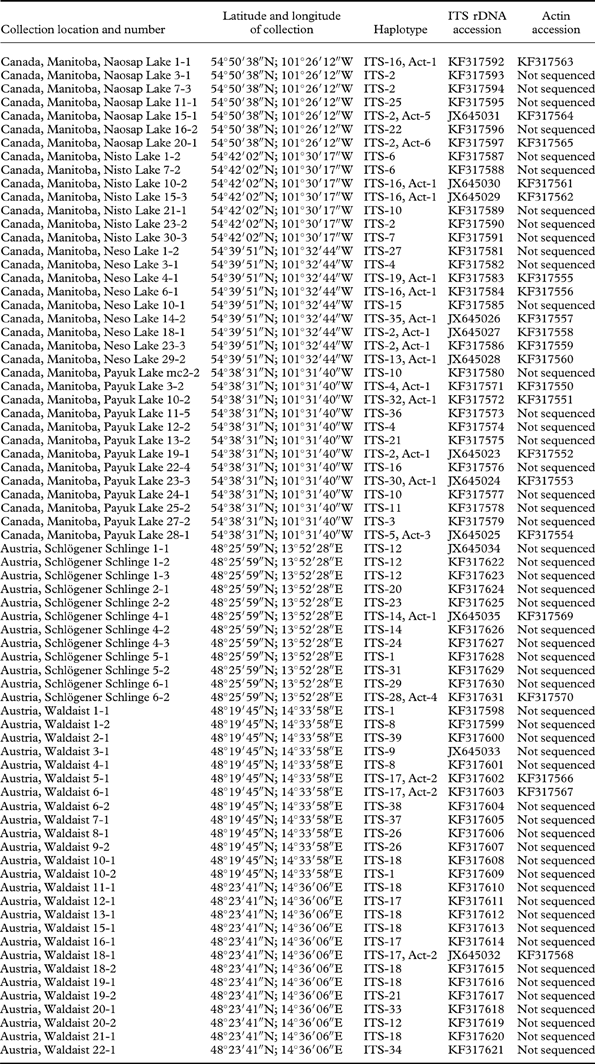
Collections of Dermatocarpon luridum included 36 samples from four lakes in west central Manitoba, Canada, and 38 samples from two river locations in Upper Austria, Austria, making a total of 74 samples (Table 1; Fig. 1). The Manitoba lakes comprise part of the Mistik Creek watershed flowing south from Naosap Lake 54°50·5′N to Payuk Lake at 54°38·5′. Twelve other lakes, including Nisto and Neso Lakes, receive and discharge water in the watershed. The Austrian Waldaist is a river system that is ultimately a contributor to the River Danube, and it also flows from north to south. Topographical relief results in a relatively steep stream gradient with rapid water flow. Habitats on both continents experience fluctuating water levels, and water movement by water flow in Austria and wave action with flow through the watershed in Manitoba; both were on granite boulders along the margin of water bodies and within the water bodies; and both were in sites that were partially shaded for a portion of the day. The forest surrounding the water body consisted of mixed broadleaf and conifer in Manitoba, and was also mixed broadleaf and conifer in Austria. While ‘population’ for this study refers to a geographical collection site representing each of the four lakes in Manitoba and the three sites along the two river systems in Austria, different definitions were assessed (see Table 3). Even though free-living and shared algal strains may be compatible with D. luridum for lichenization, the only strain that cannot be disputed as being available and compatible is the strain which is lichenized with D. luridum. Dry lichen thalli were moistened with water prior to scraping the thalli off rock surfaces, which facilitated collection of intact thalli. The lichen vouchers were air-dried and processed for storage in the cryptogamic division of the University of Manitoba herbarium (WIN), Winnipeg, Manitoba, Canada.
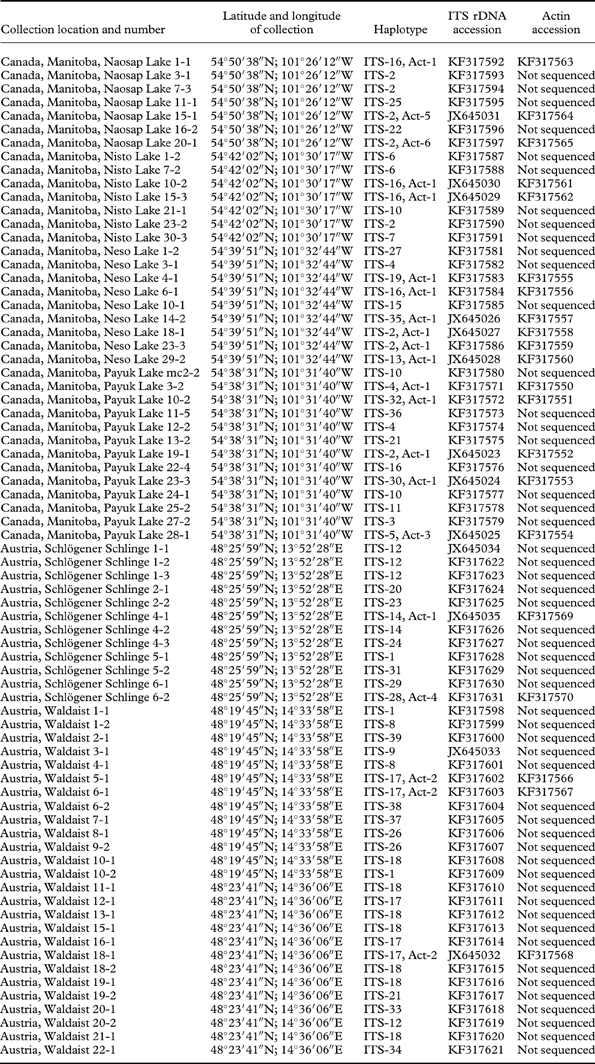
Collection information for specimens of the lichen Dermatocarpon luridum and the accession numbers for the ITSrDNA and actin gene sequences of the algal symbiont.
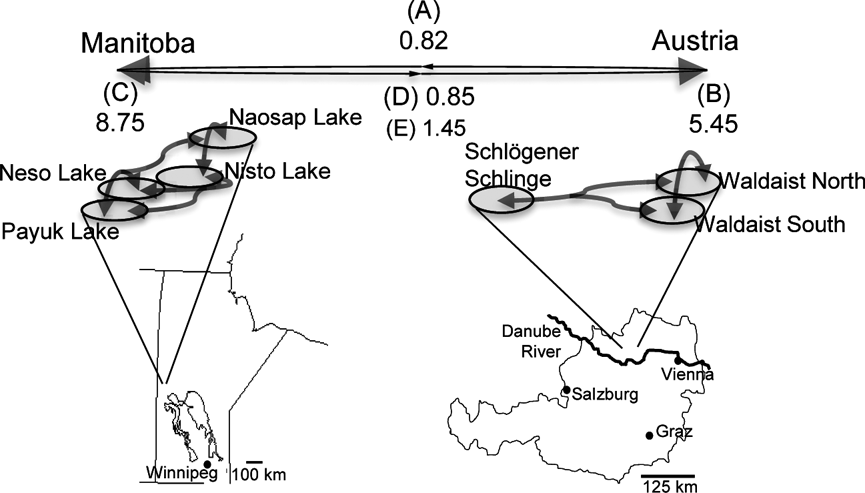
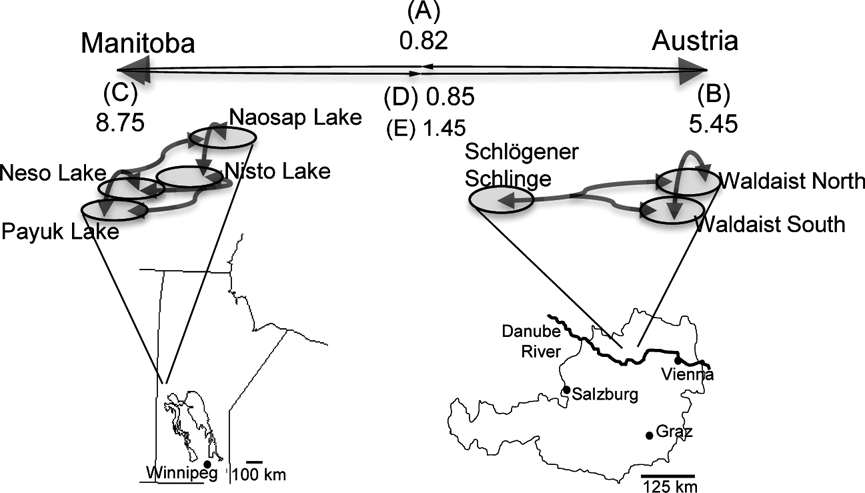
Map of Manitoba, Canada, and Austria showing locations of collection sites, and the average estimated migration rate within and between Manitoban and Austrian collection sites. A, migration between continental populations based on ITS data only; B, migration within Upper Austrian sites using ITS data only; C, migration between Manitoban sites based on ITS data only; D, migration within Manitoban sites based on actin data only; E, migration within Manitoban sites based on combined ITS/actin data. Averages were calculated from the Nm values. The lines with arrow heads between populations indicate gene flow.
DNA extraction, amplification, and sequencing
Total genomic DNA was extracted from whole lichen thalli, or in a few cases axenic algal cultures of Diplosphaera chodatii [as described in Fontaine et al. (Reference Fontaine, Beck, Stocker-Wörgötter and Piercey-Normore2012), using methods in Stocker-Wörgötter (Reference Stocker-Wörgötter, Kranner, Beckett and Varma2002) and Stocker-Wörgötter & Hager (Reference Stocker-Wörgötter, Hager and Nash2008)], and using a modified extraction protocol from Grube et al. (Reference Grube, DePriest, Gargas and Hafellner1995). Algal cultures were established from each of the Manitoba and Austrian populations, and the identification was kindly confirmed by A. Beck (Botanische Staatssammlung München, Germany; see Fontaine et al. Reference Fontaine, Beck, Stocker-Wörgötter and Piercey-Normore2012). The ITS rDNA of 74 D. chodatii samples, and the actin gene from a subset of 21 samples, was amplified by Polymerase Chain Reaction (PCR). Initially, 20 µl amplification reactions were used to determine the optimal DNA concentration for PCR. In order to ensure enough PCR product (15–30 ng µl–1) could be obtained for sequencing, four to eight replicate 20 µl reactions were performed and combined for purification. One 20 µl reaction consisted of 5–25 ng of genomic DNA, 1× PCR buffer [50 mM KCl; 100 mM Tris-HCl (pH 8·3)], 2·0 mM MgCl2, 200 µM of each dNTP, 0·5 µM of each primer, and 2 units of Taq DNA Polymerase (Invitrogen, Burlington, ON, Canada).
The ITS gene was amplified using the algal-specific forward primer STICHO-ITS-F-5' (Fontaine et al. Reference Fontaine, Beck, Stocker-Wörgötter and Piercey-Normore2012) with the universal reverse primer ITS4-3' (White et al. Reference White, Bruns, Lee, Taylor, Innis, Gelfand, Sninsky and White1990). The actin gene was amplified using the primer combination Act1T-5' and Act4T-3' (Kroken & Taylor Reference Kroken and Taylor2000). All amplifications were performed using a Biometra T-Gradient thermal cycler (Fisher Sci, Nepean, ON, Canada). The PCR cycle used to amplify the ITS was accomplished with an initial denaturation of the DNA at 94°C for 3 min; then 30 cycles of denaturation at 94°C for 1 min, annealing at 58·5°C for 35 s, and extension at 72°C for 45 s; followed by 6°C soak. For the actin gene, amplification was performed with an initial denaturation of the DNA at 94°C for 3 min; then a touchdown cycle, which consisted of 94°C for 1 min, annealing at 63°C for the first two cycles and dropping by 1°C to continue with two cycles at each degree, a final annealing temperature of 58°C for 25 cycles, and extension at 72°C for 45 s; followed by 6°C soak. Precipitation, purification, and quantification of the PCR product were performed according to the methods outlined in Fontaine et al. (Reference Fontaine, Beck, Stocker-Wörgötter and Piercey-Normore2012). Preparation of product for sequencing also followed that of Fontaine et al. (Reference Fontaine, Beck, Stocker-Wörgötter and Piercey-Normore2012) and the DNA was sequenced using BigDye 3.1 on a 3130 Genetic Analyzer (Applied Biosystems, Foster City, CA, USA).
Data analysis
All nucleotide sequences obtained for this experiment were edited using Sequencher v. 4.8 (Gene Codes Corporation, Ann Arbor, MI, USA). The alignment lengths for the ITS and actin gene sequences were 682, and 528 base pairs, respectively. However, because many of the ITS sequences (n=74) differed in their lengths, the 5′ and 3′ ends consisted of varying amounts of missing data (missing nucleotides). Therefore, sequences were truncated at the 5′ and 3′ ends to ensure all sequences were of the same length and missing data was absent. The final ITS rDNA and actin sequence alignments were 618bp and 528bp, respectively. Thirteen of the ITS rDNA sequences were derived from Fontaine et al. (Reference Fontaine, Beck, Stocker-Wörgötter and Piercey-Normore2012).
The ITS rDNA and actin nucleotide sequences were subjected to multiple alignment in ClustalX (Thompson et al. Reference Thompson, Gibson, Plewniak, Jeanmougin and Higgins1997). The ITS rDNA phylogenetic analysis was conducted using Neighbour-Joining (NJ) and Maximum Parsimony (MP) in PAUP* 4.0b10 (Swofford Reference Swofford2003), and Maximum Likelihood (ML) in MEGA version 5 (Tamura et al. Reference Tamura, Peterson, Peterson, Stecher, Nei and Kumar2011). Each alignment was exported in nexus format and for the Neighbour-Joining (NJ) analysis, the Tamura-Nei plus gamma model was used. The ML analysis was performed using parameters including uniform rates among sites, the Nearest Neighbour Interchange (NNI) heuristic method, all gaps were treated as missing data, and the Kimura 2-parameter model. The MP analysis was performed using parameters including tree bisection and reconnection (TBR) branch swapping, heuristic searches using 1000 random addition replicates and bootstrap searches of 500 resamplings (Felsenstein Reference Felsenstein1985). Bootstrap was carried out using the MP option in PAUP, and values ≥70 are reported in the phylogeny. The ITS and actin nexus files were analyzed within TCS (Clement et al. Reference Clement, Posada and Crandall2000) for haplotype abundances, using the 5th state criteria where gaps were treated as a fifth state rather than missing data, and the probability of parsimony was set at 95%. The ITS rDNA alignment had 2 gaps of 5–8 spaces, 3 gaps of 1 space, and 2 gaps of 2 spaces. The actin gene alignment had 1 gap of 5 spaces.
The genetic distances of nucleotide sequences were calculated within GenAlEx following Excoffier et al. (Reference Excoffier, Smouse and Quattro1992). To test for isolation-by-distance, a Mantel test was implemented within GenAlEx v. 6.5 b3 (Bohonak Reference Bohonak2002). This test is used to assess the correlation strength of pairwise genetic distances and pairwise geographical distance. Global positioning (GPS) coordinates were converted from degrees, minutes and seconds to universal transverse mercator (UTM) and again to kilometres (km) to generate the pairwise geographical distances between sites for the Mantel Test. Analysis of genetic diversity was also carried out using GenALEx v. 6.5 b3 (Peakall & Smouse Reference Peakall and Smouse2006, Reference Peakall and Smouse2012) in the form of analysis of molecular variance (AMOVA) and ϕPT fixation index (analogous to FST fixation index). For all AMOVA analyses, 999 permutations were used.
The data sets were analyzed in two ways: the first to assess variation and differences in structure between Manitoba, Canada and Upper Austria, Austria using ITS rDNA; and the second to assess variation and structure within Manitoba, Canada using actin gene sequences. The Manitoba populations were also assessed using the ITS rDNA data alone and in combination with actin genes (results not shown), but the results revealed similar patterns of genetic diversity. To assess variation between North America and Europe the ITS rDNA sequence data were segregated in five ways (see Table 3): 1) two regions and seven populations were defined with Manitoba and Austria representing the two regions, and Payuk Lake, Neso Lake, Nisto Lake and Naosap Lake, Schlögener Schlinge, Waldaist South (collection sites 1–10) and Waldaist North (collection sites 11–22) representing seven different populations; 2) two regions and three populations, with Manitoba and Austria representing the two regions, and the four lakes within Manitoba representing one population, and within Austria, Schlögener Schlinge and Waldaist North and South representing two populations; 3) one region and seven populations, with Manitoba and Austria combined into a single region, and each of the lakes within Manitoba and Austria representing a population for a total of seven populations; 4) one region and two populations, with Manitoba and Austria representing one region, while within Manitoba, the four lakes represent one population, and within Austria, Schlögener Schlinge and Waldaist (North and South sites) represent one population; and lastly 5) Manitoba and Austria represented as a single region, and within Manitoba, the four lakes representing one population, and within Austria, the three sites representing one population.
To assess the variation within Austria alone, the ITS data were categorized for analysis as follows: 1) Schlögener Schlinge and Waldaist represent two regions, where Schlögener Schlinge is also a population, and Waldaist has two populations (North and South sites); 2) all Austrian sites are part of one region broken into three populations [Schlögener Schlinge, Waldaist (North) and Waldaist (South)]; and 3) all Austrian sites are part of one region broken into two populations (Schlögener Schlinge and Waldaist).
The actin gene sequences were used to assess population structure within Manitoba and the data were categorized as one region with four populations (each lake). The actin data set consisted of 16 samples from Manitoba. When the five Upper Austrian samples were added to the analyses (n=21), the number of regions and populations was set to two, reflecting the Waldaist and Schlögener Schlinge populations.
Fixation index (ϕ) scores vary from three (ϕRT, ϕPR, and ϕPT), when two regions were declared, to two (ϕPR, and ϕPT) when one region was declared. ϕRT describes variation among regions, ϕPR describes variation among populations, and ϕPT describes variation within populations. Euclidean pairwise ϕPT scores were also obtained from the AMOVA analyses. To determine significance (P-values) for the scores of the ϕ statistics and the pairwise ϕPT scores, an alpha-value of 0·05 was used.
Finally, ϕ scores were used within the GenAlEx v. 6.5 b3 software to estimate the rate of migration per generation among populations, Nm (rate of migration between populations relative to the product of the effective population size). N is the effective population size, m is the effective proportion of immigrants, and ϕ (analogous to FST ) is the fixation index, a way of measuring variation in allele frequencies among populations. Values of Nm >1 suggest that there is enough gene flow to negate the effects of genetic drift, and Nm values >4 imply that the population or populations belong to one panmictic (randomly mating) population (Wright Reference Wright1931). All nucleotide sequences have been deposited in the NCBI GenBank database (Table 1).
Results
Genetic variation of Diplosphaera chodatii
A total of 74 ITS rDNA gene sequences were obtained for genetic structure analysis of Diplosphaera chodatii photobionts in North America and Europe. Thirty-six nucleotide sequences were obtained from North America, while 38 nucleotide sequences were obtained from Europe. A subsample of 21 actin gene sequences, 16 from Canadian samples and 5 from Austrian samples, were also obtained (Table 1).
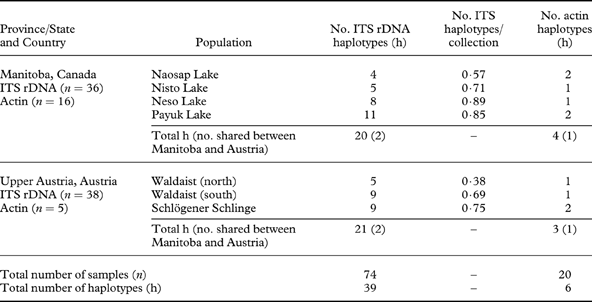
The total number of haplotypes observed in the ITS rDNA data set (n=74) was 39, where 20 different haplotypes were found from the North American and 21 haplotypes from the European populations, respectively, and two ITS haplotypes shared between the two continents (Table 2). The total number of haplotypes in the actin data set was six, four in North America and three in Europe. One of the six haplotypes was shared between the two continents (Table 2). The largest number of ITS rDNA haplotypes within the North American collection sites was 11 haplotypes from Payuk Lake, and the smallest number was four from Naosap Lake. Four haplotypes were shared among all four sites. Payuk Lake shared two haplotypes with Neso Lake, two with Nisto Lake, and one with Naosap Lake. Neso Lake also shared one haplotype with Nisto Lake, and two with Naosap Lake. Lastly, Nisto Lake shared two haplotypes with Naosap Lake. A total of 21 ITS rDNA haplotypes in 38 Diplosphaera chodatii samples from Austrian were obtained (Table 2). The number of haplotypes for Waldaist South (n=13) and Waldaist North (n=13), were nine and five, respectively (Table 2). Two haplotypes are shared between the north and south collection sites. Nine haplotypes were reported from 12 samples within the Schlögener Schlinge location. Two of the haplotypes were shared with the Waldaist locations.
The number of haplotypes for the algal ITS rDNA and actin nucleotide sequence data sets representing lichen samples collected in Manitoba and Austria.
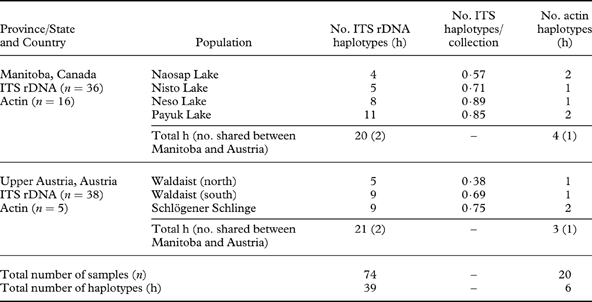
The actin sequence in this study is most similar to the beta-actin gene of Chlorella ellipsoidea (AB053215; e-score 1e-47; 89% identity in 159 bases), based on a BLASTn search in NCBI GenBank. A total of four actin haplotypes were observed from the 16 samples collected within Manitoba (Table 2). Payuk Lake and Naosap Lake had two actin haplotypes, and Neso Lake and Nisto Lake both had one actin haplotype each. All Payuk and Naosap actin haplotypes are unique to those lakes, while the single haplotype observed in each of Neso Lake and Nisto Lake was identical. There were three actin haplotypes in the five samples from Austria and one was shared with those from Canada. The average number of haplotypes per collection increased from north to south, the same direction as the water flow on both continents.
Genetic structure of Diplosphaera chodatii
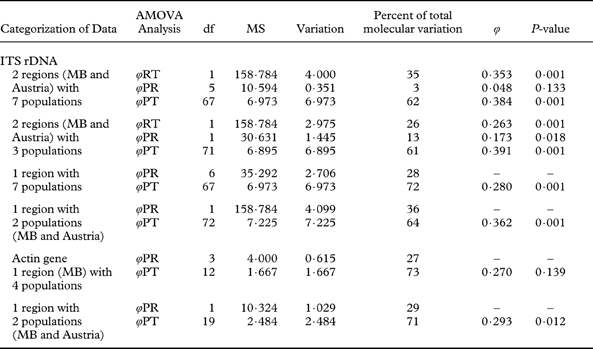
The AMOVA results for ITS rDNA were significant (P<0·05) for all population categories (except one), suggesting some genetic differentiation and, therefore, low levels of gene flow among populations (Table 3). The non-significant AMOVA (P=0·133) occurred within regions under the population scenario defining ‘two regions and seven populations’, suggesting higher levels of gene flow. The majority of molecular variation was found within populations (ϕPT), ranging from 61% to 72% depending on how the data were categorized for analysis (Table 3). Variation among populations within regions (ϕPR) fluctuated more extensively than that within populations, ranging from 3% to 36%. The variation between regions (ϕRT) was 26%–35% (Table 3). Fixation index (ϕ) scores for the analysis between regions were 0·353 and 0·263 (P=0·001) for two regions seven populations, and two regions three populations, respectively (Table 3). However, for the same population categories, the ϕ score for the analysis of within regions was lower, 0·048 (P=0·133) and 0·173 (P=0·018), suggesting lower levels of gene flow within regions than between regions. The highest levels of gene flow are inferred within populations (0·384 and 0·391). Similar high levels of gene flow within populations are also reported for the other two categories of population segregation (Table 3). A second locus, the actin gene, was also used to estimate AMOVA and ϕ statistics in two ways: 1) the actin data set for Manitoba samples (n=16), and each lake represents a population (1 region with 4 populations), and 2) the same actin data set for Manitoba samples in addition to five Austrian actin sequences [1 region with 2 populations (Manitoba and Austria)]. For the first analysis, the AMOVA revealed that 27% of the actin molecular variation within Manitoba exists among populations (within regions), and 73% of the actin molecular variation occurs within populations (Table 3). The ϕPT is 0·270 (P=0·139), suggesting genetic differentiation between these four populations within Manitoba. The AMOVA analysis that includes both Manitoba and Austrian samples shows that the majority of the variation is within populations (71%), and less variation among populations (29%) (Table 3). The ϕPT score (0·293; P=0·012) suggests genetic differentiation, which is consistent with the results of the ITS.
Analysis of molecular variance (AMOVA) based on ITS rDNA sequence data representing 74 Diplosphaera chodatii samples; 36 collected in Manitoba, Canada, and 38 collected in Austria. P-value estimates are based on 999 permutations (significant P-values are less than 0·05).
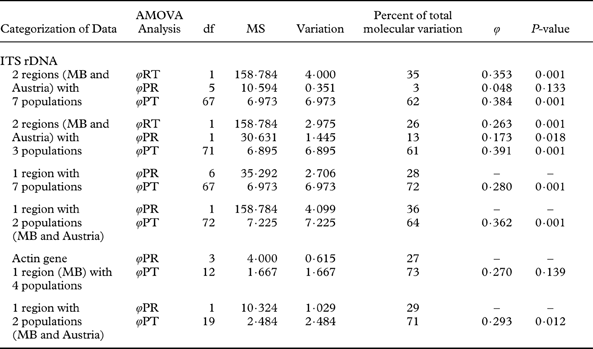
df=degrees of freedom, MS=mean squared deviations, and ϕ=Phi. See methods for data categorization; ϕRT=among regions, ϕPR=among populations (within regions), and ϕPT=within populations.
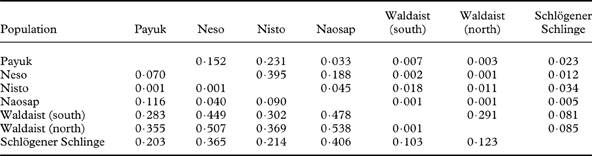
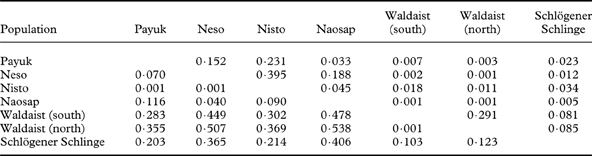
Pairwise ϕPT values between populations, as defined by seven lakes, are provided in Table 4. ϕPT scores between the Manitoba lakes show two comparisons with a significant difference, suggesting genetic differentiation, and the others had low levels of gene flow occurring between lakes. The ϕPT scores between the Austrian lakes also show low levels of gene flow where none of the comparisons were significantly different at P=0·05. In this case, the highest ϕPT value is 0·123 (P=0·085), suggesting that gene flow is more common between these sites than it is between Manitoba lakes. Pairwise ϕPT values between continents show that all of the P-values are significant (Table 4).
Pairwise ϕPT values (below diagonal) and associated AMOVA P-values (above diagonal; P<0·05) representing the samples collected at each population in Manitoba, Canada (Payuk, Nisto, Neso, and Naosap Lakes), and Upper Austria, Austria [Waldaist (south), Waldaist (north), and Schlögener Schlinge] derived from ITS rDNA sequence data.
The Mantel test does not support that differentiation among the four lakes in Manitoba is attributed to isolation-by-distance (Rxy=0·159; P=0·288). Neither does it support that differentiation among the three lakes in Austria is supported by isolation-by-distance (Rxy=0·964; P=0·165). However, when the seven lakes are examined, the Mantel test does support isolation-by-distance (Rxy=0·900; P<0·01).
Estimated migration rates were calculated for all the different categorizations of data sets into regions and populations presented in the various AMOVA tables. The mean of all these estimated migration rates are presented in Fig. 1. Migration values between lakes within Manitoba and Austria based on ITS alone are the highest at Nm=8·75 and 5·45, respectively. Migration rates between continental populations are Nm=0·82. Migration rate based on the actin nucleotide sequences between lakes within Manitoba is 0·85. The rate for Austria was not determined since it had only 5 actin sequences. The migration within Manitoban sites based on combined ITS/actin data is 1·45.
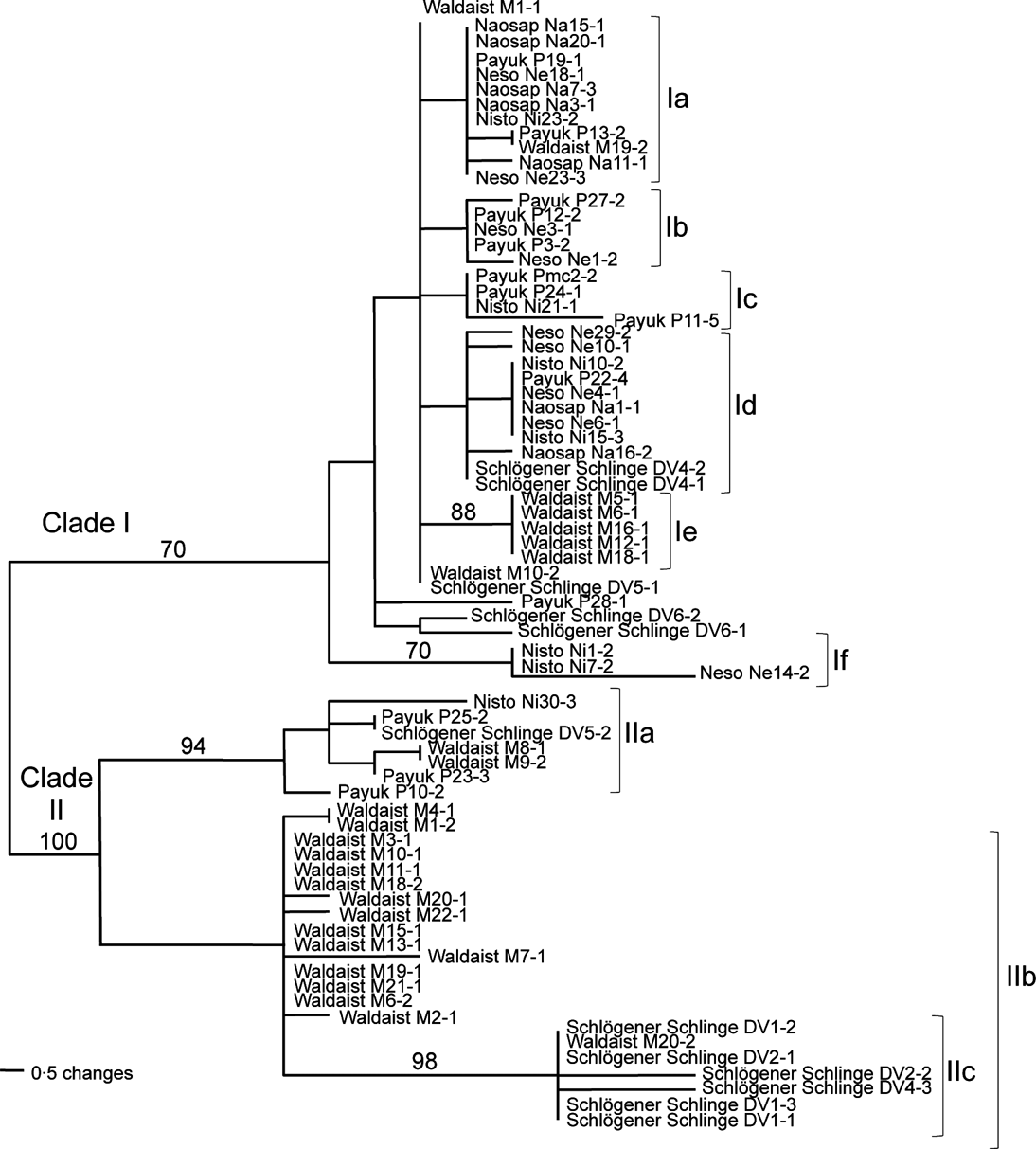
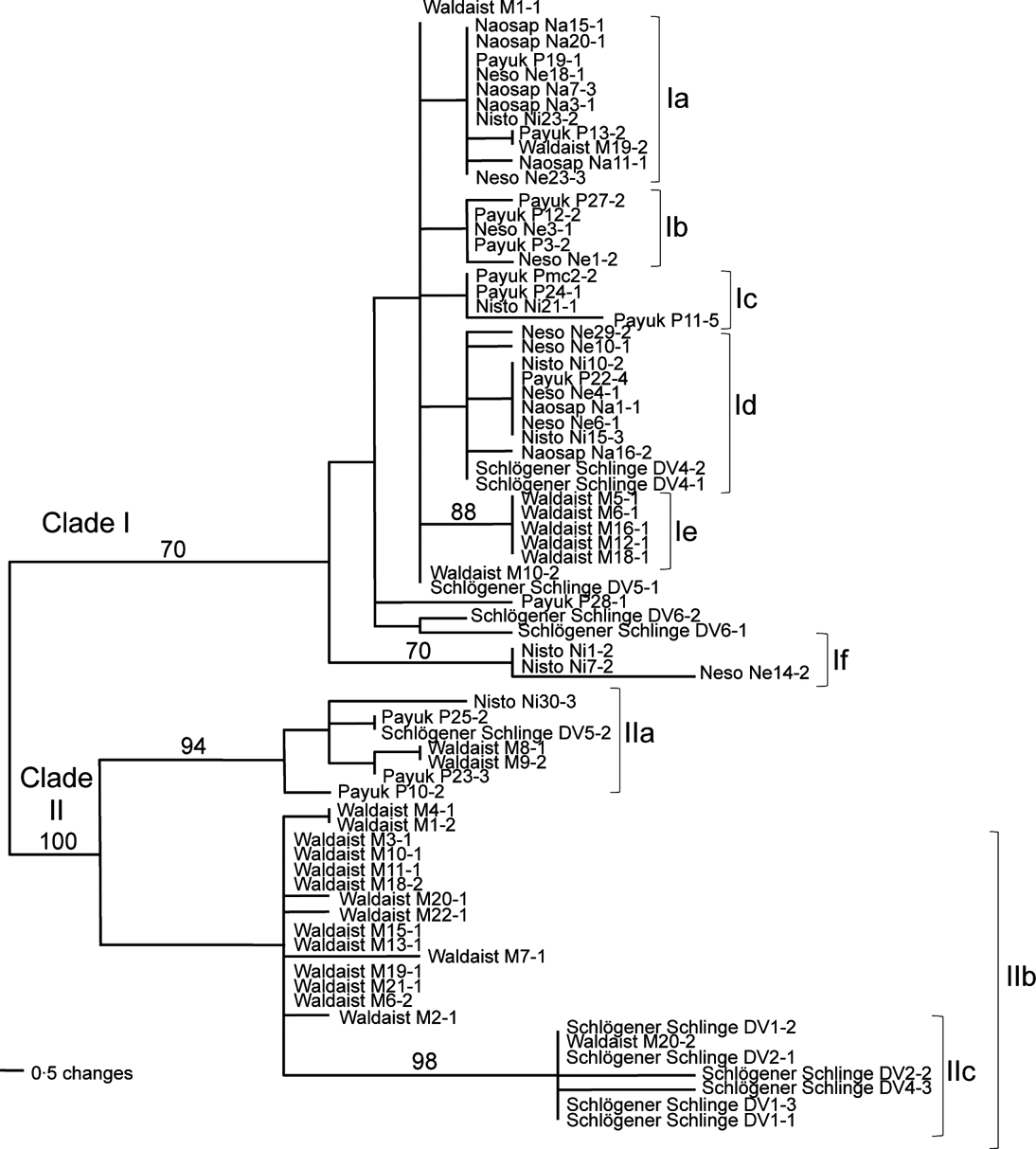
The NJ cluster analysis and the ML phylogeny show the same topology (trees not shown) as the MP phylogeny, with the exception of some minor taxon swapping in the ML tree. The ML tree showed taxon swapping within clade Ib, members of clade Ic collapsed to become part of the unresolved comb within clade I, and three taxa within clade Id formed a separate clade, but all swapping remained within clade I. Clade II was the same for all types of analyses. The MP phylogeny shows relationships among samples collected in North America and Europe, based on ITS rDNA nucleotide sequences (Fig. 2). The MP phylogram is comprised of two large clades (I and II) showing 70% and 94% bootstrap support. The tree topology can be partially explained by geographical distribution, where 32 North American and 13 European samples are in clade I (Fig. 2), and 25 European samples and 4 North American samples are in clade II. Six smaller clusters within clade I have been identified. Clades Ia, Ib, Ic, and Id have less than 70% support, while clades Ie and If have 88% and 70% bootstrap support, respectively. While five European samples fall within clade Ie, the remaining eight samples are distributed among the North American samples. Three smaller clades within clade II have been identified, with clades IIa and IIc showing 94% and 98% support, respectively. Clade IIb has less than 70% support. All four North American samples are in clade IIa with three European samples.
Midpoint rooted Maximum Parsimony phylogeny, constructed using 74 Diplosphaera chodatii ITS rDNA sequences; 36 from Manitoba, Canada, and 38 from Upper Austria, Austria. Bootstrap values ≥70% are shown above the branch internodes. Refer to Table 1 for collection site and collection numbers for each of the 74 D. chodatii samples in the phylogram.
Discussion
Continental isolation of Diplosphaera chodatii populations
This study shows that there is significant genetic differentiation between the North American and European continents, suggesting a low level of gene flow in the photobiont, Diplosphaera chodatii. While higher levels of gene flow are inferred within continents, only one haplotype is shared between the two continents. The sharing of a single haplotype over a large distance may be explained by at least four possible scenarios, but they may not be mutually exclusive: 1) genetic differentiation may be attributable to considerable genetic drift as a result of isolation-by-distance (Wright Reference Wright1943); 2) recent gene flow may have occurred by means of a rare, but possible, long-distance dispersal event resulting in the sharing of one haplotype; 3) genetic mixing may have already been present from historical gene flow and the loss of shared haplotypes occurred over time through vicariance events; and 4) while an effort was made to ensure the habitats in which the lichen was collected was the same between continents, the possibility that the population differentiation was a result of habitat differences cannot be eliminated.
Isolation-by-distance was previously supported for photobiont populations of Lobaria pulmonaria (L.) Hoffm. (Walser et al. Reference Walser, Holderegger, Gugerli, Hoebee and Scheidegger2005) and Cetraria aculeata (Fernández-Mendoza et al. Reference Fernández-Mendoza, Domaschke, García, Jordan, Martín and Printzen2011; Domaschke et al. Reference Domaschke, Fernández-Mendoza, García, Martín and Printzen2012). If gene flow in green algae is assumed to follow the ‘everything is everywhere’ hypothesis because of their small organismal size (Finlay Reference Finlay2002), long distance dispersal would be expected to be common. However, a view of a more restricted distribution of microbial eukaryotes has been gaining support (Luo et al. Reference Luo, Pflugmacher, Pröschold, Walz and Krienitz2006; Foissner Reference Foissner2008; Evans et al. Reference Evans, Wortley, Simpson, Chepurnov and Mann2008), but less is known about terrestrial green algae (Rindi et al. Reference Rindi, Allali, Lam, López-Bautista, Maletta and Rescigno2009) and even less about lichen algae (Werth Reference Werth2011). The genetic structure and diversity of D. chodatii support the more restricted distribution and limited dispersal of algae.
Infrequent long distance dispersal and colonization events were suggested for the photobiont of other lichen species (Högberg et al. Reference Högberg, Kroken, Thor and Taylor2002; Walser et al. Reference Walser, Holderegger, Gugerli, Hoebee and Scheidegger2005). Diatom populations are thought to undergo clonal reproduction within lakes and more variation between lakes (Soudek & Robinson Reference Soudek and Robinson1983; Casteleyn et al. Reference Casteleyn, Evans, Backeljau, D'hondt, Chepurnov, Sabbe and Vyverman2009). In contrast, Daphnia magna showed higher genetic diversity within lakes (Walser & Haag Reference Walser and Haag2012). If Diplosphaera chodatii is mainly dispersed by water, the geographical barriers of land and salt water between Manitoba and Austria would limit its dispersal (Hanski Reference Hanski, Hanski and Gilpin1997). However, D. chodatii can withstand significant levels of desiccation and nutrient stress (Zhang & Wei Reference Zhang and Wei2011), supporting the possibility of long-distance dispersal through the jet stream. This study provides evidence for rare long-distance dispersal events for lichenized D. chodatii.
The genetic differentiation in D. chodatti may also be explained by historical gene flow and loss of haplotypes through long-term isolation after vicariance events (Walser et al. Reference Walser, Holderegger, Gugerli, Hoebee and Scheidegger2005; Galloway Reference Galloway and Nash2008). Vicariance events were also used to explain the genetic differentiation of a red alga (Hommersand & Fredericq Reference Hommersand, Fredericq, Chapman, Anderson, Vreeland and Davison2003) and lichen fungi (Printzen et al. Reference Printzen, Ekman and Tønsberg2003). Other studies on gene flow in lichens focused mainly on the fungal partner (Palice & Printzen Reference Palice and Printzen2004; Walser et al. Reference Walser, Holderegger, Gugerli, Hoebee and Scheidegger2005; Widmer et al. Reference Widmer, Dal Grande, Cornejo and Scheidegger2010). Palice & Printzen (Reference Palice and Printzen2004) hypothesized an absence of long-distance dispersal and long-term isolation of the populations on each continent. If this same explanation can be used for the pattern in D. chodatii, the single haplotye shared between continents may have resulted from historical gene flow.
Gene flow of D. chodatii among populations within continents
Inferred gene flow between algal populations (defined as each water body) within each of the two continents was greater than gene flow between continents. The geographical scale within continents was similar to the scale in other studies that provided evidence for photobiont gene flow for the lichens Ramalina menziesii Taylor (Werth & Sork Reference Werth and Sork2010) and Evernia mesomorpha Nyl. (Piercey-Normore Reference Piercey-Normore2006). The high migration rate between Manitoba lakes (Rxy=8·75; Fig. 1) and the sharing of haplotyes among lakes suggests that migration occurs among lakes but it is not known if it occurs by wind or water. If the algae are dispersed by water, the pattern of increasing number of haplotypes with direction of water flow can be explained by the four lakes belonging to the same watershed. A similar pattern is present in the Waldaist river system (Table 2). Further study is needed to reveal the level of genetic diversity in lakes outside the watershed but in close geographical proximity. In Austria, gene flow is higher between the two Waldaist sites than between Waldaist and Schlögener Schlinge. This supports isolation-by-distance for this system, where gene flow is occurring within the two Waldaist sites that are connected by a river and are geographically closer to one another than they are to the Schlögener Schlinge site.
Results from studies on the photobiont population structure of epiphytic lichens that grow on trees such as Trebouxia decolorans Ahmadjian (from Ramalina menziesii; Werth & Sork Reference Werth and Sork2010) and Dictyochloropsis reticulata (Tscher.-Woess) Tscher.-Woess (from Lobaria pulmonaria; Walser et al. Reference Walser, Holderegger, Gugerli, Hoebee and Scheidegger2005), were consistent with the regional analyses of Diplosphaera chodatii in this study. Other studies showed that photobiont diversity was high in Ramalina sinensis Jatta (Francisco de Oliveira et al. Reference Francisco de Oliveira, Timsina and Piercey-Normore2012) over 400 km, but structured in Evernia mesomorpha over a 4 km range (Piercey-Normore Reference Piercey-Normore2006). Piercey-Normore (Reference Piercey-Normore2004) showed that photobiont diversity differed for three species of Cladonia distributed among the same habitats and locations, suggesting that selection by fungal species may also play a role in the distribution of lichenized algae. In Trebouxia decolorans associated with Ramalina menziesii growing on three different tree species, it was suggested that substratum ecology played a role in the availability of photobiont haplotypes within a small geographical scale (Werth & Sork Reference Werth and Sork2010). The results of Yahr et al. (Reference Yahr, Vilgalys and DePriest2006) also revealed that habitat is a primary factor for the differentiation of photobiont populations associating with Cladonia subtenuis (Abbayes) Mattick. These results would imply that substratum features and fungal selection of the algal partner may influence photobiont haplotype diversity, and thus population structure of Diplosphaera chodatii in association with D. luridum.
Mode of dispersal
Dispersal of the photobiont associated with Dermatocarpon luridum can occur only by fragmentation since D. luridum does not produce specialized vegetative propagules. However, it is not known if the common and widely distributed free-living D. chodatii may be a suitable strain for association with D. luridum. The mode of photobiont dispersal may influence population structure (Yahr et al. Reference Yahr, Vilgalys and DePriest2004, Reference Yahr, Vilgalys and DePriest2006; Ohmura et al. Reference Ohmura, Kawachi, Kasaie, Watanabe and Takeshita2006; Werth & Sork Reference Werth and Sork2010; Peksa & Skaloud Reference Peksa and Skaloud2011) where vegetative propagules will provide a vehicle for dispersal that is not available to free-living algae but will not likely disperse long distances. Dispersal of D. chodatii may also be facilitated by exchange of algal partners from other lichens. Close relatives of D. luridum, such as members of Endocarpon, Staurothele and Verrucaria, also associate with D. chodatii (Thüs et al. Reference Thüs, Muggia, Pérez-Ortega, Favero-Longo, Joneson, O'Brien, Nelsen, Duque-Thüs, Grube and Friedl2011; Fontaine et al. Reference Fontaine, Beck, Stocker-Wörgötter and Piercey-Normore2012), making the potential for algal exchange between species' fragments a feasible method for acquiring different haplotypes (Ohmura et al. Reference Ohmura, Kawachi, Kasaie, Watanabe and Takeshita2006; Piercey-Normore Reference Piercey-Normore2006; Fernández-Mendoza et al. Reference Fernández-Mendoza, Domaschke, García, Jordan, Martín and Printzen2011). If these close lichen relatives disperse their ascospores with D. chodatii, living within the hymenial layer of the perithecia, a suitable photobiont will be commonly available to the fungal spore.
Sampling limitations
The higher proportion of haplotypes in the nuclear ITS rDNA than the actin gene of D. chodatii suggested that the ITS rDNA provides more variation than the actin gene for a photobiont population study. The ITS rDNA has been a standard population marker in studies on lichen algae (Kroken & Taylor Reference Kroken and Taylor2000; Yahr et al. Reference Yahr, Vilgalys and DePriest2004, Reference Yahr, Vilgalys and DePriest2006; Ohmura et al. Reference Ohmura, Kawachi, Kasaie, Watanabe and Takeshita2006; Piercey-Normore Reference Piercey-Normore2006; Doering & Piercey-Normore Reference Doering and Piercey-Normore2009; Werth & Sork Reference Werth and Sork2010; Fernández-Mendoza et al. Reference Fernández-Mendoza, Domaschke, García, Jordan, Martín and Printzen2011; Domaschke et al. Reference Domaschke, Fernández-Mendoza, García, Martín and Printzen2012). The actin gene is a single copy nuclear gene that provided greater resolution than the ITS rDNA between species of algae in the genus Asterochloris (Skaloud & Peksa 2010), and showed divergent introns between clades of Evernia mesomorpha associated with members of Trebouxia jamesii (Piercey-Normore 2009). However, actin has fewer haplotypes than ITS rDNA in this study with members of Diplosphaera chodatii. This may be explained by the actin gene being most similar to the beta-actin of Chlorella ellipsoidea, with no evidence for an intron, rather than the alpha-actin with an intron, which is used in many studies on lichen algae. More investigation on the algal actin gene variation would be needed for D. chodatii. In some samples, the ITS rDNA variation was greater than the actin variation, and in other samples the actin variation was greater than the ITS rDNA variation. This may be explained by algal recombination, as in Letharia vulpina (Kroken & Taylor Reference Kroken and Taylor2000). Clade IIa (Fig. 2) shows samples from both North America and Europe, suggesting that this may be a recombining lineage.
Studies on sampling effort suggest that a minimum number of 20 lichen thalli would be required from a population in order to obtain haplotype saturation of either symbiont (Lindblom Reference Lindblom2009), even though this study refers to lichen fungi. Domaschke et al. (Reference Domaschke, Fernández-Mendoza, García, Martín and Printzen2012) suggested “stopping rules”, to indicate the point at which additional sampling is unnecessary. However, this rule is suitable for studying species diversity (Magurran Reference Magurran2004) but it may not be suitable for genetic diversity (Domaschke et al. Reference Domaschke, Fernández-Mendoza, García, Martín and Printzen2012). Werth (Reference Werth2010) applied rarefaction methods to a microsatellite data set to determine the number of samples per population, across a larger geographical region, to adequately assess the allelic diversity of a species. She reported that 20 fungal and slightly more algal samples are needed per population; 25–30 populations and 300–400 samples in total would show most of the allelic diversity present. This study examined c. 20 samples per population, which should be adequate to show most of the diversity present within the two regions of populations examined. However, since the sampling of 74 specimens in total and seven populations (defined as water bodies) in this study under-represents the worldwide diversity present in D. chodatii, this study provides the first estimation of diversity in D. chodatii and has identified the areas where attention is needed in future studies of this species. These areas include: the vector of dispersal by water or wind; the compatibility and availability of free-living lineages of D. chodatii for lichenization; and the population genetic structure of the alga, regardless of the mycobiont association or free-living nature with a broader sampling regime.
In conclusion, this is the first investigation of population diversity for the photobiont associated with D. luridum. This study establishes that the ITS rDNA is a suitable marker to study the population structure of this alga, and that the actin gene also provides information with less variability. The study also provides the first evidence for this species to support gene flow within and between populations (defined as water bodies) of lichenized Diplosphaera chodatii, on a continent but not between continents, which supports the isolation-by-distance theory. Furthermore, a pattern of increased numbers of haplotypes with direction of water flow may be explained if algae are dispersed by water within these watersheds. Since this study examined only geographical regions from the widely distributed D. chodatii, there may also be multiple gene pools of D. chodatii that are evolving more or less independently from one another. Because the alga is globally distributed, these gene pools may include D. chodatii strains associated with D. luridum, with other lichen fungi, or as free-living populations in any geographical location outside the populations studied. While this lichenized algal population cannot be disputed as being available to D. luridum, because it is associated with D. luridum in all samples in this study, it can only be speculated that the D. chodatii strains associated with other lichen fungi or in a free-living state are available to D. luridum for lichenization. Further study on these other strains of D. chodatii is needed to clarify these questions.
The authors are grateful to C. Deduke (Canada), R. Türk, (Austria) and F. Priemetzhofer (Austria) for field assistance; G. Brunauer (Austria) for laboratory assistance; and A. Beck (Germany) for assistance with cultures and algal identification. Financial support was provided by the Natural Sciences and Engineering Research Council of Canada (NSERC) to M.P-N. and K. F., and FWF grants (Austrian Science Foundation) to E.S-W. P20887, P23570.