Introduction
Traditional conceptualizations of psychopathology presume that symptoms of mental disorders are reflective of underlying diseases. In this conceptualization, the co-occurrence or non-random clustering of symptoms is due to an underlying common cause (see Borsboom, Reference Borsboom2008; Schmittmann et al. Reference Schmittmann, Cramer, Waldorp, Epskamp, Kievit and Borsboom2013). Thus, an entity such as major depressive disorder (MDD) is hypothesized to cause sad mood, anhedonia, and insomnia in the same way that the smallpox virus causes pustules, fever, and headache (Fried, Reference Fried2015). The models employed to investigate psychopathology have assumed the common cause perspective of mental disorders. For example, reflective latent variable models of psychopathology, in which symptoms are indicators of an underlying latent variable, are consistent with a common cause perspective. Similarly, the use of sum scores to describe psychopathology severity assumes that symptoms are interchangeable indicators of the same underlying condition and can thus be summed to create a total score (see Fried & Nesse, Reference Fried and Nesse2015a , Reference Fried and Nesse b ).
Importantly, the common cause approach has the potential to obscure important differences between specific symptoms, as well as relationships among symptoms. For example, symptoms are differentially associated with impairments (Fried & Nesse, Reference Fried and Nesse2014), predisposing risk factors (Fried & Nesse, Reference Fried and Nesse2014) and neural substrates (e.g. Davidson et al. Reference Davidson, Pizzagalli, Nitschke and Putnam2002; Kapur et al. Reference Kapur, Phillips and Insel2012). Further, there is evidence that symptoms influence the development of other symptoms. For example, animal and human models suggest that restricted sleep is followed by depression and anxiety symptoms (e.g. Neckelmann et al. Reference Neckelmann, Mykletun and Dahl2007; Novati et al. Reference Novati, Roman, Cetin, Hagewoud, den Boer, Luiten and Meerlo2008; Baglioni et al. Reference Baglioni, Battagliese, Feige, Spiegelhalder, Nissen, Voderholzer and Riemann2011), and hopelessness prospectively predicts suicidal ideation (e.g. Beck et al. Reference Beck, Brown, Berchick, Stewart and Steer1990; Fawcett et al. Reference Fawcett, Scheftner, Fogg, Clark, Young, Hedeker and Gibbons1990). Similarly, the alleviation of one symptom may positively affect other symptoms. In individuals receiving treatment for depression, changes in one symptom have been found to predict changes in other symptoms the following week, independent of a general decrease in symptom severity (Bringmann et al. Reference Bringmann, Lemmens, Huibers, Borsboom and Tuerlinckx2015). One interpretation of this finding is that effective therapies target some symptoms first, which leads to downstream effects on other symptoms (Cramer et al. Reference Cramer, Waldorp, van der Maas and Borsboom2010). This interpretation directly conflicts with the common cause perspective. If symptoms directly interact, the assumption that the covariance among symptoms results from a common cause is not fully equipped to elucidate the structure of psychopathology.
The causal systems perspective (Borsboom, Reference Borsboom2008) describes the possibility that symptom co-occurrence is due to direct symptom-to-symptom relationships rather than a common cause. According to this perspective, ‘symptoms are constitutive of mental disorder, not reflective of it’ (McNally et al. Reference McNally, Robinaugh, Wu, Wang, Deserno and Borsboom2015, p. 2): in other words, ‘causal, meaningful relationships between symptoms not only exist and should be acknowledged, but in fact are the very stuff of which mental disorders are made’ (Borsboom & Cramer, Reference Borsboom and Cramer2013, p. 96). Thus, anhedonia, sad mood, and insomnia are not caused by an entity ‘depression’ in the same way that a brain tumor causes a headache. Rather, the causal systems perspective posits that symptoms directly influence each other and have their own genetic, neural, and psychological underpinnings.
Researchers have used network analysis to assess these symptom-symptom interactions. Network analysis, a set of procedures based on the modeling of dynamical systems (Barrat et al. Reference Barrat, Barthélemy and Vespignani2012), provides a visual depiction of the complex associations among symptoms. A tightly connected network with many strong connections among symptoms is considered a ‘riskier’ network because activation of one symptom can quickly spread to other symptoms, leading to more chronic symptoms over time (van Borkulo et al. Reference van Borkulo, Boschloo, Borsboom, Penninx, Waldorp and Schoevers2015). Network analysis also allows identification of highly ‘central’ or influential symptoms, defined by having, on average, strong connections with other symptoms. When a highly central symptom is activated (i.e. a person reports the presence of the symptom), it will influence other symptoms to become activated as well, maintaining the symptom network. Most relevant to the current study, recent work has supported the relative importance of sad mood and anhedonia in depression as these symptoms’ centrality indices rank the highest among all depression symptoms (e.g. Fried et al. Reference Fried, Epskamp, Nesse, Tuerlinckx and Borsboom2016a , Reference Fried, van Borkulo, Epskamp, Schoevers, Tuerlinckx and Borsboom b ; Fried & Nesse, Reference Fried and Nesse2014). Interestingly though, together, the symptoms from the Diagnostic and Statistical Manual of Mental Disorders (DSM; APA, 2013) criteria for depression are not more central than non-DSM depression symptoms (e.g. sympathetic arousal) (Fried et al. Reference Fried, Epskamp, Nesse, Tuerlinckx and Borsboom2016a , Reference Fried, van Borkulo, Epskamp, Schoevers, Tuerlinckx and Borsboom b ).
The present study
To date, most network studies have examined symptom relationships and centrality within a single disorder. However, network analysis may be particularly useful for understanding co-morbidity because it permits the identification of potential pathways from one disorder to another (see Cramer et al. Reference Cramer, Waldorp, van der Maas and Borsboom2010). We sought to extend the existing literature in several ways by examining the symptom network of one of the most precarious diagnostic boundaries, i.e. between MDD and generalized anxiety disorder (GAD), in a large psychiatric sample. We utilized recent tools that have been developed to examine the stability of cross-sectional networks, as well as developed new procedures for this. We also used a clinical database with complete symptom data. This is crucial because the only other study that has examined MDD and GAD symptoms relied on an instrument that contained ‘skip-out’ criteria (Cramer et al. Reference Cramer, Waldorp, van der Maas and Borsboom2010). Thus, failure to endorse core symptoms (e.g. sad mood or anhedonia for depression) led to skipping all other symptoms of that disorder, resulting in large amounts of missing data. Finally, no studies have examined whether the MDD and GAD network changes over the course of treatment.
Thus, we designed the current study with three main goals: (1) characterize the MDD/GAD symptom network structure in a psychiatric sample, (2) determine the stability of the network, and (3) test whether the network changed over the course of treatment. For Aim 1, we investigated the connectedness between symptoms, the centrality of different symptoms, and identified potential symptoms that link disorders. Based on prior results (e.g. Bringmann et al. Reference Bringmann, Lemmens, Huibers, Borsboom and Tuerlinckx2015; Fried et al. Reference Fried, Epskamp, Nesse, Tuerlinckx and Borsboom2016a , Reference Fried, van Borkulo, Epskamp, Schoevers, Tuerlinckx and Borsboom b ), we hypothesized that sad mood and anhedonia would exhibit high centrality among depression symptoms and that worry symptoms would be most central among anxiety symptoms. Similar to Cramer et al. (Reference Cramer, Waldorp, van der Maas and Borsboom2010), we predicted that symptoms appearing in the diagnostic criteria of both MDD and GAD would serve as pathways between symptoms of anxiety and depression. In particular, we expected sleep (Fawcett et al. Reference Fawcett, Scheftner, Fogg, Clark, Young, Hedeker and Gibbons1990; Durmer & Dinges, Reference Durmer and Dinges2005; Ferentinos et al. Reference Ferentinos, Kontaxakis, Havaki-Kontaxaki, Dikeos and Papadimitriou2009) and concentration (Davis & Nolen-Hoeksema, Reference Davis and Nolen-Hoeksema2000; Joormann & Gotlib, Reference Joormann and Gotlib2008; Stefanopoulou et al. Reference Stefanopoulou, Hirsch, Hayes, Adlam and Coker2014) to link other symptoms of depression and anxiety symptoms. For Aim 2, given our sample size, we expected the network edges representing the magnitude of association between symptoms and centrality indices to be stable. Finally, for Aim 3, we hypothesized that symptom networks created from data collected at pre- and post-treatment would have a stable structure. For example, a prior network analysis study showed that even as symptoms decreased overall, the most central symptoms remained the same (e.g. Robinaugh et al. Reference Robinaugh, LeBlanc, Vuletich and McNally2014). At the same time, a recent study showed that the correlations among depression symptoms increased strongly and consistently over time while patients improved in symptomatology (Fried et al. Reference Fried, Epskamp, Nesse, Tuerlinckx and Borsboom2016a , Reference Fried, van Borkulo, Epskamp, Schoevers, Tuerlinckx and Borsboom b ). Thus, we hypothesized that the interconnectedness or global strength of symptom associations would increase over the course of treatment, even as the network structure (i.e. centrality of specific symptoms) remained stable.
Method
Participants and treatment setting
Participants were receiving treatment for mood, anxiety, personality, and psychotic disorders at the Behavioral Health Partial Hospital Program at McLean Hospital (for a review of the treatment, see Beard & Björgvinsson, Reference Beard and Björgvinsson2013). Partial hospitals provide intensive treatment during the day with patients returning to their homes in the evening. The current study utilized self-report data collected in the routine clinical care of 1235 patients from July 2012 to July 2014 at admission and discharge. Missing data were handled with listwise deletion because typically participants were missing all items from one or both questionnaires. We excluded 206 subjects from admission data (final N = 1029) and 465 from discharge data (final N = 807; final N for both admission and discharge = 742). Data were collected using Research Electronic Data Capture (REDCap; Harris et al. Reference Harris, Taylor, Thielke, Payne, Gonzalez and Conde2009). Partners Healthcare Internal Review Board approved the study as exempt due to the use of a de-identified dataset.
Measures
The Mini International Neuropsychiatric Interview (MINI; Sheehan et al. Reference Sheehan, Lecrubier, Sheehan, Amorim, Janavs, Weiller, Hergueta, Baker and Dunbar1998) was administered by doctoral practicum students and clinical psychology interns with weekly supervision by a postdoctoral fellow. The MINI is a structured interview to assess DSM-IV Axis I disorders. It has strong reliability and validity in relation to the Structured Clinical Interview for DSM-IV (kappas range from 0.89 to 1.0; Sheehan et al. Reference Sheehan, Lecrubier, Sheehan, Amorim, Janavs, Weiller, Hergueta, Baker and Dunbar1998).
MDD and GAD symptoms were assessed via the Patient Health Questionnaire-9 (PHQ-9; Kroenke et al. Reference Kroenke, Spitzer and Williams2001) and the 7-item Generalized Anxiety Disorder Scale (GAD-7; Spitzer et al. Reference Spitzer, Kroenke, Williams and Löwe2006), self-report measures of depression and anxiety symptom severity, respectively, over the prior 2 weeks. Participants rated symptoms on a scale from 0 (not at all) to 3 (nearly every day). Both PHQ-9 and GAD-7 have demonstrated good psychometric properties (Kroenke et al. Reference Kroenke, Spitzer and Williams2001, Reference Kroenke, Spitzer, Williams, Monohan and Löwe2007; Spitzer et al. Reference Spitzer, Kroenke, Williams and Löwe2006; Löwe et al. Reference Löwe, Decker, Müller, Brähler, Schellberg, Herzog and Herzberg2008) and have been validated as severity measures in our partial hospital population (Beard & Björgvinsson, Reference Beard and Björgvinsson2014; Beard et al. Reference Beard, Hsu, Rifkin, Busch and Björgvinsson2016).
Analyses
Aim 1: Characterization of MDD/GAD symptoms network at admission.
Edges. In network parlance, symptoms are ‘nodes,’ and relationships between symptoms are ‘edges.’ To calculate the edges, we computed polychoric correlations between all items. Polychoric correlations estimate the association between two variables that are theorized to be continuous and normally distributed but are measured on ordinal scales. We estimated the network via a Graphical Gaussian Model (GGM; Lauritzen, Reference Lauritzen1996), in which edges represent conditional independence relationships among the nodes. These edges can be understood as partial correlations, representing the relationship between two nodes when controlling for all other relationships in the network. GGMs estimate a large number of parameters (i.e. 16 nodes requires the estimation of 136 parameters: 16 threshold parameters and 16 × 15/2 = 120 pairwise association parameters) that likely result in some false-positive edges. Therefore, it is common to regularize GGMs via the graphical lasso (glasso; see Tibshirani, Reference Tibshirani1996; Friedman, et al. Reference Friedman, Hastie and Tibshirani2008; for details). This algorithm shrinks all edges in the network, and sets small edges exactly to zero, which leads to a sparse (i.e. parsimonious) network that explains the covariance among nodes with as few edges as necessary. We estimated the GGMs using the R package qgraph (Epskamp et al. Reference Epskamp, Cramer, Waldorp, Schmittmann and Borsboom2012) that automatically implements the glasso regularization in combination with extended Bayesian Information Criterion (EBIC) model selection as described by Foygel & Drton (Reference Foygel and Drton2010). First, 100 different network models with different degrees of sparsity are estimated. Second, the model with the lowest EBIC is selected, given a certain value on the hyperparameter γ, which controls the trade-off between including false-positive edges and removing true edges. We set the starting value of γ to 0.5 as recommended by Foygel & Drton (Reference Foygel and Drton2010). Detailed tutorials on network estimation, inference, stability, and regularization for psychopathological networks using the free statistical programming language R can be found elsewhere (Epskamp et al. Reference Epskamp, Borsboom and Fried2016; Epskamp & Fried, Reference Epskamp and Fried2016). For network visualization, the thickness of the edges represents the magnitude of the association. Node placement was determined by the Fruchterman-Reingold algorithm, which places nodes with stronger average associations closer to the center of the graph (Fruchterman & Reingold, Reference Fruchterman and Reingold1991). The R (R Core Team, 2014; version 3.2.3) package qgraph (version 1.3.3; Epskamp, et al. Reference Epskamp, Cramer, Waldorp, Schmittmann and Borsboom2012; Friedman et al. Reference Friedman, Hastie and Tibshirani2014) was used to calculate and visualize the networks.
Centrality. We calculated several indices of node centrality to identify which symptoms are most central to the network (Opsahl et al. Reference Opsahl, Agneessens and Skvoretz2010). For each node, we calculated strength (absolute sum of edge weights connected to a node), closeness (average distance from the node to all other nodes in the network), and betweenness (the number of times that a node lies on the shortest path between two other nodes).
Aim 2: Stability of MDD/GAD network
We used two approaches to determine network stability, explained in detail in the Supplementary material. First, we used a permutation-based approach in which we divided the full sample (separately for both admission and discharge) into two randomly selected sub-samples, estimated networks independently, correlated edge and centrality values from the independent networks, and repeated this process 10 000 times.
Second, we used a bootstrap approach to calculate 95% confidence intervals (CIs) for the edge values (Epskamp et al. Reference Epskamp, Borsboom and Fried2016). Because bootstrapped CIs could not be estimated for centrality values, we repeatedly correlated (a) centrality values calculated from the complete data set with (b) centrality values calculated from a subsample with a percentage (e.g. 20% or 50%) of nodes or participants missing. For the latter analysis, if correlation values decline substantially as nodes or participants are removed, we would consider this centrality metric to be unstable.
Aim 3: Comparing admission and discharge networks.
We examined two characteristics of the network that could change from admission to discharge: global network strength (i.e. change in the sum of all edges from admission to discharge) and network structure (e.g. if several of the most connected nodes at admission become some of the least connected at discharge and vice versa, it would indicate large structural change). We used a permutation test called the Network Comparison Test (NCT) to test for change in global network strength (van Borkulo et al. Reference van Borkulo, Boschloo, Borsboom, Penninx, Waldorp and Schoevers2015). We investigated whether the observed difference between the absolute sum of all edges in each network was more extreme than the 95th percentile (α = 0.05) on a null distribution. To make a distribution of NCT values under the null hypothesis that admission and discharge networks (i.e. dependent samples) are equal, we randomly switched, 50% of participants’ admission and discharge data, constructed networks, calculated a NCT score and repeated this process 10 000 times.
To test for change in network structure, we correlated (a) the values for edges from the admission and discharge networks, and (b) the values for each centrality index (with Spearman rank-order correlations). We evaluated the stability of the network structure by examining the magnitude of the correlations rather than statistical significance. All analyses investigating changes of network global strength and structure included the 742 participants with complete data at both time points.
Results
Participants and overall treatment response
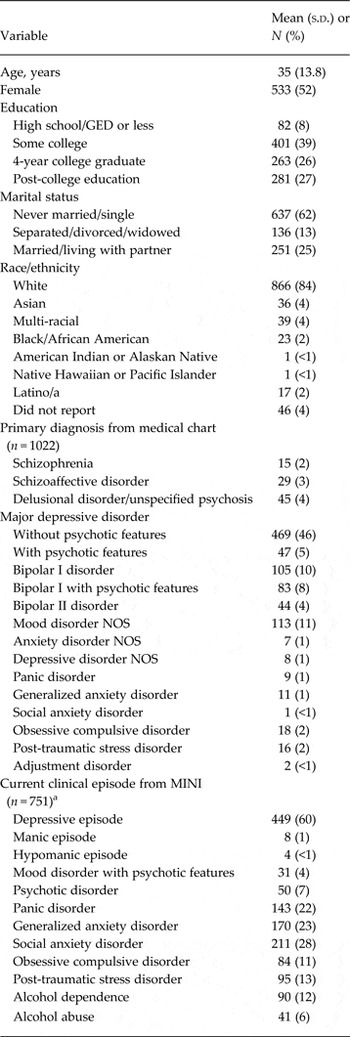
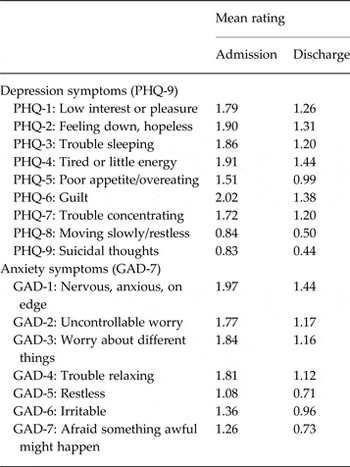
Patients were primarily single, White, and middle-aged (see Table 1). Table 2 presents mean scores for each symptom on the PHQ-9 and GAD-7. Paired-samples t tests, Bonferroni corrected for 18 tests, revealed that individual symptoms and total scores significantly decreased from admission to discharge (p's < 0.001; mean treatment duration = 8.2 days (s.d. = 3.2)).
Demographic and clinical characteristics (n = 1029)

GED, General equivalency diploma; NOS, not otherwise specified; MINI, Mini International Neuropsychiatric Interview.
a Percentages exceed 100% due to co-morbidity; 279 patients did not complete a structured interview while attending the partial hospital.
Mean score for each symptom on the PHQ-9 and GAD-7 at admission and discharge

PHQ-9, Patient Health Questionnaire-9 (Kroenke et al. Reference Kroenke, Spitzer and Williams2001); GAD-7, 7-item Generalized Anxiety Disorder Scale (Spitzer et al. Reference Spitzer, Kroenke, Williams and Löwe2006).
Aim 1: Characterize MDD/GAD symptoms network at admission
Network structure
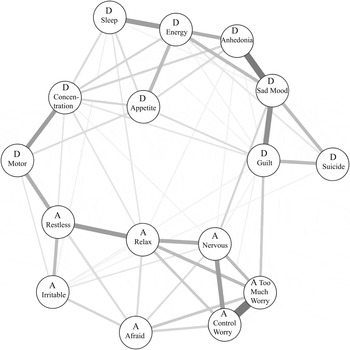
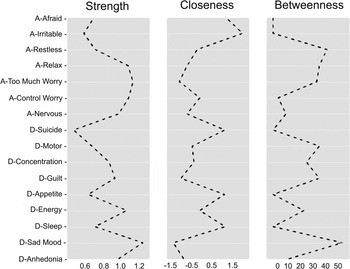
Fig. 1 presents the network at admission, and Fig. 2 presents the centrality indices. Approximately 38% of all network edges were set to zero. The two strongest edges were between ‘too much worry’ and ‘unable to control worry’ among anxiety items, and between ‘sad mood’ and ‘anhedonia’ among depression symptoms. Based on confidence intervals (see Supplementary material), both of these edges were significantly larger than all other edges. Within the anxiety items, ‘unable to control worry’ had a strong connection with ‘being nervous’, which had a strong connection with ‘unable to relax’. Among the ten (8.3%) strongest edges, only one linked anxiety and depression symptoms: ‘motor’ from depression scale and ‘restlessness’ from the anxiety scale. Although this cross-diagnostic connection makes this edge a candidate for a bridge symptom, ‘motor’ (which does not distinguish between motor agitation and retardation) was on average more strongly related to anxiety items (average edge weight 0.051) than depression symptoms (average edge weight 0.036). All other PHQ-9 and GAD-7 items displayed higher connections with other items from the same questionnaire (average edge weight range 0.047–0.149) than across questionnaires (average edge weight range 0.003–0.025). Finally, there were two other edges with CIs that did not contain zero and bridged anxiety and depression symptoms: ‘guilt’ – ‘too much worry’ and ‘sad mood’ – ‘nervous’.
Network of anxiety and depression symptoms at admission.

Centrality indices of network at admission.

In the entire network, ‘sad mood’ was the most central symptom across all centrality indices, followed by the anxiety symptoms: ‘too much worry’, ‘unable to control worry’, and ‘unable to relax’. Following these, the most central depression symptoms were ‘low energy’, ‘anhedonia’, and ‘guilt/worthlessness’. ‘Suicide’ and ‘irritable’ were the least central symptoms.
Aim 2: Stability of networks
For network edges, both the split-half permutation method (admission mean split-half r s = 0.75, interquartile range 0.77–0.72) and bootstrap 95% CIs revealed high stability. Among centrality indices, strength was highly stable. Consistent with prior work (Epskamp et al. Reference Epskamp, Borsboom and Fried2016), closeness and betweenness had relatively poor stability. These results were consistent across both admission and discharge (see Supplemental material).
Aim 3: Comparing admission and discharge networks
The repeated-measures NCT revealed that the global edge strength significantly increased from admission (NCT sum = 6.87) to discharge (NCT sum = 7.05; NCT difference = 18.51, p = 0.007). In other words, the sum of the absolute values of all edge weights was larger at discharge compared to admission. Regarding network structure, spearman correlations between admission and discharge were large for network edges (r s = 0.78) and centrality indices [strength (r s = 0.96), closeness, (r s = 0.60), betweenness (r s = 0.71)]. In combination, these findings suggest that the global connectivity of the network increased over time, but the structure of the network remained roughly intact.
Discussion
This study is the first to characterize depression and anxiety symptom networks within a large psychiatric sample, and with instruments that did not include skip-out criteria. Overall, the findings suggest that some symptom associations are stronger than others and that individual depression and anxiety symptoms are not equally important in the network. In general, connections between symptoms within each disorder were higher than connections between disorders. Importantly, both network edges and the strength centrality metric were stable, increasing confidence in drawing conclusions from the cross-sectional networks. In terms of change over the course of partial hospitalization, while symptom severity decreased and the strength of symptom associations increased from admission to discharge, the structure of the network remained stable.
The edges between ‘too much worry’ and ‘unable to control worry’ and between ‘sad mood’ and ‘anhedonia’ were significantly stronger than all other edges in the network. The motor symptom from MDD and the restlessness symptom from GAD were the most strongly connected items across the two disorders. Interestingly, the motor symptom from MDD showed stronger connections with anxiety symptoms than with MDD symptoms. Contrary to expectations, there was no strong bridge pathway involving sleep or concentration symptoms; however, unexpected bridge pathways emerged. Edges between ‘guilt’ and ‘too much worry’ and between ‘sad mood’ and ‘feeling nervous’ had confidence intervals that did not include zero. While our cross-sectional design does not permit inferences regarding the directionality of these bridge pathways, prior longitudinal data supports the possibility of a bi-directional connections such that anxiety can lead to depression (Kaufman & Charney, Reference Kaufman and Charney2000; Wittchen et al. Reference Wittchen, Kessler, Pfister and Lieb2000; Avenevoli et al. Reference Avenevoli, Stolar, Li, Dierker and Ries Merikangas2001) and that depression leads to anxiety (Moffitt et al. Reference Moffitt, Harrington, Caspi, Kim-Cohen, Goldberg, Gregory and Poulton2007; Cramer et al. Reference Cramer, Waldorp, van der Maas and Borsboom2010; Zavos et al. Reference Zavos, Rijsdijk and Eley2012).
The strength centrality index (i.e. absolute sum of edge weights connected to a node) demonstrated excellent stability; thus, we focus our discussion of symptom centrality on strength. The symptoms of ‘sad mood’ and ‘too much worry’ were the most central to the network. These findings are consistent with their current status as hallmark symptoms required for a diagnosis of MDD and GAD and with prior studies (Fried & Nesse, Reference Fried and Nesse2014; Fried et al. Reference Fried, Epskamp, Nesse, Tuerlinckx and Borsboom2016a , Reference Fried, van Borkulo, Epskamp, Schoevers, Tuerlinckx and Borsboom b ). Low-energy was another highly central depression symptom; a finding that deviates from common conceptualizations of depression, but converges with another recent study that found that low energy was the most central depression symptom (Fried et al. Reference Fried, Epskamp, Nesse, Tuerlinckx and Borsboom2016a , Reference Fried, van Borkulo, Epskamp, Schoevers, Tuerlinckx and Borsboom b ). Finally, the least central symptom was suicidal ideation. Prior network analyses have yielded mixed findings regarding the centrality of suicidal ideation; although others have also found that is has low centrality (Fried et al. Reference Fried, Epskamp, Nesse, Tuerlinckx and Borsboom2016a , Reference Fried, van Borkulo, Epskamp, Schoevers, Tuerlinckx and Borsboom b ), other work suggested high centrality (e.g. Bringmann et al. Reference Bringmann, Lemmens, Huibers, Borsboom and Tuerlinckx2015). In the current study, suicidal ideation had the lowest mean and standard deviation, which may have artificially lowered its centrality. It will be important for future studies to investigate how the frequency of specific symptoms affects their centrality.
We found that the strength of the relationships between the symptoms significantly increased from admission to discharge. This is consistent with recent work showing that the correlations among depression symptoms increase over the course of treatment (Fried et al. Reference Fried, Epskamp, Nesse, Tuerlinckx and Borsboom2016a , Reference Fried, van Borkulo, Epskamp, Schoevers, Tuerlinckx and Borsboom b ). These authors explored several possible explanations for changes in relationships across time, including spurious effects due to measurement flaws, but found no likely causes. For the current study, both admission and discharge sum scores were relatively normally distributed without any apparent strong floor or ceiling effects. There was a large shift from admission (50% of all responses were a 2 or 3 on the 0 to 3 scale) to discharge (28% of all responses were a 2 or 3), but we could find no relationship between this change in overall item endorsement and the increased correlations between the items at discharge. While the replication of this effect is intriguing, its cause it unclear. Additionally, as this study did not include a control group, it is not clear whether the increased global edge strength is due to treatment, repeated assessment, or some other factor. Despite the large reduction in symptom severity and increase in global strength of associations from admission to discharge, the edges between the symptoms and centrality values (i.e. the structure of the network) remained intact. Future research should test whether a network that retains its structure through treatment is more vulnerable to relapse, and whether interventions that successfully eliminate edges, thereby changing network structure, reduce vulnerability to relapse.
It is worthwhile to note that the main difference between examining MDD and GAD from a causal systems perspective v. a common cause perspective is conceptual rather than statistical in nature. Latent variable models can be transformed into network models and vice versa (Epskamp et al. Reference Epskamp, Maris, Waldorp, Borsboom, Irwing, Hughes and Boothin press; Molenaar, Reference Molenaar2010). Instead, the two perspectives lead to different inquiries. If symptoms are indicators of an underlying cause, there is no theoretical basis to examine bridge symptoms between disorders; and, we know of no study using a common cause framework that has included such an analysis. Similarly, high factor loadings would suggest that some items are better indicators of the common cause than others; whereas, within a causal systems perspective, high centrality nodes in a network are interpreted as crucial in the etiology and maintenance of the network. The two perspectives also lead to divergent future directions. From the common cause perspective, future studies should explore the biological correlates of latent factors, such as the p-factor (Caspi et al. Reference Caspi, Houts, Belsky, Goldman-Mellor, Harrington, Israel, Meier, Ramrakha, Shalev, Poulton and Moffitt2014). From the casual systems perspective, important next steps are testing whether, compared with lower centrality nodes, nodes with higher centrality are better prospective predictors of overall network activation (Robinaugh et al. Reference Robinaugh, Millner and McNally2016) and whether targeting more central nodes in treatment is more efficient and effective at reducing overall network activation compared with targeting peripheral nodes. Finally, it should be emphasized that these two conceptual frameworks are not mutually exclusive. There are likely to be some symptoms within a network that covary due to a common cause, which may itself be causally related to other symptoms.
There are several clinical implications of the current findings. As mentioned, interventions would likely be more efficient if they target central symptoms. Targeting the depression symptoms of sad mood, low energy, and anhedonia may therefore be most influential in reducing overall symptom severity. Cognitive Behavioral Therapy (CBT) targets most of these symptoms directly via behavioral activation and cognitive restructuring, which may explain the ability of very brief CBT to improve depression symptoms (e.g. Björgvinsson et al. Reference Björgvinsson, Kertz, Bigda-Peyton, Rosmarin, Aderka and Neuhaus2014). Regarding anxiety symptoms, our findings suggest that treatments that first target worry should be most effective. However, CBT manuals (i.e. Craske & Barlow, Reference Craske and Barlow2006) for GAD do not target worry via problem solving and worry exposures until the end of treatment (chapters 8 and 10 respectively). The current findings suggest that targeting worry earlier should improve efficiency.
The current study had several strengths. First, unlike prior studies that used instruments with skip-out criteria (Cramer et al. Reference Cramer, Waldorp, van der Maas and Borsboom2010), all participants rated each symptom, resulting in more accurate network estimates. Second, data were collected as part of standard clinical care and therefore obtained from individuals who may not typically participate in research. Third, the sample had a range of DSM diagnoses and severity levels. Given that co-morbidity is more common than not, this sample provided a more realistic depiction of psychopathology than studies that screen out people with co-morbid disorders. Additionally, a diverse diagnostic clinical sample likely provides increased endorsement and variability among all symptoms, including symptoms outside of participants’ diagnosed disorder(s), as compared to a general population sample, which may have a restricted range due to a large number of healthy individuals that endorse few or no symptoms.
The current study also had several limitations. First, the edges were calculated with cross-sectional data, precluding estimations of important network characteristics, such as the direction of edges or cyclical, self-reinforcing edges. Furthermore, cross-sectional edges represent both within- and between-subjects effects that cannot be disentangled (Hamaker, Reference Hamaker, Mehl and Conner2012). Experimental and prospective designs are required to test the assumptions underlying the causal systems perspective. Second, although the qgraph glasso and EBIC procedure conducts model comparison that maximizes fit, we do not report any goodness-of-fit metrics for networks because they do not yet exist for this purpose (Kolaczyk & Csárdi, Reference Kolaczyk and Csárdi2014). Third, we relied on self-report measures available from an existing database, and some items aggregated symptoms (e.g. combining insomnia and hypersomnia). Fourth, we used single-items to measure each symptom. This approach is crude (Fried & Nesse, Reference Fried and Nesse2015a , Reference Fried and Nesse b ) given that there are entire research areas on some nodes included here (e.g. anhedonia, Treadway & Zald, Reference Treadway and Zald2011). Furthermore, some nodes may actually be measuring overlapping constructs (e.g. ‘too much worry’ and ‘unable to control worry’), which could artificially inflate edge weights and centrality. Currently, there is no canonical approach within networks to determine topological overlap (Zhang & Horvath, Reference Zhang and Horvath2005) and combine overlapping items. Fifth, the sample was limited in ethno-racial diversity. Finally, a high degree of co-morbidity in our sample rendered subgroup analyses of ‘pure’ diagnostic categories (e.g. those with just MDD) impossible, though this limitation is offset by the greater ecological validity of a highly co-morbid sample.
In conclusion, consistent with the DSM, we found that anhedonia, sad mood, and worry were the most central symptoms of depression and anxiety. Although we found that anxiety and depression symptoms were more connected within-disorder than between-disorders, we identified a few potential edges bridging anxiety and depression. We also identified highly central items within each that would be prime candidates for future longitudinal and experimental research efforts to confirm their causal role and to identify their genetic, neurological, and cognitive underpinnings.
Supplementary material
The supplementary material for this article can be found at http://dx.doi.org/10.1017/S0033291716002300.
Acknowledgements
We are grateful to Denny Borsboom, Richard J. McNally, and Alexandra Silverman for their comments on a draft of the manuscript and to the patients and staff of the Behavioral Health Partial Hospital at McLean Hospital. This work was conducted with support from Harvard Catalyst The Harvard Clinical and Translational Science Center (National Center for Research Resources and the National Center for Advancing Translational Sciences, National Institutes of Health Award UL1 TR001102) and financial contributions from Harvard University and its affiliated academic healthcare centers. The content is solely the responsibility of the authors and does not necessarily represent the official views of Harvard Catalyst, Harvard University and its affiliated academic healthcare centers, or the National Institutes of Health.
Declaration of Interest
None.