Introduction
Olfactory dysfunction is a common disorder, affecting up to 20 per cent of the general population.Reference Landis, Konnerth and Hummel1 Head trauma is the third most common aetiology for olfactory dysfunction,Reference Collet, Grulois, Bertrand and Rombaux2 which can have a tremendous impact on the patients' quality of life, and often indicates an increased risk of adverse cognitive and functional outcomes.Reference Schofield, Moore and Gardner3, Reference Costanzo and Miwa4 Given the limited treatment options for post-traumatic olfactory dysfunction and the fact that most patients benefit very little from therapy,Reference Costanzo and Miwa4, Reference Rombaux, Huart, Deggouj, Duprez and Hummel5 comprehensive counselling regarding the patients' prognosis should be considered an important part of the management strategy.
Assessing the possibility of recovery from post-traumatic olfactory dysfunction provides useful prognostic information for patients; however, an equally critical but easily overlooked consideration is the risk of deterioration in olfactory function. This potential risk may be of particular concern for the patients, especially those with residual olfactory function. However, there has thus far been relatively little research on the potential risk of functional deterioration. In addition, the outcomes following treatment for olfactory dysfunction are generally classified by category (anosmia, hyposmia and normosmia) using scaled scoring or changes in scores over time.Reference Schofield, Moore and Gardner3 These findings, however, represent measured results, rather than outcomes perceived by patients themselves. This study aimed to evaluate improvement and deterioration in olfactory function among patients with head trauma, based on measured and self-rated assessments.
Materials and methods
Ethical considerations
This descriptive, retrospective chart review study was approved by the Institutional Review Board of Taipei Veterans General Hospital, a tertiary referral centre in Taiwan (protocol number: 2014-02-004AC). Written informed consent was obtained from all involved patients.
Study design and patients
Patients with post-traumatic olfactory dysfunction were screened between 2007 and 2013. The inclusion criteria included: (1) a history of loss of olfactory function following head trauma, (2) patency of the olfactory cleft and (3) no previous history of olfactory dysfunction caused by idiopathic or other conditions. The diagnosis of each case was based on a close sequential correlation between the trauma and the observed olfactory dysfunction.
Intranasal endoscopic analysis was performed on all patients during the first and last visits in order to exclude any cases of intranasal pathology such as polyps, synechia or signs of chronic rhinosinusitis. Magnetic resonance imaging (MRI) was also performed during the first visit, the results of which were reviewed by the same radiologist.
The treatment strategy at our institute was to use a tapered course of oral prednisolone,Reference Jiang, Wu, Liang, Shiao, Hsin and Su6, Reference Ikeda, Sakurada, Takasaka, Okitsu and Yoshida7 and mecobalamin (vitamin B12),Reference Fujii, Fukazawa, Takayasu and Sakagami8, Reference Fukazawa, Fujii, Tomofuji, Ogasawara, Seo and Sakagami9 followed by treatment with Ginkgo biloba.Reference Seo, Lee, Mo, Lee, Rhee and Kim10–Reference Elovic and Zafonte12 The dosage of prednisolone was tapered over a period of four weeks, as follows: 30 mg/day in the first week, 20 mg/day in the second week, 10 mg/day in the third week and 5 mg/day in the last week. Mecobalamin and G biloba were administered orally at a daily dose of 750–1500 µg and 120–240 mg, respectively.
Quantitative olfactory test
Olfactory function was assessed by administering the ‘Sniffin’ Sticks' test (Burghart, Wedel, Germany) during the first and last visits. The testing procedure was the same as previously reported.Reference Hummel, Sekinger, Wolf, Pauli and Kobal13 The sum of the olfactory threshold, odour discrimination and odour identification (‘TDI’) scores ranged from 1 to 48. A threshold, discrimination and identification score of 15 or less was defined as anosmia, 30 or more as normosmia, and intermediate scores as hyposmia.Reference Hummel, Kobal, Gudziol and Mackay-Sim14 Improvement and deterioration in olfactory function were respectively defined as an increase or decrease in threshold, discrimination and identification score of 6 or more, which has been described as a change perceptible to the patient.Reference Reden, Mueller, Mueller, Konstantinidis, Frasnelli and Landis15 Patients with only 1 of the 3 parameters (threshold, discrimination or identification) were excluded from this study, resulting in a total of 80 patients.
Subjective olfactory rating
Among the 80 patients, 51 completed self-rated questionnaires related to olfactory dysfunction. Subjective evaluations of impairment were scored using a visual analogue scale (VAS) ranging from 0 to 10, where 0 represented complete loss of olfactory function and 10 represented extremely sensitive olfactory function. Subjective improvement and decline in olfactory function were respectively defined as an increase or decrease between the initial and final self-rated scores.
Outcome assessments and statistical methodology
Pearson's chi-square test and Fisher's exact test were used to analyse the categorical variables. A paired samples t-test was used to calculate the differences in scores between the first and last visits. Clinical factors with a potential impact on changes in olfactory function were evaluated using multivariate logistic regression analysis. These factors included sex, age, anosmia on first visit, duration of the disorder (interval between onset of symptoms and last visit), loss of consciousness following the injury and the integrity of the olfactory bulb as evidenced by MRI on the first visit. The integrity of the olfactory bulb was defined in terms of the visibility of and symmetry between the two olfactory bulbs, without grossly abnormal or atrophic changes. The correlation between the scores of the two examinations was evaluated using the Spearman test. All statistical analyses were performed using SPSS version 18.0 (SPSS, Chicago, Illinois, USA), and p values of less than 0.05 were considered statistically significant.
Results
There were an equal number of male (n = 40) and female (n = 40) patients, with a mean age of 40.09 ± 14.42 years (range, 17–71 years). A median duration of 5 months elapsed between the onset of symptoms and the first visit (range, 1–240 months) and 15.5 months between the onset of symptoms and the last visit (range, 2–241 months). The period of observation was defined as the interval between first and last visits. The median period of observation was 9.1 months (range, 1–52 months).
Changes in severity
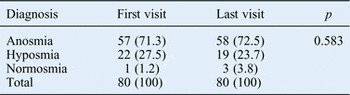
Table I illustrates the distribution of diagnoses at the first and last visits. At the first visit, anosmia was observed in 71.3 per cent of the patients, hyposmia in 27.5 per cent and normosmia in 1.2 per cent; at the last visit, anosmia was observed in 72.5 per cent of the patients, hyposmia in 23.7 per cent and normosmia in 3.8 per cent (Fisher's exact test, p = 0.583). Three patients with hyposmia (3.8 per cent) eventually regained normal olfactory function. In addition, one and three patients were deemed normosmic at the first and last visits, respectively. To facilitate subsequent dichotic comparisons, we combined the patients with hyposmia and normosmia into a single group, which was referred to as the non-anosmia group.
Distribution of diagnoses at first and last visits*

Data represent numbers (and percentages) of cases unless indicated otherwise. *Total n = 80
Clinical features and anosmia associations
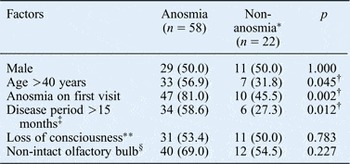
Table II presents a comparison of clinical features between patients with and without anosmia at the last visit. No associations were observed between anosmic status on the last visit and: sex, loss of consciousness or olfactory bulb integrity (all p > 0.05). However, compared with the non-anosmia group, the anosmic group included a significantly greater number of patients who: were older (over 40 years, p = 0.045), presented with anosmia at the first visit (p = 0.002) and exhibited symptoms of the disorder for a longer period (over 15 months, p = 0.012).
Comparison of clinical features between patients with and without anosmia at last visit

Data represent numbers (and percentages) of cases unless indicated otherwise. *Only three patients had normosmia in the non-anosmia group. †p < 0.05. ‡Disease period was defined as the interval between onset of symptoms and last visit. **Loss of consciousness after injury. §Defined as grossly abnormal or atrophic changes of the olfactory bulb.
Comparison of scores
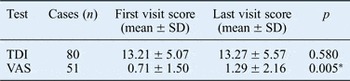
We evaluated the differences in scores (olfactory threshold, odour discrimination and odour identification, and VAS) between the first and last visits (Table III). No significant differences were observed in the average threshold, discrimination and identification scores between the two examinations (p = 0.580); however, the average VAS score at the last visit was significantly higher than that at the first visit (p = 0.005).
Comparison of scores at first and last visits

*p < 0.05. SD = standard deviation; TDI = olfactory threshold, odour discrimination and odour identification; VAS = visual analogue scale
Reciprocal relationship between score types
Given the difference between the threshold, discrimination and identification scores (no significant change) and VAS scores (significant improvement) in follow-up observations, we evaluated their reciprocal relationship among the 51 patients with complete threshold, discrimination and identification and VAS data (Table IV). The sensitivity of self-rated improvement or decline in olfactory function (to identify measured improvement or decline) was low (16.7 per cent and 0 per cent, respectively). The sensitivity of measured improvement or decline in olfactory function (to identify self-rated improvement or decline) was not high (75.0 per cent and 0 per cent, respectively).
Sensitivity of subjective and objective olfactory dysfunction measures*

Data represent numbers of cases unless indicated otherwise. *Total n = 51. TDI = olfactory threshold, odour discrimination and odour identification
Predictors of olfactory change
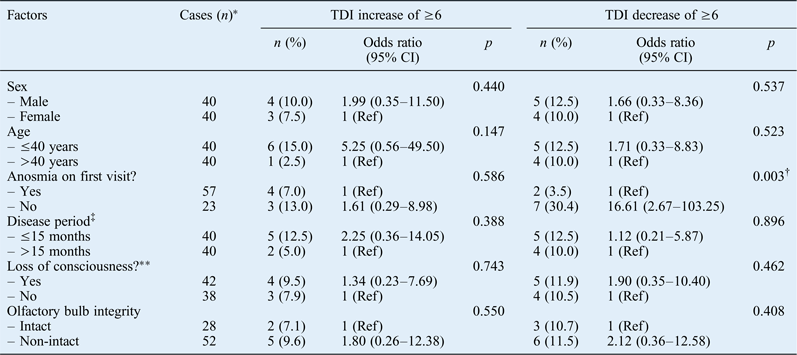
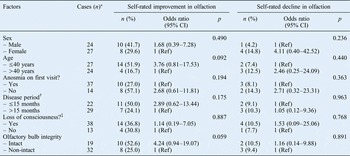
In this study, seven (9 per cent) of the patients showed measured improvements and nine (11 per cent) showed measured deterioration in olfactory function (Table V). In contrast, 18 (35 per cent) of the patients reported subjective improvements and 5 (10 per cent) reported deterioration in olfactory function (Table VI). The measured decline in olfactory function was based on initial anosmic status (p = 0.003; Table V). Other factors were not viewed as significant determinants in the subjective or objective evaluation of changes associated with olfactory function (all p > 0.05; Tables V and VI).
Multivariate analysis of prognostic factors affecting objectively measured changes in olfaction
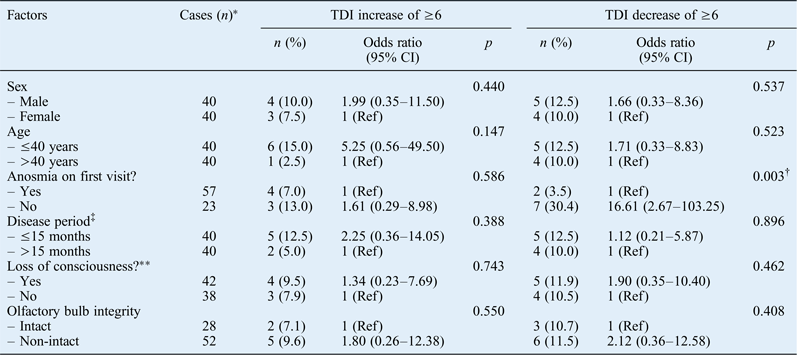
*Total n = 80. †p < 0.05. ‡Defined as the interval between onset of symptoms and last visit. **Loss of consciousness after injury. TDI = olfactory threshold, odour discrimination and odour identification; CI = confidence interval; Ref = reference category
Multivariate analysis of prognostic factors affecting subjective awareness of changes in olfaction

*Total n = 51. †Defined as the interval between onset of symptoms and last visit. ‡Loss of consciousness after injury. CI = confidence interval; Ref = reference category
Score correlations
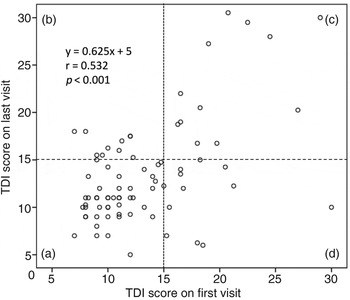
Figure 1 presents the threshold, discrimination and identification scores of the 80 patients at the first and last visits. A positive correlation was shown to exist between the threshold, discrimination and identification scores obtained during the two examinations (rho = 0.532, p < 0.001). A positive correlation was also observed in the VAS scores between the two examinations (rho = 0.559, p < 0.001).
Positive correlation between the (sum of) olfactory threshold, odour discrimination and odour identification (TDI) scores of the 2 examinations for the 80 patients. Dashed lines indicate function score limits for the patients with anosmia (score of 15 or less). A = anosmia to anosmia; B = anosmia to non-anosmia; C = non-anosmia to non-anosmia; D = non-anosmia to anosmia

Discussion
Time lag prior to diagnosis
The median time from the onset of symptoms to initial diagnosis was five months, which implies that most of the patients did not undergo olfactory examinations immediately after the trauma. A similar observation was reported by London et al., who noted a 15-month delay prior to diagnosis among 106 patients with head trauma.Reference London, Nabet, Fisher, White, Sammel and Doty16 This may be because 40 per cent of the patients with head trauma were unaware of olfactory dysfunction,Reference Callahan and Hinkebein17 and it is unlikely that clinicians would consider referring patients for olfactory disorders without indicators. Generally, patients are concerned with the recovery of other sequelae related to head injury, such that they gradually become aware of a loss of olfactory function.
No specific treatment has been developed for post-traumatic loss of olfactory function; therefore, these delays have no effect on long-term outcomes. Nonetheless, it may be helpful to raise awareness among clinicians of the need to provide counselling related to the possible loss of olfactory function. In addition, routine otolaryngological referral for patients with head injury may be appropriate in some cases.
Limited therapeutic benefits
To date, no standard treatment has been established for patients with post-traumatic loss of olfactory function,Reference Jiang, Wu, Liang, Shiao, Hsin and Su6, Reference Fujii, Fukazawa, Takayasu and Sakagami8 and concern remains whether patients actually benefit from these measures. Therapeutic trials involving steroids have shown that the oral administration of prednisolone may improve olfactory function in some patients.Reference Jiang, Wu, Liang, Shiao, Hsin and Su6, Reference Ikeda, Sakurada, Takasaka, Okitsu and Yoshida7 Previous studies have also reported that mecobalamin (vitamin B12)Reference Fujii, Fukazawa, Takayasu and Sakagami8, Reference Fukazawa, Fujii, Tomofuji, Ogasawara, Seo and Sakagami9 and G biloba Reference Seo, Lee, Mo, Lee, Rhee and Kim10–Reference Elovic and Zafonte12 may have potential benefits in recovering olfactory function. Thus, the main treatment for post-traumatic olfactory dysfunction at our institute is a tapered course of oral steroids, followed by mecobalamin and G biloba thereafter.
In the present study, only three patients with hyposmia (3.8 per cent) regained normal olfactory function, and the measured improvement in olfactory function was only 9 per cent. This appears to support the poor prognosis for such patients and the limited therapeutic benefits of common treatment regimes.Reference Costanzo and Miwa4, Reference Rombaux, Huart, Deggouj, Duprez and Hummel5 Jiang et al. reported that only 16.4 per cent of patients presenting with post-traumatic loss of olfactory function showed improvements after treatment with oral steroids.Reference Jiang, Wu, Liang, Shiao, Hsin and Su6 In addition, negative reactions to this form of treatment have led to unjustified negative expectations and cause patients considerable anxiety. Thus, in clinical practice, comprehensive prognostic counselling should be provided for all patients presenting with these symptoms.
Disparity between quantitative and self-rated changes
No significant differences in average olfactory threshold, odour discrimination and odour identification scores were observed between the first and last examinations (p = 0.580; Table III), which is consistent with the findings of Reden et al.Reference Reden, Mueller, Mueller, Konstantinidis, Frasnelli and Landis15 In contrast, the average VAS scores indicated a significant improvement between the first and last visits (p = 0.005). Despite the fact that a statistically significant difference of p = 0.005 does not necessarily mean a clinically significant difference, the distinct statistical level of dominance reflects a discrepancy between measured and self-rated scores of olfactory function. This disparity was confirmed by the fact that the sensitivity of subjective analysis (to identify measured outcomes) was low (0 to 16.7 per cent; Table IV). These results are consistent with those of Landis et al.Reference Landis, Hummel, Hugentobler, Giger and Lacroix18 and our previous study, in which the sensitivity of self-rated evaluations of olfactory function ranged from 17 to 24 per cent.Reference Shu, Hummel, Lee, Chiu, Lin and Yuan19 Our results also demonstrate that a measured improvement or decline in olfaction does not necessarily indicate an actual, perceived improvement or decline (Table IV). The fact that the threshold, discrimination and identification (measured) and VAS (self-rated) scores bore little relation to each other with regard to sensitivity necessitates specific interpretation of two-fold prognostic information based on measured and self-rated functional outcomes.
Prognostic information related to olfactory changes
In this study, 11 per cent of 80 patients showed a measured deterioration in olfactory function (Table V). These findings confirm those of Reden et al., who reported that 7.1 per cent of 99 patients with post-traumatic olfactory dysfunction exhibited lower test results at the final visit.Reference Reden, Mueller, Mueller, Konstantinidis, Frasnelli and Landis15 We further performed a multivariate analysis to make predictions regarding changes in the measured and self-rated values related to olfactory function. We found that patients who were not initially identified as anosmic (22 with hyposmia and 1 with normosmia) were shown to be more prone to a decrease in threshold, discrimination and identification score by 6 or more points, compared with patients who had been diagnosed with anosmia (57 patients, p = 0.003; Table V). This prognostic information is particularly important for patients with residual olfactory function (i.e. hyposmia and normosmia), owing to the possibility of degenerating into anosmia, as shown in area ‘D’ of Figure 1.
Symptom duration was shown not to be a meaningful indicator of changes in olfactory function. This finding is consistent with that of Doty et al., who observed that the length of time elapsed since the head injury was unrelated to the degree to which olfactory function had been compromised.Reference Doty, Yousem, Pham, Kreshak, Geckle and Lee20 Currently, no consensus has been reached with regard to the duration of time that could be considered sufficient for follow-up assessments. Most patients with post-traumatic disorders are informed that olfactory recovery becomes unlikely six months to one year after injury;Reference Costanzo and Miwa4, Reference Reden, Mueller, Mueller, Konstantinidis, Frasnelli and Landis15 however, this can cause patient anxiety throughout this follow-up period. In addition, our findings indicate that such a conclusion may be premature. We are unable to claim that an equal percentage of patients will experience olfactory improvement or decline before and after 15 months of disease; however, our findings indicate that patients who have had these symptoms for a longer duration (over 15 months) have the same likelihood of olfactory improvement or decline as those with a shorter duration (15 months or less, p > 0.05; Tables V and VI).
At more than 15 months after the onset of olfactory loss, evaluations based on threshold, discrimination and identification measurements showed an improvement in olfactory function in 2 patients and a deterioration in 4 patients (Table V). Similarly, self-reported evaluations indicated an improvement in olfactory function in seven patients and a deterioration in three patients (Table VI). The possibility of delayed changes in olfactory status has been reported in previous studies,Reference Reden, Mueller, Mueller, Konstantinidis, Frasnelli and Landis15, Reference Zusho21 suggesting that a one-year follow-up period would be too short to definitively determine the final status of olfaction. Welge-Lüssen et al. recommended a follow-up period of more than two years for patients with post-traumatic olfactory disorders.Reference Welge-Lüssen, Hilgenfeld, Meusel and Hummel22
Another issue is the relationship between the severity of head trauma and the recovery of olfactory function. Our results did not indicate a correlation between a loss of consciousness and final olfactory status (Table II). In addition, a loss of consciousness could not be considered a predictor of measured or self-rated olfactory improvement or deterioration (Tables V and VI). Our observations are in line with those of Jiang et al.Reference Jiang, Wu, Liang, Shiao, Hsin and Su6 and Ikeda et al.,Reference Ikeda, Sakurada, Takasaka, Okitsu and Yoshida7 who reported that olfactory outcomes are uncorrelated with an initial loss of consciousness following head injury. These findings are also consistent with those of Welge-Lüssen et al., who failed to observe any correlation between the severity of the trauma and improvements in one's sense of smell.Reference Welge-Lüssen, Hilgenfeld, Meusel and Hummel22 Our results are further supported by Haxel et al., who found no obvious relationship between the Glasgow Coma Scale and threshold, discrimination and identification scores.Reference Haxel, Grant and Mackay-Sim23 Nonetheless, a number of studies contradict the above findings,Reference Schofield, Moore and Gardner3, Reference Callahan and Hinkebein17, Reference Green and Iverson24 which may be due to differences in the definitions of trauma severity and/or variations between the tests administered and the times that they were administered.
Positive correlations between scores of each visit
This study identified a significant correlation between the threshold, discrimination and identification scores obtained during the first and last examinations (p < 0.001; Figure 1). A similar correlation was observed between the VAS scores of the first and last examinations (p < 0.001). This could be viewed as a confirmation that the status of olfaction had not actually changed, thereby suggesting a poor prognosis for patients with initially poor olfactory function.
Prognostic counselling and compensatory strategies
Head trauma is the third most common aetiology for olfactory dysfunction,Reference Collet, Grulois, Bertrand and Rombaux2 with more than half of head trauma patients exhibiting olfactory dysfunction.Reference Callahan and Hinkebein17 However, as many as 40 per cent of these patients are unaware of olfactory dysfunction, which can have a tremendous impact on patients' quality of life, and often indicates an increased risk of adverse cognitive and functional outcomes.Reference Schofield, Moore and Gardner3, Reference Costanzo and Miwa4 Hence, prognostic counselling on the potential impact of head injury on olfaction and the likelihood of olfactory dysfunction is of critical importance. In particular, patients should be aware of the risk of olfactory deterioration. This prognostic information may be particularly relevant for patients with overly optimistic expectations about olfactory recovery.
• More than half of head trauma patients exhibit olfactory dysfunction; however, approximately half of these are unaware of olfactory loss
• This study evaluated post-traumatic olfactory prognosis among patients with head injury
• Prognosis of olfactory recovery was poor, especially for patients with lower olfactory scores initially
• Initial non-anosmic status was predictive of measured olfactory decline
• Given the impact of olfactory dysfunction on quality of life, prognostic counselling on the potential impact of head injury on olfaction is critical
• Safety education (e.g. use of smoke detectors and gas alarms) may assist patients in dealing with olfactory impairment
Despite a poor prognosis, safety education and compensatory strategies may assist patients in dealing with olfactory impairment. For instance, the use of smoke detectors and gas alarm devices is a critical step to prevent injuries associated with toxicity from carbon monoxide and other gases such as cyanide. In addition, patients may add excessive amounts of salt to their food in order to compensate for the loss of food flavour.Reference Costanzo and Miwa4 Clinicians and nutritionists should provide special dietary instructions to such patients, especially those with cardiovascular diseases and hypertension.
Study limitations
Some possible limitations should be discussed. Given the retrospective nature of the study, some unknown confounding factors may not have been included in the logistic regression model to establish the independent correlations with the clinical outcomes. Further prospective, randomised, controlled trials are required to assess the role of post-traumatic cognitive impairments in olfactory changes. In this study, the time lag prior to diagnosis was 5 months or less in most of the patients (43 cases, 54 per cent), but was over 60 months in 5 patients (6 per cent). Similarly, most of the patients (50 cases, 63 per cent) had a follow-up period of 9 months or less, but 2 patients (3 per cent) had a follow-up period of over 24 months. The length of time between symptom onset and first visit varied, as did that between the first and final visit. One possible reason for this is the fact that many patients come to our institution (one of the few tertiary medical centres that can offer olfactory examinations in Taiwan) from urban and rural areas of the country. There may be a difference between urban and rural populations in terms of their awareness of the importance of a health issue, which could cause a wide range in the length of periods between visits.
Conclusion
Patients suffering a loss in olfactory function may be unable to recognise gas leaks, volatile materials and spoiled foods, but remain oblivious to their limitations. These risks and other disadvantages resulting from this disorder adversely affect patients' quality of life. This study provides evidence to support the provision of comprehensive counselling regarding patients' prognosis as an integral part of the management strategy, aimed at assisting patients to deal with post-traumatic olfactory dysfunction.
Acknowledgements
We thank Dr La-Yuan Fan for her assistance in collecting data, and thank Dr Jiing-Feng Lirng for his assistance in image processing and analysis.