Social movements seek social and political change in very specific political, economic, and cultural contexts. Their very imperative for structural change means that they are nonbureaucratic, noninstitutional, fluid collectives that have no single head office and few formal records of their existence. This poses a substantial problem for researchers—how do we locate, measure, and record the trajectories of these phenomena?
Over the last three decades, protest event analysis has become a common research method employed by researchers to map the trajectory of social movements. Data sets based on newspaper reports, police files, and city hall records have been used to compare changes in the levels of protest over time (Tilly Reference Tilly1978), to compare different movements (Giugni Reference Giugni2004), and to examine patterns of latency and visibility in different national contexts (Kriesi et al. Reference Kriesi, Koopmans, Duyvendak and Guigni1995). However, from the beginning, researchers have questioned whether protest event data sets adequately represent the fluid action systems that are social movements (see Barranco and Wisler Reference Barranco and Wisler1999; Kerbo and Shaffer Reference Kerbo and Shaffer1986; Maney and Oliver Reference Maney and Oliver2001; Myers and Caniglia Reference Myers and Caniglia2004; Snyder and Kelly Reference Snyder and Kelly1977). For Gregory Maney and Pamela Oliver (Reference Maney and Oliver2001, 132) the problem is that “often studies have relied on untested assumptions about the relationship between the data and the underlying pool of events they are supposed to represent.” I would contend that the problem is even deeper than they suggest, as protest event studies have often relied on untested assumptions about the relationship between the protest event data, underlying “contentious events”, and social movements themselves.
All who use media data need to recognize that decisions on whether social movement actions should be reported by newspapers are shaped by media routines, news values, media sensitivity caused by the political climate and the contextual characteristics of events such as where they are located (Snyder and Kelly Reference Snyder and Kelly1977 121), and media ownership. Newspaper production values lead to an overreporting of “contentious” or “unique” events, and an underreporting of other forms of social-movement claim making (Ortiz et al. Reference Ortiz, Myers, Wall and Diaz2005). In addition, media routines favor more bureaucratic movements with staff on hand to answer the inquiries of journalists. Related to this, collectives with higher “standing” (Gamson Reference Gamson, Snow, Soule and Kriesi2004) and those with claims based on issues that are already of concern to media outlets (Smith et al. Reference Smith, McCarthy, McPhail and Augustyn2001) will have greater access to journalists and gain media coverage.
My own ongoing longitudinal study of New Zealand social movements illustrates how editorial decisions create reporting biases. A case in point was the existence of “women's pages” in the metropolitan daily newspaper, the New Zealand Herald, during the 1970s. It provided space for news reports on the women's liberation movement, and it was not uncommon for the “women's pages” to include reports on a seminar on abortion alongside the profiles of prominent women, such as the leader of the Girl Guide movement. But the Herald's women's pages were phased out in the 1980s, and women's organizations lost a formalized space in which their activities were recorded.
Despite these reporting biases, however, researchers should not immediately reject the media as a data source for mapping the long-term trends of social movements and struggles. The news media stand in a unique position as a window through which the interplay of social forces is represented to the world, and as such provides a “history” of social movements in the context of the social, political, and economic structures in which they operate. This contextualization is crucial, for as Ruud Koopmans (Reference Koopmans, Snow, Soule and Kriesi2004, 19) notes: “The most fundamental fact about collective action is its connectedness, both historically and spatially, and both with other instances of collective action of a similar kind, and with the actions of different claim-makers such as authorities and countermovements.”
The media then become a crucial source for students of social movements concerned with recording “history from below,” in the long tradition of writers such as E. P. Thompson and Jean Chesneaux. This history from below aims to research the way in which collectives such as social movements, political parties, and nongovernmental organizations operate between grassroots publics and elite decision-making forums. Some of these spaces—where “private troubles” become “public issues” (see Mills Reference Mills1970) and the balance of forces are contested—are easier to research than others. Written records of the collective claims of political parties are found in manifestos, speeches, parliamentary debates, conference proceedings, and statements to the mass media. Researchers may also have access to membership figures to aid them in tracking changes in the intensity of these collectives over time. Similarly, NGOs may keep data on the numbers of staff and volunteers, and will document their collective claims in annual plans, minutes of meetings, submissions to legislatures, and comments to the mass media. In contrast, social movements have no defined membership and few written records. While some social movement organizations keep formal records, these are often sporadic (due to the availability of personnel or the intensity of activity) and fail to represent the diversity of a social movement over time. This means that it is difficult to find longitudinal records of the movements, leaving the news media (with all their imperfections) as the default record keepers of social movement activity, not merely protest events.
If the media are perceived as a window into the changing balance of forces in society, and the role of social movements within this process, then researchers must alter the methods used to generate time series databases. Researchers must move beyond data sets drawn from single news sources. There is growing recognition that researchers must incorporate data from sources such as local newspapers and police reports in times series analysis (Barranco and Wisler Reference Barranco and Wisler1999; Maney and Oliver Reference Maney and Oliver2001).Footnote 1 I argue that times series should be built on multiple local newspapers to recognize the constraints that media routines and values have on what gets reported by newspapers. Local newspapers have been shown in some contexts to be more inclusive than national ones (Koopmans and Rucht Reference Koopmans, Rucht, Klandermans and Staggenborg2002, 248). This is because proximity effects what gets reported (Barranco and Wisler Reference Barranco and Wisler1999; Myers and Caniglia Reference Myers and Caniglia2004), and newspapers will favor sensational events if there is a large news catchment area, such as those that exist for national newspapers like the New York Times.
Once multiple news sources have been collected and any trends in reporting levels identified, the newspaper data must be set alongside other longitudinal data sets into social change, such as voting patterns, strike and union membership statistics, unemployment and workforce participation rates, legislative change, and changes in government. All such information must be reflected upon by using information drawn from the publications of social movement organizations and from interviews with movement activists.
To contextualize social movements as action systems formed in interaction with other collectives and existing social and political structures, researchers must also rethink the unit of analysis at the base of longitudinal studies. Most protest event analysis (PEA), as the name would suggest, focuses on contentious events such as marches, mass demonstrations, or violence. As women's movement scholars have noted, this narrow focus has led to the sidelining of institutional and cultural actions by social movements (see Ferree and Mueller Reference Ferree, Mueller, Snow, Soule and Kriesi2004; Grey and Sawer Reference Grey and Sawer2008). As Paul Bagguley (Reference Bagguley2009) notes, PEA has been used to set the boundaries of what was seen to make up the “repertoire of contention” of social movements, and then this bounded repertoire has been used to evaluate the levels of protest by movements. Although protest event research focused on contentious activity is important, researchers taking this route must acknowledge that their unit of analysis is protest events, not social movements (see Kerbo and Shaffer Reference Kerbo and Shaffer1986), or run the risk of replacing the complexity of social movement activity with a delimited version of actions.
In a recent study, Marco Giugni (Reference Giugni2004, 241) expanded the understanding of “repertoire of contention” by defining protest events “as actions by a social movement that attempts to influence the political decisions and/or sensitise the public opinion.” Empirical evidence from New Zealand reinforces the need to extend the boundaries around the repertoire of contention used in mapping the trajectory of social movements. New Zealand newspapers inadvertently reflected the need to extend the boundaries of what was considered social movement repertoires between 1968 and 2000. For example, there were reports on the ways that women's movement activists published surveys, reports, and leaflets; produced plays and films; and set up self-help centers where women “will be learning how to keep ourselves healthy” (“‘Self-Help’ Health Centre to Open,” New Zealand Herald, 23 November 1978). However, it was not just the women's liberation movement that went beyond the conventionally prescribed repertoire of contention. The New Zealand database also included newspaper reports on the antipoverty and union movement using a range of tactics: institutional and noninstitutional, disruptive and non-disruptive.
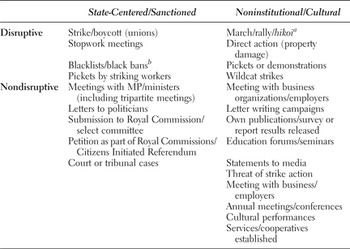
The boundaries of any repertoire of contention should be informed by empirical research, including more open-ended readings of media sources, interviews with activists, and information from social movement publications. This process was followed in the New Zealand study and led to a range of social movement tactics being identified (See Table 1). Significantly, the empirical research in New Zealand drew out reports of social movements frequently using a multiplicity of actions to advance their claims, including institutional spaces. This is not something that is unique to New Zealand; as Merrindahl Andrew (Reference Andrew2009, 15) notes, feminists seized a range of institutional opportunities to advance their claims in Australia.
New Zealand social movements' repertoire of contention (1968–2007)

aHikoi is the Maori term for a long protest march that can sometimes take days or weeks.
bA black ban is a boycott to improve working conditions, wages or to advance a political goal.
Consequently, researchers must also reconsider the search techniques used to build longitudinal data sets as these have “major implications for the validity of analyses of media coverage of collective public events” (Maney and Oliver Reference Maney and Oliver2001, 136). Most PEA data sets are built using electronic database searches. A selection bias can occur inasmuch as the keywords chosen for the database searches will never be broad enough to pick up all forms of social movement action. Maney and Oliver (Reference Maney and Oliver2001, 138) see the answer lying in “event-specific” protocol for database searches, in which extramedia and intermedia data are used to generate search terms that describe events. This may be important as a preliminary step, but there is much to be gained from reading microfilm reproductions of entire newspapers, allowing for an open-ended approach to identifying social movements' actions in the fullest sense and allowing researchers to see movement reports in the context of the changing balance of forces as represented by the media. What I share with Maney and Oliver is the desire to ensure that social movement “repertoires” are built on what movements actually do.
The impact of these modified research tactics can be illustrated by looking at the longitudinal database collected on three New Zealand social movements—the women's, union, and antipoverty movements. The database of news reports on these movements between 1968 and 2000 does not present any overreporting of contentious events.Footnote 2 Only 4.4% of the newspaper reports between 1968 and 2000 were centered on protest events, such as rallies, marches, damage to property, or other forms of contentious action. By contrast, 11.5% of the 1850 newspaper reports included in the time series were on claims made through institutional avenues, such as submissions to legislative committees, meetings with politicians, and letter writing to politicians; 31.2% were legally sanctioned strikes or stopworks; and 52.9% of the events were claim making through methods such as statements to newspapers, research reports, service provision, fund-raising, and commemorations. As with more narrowly conceived protest event analyses, the longitudinal data revealed visible patterns with regard to the reporting of social movement actions during the 33-year time frame between the start of 1968 and the end of 2000. There was a period of relative stability in the 1970s with regard to the number of news media stories about the three movements, then a rapid rise in the reporting of claims in the second half of the 1980s, and finally a decline in the number of newspapers articles in the 1990s. The pattern identified within this time frame must now be compared to other longitudinal data that illustrate political, economic, and social change in New Zealand in order to try to understand if the changes in the levels of reporting can be attributed to factors that are internal or external to the movements, or perhaps to media processes.
For phenomena that have often eschewed institutional processes, the media are the best data source for examining over long periods of time the place of social movements within the changing balance of forces of society over time. However, researchers must avoid seeing the media as the “reality” or representing the entirety of actions by social movements, and set any time series based on media reports in the context of other longitudinal quantitative data and against qualitative information drawn from social movements.