From the earliest periods of Near Eastern history ceremonial maces, sceptres and staffs were symbols of power carried by gods and kings.Footnote 1 They could be bestowed on messengers and heralds in order to vest them with the authority of the original bearer.Footnote 2 Secondarily, these insignia helped to protect the messenger as they communicated that the bearer acted on the command of a higher authority. The most widely attested Akkadian word for staff or sceptre is haṭṭu.Footnote 3 Huṭāru, equated with haṭṭu in lexical lists, is a word for “staff” or “sceptre” attested primarily in texts from first-millennium Assyria and Babylonia.Footnote 4 The official lú–gidru = ša huṭāri “staff bearer” turns up among other palace personnel such as the ša pān ekalli, “palace supervisor”, and ša maṣṣarti, “guardsmen”.Footnote 5 The most intriguing attestations are the Neo-Babylonian ones in which Huṭāru – frequently preceded by the determinative for “divine” – is a non-anthropomorphic deity in the Eanna temple of Uruk.Footnote 6
The divine messenger staff of Eanna
In contrast to standards,Footnote 7 Eanna's Huṭāru was not a non-anthropomorphic representation of a deity but rather a deified object that also had a practical use: it served as a messenger staff, bestowing the temple's authority on men who travelled outside the town on an official mission. Such a mission was, for instance, the gathering of small livestock from the countryside on behalf of the temple administration (Beaulieu Reference Beaulieu2003: 352). This is attested in the judiciary record YOS 7, 15. According to this document, a certain Šamaš-iddin collected ewes with the help of the Huṭāru but instead of delivering the ewes to the temple, he illegally appropriated them. A hired man who accompanied Šamaš-iddin testified:
When Šamaš-iddin, son of Nabû-nādin-šumi, took me with him for hire (i.e., as a hireling), he had the Divine Staff with him. He collected ewes, income of the Lady-of-Uruk, but he sheared (them) in his house and marked the ewes illegally with his own branding iron.Footnote 8
The Staff accompanied messengers and deliveries only when the mission was important, urgent or unusual (e.g., ad hoc taxation)Footnote 9 or when hindrances were expected. A good example is the letter YOS 3, 71. It was written by two men who transported early choice dates harvested in Abu and Ulūlu, viz., one and two months before the (main) date harvest in other parts of Babylonia began. The pertinent passage of the letter reads:Footnote 10
We have brought 220 kurru of dates from the Harru-ša-Iddinaya upstream. But now we are held back because of the customs official (rab kāri) of the harbour of Bīt-Kāṣir. A letter by my lord for Nūnaya, the harbour customs official, should arrive so that he will let us pass the harbour. The dates […], (of) makkasu-(quality) of the months Abu and Ulūlu should arrive! A letter of my lord concerning this must come quickly! Every day half a shekel of silver as the rent for the boat, and one shekel of silver per day as wage for the hirelings accumulate on our account. The lord should know: we have been held in the harbour since the 20th. The Divine Staff should come together with the letter of my lord so that it may sit in the boat.
Because the harbour official did not allow the suppliers to continue their journey, they turned to the bishop of Eanna for a permit to leave the harbour. It is likely that the customs official demanded the harbour tax from them but temples may have been exempt (Joannès Reference Joannès2002: 604–5). The two senders thus needed a confirmation that they were indeed conducting the shipment on behalf of the Eanna temple. In addition to the letter, they asked for the Huṭāru to travel with them in the boat. The Divine Staff was a visible sign that they were on an official mission of the temple, and thereby an effective measure to avoid any further interferences and obstructions by customs and other officials. Avoidance of obstructions, either in transport or during the collection of goods, may also have been the reason for the bishop's order to give the “small gold Divine Staff” to two suppliers of Tilmun-dates. From the following letter (BIN 1, 19) we learn that Eanna had two Divine Staffs, a small gold one and a larger one, and that they were, at least at the time of writing, to be found in the storehouse bīt karê.
Give the small gold Huṭāru that is deposited together with the large Huṭāru in the storehouse (bīt karê) to Aplaya and Gimillu so that they can take (it) with them in their boat. We have sent them for Tilmun-dates of the regular offerings.Footnote 11
The location of the Divine Staff in the storehouse is surprising at first but it makes good sense because the bīt karê was the temple's main storehouse where the raw materials for the offerings were kept. It was a heavily guarded complex, located in front of the city walls of Uruk with immediate access to the canal Harru-ša-Lâbâši.Footnote 12 Delivery messengers who were sent to collect goods will often have started out and returned there. Because it was a guarded complex, it often served as a temporary prison for culprits.Footnote 13 We do not know whether it was possible to steal the Divine Staff from there and escape from the complex, but litigation records show that the Divine Staff occasionally fell into the wrong hands.Footnote 14
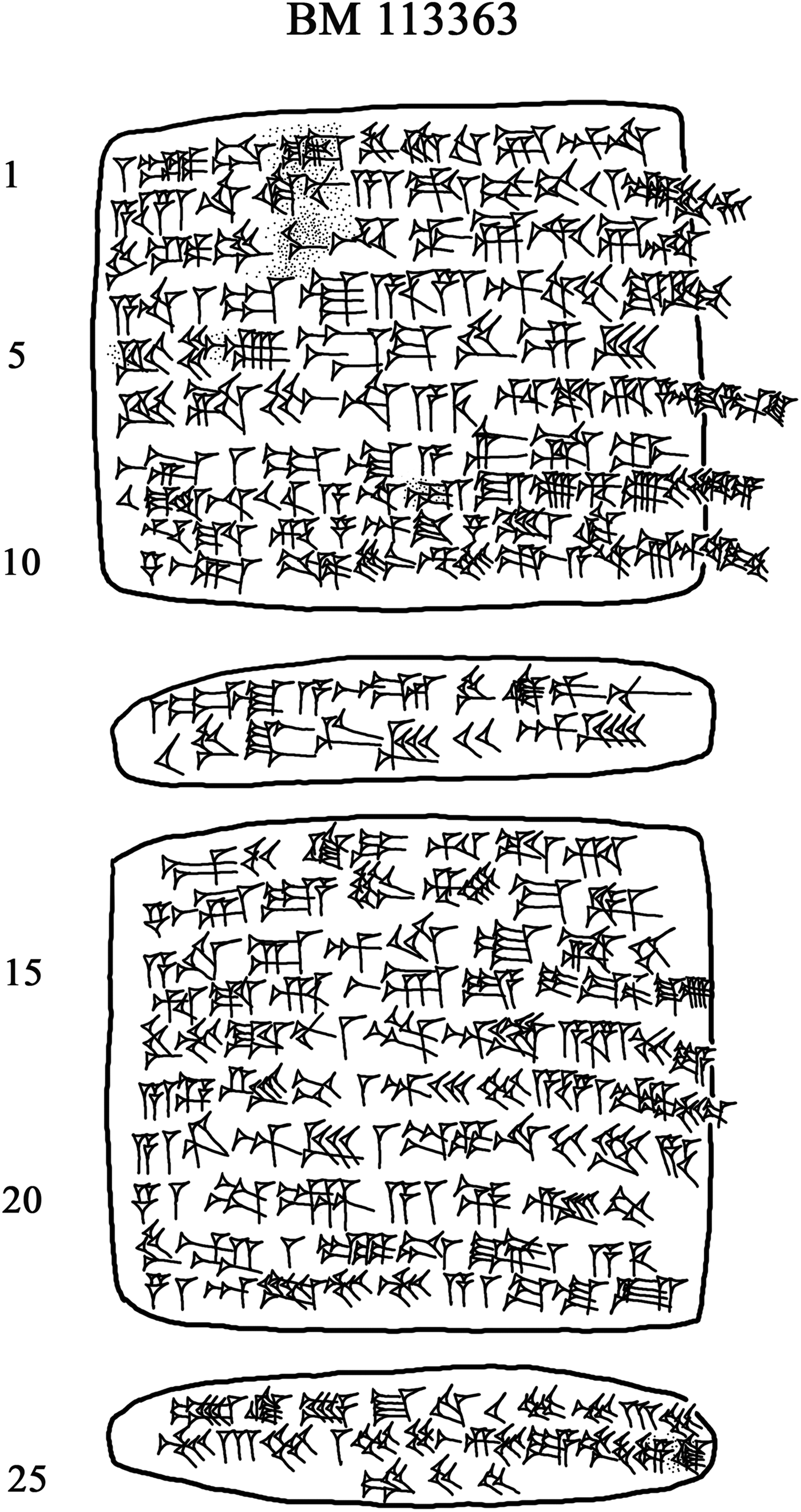
The following text provides new evidence for the Huṭāru (Fig. 1).Footnote 15 This costly Staff had gone astray, and a man named Aplaya was interrogated about it. Whether it is the same Aplaya as in BIN 1, 19 quoted above remains unclear.Footnote 16
Copy of BM 113363

Transliteration
Obv. 1 mdag-gin-ibila lúšà.tam é.an.na
a-šú šá mna-di-nu a mda-bi-bi u mdag-šeš-mu
lú sag lugal ⸢lú⸣en pi-qit-ti é.an.na
a-na map-la-<a> a-šú šá mdutu-tin-su-iq-bi
5 iq-bu-ú um-ma lúunmeš
iq-ta-bu-na-a-šú ḫu-ṭa-ri šá dgašan šá ⸢unug⸣ki
ina é map-la-a ni-ta-mar (erasure)
u it-ti-šú a-na ⸢uru(!)⸣su-ú-ḫu ú-še-le-e
ḫu-ṭa-ri šá dgašan šá unugki
10 šá ina é-ka in-nam-mar a-na é.an.na i-din
Left map-la-a ina ukkin lúqí-pa-nu
u lúdumu dùmeš niš dingirmeš
Rev. iz-kur ki-i ḫu-ṭa-ri
šá ina é-ia in-nam-ma-ru
15 a-na é.an.na at-ta-din
ḫu-ṭa-ri ina é-ia i-ba-⸢áš⸣-šu-ú
lúmu-kin-nu mìr-damar.utu a-šú šá mnumun-ia
a me-gi-bi md30-kam a-šú šá mdag-mu-giš
a mdù-dingirmeš mdag-na-din-šeš a-šú
20 šá mìr-den a me-gi-bi
lúumbisag mdag-gin-ibila a-šú
šá mdamar.utu-mu-mu a mba-la-ṭu
Top unugki iti.šu u4.10.kam mu.3.kam
{mu.3.kam} mkam-bu-zi-ia lugal tin.tirki
25 lugal kur.kur
Nabû-mukīn-apli, the bishop (šatammu) of Eanna, son of Nādin, descendant of Dābibi and Nabû-ahu-iddin, the royal courtier (and) supervisor of Eanna (ša rēš šarri bēl piqitti ayakki) spoke to Aplaya, son of Šamaš-balāssu-iqbi, as follows: “People have told us: ‘We saw the Staff (Huṭāru) of the Lady-of-Uruk in the house of Aplaya, and he took it with him upstream to Sūhu.’ Give the Staff of the Lady-of-Uruk that was seen in your house to Eanna!” Aplaya swore an oath in the assembly of the trustees and the gentlemen (as follows): “I cannot give the Staff that was seen in my house to Eanna (because) the Staff is not in my house.”
Witnesses: Arad-Marduk, son of Zēria, descendant of Egibi; Sîn-ēreš, son of Nabû-šumu-līšir, descendant of Bani-ilī; Nabû-nādin-ahi, son of Arad-Bēl, descendant of Egibi.
Scribe: Nabû-mukīn-apli, son of Marduk-šumu-iddin, descendant of Balāṭu.
Uruk, the 10th of Duʾuzu of the 3rd year of Cambyses, king of Babylon, king of the lands.
Philological commentary
Lines 6, 9, 13 and 16: Nowhere in this text is Huṭāru preceded by the determinative dingir for “divine”. Nevertheless we are dealing with the same object. Another deified object that did not represent anthropomorphic gods (in contrast to standards) but was a deified item for practical use was the Kakkabtu, the star-shaped branding iron of Eanna. It appears with and without the dingir determinative. On the third day of Addāru Kakkabtu and the Urdimmus (chimeras) received a sheep as an offering (Beaulieu Reference Beaulieu2003: 353). So far there is no attestation for an offering for the divine Huṭāru.
Lines 10 and 14: The verbal form innammar is the present-future tense of the N-stem of amāru,“to see”, but the act of seeing happened in the past. The form must therefore be interpreted as iterative in a past context for which the iparras-form may be used (GAG § 78e; Streck Reference Streck1995: 116–17).
Lines 13–16: The oath, which at first glance looks like a defiant statement, corresponds to the well-known grammatical features of oaths.Footnote 17 Oaths introduced by kī alone are negative oaths. The negative promissory oath (“(may I be cursed) if I will give…” or “I will certainly not give…”) is constructed with the iptaras-form. The negative assertory oath calls for a verbal form in the past tense (iprus), rarely a stative. However, the verb bašû, “to be, to exist”, is an exception; in this case the form iparras is used (Hackl Reference Hackl2007: 73–9). Šamaš-balāssu-iqbi swore a negative promissory oath (kī… attadin) and a negative assertory oath (kī… ibaššû) while both verbal forms depend on the same kī. The cumbersome wording must hearken back to the pre-formulation of the oath. The high official's prompt was: “Give the Staff that has been seen in your house to Eanna.” The oath corresponds exactly to this prompt: (May I be cursed) “if I will/can give the Staff that has been seen in my house to Eanna, and (if) the Staff is in my house.”
The document was issued shortly after the barley harvest of the third year of Cambyses, a period of severe famine in Babylonia. The barley harvests of that and of the two preceding years had failed. People became desperate in face of the scarcity of food, and the crime rate went through the ceiling. The famine was caused by a draught that affected southern Babylonia most. In Sūhu, located at the Euphrates elbow in northern Mesopotamia, water was most likely still sufficient to irrigate the valley of the Middle Euphrates. Taking the Divine Staff to Sūhu implies that the Eanna either called in newly harvested barley from land holdings, or that it collected sheep grazing in the area.Footnote 18
Aplaya swore that he could not return the Divine Staff because it was no longer in his possession. We have no reason to assume that he lied under oath. Another litigation protocol, issued six months later in Ṭebētu of the same year, possibly tells us in whose hands the Huṭāru really was. YOS 7, 146 (dated 22.X.3 Camb) reports that the sheep breeder Anu-šarru-uṣur had used the Divine Staff “without the permission” of the bishop, the royal supervisor, or the clerks of Eanna to collect temple animals that had been grazing in the countryside:
Anu-šarru-uṣur, son of Innin-šumu-iddin, sheep breeder of Ištar-of-Uruk, under whose responsibility small livestock from the fold, property of Ištar-of-Uruk, grazed and (then) disappeared, and who had carried off the Divine Staff without the permission of Nabû-mukīn-apli, the bishop (šatammu) of Eanna, son of Nādin, descendant of Dābibi, (or) of Nabû-ahu-iddin, the royal courtier (and) supervisor of Eanna (ša rēš šarri bēl piqitti ayakki), or of the clerks (ṭupšarrū) of Eanna, in order to collect freely roaming small livestock from the countryside from the free men, but he has not delivered them (viz., the animals) to the exchequer of Eanna.Footnote 19
It seems that this man in desperation had little respect of the minor god but abused the Staff as an effective means to rip off fellow citizens. The text is phrased in a way that establishes Anu-šarru-uṣur's unlawful appropriation of the Huṭāru as a fact. Several months must have passed between this crime and the trial in Ṭebētu, as the document continues by reporting that Anu-šarru-uṣur had been on the run and later been taken captive by a delinquent temple dependent who extorted ten shekels of silver from him in return for not handing him over to the Eanna authorities. The search for the missing Huṭāru in BM 113363 and this episode are therefore likely related.
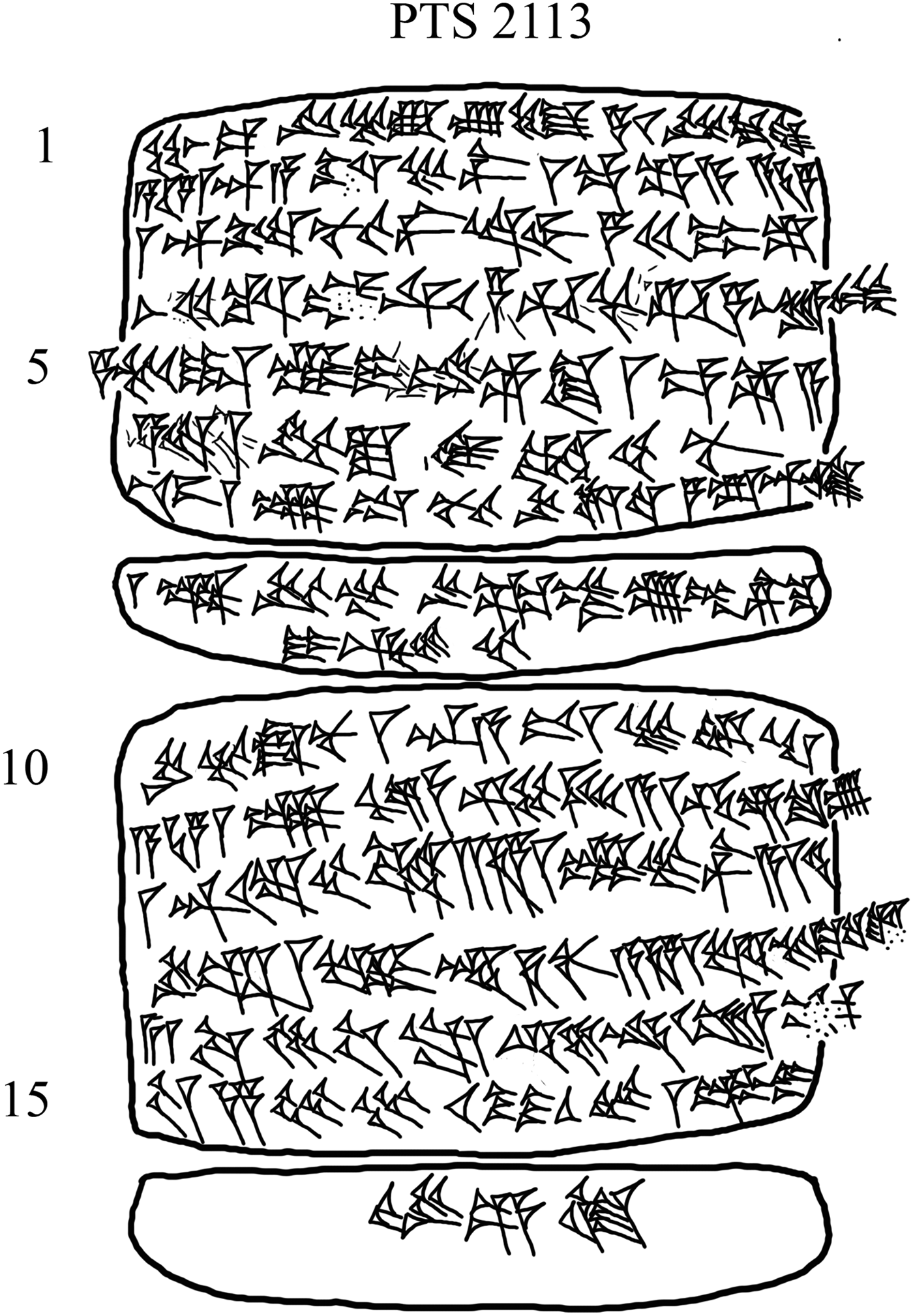
Before the Huṭāru lived through the adventures described above, it had been used legally for the collection of dues. In the text edited below from the last year of Nabonidus’ reign, we learn a puzzling detail, namely that one had to pay a fee for the use of the Staff (Fig. 2).Footnote 20
Copy of PTS 2113

Transliteration
Obv. 1 pu-ut lúmu-kin-ú-tu šá mšeš-lu-mur
a-šú šá mda-num-mu-dù mzalág-e-a a-šú šá
mdamar.utu-numun-dù na-ši šá 25 gur
ina man-da-⸢at⸣-ti šá hu-ṭar-ri šá ina iti.sig4
5 šá mu.17.<kam> mdag-i lugal eki mzalág-e-a
a-na mšeš-lu-mur id-din-nu
ina igi mdag-gin-numun lúšà.tam šá é.an.na-ki
Edge mdag-šeš-mu lúsag.lugal ú-kan-ni-ma
i-nam-din
Rev. 10lúmu-kin-nu mda-num-mu-im-na
a-šú šá mdag-kar-zimeš a mhu-un-zu-ú
mdu.gur-tin-iṭ a-šú šá mdag-mu-dù a mtin
lúumbisag mdag-en-šú-nu a-šú šá mdag-mu-dib-ud-da
a mba-bu-tú urunam-ri iti.⸢ne⸣
15 u4.5.kam mu.17.kam mdag-i
lugal eki
Nūrea, the son of Marduk-zēru-ibni, bears the guarantee for the testimony concerning Ahu-lūmur, son of Anu-šumu-ibni, with respect to the 25 kurru from the mandattu-payment of the Staff (Huṭāru) that Nurēa gave to Ahu-lūmur in the month Ayyāru of the 17th year of Nabonidus, king of Babylon. He must establish proof and give (a document that constitutes the proof) in the presence of Nabû-mukīn-zēri, the bishop of Eanna (šatammu), (and) Nabû-ahu-iddin, the royal courtier.
Witnesses: Anu-šumu-imna, son of Nabû-ēṭir-napšāti, descendant of Hunzû; Nergal-uballiṭ, son of Nabû-šumu-ibni, descendant of Balāṭu.
Scribe: Nabû-bēlšunu, son of Nabû-mušētiq-ūdi, son of Bābūtu.
Namri, the 5th of Abu of the 17th year of Nabonidus, king of Babylon.
Philological commentary
Line 1: See Holtz (Reference Holtz2009: 143–51) for the pūt mukinnūti formula.
Line 6: The beginning of this line is written over an erasure.
Line 7: The -ki is a phonetic complement indicating the reading Ayakki, as in the Basetki inscription of Naramsin (there: é.an.na-ki-im): see Beaulieu (Reference Beaulieu2002).
Lines 8–9: The enclitic -ma creates a logical connection between two phrases. If nadānu “to give” is taken to mean “to pay”, the construction ukannima inamdin would run against the sense of the document: Nūrea had testified that he paid 25 kurru (of barley, probably) to Anu-šumu-ibni. If he succeeds in proving it, he would not pay. I understand the phrase as an ellipsis, “he will establish proof and give (the proof)”. The proof is most likely a written record, e.g., a quitclaim. Hence, “he must establish proof by showing (a document)”. There are parallel constructions in which the written record that needs to be provided is omitted, e.g., išazzazma inamdin, “he will book (it) and give (the written record about the booking)” and ilṭurūma ana šatammi iddinū, “which they wrote down and gave (the document) to the bishop” (BIN 1, 112) (Weszeli Reference Weszeli2005).Footnote 21
Line 14: Namri is perhaps an abbreviation of the locality Namri-Saparrāta or Āl(u)-(ša)-Nār-Saparrāta that is attested in Uruk texts (RGTC 8: 234). Apart from that, PTS 2935 mentions a village Namri, sīhu ša Nabû-⸢x⸣.
The document was drawn up after a hearing at the Eanna assembly. Nūrea asserted that he had paid 25 kurru (of barley) but Ahu-lūmur denied it. The issue was postponed to give Nūrea time to produce written evidence for the payment.
What is most surprising is that a mandattu-payment was due for the Huṭāru. In Neo-Babylonian contexts mandattu is most often a compensatory payment due to the owner (“Gewalthaber”) of, e.g., a slave or a temple dependant whose working capacity is used by somebody else, either because this dependant is hired out or because his/her return is delayed. It can also designate the rent for objects, such as boats, or additional fees besides the rent of fields.Footnote 22 25 kurru (4500 litres) is not little and the ina shows that it was not the complete sum. For what exactly was the mandattu due? Were collectors who called in property for the temple obliged to pay for the use of the Staff? This is not likely if the collectors were mere administrators acting on behalf of the temple. But it is conceivable if the Staff were put into the service of an entrepreneur who paid a fixed sum to the temple in exchange for the right to collect dues. If we knew Nūrea's profession we would gain more clarity but this text is so far the only attestation of Nūrea/Marduk-zēru-ibni. His opponent, Ahu-lūmur, son of Anu-šumu-ibni, is known. He was a boatman who is mentioned in the letter YOS 3, 172. The senders of that letter tell their superiors at the temple that they tried to hire boats but they could not find any:
Although we walked upstream on the bank of the river from Kapru till Šaragītu, none of the boats that were there was launched for hire. … We could not find a boat to rent, and Nabû-karābi-išme had loaded the boat of Ahu-lūmur, son of Anu-šumu-ibni, with merchandise.Footnote 23
Ahu-lūmur's boat was apparently at Eanna's disposal but already in use.Footnote 24 But why was it so difficult to rent a boat? The appearance of Ahu-lūmur dates YOS 3, 172 roughly to the time of Nabonidus. If the letter were written in the 16th or 17th year as well, it may possibly be related to the general unrest in the advent of the Persian threat. Kapru is located in former Bīt-Yakīn, the marshland east of Uruk towards Elam. This border area may have been insecure already before Babylon fell to Cyrus’ army in Tašrītu (month seven).Footnote 25 PTS 2113, the document concerning the 25 kurru as mandattu for the Huṭāru, is dated in Abu (month five) but refers to an incident in Ayyāru (month two). We can assume a general sense of imminence that led people to safeguard their possessions and hoard foodstuffs, the prices for which would shoot up in the event of a war in the country. The second month is the time of the barley harvest; Nūrea may have wanted to collect dues such as the tithe swiftly and safely, without the risk of running into difficulties, for example because of Persian military activities in the area. Alternatively, he may have feared that his transport would be slowed down for other reasons, such as obstructions or hostilities on part of the tenants, without the help of the Huṭāru. Without further information about this case the exact agreement between Nūrea and the Eanna temple remains somewhat elusive. Yet there are Old Babylonian texts about the hire of divine symbols in the context of collecting harvest dues that may be comparable.
The Old Babylonian “journey” of the divine weapon
In the Old Babylonian period, divine symbols or weapons were used, “to ensure the just collection of taxes and tithes and the fair distribution and storage of the harvest yield…” (Harris Reference Harris, Güterbock and Jacobsen1965: 224; Stol Reference Stol and Boiy2012) in addition to their role in oath procedures. One text tells us that the reason for the “journey” (kaskal) was, “to make the sons of the god and the sons of the goddess living in the countryside deliver the barley, the aširtum, and bring (it) to Sippar” (Stol Reference Stol and Boiy2012: 570–72).Footnote 26 Thus, the objects carried by the priests accompanying tax collectors during the “journey” symbolized divine authority. The “journey” was a source of income for the priests and the temple. According to Ellis (Reference Ellis, Behrens, Loding and Roth1989: 132), priests even traded the right to conduct the journey: “the texts attest the leasing of a prebendary privilege, which presumably conferred a stipendiary income on the lessee, as well as yielding rental fees for the temple.”Footnote 27
In the Old Babylonian period the lease of a divine symbol to enforce the collection of taxes or harvest dues seems to have been a regular practice. In the Neo-Babylonian Eanna temple, Ištar's Staff was regularly used to collect animals from the grazing grounds. PTS 2113 may be the first evidence that the Huṭāru was also used to collect harvest dues, and that – just as in the Old Babylonian period – the temple drew an income from this practice. It remains unclear whether this was a usual procedure or an exception.
The ‘Doppellöwenkeule’ – Eanna's Huṭāru?
BIN 1, 19 tells us that Eanna's Divine Staff had two representations. There was a large Huṭāru that dwelt in the storehouse (bīt karê). This may have been the object that was regularly taken on journeys to collect dues. The small gold (or gilded) Huṭāru was a symbol, perhaps in the temple proper, that was probably seldom taken on missions outside the town. Another text informs us about the existence of two covers (talbuštu) made of red and blue wool (Beaulieu Reference Beaulieu2003: 352).Footnote 28 They may have been worn by the Huṭārus when not in use. We have no textual information about what the Staff looked like. But we do have iconographic evidence that may possibly be identified with the Huṭāru.
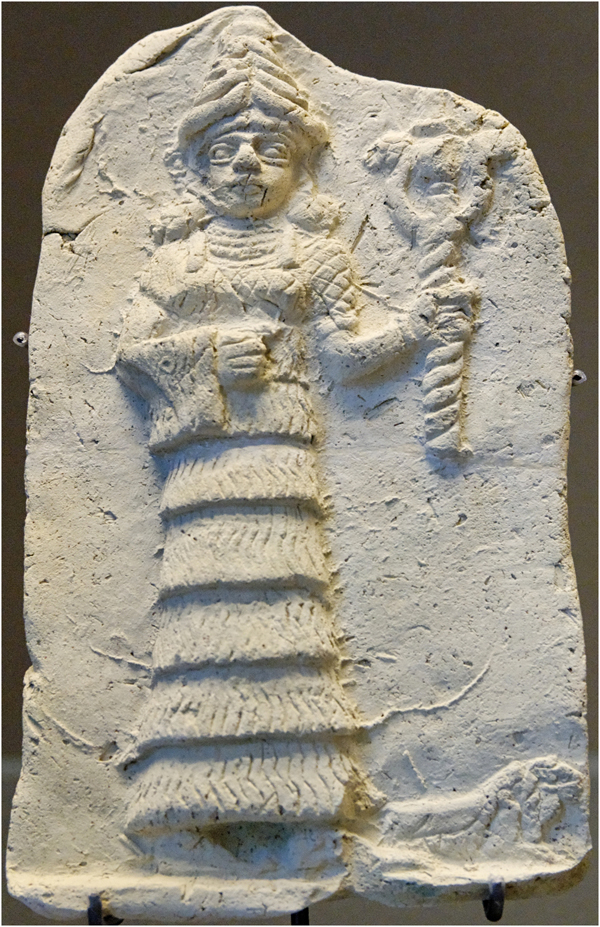
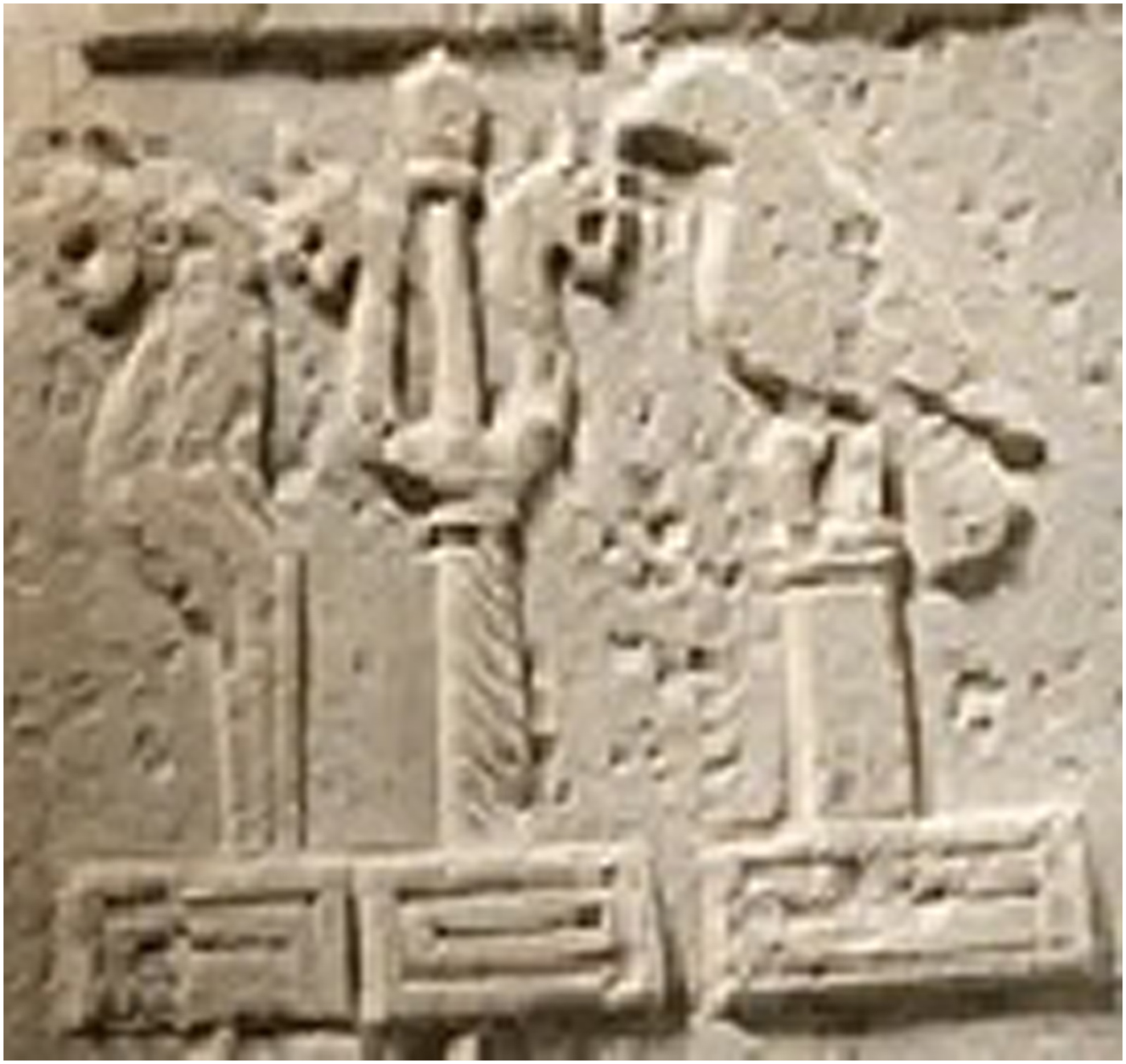
Old Babylonian iconographic representations of Ištar occasionally show the goddess holding a ceremonial mace or sceptre with a twisted shaft and animal protomes (Fig. 3). The object has been dubbed “Doppellöwenkeule” although the animal heads are not always clear lions. Variants of it are frequently depicted on cylinder seals.Footnote 29 The object's importance is underlined by the fact that it is represented alone on a terracotta plaque from Babylon.Footnote 30 A variant with an actual mace head figures as a symbol on Middle Babylonian kudurrus (Fig. 4).Footnote 31 The staff is reminiscent of the Graeco-Roman herald's staff, kērykeion/caduceus, borne by the messenger god Hermes/Mercury and Iris as the messenger of Hera, but a major difference is that the animals face outwards on the Near Eastern artefacts.Footnote 32 The Old Babylonian staff was probably originally a ceremonial mace as it ends in a knob.
Old Babylonian terracotta plaque from Ešnunna now housed in the Louvre (AO 12456). © CC, Photo: M. Lan Nguyen. See also Marzahn and Schauerte (Reference Marzahn and Schauerte2008: 175, 194, no. 112)

The symbol of the “Doppellöwenkeule” on the kudurru VA Bab 04375, © Staatliche Museen zu Berlin. Photo (detail): O. Teßmer

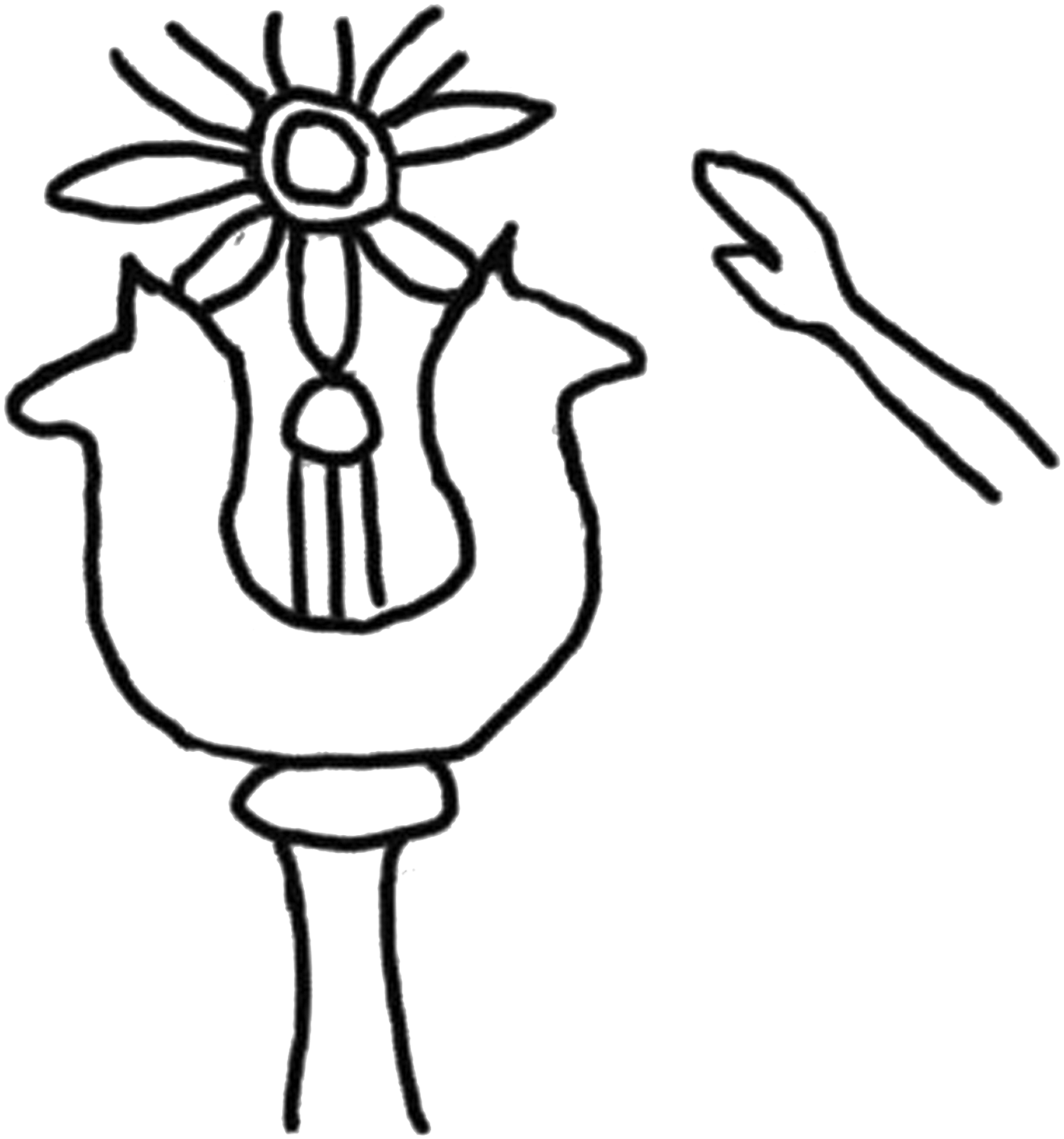
A similar object turns up in Neo-Babylonian sealings on tablets from the Eanna archive (Fig. 5).Footnote 33 A rosette with eight leaves sits above the object. It is unclear whether the rosette is merely an additional decor on the seals or whether it is part of the Neo-Babylonian object itself. The sealings stem from at least three different seals, a stamp seal and two cylinder seals. When the cylinder seal is rolled further, the arm of a worshipper becomes visible.
Sealing showing the “Doppellöwenkeule” on the tablet GC 1, 183 (Ehrenberg Reference Ehrenberg1999, no. 15) from the Eanna archive

All the texts on which sealings with this motif appear date to the last years of Nebuchadnezzar's reign and come from the same administrative setting. They are all related to the management of Eanna's stocks, e.g., booking deliveries of beer, bread, flour and rarely barley. The sealing party in these decentralised deliveries was the temple, or more specifically, the clerks who had authorised the payment and who were responsible for booking the payment in the producer's account.Footnote 34 We can identify one of the seal owners as a clerk named Bēl-nādin-apli on the basis of a letter order issued and sealed by him. This man appears occasionally as a recipient of letters written by deputies from building sites to the temple.Footnote 35 He must have been an accountant who, together with a few colleagues, had oversight of Eanna's stocks on an everyday basis, goods that likely were stored in the bīt karê where the Huṭāru was kept.Footnote 36 The representation of the Staff on Bēl-nādin-apli's and his colleagues’ seals would befit their identity as clerks in the everyday management of Eanna's resources.
Beaulieu (Reference Beaulieu2003: 354) discussed the object on the sealings in connection with the divine Urigallu standard symbolizing Ištar. I agree with him that it cannot represent the Urigallu because the object “does not correspond to the textual descriptions of the Divine Urigallu Standard of the goddess and appears to belong to a different type of object than the Urigallu standards depicted in Neo-Assyrian art.” The fact that the cylinder seal, when rolled, shows a trace of a worshipper is also not an argument for the interpretation of this object as a standard. Divine Huṭāru was a minor god. We do not (yet) have proof that it received worship, but since Kakkabtu (the branding iron) did, it is conceivable that Huṭāru received the same honours. Moreover, the object is held by Ištar herself in Old Babylonian iconography. Hence, although proof is beyond reach, I believe it is worthwhile considering Ištar's double headed animal symbol as the shape of Eanna's deified messenger staff Huṭāru.