Methicillin-resistant Staphylococcus aureus (MRSA) colonization is common in hospitals and nursing homes, and carriage is associated with subsequent infection. Reference Dantes, Mu and Belflower1,Reference Huang, Singh and McKinnell2 The nose is the primary MRSA reservoir; 80% of infections are caused by nasal strains. Reference Perl, Cullen and Wenzel3,Reference von Eiff, Becker, Machka, Stammer and Peters4 Mupirocin ointment is the most commonly used preventative agent to clear MRSA from the nose due to evidence that it decreases MRSA infections by 45% among treated carriers. Reference van Rijen, Bonten, Wenzel and Kluytmans5 However, mupirocin resistance has been identified in several regions and is increasing. Worldwide prevalence of mupirocin resistance ranges between 4.6% and 17.8%. Reference Deshpande, Fix, Pfaller and Jones6 In the United States, high-level resistance is 4%–5%, and as high as 10%–15% in some areas. Reference Richter, Diekema and Heilmann7 Antiseptics are a promising alternative because, unlike antibiotics, they have not been associated with clinically meaningful resistance. Povidone-iodine (iodophor) is an antiseptic that suppresses Staphylococcus aureus with a single dose and has been shown to prevent surgical-site infections. Reference Phillips, Rosenberg and Shopsin8 Nasal iodophor swabs are available in 5% and 10% formulations. Here, we report the results of a quasi-experimental study evaluating the impact of a single-swab per nostril 10% iodophor regimen with a manufacturer-recommended double-swab per nostril 5% iodophor regimen (https://multimedia.3m.com/mws/media/716786O/skin-and-nasal-application-instructions.pdf) in reducing MRSA carriage among nursing-home residents.
Methods
Parent nursing home decolonization study
We conducted a 9-month study between June 2015 and February 2016 at 3 southern California nursing homes to assess the impact of universal decolonization on multidrug-resistant organism carriage, including MRSA. Reference McKinnell, Miller and Singh9 The baseline period Reference McKinnell, Miller and Singh9 was June–August 2015; the phase-in period was September–November 2015; and the intervention period was December–February 2016. Body decolonization involved daily chlorhexidine (CHG) antiseptic bathing (2% no-rinse cloths for bed baths, or 4% liquid rinse-off for showering) and nasal decolonization with 5% nasal iodophor swabs (3M) for 5 days for new admissions and Monday–Friday every other week for the entire nursing home. The 5% nasal iodophor administration consisted of 2 swabs per nostril applied for 30 seconds per nostril twice daily (8 swabs per day). To assess for MRSA prevalence, we conducted 6 rounds of point-prevalence bilateral nares and skin (combined axilla and groin) swab testing from 50 randomly selected residents during the baseline and intervention periods.
We report here the experience in 1 (of the 3) participating nursing homes that adopted 2 different regimens of nasal antiseptic decolonization after the parent study was completed.
Post-study quality improvement program assessment
Following the 9-month decolonization study, 1 nursing home adopted the decolonization regimen as a quality improvement (QI) initiative. However, nursing staff expressed pragmatic concerns with the nasal iodophor administration, indicating that 2 swabs per nostril was redundant and a 30-second application per nostril was impractical. Nursing staff reported that iodophor was generally applied for several seconds (rather than 30 seconds) per nostril due to time constraints. In response to this feedback, the nursing home implemented nasal decolonization using a 10% generic iodophor swab, applying 1 swab per nostril twice daily for at least 3 revolutions rather than two 5% iodophor swabs per nostril. The twice daily administration schedule was retained.
To understand the effectiveness of the modified nasal application protocol, we conducted a 5-week prospective cohort study (August–September 2016) of nasal decolonization with 10% nasal iodophor administered twice daily, on admission and Monday–Friday every other week plus body decolonization with daily CHG bathing or showering. We conducted 2 point-prevalence samplings 4 weeks apart involving bilateral nares and axilla or groin swabs collected from 50 randomly selected residents.
Demographic and medical characteristics of randomly sampled residents were compared among the baseline, double-swab 5% iodophor intervention, and single-swab 10% iodophor intervention periods. Changes in MRSA nasal, and overall carriage (nasal or skin) were compared between each intervention period and the baseline period, as well as between the 2 intervention periods using Fisher exact tests and logistic regression models that controlled for history of MRSA, diabetes, wounds, incontinence, dementia, bedbound status, presence of central lines, and presence of urinary catheters. Models comparing the 2 intervention periods to each other additionally accounted for treatment with CHG or iodophor in the past 24 hours. Studies were approved by the UC Irvine Institutional Review Board.
Results
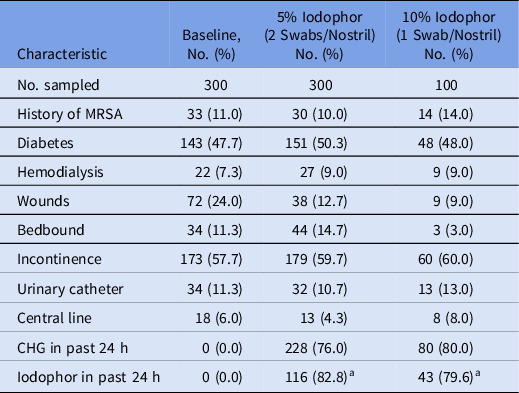
Point-prevalence swabs were collected from 300 randomly selected residents during the baseline period and again during the intervention period; during the poststudy quality improvement assessment period, 100 randomly selected residents were swabbed. Resident characteristics are presented in Table 1.
Nursing-Home Resident Characteristics by Study Period

Note. MRSA, methicillin-resistant Staphylococcus aureus; CHG, chlorhexidine gluconate. We detected no statistically significant differences in characteristics among periods for all 3 groups. CHG use and iodophor use in the baseline period differed from the 2 intervention periods (P < .001 for all comparisons).
a Nasal iodophor was given Monday–Friday every other week, except for new admissions, who received 5 days of twice daily iodophor on admission. Half of the samples for MRSA colonization were taken during weeks in which all residents were scheduled to get iodophor. The other half of the samples were taken on weeks that nasal iodophor was not scheduled to be given to all residents. During the 5% iodophor intervention, 116 of the 140 residents due to receive iodophor in the 24 hours prior to sampling actually received iodophor. During the 10% iodophor intervention, 43 of the 54 residents due to receive iodophor in the 24 hours prior to sampling actually received iodophor.
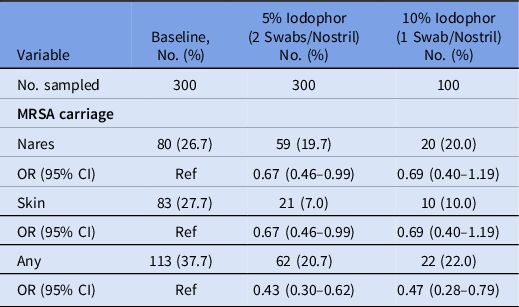
The relative raw reduction in nasal MRSA carriage was 26% in both iodophor treatment periods, from a baseline prevalence of 27% to 20% for both the double-swab 5% iodophor and single-swab 10% iodophor regimens (Table 2). Similar raw reductions were also observed for either nares or skin carriage between the 2 regimens (P = .40) (Table 2). Adjusted models revealed identical 40% reductions in MRSA nasal carriage when comparing the baseline period independently to the double-swab 5% iodophor group (P = .03) and the single-swab 10% iodophor group (P = .10) (Table 2). Adjusted models also revealed identical 60% reductions in MRSA carriage from nares and axilla or groin when comparing the baseline period to either the double-swab 5% (P < .001) or single-swab 10% (P = .007) nasal iodophor groups. We detected no significant difference between the single-swab and the double-swab regimens for MRSA nasal carriage (OR, 1.02; 95% CI, 0.58–1.8; P = .90) or MRSA carriage on any body site (OR, 1.08; 95% CI, 0.62–1.88; P = .60). Adherence to the nasal administration protocols was similar between groups: 83% and 80% in the 5% and 10% nasal iodophor groups, respectively.
MRSA Carriage by Study Period, Adjusted Models

Note. MRSA, methicillin-resistant Staphylococcus aureus; OR, odds ratio; CI, confidence interval; Ref, referent group.
Discussion
Similar reductions in nasal and any site (nasal or skin) MRSA carriage occurred using a single-swab per nostril 10% iodophor regimen (4 swabs per day) compared with a double-swab per nostril 5% iodophor regimen (8 swabs per day). In addition, the 10% iodophor regimen involved a generic formulation, which would reduce costs further.
Reasons for the similar performance of these 2 regimens include the possibility that the higher 10% iodophor concentration may have delivered sufficient iodophor using fewer swabs. This finding could be important because nurses reported being unlikely to apply the nasal products for the recommended 30 seconds per swab due to time constraints. We instituted the operational instruction to apply the swabs for “at least 3 revolutions” to ensure adequate application to all surfaces of the nostrils. Furthermore, nurses reported that using 2 swabs per nostril seemed wasteful given adequate nares saturation from a single swab.
We detected significant reductions in overall MRSA carriage when comparing either iodophor regimen period to the baseline period (60% reduction for both periods). However, 40% reductions in nasal MRSA carriage occurred from the baseline period to both intervention periods, and they had discordant significance values, likely due to the 3-fold smaller number of samples taken during the 10% iodophor QI initiative.
Notably, our results were similar even though the baseline and single-swab 10% iodophor sampling occurred in the summer and the double-swab 5% iodophor sampling occurred in the winter. Several studies have shown that MRSA rates and transmissibility are higher in the summer months, suggesting that the relative performance of the 10% iodophor compared with the 5% iodophor may be even better than our data indicate. Reference Mermel, Machan and Parenteau10
Although further studies with larger sample sizes are warranted, this study supports the use of a single-swab per nostril 10% generic iodophor as similarly effective to a 2-swab per nostril 5% iodophor to reduce MDRO carriage. In addition, the nurses’ feedback highlights that infection prevention programs must consider feasibility and implementation ease even for simple interventions to ensure optimal results.
Acknowledgments
We are grateful to Coventry Court Health Center (CCHC) for their participation in this project. We thank Linda Budy, RN, for her valuable contribution to this work and her deep dedication to the care of residents as chief nursing officer at CCHC before and during the COVID pandemic. She will be deeply missed.
Financial support
Funding for this study was provided by the Centers for Disease Control and Prevention (CDC) Prevention Epicenters (grant no. 1U54 CK000172 to Platt/Huang). Nasal antiseptic swabs for the parent nursing home decolonization study were contributed by 3M.
Conflicts of interest
Authors L.G.M., R.D.S., J.A.M., T.D.C, M.E., and G.M.G., have conducted studies in which participating hospitals and nursing homes have received contributed antiseptic product from 3M, Xttrium,Medline, and Stryker. Authors L.T.H. and S.S.H. have conducted studies in which participating hospitals and nursing homes have received contributed antiseptic product from 3M, Xttrium, Medline, Stryker, and Molnlyke.