Women are twice as likely as men to experience major depression throughout life. Although this sex difference exists worldwide (Wolk & Weissman, Reference Wolk, Weissman, Oldham and Riba1995), the rates of depression are actually similar among girls and boys before adolescence, and even slightly higher among boys (Cyranowski, Frank, Young, & Shear, Reference Cyranowski, Frank, Young and Shear2000). After the onset of puberty (11–14 years old), however, the prevalence of depression dramatically shifts to a 2:1 girls to boys ratio (Kessler, Reference Kessler2003). This raises questions about the role pubertal milestones might have as risk factors for depression (Young & Altemus, Reference Young and Altemus2004). In accordance, one of the most robust antecedents for developing depression for girls and women is earlier onset of menarche (Harlow, Cohen, Otto, Spiegelman, & Cramer, Reference Harlow, Cohen, Otto, Spiegelman and Cramer2004; Kutcher et al., Reference Kutcher, Kusumakar, LeBlanc, Santor, Lagace and Morehouse2004). Two explanatory frameworks have been proposed to explain this: the early timing hypothesis and the stressful change hypothesis.
Early Timing Hypothesis and Stressful Change Hypothesis
The early timing hypothesis proposes that girls who mature earlier than their peers are more vulnerable to psychological distress (Caspi & Moffitt, Reference Caspi and Moffitt1991; Ge, Conger, & Elder, Reference Ge, Conger and Elder1996). Puberty is a critical period that is often associated with conflicts with parents, tumultuous romantic attachments, and changes in body image (Caspi & Moffitt, Reference Caspi and Moffitt1991; Conger, McCarty, Yang, Lahey, & Kropp, Reference Conger, McCarty, Yang, Lahey and Kropp1984). In agreement, family discord predicts early menarche and depressive symptoms in girls (Ellis & Essex, Reference Ellis and Essex2007; Ellis & Garber, Reference Ellis and Garber2000). Such girls may also be more sensitive to additive or interactive effects with other environmental stressors (Joinson, Heron, Lewis, Croudace, & Araya, Reference Joinson, Heron, Lewis, Croudace and Araya2011). However, there is currently a paucity of evidence linking age of menarche to psychosocial stressors known to be salient during adolescence.
The stressful change hypothesis proposes that menarche itself is a stressful developmental milestone and that all girls will eventually experience some level of distress regardless of maturation timing (Joinson et al., Reference Joinson, Heron, Lewis, Croudace and Araya2011). According to this framework, the highest level of depressive symptoms should occur proximal to the time of menarche onset, albeit these mood disturbances are transient. Both the early timing hypothesis and the stressful change hypothesis, respectively, propose that the stress associated with either early maturation or the onset of first menses are key for predicting the association between menarche and depressive symptoms in adolescent girls exposed to environmental stressors. In order to further understand these phenomena, future studies would benefit from collecting concomitant measures of stress hormone functioning that are intricately connected to both age of menarche and depression.
Heightened distress activates the hypothalamic–pituitary–adrenal (HPA) axis secretion of cortisol, the main stress hormone in humans. Both basal and stress-induced HPA activity is significantly heightened during adolescence (McCormick, Robarts, Gleason, & Kelsey, Reference McCormick, Robarts, Gleason and Kelsey2004; Netherton, Goodyer, Tamplin, & Herbert, Reference Netherton, Goodyer, Tamplin and Herbert2004). Moreover, chronic exposure to high levels of cortisol can precipitate major depressive disorders in adolescence (Cyranowski et al., Reference Cyranowski, Frank, Young and Shear2000; Goodyer et al., Reference Goodyer, Herbert, Altham, Pearson, Secher and Shiers1996; Halligan, Herbert, Goodyer, & Murray, Reference Halligan, Herbert, Goodyer and Murray2007) and adulthood (Brown & Harris, Reference Brown and Harris1978). High levels of stress hormones may therefore be a key predictor of increased depressive symptoms that must be further investigated in studies of pubertal development using existing methodologies.
Menarcheal Timing and Menarcheal Status
The early timing hypothesis and the stressful change hypothesis are associated with two menarcheal classifications: respectively, menarcheal timing and menarcheal status. Although early age of menarche has been associated with depressive symptoms in adolescence (Kaltiala-Heino, Kosunen, & Rimpela, Reference Kaltiala-Heino, Kosunen and Rimpela2003; Kaltiala-Heino, Marttunen, Rantanen, & Rimpela, Reference Kaltiala-Heino, Marttunen, Rantanen and Rimpela2003) and thereafter in adulthood (Harlow et al., Reference Harlow, Cohen, Otto, Spiegelman and Cramer2004), other studies have reported negative findings (Boden, Fergusson, & Horwood, Reference Boden, Fergusson and Horwood2011) and even that later age of menarche (age 16) corresponds with increased depressive symptoms in adulthood (Herva et al., Reference Herva, Jokelainen, Pouta, Veijola, Timonen and Karvonen2004). Given these discrepancies, some studies have therefore opted to compare groups of adolescent girls based on menarcheal timing according to population-based average ages: early (typically 11 and younger), on-time (between 12 and 15), or late (above 16 years of age; Joinson et al., Reference Joinson, Heron, Lewis, Croudace and Araya2011; Stice, Presnell, & Bearman, Reference Stice, Presnell and Bearman2001). Using this classification system, studies have demonstrated that girls with early menarcheal timing report increased depressive symptoms at ages 13 and 15 (Joinson et al., Reference Joinson, Heron, Lewis, Croudace and Araya2011; Stice et al., Reference Stice, Presnell and Bearman2001), or when tested during later high school or college years (Deng et al., Reference Deng, Tao, Wan, Hao, Su and Cao2011). In summary, menarcheal timing is a continuous classification system that ranks the status of pubertal development based on age differences.
As an alternative to menarcheal timing, menarcheal status is a binary grouping variable (presence or absence of menarche) amenable to time of testing. Using menarcheal status, Capron, Therond, and Duyme (Reference Capron, Therond and Duyme2007) found that among nonintact families (loss of a parent through divorce or death), girls with menses present significantly greater depressive scores than girls who had not yet started their menses presumably due to the instability and lack of emotional support felt. Similarly, a study of girls (12–15 years) with depressed mothers (high-risk group) or nondepressed mothers (low-risk group) demonstrated a concordant pattern: girls from the high-risk group (93%) had started their menses at the start of the study compared to girls from the low-risk group (77.5%; Kutcher et al., Reference Kutcher, Kusumakar, LeBlanc, Santor, Lagace and Morehouse2004). Finally, among a large sample of boys and girls ages 14 to 17, menstruating girls of all age groups reported increased depressive symptomatology (Patton et al., Reference Patton, Hibbert, Carlin, Shao, Rosier and Caust1996). In summary, menarcheal status represents a categorical classification system of pubertal development regardless of age.
Taken together, menarcheal timing and menarcheal status are interconnected constructs. Both are inherently conceptualized within the context of developmental milestones, and age of pubertal onset is central to both. Notwithstanding, they differ in terms of reported associations to outcome measures as a function of retrospective, cross-sectional, or prospective study designs. Because there is no consensus on which method is preferable in longitudinal research, it could be argued that assessing both menarcheal status and menarcheal timing would be justified. In addition, the aforementioned frameworks have fostered important ways of conceptualizing developmental stages in relation to depressive symptoms; however, there are various methodological considerations that have received limited attention, such as inclusion of boys, interpersonal relations and morphological covariation, and stressful contexts.
Methodological Considerations
First, the exclusion of boys when assessing depressive symptoms in adolescent girls as a function of menarcheal status precludes any delineation of sex differences in the prevalence of depression that emerges during adolescence. In particular, the inclusion of boys is important in understanding differential gradients that may exist in this depression gender-gap ratio among menarcheal girls versus nonmenarcheal girls versus boys. It is important that boys also experience puberty at a later age than girls (Tanner, Reference Tanner and Gardner1969), and this has been shown to correspond to important changes in biopsychosocial functioning (Mendle, Harden, Brooks-Gunn, & Graber, Reference Mendle, Harden, Brooks-Gunn and Graber2010, Reference Mendle, Harden, Brooks-Gunn and Graber2012). Boys therefore represent an important contrast group in studies endeavoring to understand sex differences in depression as a function of menarchal status in girls.
Second, many studies do not assess confounding interpersonal and morphological influences on menarche and increased depressive symptomatology in adolescent girls. For instance, body mass index (BMI) increases significantly with the onset of puberty and is associated with both levels of depressive symptoms (Cortese et al., Reference Cortese, Falissard, Angriman, Pigaiani, Banzato and Bogoni2009; Needham & Crosnoe, Reference Needham and Crosnoe2005) and menarcheal timing (Lee et al., Reference Lee, Appugliese, Kaciroti, Corwyn, Bradley and Lumeng2007; Wouters, Larsen, Dubas, & Geenen, Reference Wouters, Larsen, Dubas and Geenen2011). Another confounder is the increased social demands of interpersonal and romantic relations that can contribute to depressive symptoms for adolescents (Conley, Rudolph, & Bryant, Reference Conley, Rudolph and Bryant2012), particularly at the time of school transitions (Newman, Lohman, & Newman, Reference Newman, Lohman and Newman2007; Newman, Newman, Griffen, O'Connor, & Spas, Reference Newman, Newman, Griffen, O'Connor and Spas2007). The onset of menarche may therefore be characterized by important and potentially distressing changes in anthropometry and the number and/or type of friendships formed.
Third, the noninclusion of commonly experienced environmental stressors in studies testing the early timing and/or the stressful changes hypotheses is problematic. Both hypotheses propose that the stress associated with either early maturation or the apparition of first menses will predict the association between menarche and depressive symptoms in adolescent girls exposed to other environmental stressors. Although studies have assessed the impact of various stressful contexts such as parental conflicts (Ellis & Essex, Reference Ellis and Essex2007; Ellis & Garber, Reference Ellis and Garber2000), family structure (Capron et al., Reference Capron, Therond and Duyme2007), and maternal depressive symptomatology (Kutcher et al., Reference Kutcher, Kusumakar, LeBlanc, Santor, Lagace and Morehouse2004) in menarcheal and nonmenarcheal girls, no study has assessed the association between menarcheal status and depressive symptoms in adolescent girls exposed to the same environmental stressor.
Situations that are novel, unpredictable, threatening to the self, and/or uncontrollable contribute to elevated cortisol levels (Dickerson & Kemeny, Reference Dickerson and Kemeny2004; Lupien et al., Reference Lupien, Ouellet-Morin, Hupbach, Walker, Tu, Buss, Cicchetti and Cohen2006; Mason, Reference Mason1968). In a previous study by our group, we recruited 406 children ages 6 and 16 years and demonstrated that the transition from elementary to secondary school led to significant increases in cortisol in adolescents from both low and high socioeconomic strata (Lupien, King, Meaney, & McEwen, Reference Lupien, King, Meaney and McEwen2001). This finding suggests that this scholastic transition may represent a significant stressor marking the first major change in the status of adolescents. In Quebec's education system, Grade 7 marks the start of secondary education until Grade 11, at which time graduates advance into the General and Vocational Colleges system prior to university education. In the absence of middle school, adolescents entering secondary school are often moving away from relatively small, community-based schools, to larger units until Grade 11. In so doing, these adolescents go from being the oldest and biggest students to being the youngest and generally smallest students. Elsewhere, secondary education is reported to be associated with negative outcomes including poorer attendance, declines in grades, newly emerging disciplinary problems, and new feelings of alienation or social rejection (Moyer, Reference Moyer and Motta1982) as well as a decline in a sense of school belongingness and an increase in depressive symptoms (Newman, Newman, et al., Reference Newman, Newman, Griffen, O'Connor and Spas2007).
In light of the existent literature, the goal of the present study was to test the early timing and stressful change hypotheses by measuring both depressive symptoms and salivary cortisol levels in a group of adolescent girls and boys who were experiencing the potentially distressing transition from elementary to secondary school as they started Grade 7. Testing occurred at four time points beginning in September (first month of the school year) through February (mid-school year) in order to assess whether presence of depressive symptoms and/or high levels of cortisol in a particular group would be transient or constant across the school year.
Study Hypotheses
Note that the hypotheses notations correspond to the figures (1A = 1a, 1B = 1b, 2A = 2a, 2B = 2b). Our primary hypotheses were as follows: (1A) if presence of menarche contributes to the gender-gap ratio in depressive symptoms above and beyond the effect of sex, then girls who started their menses prior to or at the beginning of the study should present significantly higher depressive symptoms than nonmenarcheal girls and boys; and (2A) if starting secondary school is a significantly distressing transition for adolescents, then salivary cortisol levels should significantly increase across the school year in both boys and girls.
We then tested secondary predictions emerging from the early timing hypothesis and the stressful change hypotheses: (1B) if menarcheal timing (early vs. on-time menarche) predicts increased depressive symptoms in adolescent girls as suggested by the early timing hypothesis, then only girls who started menarche before the age of 11 should present increased depressive symptoms in comparison to girls with on-time menarche throughout the four time points; and (2B) if the presence of menarche acts as a significant but temporary stressor in the lives of adolescent girls, then girls who have started their menses before starting secondary school should present significantly higher cortisol levels at the beginning of the study in comparison to girls who did not start their menses and boys. If this is transient, than this difference should only be apparent at the beginning of the study and decrease with time.
Methods
Participants
A total of 504 adolescents (260 boys and 244 girls) ages 11 to 13 years (M = 12.02 ± 0.26 years) were recruited from two private secondary schools in Montreal, Quebec, Canada. Following the Quebec education system, participants were first-year secondary school students (Grade 7). The ethics committees for the Douglas Mental Health University Institute and the Louis-H. Lafontaine Mental Health University Institute approved this study. Adolescents' parents signed a consent form, while the adolescents themselves signed an assent form. Throughout the school year, participants received workshops on stress as part of the DeStress for Success© program (http://www.humanstress.ca/programmes/de-stress-for-success.html) developed for adolescents.
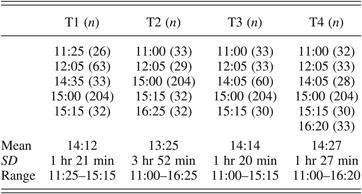
Adolescents were fluent in French and were tested during school hours in collaboration with school administrators and instructors. At both schools, testing occurred as follows: Time 1 (T1) during the last week of September, Time 2 (T2) in November, Time 3 (T3) in December, and Time 4 (T4) in mid-February. School 1 allowed testing to take place at different times over the course of the day, while School 2 only allowed testing at the end of classes during students' mandatory study period. Due to the constraints of such scheduling, we needed to control for the circadian cycle of cortisol throughout the day while maintaining the largest sample size possible. To do so, we selected adolescents who were exclusively tested in the afternoon. This led to a sample size of 360 adolescents (198 boys, 162 girls) from School 1 (n = 156; 77 boys, 79 girls) and School 2 (n = 204; 120 boys, 84 girls) used in our analyses (see Table 1). Adolescents were free of medication that may affect depressive symptoms or cortisol levels, and they did not present other psychiatric, neurological, substance use, or general health problems. The adolescents who were selected based on time of testing were not different from those who were excluded on age, sex distribution, BMI, and number of friends.
Times at which salivary cortisol samples were collected

Note: Samples 1 and 2 were taken approximately 45 min apart and averaged. Times here reflect Sample 1 collection. Samples collected before 12:00 p.m. were excluded from analyses. Preliminary analysis revealed no significant differences in salivary cortisol levels as a function of time slots used.
Measures
Menarcheal status and menarcheal timing
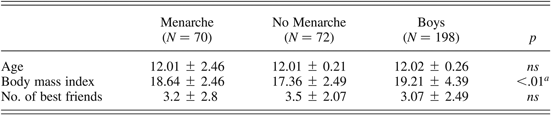
Girls were asked at the beginning (T1) and end (T4) of the study whether they had reached menarche (“Have you started your menstruation?”). Seventy girls had already reached menarche before the beginning of the study (menarche group), while 72 had still not reached menarche by the end of the study (no-menarche group; Table 2). If girls had begun menarche during study participation, they were asked to specify when this occurred (i.e., “beginning of January”). Twenty girls reached menarche during the study; however, they were excluded from the analyses because of restricted power that could not allow us to contrast them to the menarche and no-menarche groups. Boys (n = 198) served as a control group.
Group differences on potential confounding factors associated with depression and cortisol levels as a function of sex and menarcheal status in 360 adolescents (mean ± standard deviation)
aNo menarche group significantly different from boys.
In accordance with extant theoretical and empirical literature, two menarcheal classifications were sequentially analyzed as predictors of depressive symptoms and cortisol levels across the school year. First, menarcheal status (menarche or no-menarche groups or boys) was used to test the stressful change hypothesis. Second, menarcheal timing (early or on-time groups) was used to explore the early timing hypothesis in a subset of girls. In this manner, girls from the menarche group were subdivided into two groups based on previous large-scale studies (Joinson et al., Reference Joinson, Heron, Lewis, Croudace and Araya2011; Stice et al., Reference Stice, Presnell and Bearman2001): early menarche (10–11 years) and on-time menarche (12–13 years).
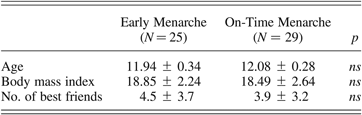
In this sample, there were 25 girls in the early group (M age = 11.9 ± 1.9 years) and 29 girls in the on-time group (M age = 12.08 ± 0.28 years). For each girl, we calculated the number of months that elapsed between onset of menarche and actual age at the time of the study: groups differed significantly with regard to months since menarche, F (1, 49) = 11.4; p < .001. For the girls who reached early menarche, there was a mean of 12.8 ± 1.9 months that had elapsed since onset of menarche and time of the study. For the girls who reached on-time menarche, there was a mean of 5.5 ± 1.1 months that had elapsed between onset of menarche and time of the study. The two groups of girls did not differ with regard to their age during testing (see Table 3).
Group differences on potential confounding factors associated with depression and cortisol levels as a function of sex and menarcheal timing in girls from the menarche group (mean ± standard deviation)
Depressive symptoms
The 27-item French-validated version (Saint-Laurent, Reference Saint-Laurent1990) of the Child Depression Inventory (CDI) developed for children ages 7 to 17 (Kovacs, Reference Kovacs1981, Reference Kovacs1991) was administered to measure self-rated depressive symptoms. Each item contains three choices, ranging from 0 to 2, providing a possible score between 0 and 54. To standardize scores, our statistical analyses used t scores transformed from the raw data. The CDI was administered at each of the four study time points. Only participants who completed at least two of the four CDI questionnaires between T1 and T4 were included in analyses. In sum, total scores on the CDI (t scores) served as the primary measure of self-rated depressive symptoms.
Salivary cortisol levels
Cortisol levels were assessed in saliva samples obtained twice during each testing session. For each saliva sample, participants provided 2 ml of pure saliva (no cotton swab) in a small tube (Salivette®; Sarstedt, Germany). Samples used for analyses were obtained between noon and 5 p.m. Approximately 45 min elapsed between retrieving Sample 1 and Sample 2 from all of the participants. The process was repeated for each testing session. Preliminary analysis ascertained that cortisol levels did not differ as a function of average time slots.
At the end of each testing session, saliva samples were stored in freezers at −20°C at the Centre for Studies on Human Stress (www.humanstress.ca) until determination using a high sensitivity enzyme immune assay kit (Salimetrics® State College, PA, Catalogue No. 1-3102). Frozen samples were brought to room temperature to be centrifuged at 15000 × g (3000 rpm) for 15 min. The range of detection for this assay is between 0.012 and 3 µg/dl. Upon receiving duplicate assay values for each sample, we averaged these values together.
The two cortisol samples taken at each testing session were averaged to account for intra- and interindividual variability during group testing (Lupien et al., Reference Lupien, King, Meaney and McEwen2001). This protocol was necessarily employed to minimize the potentially confounding influence of extraneous factors (e.g. food intake, tester effects, and novelty) that can distort the representation of a single measurement.
Potential confounders
BMI
Height and weight was obtained from self-report in conjunction to tester assistance of height when necessary. BMI was calculated as weight (kg) divided by height (m2). There were 121 cases of missing height or weight information; therefore, the BMI analysis included a reduced number of participants from each group: menarche (n = 46), no-menarche (n = 47), and boys (n = 146).
Number of best friends
A growing body of research suggests that puberty influences peer relations and depression (Conley et al., Reference Conley, Rudolph and Bryant2012). Girls are particularly effected by these interpersonal stressors (Hankin, Mermelstein, & Roesch, Reference Hankin, Mermelstein and Roesch2007; Rudolph & Klein, Reference Rudolph and Klein2009), underlining the important role social contexts exert on sex differentiated pathways toward psychopathology (Conley & Rudolph, Reference Conley and Rudolph2009). Because having a limited number of friends is a potential social stressor in and of itself, it represents a logical proxy of social support at a quantitative and not a qualitative level. In accordance, adolescents in the current study were ask to indicate the number of best friends they had at the time of the study. Participants completed this questionnaire at the end of the study to best represent the number of best friends each adolescent had 7 months after starting secondary school. There were 46 cases of missing data for number of best friends; therefore, the analysis included a reduced number of participants from each group: menarche (n = 69), no menarche (n = 67), and boys (n = 178).
Protocol
Participants were tested in groups during class or a study period. At each testing session, participants provided a saliva sample at the start of testing. A demographics questionnaire completed during the first testing session provided information on sex, age, height, weight, medication, and illnesses. This was followed by a series of cognitive tests (not reported here) and psychological questionnaires that included the CDI completed at each testing session. At the end of each testing session, approximately 45 min in, a second saliva sample was obtained. The questionnaire on menstrual milestones in girls was administered at the beginning (T1) and end (T4) of the study.
Treatment of the data
Preliminary descriptive statistics were conducted to examine normal distributions, means, and variance. Data points for the CDI and cortisol levels were removed if they were 3 standard deviations above the mean of the group, controlling for sex. The standard deviations were small, and only 10 of the original 504 participants were removed in this manner: 3 in the menarche group, 3 in the no menarche group, and 4 boys. Preliminary analyses compared groups for the confounding effects of age, BMI, and number of best friends. When variables were shown to be different across groups, they were included as covariates in subsequent analyses.
For this study, data were needed for menarcheal status, depressive symptoms, salivary cortisol levels, BMI, and number of best friends. Of the 506 adolescents in the cohort, 360 adolescents (198 boys; 162 girls) were selected because their salivary cortisol levels were taken in the p.m. Of the 360 individuals, varying numbers were excluded depending on the measure being analyzed. Of the 360 individuals, 70 girls were in the menarche group, whereas 72 girls were in the no-menarche group. There were 20 girls who reached menarche during the study, but tey were excluded due to small sample size, which would prevent appropriate comparisons with the menarche and nonmenarche groups. The BMI rating involved 121 cases of missing height/weight information, leaving n = 46 (menarche group); n = 47 (no-menarche group); and n = 146 (boys group). There were 42 cases of missing data for number of best friends, resulting in n = 69 (menarche group), n = 67 (no-menarche group); and n = 178 (boys group).
Statistical analyses
To first test the stressful change hypothesis, we performed one-way repeated-measure analyses of vaariance (ANOVAs) on total CDI scores and salivary cortisol levels with group (menarche vs. no menarche vs. boys) as the between-subject factor and time (T1 through T4; CDI scores or cortisol levels) as the within-subject factor. To test the early timing hypothesis in a second way, we performed one-way repeated ANOVAs on total CDI scores and salivary cortisol levels in girls from the menarche group with group (early vs. on-time menarche) as the between-subject factor and time (T1 through T4) as the within-subject factor. For all the repeated measure ANOVAs, Greenhouse–Geisser corrections were applied (Greenhouse & Geisser, Reference Greenhouse and Geisser1959) when the assumption of sphericity was violated. For all significant main and interaction effects, we used Tukey post hoc analyses. Given that data from the menarche group were used in two statistical analyses, we used a Bonferroni correction (0.05/2 = 0.025) to conservatively ascertain statistical significance. All statistical analyses were performed using Statistical Package for the Social Sciences 16.0.0 software package for Macintosh.
Results
Preliminary analyses on potential confounding variables between menarcheal status groups
Table 2 presents the data on age, BMI, and number of best friends in girls grouped as a function of menarcheal status (menarche vs. no-menarche) as well as for boys. Preliminary analyses revealed no group differences for age or number of best friends, although BMI was significant, F (2, 238) = 4.29, p < .01. Post hoc analyses revealed that girls from the no-menarche group presented significantly lower BMI than did girls from the menarche group and boys (p < .001). Given this group difference, only BMI was entered as a covariate in subsequent analyses pertaining to menarcheal status.
Menarcheal status and depressive symptoms
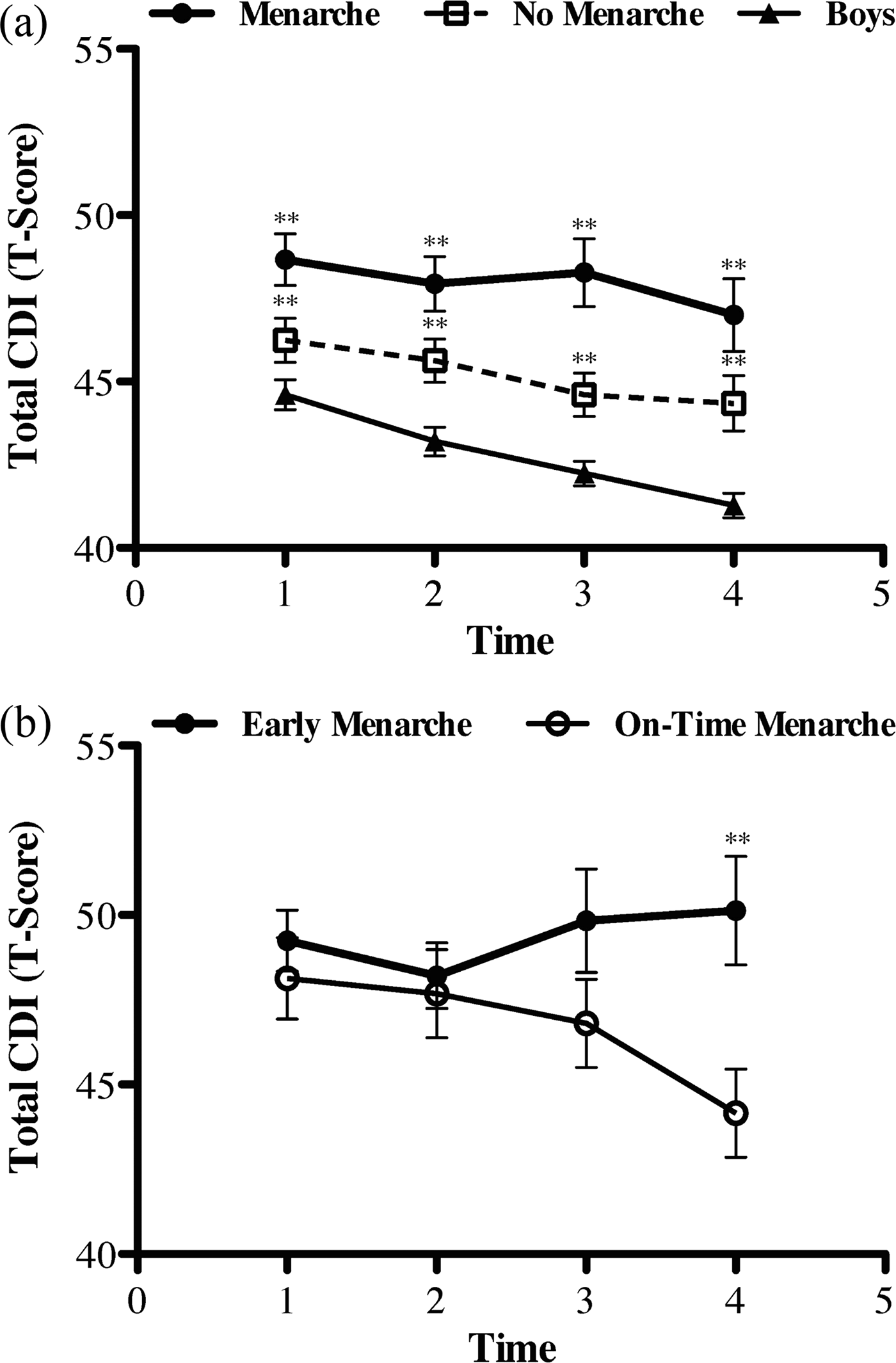
Results of the one-way repeated measure ANOVA performed on depressive scores showed a main effect of time, F (3, 753) = 12.67, p < .0001, a main effect of group, F (2, 251) = 27.3, p < .0001, and a BMI covariation effect, F (2, 183) = 19.89, p < .0001, but no interaction effects (see Figure 1a). The main effect of time revealed that depressive scores decreased significantly with subsequent testing sessions across all groups. The main effect of group revealed that girls from the menarche group presented significantly higher depressive scores than did girls from the no-menarche group and boys. In addition, girls from the no-menarche group presented significantly higher depressive scores when compared to boys (p < .01).
Mean Child Depression Inventory scores (standardized t scores ± standard error of the mean) throughout testing sessions 1 to 4 among (a) girls from the menarche and no-menarche groups and boys (*significantly different from the other two groups) and (b) girls from the early menarche and the on-time menarche groups (**significant group difference).
Menarcheal status and salivary cortisol levels
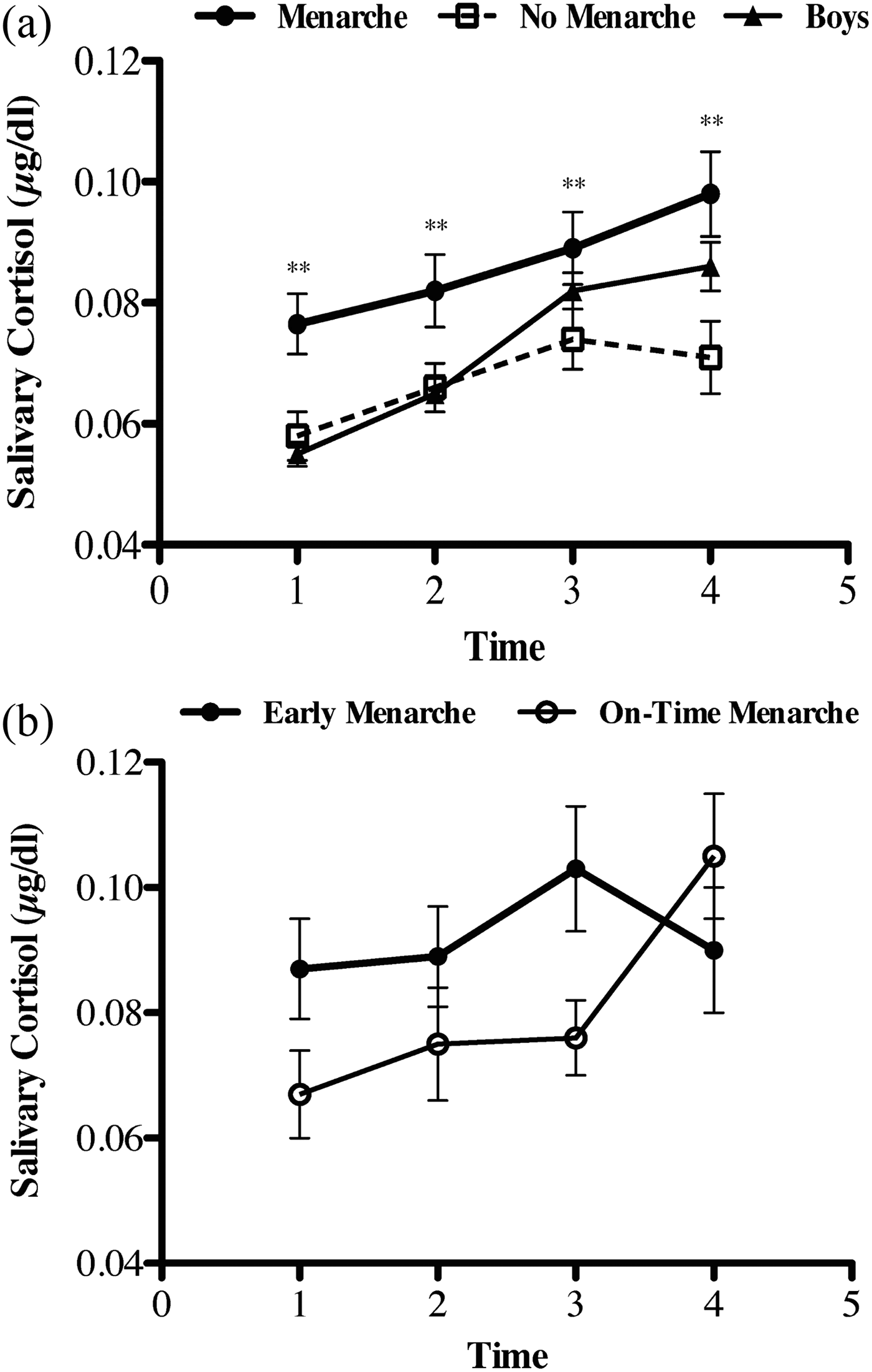
Results of the one-way repeated measure ANOVA performed on salivary cortisol levels showed a main effect of time, F (3, 846) = 17.49, p < .0001, a main effect of group, F (2, 282) = 9.401, p < .0001, and a BMI covariation effect, F (2, 202) = 7.02, p < .001, but no interaction effects (see Figure 2a). The main effect of time showed that salivary cortisol levels significantly increased throughout the school year across all groups. The main effect of group showed that, on average, girls from the menarche group presented significantly higher salivary cortisol levels when compared to girls from the no-menarche group and boys. Girls from the no-menarche group again differed significantly overall from boys on salivary cortisol levels (p < .01).
Mean salivary cortisol levels (μg/dl ± standard error of the mean) throughout testing sessions 1 to 4 among (a) girls from the menarche and no-menarche groups and boys (*significantly different from no-menarche girls and boys) and (b) girls from the early menarche and on-time menarche groups.
In order to assess whether mean cortisol levels across the four testing sessions were associated with mean CDI scores, we executed Pearson correlations between mean CDI scores and mean salivary cortisol levels in each group taken separately. We found no significant correlation between mean cortisol levels and mean CDI scores across groups.
Preliminary analyses on potential confounding variables between menarcheal timing groups
Table 3 presents the data on age, BMI, and number of best friends in girls grouped as a function of menarcheal timing (early menarche vs. on-time menarche). Because preliminary analyses revealed no group differences, none were used as covariates in analyses.
Menarcheal timing and depressive symptoms
Results of the one-way repeated measures ANOVA performed on depressive scores revealed a significant interaction between group (early vs. on-time menarche) and time (T1 through T4) on depressive scores, F (3, 99) = 4.41, p < .006. Group comparisons at each time point showed that girls from the early and on-time menarche groups did not differ on depressive scores for the first three time points, although they did differ at the last time point (T4) of the study, F (1, 60) = 8.41, p < .005. At this time point, girls from the on-time menarche group showed significantly lower depressive scores in comparison to girls from the early menarche group (see Figure 1b).
Menarcheal timing and salivary cortisol levels
Results of the one-way repeated ANOVA performed on salivary cortisol levels revealed no significant main effect nor interactions between group and time (see Figure 2b).
Discussion
This longitudinal study assessed differences in depressive symptoms and salivary cortisol levels as a function of menarcheal status and menarcheal timing among adolescents undergoing a scholastic transition. Our findings provide three important sets of information. First, we found that girls who started menstruating before starting secondary school, which begins at Grade 7 in Quebec's education system, reported significantly higher depressive scores and higher cortisol levels than nonmenarcheal girls as well as boys. Second, we found that girls from the early menarche group showed consistently elevated levels of depressive symptoms during this study, while depressive symptoms in the on-time menarche group were more transient and diminished at study conclusion. Third, we expand our previous work by showing that starting secondary school is associated with increased salivary cortisol levels in adolescent boys and girls.
The results of the present study allow some insights into both the stressful change and the early timing hypotheses. First, the stressful change hypothesis predicts that menarche is a significant, albeit transient, factor due in part to novelty, discomfort, adaption to sanitary needs, and other stressors associated with menstruation. In accordance, the menarche group presented significantly higher levels of depressive symptoms and cortisol levels in comparison to girls from the no-menarche group and boys across the 5-month period. Second, the early timing hypothesis predicts that girls who start menarche before the age of 11 (early menarche group) should present higher depressive symptoms in comparison to girls with on-time menarche; however, this difference should not be transient but be apparent at each time point of the study.
This was partially confirmed because girls from the early and on-time menarche groups presented similar depressive scores at the first three time points. At study conclusion, girls from the on-time menarche group showed decreases in depressive symptoms in comparison to girls from the early-menarche group. Taken together, our findings suggest that girls who mature earlier than their peers are more vulnerable to psychological distress (Caspi & Moffitt, Reference Caspi and Moffitt1991; Ge et al., Reference Ge, Conger and Elder1996; Joinson et al., Reference Joinson, Heron, Lewis, Croudace and Araya2011). While girls who reached menarche on time experienced increased depressive symptoms when starting secondary school, these were transient and decreased over time in line with the stressful change hypothesis.
Our findings using menarcheal status as a grouping variable shed light on sex differences in depressive symptomatologies. While girls from the menarche group presented significantly higher depressive scores and cortisol levels than girls from the no-menarche group and boys, girls from the no-menarche group still presented significantly higher depressive scores and cortisol levels than boys. This is inconsistent with the hypothesis that menarche is the only factor behind the emergence of marked sex differences in depressive symptoms upon puberty onset and thereafter. Instead, sex can be considered an as an important modulator. Moreover, while the no-menarche girls were not yet menstruating, changes relating to puberty were likely in progress and influencing outcomes. Finally, we did not find significant differences between groups on the number of best friends, suggesting that the sex difference in depressive scores cannot be attributed to social relationships when starting secondary school; however, more refined measures of social support would have been useful in addressing this.
Turning to our stress hormone findings, there are three possibilities for the increased cortisol levels observed among menarcheal girls regardless of menarcheal timing. The first possibility is that onset of menarche leads to increased secretion of cortisol in girls through the close interactions between the HPA and the hypothalamic–pituitary–gonadal axes (Chrousos, Torpy, & Gold, Reference Chrousos, Torpy and Gold1998) under both basal and stressful conditions. In particular, estrogens stimulate HPA axis activity and modify glucocorticoid and mineralocorticoid functions in several animal species (Burgess & Handa, Reference Burgess and Handa1992; Handa, Burgess, Kerr, & O'Keefe, Reference Handa, Burgess, Kerr and O'Keefe1994; Viau & Meaney, Reference Viau and Meaney1991). Although studies among humans are less clear, it is known that estrogen replacement increases concentrations of free cortisol (Burgess & Handa, Reference Burgess and Handa1992; Chrousos et al., Reference Chrousos, Torpy and Gold1998) and that onset of menarche is associated with increased cortisol levels in the afternoon phase (Oskis, Loveday, Hucklebridge, Thorn, & Clow, Reference Oskis, Loveday, Hucklebridge, Thorn and Clow2009).
The second possibility is that onset of menarche in girls leads to increased reactivity to environmental stressors. In the present study, we found that menarcheal girls presented significantly higher cortisol levels throughout the study when compared to nonmenarcheal girls and boys. When subanalyzed as a function of menarcheal timing, we found that girls with early and on-time menarche presented no difference in cortisol levels across testing sessions. This is consistent with the notion that presence of menarche, more so than timing per se, may increase reactivity to environmental stressors. Given the close interactions existing between the HPA and the hypothalamic–pituitary–gonadal axes (Chrousos et al., Reference Chrousos, Torpy and Gold1998), it is possible that increases in estrogen secretion might be associated with onset of menarche in adolescent girls, which in turn modulate regulation of the stress response. Further studies measuring cortisol reactivity to psychosocial stressors before and after onset of menarche in adolescent girls would provide important data on this issue.
The third possibility is that our stress hormone findings might represent a naturalistic adaptation to starting secondary school. The significant increase in salivary cortisol levels observed across all groups (girls and boys) may indicate that starting secondary school is a stressful experience as previously proposed by our group (Lupien et al., Reference Lupien, King, Meaney and McEwen2001). Notwithstanding, the current study cannot address whether these elevations are due specifically to secondary school transitioning or to any number of other factors such as pubertal development itself. In particular, we cannot be certain that this scholastic transition is stressful without earlier information while participants were in elementary school.
Alternatively, natural seasonal variations in cortisol levels (King et al., Reference King, Rosal, Ma, Reed, Kelly and Stanek2000) may have confounded our results, given higher observed cortisol levels in the winter (T3 and T4 of this study) compared to fall (T1 and T2 of this study). While one study found higher levels in the winter than in the summer among men ages 24 to 33 (Walker, Best, Noon, Watt, & Webb, Reference Walker, Best, Noon, Watt and Webb1997), a more recent study of 120 participants ages 8 to 14 reported highest cortisol levels in spring/summer seasons but not in the winter (Matchock, Dorn, & Susman, Reference Matchock, Dorn and Susman2007). Another study found that salivary cortisol levels are highest in February, March, and April in working adults ages 32 to 61 (Persson et al., Reference Persson, Garde, Hansen, Osterberg, Larsson and Orbaek2008). In addition to the elusive effects of hemispheric differences in seasonality, these findings highlight the importance of controlling for seasonal variations in psychoneuroendocrine research. This is especially the case among children and adolescents, whereby we know so little and need much more research to clarify this issue.
In addition, constitutionally higher levels of cortisol associated with onset of menarche may enhance girls' vulnerability to depression in association with genetic, race/ethnicity (Hayward, Gotlib, Schraedley, & Litt, Reference Hayward, Gotlib, Schraedley and Litt1999), and/or other environmental factors (Netherton, Goodyer, Tamplin, & Herbert, Reference Netherton, Goodyer, Tamplin and Herbert2004). Nevertheless, in the present study, we found no significant correlation between circulating levels of cortisol and depressive symptoms across groups. This result shows that actual circulating levels of cortisol, although higher in menarcheal girls, may not be the cause of the increased depressive symptoms observed in this group. It is also important to note that depressive symptoms decreased overall for the sample, which could be explained by a regression to the mean that could be due to habituation to the school environment. By contrast, cortisol levels steadily increase throughout the school year, suggesting a disassociation in early adolescence that might change over time in the advent of clinical depression. At a conceptual level, we speculate subclinical depressive symptoms may increase toward clinical thresholds as a whole new array of social, cognitive, and behavioral factors secondary to puberty onset emerge such as dating, sexuality, academic pressures, aptitude assessment, and a whole plethora of phenomena characterizing middle adolescence.
Previous investigations of children (Ellis, Essex, & Boyce, Reference Ellis, Essex and Boyce2005; Essex, Klein, Cho, & Kalin, Reference Essex, Klein, Cho and Kalin2002; Smider et al., Reference Smider, Essex, Kalin, Buss, Klein and Davidson2002), adolescents (Goodyer et al., Reference Goodyer, Herbert, Altham, Pearson, Secher and Shiers1996; Halligan et al., Reference Halligan, Herbert, Goodyer and Murray2007; Murray, Reference Murray and Goodyer2003), and adults (Burke, Davis, Otte, & Mohr, Reference Burke, Davis, Otte and Mohr2005; Gold, Drevets, & Charney, Reference Gold, Drevets and Charney2002; Heim et al., Reference Heim, Newport, Wagner, Wilcox, Miller and Nemeroff2002) suggest that it is not levels of cortisol that seems to predict onset of depression per se, but rather the long-term exposure of the brain to high levels of cortisol. If onset of menarche leads to increased cortisol levels through an endocrine mechanism and/or through increased reactivity to environmental stress, then it may be that girls who reach early menarche are exposed to high levels of cortisol at a significantly younger age and for a significantly longer period of time than girls who reach menarche at a normal age. This cumulative exposure to high levels of cortisol may explain the presence of consistent elevations in depressive symptoms in girls with early menarche.
Brain vulnerability to early menarche hypothesis
Stress hormones are liposoluble steroids that rapidly access the brain where they bind to glucocorticoid receptor-dense regions: the hippocampus, the amygdala, and the frontal cortex (Lupien, McEwen, Gunnar, & Heim, Reference Lupien, McEwen, Gunnar and Heim2009). These three brain regions are involved in the development of depressive disorders (for recent reviews, see Bellani, Baiano, & Brambilla, Reference Bellani, Baiano and Brambilla2011; Koenigs & Grafman, Reference Koenigs and Grafman2009; MacQueen & Frodl, Reference MacQueen and Frodl2011), and it is interesting that they develop at different rates among humans (for a review, see Lupien et al., Reference Lupien, McEwen, Gunnar and Heim2009). Total hippocampal volume remains relatively stable between ages 4 and 25, suggesting that it is fully developed before the age of 4 although it continues to show neuronal proliferation, myelination, and pruning (Gogtay et al., Reference Gogtay, Nugent, Herman, Ordonez, Greenstein and Hayashi2006; Teicher, Andersen, Polcari, Anderson, & Navalta, Reference Teicher, Andersen, Polcari, Anderson and Navalta2002). The amygdala exhibits a continuous period of development extending from Year 1 through late childhood (Tottenham, Hare, & Casey, Reference Tottenham, Hare, Casey, Phelps and Whalen2009), whereas white and gray matter volumes follow an inverted U developmental trajectory with the latest peaks occurring in high association areas such as the dorsolateral prefrontal cortex. In humans, the frontal lobe gray matter reaches its maximal volume at 11.0 years in girls and 12.1 years in boys (Giedd & Rapoport, Reference Giedd and Rapoport2010).
Early age of menarche is considered to occur among girls 11 years old or younger, the exact same age at which the frontal lobes are in the process of reaching their maximal volumes in girls (Giedd & Rapoport, Reference Giedd and Rapoport2010). Chronic exposure of the still developing frontal brain regions to high levels of cortisol could induce a heterotypic reorganization of synaptic development, programming of neurotrophic factors, or changes in gene expression in fontal brain regions that could modify the developmental trajectories of these girls. In contrast, girls who reach on-time menarche between 12 and 15 years old might secrete increased cortisol levels upon onset of menarche; however, this would occur when the frontal brain regions have already reached their maximal volume and are therefore no longer as vulnerable. This may offer greater protection against high levels of cortisol among these girls in comparison to girls who reached menarche earlier when the frontal cortex was more malleable.
We propose the “brain vulnerability to early menarche hypothesis,” that early menarche should be associated with significant differences in the development of glucocorticoid-sensitive brain regions, with a particular effect on frontal regions. Future studies measuring frontal lobe volumes and/or function in relation to menarcheal status and/or timing will be important at testing this developmental hypothesis in relation to depressive symptoms in adolescent girls.
Strengths and limitations
The current study has a number of strengths, including a large sample size, repeated measures of self-reported depressive symptoms and cortisol levels, a narrow age range, inclusion of boys, and availability of data on potential confounding factors.
Nevertheless, some key limitations warrant consideration. First, despite our initially large sample size, missing data, grouping strategies, and eliminations substantially reduced overall power and is therefore a major representative limitation. Due to limited power of our menarcheal timing subanalyses, in particular, we must be cautious in our conclusions and implications for the stressful change hypothesis. In terms of generalizability, we only tested adolescents from private secondary schools who were from medium to high socioeconomic status (SES). Although this allowed for a homogeneous sample, our findings may not apply to adolescents of lower SES. In previous studies, our group demonstrated that children from low SES present significantly higher cortisol levels than children from high SES only until they transition into secondary school, at which point cortisol levels no longer differ (Lupien et al., Reference Lupien, King, Meaney and McEwen2001). This suggests that SES differentials might equalize during adolescence (West, Reference West1997); however, it is unclear whether low SES may interact with high cortisol levels to confer greater vulnerability to depressive symptomatology in menarcheal girls at later ages, or perhaps even how low SES might contribute to an earlier age of menarche. Likewise, we did not measure coping strategies and other contextual information that influence the potentially distressing experience of starting secondary school for adolescents ages 11 to 13.
Second, we did not control for menstrual cycling at the time of testing in the menarche group. Cortisol levels differ as a function of the menstrual cycle, with highest levels of basal and reactive cortisol levels being observed during the luteal phase when compared to the follicular phase (Kirschbaum, Kudielka, Gaab, Schommer, & Hellhammer, Reference Kirschbaum, Kudielka, Gaab, Schommer and Hellhammer1999). While we may have tested some girls during the luteal phase, our sample size was large enough to allow for random distribution of testing throughout the menstrual cycle. Similarly, we did not control for secondary sex characteristics of pubertal development with measures such as the Tanner stage sketches (Oldehinkel, Verhulst, & Ormel, Reference Oldehinkel, Verhulst and Ormel2011) nor did we include girls who started menstruating during study participation because of restricted power.
Third, we did not control for familial psychosocial factors. For instance, discordant family dynamics predict early menarche (Ellis & Essex, Reference Ellis and Essex2007; Ellis & Garber, Reference Ellis and Garber2000) and menarcheal girls from nonintact families report significantly greater depressive symptoms than nonmenarcheal girls from similar backgrounds (Capron et al., Reference Capron, Therond and Duyme2007). Consequently, it is possible that the effect of early menarche on depressive symptoms and cortisol levels in adolescent girls may be modulated by the presence of family discord. Likewise, our measure of number of friends is at best a proxy of social support that should have been measured using standard instruments.
Fourth, we did not measure whether presence of depressive affect during childhood can predict early age at menarche and increased cortisol levels in adolescence. In a pioneering prospective study of premenarcheal girls ages 10 to 14 years, breast development, weight, family relations, and depressive affect were predictive of earlier age at menarche (Graber, Brooks-Gunn, & Warren, Reference Graber, Brooks-Gunn and Warren1995). Likewise, experiencing depressive symptoms at premenarche significantly predict negative emotional responses at postmenarche (Rierdan & Koff, Reference Rierdan and Koff1990). In the current study, the menarche group consistently manifested the highest depressive scores and cortisol levels over 6 months; however, it was not possible to ascertain their depressive or endocrine profiles prior to study participation. Future longitudinal studies assessing biopsychosocial factors before and after onset of menarche are necessary.
Implications and future directions
Taken together, our findings extend the early timing and the stressful change hypotheses by showing that the presence of menarche when starting secondary school in Grade 7 for Quebecers is associated with significantly higher depressive symptoms and cortisol levels. These effects are more transient among girls who reach menarche on time in comparison to girls who reach menarche early. Given that menarche is associated with significantly higher cortisol levels, we propose that cumulative exposure to high levels of cortisol in adolescent girls that is catalyzed by early menarche may have a pronounced negative impact on the developing brain that ultimately contributes to increased depressive vulnerability in adulthood. Previous studies demonstrate that cortisol levels can be significantly decreased with targeted interventions for children (Dozier et al., Reference Dozier, Peloso, Lindhiem, Gordon, Manni and Sepulveda2006; Fisher, Stoolmiller, Gunnar, & Burraston, Reference Fisher, Stoolmiller, Gunnar and Burraston2007). A major implication of the current findings underline the importance of designing interventions tailored for adolescent girls going through menarche at the time of secondary school transition because this could potentially reduce the occurrence of depression throughout their lives (Adam, Sutton, Doane, & Mineka, Reference Adam, Sutton, Doane and Mineka2008).