I. INTRODUCTION
Porous ceramics are characterized by their high permeability, high surface area, light weight, thermal shock resistance and good strain, and damage tolerance. This unique combination of properties allows porous ceramics to be made for many applications, including high temperature gas filters,Reference Park, Lee and Lee1 separation membranes,Reference Saggio-Woyansky, Scott and Minnear2 catalyst supports,Reference Kim, Lee, Han and Park3,Reference Furuta, Katsuki and Komarneni4 refractory linings, thermal insulators, light weight structures,Reference Saggio-Woyansky, Scott and Minnear2,Reference Montanaro, Jorand, Fantozzi and Negro5 and biomedical substitutes for bone and teeth.Reference Sepulveda, Ortega, Innocentini and Pandolfelli6,Reference Hing7 Methods of preparation include burning a polymer,Reference Zhu, Jiang and Tan8 solid-state sintering,Reference Kwon, Son, Suh and Kim9 gelcasting,Reference Geis, Fricke and Löbmann10–Reference Mao, Shimai, Dong and Wang15 and replication of polymer foams by impregnation.Reference Peng, Fan, Evans and Busfield16 Porosity, cell size, and morphology of porous ceramics can be controlled while needed. Gelcasting is an attractive method for the fabrication of porous ceramics because the process is simple and convenient. Recently, a novel gelling systemReference Yang, Shimai and Wang17 was developed for the fabrication of alumina ceramics using only a water-soluble copolymer of isobutylene and maleic anhydride (commercial name Isobam).
We extend this novel gelling system to prepare porous alumina ceramics by the addition of mechanical foaming. The influence of the surfactant content on gelling behavior of the alumina slurry and porosity, cell size, and compressive strength of the sintered porous ceramics was investigated.
II. EXPERIMENTAL PROCEDURE
Al2O3 powder (AES-11, Sumitomo Chemical Co., Ltd., Tokyo, Japan, d 50 = 0.45 μm, BET = 6.4 m2/g), deionized water, and Isobam 104# (a copolymer of isobutylene and maleic anhydride, Kuraray Co., Ltd. Osaka, Japan, simply noted as Isobam hereafter) were used as raw materials. Morphology of the alumina powder and molecular structure of the Isobam were previously reported.Reference Yang, Shimai and Wang17 Surfactant EMAL TD (C12H25OSO3H·N(C2H4OH)3) as a 40 vol% aqueous solution (Kao Chemical Co., Tokyo, Japan, noted as Surf-E hereafter) was selected as the foaming agent.
Alumina slurries with 50 vol% solid loading and 0.3 wt% Isobam (relative to the weight of alumina powder) were prepared by ball-milling. A typical formula was: 480 g alumina powder, 120 mL de-ionized water, and 1.44 g Isobam. A kitchen mixer was used to generate foams. Settings were 1000 rpm for 10 min and followed by 200 rpm after addition of up to 0.8 vol% Surf-E (relative to the volume of the slurry, the data were calculated by excluding water from the EMAL TD aqueous solution). The resultant foams, with a volume of 1200 mL, were poured into a plastic mold (15 × 15 × 5 cm3). After drying, the foamed Al2O3 was sintered at 1600 °C for 3 h.
The rheological properties and viscosity of the slurries were measured using a stress-controlled rheometer (Physica MCR301, Anton Paar, Graz, Austria) with a parallel plate (25 mm in diameter, gap: 1 mm). Microstructures were observed by a scanning electron microscope (JSM JEOL-6390, Tokyo, Japan) with a magnification of 50x. The diameter of each pore was measured and the average pore size was calculated for each sample. The compressive strength was measured using an Instron-5566 universal testing machine at a loading rate of 1.5 MPa/s. The sample used in compressive strength testing was 20 × 20 × 20 mm in size.
III. RESULTS AND DISCUSSION
A. Effect of Surf-E on zeta potential of the Al2O3 slurry
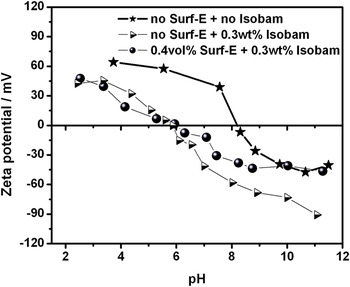
Figure 1 shows the influence of Surf-E on zeta potential of the alumina slurry. The isoelectric point of alumina in aqueous slurry was pH = 8.3. The addition of 0.3 wt% Isobam resulted in an isoelectric point of pH = 5.8 and zeta potential of −60 mV at pH = 8.3. When both 0.4 vol% Surf-E and 0.3 wt% Isobam were added, the zeta potential of the slurry was −40 mV at pH = 8.3. It can be inferred that the addition of 0.4 vol% Surf-E had little negative effect on the dispersion role of Isobam. In a previous paper,Reference Yang, Shimai and Wang17 we reported the dispersing ability of Isobam was similar to that of a conventional dispersant NH4+PAA. Presently, Isobam was first mixed with water, alumina powder to allow adsorption, followed by the addition of Surf-E. Isobam is a long chain polymer, and Surf-E is a small one. Surf-E had no opportunity to adsorb on the alumina particles and could neutralize electronic charges of Isobam. As a result, the zeta potential of alumina was not as high as that of Isobam alone.
Effect of Surf-E on zeta potential of the alumina slurry.

B. Influence of Surf-E on the rheological properties of slurry
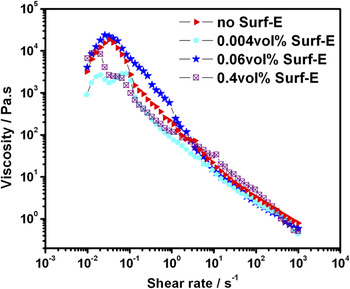
Figure 2 shows the rheological properties of slurries (50 vol% solid loading, 0.3 wt% Isobam) with different amounts of Surf-E added before foaming. All the slurries prepared in this way had a shear thinning behavior and little change in viscosity with the addition of Surf-E. The shear thinning behavior is favorable for stabilizing bubbles, and the low viscosity under a high shearing rate may significantly improve foaming.
Rheological flow curves of slurries with different amounts of Surf-E (50 vol% solid loading, 0.3 wt% Isobam).

C. The influence of surfactant on gelling behavior
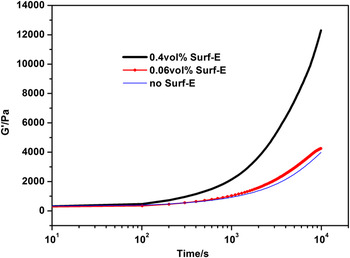
Figure 3 shows the influence of surfactant on the storage modulus G′ of slurries with 50 vol% solid loading and 0.3 wt% Isobam before foaming. The addition of Surf-E accelerated the gelling speed. Taking a G′ of 3000 Pa as a goal, gelling time of the alumina slurry with 50 vol% solid loading and 0.3 wt% Isobam, without Surf-E, was 108 min. The gelling time was 87 and 26 min when 0.06 and 0.4 vol% Surf-E, respectively, was added. A possible accelerating mechanism was the esterification reaction between Isobam and Surf-E. Surf-E is triethanol amine lauryl sulfate, containing three –OH groups per molecule. Isobam contains three kinds of functional groups –COO−NH4+, –CONH2, and anhydride, which can change to –COOH after hydrolysis. Networks may form by the esterification of the –OH of Surf-E with the –COOH of the hydrolyzed Isobam. Therefore, the addition of Surf-E accelerated gelation of the slurry.
G′ of the slurries (50 vol% solid loading, 0.3 wt% Isobam) with different amounts of Surf-E added before foaming.

D. Foaming of the Al2O3 slurry
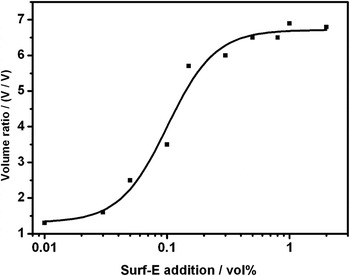
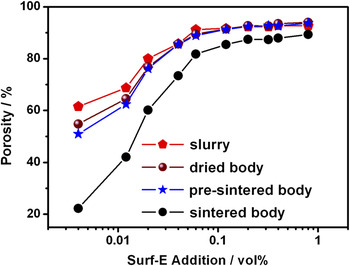
Figure 4 shows the influence of the Surf-E content on the foaming ability of slurries with 50 vol% solid loading and 0.3 wt% Isobam. The foaming ability was evaluated using the foam volume expansion ratio, defined as the ratio of foamed slurry volume to that of the original. The volume ratio increased as the surfactant content increased, with a maximum ratio of 6.5 when 0.5 vol% Surf-E was added. The volume ratio did not increase further if more Surf-E was added. The reason may be that surfactant adsorption at the gas–liquid interface decreases the interfacial energy,Reference Gonzenbach, Studart, Tervoort and Gauckler18 which was beneficial to the generation of bubbles. With the addition of more surfactant, the interfacial energy decreases to a minimum level. On the other hand, the foaming parameters, such as stirring speed and stirring time, are fixed. This kept the foaming ability constant. Similarly, the porosity of the slurries increased with the addition of Surf-E. This porosity was maintained in the dried gel, presintered body, and sintered body (Fig. 5).
Foaming capacity with the addition of Surf-E addition.

Porosity varied with the Surf-E content.

E. Shrinkage behavior of porous Al2O3 ceramics
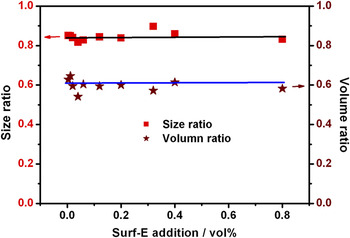
TG measurement was carried out for the dried green body made from a slurry (50 vol% solid loading) with 0.3 wt% Isobam for gelling and 0.06 vol% Surf-E for foaming. The mass loss was only 0.78% mainly occurring between 200 and 500 °C. Compared with a traditional gelling system such as epoxy and amine,Reference Mao, Shimai, Dong and Wang15 which used 3–5 wt% organic additives, the addition of 0.3 wt% organic additive to our system made the debinding process easier and simpler. For example, a 50-mm thick sample could be heated at a heating rate of 3–5 °C/min. However, a similar sample made with epoxy and amine must be heated slowly (<1 °C/min) to ensure sufficient removal of the organic additives. In the present case, we found porous ceramics could be finished in only one step without a separate debinding process. The shrinkage of porous Al2O3 ceramics with different amounts of Surf-E is shown in Fig. 6. The linear ratio of the sintered bodies to green bodies was between 0.8 and 0.9. The volume ratio of the sintered bodies to the green bodies was about 0.6 for porous Al2O3 ceramics with different amounts of Surf-E added. The main reason that the strut density was almost the same because the amount of organic additives (including gelling agent and foaming agent) is very small. This resulted in little shrinkage of the porous Al2O3 ceramics with different porosities. The largest porous sample made using the present method was 115 × 65 × 230 mm3.
Shrinkage ratio of porous Al2O3 ceramics with different porosities.

F. Microstructure of porous Al2O3 ceramics
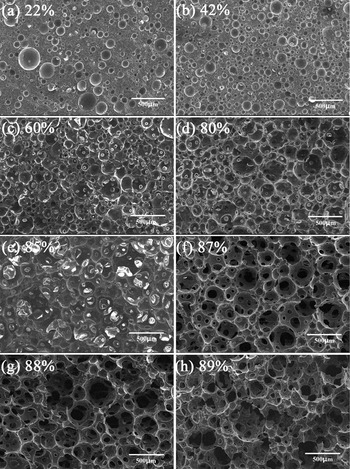
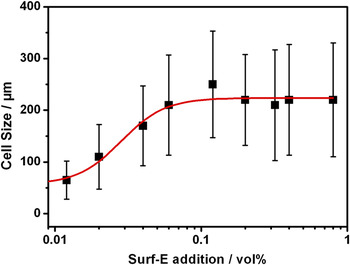
Figure 7 shows the relation between microstructure of porous Al2O3 ceramics and the surfactant content. The porosity and cell size increased as the surfactant content increased. The porosity first increased and then remained constant as the surfactant content increased. At lower surfactant content, e.g., 0.004 and 0.012 vol%, the porosity was lower and the distance between insulated cells was too far for bubbles to coalesce with each other before gelling. This resulted in porous Al2O3 ceramics with isolated cells [Figs. 7(a)–7(b)]. The cell size was smaller and more separate when the surfactant content was lower. Using the same foaming time and foaming speed, the surface energy between water and air decreased as the surfactant content increased. This allowed more bubbles to remain in the slurry. Thus, porosity increased as the surfactant content increased, leading to higher bubble density and bubble coalesce. As a result, the cell size increased with the porosity [Figs. 7(c)–7(h)]. Porosity of the sintered bodies ranged from 20 to 89% (Fig. 7), while the mean cell size varied from 60 to 220 μm (Fig. 8).
SEM images of porous Al2O3 ceramics. Addition of (a) 0.004%, (b) 0.012%, (c) 0.02%, (d) 0.06%, (e) 0.12%, (f) 0.32%, (g) 0.4%, and (h) 0.8% Surf-E, respectively (porosity shown on the top of each picture).

Cell size varied with the Surf-E content (error bars indicate standard deviation).

G. Compressive strength of porous Al2O3 ceramics
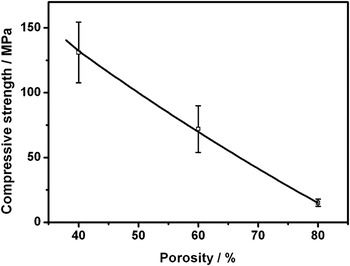
The compressive strength of Al2O3 porous ceramics with various porosities is presented in Fig. 9. Porous Al2O3 ceramics had a high compressive strength. When the porosity was 60%, the compressive strength was 75 MPa. This was higher than that of conventional porous alumina with similar porosity.Reference Prabhakaran, Melkeri, Gokhale and Sharma19 The higher strength was attributed to the higher density of the struts of porous Al2O3 ceramics. The compressive strength decreased with increased porosity, similar to most porous ceramics.Reference Brezny and Green20 Porous Al2O3 ceramics with low porosity had small cell size as seen in Figs. 7(a)–7(b). Machined samples had few cell window edges and more strong struts. Higher porosity samples [Fig. 7(d)] had larger cell size and thinner and longer struts. The edge of machined samples had large cell window edges, which made the porous ceramics weaker.
Compressive strength of porous Al2O3 ceramics with different porosities (error bars indicate standard deviation).

IV. CONCLUSIONS
Porous Al2O3 ceramics were successfully prepared using rapid gelation with 0.3 wt% Isobam as a gelling agent and a small amount of EMAL TD as a surfactant. The entire process was performed at room temperature in air. Using this simple and the convenient process, porous Al2O3 ceramics were sintered in only one step without additional debinding. The porosity was controlled between 20 and 89%, with a mean cell size of 60–220 μm. The compressive strength of the porous Al2O3 ceramics with a porosity of 60% reached 75 MPa. The addition of surfactant accelerated the gelling process.
ACKNOWLEDGMENTS
The authors would like to thank Kuraray Co. Ltd. and Kao Co. Ltd. of Japan for donating organic materials.