









1 Introduction
Our goal is to establish two general identities involving arithmetical functions whose generating functions are Dirichlet series satisfying Hecke’s functional equation. For example, two of these arithmetical functions are
 $r_k(n)$
, the number of representations of n as a sum of k squares, and Ramanujan’s arithmetical function
 $\tau (n)$
. Our general theorems involve the Bessel function of imaginary argument
 $I_{\nu }(z)$
and the modified Bessel function
 $K_{\nu }(z)$
, defined, respectively, in (2.1) and (2.2).
One of the identities is a modular or theta relation in which, roughly, the exponential functions are replaced by modified Bessel functions. The other is a transformation formula in which ordinary hypergeometric functions appear on one side. Certain special cases, which we cite in the sequel, of each of the two primary identities have appeared in the literature. However, the general theorems and the majority of the examples are new.
We consider the class of arithmetical functions studied by Chandrasekharan and Narasimhan [Reference Chandrasekharan and Narasimhan9]. Let
 $a(n)$
and
 $b(n)$
,
 $1\leq n<\infty $
, be two sequences of complex numbers, not identically 0. Set
 $$ \begin{align} \varphi(s):=\sum_{n=1}^{\infty}\dfrac{a(n)}{\lambda_n^s}, \quad \sigma>\sigma_a; \qquad \psi(s):=\sum_{n=1}^{\infty}\dfrac{b(n)}{\mu_n^s}, \quad \sigma>\sigma_a^*, \end{align} $$
where, throughout our paper,
 $\sigma =\mathrm {Re}(s)$
,
 $\{\lambda _n\}$
and
 $\{\mu _n\}$
are two sequences of positive numbers, each tending to
 $\infty $
, and
 $\sigma _a$
and
 $\sigma _a^*$
are the (finite) abscissae of absolute convergence for
 $\varphi (s)$
and
 $\psi (s)$
, respectively. Assume that
 $\varphi (s)$
and
 $\psi (s)$
have analytic continuations into the entire complex plane
 $\mathbb {C}$
and are analytic on
 $\mathbb {C}$
except for a finite set
 $\bf {S}$
of poles. Suppose that for some
 $\delta>0$
,
 $\varphi (s)$
and
 $\psi (s)$
satisfy a functional equation of the form
 $$ \begin{align} \chi(s):=(2\pi)^{-s}\Gamma(s)\varphi(s)=(2\pi)^{s-\delta}\Gamma(\delta-s)\psi(\delta-s). \end{align} $$
Chandrasekharan and Narasimhan proved that the functional equation (1.2) is equivalent to Theorems 1.1 and 1.2 [Reference Chandrasekharan and Narasimhan9, p. 6, Lemmas 4 and 5], the first of which is due to Bochner [Reference Bochner8]. Hence, the validity of any one of (1.2) and Theorems 1.1 and 1.2 implies the truth of the other two identities.
Theorem 1.1 The functional equation (1.2) is equivalent to the ‘modular’ relation
 $$ \begin{align} \sum_{n=1}^{\infty}a(n)e^{-\lambda_n x}=\left(\dfrac{2\pi}{x}\right)^{\delta}\sum_{n=1}^{\infty}b(n)e^{-4\pi^2\mu_n/x}+P(x), \qquad \mathrm{Re}(x)>0, \end{align} $$
where
 $$ \begin{align*} P(x):=\frac{1}{2\pi i}\int_{\mathcal{C}}(2\pi)^z\chi(z)x^{-z}dz, \end{align*} $$
where
 $\mathcal {C}$
is a curve or curves encircling all of
 $\bf {S}$
.
Recall that the ordinary Bessel function
 $J_{\nu }(z)$
is defined by [Reference Watson26, p. 40]
 $$ \begin{align*} J_{\nu}(z):=\sum_{n=0}^{\infty}\dfrac{(-1)^n\left(\frac12 z\right)^{\nu+2n}}{n!\Gamma(\nu+n+1)}, \quad z\in\mathbb{C}. \end{align*} $$
Theorem 1.2 Let
 $x>0$
and
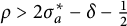 $\rho>2\sigma _a^*-\delta -\frac 12$
. Then the functional equation (1.1) is equivalent to the Riesz sum identity
 $$ \begin{align} &\dfrac{1}{\Gamma(\rho+1)}{\sum_{\lambda_n\leq x}}^{\prime}a(n)(x-\lambda_n)^{\rho}\nonumber\\&\quad = \left(\dfrac{1}{2\pi}\right)^{\rho} \sum_{n=1}^{\infty}b(n)\left(\dfrac{x}{\mu_n}\right)^{(\delta+\rho)/2}J_{\delta+\rho}(4\pi\sqrt{\mu_n x})+Q_{\rho}(x), \end{align} $$
where the prime
 $\prime $
on the summation sign on the left side indicates that if
 $\rho =0$
and
 $x\in \{\lambda _n\}$
, then only
 $\tfrac 12 a(x)$
is counted. Furthermore,
 $Q_{\rho }(x)$
is defined by
 $$ \begin{align} Q_{\rho}(x):=\dfrac{1}{2\pi i}\int_{\mathcal{C}}\dfrac{\chi(z)(2\pi)^zx^{z+\rho}}{\Gamma(\rho+1+z)}dz, \end{align} $$
where
 $\mathcal {C}$
is a curve or curves encircling
 $\bf {S}$
.
Chandrasekharan and Narasimhan [Reference Chandrasekharan and Narasimhan9, p. 14, Theorem III] show that the restriction
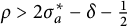 $\rho>2\sigma _a^*-\delta -\frac 12$
can be replaced by
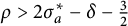 $\rho>2\sigma _a^*-\delta -\frac 32$
under certain conditions. Because we later use analytic continuation, this extension is not important here.
Theorem 1.1 is not explicitly used in the sequel. However, Theorem 1.2 is the key to our primary theorems, Theorems 3.1 and 10.1.
Our examples include the following arithmetical functions:
 $r_k(n)$
, the number of representations of n as a sum of k squares;
 $\sigma _k(n)$
, the sum of the kth powers of the divisors of n; Ramanujan’s arithmetical function
 $\tau (n)$
; both odd and even primitive characters
 $\chi (n)$
; and
 $F(n)$
, the number of integral ideals of norm n in an imaginary quadratic number field.
2 Facts about Bessel functions
The Bessel function of imaginary argument
 $I_{\nu }(z)$
is defined by [Reference Watson26, p. 77]
 $$ \begin{align} I_{\nu}(z):=\sum_{n=0}^{\infty}\dfrac{(\frac12 z)^{\nu+2n}}{n!\Gamma(\nu+n+1)},\quad z\in \mathbb{C}, \end{align} $$
whereas the modified Bessel function
 $K_{\nu }(z)$
is defined by [Reference Watson26, p. 78]
 $$ \begin{align} K_{\nu}(z)&:=\frac{\pi}{2}\dfrac{I_{-\nu}(z)-I_{\nu}(z)}{\sin \nu\pi}, \quad z\in \mathbb{C}, \nu\notin\mathbb{Z},\\ K_n(z)&:=\lim_{\nu\to n}K_{\nu}(z), \qquad\qquad n\in\mathbb{Z}.\notag \end{align} $$
As special cases [Reference Watson26, p. 80],
 $$ \begin{align} \hspace{8pt}I_{1/2}\left(z\right)&=\sqrt{\frac{2}{\pi z}}\sinh z, \hspace{-8pt}\end{align} $$
 $$ \begin{align} K_{1/2}\left(z\right)&=\sqrt{\frac{\pi}{2 z}}e^{-z}. \end{align} $$
For
 $\nu \in \mathbb {C}$
[Reference Watson26, p. 79],
 $$ \begin{align} K_{\nu}(z)=K_{-\nu}(z). \end{align} $$
For
 $\mathrm {Re}(\nu )>0$
[Reference Berndt, Dixit, Kim and Zaharescu6, p. 329],
 $$ \begin{align} \lim_{z\to 0}z^{\nu}K_{\nu}(z)=2^{\nu-1}\Gamma(\nu). \end{align} $$
The three foregoing Bessel functions satisfy the differentiation formulas [Reference Watson26, pp. 66 and 79]
 $$ \begin{align} \dfrac{d}{dz}\left(z^{\nu}J_{\nu}(z)\right)=&z^{\nu}J_{\nu-1}(z), \end{align} $$
 $$ \begin{align} \dfrac{d}{dz}\left(z^{\nu}I_{\nu}(z)\right)=&z^{\nu}I_{\nu-1}(z), \end{align} $$
 $$ \begin{align} \hspace{5pt}\dfrac{d}{dz}\left(z^{\nu}K_{\nu}(z)\right)=&-z^{\nu}K_{\nu-1}(z). \hspace{-5pt}\end{align} $$
We shall need their asymptotic formulas as
 $z\to \infty $
, namely [Reference Watson26, pp. 199, 202, and 203],
 $$ \begin{align} \hspace{12pt}J_{\nu}(z)=&\sqrt{\dfrac{2}{\pi z}}\left(\cos(z-\tfrac12 \nu\pi-\tfrac14 \pi)+O\left(\dfrac{1}{z}\right)\right), \hspace{-12pt}\end{align} $$
 $$ \begin{align} \hspace{-17pt}I_{\nu}(z)=&\sqrt{\dfrac{1}{2\pi z}}e^z\left(1+O\left(\dfrac{1}{z}\right)\right), \hspace{17pt}\end{align} $$
 $$ \begin{align} \hspace{-20pt}K_{\nu}(z)=&\sqrt{\dfrac{\pi}{2 z}}e^{-z}\left(1+O\left(\dfrac{1}{z}\right)\right).\hspace{20pt} \end{align} $$
Lemma 2.1 [Reference Watson26, p. 417]
Let
 $a>0$
,
 $\mathrm {Re}(\mu )>-1$
, and
 $\nu \in \mathbb {C}$
. Then,
 $$ \begin{align*} \int_0^{\infty}\dfrac{K_{\nu}(a\sqrt{t^2+z^2})}{(t^2+z^2)^{\nu/2}}t^{2\mu+1}dt =\dfrac{2^{\mu}\Gamma(\mu+1)}{a^{\mu+1}z^{\nu-\mu-1}}K_{\nu-\mu-1}(az). \end{align*} $$
Lemma 2.2 [Reference Watson26, p. 416]
For
 $a,b>0$
,
 $\mathrm {Re}(z)>0, \mathrm {Re}(\mu )>-1$
, and
 $\nu \in \mathbb {C}$
 $$ \begin{align*} \int_0^{\infty}J_{\mu}(bx)\dfrac{K_{\nu}(a\sqrt{z^2+x^2})}{(z^2+x^2)^{\nu/2}}x^{\mu+1}dx =\dfrac{b^{\mu}}{a^{\nu}}\left(\dfrac{\sqrt{a^2+b^2}}{z}\right)^{\nu-\mu-1}K_{\nu-\mu-1}(z\sqrt{a^2+b^2}). \end{align*} $$
3 The first primary theorem
Theorem 3.1 Let
 $\mathrm {Re}(\nu )>-1$
,
 $\mathrm {Re}(c), \mathrm {Re}(r)>0$
, and
 $\rho>-1$
. Then,
 $$ \begin{align} \dfrac{1}{\Gamma(\rho+1)}\sum_{n=1}^{\infty}a(n)\int_{\lambda_n}^{\infty}(x-\lambda_n)^{\rho}(c^2+x)^{-\nu/2}K_{\nu}\left(4\pi r\sqrt{c^2+x}\right)dx\notag\\ =\dfrac{1}{(2\pi)^{\rho+1}r^{\nu}c^{\nu-\delta-\rho-1}} \sum_{n=1}^{\infty}\dfrac{b(n)}{(r^2+\mu_n)^{(\delta+\rho-\nu+1)/2}}K_{\delta+\rho+1-\nu}\left(4\pi c\sqrt{r^2+\mu_n}\right)\notag\\ +\int_0^{\infty}Q_{\rho}(x)(c^2+x)^{-\nu/2}K_{\nu}\left(4\pi r\sqrt{c^2+x}\right)dx, \end{align} $$
where it is assumed that the integral
 $Q_{\rho }(x)$
, defined by (1.5), converges absolutely.
Proof Assume that
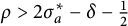 $\rho>2\sigma _a^*-\delta -\frac 12$
. Multiply both sides of (1.4) by
 $$ \begin{align*} (c^2+x)^{-\nu/2}K_{\nu}\left(4\pi r\sqrt{c^2+x}\right), \qquad c,r>0, \end{align*} $$
and integrate over
 $0\leq x<\infty $
. Let
 $F_1(\delta ,\rho ,\nu )$
denote the left-hand side, and let
 $F_2(\delta ,\rho ,\nu )$
and
 $F_3(\delta ,\rho ,\nu )$
denote, in order, the two terms on the right-hand side that we so obtain.
First,
 $$ \begin{align} F_1(\delta,\rho,\nu)=&\dfrac{1}{\Gamma(\rho+1)}\int_0^{\infty}{\sum_{\lambda_n\leq x}}^{\prime}a(n)(x-\lambda_n)^{\rho}(c^2+x)^{-\nu/2}K_{\nu}\left(4\pi r\sqrt{c^2+x}\right)dx\notag\\ =&\dfrac{1}{\Gamma(\rho+1)} \sum_{n=1}^{\infty}a(n)\int_{\lambda_n}^{\infty}(x-\lambda_n)^{\rho}(c^2+x)^{-\nu/2}K_{\nu}\left(4\pi r\sqrt{c^2+x}\right)dx. \end{align} $$
Second, after we invert the order of summation and integration by absolute convergence on the right-hand side, we are led to the integral
 $$ \begin{align} I(\delta,\rho,\nu):=&\int_0^{\infty}x^{(\delta+\rho)/2} (c^2+x)^{-\nu/2}J_{\delta+\rho}(4\pi\sqrt{\mu_n x})K_{\nu}\left(4\pi r\sqrt{c^2+x}\right)dx\notag\\ =&2\int_0^{\infty}u^{\delta+\rho+1}J_{\delta+\rho}(4\pi u\sqrt{\mu_n}) \dfrac{K_{\nu}(4\pi r\sqrt{c^2+u^2})}{(c^2+u^2)^{\nu/2}}du. \\[-15pt]\nonumber\end{align} $$
Apply Lemma 2.2 with
 $$ \begin{align*}\mu=\delta+\rho,\qquad a=4\pi r, \qquad \text{and} \qquad b=4\pi\sqrt{\mu_n}.\\[-15pt]\end{align*} $$
Hence, from (3.3), for
 $\delta +\rho>-1$
,
 $$ \begin{align} I(\delta,\rho,\nu)=& 2\dfrac{(4\pi\sqrt{\mu_n})^{\delta+\rho}}{(4\pi r)^{\nu}} \left(\dfrac{\sqrt{(4\pi r)^2+(4\pi\sqrt{\mu_n})^2}}{c}\right)^{\nu-\delta-\rho-1}\notag\\ &\times K_{\nu-\delta-\rho-1}\left(c\sqrt{(4\pi r)^2+(4\pi\sqrt{\mu_n})^2}\right)\notag\\ =&\dfrac{\mu_n^{(\delta+\rho)/2}}{2\pi r^{\nu}c^{\nu-\delta-\rho-1}}(r^2+\mu_n)^{(\nu-\delta-\rho-1)/2} K_{\nu-\delta-\rho-1}\left(4\pi c\sqrt{r^2+\mu_n}\right).\\[-15pt]\nonumber \end{align} $$
In summary, with the use of (2.5) and (3.4), we have
 $$ \begin{align} F_2(\delta,\rho,\nu)&=\dfrac{1}{(2\pi)^{\rho+1}r^{\nu}c^{\nu-\delta-\rho-1}} \sum_{n=1}^{\infty}\dfrac{b(n)}{(r^2+\mu_n)^{(\delta+\rho-\nu+1)/2}}K_{\nu-\delta-\rho-1}\left(4\pi c\sqrt{r^2+\mu_n}\right)\nonumber\\[-10pt] &=\dfrac{1}{(2\pi)^{\rho+1}r^{\nu}c^{\nu-\delta-\rho-1}} \sum_{n=1}^{\infty}\dfrac{b(n)}{(r^2+\mu_n)^{(\delta+\rho-\nu+1)/2}}K_{\delta+\rho+1-\nu}\left(4\pi c\sqrt{r^2+\mu_n}\right).\\[-15pt]\nonumber \end{align} $$
Third,
 $$ \begin{align} F_3(\delta,\rho,\nu)=&\int_0^{\infty}Q_{\rho}(x)(c^2+x)^{-\nu/2}K_{\nu}\left(4\pi r\sqrt{c^2+x}\right)dx.\\[-15pt]\nonumber \end{align} $$
We now gather together (3.2), (3.5), and (3.6) to conclude (3.1), which we have proved for
 $\nu , r, c>0$
. However, in view of (2.12), we see that by analytic continuation, (3.1) holds for
 $\mathrm {Re}(\nu )>-1$
, and
 $\mathrm {Re}(c), \mathrm {Re}(r)>0$
. The conditions
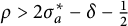 $\rho>2\sigma _a^*-\delta -\frac 12$
and
 $\delta +\rho>-1$
can be discarded by analytic continuation in
 $\rho $
.
4 The special case
 $\rho =0$

We consider Theorem 3.1 in the special case
 $\rho =0$
.
Theorem 4.1 Let
 $\mathrm {Re}(\nu )>-1$
and
 $\mathrm {Re}(c), \mathrm {Re}(r)>0$
. Assume that the integral below converges absolutely. Then,
 $$ \begin{align*} \dfrac{1}{2\pi r}\sum_{n=1}^{\infty}\dfrac{a(n)}{(c^2+\lambda_n)^{(\nu-1)/2}} K_{\nu-1}\left(4\pi r\sqrt{c^2+\lambda_n}\right)\notag\\ =\dfrac{1}{2\pi r^{\nu}c^{\nu-\delta-1}} \sum_{n=1}^{\infty}\dfrac{b(n)}{(r^2+\mu_n)^{(\delta-\nu+1)/2}}K_{\delta+1-\nu}\left(4\pi c\sqrt{r^2+\mu_n}\right)\notag\\ +\int_0^{\infty}Q_{0}(x)(c^2+x)^{-\nu/2}K_{\nu}\left(4\pi r\sqrt{c^2+x}\right)dx. \end{align*} $$
Proof First, set
 $$ \begin{align*}u=4\pi r\sqrt{c^2+x} \quad \Rightarrow dx=\dfrac{u}{8\pi^2r^2}du.\end{align*} $$
Hence, in turn, using (2.5) and (2.9), we find that
 $$ \begin{align*} \int_{\lambda_n}^{\infty}(c^2+x)^{-\nu/2}&K_{\nu}\left(4\pi r\sqrt{c^2+x}\right)dx =\int_{4\pi r\sqrt{c^2+\lambda_n}}^{\infty}\left(\dfrac{u}{4\pi r}\right)^{-\nu}\left(\dfrac{u}{8\pi^2r^2}\right)K_{\nu}(u)du\notag\\ =&\dfrac{2}{(4\pi r)^{2-\nu}}\int_{4\pi r\sqrt{c^2+\lambda_n}}^{\infty}u^{-\nu+1}K_{\nu}(u)du\notag\\ =&2(4\pi r)^{\nu-2}\int_{4\pi r\sqrt{c^2+\lambda_n}}^{\infty}u^{-\nu+1}K_{-\nu}(u)du\notag\\ =&-2(4\pi r)^{\nu-2}\int_{4\pi r\sqrt{c^2+\lambda_n}}^{\infty}\dfrac{d}{du}\left(u^{-\nu+1}K_{-\nu+1}(u)\right)du\notag\\ =&2(4\pi r)^{\nu-2}(4\pi r\sqrt{c^2+\lambda_n})^{-\nu+1}K_{-\nu+1}(4\pi r\sqrt{c^2+\lambda_n})\notag\\ =&\dfrac{1}{2\pi r}(c^2+\lambda_n)^{-(\nu-1)/2}K_{\nu-1}(4\pi r\sqrt{c^2+\lambda_n}). \end{align*} $$
Thus, the sum on the left-hand side of (3.1) reduces to
 $$ \begin{align*} \dfrac{1}{2\pi r}\sum_{n=1}^{\infty}\dfrac{a(n)}{(c^2+\lambda_n)^{(\nu-1)/2}} K_{\nu-1}(4\pi r\sqrt{c^2+\lambda_n}). \end{align*} $$
The remaining part of the proof is immediate after setting
 $\rho =0$
in Theorem 3.1.
Before giving examples in illustration of Theorem 4.1, we offer remarks on previous work. Theorem 3.1 is new. The first author’s paper [Reference Berndt3, p. 342] contains the first statement and proof of Theorem 4.1 [Reference Berndt3, pp. 342–344]. Our proof here is completely different from that in [Reference Berndt3]. Theorem 4.1 was also established via the Voronoï summation formula in [Reference Berndt4, p. 154]. The special case,
 $\delta =1$
, of Theorem 4.1 was first established by Oberhettinger and Soni [Reference Oberhettinger and Soni22, p. 24] in 1972.
To illuminate the equivalence of the functional equation (1.2), the modular relation (1.3), and the Riesz sum identity (1.4), Chandrasekharan and Narasimhan [Reference Chandrasekharan and Narasimhan9] examine the three identities with particular arithmetical functions. For more details about the functional equations associated with these arithmetical functions, and for calculations of
 $Q_0(x)$
, see their paper [Reference Chandrasekharan and Narasimhan9].
In the examples below, we refer to calculations made by Chandrasekharan and Narasimhan [Reference Chandrasekharan and Narasimhan9] to illustrate Theorem 1.2. In particular, we use a few of their determinations of
 $Q_{\rho }(x)$
.
5 Example:
$r_k(n)$

Let
 $r_k(n)$
denote the number of representations of the positive integer n as a sum of k squares, where
 $k\geq 2$
. Then,
 $$ \begin{align*}\zeta_k(s):=\sum_{n=1}^{\infty}\dfrac{r_k(n)}{n^s},\qquad \sigma>k/2,\end{align*} $$
satisfies the functional equation
 $$ \begin{align} \pi^{-s}\Gamma(s)\zeta_k(s)=\pi^{s-k/2}\Gamma(k/2-s)\zeta_k(k/2-s). \end{align} $$
Thus, in the notation of (1.2),
 $$ \begin{align*} \varphi(s)=\psi(s)=2^s\zeta_k(s), \quad a(n)=b(n)=r_k(n), \quad \delta=\dfrac{k}{2}, \quad \text{and} \quad \lambda_n=\mu_n=\dfrac{n}{2}. \end{align*} $$
From the functional equation (5.1),
 $\zeta _k(0)=-1$
, and furthermore
 $\zeta _k(s)$
has a simple pole at
 $s=k/2$
with residue
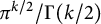 $\pi ^{k/2}/\Gamma (k/2)$
. It readily follows from (1.5) that
 $$ \begin{align} Q_{\rho}(x)=-\dfrac{x^{\rho}}{\Gamma(\rho+1)}+\dfrac{(2\pi x)^{k/2}x^{\rho}}{\Gamma(\rho+1+k/2)}. \end{align} $$
Applying Theorem 3.1, we find that for
 $\mathrm {Re}(\nu )>-1$
,
 $\mathrm {Re}(c), \mathrm {Re}(r)>0$
, and
 $\rho>-1$
,
 $$ \begin{align} \dfrac{1}{\Gamma(\rho+1)}\sum_{n=1}^{\infty}r_k(n)\int_{n/2}^{\infty}(x-n/2)^{\rho}(c^2+x)^{-\nu/2}K_{\nu}\left(4\pi r\sqrt{c^2+x}\right)dx\notag\\ =\dfrac{1}{(2\pi)^{\rho+1}r^{\nu}c^{\nu-k/2-\rho-1}} \sum_{n=1}^{\infty}\dfrac{r_k(n)}{(r^2+n/2)^{(k/2+\rho-\nu+1)/2}}K_{k/2+\rho+1-\nu}(4\pi c\sqrt{r^2+n/2})\notag\\ +\int_0^{\infty}\left(-\dfrac{x^{\rho}}{\Gamma(\rho+1)} +\dfrac{(2\pi x)^{k/2}x^{\rho}}{\Gamma(\rho+1+k/2)}\right) (c^2+x)^{-\nu/2}K_{\nu}\left(4\pi r\sqrt{c^2+x}\right)dx. \end{align} $$
First, making the trivial change of variable
 $x=t^2$
, and applying Lemma 2.1 with
 $ a=4\pi r,\,\,z=c,$
and
 $\mu =\rho $
, we find that
 $$ \begin{align} -\int_0^{\infty}\dfrac{x^{\rho}}{\Gamma(\rho+1)}(c^2+x)^{-\nu/2} K_{\nu}\left(4\pi r\sqrt{c^2+x}\right)dx=-\dfrac{2^{\rho+1}}{(4\pi r)^{\rho+1}c^{\nu-\rho-1}}K_{\nu-\rho-1}(4\pi rc). \end{align} $$
Second, again making the trivial change of variable
 $x=t^2$
, and applying Lemma 2.1 with
 $ a=4\pi r, z=c,$
and
 $\mu =\rho +\frac 12 k$
, we find that
 $$ \begin{align} &\int_0^{\infty}\dfrac{ x^{\rho+k/2}}{\Gamma(\rho+1+k/2)}(c^2+x)^{-\nu/2} K_{\nu}\left(4\pi r\sqrt{c^2+x}\right)dx\nonumber\\ &\qquad =\dfrac{2^{\rho+k/2+1}}{(4\pi r)^{\rho+k/2+1}c^{\nu-\rho-k/2-1}}K_{\nu-\rho-k/2-1}(4\pi rc). \end{align} $$
Now, put (5.4) and (5.5) into (5.3) to deduce that
 $$ \begin{align*} \dfrac{1}{\Gamma(\rho+1)}\sum_{n=1}^{\infty}r_k(n)\int_{n/2}^{\infty}(x-n/2)^{\rho}(c^2+x)^{-\nu/2}K_{\nu}\left(4\pi r\sqrt{c^2+x}\right)dx\notag\\ =\dfrac{1}{(2\pi)^{\rho+1}r^{\nu}c^{\nu-k/2-\rho-1}} \sum_{n=1}^{\infty}\dfrac{r_k(n)}{(r^2+n/2)^{(k/2+\rho-\nu+1)/2}}K_{k/2+\rho+1-\nu}(4\pi c\sqrt{r^2+n/2})\notag\\ -\dfrac{2^{\rho+1}}{(4\pi r)^{\rho+1}c^{\nu-\rho-1}}K_{\nu-\rho-1}(4\pi rc) +\dfrac{(2\pi)^{k/2}2^{\rho+k/2+1}}{(4\pi r)^{\rho+k/2+1}c^{\nu-\rho-k/2-1}}K_{\nu-\rho-k/2-1}(4\pi rc). \end{align*} $$
Next, appealing to Theorem 4.1 and (5.2) in the case
 $\rho =0$
, we deduce that
 $$ \begin{align} &\dfrac{1}{2\pi r}\sum_{n=1}^{\infty}\dfrac{r_k(n)}{(c^2+n/2)^{(\nu-1)/2}}K_{\nu-1}(4\pi r\sqrt{c^2+n/2})\notag\\ =&\dfrac{1}{2\pi r^{\nu}c^{\nu-k/2-1}}\sum_{n=1}^{\infty}\dfrac{r_k(n)}{(r^2+n/2)^{(k/2-\nu+1)/2}} K_{k/2+1-\nu}(4\pi c\sqrt{r^2+n/2})\notag\\ &+\int_0^{\infty}\left(-1+\dfrac{(2\pi x)^{k/2}}{\Gamma(1+k/2)}\right)(c^2+x)^{-\nu/2} K_{\nu}\left(4\pi r\sqrt{c^2+x}\right)dx.\\[-9pt]\nonumber \end{align} $$
Now, use (5.4) and (5.5) in the case
 $\rho =0$
. If we define
 $r_k(0)=1$
and use (2.6), we see that (5.4) in the case
 $\rho =0$
can be written as the term for
 $n=0$
in the series on the left-hand side of (5.6), whereas (5.5) in the case
 $\rho =0$
can be considered as the term for
 $n=0$
in the series on the right-hand side. Multiplying both sides of the resulting identity by
 $2\pi r$
, and replacing
 $\nu $
by
 $\nu +1$
, we conclude that
 $$ \begin{align}&\qquad\qquad\ \ \sum_{n=0}^{\infty}\dfrac{r_k(n)}{(c^2+n/2)^{\nu/2}}K_{\nu}(4\pi r\sqrt{c^2+n/2})\notag\\ &= \dfrac{1}{r^{\nu}c^{\nu-k/2}}\sum_{n=0}^{\infty}\dfrac{r_k(n)}{(r^2+n/2)^{(k/2-\nu)/2}}K_{k/2-\nu}(4\pi c\sqrt{r^2+n/2}).\\[-9pt]\nonumber \end{align} $$
The identity (5.7) was also established by the first author, Lee, and Sohn [Reference Berndt, Lee, Sohn and Alladi7, p. 39, equation (5.5)]. For
 $k=2$
, (5.7) was first proved by Dixon and Ferrar [Reference Dixon and Ferrar12, p. 53, equation (4.13)] in 1934. A different proof for
 $k=2$
was given by Oberhettinger and Soni [Reference Oberhettinger and Soni22, p. 24].
6 Example:
$\sigma _k(n)$

Let
 $\sigma _k(n)$
denote the sum of the kth powers of the divisors of n, where it is assumed that k is an odd positive integer. The generating function for
 $\sigma _k(n)$
is given by
 $$ \begin{align*} \zeta_k(s):=\zeta(s)\zeta(s-k)=\sum_{n=1}^{\infty}\dfrac{\sigma_k(n)}{n^s}, \qquad \sigma> k+1,\\[-9pt] \end{align*} $$
and it satisfies the functional equation
 $$ \begin{align} (2\pi)^{-s}\Gamma(s)\zeta_k(s)=(-1)^{(k+1)/2}(2\pi)^{-(k+1-s)}\Gamma(k+1-s)\zeta_k(k+1-s).\\[-9pt]\nonumber \end{align} $$
In the notation of the Dirichlet series and functional equation in (1.1) and (1.2), respectively,
 $$ \begin{align*} a(n)=\sigma_k(n), \quad b(n)=(-1)^{(k+1)/2}\sigma_k(n), \quad\lambda_n=\mu_n=n,\quad \delta=k+1. \end{align*} $$
Now,
 $Q_0(s)$
is the sum of the residues of
 $$ \begin{align*} R(z):=\dfrac{\Gamma(z)\zeta(z)\zeta(z-k)x^{z}}{\Gamma(z+1)}. \end{align*} $$
(In Chandrasekharan and Narasimhan’s paper [Reference Chandrasekharan and Narasimhan9], they utilize a different convention for Bernoulli numbers, and so our representation for
 $Q_0$
takes a different form from theirs.) Observe that
 $R(z)$
has simple poles at
 $z=0,-1,k+1$
. Using Euler’s formula,
 $$ \begin{align*}\zeta(2n)=(-1)^{n-1}\dfrac{(2\pi)^{2n}B_{2n}}{2(2n)!}, \qquad n\geq 1,\end{align*} $$
where n is a positive integer and
 $B_{n}$
denotes the nth Bernoulli number, we readily find that
 $$ \begin{align} Q_0(x)=\dfrac{B_{k+1}}{2(k+1)}-\dfrac{\delta_{1,k}x}{2} +\dfrac{(2\pi)^{k+1}(-1)^{(k-1)/2}B_{k+1}x^{k+1}}{2(k+1)\Gamma(k+2)}, \end{align} $$
where
 $$ \begin{align*} \delta_{1,k}=\begin{cases} 1, \quad \text{ if } k=1,\\ 0, \quad \text{otherwise}. \end{cases} \end{align*} $$
Applying Theorem 4.1 and employing (6.2), we find that
 $$ \begin{align} &\dfrac{1}{2\pi r}\sum_{n=1}^{\infty}\dfrac{\sigma_k(n)}{(c^2+n)^{(\nu-1)/2}}K_{\nu-1}\left(4\pi r\sqrt{c^2+n}\right)\notag\\ =&\dfrac{1}{2\pi r^{\nu}c^{\nu-k-2}}\sum_{n=1}^{\infty}\dfrac{(-1)^{(k+1)/2}\sigma_k(n)}{(r^2+n)^{(k+2-\nu)/2}} K_{k+2-\nu}\left(4\pi c\sqrt{r^2+n}\right)\notag\\ &+\int_0^{\infty}\left(\dfrac{B_{k+1}}{2(k+1)}-\dfrac{\delta_{1,k}x}{2} +\dfrac{(2\pi)^{k+1}(-1)^{(k-1)/2}B_{k+1}x^{k+1}}{2(k+1)\Gamma(k+2)}\right)\nonumber\\& \times (c^2+x)^{-\nu/2} K_{\nu}\left(4\pi r\sqrt{c^2+x}\right)dx. \end{align} $$
Let
 $I_1, I_2$
, and
 $I_3$
denote, respectively, the three integrals on the right side of (6.3). In each instance below, we initially make the change of variable
 $x=t^2$
. First, by Lemma 2.1,
 $$ \begin{align} I_1=\dfrac{B_{k+1}}{2(k+1)}\int_0^{\infty}(c^2+x)^{-\nu/2}K_{\nu}\left(4\pi r\sqrt{c^2+x}\right)dx =\dfrac{B_{k+1}}{k+1}\,\dfrac{1}{4\pi rc^{\nu-1}}K_{\nu-1}(4\pi rc). \end{align} $$
Second, apply Lemma 2.1 with
 $a=4\pi r, z=c$
, and
 $\mu =1$
. Hence,
 $$ \begin{align} I_2=-\dfrac{\delta_{1,k}}{2}\int_0^{\infty}(c^2+x)^{-\nu/2}K_{\nu}\left(4\pi r\sqrt{c^2+x}\right)x\,dx =-\delta_{1,k}\dfrac{2}{(4\pi r)^2c^{\nu-2}}K_{\nu-2}(4\pi rc). \end{align} $$
Third, we apply Lemma 2.1 with
 $a=2\pi r, z=c$
, and
 $\mu =k+1$
. Therefore,
 $$ \begin{align} I_3=&\dfrac{(2\pi)^{k+1}(-1)^{(k-1)/2}B_{k+1}}{2(k+1)\Gamma(k+2)} \int_0^{\infty}(c^2+x)^{-\nu/2}K_{\nu}\left(4\pi r\sqrt{c^2+x}\right)x^{k+1}\,dx\notag\\ =&\dfrac{(-1)^{(k-1)/2}B_{k+1}}{4\pi(k+1)r^{k+2}c^{\nu-k-2}}K_{\nu-k-2}(4\pi rc). \end{align} $$
In summary, putting (6.4)–(6.6) into (6.3), we deduce that
 $$ \begin{align} &\dfrac{1}{2\pi r}\sum_{n=1}^{\infty}\dfrac{\sigma_k(n)}{(c^2+n)^{(\nu-1)/2}}K_{\nu-1}\left(4\pi r\sqrt{c^2+n}\right)\notag\\ =&\dfrac{1}{2\pi r^{\nu}c^{\nu-k-2}}\sum_{n=1}^{\infty}\dfrac{(-1)^{(k+1)/2}\sigma_k(n)}{(r^2+n)^{(k+2-\nu)/2}} K_{k+2-\nu}\left(4\pi c\sqrt{r^2+n}\right)\nonumber\\ &+\dfrac{B_{k+1}}{k+1}\,\dfrac{1}{4\pi rc^{\nu-1}}K_{\nu-1}(4\pi rc)\notag\\ &-\delta_{1,k}\dfrac{2}{(4\pi r)^2c^{\nu-2}}K_{\nu-2}(4\pi rc) +\dfrac{(-1)^{(k-1)/2}B_{k+1}}{4\pi(k+1)r^{k+2}c^{\nu-k-2}}K_{\nu-k-2}(4\pi rc). \end{align} $$
We now put (6.7) in a more palatable form. From (6.1),
 $$ \begin{align*}\zeta_k(0)=\zeta(0)\zeta(-k)=-\dfrac12\cdot-\dfrac{B_{k+1}}{k+1}=\dfrac{B_{k+1}}{2(k+1)},\end{align*} $$
by [Reference Edwards13]. Define
 $$ \begin{align} \sigma_k(0)=-\zeta_k(0)=-\dfrac{B_{k+1}}{2(k+1)}. \end{align} $$
Thus, by (6.8), the first expression after the series on the right-hand side of (6.7) can be expressed as the term for
 $n=0$
in the series on the left-hand side. Similarly, the last expression on the right-hand side of (6.7) can be represented as the term for
 $n=0$
in the series on the right-hand side of (6.7). Thus, we can write (6.7) in the simplified form
 $$ \begin{align} &\qquad\qquad\ \ \dfrac{1}{2\pi r}\sum_{n=0}^{\infty}\dfrac{\sigma_k(n)}{(c^2+n)^{(\nu-1)/2}}K_{\nu-1}\left(4\pi r\sqrt{c^2+n}\right)\notag\\ &=\dfrac{1}{2\pi r^{\nu}c^{\nu-k-2}}\sum_{n=0}^{\infty}\dfrac{(-1)^{(k+1)/2}\sigma_k(n)}{(r^2+n)^{(k+2-\nu)/2}} K_{k+2-\nu}\left(4\pi c\sqrt{r^2+n}\right)\nonumber\\ &\qquad\qquad\quad -\delta_{1,k}\dfrac{2}{(4\pi r)^2c^{\nu-2}}K_{\nu-2}(4\pi rc). \end{align} $$
Multiplying both sides of (6.9) by
 $2\pi r$
, and replacing
 $\nu $
by
 $\nu +1$
, we deduce that
 $$ \begin{align} &\qquad\qquad\quad\qquad\qquad\quad \sum_{n=0}^{\infty}\dfrac{\sigma_k(n)}{(c^2+n)^{\nu/2}}K_{\nu}\left(4\pi r\sqrt{c^2+n}\right)\notag\\ &=-\dfrac{\delta_{1,k}}{4\pi rc^{\nu-1}}K_{\nu-1}(4\pi rc) +\dfrac{1}{r^{\nu}c^{\nu-k-1}}\sum_{n=0}^{\infty}\dfrac{(-1)^{(k+1)/2}\sigma_k(n)}{(r^2+n)^{(k+1-\nu)/2}} K_{k+1-\nu}\left(4\pi c\sqrt{r^2+n}\right). \end{align} $$
This identity appears to be new. If we let
 $c\to 0$
in this identity, employ the limit evaluation [Reference Berndt, Dixit, Kim and Zaharescu6, p. 329]
 $$ \begin{align*}\lim_{c\to0}c^{-\nu/2}K_{\nu}(2\pi\sqrt{c\beta})=\frac{1}{2}\Gamma(-\nu)\pi^{\nu}\beta^{\nu/2},\end{align*} $$
and replace
 $\nu $
by
 $-\nu -1$
, then we obtain the first equation on page 4794 of [Reference Berndt, Dixit, Gupta and Zaharescu5] for
 $-1<\mathrm {Re}(\nu )<1$
. The restriction
 $\mathrm {Re}(\nu )<1$
can then be removed by analytic continuation.
In a three-page fragment published with his lost notebook [Reference Ramanujan24, p. 253], [Reference Andrews and Berndt2, p. 95], Ramanujan offered a kindred formula to (6.10). If
 $\alpha $
and
 $\beta $
are positive numbers such that
 $\alpha \beta =\pi ^2$
, and if s is any complex number, then
 $$ \begin{align} &\quad \sqrt{\alpha}\sum_{n=1}^{\infty}\sigma_{-s}(n)n^{s/2}K_{s/2}(2n\alpha) -\sqrt{\beta}\sum_{n=1}^{\infty}\sigma_{-s}(n)n^{s/2}K_{s/2}(2n\beta)\notag\\ &\qquad =\dfrac14\Gamma\left(\dfrac{s}{2}\right)\zeta(s)\{\beta^{(1-s)/2}-\alpha^{(1-s)/2}\} +\dfrac14\Gamma\left(-\dfrac{s}{2}\right)\zeta(-s)\{\beta^{(1+s)/2}-\alpha^{(1+s)/2}\}. \end{align} $$
Note that (6.11) is not a special case of (6.10), and also note that (6.11) is valid for all complex s, whereas k in (6.10) is a positive odd integer. The beautiful symmetry involving the modified Bessel functions is apparent in both (6.10) and (6.11). However, in (6.10), there is symmetry in the binomial powers, whereas in (6.11), the symmetry is in the powers of the summation index.
Unaware that (6.11) was first established by Ramanujan [Reference Ramanujan24, p. 253], Guinand [Reference Guinand17] gave the first proof in print in 1955. The identity (6.11) is now known as Guinand’s formula or the Ramanujan–Guinand formula. See also [Reference Berndt, Lee, Sohn and Alladi7, pp. 25–27] for a proof. Letting
 $s=0$
in (6.11), we obtain a well-known formula of Koshliakov [Reference Berndt, Lee, Sohn and Alladi7].
The identities (6.11) and (6.10) are remindful of the Fourier expansions of real analytic Eisenstein series, which are defined on the modular group
 $ SL_{2}(\mathbb {Z})$
. For Re
 $(s)>1$
and
 $z=x+iy \in \mathbb {H}$
, define
 $$ \begin{align*} E(s,z)=\frac{1}{2}\sum_{\substack{-\infty< c,d<\infty\\(c,d)=1}}\frac{y^s}{|cz+d|^{2s}}. \end{align*} $$
The Eisenstein series
 $E(s,z)$
has a Fourier expansion that is given in terms of series involving modified Bessel function
 $K_{\nu }(z),$
namely [Reference Maass21],
 $$ \begin{align*} E(s,z)=y^s+\frac{\psi(2s-1)}{\psi(2s)}y^{1-s}+\frac{4\sqrt{y}}{\psi(2s)} \sum_{m=1}^{\infty}m^{s-\frac{1}{2}}\sigma_{1-2s}(m)K_{s-\frac{1}{2}}(2\pi my)\cos(2\pi m x ), \end{align*} $$
where
 $$ \begin{align*} \psi(s)=\pi^{-s/2}\Gamma\left( \frac{s}{2}\right)\zeta(s). \end{align*} $$
7 Example:
$\tau (n)$

Recall that the Dirichlet series for Ramanujan’s arithmetical function
 $\tau (n)$
 $$ \begin{align} f(s):=\sum_{n=1}^{\infty}\dfrac{\tau(n)}{n^s}, \quad \sigma> \dfrac{13}{2}, \end{align} $$
satisfies the functional equation
 $$ \begin{align} \chi(s):=(2\pi)^{-s}\Gamma(s)f(s)=(2\pi)^{-(12-s)}\Gamma(12-s)f(12-s). \end{align} $$
In the notation of (1.1) and (1.2), the function
 $\chi (s)$
is an entire function, and so
 $Q_0(x)\equiv 0$
. Clearly,
 $$ \begin{align} \lambda_n=\mu_n=n, \qquad\delta=12.\\[-9pt]\nonumber \end{align} $$
First, apply Theorem 3.1. For
 $\mathrm {Re}(\nu )>-1$
,
 $\mathrm {Re}(c), \mathrm {Re}(r)>0$
, and
 $\rho>-1$
, we have
 $$ \begin{align*} \dfrac{1}{\Gamma(\rho+1)}\sum_{n=1}^{\infty}\tau(n)\int_{n}^{\infty}(x-n)^{\rho}(c^2+x)^{-\nu/2}K_{\nu}\left(4\pi r\sqrt{c^2+x}\right)dx\notag\\ =\dfrac{1}{(2\pi)^{\rho+1}r^{\nu}c^{\nu-13-\rho}} \sum_{n=1}^{\infty}\dfrac{\tau(n)}{(r^2+n)^{(13+\rho-\nu)/2}}K_{13+\rho-\nu}\left(4\pi c\sqrt{r^2+n}\right).\\[-9pt] \end{align*} $$
Second, applying Theorem 4.1 and replacing
 $\nu $
by
 $\nu +1$
, we deduce that, for
 $\mathrm {Re}(\nu ), \mathrm {Re}(c), \mathrm {Re}(r)>0$
,
 $$ \begin{align} \sum_{n=1}^{\infty}\dfrac{\tau(n)}{(c^2+n)^{\nu/2}}K_{\nu}\left(4\pi r\sqrt{c^2+n}\right)= \dfrac{1}{r^{\nu}c^{\nu-12}}\sum_{n=1}^{\infty}\dfrac{\tau(n)}{(r^2+n)^{(12-\nu)/2}}K_{12-\nu}\left(4\pi c\sqrt{r^2+n}\right).\\[-9pt]\nonumber \end{align} $$
The identity (7.4) was first established by the first author, Lee, and Sohn [Reference Berndt, Lee, Sohn and Alladi7, p. 40, equation (5.7)].
8 Example: primitive characters
$\chi (n)$

Let
 $\chi $
denote a primitive character modulo q. Because the functional equations for the Dirichlet L-series
 $$ \begin{align*}L(s,\chi)=\sum_{n=1}^{\infty}\dfrac{\chi(n)}{n^s}, \qquad \sigma>0,\end{align*} $$
are different for
 $\chi $
even and
 $\chi $
odd, we separate the two cases.
Suppose first that
 $\chi $
is odd. Then, the functional equation for
 $L(s,\chi )$
is given by [Reference Davenport11, p. 71]
 $$ \begin{align} \qquad \chi(s):=\left(\dfrac{\pi}{q}\right)^{-s}\Gamma(s)L(2s-1,\chi)= -\dfrac{i\tau(\chi)}{\sqrt{q}}\left(\dfrac{\pi}{q}\right)^{-(\tfrac32-s)}\Gamma\left(\tfrac32-s\right)L(2-2s,\overline{\chi}), \end{align} $$
where
 $\overline {\chi }(n)$
denotes the complex conjugate of
 $\chi (n)$
, and
 $\tau (\chi )$
denotes the Gauss sum
 $$ \begin{align} \tau(\chi):=\sum_{n=1}^{q}\chi(n)e^{2\pi in/q}. \end{align} $$
Hence, in the notation of (1.1) and (1.2),
 $$ \begin{align} a(n)=n\chi(n),\quad b(n)=-\dfrac{i\tau(\chi)}{\sqrt{q}}n\overline{\chi}(n), \quad \lambda_n=\mu_n=\dfrac{n^2}{2q}, \quad \delta=\dfrac32. \end{align} $$
Furthermore,
 $\chi (s)$
is an entire function, and consequently
 $Q_0(x)\equiv 0$
. Applying Theorem 4.1, multiplying both sides of the resulting identity by
 $2\pi r$
, and replacing
 $\nu $
by
 $\nu +1$
, we conclude that
 $$ \begin{align*} &\qquad \qquad\quad \sum_{n=0}^{\infty}\dfrac{n\chi(n)}{(c^2+n^2/(2q))^{\nu/2}}K_{\nu}(4\pi r\sqrt{c^2+n^2/(2q)})\notag\\&=- \dfrac{i\tau(\chi)}{r^{\nu}c^{\nu-3/2}\sqrt{q}} \sum_{n=0}^{\infty}\dfrac{n\,\overline{\chi}(n)}{(r^2+n^2/(2q))^{(3/2-\nu)/2}}K_{3/2-\nu}(4\pi c\sqrt{r^2+n^2/(2q)}), \end{align*} $$
which we believe to be new.
Second, let
 $\chi $
be even. Then, the functional equation of
 $L(s,\chi )$
is given by [Reference Davenport11, p. 69]
 $$ \begin{align} \qquad\chi(s):=\left(\dfrac{\pi}{q}\right)^{-s}\Gamma(s)L(2s,\chi)= \dfrac{\tau(\chi)}{\sqrt{q}}\left(\dfrac{\pi}{q}\right)^{-(\tfrac12-s)}\Gamma\left(\tfrac12-s\right)L(1-2s,\overline{\chi}). \end{align} $$
 $$ \begin{align} a(n)=\chi(n),\quad b(n)=\dfrac{\tau(\chi)}{\sqrt{q}}\overline{\chi}(n), \quad \lambda_n=\mu_n=\dfrac{n^2}{2q}, \quad \delta=\dfrac12. \end{align} $$
Furthermore,
 $\chi (s)$
is an entire function, and consequently
 $Q_0(x)\equiv 0$
. Appealing to Theorem 4.1, multiplying both sides of the identity so obtained by
 $2\pi r$
, and replacing
 $\nu $
by
 $\nu +1$
, we conclude that
 $$ \begin{align*} &\qquad\qquad\quad \sum_{n=0}^{\infty}\dfrac{\chi(n)}{(c^2+n^2/(2q))^{\nu/2}}K_{\nu}(4\pi r\sqrt{c^2+n^2/(2q)})\notag\\&= \dfrac{\tau(\chi)}{r^{\nu}c^{\nu-1/2}\sqrt{q}} \sum_{n=0}^{\infty}\dfrac{\overline{\chi}(n)}{(r^2+n^2/(2q))^{(1/2-\nu)/2}}K_{1/2-\nu}(4\pi c\sqrt{r^2+n^2/(2q)}), \end{align*} $$
which we also believe to be a new identity.
9 Example: ideal functions
$F(n)$
of imaginary quadratic number fields

Let
 $F(n)$
denote the number of integral ideals of norm n in an imaginary quadratic number field
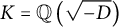 $K=\mathbb {Q}\left (\sqrt {-D}\right )$
, where D is the discriminant of K. Then, the Dedekind zeta function
 $$ \begin{align*}\zeta_{K}(s):=\sum_{n=1}^{\infty}\dfrac{F(n)}{n^s}, \qquad \sigma>1,\end{align*} $$
satisfies the functional equation [Reference Cohen10, p. 211]
 $$ \begin{align} \left(\dfrac{2\pi}{\sqrt{D}}\right)^{-s}\Gamma(s)\zeta_K(s) =\left(\dfrac{2\pi}{\sqrt{D}}\right)^{s-1}\Gamma(1-s)\zeta_K(1-s). \end{align} $$
We note from (1.1) and (1.2) that
 $$ \begin{align*} a(n)=b(n)=F(n), \qquad \lambda_n=\mu_n=n/\sqrt{D}, \qquad \delta=1. \end{align*} $$
The function
 $\zeta _K(s)$
has an analytic continuation into the entire complex plane where it is analytic except for a simple pole at
 $s=1$
. From [Reference Cohen10, p. 212],
 $$ \begin{align} \lim_{s\to 1}(s-1)\zeta_K(s)=\dfrac{2\pi h(K)R(K)}{w(K)\sqrt{D}},\\[-9pt]\nonumber \end{align} $$
where
 $h(K), R(K)$
, and
 $w(K)$
denote, respectively, the class number of K, the regulator of K, and the number of roots of unity in K. Furthermore, from (9.1) and (9.2),
 $$ \begin{align} \qquad \zeta_K(0)=\lim_{s\to 0}\dfrac{\sqrt{D}}{2\pi}\cdot\dfrac{1}{s\Gamma(s)}\cdot s\zeta_K(1-s) =\dfrac{\sqrt{D}}{2\pi}\cdot-\dfrac{2\pi h(K)R(K)}{w(K)\sqrt{D}}=-\dfrac{h(K)R(K)}{w(K)}.\\[-8pt]\nonumber \end{align} $$
For simplicity, set
 $d=\sqrt {D}, h=h(K), R=R(K)$
, and
 $w=w(K)$
. From (9.3) and (9.2),
 $$ \begin{align} Q_0(x)=&\dfrac{1}{2\pi i}\int_{\mathcal{C}}\dfrac{\Gamma(z)}{\Gamma(z+1)}d^z \zeta_{K}(z)x^zdz =-\dfrac{hR}{w}+\dfrac{2\pi hRx}{w}.\\[-8.5pt]\nonumber \end{align} $$
 $$ \begin{align} &\dfrac{1}{2\pi r}\sum_{n=1}^{\infty}\dfrac{F(n)}{(c^2+n/d)^{(\nu-1)/2}}K_{\nu-1}\left(4\pi r\sqrt{c^2+n/d}\right)\notag\\ =&\dfrac{1}{2\pi r^{\nu}c^{\nu-2}}\sum_{n=1}^{\infty}\dfrac{F(n)}{(r^2+n/d)^{(2-\nu)/2}} K_{2-\nu}\left(4\pi c\sqrt{r^2+n/d}\right)\notag\\ &+\int_0^{\infty}\left(-\dfrac{hR}{w}+\dfrac{2\pi hRx}{w}\right)(c^2+x)^{-\nu/2}K_{\nu}\left(4\pi r\sqrt{c^2+x}\right)dx.\\[-8pt]\nonumber \end{align} $$
Separate the integral on the right-hand side of (9.5) into two integrals, denoted by
 $I_1$
and
 $I_2$
, respectively. First, by Lemma 2.1, as we did in our calculation in (6.4),
 $$ \begin{align} \qquad I_1=-\dfrac{hR}{w}\int_0^{\infty}(c^2+x)^{-\nu/2}K_{\nu}\left(4\pi r\sqrt{c^2+x}\right)dx= -\dfrac{hR}{w}\dfrac{1}{2\pi rc^{\nu-1}}K_{\nu-1}(4\pi rc).\\[-8pt]\nonumber \end{align} $$
Second, by Lemma 2.1 with the same calculation as in (6.5),
 $$ \begin{align} I_2=\dfrac{2\pi hR}{w}\int_0^{\infty}x(c^2+x)^{-\nu/2}K_{\nu}\left(4\pi r\sqrt{c^2+x}\right)dx =\dfrac{hR}{2w\,\pi r^2c^{\nu-2}}K_{\nu-2}(4\pi rc).\\[-8pt]\nonumber \end{align} $$
Suppose that we define (perhaps for the first time in the literature)
 $$ \begin{align} F(0)=\dfrac{hR}{w}. \end{align} $$
Then, substituting (9.6) and (9.7) into (9.5) and employing the definition (9.8) to identify (9.6) and (9.7) as the terms for
 $n=0$
on the left- and right-hand sides below, we find that
 $$ \begin{align} &\dfrac{1}{2\pi r}\sum_{n=0}^{\infty}\dfrac{F(n)}{(c^2+n/d)^{(\nu-1)/2}}K_{\nu-1}\left(4\pi r\sqrt{c^2+n/d}\right)\notag\\ =&\dfrac{1}{2\pi r^{\nu}c^{\nu-2}}\sum_{n=0}^{\infty}\dfrac{F(n)}{(r^2+n/d)^{(2-\nu)/2}} K_{2-\nu}\left(4\pi c\sqrt{r^2+n/d}\right). \end{align} $$
Lastly, multiplying both sides of (9.9) by
 $2\pi r$
and replacing
 $\nu $
by
 $\nu +1$
, we conclude with the identity
 $$ \begin{align} &\sum_{n=0}^{\infty}\dfrac{F(n)}{(c^2+n/d)^{\nu/2}}K_{\nu}\left(4\pi r\sqrt{c^2+n/d}\right)\nonumber\\&\quad = \dfrac{1}{r^{\nu}c^{\nu-1}}\sum_{n=0}^{\infty}\dfrac{F(n)}{(r^2+n/d)^{(1-\nu)/2}}K_{1-\nu}\left(4\pi c\sqrt{r^2+n/d}\right). \end{align} $$
The identity (9.10) was first proved in 1934 by Koshliakov [Reference Koshliakov19, p. 555, equation (15)], who used the Abel–Plana summation formula.
10 The second primary theorem
Theorem 10.1 For
 $\mathrm {Re}(\nu )>-1$
,
 $\rho>-1$
,
 $\delta +\rho +\mathrm {Re}(\nu )+1>\delta _a^*>0$
, and
 $\mathrm {Re}(\sqrt {\alpha })>\mathrm {Re}(\sqrt {\beta })>0$
,
 $$ \begin{align} &\frac{1}{\Gamma(\rho+1)}\sum_{n=1}^{\infty}a(n)\int_{\lambda_n}^{\infty}(t-\lambda_n)^\rho\frac{d}{dt}H(\alpha,\beta;t)dt\nonumber\\ =&-\frac{2}{(2\pi)^{{\delta}+2\rho}}\frac{\Gamma(\nu+\delta+\rho+1)}{\Gamma(\nu+2)} \sum_{n=1}^{\infty}\frac{b(n)}{\sqrt{4\mu_n+\alpha}\sqrt{4\mu_n+\beta}} \nonumber\\ &\times\left(\frac{\sqrt{4\mu_n+\alpha}-\sqrt{4\mu_n+\beta}}{\sqrt{4\mu_n+\alpha}+\sqrt{4\mu_n+\beta}} \right)^{\nu+1}\left(\frac{1}{\sqrt{4\mu_n+\alpha}} +\frac{1}{\sqrt{4\mu_n+\beta}}\right)^{2\delta+2\rho-2}\nonumber\\ &\times{}_2F_{1}\left(\nu-\delta-\rho+2,1-\delta-\rho;\nu+2; \left(\frac{\sqrt{4\mu_n+\alpha}-\sqrt{4\mu_n+\beta}}{\sqrt{4\mu_n+\alpha}+\sqrt{4\mu_n+\beta}} \right)^{2} \right)\nonumber\\ &-\frac{Q_{\rho}(0)}{2(\nu+1)}\left(\frac{\sqrt{\alpha}-\sqrt{\beta}}{\sqrt{\alpha}+\sqrt{\beta}} \right)^{\nu+1}-\int_{0}^{\infty}Q'_{\rho}(t)H(\alpha,\beta; t)dt, \end{align} $$
where
 $$ \begin{align} H(\alpha,\beta; t):=I_{\nu+1}\left(\pi \sqrt{t}\left(\sqrt{\alpha}-\sqrt{\beta}\right)\right)K_{\nu+1}\left(\pi \sqrt{t}\left(\sqrt{\alpha}+\sqrt{\beta}\right)\right), \end{align} $$
where it is assumed that
 $Q_{\rho }(0)$
exists, and where
 ${_2F_1}(a,b;c;z)$
denotes the ordinary hypergeometric function.
Proof Replace x by t in (1.4), multiply both sides of (1.4) by
 $$ \begin{align*} \frac{d}{dt}H(\alpha,\beta;t), \end{align*} $$
where
 $H(\alpha ,\beta ;t)$
is defined by (10.2), and finally integrate with respect to t over
 $(0,\infty )$
. We see that the left-hand side becomes
 $$ \begin{align} &\frac{1}{\Gamma(\rho+1)}\sum_{n=1}^{\infty}a(n)\int_{\lambda_n}^{\infty}(t-\lambda_n)^\rho \frac{d}{dt}H(\alpha,\beta;t) dt=\frac{1}{(2\pi)^{\rho}}F_1(\alpha,\beta,\rho)+F_{2}(\alpha,\beta,\rho), \end{align} $$
where
 $$ \begin{align*} F_{1}(\alpha,\beta,\rho) &:=\sum_{n=1}^{\infty}b(n)\int_{0}^{\infty}\left(\dfrac{t}{\mu_n}\right)^{(\delta+\rho)/2} J_{\delta+\rho}\left(4\pi\sqrt{\mu_n t}\right)~H(\alpha,\beta; t) dt\end{align*} $$
and
 $$ \begin{align} F_2(\alpha,\beta,\rho)&:=\int_{0}^{\infty}Q_{\rho}(t)H(\alpha,\beta; t)dt. \end{align} $$
First, examine
 $F_1(\alpha ,\beta ,\rho )$
. Integrating by parts while using (2.7) in the form
 $$ \begin{align*} \frac{d}{dt}\left({t}^{(\delta+\rho)/2}J_{\delta+\rho}\left(a\sqrt{ t}\right)\right)=\frac{a}{2}{t}^{(\delta+\rho-1)/2}J_{\delta+\rho-1}\left(a\sqrt{ t}\right), \end{align*} $$
we find that
 $$ \begin{align} F_1(\alpha,\beta,\rho) =&\sum_{n=1}^{\infty}\frac{b(n)}{\mu_n^{(\delta+\rho)/2}}\int_{0}^{\infty}{t}^{(\delta+\rho)/2} J_{\delta+\rho}\left(4\pi\sqrt{\mu_n t}\right)~\frac{d}{dt}H(\alpha,\beta;t)\nonumber\\ =&-\sum_{n=1}^{\infty}\frac{b(n)}{\mu_n^{(\delta+\rho)/2}}\int_{0}^{\infty}\frac{d}{dt} \left({t}^{(\delta+\rho)/2}J_{\delta+\rho}\left(4\pi\sqrt{\mu_n t}\right)\right)H(\alpha,\beta;t)dt\nonumber\\ =&-2\pi\sum_{n=1}^{\infty}\frac{b(n)}{\mu_n^{(\delta+\rho-1)/2}}\int_{0}^{\infty}t^{(\delta+\rho-1)/2} J_{\delta+\rho-1}\left(4\pi\sqrt{\mu_n t}\right)H(\alpha,\beta;t)dt, \end{align} $$
where we have used the asymptotic formulas (2.10)–(2.12), the hypothesis
 $\delta +\rho>0$
, and the existence of
 $$ \begin{align*} \lim_{t\to 0}I_{\nu+1}\left(\pi \sqrt{t}\left(\sqrt{\alpha}-\sqrt{\beta}\right)\right)K_{\nu+1}\left(\pi \sqrt{t}\left(\sqrt{\alpha}+\sqrt{\beta}\right)\right), \end{align*} $$
which is explicitly calculated in (10.8).
We next employ an integral evaluation from [Reference Berndt, Dixit, Kim and Zaharescu6, p. 315]. For
 $\mathrm {Re}(\mu )>-1$
,
 $\mathrm {Re}(\mu +\nu )>-1$
, and
 $\mathrm {Re}(\pi (z+w))>|\mathrm {Re}(\pi (z-w))|+|\mathrm {Im}(\xi )|$
,
 $$ \begin{align} &\quad \int_0^{\infty}x^{\mu+1}J_{\mu}(\xi x)I_{\nu}(\pi(z-w)x)K_{\nu}(\pi(z+w)x)dx\notag\\ \quad =&\dfrac{\Gamma(\mu+\nu+1)}{\Gamma(\nu+1)}\dfrac{(\xi/2)^{\mu}}{\sqrt{\xi^2+4\pi^2z^2}\sqrt{\xi^2+4\pi^2w^2}} \left(\dfrac{\sqrt{\xi^2+4\pi^2z^2}-\sqrt{\xi^2+4\pi^2w^2}} {\sqrt{\xi^2+4\pi^2z^2}+\sqrt{\xi^2+4\pi^2w^2}}\right)^{\nu}\notag\\ \quad &\times\left(\dfrac{1}{\sqrt{\xi^2+4\pi^2z^2}}+\dfrac{1}{\sqrt{\xi^2+4\pi^2w^2}}\right)^{2\mu}\notag\\ \quad &\times {_2F_1}\left(\nu-\mu,-\mu;\nu+1; \left(\dfrac{\sqrt{\xi^2+4\pi^2z^2}-\sqrt{\xi^2+4\pi^2w^2}} {\sqrt{\xi^2+4\pi^2z^2}+\sqrt{\xi^2+4\pi^2w^2}}\right)^2\right). \end{align} $$
The Hankel inversion of the formula given above with the same kernel, that is,
 $J_{\mu }$
, was given by Koshliakov [Reference Koshliakov20, equation (1)] and is a generalization of an integral evaluation by Fock and Bursian [Reference Fock and Bursian15, pp. 361–363], arising in their study on electromagnetism (see also [Reference Fock14, equations (31) and (33)]).
In the integral on the extreme right-hand side of (10.5), make the change of variable
 $t=x^2$
and then apply (10.6) with
 $\xi =4\pi \sqrt {\mu _n}$
,
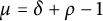 $\mu =\delta +\rho -1$
,
 $z=\sqrt {\alpha }$
,
 $w=\sqrt {\beta }$
, and
 $\nu $
replaced by
 $\nu +1$
. Thus, for
 $\mathrm {Re}(\nu +\delta +\rho )>-1$
and
 $\delta +\rho>0$
, we find that
 $$ \begin{align} &F_1(\alpha,\beta,\rho)=-2\pi\sum_{n=1}^{\infty}\frac{b(n)}{\mu_{n}^{(\delta+\rho-1)/2}} \nonumber\\&\Bigg\{\frac{2\Gamma(\nu+\delta+\rho+1)}{\Gamma(\nu+2)} \frac{(2\pi\sqrt{\mu_n})^{\delta+\rho-1}}{\sqrt{16\pi^2\mu_n+4\pi^2\alpha}\sqrt{16\pi^2\mu_n+4\pi^2\beta}}\nonumber\\ &\times\left(\frac{\sqrt{4\mu_n+\alpha}-\sqrt{4\mu_n+\beta}}{\sqrt{4\mu_n+\alpha}+\sqrt{4\mu_n+\beta}} \right)^{\nu+1}\left(\frac{1}{\sqrt{16\pi^2\mu_n+4\pi^2\alpha}} +\frac{1}{\sqrt{16\pi^2\mu_n+4\pi^2\beta}}\right)^{2\delta+2\rho-2}\nonumber\\ &\times{}_2F_{1}\left(\nu-\delta-\rho+2,-\delta-\rho+1,\nu+2, \left(\frac{\sqrt{4\mu_n+\alpha}-\sqrt{4\mu_n+\beta}}{\sqrt{4\mu_n+\alpha}+\sqrt{4\mu_n+\beta}} \right)^{2} \right)\Bigg\}\nonumber\\ =&-\frac{2}{(2\pi)^{{\delta}+\rho}}\frac{\Gamma(\nu+\delta+\rho+1)} {\Gamma(\nu+2)}\sum_{n=1}^{\infty}\frac{b(n)}{\sqrt{4\mu_n+\alpha} \sqrt{4\mu_n+\beta}}\nonumber\\&\times \left(\frac{\sqrt{4\mu_n+\alpha}-\sqrt{4\mu_n+\beta}} {\sqrt{4\mu_n+\alpha}+\sqrt{4\mu_n+\beta}} \right)^{\nu+1}\left(\frac{1}{\sqrt{4\mu_n+\alpha}} +\frac{1}{\sqrt{4\mu_n+\beta}}\right)^{2\delta+2\rho-2}\nonumber\\ &\qquad \times{}_2F_{1}\left(\nu-\delta-\rho+2,-\delta-\rho+1;\nu+2; \left(\frac{\sqrt{4\mu_n+\alpha}-\sqrt{4\mu_n+\beta}}{\sqrt{4\mu_n+\alpha}+\sqrt{4\mu_n+\beta}} \right)^{2} \right). \end{align} $$
Second, by the definitions of
 $I_{\nu }$
and
 $K_{\nu }$
in (2.1) and (2.2), respectively, and by the use of the functional equation and reflection formula for
 $\Gamma (z)$
, we find that
 $$ \begin{align} &\lim_{t\to 0}I_{\nu+1}\left(\pi \sqrt{t}\left(\sqrt{\alpha}-\sqrt{\beta}\right)\right)K_{\nu+1}\left(\pi \sqrt{t}\left(\sqrt{\alpha}+\sqrt{\beta}\right)\right)\notag\\ =&\lim_{t\to 0}\dfrac{\pi}{2\sin(\pi (\nu+1))}\dfrac{\left(\tfrac12\pi\sqrt{t}(\sqrt{\alpha}-\sqrt{\beta})\right)^{\nu+1}}{\Gamma(\nu+2)} \dfrac{\left(\tfrac12\pi\sqrt{t}(\sqrt{\alpha}+\sqrt{\beta})\right)^{-\nu-1}}{\Gamma(-\nu)}\notag\\ =&\dfrac{\pi}{2\sin(\pi(\nu+1))(\nu+1)\Gamma(\nu+1)\Gamma(-\nu)} \left(\dfrac{\sqrt{\alpha}-\sqrt{\beta}}{\sqrt{\alpha}+\sqrt{\beta}}\right)^{\nu+1}\notag\\ =&\dfrac{1}{2(\nu+1)}\left(\dfrac{\sqrt{\alpha}-\sqrt{\beta}}{\sqrt{\alpha}+\sqrt{\beta}}\right)^{\nu+1}.\\[-9pt]\nonumber \end{align} $$
Utilizing (2.11), (2.12), and (10.8) in performing an integration by parts in (10.4), we deduce that, for
 $\mathrm {Re}(\nu )>-1$
,
 $$ \begin{align} F_2(\alpha,\beta,\rho)=&-\frac{1}{2(\nu+1)}\left(\frac{\sqrt{\alpha}-\sqrt{\beta}}{\sqrt{\alpha}+\sqrt{\beta}} \right)^{\nu+1}Q_{\rho}(0)\notag\\&-\int_{0}^{\infty}Q'_{\rho}(t)I_{\nu+1}\left(\pi \sqrt{t}\left(\sqrt{\alpha}-\sqrt{\beta}\right)\right)K_{\nu+1}\left(\pi \sqrt{t}\left(\sqrt{\alpha}+\sqrt{\beta}\right)\right)dt,\\[-9pt]\nonumber \end{align} $$
where, for Re
 $(\sqrt {\alpha })>$
Re
 $(\sqrt {\beta })$
, the boundary term at
 $\infty $
vanishes, since by (2.11) and (2.12), respectively, as
 $t\to \infty $
,
 $$ \begin{align} I_{\nu}(\pi(\sqrt{t\alpha}-\sqrt{t\beta})\sim\frac{e^{\pi(\sqrt{t\alpha}-\sqrt{t\beta})}}{\pi\sqrt{2(\sqrt{t\alpha}-\sqrt{t\beta})}}\end{align} $$
and
 $$ \begin{align} K_{\nu}(\pi(\sqrt{t\alpha}+\sqrt{t\beta}))\sim\frac{e^{-\pi(\sqrt{t\alpha}+\sqrt{t\beta})}}{\sqrt{2(\sqrt{t\alpha}+\sqrt{t\beta})}}. \end{align} $$
Finally, from (10.3), (10.7), and (10.9), we deduce that
 $$ \begin{align*} &\frac{1}{\Gamma(\rho+1)}\sum_{n=1}^{\infty}a(n)\int_{\lambda_n}^{\infty}(t-\lambda_n)^\rho \frac{d}{dt}H(\alpha,\beta;t)dt\\ =&-\frac{1}{2(\nu+1)}\left(\frac{\sqrt{\alpha}-\sqrt{\beta}}{\sqrt{\alpha}+\sqrt{\beta}} \right)^{\nu+1}Q_{\rho}(0)\notag\\&-\frac{2}{(2\pi)^{{\delta}+2\rho}} \frac{\Gamma(\nu+\delta+\rho+1)}{\Gamma(\nu+2)} \sum_{n=1}^{\infty}\frac{b(n)}{\sqrt{4\mu_n+\alpha} \sqrt{4\mu_n+\beta}}\left(\frac{\sqrt{4\mu_n+\alpha}-\sqrt{4\mu_n+\beta}}{\sqrt{4\mu_n+\alpha}+\sqrt{4\mu_n+\beta}} \right)^{\nu+1}\nonumber\\ &\times\left(\frac{1}{\sqrt{4\mu_n+\alpha}} +\frac{1}{\sqrt{4\mu_n+\beta}}\right)^{2\delta+2\rho-2}\nonumber\\ &\times{}_2F_{1}\left(\nu-\delta-\rho+2,1-\delta-\rho;\nu+2; \left(\frac{\sqrt{4\mu_n+\alpha}-\sqrt{4\mu_n+\beta}}{\sqrt{4\mu_n+\alpha}+\sqrt{4\mu_n+\beta}} \right)^{2} \right)\nonumber\\ &-\int_{0}^{\infty}Q'_{\rho}(t)H(\alpha,\beta;t)dt.\notag \end{align*} $$
The proof of Theorem 10.1 is now complete.
11 The special case:
$\rho =0$

When
 $\rho =0$
in Theorem 10.1, by (10.10) and (10.11), the left-hand side of (10.1) reduces to
 $$ \begin{align*} \sum_{n=1}^{\infty}a(n)\int_{\lambda_n}^{\infty}\frac{d}{dt}H(\alpha,\beta;t)dt =-\sum_{n=1}^{\infty}a(n)H(\alpha,\beta;\lambda_n). \end{align*} $$
Hence, we have our second main theorem.
Theorem 11.1 Assume that
 $\mathrm {Re}(\nu )>-1$
and
 $\mathrm {Re}(\sqrt {\alpha })>\mathrm {Re}(\sqrt {\beta })>0$
. Also assume that
 $\delta +\mathrm {Re}(\nu )+1>\sigma _a^*>0$
. Suppose that the integral on the right side below converges absolutely and that
 $Q_0(0)$
exists. Then,
 $$ \begin{align} &\sum_{n=1}^{\infty}a(n)H(\alpha,\beta;\lambda_n)\nonumber =\frac{2(2\pi)^{-\delta}\Gamma(\nu+\delta+1)} {\Gamma(\nu+2)}\nonumber\\ &\times\sum_{n=1}^{\infty}\frac{b(n)} {\sqrt{4\mu_n+\alpha}\sqrt{4\mu_n+\beta}} \left(\frac{\sqrt{4\mu_n+\alpha}-\sqrt{4\mu_n+\beta}}{\sqrt{4\mu_n+\alpha}+\sqrt{4\mu_n+\beta}} \right)^{\nu+1}\nonumber\\ &\times\left(\frac{1}{\sqrt{4\mu_n+\alpha}} +\frac{1}{\sqrt{4\mu_n+\beta}}\right)^{2\delta-2}\nonumber\\ &\times {}_2F_{1}\left(\nu-\delta+2,1-\delta;\nu+2; \left(\frac{\sqrt{4\mu_n+\alpha}-\sqrt{4\mu_n+\beta}}{\sqrt{4\mu_n+\alpha}+\sqrt{4\mu_n+\beta}} \right)^{2} \right)\nonumber\\ &+\frac{Q_{0}(0)}{2(\nu+1)}\left( \frac{\sqrt{\alpha}-\sqrt{\beta}}{\sqrt{\alpha}+\sqrt{\beta}}\right)^{\nu+1}+\int_{0}^{\infty}Q'_{0}(x)H(\alpha,\beta;x)dx, \end{align} $$
where
 $H(\alpha ,\beta ;t)$
is defined by (10.2).
Next, we show that Theorem 4.1 from [Reference Berndt, Dixit, Gupta and Zaharescu5] can be obtained as a special case of Theorem 11.1. To that end, divide both sides of (11.1) by
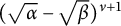 $(\sqrt {\alpha }-\sqrt {\beta })^{\nu +1}$
, and let
 $\alpha \to \beta $
. In the course of doing so, we need the limit
 $$ \begin{align} &\lim_{\alpha\to \beta}\frac{I_{\nu+1}\left(\pi \sqrt{\lambda_n}\left(\sqrt{\alpha}-\sqrt{\beta}\right)\right)K_{\nu+1}\left(\pi \sqrt{\lambda_n}\left(\sqrt{\alpha}+\sqrt{\beta}\right)\right)}{(\sqrt{\alpha}-\sqrt{\beta})^{\nu+1}}\nonumber\\&\quad =\left(\frac{\pi}{2} \right)^{\nu+1}\lambda_n^{(\nu+1)/2}\frac{K_{\nu+1}(2\pi\sqrt{\lambda_n\beta})}{\Gamma(\nu+2)}, \end{align} $$
where the definitions of
 $I_{\nu }$
and
 $K_{\nu }$
in (2.1) and (2.2), respectively, were used. On the left side of (11.1), by (2.8) and (2.9), the series converges absolutely and uniformly with respect to
 $\alpha $
for
 $0\leq \sqrt {\alpha }<\epsilon $
, for each fixed
 $\epsilon>0$
. Thus, we can interchange summation and the limit as
 $\alpha \to \beta $
on the left-hand side of (11.1) to find that
 $$ \begin{align} &\lim_{\alpha\to\beta}\sum_{n=1}^{\infty}a(n)I_{\nu+1}\left(\pi \sqrt{\lambda_n}\left(\sqrt{\alpha}-\sqrt{\beta}\right)\right)K_{\nu+1}\left(\pi \sqrt{\lambda_n}\left(\sqrt{\alpha}+\sqrt{\beta}\right)\right)\notag\\=& \frac{\left(\frac{\pi}{2} \right)^{\nu+1}}{\Gamma(\nu+2)}\sum_{n=1}^{\infty}a(n)\lambda_{n}^{(\nu+1)/2}K_{\nu+1}(2\pi\sqrt{\lambda_n\beta}). \end{align} $$
We also take the limit as
 $\alpha \to \beta $
inside the integral on the far right side of (11.1) by using a similar argument with
 $\lambda _n$
replaced by
 $x$
in (11.2). Hence,
 $$ \begin{align} &\quad \lim_{\alpha\to\beta}\int_{0}^{\infty}Q'_{0}(x)I_{\nu+1}\left(\pi \sqrt{x}\left(\sqrt{\alpha}-\sqrt{\beta}\right)\right)K_{\nu+1}\left(\pi \sqrt{x}\left(\sqrt{\alpha}+\sqrt{\beta}\right)\right)dx\notag\\ \quad =&\dfrac{\left(\frac{\pi}{2}\right)^{\nu+1}}{\Gamma(\nu+2)}\int_0^{\infty}Q_0^{\prime}(x)x^{(\nu+1)/2} K_{\nu+1}(2\pi\sqrt{\beta x})dx. \end{align} $$
Next, recall that
 ${_2F_1}(a,b;c;0)=1$
. Thus, it remains to evaluate the limit
 $$ \begin{align} &\lim_{\alpha\to\beta}\frac{\left(\sqrt{4\mu_n+\alpha}+\sqrt{4\mu_n+\beta}\right)^{-\nu-1}} {\sqrt{4\mu_n+\alpha}\sqrt{4\mu_n+\beta}}\nonumber\\ &\times\left(\frac{\sqrt{4\mu_n+\alpha}-\sqrt{4\mu_n+\beta}} {\sqrt{\alpha}-\sqrt{\beta}} \right)^{\nu+1} \left(\frac{1}{\sqrt{4\mu_n+\alpha}} +\frac{1}{\sqrt{4\mu_n+\beta}}\right)^{2\delta-2}\notag\\ =&\lim_{\alpha\to\beta}\frac{\left(\sqrt{4\mu_n+\alpha}+\sqrt{4\mu_n+\beta}\right)^{-2\nu-2}} {\sqrt{4\mu_n+\alpha}\sqrt{4\mu_n+\beta}}\nonumber\\&\quad \times (\sqrt{\alpha}+\sqrt{\beta})^{\nu+1}\left(\frac{1}{\sqrt{4\mu_n+\alpha}} +\frac{1}{\sqrt{4\mu_n+\beta}}\right)^{2\delta-2}\notag\\ =&\dfrac{2^{2\delta-2}}{(4\mu_n+\beta)^{\delta}}\left(\dfrac{\sqrt{\beta}} {2(4\mu_n+\beta)}\right)^{\nu+1}. \end{align} $$
Bringing together (11.3)–(11.5), we conclude that
 $$ \begin{align} \frac{\left(\frac{\pi}{2} \right)^{\nu+1}}{\Gamma(\nu+2)}\sum_{n=1}^{\infty}a(n)\lambda_{n}^{(\nu+1)/2}K_{\nu+1}(2\pi\sqrt{\lambda_n\beta})\nonumber\\ =\frac{2^{\delta-\nu-2}\pi^{-\delta}\beta^{(\nu+1)/2}\Gamma(\nu+\delta+1)} {\Gamma(\nu+2)}\sum_{n=1}^{\infty}\frac{b(n)}{(4\mu_n+\beta)^{\delta+\nu+1}}\nonumber\\ \qquad+\frac{\left(\frac{\pi}{2} \right)^{\nu+1}}{\Gamma(\nu+2)}\int_{0}^{\infty}Q_{0}^{\prime}(x)x^{(\nu+1)/2}K_{\nu+1}(2\pi\sqrt{\beta x})dx. \end{align} $$
Let
 $s=2\pi \sqrt {\beta }$
. Multiplying both sides of (11.6) by
 $2/s$
and by
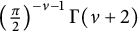 $\left (\frac {\pi }{2} \right )^{-\nu -1}\Gamma (\nu +2)$
and then integrating by parts with the aid of (2.9) and (2.12), we conclude that
 $$ \begin{align*} \frac{2}{s}\sum_{n=1}^{\infty}a(n)\lambda_{n}^{(\nu+1)/2}K_{\nu+1}(s\sqrt{\lambda_n}) =&2^{3\delta+\nu+1}\pi^{\delta}s^\nu\Gamma(\nu+\delta+1) \sum_{n=1}^{\infty}\frac{b(n)}{(16\pi^2\mu_n+s^2)^{\delta+\nu+1}}\nonumber\\ &+\dfrac{2}{s}\int_{0}^{\infty}Q_{0}^{\prime}(x)x^{(\nu+1)/2}K_{\nu+1}(s\sqrt{x})dx\notag\\ =&2^{3\delta+\nu+1}\pi^{\delta}s^\nu\Gamma(\nu+\delta+1) \sum_{n=1}^{\infty}\frac{b(n)}{(16\pi^2\mu_n+s^2)^{\delta+\nu+1}}\nonumber\\ &+\int_{0}^{\infty}Q_{0}(x)x^{\nu/2}K_{\nu}(s\sqrt{x})dx. \end{align*} $$
We hence obtain Theorem 4.1 from [Reference Berndt, Dixit, Gupta and Zaharescu5] as a corollary of Theorem 11.1.
Corollary 11.2 For
 $\mathrm {Re}(\nu )>-1$
,
 $\delta +\mathrm {Re}(\nu )+1>\sigma _a^*$
, and
 $\mathrm {Re}(s)>0$
,
 $$ \begin{align*} \frac{2}{s}\sum_{n=1}^{\infty}a(n)\lambda_{n}^{(\nu+1)/2}K_{\nu+1}(s\sqrt{\lambda_n}) =&2^{3\delta+\nu+1}\pi^{\delta}s^\nu\Gamma(\nu+\delta+1) \sum_{n=1}^{\infty}\frac{b(n)}{(16\pi^2\mu_n+s^2)^{\delta+\nu+1}}\nonumber\\ &+\int_{0}^{\infty}Q_{0}(x)x^{\nu/2}K_{\nu}(s\sqrt{x})dx, \end{align*} $$
where it is assumed that the integral converges absolutely.
Corollary 11.2 was also established in [Reference Berndt, Dixit, Gupta and Zaharescu5, Theorem 4.1].
12 Example:
$r_k(n)$

Recall (5.1) and (5.2). Applying Theorem 11.1 with
 $\alpha $
and
 $\beta $
replaced by
 $2\alpha $
and
 $2\beta $
, respectively, and
 $\nu $
replaced by
 $\nu -1$
, for
 $\mathrm {Re}(\nu )>0$
, we find that
 $$ \begin{align} &\sum_{n=1}^{\infty}r_k(n)I_{\nu}\left(\pi \sqrt{n}\left(\sqrt{\alpha}-\sqrt{\beta}\right)\right)K_{\nu}\left(\pi \sqrt{n}\left(\sqrt{\alpha}+\sqrt{\beta}\right)\right)=\nonumber\\ =&\frac{\Gamma(k/2+\nu)}{\pi^{k/2}2^{k-1}\Gamma(\nu+1)} \sum_{n=1}^{\infty}\frac{b(n)}{\sqrt{n+\alpha}\sqrt{n+\beta}} \left(\frac{\sqrt{n+\alpha}-\sqrt{n+\beta}}{\sqrt{n+\alpha}+\sqrt{n+\beta}} \right)^{\nu}\nonumber\\ &\times\left(\frac{1}{\sqrt{n+\alpha}} +\frac{1}{\sqrt{n+\beta}}\right)^{k-2}\nonumber\\&\times {}_2F_{1} \left(\nu-k/2+1,1-k/2;\nu+1;\left(\frac{\sqrt{n+\alpha}-\sqrt{n+\beta}}{\sqrt{n+\alpha}+\sqrt{n+\beta}} \right)^{2} \right)\nonumber\\ &-\frac{1}{2\nu}\left( \frac{\sqrt{\alpha}-\sqrt{\beta}}{\sqrt{\alpha}+\sqrt{\beta}}\right)^{\nu}+\int_{0}^{\infty}Q'_{0}(x)I_{\nu}\left(\pi \sqrt{2x}\left(\sqrt{\alpha}-\sqrt{\beta}\right)\right)\nonumber\\&\quad \times K_{\nu}\left(\pi \sqrt{2x}\left(\sqrt{\alpha}+\sqrt{\beta}\right)\right)dx. \end{align} $$
To evaluate the integral in (12.1), we use an integral in [Reference Gradshteyn and Ryzhik16, p. 717, equation 6.576, no. 5], namely, for
 $a>b, \mathrm {Re}(2\nu )>\lambda -1$
, and
 $\mathrm {Re}(\lambda )<1,$
 $$ \begin{align} \int_{0}^{\infty}x^{-\lambda}K_{\nu}(ax)I_{\nu}(bx)dx=\frac{b^{\nu}\Gamma\left(\frac{1-\lambda+2\nu}{2} \right)\Gamma\left(\frac{1-\lambda}{2} \right)}{2^{\lambda+1}\Gamma(\nu+1)a^{1-\lambda+\nu}} {}_2F_1\left(\frac{1-\lambda+2\nu}{2},\frac{1-\lambda}{2};\nu+1;\frac{b^2}{a^2}\right). \end{align} $$
Using (5.2) and (12.2), wherein we make the change of variable
 $t=\sqrt {2x}$
and note that
 $\lambda =1-k$
,
 $a=\pi (\sqrt {\alpha }+\sqrt {b})$
, and
 $b=\pi (\sqrt {\alpha }-\sqrt {b})$
, we deduce that
 $$ \begin{align} &\int_{0}^{\infty}Q'_{0}(x)I_{\nu}\left(\pi \sqrt{2x}\left(\sqrt{\alpha}-\sqrt{\beta}\right)\right)K_{\nu}\left(\pi \sqrt{2x}\left(\sqrt{\alpha}+\sqrt{\beta}\right)\right)dx\nonumber\\ &=\frac{k(2\pi)^{k/2}}{2\Gamma(1+k/2)}\int_{0}^{\infty}x^{k/2-1}I_{\nu}\left(\pi \sqrt{2x}\left(\sqrt{\alpha}-\sqrt{\beta}\right)\right)K_{\nu}\left(\pi \sqrt{2x}\left(\sqrt{\alpha}+\sqrt{\beta}\right)\right)dx\nonumber\\ &=\frac{k2^{k/2-1}\pi^{k/2}}{2^{k/2-1}\Gamma(1+k/2)}\int_{0}^{\infty}t^{k-1}I_{\nu}\left(\pi t\left(\sqrt{\alpha}-\sqrt{\beta}\right)\right)K_{\nu}\left(\pi t\left(\sqrt{\alpha}+\sqrt{\beta}\right)\right)dt\nonumber\\ &=\frac{k\pi^{k/2}}{\Gamma(1+k/2)} \frac{\left(\pi\left(\sqrt{\alpha}-\sqrt{\beta}\right)\right)^{\nu}\Gamma\left(\frac{k}{2}+\nu \right)\Gamma\left(\frac{k}{2} \right)}{2^{2-k}\Gamma(\nu+1)\left(\pi \left(\sqrt{\alpha}+\sqrt{\beta}\right)\right)^{\nu+k}}\cdot {}_2F_1\left(\frac{k}{2}+\nu,\frac{k}{2};\nu+1;\left(\frac{\sqrt{\alpha}-\sqrt{\beta}}{\sqrt{\alpha}+\sqrt{\beta}} \right)^{2} \right)\nonumber\\ &=\frac{2^{k-1}\Gamma\left(\frac{k}{2}+\nu \right)}{\pi^{k/2}\Gamma(\nu+1)}\left(\frac{\sqrt{\alpha}-\sqrt{\beta}}{\sqrt{\alpha}+\sqrt{\beta}} \right)^{\nu}\left(\frac{1}{\sqrt{\alpha}+\sqrt{\beta}} \right)^{k}{}_2F_1\left(\frac{k}{2}+\nu,\frac{k}{2};\nu+1;\left(\frac{\sqrt{\alpha}-\sqrt{\beta}}{\sqrt{\alpha}+\sqrt{\beta}} \right)^{2} \right). \end{align} $$
Invoking Euler’s formula [Reference Andrews, Askey and Roy1, p. 68, Theorem 2.2.5]
 $$ \begin{align*} {}_2F_1\left(a,b;c;x \right)=(1-x)^{c-a-b}{}_2F_1\left(c-a,c-b;c;x \right) \end{align*} $$
in (12.3), we find that
 $$ \begin{align} &\int_{0}^{\infty}Q'_{0}(x)I_{\nu}\left(\pi \sqrt{2x}\left(\sqrt{\alpha}-\sqrt{\beta}\right)\right)K_{\nu}\left(\pi \sqrt{2x}\left(\sqrt{\alpha}+\sqrt{\beta}\right)\right)dx\nonumber\\ =&\frac{2^{k-1}\Gamma\left(\frac{k}{2}+\nu \right)}{\pi^{k/2}\Gamma(\nu+1)}\left(\frac{\sqrt{\alpha}-\sqrt{\beta}}{\sqrt{\alpha}+\sqrt{\beta}} \right)^{\nu}\left(\frac{1}{\sqrt{\alpha}+\sqrt{\beta}} \right)^{k}{}_2F_1\left(\frac{k}{2}+\nu,\frac{k}{2};\nu+1;\left(\frac{\sqrt{\alpha}-\sqrt{\beta}}{\sqrt{\alpha}+\sqrt{\beta}} \right)^{2} \right)\nonumber\\ =&\frac{2^{1-k}\Gamma\left(\frac{k}{2}+\nu \right)(\sqrt{\alpha\beta})^{1-k}}{\pi^{k/2}\Gamma(\nu+1)}\left(\frac{\sqrt{\alpha}-\sqrt{\beta}}{\sqrt{\alpha}+\sqrt{\beta}} \right)^{\nu}\left(\frac{1}{\sqrt{\alpha}+\sqrt{\beta}} \right)^{2-k}\nonumber\\&\times{}_2F_1\left(1-\frac{k}{2}+\nu,1-\frac{k}{2};\nu+1; \left(\frac{\sqrt{\alpha}-\sqrt{\beta}}{\sqrt{\alpha}+\sqrt{\beta}} \right)^{2}\right)\nonumber\\ =&\frac{\Gamma\left(\frac{k}{2}+\nu \right)}{\pi^{k/2}2^{k-1}\Gamma(\nu+1)}\left(\frac{\sqrt{\alpha}-\sqrt{\beta}}{\sqrt{\alpha}+\sqrt{\beta}} \right)^{\nu}\left(\frac{1}{\sqrt{\alpha}}+\frac{1}{\sqrt{\beta}} \right)^{k-2}\frac{1}{\sqrt{\alpha\beta}}\nonumber\\ &\qquad \times{}_2F_1\left(1-\frac{k}{2}+\nu,1-\frac{k}{2};\nu+1;\left(\frac{\sqrt{\alpha}-\sqrt{\beta}}{\sqrt{\alpha}+\sqrt{\beta}} \right)^{2} \right). \end{align} $$
Now put (12.4) in (12.1). To obtain the final equality below, we define
 $r_k(0)=1$
. To that end,
 $$ \begin{align*}&\sum_{n=1}^{\infty}r_k(n)I_{\nu}\left(\pi \sqrt{n}\left(\sqrt{\alpha}-\sqrt{\beta}\right)\right)K_{\nu}\left(\pi \sqrt{n}\left(\sqrt{\alpha}+\sqrt{\beta}\right)\right)\nonumber\\&\quad=\frac{\Gamma(k/2+\nu)}{\pi^{k/2}2^{k-1}\Gamma(\nu+1)}\sum_{n=1}^{\infty}\frac{r_k(n)}{\sqrt{n+\alpha}\sqrt{n+\beta}}\left(\frac{\sqrt{n+\alpha}-\sqrt{n+\beta}}{\sqrt{n+\alpha}+\sqrt{n+\beta}} \right)^{\nu}\nonumber\\&\qquad\times\left(\frac{1}{\sqrt{n+\alpha}} +\frac{1}{\sqrt{n+\beta}}\right)^{k-2}\\&\qquad \times {}_2F_{1}\left(\nu-k/2+1,1-k/2;\nu+1;\left(\frac{\sqrt{n+\alpha}-\sqrt{n+\beta}}{\sqrt{n+\alpha}+\sqrt{n+\beta}} \right)^{2} \right)\nonumber\\&\qquad-\frac{1}{2\nu}\left( \frac{\sqrt{\alpha}-\sqrt{\beta}}{\sqrt{\alpha}+\sqrt{\beta}}\right)^{\nu}+\frac{\Gamma\left(\frac{k}{2}+\nu \right)}{\pi^{k/2}2^{k-1}\Gamma(\nu+1)}\left(\frac{\sqrt{\alpha}-\sqrt{\beta}}{\sqrt{\alpha}+\sqrt{\beta}} \right)^{\nu}\left(\frac{1}{\sqrt{\alpha}}+\frac{1}{\sqrt{\beta}} \right)^{k-2}\frac{1}{\sqrt{\alpha\beta}}\nonumber\\&\qquad\times{}_2F_1\left(1-\frac{k}{2}+\nu,1-\frac{k}{2};\nu+1;\left(\frac{\sqrt{\alpha}-\sqrt{\beta}}{\sqrt{\alpha}+\sqrt{\beta}} \right)^{2} \right). \end{align*} $$
Thus, with simplification,
 $$ \begin{align} &\sum_{n=1}^{\infty}r_k(n)I_{\nu}\left(\pi \sqrt{n}\left(\sqrt{\alpha}-\sqrt{\beta}\right)\right)K_{\nu}\left(\pi \sqrt{n}\left(\sqrt{\alpha}+\sqrt{\beta}\right)\right)\nonumber\\ &\quad=-\frac{1}{2\nu}\left( \frac{\sqrt{\alpha}-\sqrt{\beta}}{\sqrt{\alpha}+\sqrt{\beta}}\right)^{\nu} +\frac{\Gamma(k/2+\nu)}{\pi^{k/2}2^{k-1}\Gamma(\nu+1)} \nonumber\\&\quad \times \sum_{n=0}^{\infty}\frac{r_k(n)}{\sqrt{n+\alpha}\sqrt{n+\beta}} \left(\frac{\sqrt{n+\alpha}-\sqrt{n+\beta}}{\sqrt{n+\alpha}+\sqrt{n+\beta}} \right)^{\nu}\nonumber\\ &\qquad\times\left(\frac{1}{\sqrt{n+\alpha}} +\frac{1}{\sqrt{n+\beta}}\right)^{k-2}{}_2F_1\left(1-\frac{k}{2}+\nu,1-\frac{k}{2};\nu+1; \left(\frac{\sqrt{n+\alpha}-\sqrt{n+\beta}}{\sqrt{n+\alpha}+\sqrt{n+\beta}} \right)^{2} \right). \end{align} $$
By a different method, the identity (12.5) was also established in [Reference Berndt, Dixit, Kim and Zaharescu6, Theorem 1.6]. Letting
 $\nu =1/2$
in (12.5) yields [Reference Berndt, Dixit, Kim and Zaharescu6, Corollary 4.4]
 $$ \begin{align*} &\sum_{n=1}^{\infty}\frac{r_{k}(n)}{\sqrt{n}}e^{-\pi\sqrt{n}(\sqrt{\alpha}+\sqrt{\beta})}\sinh(\pi\sqrt{n}(\sqrt{\alpha}-\sqrt{\beta})) \\ &=-\pi\left(\sqrt{\alpha}-\sqrt{\beta}\right)-\frac{1}{2\pi^{(k-1)/2}} \Gamma\left(\dfrac{k-1}{2}\right)\sum_{n=0}^{\infty}r_k(n)\left((n+\alpha)^{(1-k)/2}-(n+\beta)^{(1-k)/2}\right),\notag \end{align*} $$
whereas dividing both sides of (12.5) by
 $(\alpha -\beta )^{\nu }$
and then letting
 $\alpha \to \beta $
gives
 $$ \begin{align} \sum_{n=0}^{\infty}r_k(n)n^{\frac{\nu}{2}}K_{\nu}(2\pi\sqrt{n\beta}) =\frac{\beta^{\frac{\nu}{2}}\Gamma\left(\nu+\frac{k}{2}\right)}{2\pi^{\nu+\frac{k}{2}}} \sum_{n=0}^{\infty}\frac{r_{k}(n)}{(n+\beta)^{\nu+\frac{k}{2}}}. \end{align} $$
The special case
 $k=2$
and
 $\nu =1/2$
of (12.6) was employed by Hardy [Reference Hardy18, equation (2.12)] to prove his famous result while investigating the Gauss circle problem, namely, as
 $x\to \infty ,$
 $$ \begin{align*}\sum_{n\leq x}r_2(n)-\pi x=\Omega(x^{1/4}).\end{align*} $$
13 Example: Ramanujan’s tau-function
$\tau (n)$

Let
 $\tau (n)$
denote Ramanujan’s famous arithmetical tau-function. Recall the associated facts and parameters given in (7.1)–(7.3). Then, from Theorem 11.1, for
 $\mathrm {Re}(\nu )>-13/2$
,
 $$ \begin{align} &\sum_{n=1}^{\infty}\tau(n)I_{\nu+1}\left(\pi \sqrt{n}\left(\sqrt{\alpha}-\sqrt{\beta}\right)\right)K_{\nu+1}\left(\pi \sqrt{n}\left(\sqrt{\alpha}+\sqrt{\beta}\right)\right)\nonumber\\ &\quad=\frac{2(2\pi)^{-12}\Gamma(13+\nu)}{\Gamma(\nu+2) }\sum_{n=1}^{\infty}\frac{\tau(n)}{\sqrt{4n+\alpha}\sqrt{4n+\beta}} \left(\frac{\sqrt{4n+\alpha}-\sqrt{4n+\beta}}{\sqrt{4n+\alpha}+\sqrt{4n+\beta}} \right)^{\nu+1}\nonumber\\ &\qquad\times\left(\frac{1}{\sqrt{4n+\alpha}} +\frac{1}{\sqrt{4n+\beta}}\right)^{22} {}_2F_{1}\left(\nu-10,-11;\nu+2;\left(\frac{\sqrt{4n+\alpha}-\sqrt{4n+\beta}}{\sqrt{4n+\alpha}+\sqrt{4n+\beta}} \right)^{2} \right). \end{align} $$
Letting
 $\nu =-\frac 12$
in (13.1) and using (2.3) and (2.4), we are led to
 $$ \begin{align} &\frac{1}{\pi\sqrt{\alpha-\beta}}\sum_{n=1}^{\infty}\frac{\tau(n)}{\sqrt{n}} e^{-\pi\sqrt{n}(\sqrt{\alpha}+\sqrt{\beta})}\sinh(\pi\sqrt{n}(\sqrt{\alpha}-\sqrt{\beta}))\nonumber\\ =&\frac{2(2\pi)^{-12}\Gamma(25/2)}{\Gamma(3/2)} \sum_{n=1}^{\infty}\frac{\tau(n)}{\sqrt{4n+\alpha}\sqrt{4n+\beta}} \left(\frac{\sqrt{4n+\alpha}-\sqrt{4n+\beta}}{\sqrt{4n+\alpha}+\sqrt{4n+\beta}} \right)^{1/2}\nonumber\\ &\times\left(\frac{1}{\sqrt{4n+\alpha}} +\frac{1}{\sqrt{4n+\beta}}\right)^{22} {}_2F_{1}\left(-21/2,-11;3/2;\left(\frac{\sqrt{4n+\alpha}-\sqrt{4n+\beta}}{\sqrt{4n+\alpha}+\sqrt{4n+\beta}} \right)^{2} \right). \end{align} $$
Employing [Reference Prudnikov, Brychkov and Marichev23, p. 461, no. 107]
 $$ \begin{align*} {}_2F_{1}\left(a,a+1/2;3/2;z \right)=\dfrac{1}{2(2a-1)\sqrt{z}}\left\{(1-\sqrt{z})^{1-2a}-(1+\sqrt{z})^{1-2a} \right\}, \end{align*} $$
with
 $a=-11$
, we find that
 $$ \begin{align} {}_2F_{1}\left(-21/2,-11;3/2;z \right)=-\dfrac{1}{46\sqrt{z}}\left\{(1-\sqrt{z})^{23}-(1+\sqrt{z})^{23} \right\}. \end{align} $$
With (13.3) in (13.2) and with considerable simplification, we deduce that
 $$ \begin{align} \sum_{n=1}^{\infty}\frac{\tau(n)}{\sqrt{n}}e^{-\pi\sqrt{n}(\sqrt{\alpha}+\sqrt{\beta})}\sinh(\pi\sqrt{n}(\sqrt{\alpha}-\sqrt{\beta}))\notag\\ =2\frac{3\cdot5\cdots21}{\pi^{11}}\sum_{n=1}^{\infty}\tau(n) \left(\frac{1}{(4n+\beta)^{23/2}}-\frac{1}{(4n+\alpha)^{23/2}}\right). \end{align} $$
If we differentiate both sides of (13.4) with respect to
 $\alpha $
and simplify, we find that
 $$ \begin{align*} \sum_{n=1}^{\infty}\tau(n)e^{-2\pi\sqrt{n\alpha}}=2\frac{3\cdot5\cdots21\cdot23}{\pi^{12}} \sum_{n=1}^{\infty}\frac{\sqrt{\alpha}\,\tau(n)}{(4n+\alpha)^{25/2}}, \end{align*} $$
which, with
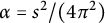 $\alpha =s^2/(4\pi ^2)$
, gives [Reference Berndt, Dixit, Gupta and Zaharescu5, equation (7.4)]
 $$ \begin{align*} \sum_{n=1}^{\infty}\tau(n)e^{-s\sqrt{n}} =2^{36}\pi^{23/2}\Gamma\left(\frac{25}{2}\right)\sum_{n=1}^{\infty}\dfrac{s\tau(n)}{(s^2+16\pi^2n)^{25/2}}. \end{align*} $$
14 Example: primitive Dirichlet characters
Let
 $\chi $
denote a primitive character modulo q. Depending on the parity of
 $\chi $
, we separate two cases. First, consider odd
 $\chi $
. Recall that the functional equation for the associated Dirichlet L-series is given in (8.1), the Gauss sum
 $\tau (\chi )$
is defined in (8.2), and the relevant parameters are given in (8.3). Consequently, by Theorem 11.1 and the fact that
 $Q_0(x)\equiv 0$
, for
 $\mathrm {Re}(\nu )>-5/2,$
 $$ \begin{align} &\sum_{n=1}^{\infty}n\chi(n)I_{\nu+1}\left(\frac{\pi n}{\sqrt{2q}}\left(\sqrt{\alpha}-\sqrt{\beta}\right)\right)K_{\nu+1}\left(\frac{\pi n}{\sqrt{2q}}\left(\sqrt{\alpha}+\sqrt{\beta}\right)\right)\nonumber\\ =&\frac{-i\pi^{-3/2}\Gamma(\nu+5/2)}{\sqrt{2q}\Gamma(\nu+2)}\tau(\chi) \sum_{n=1}^{\infty}\frac{n\bar{\chi}(n)}{\sqrt{\left(\frac{2n^2}{q}+\alpha\right)} \sqrt{\left(\frac{2n^2}{q}+\beta\right)}}\left(\frac{\sqrt{\frac{2n^2}{q}+\alpha} -\sqrt{\frac{2n^2}{q}+\beta}}{\sqrt{\frac{2n^2}{q}+\alpha}+\sqrt{\frac{2n^2}{q}+\beta}} \right)^{\nu+1}\nonumber\\ &\times\left(\frac{1}{\sqrt{\left(\frac{2n^2}{q}+\alpha\right)}} +\frac{1}{\sqrt{\left(\frac{2n^2}{q}+\beta\right)}}\right)\nonumber\\ &\times{}_2F_{1}\left(\nu+1/2,-1/2;\nu+2;\left(\frac{\sqrt{\frac{2n^2}{q}+\alpha}-\sqrt{\frac{2n^2}{q}+\beta}} {\sqrt{\frac{2n^2}{q}+\alpha}+\sqrt{\frac{2n^2}{q}+\beta}} \right)^{2} \right)\nonumber\\ =&\frac{-i\pi^{-3/2}\Gamma(\nu+5/2)}{\sqrt{2q}\Gamma(\nu+2)}\tau(\chi) \sum_{n=1}^{\infty}\frac{n\bar{\chi}(n)}{\left(\frac{2n^2}{q} +\alpha\right)\left(\frac{2n^2}{q}+\beta\right)} \frac{\left(\sqrt{\frac{2n^2}{q}+\alpha}-\sqrt{\frac{2n^2}{q}+\beta}\right)^{\nu+1}} {\left(\sqrt{\frac{2n^2}{q}+\alpha}+\sqrt{\frac{2n^2}{q}+\beta}\right)^{\nu}} \nonumber\\ &\qquad \times{}_2F_{1}\left(\nu+1/2,-1/2;\nu+2;\left(\frac{\sqrt{\frac{2n^2}{q}+\alpha}- \sqrt{\frac{2n^2}{q}+\beta}}{\sqrt{\frac{2n^2}{q}+\alpha}+\sqrt{\frac{2n^2}{q}+\beta}} \right)^{2} \right). \end{align} $$
Letting
 $\nu =-1/2$
in (14.1), using (2.3) and (2.4), appealing to the trivial fact that
 $$ \begin{align*} {}_2F_{1}\left(0,-1/2;3/2;x \right)=1, \end{align*} $$
and multiplying both sides by
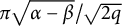 $\pi \sqrt {\alpha -\beta }/\sqrt {2q}$
, we deduce that
 $$ \begin{align} &\sum_{n=1}^{\infty}\chi(n)e^{-\frac{\pi n}{\sqrt{2q}}\left(\sqrt{\alpha}+\sqrt{\beta}\right)}\sinh\left(\frac{\pi n}{\sqrt{2q}}\left(\sqrt{\alpha}-\sqrt{\beta}\right)\right)\nonumber\\ &\quad=\frac{-i\pi^{-1/2}\Gamma(2)\sqrt{\alpha-\beta}}{2q\Gamma(3/2)} \tau(\chi)\sum_{n=1}^{\infty}\frac{n\bar{\chi}(n)} {\left(\frac{2n^2}{q}+\alpha\right)\left(\frac{2n^2}{q}+\beta\right)}\nonumber\\ &\qquad \times \frac{\left(\sqrt{\frac{2n^2}{q}+\alpha}-\sqrt{\frac{2n^2}{q}+\beta}\right)^{1/2}} {\left(\sqrt{\frac{2n^2}{q}+\alpha}+\sqrt{\frac{2n^2}{q}+\beta}\right)^{-1/2}}\nonumber\\ &\quad=\frac{-iq\tau(\chi)\left(\alpha-\beta\right)}{\pi}\sum_{n=1}^{\infty}\frac{n\bar{\chi}(n)}{\left(2n^2+\alpha q\right)\left(2n^2+\beta q\right)}. \end{align} $$
Next, let
 $\chi $
be even. Recall that the functional equation and relevant parameters are given in (8.4) and (8.5), respectively. Therefore, by Theorem 11.1, for
 $\mathrm {Re}(\nu )>-3/2,$
 $$ \begin{align} &\sum_{n=1}^{\infty}\chi(n)I_{\nu+1}\left(\frac{\pi n}{\sqrt{2q}}\left(\sqrt{\alpha}-\sqrt{\beta}\right)\right)K_{\nu+1}\left(\frac{\pi n}{\sqrt{2q}}\left(\sqrt{\alpha}+\sqrt{\beta}\right)\right)=\nonumber\\ &\quad=\frac{\sqrt{2}\Gamma(\nu+3/2)}{\sqrt{\pi q}\Gamma(\nu+2)}\tau(\chi)\sum_{n=1}^{\infty}\bar{\chi}(n) \frac{\left(\sqrt{\frac{2n^2}{q}+\alpha}-\sqrt{\frac{2n^2}{q}+\beta}\right)^{\nu+1}} {\left(\sqrt{\frac{2n^2}{q}+\alpha}+\sqrt{\frac{2n^2}{q}+\beta}\right)^{\nu+2}} \nonumber\\ &\qquad\times{}_2F_{1}\left(\nu+3/2,1/2;\nu+2;\left(\frac{\sqrt{\frac{2n^2}{q}+\alpha} -\sqrt{\frac{2n^2}{q}+\beta}}{\sqrt{\frac{2n^2}{q}+\alpha}+\sqrt{\frac{2n^2}{q}+\beta}} \right)^{2} \right). \end{align} $$
Letting
 $\nu =-1/2$
in (14.3) and using the evaluation [Reference Gradshteyn and Ryzhik16, p. 1067, Formula 9.121, no. 7]
 $$ \begin{align} {}_2F_{1}\left(1,1/2;3/2;x \right)=\frac{1}{2\sqrt{x}}\log\left(\frac{1+\sqrt{x}}{1-\sqrt{x}} \right), \end{align} $$
we obtain, after considerable simplification,
 $$ \begin{align} &\sum_{n=1}^{\infty}\frac{\chi(n)}{n}e^{-\frac{\pi n}{\sqrt{2q}}\left(\sqrt{\alpha}+\sqrt{\beta}\right)}\sinh\left(\frac{\pi n}{\sqrt{2q}}\left(\sqrt{\alpha}-\sqrt{\beta}\right)\right) =\frac{\tau(\chi)}{2q}\sum_{n=1}^{\infty}\bar{\chi}(n)\log\left(\frac{2n^2+\alpha q}{2n^2+\beta q}\right). \end{align} $$
Equations (14.1)–(14.3) and (14.5) are new. If we differentiate both sides of (14.5) with respect to
 $\alpha $
and simplify, we obtain
 $$ \begin{align*} \sum_{n=1}^{\infty}\chi(n)e^{-\frac{\pi n\sqrt{2\alpha}}{\sqrt{q}}}=\frac{\sqrt{2\alpha q}}{\pi}\tau(\chi)\sum_{n=1}^{\infty}\frac{\overline{\chi}(n)}{2n^2+\alpha q}, \end{align*} $$
which can also be derived by letting
 $\nu =-1/2$
and
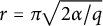 $r=\pi \sqrt {2\alpha /q}$
in [Reference Berndt, Dixit, Gupta and Zaharescu5, equation (9.6)].
Similarly, differentiating both sides of (14.2) with respect to
 $\alpha $
and simplifying, we arrive at
 $$ \begin{align*} \sum_{n=1}^{\infty}n\chi(n)e^{-\frac{\pi n\sqrt{2\alpha}}{\sqrt{q}}}=-\frac{i(2q)^{\frac{3}{2}}\sqrt{\alpha}\tau(\chi)}{\pi^2}\sum_{n=1}^{\infty}\frac{n\overline{\chi}(n)}{(2n^2+\alpha q)^2},\\[-9pt] \end{align*} $$
which also follows upon letting
 $\nu =-1/2$
and
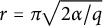 $r=\pi \sqrt {2\alpha /q}$
in [Reference Berndt, Dixit, Gupta and Zaharescu5, equation (9.3)].
15 A generalization of a theorem of Watson
The functional equation of the Riemann zeta function is given by [Reference Edwards13, p. 14]
 $$ \begin{align*} \pi^{-s/2}\Gamma(s/2)\zeta(s)=\pi^{-(1-s)/2}\Gamma((1-s)/2)\zeta(1-s).\\[-9pt] \end{align*} $$
Hence, replacing s by
 $2s$
, we see that it can be transformed into the form (1.2) with
 $\delta =1/2$
,
 $a(n)=b(n)=1$
, and
 $\lambda _n=\mu _n=n^2/2$
. Note that in (1.5),
 $$ \begin{align*} Q_0(x)=-\frac12+\sqrt{2x}.\\[-9pt] \end{align*} $$
Employing (12.2) with
 $x$
replaced by
 $\sqrt {x}$
, and then with
 $\nu $
replaced by
 $\nu +1$
, and letting
 $\lambda =0$
,
 $a=\pi \left (\sqrt {\alpha }+\sqrt {\beta }\right )$
, and
 $b=\pi \left (\sqrt {\alpha }-\sqrt {\beta }\right )$
, we find that Theorem 11.1 yields, for
 $\mathrm {Re}(\nu )>-1/2,$
 $$ \begin{align*} &\frac{1}{4(\nu+1)}\left( \frac{\sqrt{\alpha}-\sqrt{\beta}}{\sqrt{\alpha}+\sqrt{\beta}}\right)^{\nu+1}+\sum_{n=1}^{\infty}I_{\nu+1}\left(\frac{\pi n}{\sqrt2}\left(\sqrt{\alpha}-\sqrt{\beta}\right)\right)K_{\nu+1}\left(\frac{\pi n}{\sqrt2}\left(\sqrt{\alpha}+\sqrt{\beta}\right)\right)\nonumber\\ =&\frac{\Gamma(\nu+3/2)}{\sqrt{2\pi}\Gamma(\nu+2)} \frac{\left(\sqrt{\alpha}-\sqrt{\beta}\right)^{\nu+1}}{\left(\sqrt{\alpha}+\sqrt{\beta}\right)^{\nu+2}}\cdot {}_2F_{1}\left(\nu+3/2,1/2;\nu+2;\left( \frac{\sqrt{\alpha}-\sqrt{\beta}}{\sqrt{\alpha}+\sqrt{\beta}}\right)^{2} \right)\nonumber\\ &+\frac{\sqrt{2}\Gamma(\nu+3/2)}{\sqrt{\pi}\Gamma(\nu+2)} \sum_{n=1}^{\infty}\frac{\left(\sqrt{2n^2+\alpha} -\sqrt{2n^2+\beta}\right)^{\nu+1}}{\left(\sqrt{2n^2+\alpha}+\sqrt{2n^2+\beta}\right)^{\nu+2}}\nonumber\\ &\times{}_2F_{1}\left(\nu+3/2,1/2;\nu+2;\left(\frac{\sqrt{2n^2+\alpha}-\sqrt{2n^2+\beta}}{\sqrt{2n^2+\alpha}+\sqrt{2n^2+\beta}} \right)^{2} \right). \end{align*} $$
Replacing
 $\alpha $
by
 $2\alpha $
and
 $\beta $
by
 $2\beta $
, we find that
 $$ \begin{align} &\frac{1}{4(\nu+1)}\left( \frac{\sqrt{\alpha}-\sqrt{\beta}}{\sqrt{\alpha}+\sqrt{\beta}}\right)^{\nu+1}+\sum_{n=1}^{\infty}I_{\nu+1}\left(\pi n\left(\sqrt{\alpha}-\sqrt{\beta}\right)\right)K_{\nu+1}\left(\pi n\left(\sqrt{\alpha}+\sqrt{\beta}\right)\right)\nonumber\\ =&\frac{\Gamma(\nu+3/2)}{2\sqrt{2\pi}\Gamma(\nu+2)} \frac{\left(\sqrt{\alpha}-\sqrt{\beta}\right)^{\nu+1}}{\left(\sqrt{\alpha}+\sqrt{\beta}\right)^{\nu+2}}\cdot {}_2F_{1}\left(\nu+3/2,1/2;\nu+2;\left( \frac{\sqrt{\alpha}-\sqrt{\beta}}{\sqrt{\alpha}+\sqrt{\beta}}\right)^{2} \right)\nonumber\\ &+\frac{\Gamma(\nu+3/2)}{\sqrt{\pi}\Gamma(\nu+2)} \sum_{n=1}^{\infty}\frac{\left(\sqrt{n^2+\alpha} -\sqrt{n^2+\beta}\right)^{\nu+1}}{\left(\sqrt{n^2+\alpha}+\sqrt{n^2+\beta}\right)^{\nu+2}}\nonumber\\ &\qquad \times{}_2F_{1}\left(\nu+3/2,1/2;\nu+2;\left(\frac{\sqrt{n^2+\alpha}-\sqrt{n^2+\beta}}{\sqrt{n^2+\alpha}+\sqrt{n^2+\beta}} \right)^{2} \right). \end{align} $$
Dividing both sides by
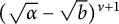 $(\sqrt {\alpha }-\sqrt {b})^{\nu +1}$
, letting
 $\alpha \to \beta $
, multiplying both sides of the resulting identity by
 $2(\nu +1)\Gamma (\nu +1)(2\sqrt {\beta })^{\nu +1}$
, replacing
 $\nu $
by
 $\nu -1$
and
 $\beta $
by
 $z^2/(4\pi ^2)$
, and rearranging, for
 $\mathrm {Re}(z)>0$
, we recover an important result of Watson [Reference Watson25, equation (4)]:
 $$ \begin{align*} \frac{1}{2}\Gamma(\nu)+2\sum_{n=1}^\infty \left(\frac{1}{2}nz\right)^\nu K_\nu(nz)&=\Gamma\left(\frac{1}{2}\right)\Gamma\left(\nu+\frac{1}{2}\right)\\&\quad \times z^{2\nu}\left\{\frac{1}{z^{2\nu+1}}+2 \sum_{n=1}^\infty \frac{1}{(z^2+4n^2\pi^2)^{\nu+\frac{1}{2}}}\right\}. \end{align*} $$
We now provide a generalization of yet another identity of Watson [Reference Watson25, equation (6)].
Corollary 15.1 Let
 $K(k)$
denote the complete elliptic integral of the first kind defined by
 $$ \begin{align} K(k):=\int_{0}^{\pi/2}\frac{d\theta}{\sqrt{1-k^2\sin^{2}(\theta)}},\qquad 0\leq |k| <1. \end{align} $$
For
 $\mathrm {Re}(\sqrt {\alpha })>\mathrm {Re}(\sqrt {\beta })>0$
,
 $$ \begin{align} &\sum_{n=1}^{\infty}I_{0}\left(\pi n\left(\sqrt{\alpha}-\sqrt{\beta}\right)\right)K_{0}\left(\pi n\left(\sqrt{\alpha}+\sqrt{\beta}\right)\right)\notag\\=&\frac{1}{\pi\left(\sqrt{\alpha}+\sqrt{\beta}\right)}K\left(\left( \frac{\sqrt{\alpha}-\sqrt{\beta}}{\sqrt{\alpha}+\sqrt{\beta}}\right)^{2}\right) +\frac{\gamma+\log\left(\sqrt{\ \alpha}+\sqrt{\beta} \right)-\log 4}{2}\notag\\&\qquad +\sum_{n=1}^{\infty}\left\{\frac{2}{\pi\left(\sqrt{n^2+\alpha}+\sqrt{n^2+\beta}\right)} K\left(\left( \frac{\sqrt{n^2+\alpha}-\sqrt{n^2+\beta}}{\sqrt{n^2+\alpha}+\sqrt{n^2+\beta}}\right)^{2}\right)-\frac{1}{2n}\right\}. \end{align} $$
Proof Corollary 15.1 follows by analytically continuing (15.1) to the region
 $\mathrm {Re}(\nu )>-3/2$
and then letting
 $\nu \to -1$
. Since the argument is similar to that given in Section 5 of [Reference Berndt, Dixit, Kim and Zaharescu6], we discuss it only briefly here.
Let
 $g(n)$
denote the
 $n{\text {th}}$
summand in the series on the right-hand side of (15.1). It is not difficult to show that, as
 $n\to \infty $
,
 $$ \begin{align*} g(n)\sim\frac{(\alpha-\beta)^{\nu+1}}{(2n)^{2\nu+3}}. \end{align*} $$
Therefore, for
 $\mathrm {Re}(\nu )>-1$
,
 $$ \begin{align*} \sum_{n=1}^{\infty}g(n)=\sum_{n=1}^{\infty}\left(g(n)-\frac{(\alpha-\beta)^{\nu+1}}{(2n)^{2\nu+3}}\right) +\frac{(\alpha-\beta)^{\nu+1}}{2^{2\nu+3}}\zeta(2\nu+3). \end{align*} $$
Substituting this in (15.1) and rearranging, we find that, for
 $\mathrm {Re}(\nu )>-1$
,
 $$ \begin{align} &\sum_{n=1}^{\infty}I_{\nu+1}\left(\pi n\left(\sqrt{\alpha}-\sqrt{\beta}\right)\right)K_{\nu+1}\left(\pi n\left(\sqrt{\alpha}+\sqrt{\beta}\right)\right)\nonumber\\&=\frac{\Gamma(\nu+3/2)}{2\sqrt{2\pi}\Gamma(\nu+2)} \frac{\left(\sqrt{\alpha}-\sqrt{\beta}\right)^{\nu+1}}{\left(\sqrt{\alpha}+\sqrt{\beta}\right)^{\nu+2}} {}_2F_{1}\left(\nu+3/2,1/2;\nu+2;\left( \frac{\sqrt{\alpha}-\sqrt{\beta}}{\sqrt{\alpha}+\sqrt{\beta}}\right)^{2} \right)\nonumber\\&\quad+\frac{\sqrt{2}\Gamma(\nu+3/2)}{\sqrt{\pi}\Gamma(\nu+2)} \sum_{n=1}^{\infty}\left(g(n)-\frac{(\alpha-\beta)^{\nu+1}}{(2n)^{2\nu+3}}\right)\nonumber\\&\quad+(\sqrt{\alpha}-\sqrt{\beta})^{\nu+1}\left(\frac{\Gamma(\nu+3/2)}{\sqrt{\pi}\Gamma(\nu+2)} \frac{(\sqrt{\alpha}+\sqrt{\beta})^{\nu+1}}{2^{2\nu+3}}\zeta(2\nu+3) -\frac{1}{4(\nu+1)\left(\sqrt{\alpha}+\sqrt{\beta}\right)^{\nu+1}}\right).\notag\\ \end{align} $$
Observe that both sides of (15.4) are analytic in Re
 $(\nu )>-2$
with a removable singularity at
 $\nu =-1$
, because
 $$ \begin{align} \lim_{\nu\to-1}\left(\frac{\Gamma(\nu+3/2)}{\sqrt{\pi}\Gamma(\nu+2)} \frac{(\sqrt{\alpha}+\sqrt{\beta})^{\nu+1}}{2^{2\nu+3}}\zeta(2\nu+3) -\frac{1}{4(\nu+1)\left(\sqrt{\alpha}+\sqrt{\beta}\right)^{\nu+1}}\right)\notag\\ =\frac{\gamma}{2}+\frac{1}{2}\log(\sqrt{\alpha}+\sqrt{\beta})-\log 2, \end{align} $$
which can be seen from expanding each side of (15.5) in Taylor series about
 $\nu =-1$
. Thus, letting
 $\nu \to -1$
on both sides of (15.4) and using (15.5), we arrive at (15.3), where we used the identity [Reference Gradshteyn and Ryzhik16, p. 908, Formula 8.113, no. 2]
 $$ \begin{align*} {_2F_1}\left(\frac12,\frac12;1;x^2\right)=\frac{2}{\pi}K(x), \end{align*} $$
where
 $K(x)$
is defined in (15.2).
As previously indicated, the identity (15.3) is a generalization of the following identity of Watson [Reference Watson25].
Corollary 15.2 For
 $\mathrm {Re}( \beta )>0$
,
 $$ \begin{align} 2\sum_{n=1}^{\infty}K_{0}(n\beta)=\pi\left\{\frac{1}{\beta} +2\sum_{n=1}^{\infty}\left(\frac{1}{\sqrt{\beta^2+4\pi^2n^2}} -\frac{1}{2n\pi}\right)\right\}+\gamma+\log\left(\frac{\beta}{2}\right)-\log 2\pi. \end{align} $$
Proof If we let
 $\alpha \to \beta $
in (15.3) and use the trivial facts
 $$ \begin{align*} \lim_{\alpha\to\beta^{+}}I_{0}(\pi(\sqrt{n\alpha}-\sqrt{n\beta}))K_{0}(\pi(\sqrt{n\alpha}+\sqrt{n\beta})) =K_{0}(2\pi\sqrt{n\beta}) \end{align*} $$
and
 $K(0)=\tfrac 12 \pi $
, we obtain (15.6).
Each of the identities (13.1), (14.1), and (14.3) can be analytically continued in the same manner as that for (15.1) for Corollary 15.1.
Letting
 $\nu =-1/2$
in (15.1), and using (2.3), (2.4), and (14.4), we obtain
 $$ \begin{align} &\frac{1}{2}\left(\frac{\sqrt{\alpha}-\sqrt{\beta}}{\sqrt{\alpha}+\sqrt{\beta}}\right)^{1/2} +\frac{\sqrt{2}}{\pi\sqrt{\alpha-\beta}}\sum_{n=1}^{\infty} \dfrac{e^{-\frac{\pi n}{\sqrt{2}}\left(\sqrt{\alpha}+\sqrt{\beta}\right)}}{n}\sinh\left(\frac{\pi n}{\sqrt2}\left(\sqrt{\alpha}-\sqrt{\beta}\right)\right)\nonumber\\ &=\frac{1}{2\sqrt{2}\pi\sqrt{\alpha-\beta}}\log\left( \frac{\alpha}{\beta}\right)+\frac{1}{\sqrt{2}\pi\sqrt{\alpha-\beta}}\sum_{n=1}^{\infty}\log\left(\frac{2n^2+\alpha}{2n^2+\beta}\right). \end{align} $$
A rearrangement of (15.7) leads to
 $$ \begin{align} \frac{\pi}{2}(\sqrt{\alpha}-\sqrt{\beta})+\sqrt2\sum_{n=1}^{\infty}\frac{e^{-\frac{\pi n}{\sqrt2}\left(\sqrt{\alpha}+\sqrt{\beta}\right)}}{n}\sinh\left(\frac{\pi n}{\sqrt2}\left(\sqrt{\alpha}-\sqrt{\beta}\right)\right)\notag\\=\frac{1}{2\sqrt{2}}\log\left( \frac{\alpha}{\beta}\right)+\frac{1}{\sqrt{2}}\sum_{n=1}^{\infty}\log\left(\frac{2n^2+\alpha}{2n^2+\beta}\right). \end{align} $$
Using the elementary Maclaurin series
 $$ \begin{align*} -\log(1-x)=\sum_{k=1}^{\infty}\dfrac{x^k}{k},\quad |x|<1, \end{align*} $$
in (15.8), we conclude that
 $$ \begin{align*} &\frac{\pi}{2}(\sqrt{\alpha}-\sqrt{\beta})+\frac{1}{\sqrt2}\log\left(\frac{1-e^{-\pi \sqrt{2\alpha}}}{1-e^{-\pi \sqrt{2\beta}}} \right)=\frac{1}{2\sqrt2}\log\left( \frac{\alpha}{\beta}\right)+\frac{1}{\sqrt{2}}\sum_{n=1}^{\infty}\log\left(\frac{2n^2+\alpha}{2n^2+\beta}\right). \end{align*} $$
Acknowledgment
The authors are very grateful to the referee for a thorough reading of their paper and for her/his accompanying suggestions, which improved the presentation in several instances.



