Whole plant form and function vary spectacularly across the seed plants. In recent years, plant evolutionary ecologists have begun to document this diversity on large geographic scales by analysing ‘functional traits’ that are indicative of whole plant performance across environmental gradients (Swenson & Enquist Reference SWENSON and ENQUIST2007, Wright et al. Reference WRIGHT, REICH, WESTOBY, ACKERLY, BARUCH, BONGERS, CAVENDER-BARES, CHAPIN, CORNELISSEN, DIEMER, FLEXAS, GARNIER, GROOM, GULIAS, HIKOSAKA, LAMONT, LEE, LEE, LUSK, MIDGLEY, NAVA, NIINEMETS, OLEKSYN, OSADA, POORTER, POOT, PRIOR, PYANKOV, ROUMET, THOMAS, TJOELKER, VENEKLAAS and VILLAR2004). Despite the high degree of functional diversity in tropical forests, convergence in function does occur locally along successional or light gradients (Bazzaz & Pickett Reference BAZZAZ and PICKETT1980, Swaine & Whitmore Reference SWAINE and WHITMORE1988).
The adaptive differentiation between light-demanding (LD) dicot tropical tree species versus shade-tolerant (ST) species has been well documented. For example, LD tree species generally have thin leaves that have higher rates of carbon assimilation per unit mass, short leaf life spans, low tissue water content, less dense stem tissue and higher mortality rates. Conversely, ST species tend to exhibit the exact opposite trait composition (reviewed in Bazzaz & Pickett Reference BAZZAZ and PICKETT1980, Swaine & Whitmore Reference SWAINE and WHITMORE1988). The trait strategies of LD species are therefore considered to be adaptations for colonization and rapid growth and primary forest species are assumed to be adapted to delay their emergence, growth and mortality. In sum, there appear to be pervasive adaptive strategies in whole plant form and function across light gradients in diocotyledonous trees in tropical rain forests (Bazzaz & Pickett Reference BAZZAZ and PICKETT1980, Swaine & Whitmore Reference SWAINE and WHITMORE1988).
Tropical herbaceous monocot species spanning similar light gradients, have received considerably less attention (Rundel et al. Reference RUNDEL, SHARIFI, GIBSON and ESLER1998). To date interspecific comparative analyses of tropical monocots focusing on leaf traits suggest that herbaceous monocots may have a gradient in leaf form and function along light gradients that is the opposite of that found in dicot trees (Cooley et al. Reference COOLEY, REICH and RUNDEL2004, Rundel et al. Reference RUNDEL, SHARIFI, GIBSON and ESLER1998). Unfortunately, these results arise from separate analyses of leaf traits from taxa spanning multiple plant orders and there exist few detailed comparative analyses of leaf and stem function across these gradients (Dominy et al. Reference DOMINY, GRUBB, JACSON, LUCAS, METCALFE, SVENNING and TURNER2008, Grubb & Jackson Reference GRUBB and JACKSON2007). The above studies have also generally not taken phylogenetic relatedness into account in their design and analyses (but see Dominy et al. Reference DOMINY, GRUBB, JACSON, LUCAS, METCALFE, SVENNING and TURNER2008). Therefore the strength of the adaptive inferences made from these studies is reduced (Felsenstein Reference FELSENSTEIN1985).
The present analyses are designed to quantify the degree of adaptive variation in stem and leaf function in tropical monocot congeneric species pairs along a light gradient in a lowland Costa Rican rain forest. The monocot order Zingiberales is an ideal group for such analyses. This is because species spanning multiple families in the order are known to occur only in high-light or low-light habitats (Cooley et al. Reference COOLEY, REICH and RUNDEL2004, Rundel et al. Reference RUNDEL, SHARIFI, GIBSON and ESLER1998, Stiles Reference STILES1975). The present study was designed to include one species in each congeneric pair representing a LD species and the other species representing a ST species. Here four congeneric species pairs are used to ask the central question of: do LD and ST tropical herbaceous monocots display similar adaptations in form and function as those documented for tropical LD and ST dicot tree species?
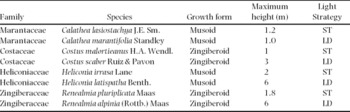
The present study was conducted at La Selva Biological Station, Costa Rica (10°28′N, 83°59′W). Annual rainfall at La Selva averages 4 m. Four congeneric species pairs from four separate families in the order Zingiberales were utilized for this study. The eight species used represent the families Costaceae, Heliconiaceae, Marantaceae and Zingiberaceae and were chosen because they were in abundance, identifiable to species in the field based on reproductive morphology, and one of the species in each congeneric pair is known to be a LD species and the other is a ST species (Cooley et al. Reference COOLEY, REICH and RUNDEL2004, Rundel et al. Reference RUNDEL, SHARIFI, GIBSON and ESLER1998, Stiles Reference STILES1975, Table 1).
The eight species used for the study, their growth form, maximum height and light habitat type they generally inhabit in the La Selva Reserve. Height values were recorded from Maas (Reference MAAS1972, Reference MAAS1977), Berry & Kress (Reference BERRY and KRESS1991) and field measurement for Calathea.

In this study five plant functional traits were selected that are often cited as representing fundamental functional trade-offs. Specifically, this study quantified lamina area, specific leaf area, lamina succulence, culm tissue density and culm succulence. Lamina area was used to represent a trade-off between laminar area deployed for light capture and increased lamina temperatures (Dolph & Dilcher Reference DOLPH and DILCHER1980). Specific leaf area (SLA: ratio of leaf area to dry leaf mass) represented a trade-off between low construction costs, high photosynthetic rates and short leaf life spans (Wright et al. Reference WRIGHT, REICH, WESTOBY, ACKERLY, BARUCH, BONGERS, CAVENDER-BARES, CHAPIN, CORNELISSEN, DIEMER, FLEXAS, GARNIER, GROOM, GULIAS, HIKOSAKA, LAMONT, LEE, LEE, LUSK, MIDGLEY, NAVA, NIINEMETS, OLEKSYN, OSADA, POORTER, POOT, PRIOR, PYANKOV, ROUMET, THOMAS, TJOELKER, VENEKLAAS and VILLAR2004). Lamina and culm succulence represented a trade-off between long persistence and low productivity (Garnier & Laurent Reference GARNIER and LAURENT1994). Culm tissue density represented a trade-off between construction cost and biomechanical strength (Swenson & Enquist Reference SWENSON and ENQUIST2007, Reference SWENSON and ENQUIST2008).
Leaves were collected from 15 adult individuals of each species. As some of the species studied often grow in clonal groups, collections were taken from individual culms at least 50 m apart to reduce the likelihood of collecting multiple samples from a single genetic individual. Upon returning to the laboratory the wet mass was recorded for each lamina using an analytical balance and the area of each lamina was recorded. The laminae were then placed in a drying oven at 60 °C until a consistent weight was achieved. The dry mass of each lamina used to calculate the SLA and lamina succulence (LS; mass of water per unit leaf area).
Basal sections of the functionally analogous musoid petioles and zingiberoid main stems (Cooley et al. Reference COOLEY, REICH and RUNDEL2004), collectively referred to as culms, were collected from 15 adult individuals in the field for analyses of tissue water content and density. Upon returning from the field, the fresh volume of each section of culm was quantified using a water displacement method. The sections were then placed in a 60 °C drying oven until a consistent weight was achieved. The density of each culm was then quantified as dry mass divided by fresh volume. Culm succulence was quantified as mass of water per unit volume.
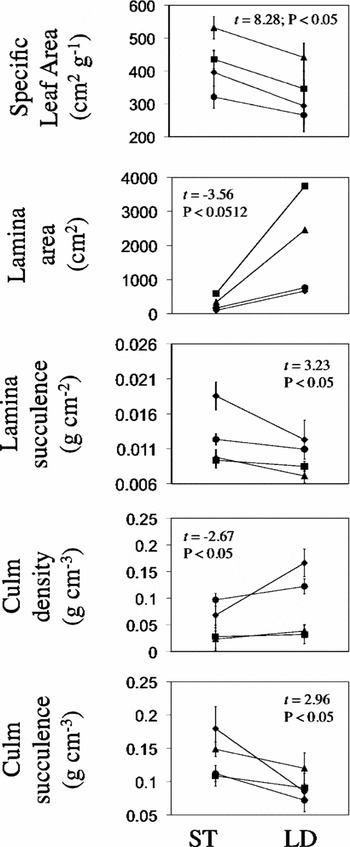
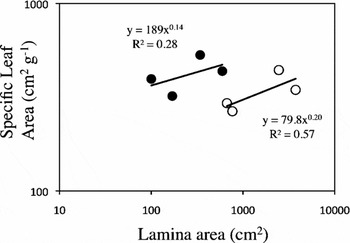
The following three leaf traits: specific leaf area (SLA), lamina area (LA) and lamina succulence (LS) were quantified for 15 individuals of each species in this study. For each species pair, the ST species had a higher SLA than the congeneric LD species (Figure 1). The ST species had lower LA values when compared with their congeneric LD counterparts (Figure 1). Thus, LD forest species have larger laminae with higher SLA. Similar to the monocot patterns shown here, dicot species are known to show an increase in SLA with lamina area (Shipley Reference SHIPLEY1995). Interestingly, when SLA was regressed onto LA the regression line for the ST species had a higher intercept as compared with the regression line for the LD species (Figure 2). This predicts that for two tropical herbaceous monocots, one ST and one LD, of equal lamina areas the ST species should allocate less mass per leaf. This prediction stands in opposition to what has been reported in dicot species (Shipley Reference SHIPLEY1995). This prediction could not be directly studied with the species used as all LD species had significantly larger lamina areas than their ST congeners.
The difference in mean value of the five functional traits in the ST versus LD species each of the four congeneric species pairs. Diamonds represent the two species of Costus; circles represent the two species of Renealmia; triangles represent the two species of Calathea; and squares represent the two species of Heliconia.

The relationship between SLA and lamina area in LD (white) and ST (black) species.

The LD species were found to have lower leaf succulence (LS) than their congeneric ST counterparts (Figure 1). The LS of a plant is equal to the amount of water per unit leaf area and it reflects the amount of structural tissue present in a given area of leaf. Thus, LD species with lower LS allocate a greater amount of carbon per unit leaf area as shown in the SLA results.
Two culm traits, culm density (CD) and culm succulence (CS), were selected for analysis and were quantified for 15 individuals from each of the eight study species. The CD of a plant was quantified as the amount of culm dry mass per unit volume and is indicative of carbon investment, structural stiffness and biomechanical strength. The LD species were found to have higher CD than the ST species (Figure 2). Similarly, the LD species also had lower CS values (Figure 1). Both traits reflect the level of carbon allocation to the culm, which allows for variation in biomechanical strength. Given this information it is also important to note that the LD species in this study generally have greater asymptotic heights than the ST species (Table 1).
This study asked whether fundamental functional trade-offs displayed in tropical dicot tree species along light habitat gradients are also detectable in tropical monocot herbaceous species in the order Zingiberales. In particular, tropical dicot tree species in high-light habitats tend to invest less carbon per unit area (leaves) or volume (stems), and they tend to have high growth and mortality rates. Conversely, tree species in low-light habitat forests often have a higher structural investment and slower growth and mortality rates (Bazzaz & Pickett Reference BAZZAZ and PICKETT1980, Swaine & Whitmore Reference SWAINE and WHITMORE1988). The present study investigated whether these same strategies were found within leaves and stems of tropical rain-forest monocots.
On the leaf level all LD species were found to have a higher carbon investment per unit area than their ST congener (Figures 1 and 2). Specifically, LD species have lower specific leaf areas (SLA) and lower leaf succulence. Further, LD species had significantly larger leaves. The general pattern of higher structural investment in LD species was also found in culm traits. Specifically, LD species had higher culm tissue densities and lower culm succulence values.
The increased allocation of tissue per unit area (SLA) or volume (CD) found in this study stand in opposition to the general trends found in tropical dicot trees along light gradients. There are several potential adaptive explanations for the observed reversal of monocot trait strategies along a light gradient of which I will discuss only one. Specifically, ST species are more likely to experience damage due to falling debris as compared to LD species (Cooley et al. Reference COOLEY, REICH and RUNDEL2004). Falling debris from large trees is likely to be catastrophic to any understorey plant, but particularly to species that are herbaceous. In herbaceous understorey plants there would be no reason to have denser tissue to prevent against physical damage as even the densest non-woody tissue would be destroyed by falling branches. Thus ST species may produce cheap culm tissue in order to reduce the losses in the likely event of falling debris. As a result of constructing cheaper and weaker culms, ST species can only support a smaller amount of leaf biomass than their LD counterparts. This leaf biomass should then be optimally expanded for resource capture per unit tissue density and length of culm (i.e. biomechanical strength).
The above comparative research was designed to determine whether tropical monocot herbaceous species have analogous trends in form and function along light gradients as those found in tropical dicot trees. The results show that monocots do not always follow the same trends as dicots. Here, it is argued that this trend is largely due to biomechanical constraints, but further investigations that quantify the variation in these trait values within genera would prove useful (Dominy et al. Reference DOMINY, GRUBB, JACSON, LUCAS, METCALFE, SVENNING and TURNER2008). Lastly, the work generally argues for further investigations into tropical monocot community functional diversity (Dominy et al. Reference DOMINY, GRUBB, JACSON, LUCAS, METCALFE, SVENNING and TURNER2008, Grubb & Jackson Reference GRUBB and JACKSON2007), as there appear to be novel mechanisms promoting their functional diversity and productivity.
ACKNOWLEDGEMENTS
This work was funded by the Rexford Daubenmire Fellowship awarded by the Organization for Tropical Studies (OTS). The manuscript benefited from critical comments from reviewers.