Catecholaminergic polymorphic ventricular tachycardia is a rare arrhythmogenic disorder. It is characterised by bidirectional or polymorphic ventricular arrhythmias, triggered by physical or emotional stress. Structural abnormalities of the heart are typically not present and the QT interval is not prolonged.Reference Leenhardt, Lucet, Denjoy, Grau, Ngoc and Coumel 1 , Reference Sumitomo, Harada and Nagashima 2 The autosomal dominant entity of the disease is caused by mutations in the cardiac ryanodine receptor type 2 gene.Reference Priori, Napolitano and Tiso 3 Cardiac events such as syncope, aborted cardiac arrest or sudden cardiac death are frequently observed in patients with catecholaminergic polymorphic ventricular tachycardia, especially when the diagnosis is made at a young age.Reference Hayashi, Denjoy and Extramiana 4
We report an unusual case of the disease in a girl who first presented with complex atrial tachycardia. Malignant ventricular arrhythmias were observed later in the course of the disease. In this girl, a mutation of the ryanodine receptor type 2 gene, which has not been described so far, was discovered.
Case report
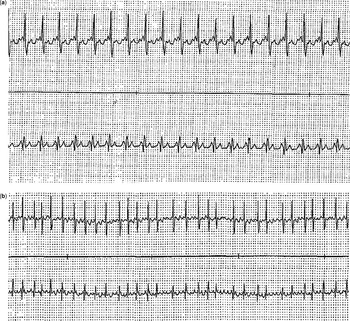
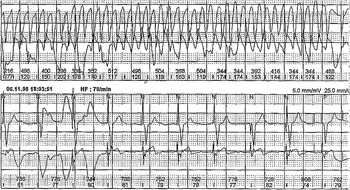
Our patient presented with supraventricular tachycardia at the age of 5 years. The tachycardia occurred during surgery of an inguinal hernia; the initial heart rate was 210 bpm. The child was transferred to the Department for Pediatric Cardiology. Both 12-lead ECG and transoesophageal ECG showed atypical atrial flutter with an atrial rate of about 400 bpm and 2:1 to 4:1 AV conduction. Transoesophageal overdrive pacing was not successful, but during the procedure spontaneous conversion to sinus rhythm with a heart rate of 140 bpm occurred. Repeated Holter-ECGs showed almost incessant tachycardia with atrial fibrillation, atrial flutter (Fig 1) and multifocal atrial tachycardia, but also short episodes of sinus bradycardia with atrial standstill longer than 2 seconds. No ventricular arrhythmias were registered. Echocardiography revealed signs of tachymyopathy with reduced systolic function of an enlarged left ventricle. Different antiarrhythmic drugs including digoxin, propranolol and propafenone did not control the tachycardia, but caused aggravation of bradycardia and sinus arrests. Therefore, before a more aggressive antiarrhythmic drug therapy with amiodarone and digoxin, the patient received a single-chamber pacemaker. Under combined antiarrhythmic medication, sustained supraventricular tachycardias were no longer observed, but the patient presented with two episodes of syncope 2 months later. A Holter-ECG revealed an episode of torsade-de-pointes tachycardia. This was interpreted as the proarrhythmic effect of amiodarone, and thus treatment with this drug was terminated. A treatment with verapamil, digoxin and propranolol was begun. This, however, resulted in a recurrence of the atrial arrhythmias. The echocardiography again revealed signs of tachymyopathy. Therefore, an electrophysiological study was performed under general anaesthesia, targeting the atrial arrhythmias. During this examination, no sustained atrial arrhythmia could be induced by programmed stimulation, not even after isoprenalin provocation. Owing to the fact that atrial flutter had been documented by Holter-ECG, ablation of the cavotricuspidal isthmus was performed without a positive effect on the recurrence of other atrial arrhythmias. In a second electrophysiological study, which was performed under sedation, multifocal atrial tachycardia with an origin in the left atrium was seen. Catheter ablation was focused on three dominant endocardial breakout sites. After this, many different atrial breakout sites were seen distant from the targeted regions. Further treatment with verapamil, digoxin and propranolol finally resulted in a satisfactory heart rate control. About 1 year later, the girl collapsed, and cardiopulmonary resuscitation was necessary because of ventricular fibrillation. Owing to the fact that rapid conduction of atrial fibrillation to the ventricles with ventricular destabilisation was suspected to be the cause of cardiac arrest, RF ablation of the AV junction was performed, and antiarrhythmic therapy was terminated. However, a few weeks later the girl had to be resuscitated again twice, and polymorphic ventricular tachycardias could be documented during Holter monitoring (Fig 2). During exercise testing, typical bidirectional ventricular extrasystoles could be provoked for the first time. Treatment with propranolol was begun again, as now catecholaminergic polymorphic ventricular tachycardia was suspected. The implantation of an ICD was recommended, but the mother did not consent to the operation. With propranolol doses of 4–5 mg/kg/day, no malignant ventricular arrhythmias were observed during 10 years of follow-up.
Initial Holter-ECG. ( a ) Atypical atrial flutter with 2:1 conduction and a heart rate of 200 bpm, ( b ) atrial fibrillation with irregular conduction.

Ventricular tachycardia, terminating spontaneously, in a Holter-ECG short after second cardiopulmonary resuscitation.

There was no family history of syncope or sudden cardiac death.
Molecular genetic testing revealed a mutation in the ryanodine receptor type 2 receptor gene, leading to the diagnosis of catecholaminergic polymorphic ventricular tachycardia. The mutation discovered in this girl has not been described before. It is characterised by the substitution of alanine by threonine in position 4091 of the gene encoding ryanodine receptor type 2. Molecular genetic testing of the mother did not show a mutation of the ryanodine receptor type 2 receptor gene; the father refused to be tested. Other relatives could not be tested.
Discussion
Catecholaminergic polymorphic ventricular tachycardia is an inherited arrhythmogenic disorder that most frequently presents with syncope, aborted cardiac arrest, or dizziness and palpitations during exercise or emotional stress.Reference Leenhardt, Lucet, Denjoy, Grau, Ngoc and Coumel 1 , Reference Hayashi, Denjoy and Extramiana 4 In some patients, an association with atrial flutter, atrial fibrillation and sinus node dysfunction has been described,Reference Postma, Denjoy and Kamblock 5 – Reference Kazemian, Gollob, Pantano and Oudit 8 but in all reported cases the dominant and primary manifestation of the disease was complex ventricular arrhythmias.
The case presented here is to our knowledge the first report on a patient with catecholaminergic polymorphic ventricular tachycardia, who presented with complex atrial tachycardia and sinus node dysfunction before manifestation of typical ventricular arrhythmias. This is associated with a new mutation of the ryanodine receptor type 2 gene.
The pathogenetic mechanism of catecholaminergic polymorphic ventricular tachycardia is a dysfunction of the ryanodine receptor type 2.Reference Priori, Napolitano and Tiso 3 This receptor is responsible for the Ca2+-induced Ca2+ release from the sarcoplasmic reticulum, leading to muscle contraction. Gene mutations in the ryanodine receptor type 2 gene lead to Ca2+ overload in myocardial cells by increasing the Ca2+-induced Ca2+ release, probably by reducing the threshold for spontaneous Ca2+ release from the sarcoplasmic reticulum.Reference Jiang, Xiao and Yang 9 With additional sympathetic stimulation, this is hypothesised to induce delayed afterdepolarisation, triggered activity and consequent malignant ventricular arrhythmias.
It is not surprising that mutations of this receptor can cause both atrial and ventricular arrhythmias, as ryanodine receptor type 2 is present in atrial and ventricular myocardium.Reference Postma, Denjoy and Kamblock 5 – Reference Kazemian, Gollob, Pantano and Oudit 8 Further, defective ryanodine receptor type 2 regulation has been shown to play a role in the initiation and maintenance of atrial fibrillation.Reference Vest, Xander and Wehrens 10
It remains unclear why in our patient the disease first presented with atrial arrhythmia, whereas in all other reported cases the primary manifestation was ventricular arrhythmias, with atrial arrhythmias presenting only occasionally.
The case report warrants caution with the management of young patients presenting with unusual and complex atrial arrhythmias, as they can be the first electrophysiological sign of a life-threatening cardiac disease.
Acknowledgements
The authors wish to thank Dr. Hebe, Bremen, and Prof. Paul, Göttingen, for constructive discussions on this case, and Dr. Klein and Dr. Rost, Martinsried, for performing the moleculargenetic testing.