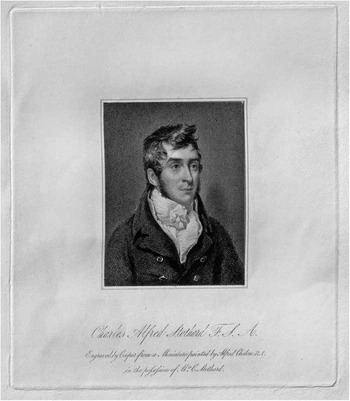
The Monumental Effigies of Great Britain by Charles Alfred Stothard, FSA (1786–1821) (fig 1), published posthumously as a book in 1832, is now widely acknowledged to be the finest example of its specialized – and once very important – historicist genre, and to contain plates of unprecedented accuracy and beauty.Footnote 1 The etchings of medieval tomb effigies, brasses and ‘weepers’ are gathered together in a systematically organized visual survey whose fidelity to the objects depicted seemed, to Stothard's contemporaries, to be guaranteed by the artist's supremely knowledgeable and accurate draughtsmanship.Footnote 2 The ‘bird's-eye’ and profile viewpoints which he almost invariably adopted, his careful selection and presentation of details, and the expert hand-colouring of some particulars – for example, unusual components of costume or armour and extant remnants of original polychromy – or small-scale reconstructions of the effigies’ painted appearances (or, rarely, whole compositions), endow Stothard's etchings with an enduring value as beautiful, but also ‘archaeologically accurate’, records.Footnote 3 In fact, two centuries after he began work, medieval art historians still frequently employ etchings from the Monumental Effigies as illustrations when they discuss the original works he portrayed.Footnote 4 Historians of late eighteenth- and early nineteenth-century art, on the other hand, have instead deployed the book as a key example of that period's new emphasis on structured series of images; or they have focused on situating the Monumental Effigies in the historical context within which it was produced, eschewing visual analysis of individual plates.Footnote 5 Surprisingly little attention, however, has been paid to the actual facture of the Monumental Effigies or to the many difficulties which delayed the book's completion for more than a decade after the artist's death, and which had a profound impact on its final form.Footnote 6 The reasons why his widow, (Anna) Eliza (1790–1883), was forced to employ several different artists to etch twenty-seven of the book's plates from Stothard's drawings have never been examined but this compelling story can be uncovered when the precise chronology of the book's completion is reconstructed.Footnote 7
Portrait of Charles Alfred Stothard, FSA, engraved by Robert Cooper from a miniature by Alfred Chalon, RA, in the Monumental Effigies. Photograph: Society of Antiquaries of London

This paper will distinguish Stothard's own contributions from those of his successors in the book as it was finally published. In identifying the specific characteristics of Stothard's greatest etchings, we must first analyse some of the influences that shaped his approach. Only then shall we be in a position to compare his prints with those of the artists who etched – or planned to etch – the prints of the Monumental Effigies from his drawings, after Charles's fatal accident. In order to resituate his work in the period within which it was produced and had its first reception, we shall also recover the criteria used by some contemporaries to discriminate between Stothard's etchings and the prints published by his predecessors and immediate successors.Footnote 8 Contemporary reviewers explicitly praised the technical virtuosity of Stothard's prints and – as he himself did – favourably contrasted their accuracy to the objects depicted with the inaccuracies and technical inadequacies evident in the prints published by his predecessors. The fidelity of Stothard's etchings to his superb scale drawings and watercolours (today housed in the British Museum) was also noted.Footnote 9 Critics also subtly discriminated between Stothard's own etchings and those of the other artists who produced prints from his drawings for the Monumental Effigies after the artist's death.
Stothard's Etching Technique
Before we can analyse what contemporaries perceived to be the distinctive merits of Stothard's etchings, we have first to recognize that his prints are not themselves stylistically homogeneous. The artist made considerable stylistic and technical progress during his work on the Monumental Effigies. No modern commentator has, though, analysed the substantial differences between Stothard's earliest and his latest prints, perhaps because the artist's increasing mastery of his medium can only be properly grasped when the very complicated history of the book's construction is first unravelled.
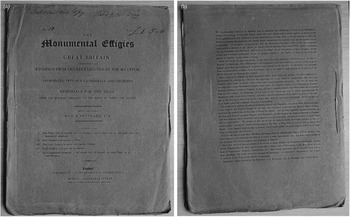
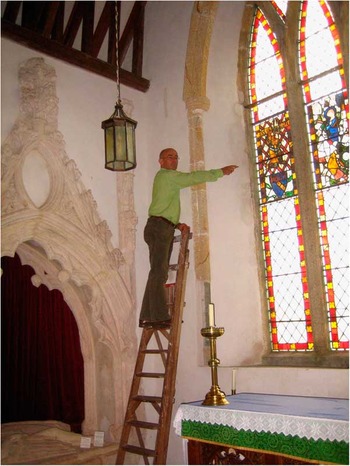
The Monumental Effigies was issued to approximately seventy subscribers in separate ‘numbers’, at £1 for the small paper (quarto) and £1 8s for the large (folio) versions from June 1811. Each published number, or part, would contain twelve etchings, loosely stitched into a blue-grey paper folder (figs 2a and 2b). The whole work was planned to comprise a dozen such numbers, one to be issued every four months.Footnote 10 There would also be a substantial textual component, but this would only be supplied with the twelfth and final number. This letter-press would comprise a general introduction to the subject of monumental effigial sculpture in Britain, and a separate text to accompany each etching. The latter text would, Stothard indicated, ‘give an account of the Person to whose Memory the Monument was erected, remarks on the Costume wherever they may be made with certainty, and a Description of the Monument as to its state of Preservation, Situation, Architecture &c.’.Footnote 11 Instructions that would be issued to the book-binder at the end of the project would enable him to organize the etchings by the approximate date assigned to the effigy and to collate the texts to accompany and introduce them. However, the artist was lagging seriously behind his original schedule, which projected the issue of three numbers a year, when he died unexpectedly after falling from a ladder in the church at Bere Ferrers, Devon, on 28 May 1821(fig 3).Footnote 12 His work had, it is true, been interrupted by other important commissions – most notably his three campaigns to depict the entire Bayeux Tapestry for the Society of Antiquaries, and work such as that on which he was engaged at the time of his death, tracing stained glass for illustration in the Devon volume for the brothers Samuel (1763–1819) and Daniel Lysons's (1762–1834) Magna Britannia series of illustrated county histories.Footnote 13 Still, at the time of his accident, he had not yet completed the etchings for the tenth number of the Monumental Effigies, and he had only composed a small portion of the letter-press, despite having been at work on the project for a decade.
(a) Front face of folder in which a set of a dozen etchings of the Monumental Effigies was issued. This is issue number 10 and it shows the price increase to £1 5s 0d, which Eliza Stothard was constrained to make. (b) The rear of the folder; sets of a dozen etchings were issued in each folder. Photographs: West Country Studies Library, Exeter

The author points to the east window embrasure in the chancel of Bere Ferrers church, Devon, where the ladder Charles Stothard had borrowed from a local gardener was placed. Stothard was tracing the northernmost panel of the stained glass when he fell to his death. Photograph: M Hale

There are two reasons why the major differences between Stothard's early and his late etchings are not immediately evident in the book as it was finally published. The first reason is that the plates are not bound in the sequence in which Stothard actually issued his sets of prints but in (what was thought to be) the chronological order the effigies he depicted were made.Footnote 14 This reordering was, as we have seen, Stothard's plan from the outset. The second reason, however, is one which he could never have envisaged: after his sudden and unexpected death, four other artists, between them, etched the remaining twenty-seven prints from his drawings and, because of the book's chronological rationale, their work is interspersed in the book with his own.Footnote 15 The result is that the modern reader or viewer initially registers only the visual heterogeneity of the etchings in the book, if, indeed, he or she even discerns the variations in style at all. By contrast, the progress in Stothard's etching technique (and, hence, also, the different characteristics of his successors’ work) would have been immediately evident to his subscribers, who received the prints in the order in which they were published, a dozen at a time.Footnote 16 Indeed, Stothard's stylistic and technical progress (the two are directly linked here) was explicitly noticed in the review of the book in the Gentleman's Magazine for 1832: ‘the first numbers of his publication were greatly exceeded in style of execution by those which followed’.Footnote 17 Today, then, we must first ascertain the order in which the plates were actually etched and issued, before we can grasp the nature of Stothard's decade-long stylistic and technical development.
Stothard never attempted to publish his etchings in the chronological sequence of the effigies they represented. Even had he wished to, he could not have done so, not least because he only possessed a tentative and provisional list of the sculptures and brasses to be illustrated at the beginning of his project.Footnote 18 He knew that his work would require a great deal of first-hand investigation and research. Writing to a friend in January 1812, just after he had issued the second number, he clarified his thinking about the chronological scope of the Monumental Effigies, and also revealed how far the whole project was experimental and iterative in nature:
I proposed in the Prospectus of my work giving Monumental Effigies from the time of the Conquest to the reign of Henry 8th. The reason I did it was this, I had (and still have) the hope of finding specimens nearly as old. I have made enquiries of different persons, who have told me that there were no specimens older than the reign of King John. They in general had no other reason than that Mr. Gough had not given any older.Footnote 19 I considered this as no authority nor could I find any reason why there should not be any remaining. Has any person been at the pains to visit remote churches and if so were they fit judges of the ages of such relics? I may be too sanguine in my expectations. Even should I fail, the research may bring interesting subjects to light.Footnote 20
To prosecute this research, Stothard visited separate geographical regions, frequently walking enormous distances in the course of his tours, to see and draw prospective subjects. At first, the plates were issued in an order closely reflecting these journeys, but this changed in later numbers as he built up a stock of drawings, and sometimes etched effigies he had drawn years before. So, we must recover the sequence in which he actually etched and issued his prints for the Monumental Effigies. In default of a complete series still in their original wrappers, this can be reconstructed from the dates on the plates, which ostensibly record when they were drawn and etched as well as when they were published (although the information has to be treated carefully because these dates are sometimes wrong);Footnote 21 from the (occasionally unreliable) information about their publication order given at the back of the 1832 edition of the book;Footnote 22 from a few numbers that survive still bound into their original paper wrappers;Footnote 23 and from letters and observations in the Memoirs of her late husband, published by Eliza in 1823, or preserved elsewhere.Footnote 24
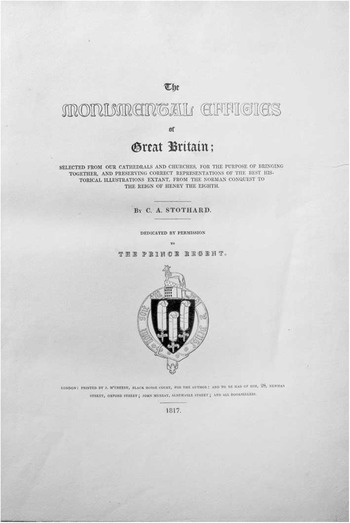
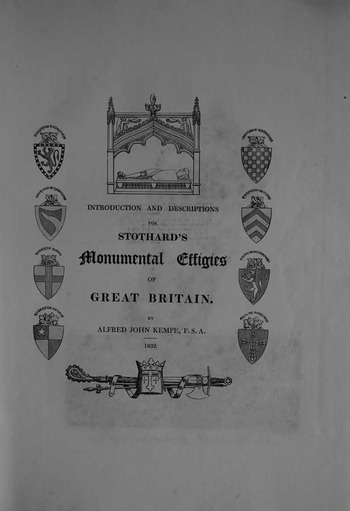
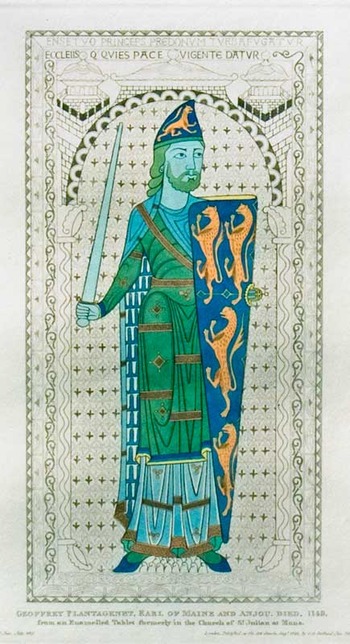
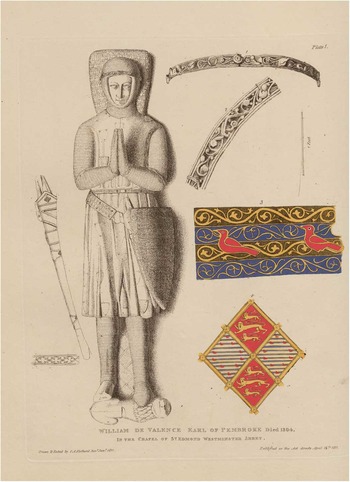
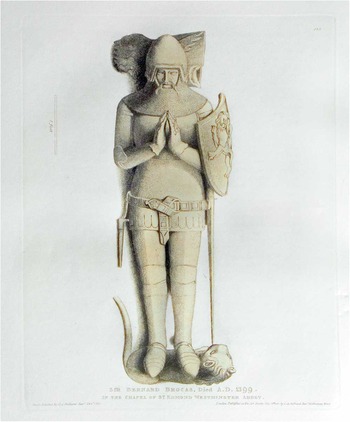
By the time of his fatal accident in May 1821, Stothard had issued nine numbers, each containing twelve plates, and he had etched nine of the dozen plates of the tenth part.Footnote 25 His young widow, writing later that year, undertook to have the remaining two numbers completed from his original drawings and the text written up from his manuscript notes.Footnote 26 She had by then already published the ‘Plantagenet tablet’, fully coloured (fig 4), and the bird's-eye ‘Royal Effigies at Fontevraud in France’, also fully hand-painted, as separate plates.Footnote 27 Charles had rediscovered the royal effigies at Fontevraud in 1816, where they were languishing in a cellar. When the Prince Regent saw Stothard's drawings, he ‘expressed his desire for their publication, and [also] granted his permission to allow Charles to dedicate his work, “The Monumental Effigies”, to himself’.Footnote 28 It was to celebrate this important royal endorsement that Stothard included a title page, with its dedication of the Monumental Effigies to the Prince Regent, in the eighth number he issued, probably in February 1818.Footnote 29 This title page bears the date 1817 (fig 5), and its inclusion in the book has caused later scholars considerable confusion because, as already stated, the completed book was actually only published in 1832.Footnote 30 The latter is the date on the second title page, which was issued with the introduction and descriptions (largely) composed by Stothard's friend and brother-in-law, Alfred John Kempe, FSA (c 1785–1846), in the final number of the Monumental Effigies (fig 6).Footnote 31 Stothard had etched both the ‘Plantagenet tablet’ and Fontevraud plates before his death and had initially hoped to include fully painted versions in the Monumental Effigies, before trial paintings revealed it would be financially impossible. He estimated that the gold alone on each Fontevraud plate cost more than 4s and the complexity of the painting meant each print took his colourist three days.Footnote 32 As a result, the plate would cost more than a dozen ordinary etchings in a number of the Monumental Effigies. So, before his death, Stothard had already decided to issue these plates, fully coloured, separately (although the ‘Plantagenet tablet’ would be included in the Monumental Effigies, in a version in which only the figure was painted) (fig 7). The newly crowned George iv, when expressing his condolences to Stothard's widow, gave evidence of his continuing interest in the artist's work when he desired that she dedicate the fully coloured Plantagenet (fig 4) and Fontevraud plates to himself.Footnote 33 This would have gratified Stothard, who had taken considerable pains to establish his name as a great antiquarian artist. Writing to the publisher William Stevenson in 1815, he had said: ‘I hope I may be remunerated in the end, and acquire reputation, which last may enable me to stretch my wings for future projects’.Footnote 34 After his election as a Fellow of the Society of Antiquaries in 1819 he usually added FSA or FAS after his name on his etchings. In fact, right from the start of his career, Stothard had taken every precaution to enhance and protect his reputation. He even re-etched four drawings because he was dissatisfied with the first ones and circulated the new etchings gratis to his subscribers: these were the two plates (plates 44 and 45 according to the 1832 book's numbering of the plates) of William de Valence (fig 8), both from issue number I; one of the Black Prince (85) from part no. II, and one (98), surprisingly, from set number VI. Stothard went so far as to withdraw his two plates of the effigy of Sir Bernard Brocas (exec. 1400) issued in No. I (fig 9), because he subsequently doubted the authenticity of the effigy (thus reducing the number of plates in the book to 142 from 144, excluding the two plates found in the introduction).Footnote 35
The ‘Plantagenet tablet’, published fully painted, by Eliza Stothard, after her husband's death. Photograph: Society of Antiquaries of London

First title page of the Monumental Effigies, showing the 1817 date. Photograph: Society of Antiquaries of London

Second title page, of 1832, which marks the date of the book's completion and publication. Photograph: Society of Antiquaries of London

The ‘Plantagenet tablet’, partly painted, for publication in the Monumental Effigies. Photograph: Society of Antiquaries of London

Cancelled plate of the effigy of William de Valence from the Monumental Effigies. Photograph: Society of Antiquaries of London

Cancelled plate of the effigy of Sir Bernard Brocas from the Monumental Effigies. Photograph: Society of Antiquaries of London

A total of four of the dozen etchings in the first number published by Stothard were therefore rejected or re-etched. All twelve prints published in this first issue were of effigies from the Temple church or Westminster Abbey:
(26–27): William Mareschal, Temple church;Footnote 36
(38): Robert Ros, Temple church;
(44–45): William de Valence, Earl of Pembroke, d. 1296, Westminster Abbey;Footnote 37
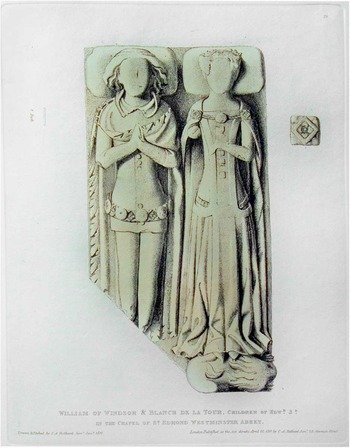
(79–81): William of Windsor and Blanch of the Tower, Westminster Abbey (fig 10);
Effigies of William of Windsor and Blanch of the Tower from the Monumental Effigies. Photograph: Society of Antiquaries of London

(117–118): Philippa, Duchess of York, d. 1423, Westminster Abbey;
(subsequently cancelled): two of Sir Bernard Brocas, Westminster Abbey.Footnote 38
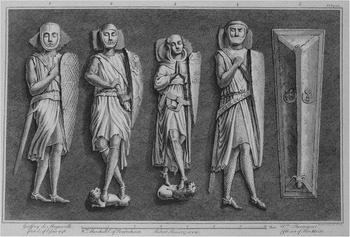
The style of these first etchings constitutes a considerable advance over many of the engravings found in the massive volumes of Richard Gough's Sepulchral Monuments in Great Britain, the only British precedent for Stothard's Monumental Effigies.Footnote 39 The first volume of Gough's work had been published in 1786, the second in 1796 and an introduction in 1799. Together, they covered the development of sepulchral monuments from the eleventh to the fifteenth centuries; a third volume, intended to deal with the sixteenth century, was never completed.Footnote 40 Stothard was profoundly critical of Gough's plates (fig 11), engraved by Basire and others, which occasionally simplified or falsified the drawings, supplied by such artists as John Carter (who also contributed engravings after his own drawings).Footnote 41 The qualitative variation in the engravings was certainly very considerable and, unsurprisingly, Stothard denigrated the inaccuracies in his predecessor's work, rather than commending the many great achievements: ‘the delineating part is so extremely incorrect, and full of errors,’ he wrote, ‘that at a future period, when the originals no longer exist, it will be impossible to form any correct idea of what they really were’.Footnote 42
Temple church effigies, drawn and engraved by Basire for Richard Gough's Sepulchral Monuments. Photograph: author

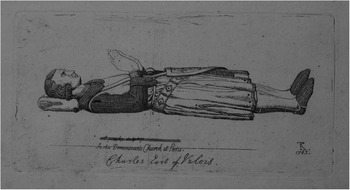
Charles was probably taught etching by his father, the celebrated artist Thomas Stothard, RA (1755–1834), who had first suggested monumental effigies as a worthy object of study to his son as early as 1802. In a letter of August 1811, Charles refers to an etching by his father of John of Eltham's effigy in Westminster Abbey, and this suggests both Thomas's enduring personal interest in the subject of monumental effigies and hints that he may have offered his son technical assistance and advice.Footnote 43 Right at the end of his life, Charles was still keeping papers at his father's house at 28 Newman Street; he also stored brass rubbings there, testifying that their close relationship continued even after his marriage to Eliza, when he moved into her parents’ house.Footnote 44 Thomas's direct involvement in his son's project is proved by his supplying the drawing from which Charles etched the superb print which was to serve as the frontispiece to the Monumental Effigies (fig 12). What is slightly unexpected, however, is that the etchings of French medieval monuments (fig 13), by the Revd Thomas Kerrich, FSA (1748–1828), the university librarian at Cambridge, were even more influential on the development of Stothard's style and etching technique.
Frontispiece of the Monumental Effigies, drawn by Thomas Stothard, RA, and etched by Charles. Photograph: Society of Antiquaries of London

Etching by Thomas Kerrich, FSA, dated 1785, of Charles, Earl of Valois, then in the Dominican church, Paris. Photograph: author

Thomas Kerrich was an antiquary with a specialized interest in armour but he was also, amongst other things, an extremely talented amateur artist, with a very remarkable collection of prints and paintings, many of which are now in the Fitzwilliam Museum, Cambridge, or in the possession of the Society of Antiquaries.Footnote 45 His own etchings, which have never received modern attention, reveal a close study of Dutch seventeenth-century etchings and his own great mastery of the medium.Footnote 46 Stothard wrote to Kerrich on 24 June 1811 requesting a set of his ‘very beautiful etchings, from monuments in France, which I am told are not to be purchased but are given by yourself to your particular friends’, adding: ‘As I am now etching a part of a work of considerable magnitude of Monumental Effigies of Great Britain, I could wish to have a few of your Etchings by me as they are so excellent in their way – that I cannot but look up to them as models for my imitation’.Footnote 47 Eliza later claimed that ‘it was the sight of [Kerrich's] etchings that determined Charles upon executing, with his own hand, the subjects of his work on The Monumental Effigies of Great Britain’.Footnote 48 Stothard himself declared as much in a letter to Kerrich on 3 August 1811, enclosing the first dozen plates of the Monumental Effigies: ‘I have sent you the first number of my work, of which I entreat your acceptance as it was the sight of your Etchings which led me to be so much interested in this subject as I now am – if any thing should occur to you, which you would think would improve the Work, I should feel honoured by your Remarks’.Footnote 49 With characteristic honesty, he also declared this debt to Kerrich in the text that was printed on the wrappers in which each number of the Monumental Effigies was circulated:
There are, though not generally known, as they have never been published, a few Etchings by the Rev. T. Kerrich, of Cambridge, from monuments in the Dominicans and other churches in Paris, which claim the highest praise that can be bestowed, as well for their accuracy as for the style in which they are executed: these are mentioned as a tribute which they deserve, and as the sight of them induced the Proprietor of this work to execute the Etchings for it himself.Footnote 50
Charles's first etchings are comparable to Kerrich's – like them concentrating on the effigies and providing some details (Gough's work contained representations of effigies but also many general views, and architectural and other details).Footnote 51 However, although Stothard's etchings are extremely accurate (Kerrich's etchings sometimes include incorrectly rendered details) and Stothard included hand-coloured details (in the case of William de Valence's effigy), as a group the etchings issued in the first number have blurrier outlines, they are less precise, more tentative and fragile, and the overall impression is actually much less accomplished than in Kerrich's confident work.Footnote 52 The latter must have been flattered by the explicit praise of his etchings on the wrappers of the first number of the Monumental Effigies and throughout the subsequent stages of the project Stothard benefited from his advocacy, advice and friendship. Eliza stated:
Mr Kerrich was one of the earliest and most zealous friends Charles ever found. To great antiquarian knowledge, he united the most accurate skill as a draughtsman. Of his judgment my husband entertained the highest opinion and always declared, that to his just and candid criticism during the progress of the work, he felt greatly indebted for much of its improvement. Mr Kerrich, he would say, was a severe judge, but one who never bartered his sincerity for compliment, and whose praise was worth receiving, as it was the commendation of judgment without flattery.Footnote 53
By etching his drawings himself – rather than handing them over to a specialist in the more technically demanding and specialized art of engraving – Stothard exercised complete control over the manner in which his drawings were reproduced as prints and, of course, substantially reduced his potential costs. Etching was fraught with technical problems, though, as John Sell Cotman (1782–1842) several times complained to his friend Francis Cholmeley in 1811 when he experienced difficulties with the tricky medium, and it is evident that Stothard benefited from Kerrich's guidance.Footnote 54 In January 1812, Charles wrote to him, sending the second part of the Monumental Effigies:
With this I have sent you my 2nd number in which I hope you may find that I have somewhat improved in my etching, if so it is through your good advice, for which and the candour with which you gave it, accept my sincere thanks. I feel that I have not succeeded in one thing you recommended to me, I mean the representation of polished surfaces, this is an ultimatum to which I fear I shall never arrive. From the experiments I have made I despair of success. Your points concerning the ambiguities I had left in the figure of William Mareschal came very timely as I had then just began my drawings, of the justice of your remarks I was convinced and attended to them.Footnote 55
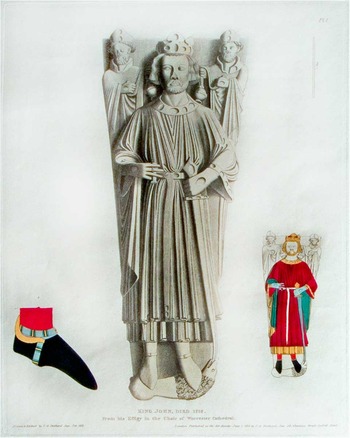
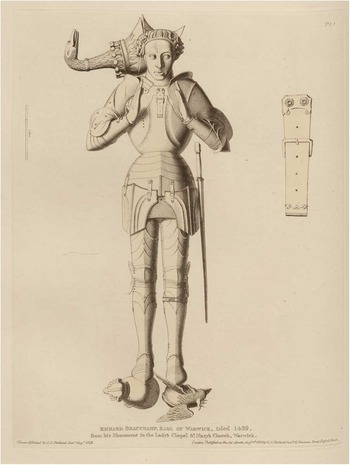
The extremely rapid technical improvement in Charles's etchings for the second number, particularly the progress towards a sharper delineation of outline, enhanced three-dimensionality and greater clarity of details, are visual evidence both that Kerrich offered him criticism and also that Stothard swiftly absorbed his lessons.Footnote 56 Kerrich's advice evidently also extended to his drawings, for they reveal similar technical advances. The prints in the second number were drawn and etched between August and October 1811, and included Aylmer de Valence's effigy at Westminster, but the rest were from Kent, with a particular emphasis on those in Canterbury Cathedral.Footnote 57 The masterful etchings of Henry iv and Queen Joan of Navarre are particularly notable measures of Stothard's technical advance. By the third number, which included further effigies from the Temple church, Westminster and Canterbury, the characteristics of Stothard's mature etching style are already present and in later etchings – such as those (11 and 12) of King John, from Nos VI and VII (fig 14) – his decisive and virtuosic handling of the needle is remarkable.Footnote 58 Stothard's sharp and elegant control of the linear medium enabled him to reproduce his drawings precisely and rapidly in print form and his superlative etchings of Richard Beauchamp's gilt-bronze effigy (121, 122, 124), for example, demonstrate how he had completely mastered even the representation of polished surfaces, of which he had earlier despaired (fig 15). In September 1821, Eliza sent Kerrich copies of these three etchings, which she said ‘rank amongst the most beautiful etchings of my beloved Charles’.Footnote 59
Effigy of King John from the Monumental Effigies. Photograph: Society of Antiquaries of London

Effigy of Richard Beauchamp from the Monumental Effigies. Photograph: Society of Antiquaries of London

Stothard had etched nine numbers of the Monumental Effigies, totalling 108 plates, and an additional nine etchings for the tenth number before his tragic death. This left three needed to complete No. X, and another twenty-four for the remaining two numbers. Fortunately for his young widow, eight months pregnant at the time of Stothard's fatal accident, her brother, Alfred Kempe, who was a well-known, if rather undistinguished, antiquary, could write the bulk of the text; but Eliza faced a serious problem in finding another artist to complete the remaining etchings from her late husband's drawings.Footnote 60 Before an artist could even be employed, however, she had to overcome considerable difficulties in identifying the subjects of Stothard's drawings.Footnote 61 In November 1821, she lamented to Henry Ellis (when appealing for his assistance) that her late husband:
has left sufficient drawings to complete the original plan of the 12th No., with many interesting ms notes etc on the subject of his work, but unfortunately, from a habit of scarcely ever writing upon his drawings, he had not marked whose Effigies they were, or in what Church to be found, and I am totally at a loss to know in what manner I am to gain this very necessary information.Footnote 62
The next month, Eliza wrote to Kerrich on the same subject, adding further detail:
Several of the plates etched, and the remaining drawings made by my beloved husband, he has not named, so that we know not whose effigies they are or in which church to be found. I wish you could see them. I doubt not you would immediately recognise many.
She goes on to describe ‘one rather singular, it represents a female holding a child, with a long broken scroll, an inscription upon it imperfect’.Footnote 63 This is the female effigy at Scarcliffe in Derbyshire, which Stothard had drawn in July 1816.Footnote 64 She, however, supposed it might have been at Ely, and she and her antiquarian friends evidently had great difficulty in identifying some of the subjects Charles had depicted during his wide-ranging travels visiting medieval churches. He had reserved some subjects, drawn years earlier, for etching in later numbers and identifying them will have posed particular difficulties. Eliza never was able to assign some of the drawings to their subjects, but in the end, a sufficient number could be confidently identified for the remaining etchings to be made.Footnote 65 Now, though, she had to find an artist of the right calibre.
The Painfully Slow Completion Of The Monumental Effigies
Contemporary praise for the brilliance of Stothard's etching technique exacerbated the difficulties his widow faced in finding an etcher who could complete the tenth number and etch his drawings for the eleventh and twelfth ones. By the time of his death, Stothard was widely appreciated as an antiquarian artist of the very highest quality – he had been appointed historical draughtsman to the Society of Antiquaries of London in July 1815 and, four years later, was elected a Fellow in recognition of his deep scholarly knowledge.Footnote 66 Sir Joseph Banks said ‘he did not think there was a young man in England of greater promise, and that in his way he was unequalled’ and the antiquary Samuel Lysons exclaimed to Charles, in words that would subsequently seem sadly ironic: ‘You have given us a work, Stothard, that does honour to our country; we have till now seen nothing like it. Persevere; complete the thing, – and I hope yet to live to see you as great as you deserve to be’.Footnote 67 Charles's widow, writing just after Charles's death, reflected:
The work on the Monumental Effigies gradually obtained great and deserved celebrity, both for its research, its extreme accuracy, and the exceeding beauty of the etchings. Several of our first artists and engravers freely gave it as their opinion, that such etchings had never before been produced; that they possessed the finish of the finest drawing, with a masterly execution, and a boldness of light and shadow, that gave them equal delicacy and force.Footnote 68
Two chief points emerge from this praise of Stothard's etchings. First, it is revealing that Eliza distinguished between ‘artists’ and ‘engravers’. Many painters and sculptors looked down on those who were exclusively engaged in the reprographic medium of engraving: engravers were rejected as Royal Academicians in 1809 and again in 1812, when thirteen engravers joined John Landseer in lobbying to be admitted. The academicians, in rebuffing them, claimed that engraving is devoid of the ‘intellectual qualities of Invention and Composition’, continuing: ‘its greatest praise consists in translating with as little loss as possible the beauties of these original Arts of Design’.Footnote 69 Stothard's work could be exempted from such criticism because (like Cotman) he himself was his own interpreter. Moreover, his brilliance with the pencil was matched by his mastery of etching. The use of the etching needle on the prepared ground of the plate (ready for biting in with acid) is widely viewed as analogous to the process of drawing: Hind states that the soft wax ground ‘offers practically no resistance to the needle, permitting the same freedom of hand as in drawing’.Footnote 70 Early nineteenth-century artists would not necessarily have agreed and the period saw a great deal of technical innovation: in 1811, the same year that Stothard began publication of his Monumental Effigies, John Hassell (1767–1825) published his Calcographia: or, the art of multiplying, with perfection, drawings, after the manner of chalk, black lead pencil, and pen and ink, which pioneered a hybrid process, using pen on a prepared ground, precisely because he found that the etching ‘needle[,] always scratchy[,] gives but an imperfect freedom of the pencil’.Footnote 71 It was therefore a tribute to his overcoming the limitations of his medium that Stothard's etchings seemed to have the ‘finish of the finest drawing’.
Secondly, Eliza's highlighting of the ‘research’, ‘accuracy’ and beauty’ of Charles's work goes to the heart of contemporary esteem for Stothard's achievement. For his contemporaries, Stothard's representations of monumental effigies, ‘weepers’ and brasses were informed by his profound scholarly knowledge of his subject matter. Indeed, they saw his ‘research’ – his wide reading of secondary and primary sources and his first-hand investigation of the effigies – as enhancing his ability both to select and to represent medieval subjects. The dichotomy the modern viewer may suppose between the artistically beautiful and the archaeologically exact rendition was, for Stothard's contemporaries, resolved in the work of an artist whose representations were informed by knowledge, skill and taste in equal measures.Footnote 72 The visual presentation of medieval effigies in prints was not a purely utilitarian occupation, but was profoundly affected by intellectual activity, artistic selectivity and interpretation. The point is made by the reviewer of the tenth number of the Monumental Effigies in the Gentleman's Magazine for 1824: ‘the delicacy and accuracy of his [Stothard's] representations cannot be surpassed’.Footnote 73 Because the viewer only apprehended the medieval subjects through the lens of the artist's aesthetic sensibility, the latter's artistic taste and skill was of decisive importance. Stothard's representational accuracy was enhanced by his ‘masterly execution […] delicacy and force’ to which Eliza refers. So, his etchings, for contemporary commentators, combined the potency of discriminating aesthetic taste with reprographic accuracy. This made the search for a suitable successor all the more problematical.
Aggravating Eliza's difficulties was her financial position.Footnote 74 Stothard had confidently invested in anticipation of his future earnings, and had not paid enough attention to his finances, leaving his widow very short of money. Her brother, Alfred Kempe, when writing to Kerrich on 10 July 1821 to tell him that Eliza had been safely delivered of a daughter, Blanch, confided: ‘I wish I could say that Charles had left them in affluent circumstances; his own dues will I fear be barely sufficient to answer the debts contracted on account of his work’, and Kempe asked Kerrich to enquire whether No. IX had been delivered to some subscribers who had not yet paid their accounts.Footnote 75 Eliza was well aware that her financial woes would be aggravated by the fact she would have to pay a commercial rate to an artist for etching Charles's drawings. She told a subscriber: ‘I shall feel grateful for a continuance of the patronage of his subscribers to this work, as now my Husband (who executed every part himself) is no more, the expense will be tenfold’.Footnote 76 Just as Charles had, so she too must have hoped that the sales of the tenth number would enable her to pay for the etching of the eleventh, and that its sales in turn would help her finance the project's completion, but she was obliged to increase the cost of each number to subscribers by 5s and she was also forced to charge separately for the substantial letter-press which she included in a thirteenth and final number.Footnote 77 Her desire to maintain the elevated quality of her late husband's works was a constant theme and is revealed by her continued patronage of Stothard's skilled but expensive colourist. She declared to Kerrich on 1 October 1821: ‘It is my wish (that now the management of dear Charles's works have fallen into my hands) that they should not be injured or less worthy the attention of his friends and the public from any want of proper care and attention to their colouring.’Footnote 78 Accordingly, she continued to employ Edward Davies (1783–1845), whom her husband had carefully trained, for the hand-painted colouring of the plates.Footnote 79
As already indicated, Stothard had etched nine plates for the tenth number by the time of his death. The remaining three prints were etched from his drawings by two separate artists. Charles's younger brother, Robert (fl 1821–67), provided two: Robert, Duke of Normandy, Gloucester Cathedral (23) (fig 16), and one of the Neville family at Brancepeth, Durham (135); and Edward Blore (1787–1879) etched the final effigy in this number, representing Sir Thomas Cawne, at Ightham, Kent (77) (fig 17).Footnote 80 We can only conjecture why it should have been necessary to employ two different etchers. Robert Stothard was a talented artist, who also finished off his brother's work on the Devon Magna Britannia volume for Daniel Lysons, but he may well have felt reluctant to take on the major task of completing the Monumental Effigies.Footnote 81 This was a pity, because, as the book's reviewer in the Gentleman's Magazine observed, his etchings closely resembled his brother's in style.Footnote 82 Perhaps Robert had his nose put out of joint by his failure to secure Charles's post as historical draughtsman to the Society of Antiquaries in spite of Kempe's (rather clumsy) lobbying on his behalf.Footnote 83
Effigy of Robert, Duke of Normandy, drawn by Charles Stothard and etched by his brother, Robert, for the Monumental Effigies. Photograph: Society of Antiquaries of London

Effigy of Sir Thomas Cawne, drawn by Charles Stothard and etched by Edward Blore for the Monumental Effigies. Photograph: Society of Antiquaries of London

For whatever reason, Eliza turned to Blore, who had already made a name for himself as a rising star of antiquarian illustration, supplying drawings or engravings for numerous works – for example, his father's The History and Antiquities of the County of Rutland, in 1811,Footnote 84 and John Britton's The History and Antiquities of the Metropolitical Church of York, published in 1819, for which he had drawn several effigies and monuments (as well as architecture) and supplied an etching.Footnote 85 Britton must surely have known Charles Stothard: he had dedicated the plate of Lindisfarne church in volume iv of The Architectural Antiquities of Great Britain to his father.Footnote 86 He may have recommended Blore, a versatile and accomplished artist who was soon to become a highly successful architect.Footnote 87 Blore was well connected and was elected a Fellow of the Society of Antiquaries in 1823.Footnote 88 He was roughly the same age as Stothard and so must have been an obvious choice to etch the deceased artist's drawings. His etching (77) of Sir Thomas Cawne's effigy for the Monumental Effigies (fig 17) is of very high quality and ‘very elaborately finished’, as the Gentleman's Magazine reviewer commented.
It might, then, seem surprising that he was not employed to etch any of the effigies in the remaining two numbers of the Monumental Effigies (fig 17). The reason was not financial. It is revealed in an outraged notice, which must have been printed in 1823 or 1824 – ie well before Stothard's book was finally completed – and which is preserved at the back of Sir Richard Colt Hoare's (subscriber's) copy of the Monumental Effigies in the library of the Yale Center for British Art. This provides clear evidence why there had been a decisive break between Blore and Charles's widow (who had remarried in 1823). She writes:
The Proprietor takes this opportunity of noticing the following extraordinary passage, which occurs in the prospectus of a work lately advertised, called the Monumental Remains of Great Britain, ‘in which the publishers assert that “no work” (except their own), has been devoted to the Monumental Remains of the most eminent Persons in British History & c’. The falsehood of an assertion at once so disingenuous and unfeeling towards the eminent talents and revered memory of the late Mr Charles Stothard (when his Original Monumental Work has been twelve years before the public) needs no comment.Footnote 89
The reference here is to the prospectus Blore issued for his Monumental Remains of Noble and Eminent persons comprising the Sepulchral Antiquities of Great Britain, engraved from drawings by Edward Blore FSA.Footnote 90 All the drawings for the Monumental Remains would, the prospectus promised, be executed by Blore, who would also engrave the majority of the plates and supervise the engraving of the rest.Footnote 91 The publication was to comprise twenty-four parts at 10 shillings each, each part comprising five plates – making 120 in all – and accompanying letter-press: at £1 for ten plates, this now slightly undercut the £1 5s that Eliza was obliged to charge for each new number of Stothard's Monumental Effigies.Footnote 92 The prospectus flagrantly echoed phrases originally used by Stothard (and printed on the wrappers in which each number of his etchings of Monumental Effigies was issued), adding insult to potential injury. Blore, or his publishers, wrote:
The Sepulchral Remains of a nation are universally allowed to be objects of the greatest importance, affording the most unerring illustrations of the progress of the Arts of Design and Sculpture, of the changes of Costume in the various ranks of society, and […] in many cases [are] the only existing memorials of Illustrious Individuals.
It was the following passage, however, which so offended Eliza:
It is a matter of astonishment, that whilst the attention of the Architect and the Antiquary has been engaged, almost to satiety, in delineating the exterior of our great Ecclesiastical Buildings, no work has been devoted to the Monumental Remains of the most Eminent Persons in British History which decorate their interiors.Footnote 93
Stothard's brilliant work was not even mentioned and, almost insultingly, Blore's prospectus offered an introductory treatise on the subject of British sepulchral monuments at the end, as well as historical, biographical and local notices to accompany each plate. This promised combination of textual components sounded virtually identical to Stothard's plans. As Eliza will immediately have realized, if Blore's venture were to be successful, it would adversely affect the market for Stothard's Monumental Effigies. Indeed, it might have made the completion of that work impossible. Blore may have seen an opportunity to fill the void left by Stothard's death and correctly realized that Eliza's ability to complete the work was severely compromised by several factors: her composition and publication of the Memoirs of Stothard in 1821–3; the terrible impact on her of the death of her infant daughter in February 1822, which led to her temporary blindness; her remarriage later that year and move to Devon; and her writing of a three-volume historical novel, De Foix, which she had started before Charles's death and which she published in 1826. In the event, although the first two numbers of the Monumental Remains were favourably received (they were positively reviewed in the same year (1824) that the Gentleman's Magazine also reviewed the tenth number of the Monumental Effigies), the project was a commercial failure and only six numbers, comprising thirty plates and texts, were published.Footnote 94 They were brought together in 1826 as a chronologically disorganized book, without any introductory treatise, and with the plates rather weighed down by the very detailed biographical and historical notices by the Revd Philip Bliss (1787–1857).Footnote 95
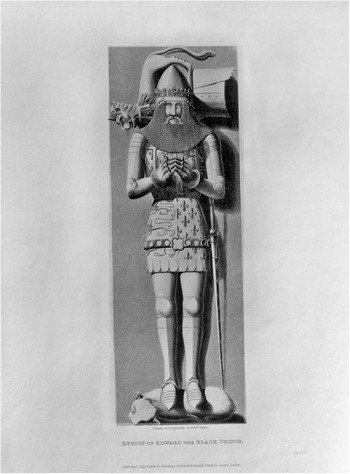
The differences that can be discerned between the plates in the Monumental Remains and those of the Monumental Effigies are fascinating. First, and most obviously, Blore's standard engravings were in a smaller imperial octavo size (7.5” by 11„, compared to Stothard's quarto or folio etchings).Footnote 96 Secondly, although they included effigies (such as that of Queen Eleanor of Castile, drawn by Blore and engraved by Henry Le Keux) as well as views of the whole monument in its architectural setting (such as that of Edward iii, drawn and engraved by Blore), the often atmospheric engravings varied in quality. Certainly, none attained the qualitative levels of Stothard's etchings. In the 1824 Gentleman's Magazine review of the first two numbers of Blore's Monumental Remains, Le Keux's engraving technique was lavishly praised and Blore's own engravings were generally commended as approaching this level of clarity. One exception was Blore's plate of the effigy of the Black Prince, which was criticized as ‘unfinished’ because of the way that too much paper was left plain to show light falling on the gilt-bronze surfaces of the effigy (fig 18).Footnote 97 Representing polished surfaces was, as we have seen, a difficult problem. Fascinatingly, the 1832 reviewer of Stothard's work in the Gentleman's Magazine himself explicitly compared the Monumental Effigies with Blore's book. The latter was, he opined:
beautifully executed, as far as regarding the architecture and general effect of the tombs; but the figures which are attached to them will bear no comparison with those represented in Mr Stothard's work. His firm, severe, but elegant outline is wanting. There are no details of ornamented parts. Above all, its editors greatly erred in causing the slabs on which the effigies repose, to be represented in the drawings, a circumstance which gives them a very heavy appearance, and which Mr C. Stothard throughout his publication most judiciously avoided.Footnote 98
Blore's engraving of the Black Prince's effigy from the Monumental Remains. Photograph: Society of Antiquaries of London

Blore's work was criticized because his plates did not exhibit the refined selectivity that so distinguished Stothard's endeavours. It was the clear, precise, exquisitely linear focus on the effigies in Stothard's etchings and the selected magnification of details (sometimes hand-coloured) which attracted contemporary admiration.Footnote 99 Beside Stothard's superlative etchings, Blore's engravings must have seemed slightly old-fashioned, or picturesque.Footnote 100 The linear clarity and supreme quality of Stothard's etchings set them apart as something distinctively different.
After her evidently painful conflict with Blore, Stothard's widow turned, for the etchings of the eleventh number, to a much older man, Bartholomew Howlett (1767–1827) (fig 19).Footnote 101 Howlett was then in his late fifties and was principally known as an architectural engraver. Like Blore, he had contributed to John Britton's antiquarian publications, and he may well have known Charles Stothard himself, perhaps in connection with Howlett's huge series of drawings of medieval seals – Stothard was himself planning a work on seals – or through one of the many other points of contact between antiquarian illustrators.Footnote 102 Howlett completed the eleventh number but died, aged sixty, on 18 December 1827.Footnote 103 Eliza now had to find yet another artist to etch Stothard's drawings for the twelfth number. She selected a much younger man, Charles John Smith, FSA (1803–38), an antiquarian artist in his twenties, to etch the final dozen plates. The reviewer in the Gentleman's Magazine expressed a sensitive discrimination between Howlett's and Smith's etchings from Stothard's drawings:
There is less of the neatness of finish in Mr Howlett's etchings than in Mr Smith's, but there is also less of the mechanism of the graphic art, and more of the feeling of Mr Stothard's inimitable drawings. A certain hardness of manner is the defect which Mr Smith has to correct; his hand is otherwise firm, decided, and capable of exquisite finish.Footnote 104
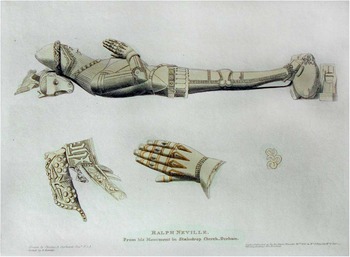
Effigy of Ralph Neville, profile, drawn by Charles Stothard and etched by Bartholomew Howlett for the Monumental Effigies. Photograph: Society of Antiquaries of London

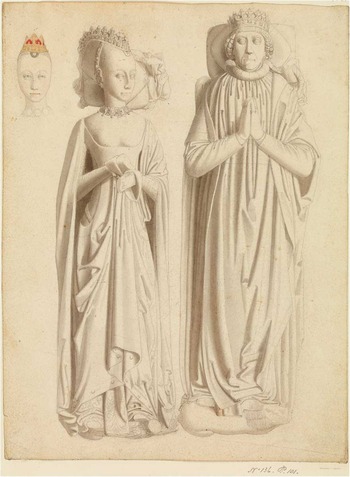
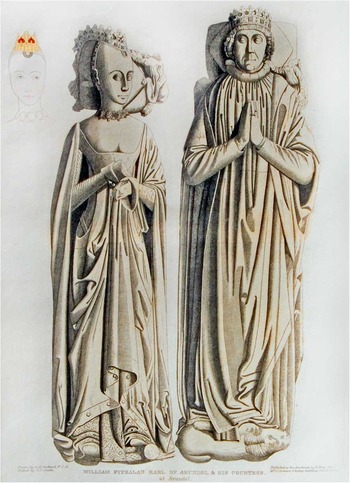
If we compare Stothard's drawing of William Fitzalan, Earl of Arundel, and his wifeFootnote 105 with Smith's plate, we can perhaps see the reviewer's point (figs 20 and 21): Smith's work (136) is a little hard-edged by comparison both with the drawing and with Stothard's plate of the same subject. Smith can hardly have been pleased to read Alfred Kempe's critique of his etching (100) from Stothard's drawing of a Basset and his lady at Atherington, Devon (the last effigies Stothard ever drew), in the text of the Monumental Effigies itself: ‘Mr Stothard's original drawing has been very faithfully followed in the etching; but no needle but his own could give an idea of its pure taste and elegant precision’.Footnote 106 Smith was an extremely accurate copyist and an already accomplished antiquarian artist: his Autographs of Royal, Noble, Learned, and Remarkable Personages conspicuous in English History, from the reign of Richard the Second to that of Charles the Second, with some illustrious foreigners, with biographical memoirs (by John Gough Nichols), published in book form in 1829, contains superb facsimiles of autograph letters and is still of value.Footnote 107 Smith also made major contributions to Cartwright's The Rape of Arundel, published in 1830, most pertinently, perhaps, two fine plates of effigies at Ifield and Horsham.Footnote 108 He later undertook another serial work by himself, the rather startlingly miscellaneous Historical and literary curiosities consisting of facsimiles of original documents, scenes of remarkable events (1835–40), but he died in 1838, aged thirty-four (the same age that Stothard was at his death), when it was still in progress.Footnote 109
Charles Stothard's drawing of William Fitzalan, Earl of Arundel, and his wife. Photograph: © The Trustees of the British Museum

Charles Smith's etching after Stothard's drawing of William Fitzalan, Earl of Arundel, and his wife for the Monumental Effigies. Photograph: Society of Antiquaries of London

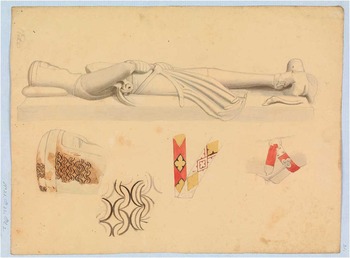
For all of those tasked with etching from Stothard's drawings, difficulties of interpretation must have arisen in determining from his drawing of an effigy which they themselves had never seen, precisely what Stothard himself had observed, or intended to be represented. Stothard sometimes transcribed his drawings exactly in his etchings; on other occasions, though, he reorganized details on the page, occasionally omitting some of them, or combining them on a plate with others.Footnote 110 In the design and adjustment of details for the etched plate, Stothard can be observed in the process of assessing visual layout, ensuring the results were aesthetically satisfactory and calculating which details merited the expensive process of hand-colouring. Watercolour trial marks and blotches appear on some of the drawings; it is quite likely that Stothard had his watercolours with him in some instances, transcribing the painted details on site (fig 22).Footnote 111 On other occasions, he noted the colours in pencil on his sketches, as an aide-mémoire for later painting.Footnote 112 Sometimes he schematically indicated details or omitted parts, having drawn half a feature fully, to save time: this was enough for his own information because he could recall what he had seen.Footnote 113 However, this ‘shorthand’ will certainly have presented problems to an artist etching from Stothard's drawing without any first-hand knowledge of the original subject: he could not tell whether Stothard was abbreviating to save himself time, or whether he was recording with archaeological accuracy, all that remained. Alfred Kempe explicitly noted of one of Howlett's etchings (of Ralph Neville) that, ‘The mailing of the camail was left blank in Mr Stothard's original drawing, which has therefore been followed, but there is no doubt but he intended it should be filled up’.Footnote 114 For Eliza, there was also a risk in giving Stothard's drawings to other artists to etch: in the case of Stothard's drawing of Lord Bardolph and his lady in Dennington church, Suffolk,Footnote 115 she has angrily noted on the mount: ‘After the death of poor Mr Stothard, this beautiful drawing was placed in the hands of [Smith – erased] to engrave it [sic], and he returned it in this filthy state’.Footnote 116
Charles Stothard's watercolour details of effigy of a knight at Rampton in Cambridgeshire. Photograph: © The Trustees of the British Museum

The twelfth part of the Monumental Effigies, containing Smith's etchings, was not the final number. The bulk of the extensive letter-press – in the main composed by Alfred Kempe but incorporating Stothard's draft introduction and doubtless making use of his manuscript notes – along with some additional illustrative materials, was issued in a thirteenth and final number, for which Eliza had to charge separately.Footnote 117 By then, the complicated and expensive process of completing the book had dragged on for eleven years from Stothard's death. Those of the seventy or so original subscribers who survived had waited twenty-one years, not the four years Stothard initially promised, for the book to be completed.
An Abortive Continuation Of The Monumental Effigies
In the particular field of antiquarian draughtsmanship in which he stands pre-eminent, Stothard's only real successors, as Richard Knowles has justly remarked, were the father and son George (1793–1842) and Thomas Hollis (1818–43).Footnote 118 Their Monumental Effigies of Great Britain, of which a first number, comprising ten plates, priced at 12s 6d, was issued on 1 June 1840, was a work explicitly intended – as its very title indicates – as a continuation of Stothard's. Its format, size and paper were intended to be identical, as announced on the paper wrappers in which each part was distributed:Footnote 119 the original wrappers are bound into the copy of their work bequeathed to the Society of Antiquaries by H F D Evans in 1967.Footnote 120 The prospectus advertised that it was to be completed in fifteen parts, one issued every three months.Footnote 121 The Hollises’ reverential emulation and continuation of his project is potent testimony to the impact of Stothard's book on contemporaries and to the market which it helped to create, but their magnificent work too was left incomplete, after the issue of only six numbers, when George's death in 1842 was followed by that of his twenty-five-year-old son in October the following year. The strain of drawing and – after his father's death – of etching the prints (fig 23) to an impossibly tight schedule – in order to provide financial support to his mother – was too much for Thomas's health. The Hollises’ Monumental Effigies was never published in its intended form and the sixty completed etchings remain disarranged and without any accompanying text.
A lady of the Arden family in Aston church, Warwickshire, drawn by Thomas Hollis and etched by George Hollis in 1840. Photograph: Society of Antiquaries of London

The very fact that Thomas Hollis's life is effectively unrecorded beyond his brief obituary in the Gentleman's Magazine raises a final important issue in considering Stothard's contemporary and later reception.Footnote 122 It may seem paradoxical to advance this contention, at the end of a detailed critical reappraisal and recontextualization of Stothard's etchings, but Romantic biography probably played a crucial role in shaping the later evaluation of Charles Stothard's art. Alfred Kempe's lengthy obituary of his friend and brother-in-law in the Gentleman's Magazine of 1821 was the first step (and was effectively reiterated within the text of the Monumental Effigies itself).Footnote 123 The narrative of Stothard's tragically ironic end – smashing his head on the slab of a monumental effigy when he fell from a ladder, leaving his young wife eight months' pregnant – cannot have failed to move the reader. Even more affecting was the publication in 1823 of Eliza's intense and highly wrought Memoirs … of the late Charles Alfred Stothard, F.S.A., in which she assembled her late husband's correspondence, journals and antiquarian essays, wrote of their life together and added an emotion-laden account of his final days and fatal accident and of the subsequent death of their infant daughter.
Stothard's critical fortune was decisively affected by the fact that he had married a woman whose highly pitched sensitivity was balanced by two key attributes: a determination to complete her husband's work in spite of terrible adversity and considerable literary talent.Footnote 124 Without the first quality, the Monumental Effigies would never have been brought to completion. And, whilst it would clearly be absurd to suggest that Eliza transmuted her late husband into a fictional character, it is certainly the case that her developing skill as a writer of the new genre of historical novel received some early practice in the Memoirs.Footnote 125 Handsome and modest, but with a strong sense of his own worth, passionate, serious, accomplished and prone to melancholy, Stothard possessed all the attributes necessary for her posthumous casting of him as a Romantic hero.Footnote 126 Eliza's passionate commitment to her first husband's memory (even after her remarriage in 1823), and her moving account of his death, partially conditioned contemporary responses to Stothard and still affect our own.Footnote 127
Certainly, her great-nephew and godson, John Alfred Kempe, who edited her autobiography, published in 1884, adopted too critical and patronizing an attitude to her defects, in denigrating her work as deficient in logical judgement, without adequately recognizing her substantial achievements.Footnote 128 For not only did Eliza slowly drag the Monumental Effigies to final publication; she also furnished a mass of biographical information about Stothard, documenting his aims, ambitions and methods in the Memoirs.Footnote 129 Charles also occupies a major place in her posthumously published Autobiography. In her old age, she sold the copyright of the Monumental Effigies to Bohn and a new edition was published in 1876, bringing Stothard's work before a new generation; the publication of her autobiography eight years later must have refocused attention on his achievement. No such attention was ever devoted to the Hollises, whose work was abruptly terminated with their deaths.Footnote 130 So, it can be compellingly argued, it was not Stothard's prodigious talent alone, but Eliza's determination to see his work through to completion, her literary abilities and her copious documentation of Charles's life and art – as well as her brother's commitment to complete the text – that helped propel Stothard into art-historical immortality. By contrast, the Hollises’ magnificent continuation of his work languishes textless and incomplete, and its creators are all but forgotten.
ABBREVIATIONS AND BIBLIOGRAPHY
- Abbreviations
- BL
-
British Library, London
- BM
-
British Museum, London
- CCC
-
Corpus Christi College, Cambridge
- GM
-
Gentleman's Magazine
- ME
-
Stothard, C A 1832. The Monumental Effigies of Great Britain
Acknowledgements
During my Visiting Fellowship at the Yale Center for British Art in New Haven, I was given access to materials in their care and kind assistance by Elisabeth Fairman, FSA, Senior Curator of Rare Books and Manuscripts, and John Monahan, Senior Curatorial Assistant. I am also grateful to the Master and Fellows of Corpus Christi College, Cambridge; the staff of the Prints and Drawings Department of the British Museum; the Manuscripts Room of the British Library; the Rare Books Room of the University Library, Cambridge; Adrian James of the library of the Society of Antiquaries of London; and the West Country Studies Library, Exeter, for access to manuscripts, prints, books and drawings. Professors Brendan Cassidy, FSA, and Rosemary Sweet, FSA, and Drs John Blatchly, FSA, Lisa Ford and Matthew Potter have kindly commented on drafts of this paper, and I have also benefited from discussions with Professors Stephen Bann, FSA, and Elizabeth Prettejohn. Richard Knowles, FSA, and Philip Lankester, FSA, kindly waived their anonymity as referees for the paper and I am grateful to them and to the other anonymous reviewer for their comments and suggestions. The warm generosity with which they have discussed the paper has made my work on it a real pleasure. Any errors which have escaped so much scrutiny must be blamed on the author. This work forms a strand of the ‘Representing Re-Formation’ project, funded by the Science and Heritage programme.