


Let me conclude by again referring to the war in which we are all engaged, whether we stand in the presence of a class in the heart of a ghetto or lie steel-helmeted in the fields of Flanders. —William L. Ettinger, superintendent of New York City public schools.Footnote 1
Hyman Herman, a sixteen-year-old student attending DeWitt Clinton High School in New York City, could scarcely have imagined that his impassioned letter would ignite headlines and spread hysteria among public schools across the United States. Written in December 1917, the letter was part of a routine classroom assignment: to write a letter addressing President Woodrow Wilson directly. Yet what began as an exercise in civic engagement quickly became a national controversy. Samuel Schmalhausen, a teacher who believed fervently that young people should be encouraged to think critically and speak freely—even, and perhaps especially, in times of war—had devised the assignment. Schmalhausen believed that his students had the right to articulate their own views, unfettered by political rhetoric. Herman took the assignment seriously, but in doing so, he exposed the fragile boundary between free speech and perceived disloyalty in a nation on edge. Blending irony with invective, Herman wrote to Wilson: “you are ready to slaughter us all in order that we may enjoy that in death which we are now lacking in life.” Calling Wilson “a Messiah in disguise” animated by “a mad desire for murder,” Herman also castigated U.S. intervention itself, directing particular scorn at what Wilson described as a “war for democracy.”Footnote 2 To the teenager, the slogan rang hollow—an abstraction used to justify bloodshed rather than a genuine promise of liberty.
How the letter found its way onto Wilson’s desk remains a mystery. That a teacher had approved—even encouraged—such an open display of dissent shocked a wartime society primed to equate criticism with disloyalty. Almost overnight, what had been a simple classroom exercise became a federal affair. DeWitt Clinton High School dismissed Schmalhausen, along with two other teachers, Thomas Mufson and A. Henry Schneer, charging them with fostering disloyalty in the classroom.Footnote 3 The school officials dismissed Mufson for discussing anarchism with his students, an intellectual discussion that they instead framed as political contagion in the charged atmosphere of wartime United States. They fired Schneer for refusing to permit a U.S. Army officer to deliver a talk on the ongoing war in Europe in his classroom. School officials saw his refusal as evidence of insubordination and suspect loyalty.Footnote 4 John L. Tildsley, the associate superintendent of New York City public schools, sought to calm anxious parents through a public reassurance. He declared that “teachers who do not give loyal support to the government in the conduct of the war” would not be tolerated.Footnote 5 Tildsley moved swiftly to tighten control over schools. He instructed the principals of New York City’s twenty-four high schools to submit the names of any teacher “whose loyalty is not above suspicion,” thus inviting surveillance into the daily life of the schools.Footnote 6
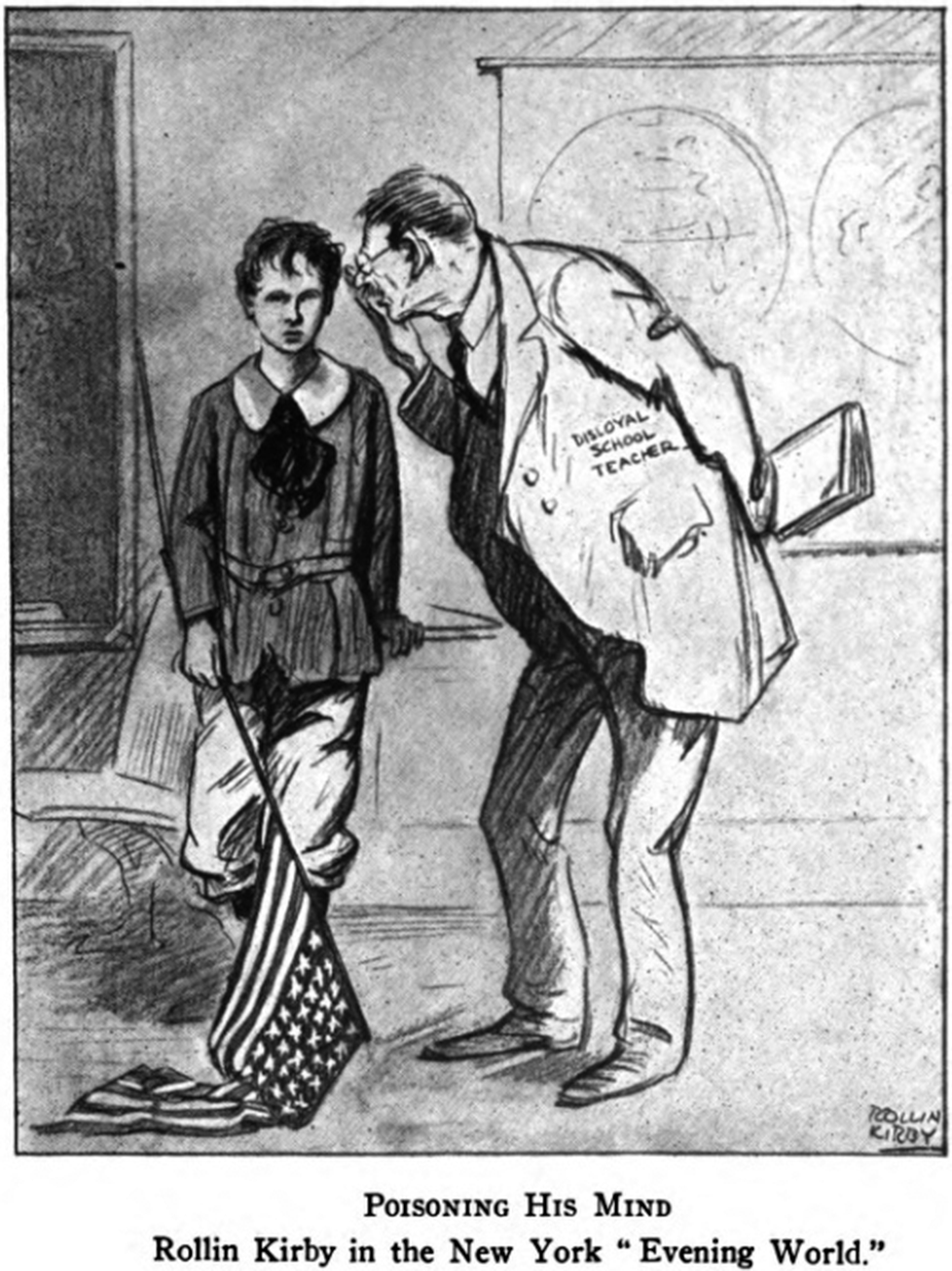
Although the DeWitt Clinton Affair (as it came to be known) drew intense public attention in New York City, it was far from an isolated episode. Across the United States, similar scenarios unfolded as school boards dismissed, disciplined, or silenced teachers branded as unpatriotic. Loyalty in public school classrooms took on an almost sacred importance. Across the nation, patriotic organizations, local and state authorities, and parents became acutely aware that students might encounter dangerous ideas within the supposedly safe confines of the classroom (Figure 1).
Cartoon by Rollin Kirby, an American political cartoonist, depicting a disloyal teacher whispering into a student’s ear and indoctrinating him in a classroom. It was published in the New York Evening World in 1918. Public domain.

Between August 1914 and April 1917, the United States’ official stance of neutrality had shielded teachers’ public speech. Neutrality allowed people to air personal convictions and political leanings despite professional duties. But once Congress declared war on the Central Powers in April 1917, opinions that had once been tolerated were recast as disloyal, if not outright treasonous. Citizens’ loyalty came under intense scrutiny.Footnote 7 Under the 1917 Espionage and the 1918 Sedition Acts, local, state, and federal authorities monitored and prosecuted citizens for alleged disloyalty.Footnote 8 Section 3 of the June 15, 1917, Act of Congress, known as the Espionage Act, read that “whoever, when the United States is at war, shall willfully make or convey false reports or false statements with intent to interfere with the operation or success of the military or naval forces of the United States or to promote the success of its enemies, and whoever, when the United States is at war, shall willfully cause or attempt to cause insubordination, disloyalty, mutiny, or refusal of duty in the military or naval forces of the United States … shall be punished by a fine of not more than $10,000 or imprisonment for not more than twenty years, or both.”Footnote 9 Section 3 clearly specified that American citizens attempting to encourage insubordination, disloyalty, or mutiny would be punished.Footnote 10 The law curtailed rights protected by the First Amendment, namely the ability to willfully criticize the federal government and reject the Selective Service Act.Footnote 11 Moreover, both the 1917 Espionage Act and the 1918 Sedition Act sharply curtailed educators’ rights to free speech in the classroom.Footnote 12 With the nation at war, Americans increasingly sought to ensure that classrooms were places where loyalty and patriotism were not merely encouraged but required, leaving little tolerance for dissent.Footnote 13 In this climate, patriotic organizations frequently portrayed teachers as potentially perfidious agitators—figures capable of indoctrinating children with foreign or subversive ideologies and endangering the nation from within. Local, state, and federal authorities responded by monitoring classrooms for signs of disloyalty and systematically removing educators deemed insufficiently patriotic.
Historians of U.S. education have long maintained that after Congress declared war on the Central Powers in April 1917, local, state, and federal authorities coordinated with school boards to restrict speech considered disloyal, punish allegedly disloyal teachers, and ensure that U.S. classrooms were spaces of ideological conformity, where loyalty to the country was without question.Footnote 14 Although the present article does not dispute this conclusion, the picture it paints is rather incomplete. While historians have largely emphasized the coercive strategies used by authorities to compel teachers and university faculty to pledge allegiance to the state, my research reveals that although school boards and superintendents employed coercion to silence teachers, teachers’ unions and academic organizations willingly agreed to temporarily renegotiate their understanding of teachers’ constitutional rights.
This article reveals that during the war, educators at all levels—primary, secondary, and postsecondary—could face a hard choice between honoring personal convictions and honoring the imperative to promote national unity. These tensions, however, were not simply institutional and pedagogical. Rather, they reflected a broader shift in both the meaning and function of prevailing debates over education and democracy during this unprecedented period. Patriotic organizations and assimilationists prevailed not solely through coercive measures but also by shaping a new narrative in which morality—rather than patriotism—demanded teachers’ loyalty in wartime. Being loyal in wartime, they claimed, was the morally correct thing to do, and failing to do so was seen not merely as unpatriotic but as immoral. Disloyalty thus became a moral failing because teachers, as public officials, were responsible for shaping students into future citizens and were expected to model proper behavior—an expectation that still persists today. Within schools and universities, many educators came to accept that speech and conduct acceptable in times of peace were not justifiable in times of war. To persist in such practices, they argued, would dishonor the U.S. soldiers fighting and dying on the Western Front. They actively participated in redefining their rights and responsibilities as educators and citizens. Within the profession, teachers’ organizations worked to persuade their members that intellectual restraint, patriotic conformity, and temporary limits on academic freedom were not a betrayal of democratic principles, but rather a necessary and ethical response to the exigencies of total war.
As educators came to view opposition to the war effort as morally wrong, teachers’ associations aligned themselves with the government, and leaders in higher education—most notably the American Association of University Professors (AAUP)—argued that faculty members could not assume that their First Amendment rights would be unconditionally protected in times of national crisis. Even though these organizations claimed to represent teachers and academics, during the Gilded Age and Progressive Era they were relatively young and elitist organizations and did not represent the entire profession (the AAUP, for instance, was founded in 1915). At this moment of war, they fueled debates over the meaning and limits of academic freedom, pitting two fundamentally irreconcilable interpretations against one another: one emphasizing absolute freedom of speech and the other subordinating that freedom to patriotic duty. These tensions had already divided Gilded Age and Progressive Era reformers and educators—and continue to spark contentious debates among teachers and academics today.Footnote 15 But what is particularly striking during World War I, however, is that teachers’ unions and academic organizations rapidly recognized that criticizing the government in the classroom was a reproach to students (and parents) who supported it and was a grave insult to the soldiers who were fighting and dying on the Western Front. Free speech was one matter; moral responsibility was quite another.
Monitoring Disloyalty Among School Teachers
Between the Civil War and World War I, conflicting visions of patriotism emerged and often clashed. Assimilationists urged immigrants to abandon their languages and cultures, while more liberal-thinking cultural pluralists encouraged immigrants to preserve their customs. But both groups believed that rituals such as displaying the flag and singing patriotic songs would foster patriotism, strengthen a sense of belonging among diverse ethnic and linguistic groups, and ultimately fortify the nation.Footnote 16 And although they “differed greatly over the degree to which immigrants should abandon or assert their previous cultures in the process of becoming Americans,” both groups concurred that some level of Americanization was necessary.Footnote 17 Assimilationists viewed flags and pledges of allegiance as “rituals of unity,” civic performances that fostered loyalty, discipline, and a shared national identity.Footnote 18 Through their repeated and highly symbolic use, these rituals would socialize individuals—particularly immigrant children—into a common political culture. They reinforced a sense of belonging while shaping how people understood themselves in relation to the nation-state.Footnote 19
Gilded Age and Progressive Era reformers and educators had for some time promoted patriotism in public schools, particularly as a means of integrating immigrants.Footnote 20 For instance, in 1892, to mark what was hailed as the four-hundredth anniversary of Christopher Columbus’s discovery of America, public schools invited children to raise and salute the U.S. flag.Footnote 21 The September 8, 1892, issue of Youth’s Companion, a popular children’s magazine, included the “Pledge of Allegiance,” by Francis Bellamy, explaining the ritual: “every pupil gives the Flag the military salute—right hand lifted, palm downward, to a line with the forehead and close to it.”Footnote 22 Gradually, the question of whether to display the U.S. flag in public schools dominated debates in legislatures across the country. Illinois, for instance, became the first state to legislate the display of the American flag in public schools. In 1895, the Illinois legislature passed a law that “all colleges and educational institutions of every description in this State, whether State, county, municipal, district, sectarian or private … provide United States national flags.”Footnote 23 On April 22, 1898, the New York legislature passed a similar law that every public school should display the U.S. flag.Footnote 24 Charles R. Skinner, New York’s superintendent of public instruction, hailed the legislature’s decision. In an address before the Patria Club at Delmonico’s that same year, Skinner proclaimed: “I would see the American flag over every schoolhouse, and the children reading the red as love, the blue as law, and the white the hopes that our fathers saw in a broader liberty.”Footnote 25 An assimilationist, Skinner did not hesitate to rely on coercive measures to force public schools to comply. For instance, in 1902, he withheld funds from non-compliant school districts that refused to display a bunting flag.Footnote 26 By 1905, sixteen states had adopted school flag laws.
Even though assimilationists and cultural pluralists clashed over whether or not to display the flag in public schools, the growing movement for Americanizing was gradually pushing state legislatures and American society more broadly toward adopting patriotic symbols.Footnote 27 In an overt effort to foster youthful patriotism, an article published in the Youth’s Companion asked: “Who will lead the movement for YOUR state?”Footnote 28
Similarly, assimilationists and cultural pluralists clashed over what to teach in the classroom. Assimilationists theorized about the importance of patriotism in shaping children’s experiences and values. Assimilationists encouraged teachers to instill national pride through a relatively U.S.-centric vision of history. In his 1900 Manual of Patriotism, Skinner included quotations and patriotic songs that pupils could memorize.Footnote 29 Skinner believed it was teachers’ mission to “teach the children that it is grander by far to be an American to-day than it was to be a Roman citizen 2,000 years ago.”Footnote 30 His politically driven goal was to cultivate “a national ethos” among children, thus highlighting the central role of teachers as agents of civic formation who shaped young minds.Footnote 31 Conversely, cultural pluralists argued that education should broaden children’s horizons and cultivate an openness to the wider world. They emphasized values such as international cooperation, human brotherhood, and respect for the rule of law as essential foundations for a more peaceful global order. By the time the United States entered World War I, Gilded Age and Progressive Era assimilationists and cultural pluralists had turned to public schools to enforce their respective visions of patriotism, integrate foreign-born groups, and unify the nation, though they differed on how far Americanization should go and how it should be implemented.Footnote 32
Once the United States declared war on the Central Powers in April 1917, patriotic organizations marginalized cultural pluralism, recasting it as a form of dissent. What had previously been a legitimate and even respected position in public life was now increasingly viewed with suspicion.Footnote 33 Patriotic organizations and assimilationists widely regarded public schools as prime sites for enforcing a uniform national identity, equating loyalty with conformity and leaving little room for cultural difference. They promoted Americanization programs, insisting that immigrants and native-born citizens alike demonstrate unquestioning allegiance to the United States.Footnote 34
Between April 1917 and November 1918, school boards discharged teachers not only for allegedly spreading disloyalty within the classroom but also for statements or actions undertaken outside school hours. The fact that both were treated with equal severity reveals the pervasive anxiety about any hint of sedition in public schools.
For example, school boards dismissed teachers on the basis of their personal convictions and political leanings, despite the absence of any indication that they had expressed dissenting views in the classroom. In Minnesota, for instance, Minneapolis’s board of education fired O. J. Arneson “because of his admitted membership in the Industrial Workers of the World and expressed beliefs which the board held to be inimical to the government.”Footnote 35 Similarly, New York City’s board of education unanimously voted to dismiss Herman P. Levine after he refused to register for the draft, treating his personal act of disobedience as incompatible with his role as a public school teacher.Footnote 36 In Buffalo, New York, Henry P. Emerson, the superintendent of education, removed Margaret Fotheringham after she had been “arrested with other suffragists for picketing in front of the White House.”Footnote 37 This case was reported throughout the United States, with a Colorado newspaper noting that the board of education unanimously voted to terminate her employment for being absent from her school duties without leave.Footnote 38 “It is no credit to a city,” Emerson declared, “to have a teacher on its payrolls who is daily insulting the President of the United States.”Footnote 39
While some educators faced termination solely for personal beliefs voiced outside school walls, school boards generally dismissed them for expressing controversial views within the classroom. In July 1917, Clinton High School in Iowa removed Jānis A. Kalniņš (John A. Kalnin) when he declined to teach his students about the U.S. draft system.Footnote 40 When Dorothy Adams, a teacher in Nevada’s Big Meadows school, refused to stand while the national anthem was sung and objected to its being sung in the school, the district’s superintendent called for an investigation. She admitted that “neither the flag nor the national anthem had a significance” and was subsequently dismissed for disloyal utterances and actions.Footnote 41
Parents pressured schools and superintendents to remove allegedly disloyal teachers, claiming that the teachers were turning impressionable children against the government. “Parents,” the Connecticut-based New Britain Herald reported, “have in some cases demanded the dismissal of teachers in this country and have won out.” However, the paper was quick to point out that, in some cases, the accusations had been unfounded. Rather than dwelling on the reasons parents asked to have teachers dismissed—ranging from political differences to personal grievances—the New Britain Herald drew a stark comparison between the United States and Bolshevik Russia: “Russia is a little advanced in this school matter, but really we don’t know of any country in which an unpopular teacher is bound to hold his place against the protests of pupils or parents or both.”Footnote 42 The disciplining of teachers for their conduct or speech in public arenas astounded many.Footnote 43
Conflicting views, personal grudges, and long-standing animosities intensified the politically charged environment and placed teachers at risk. Charles B. Stillman, the president of the American Federation of Teachers (the national teachers’ union), asked Americans to be careful. While he condemned disloyalty in public schools, he urged that “the public must carefully assure itself that charges of disloyalty or of any other nature that may be peculiarly effective at the time, are not cloaks under which official superiors may attempt to secure retaliation for a self-respecting lack of subserviency on the part of teachers under them.”Footnote 44 What had happened at DeWitt Clinton High School sharply divided public school teachers. In response to the dismissals, the teachers’ union circulated a pamphlet accusing John Walen, the chair of the New York State Board of Education’s Committee on High Schools, of acting out of personal revenge. Ira S. Wile, the New York City commissioner of education, argued that the war had radicalized the state board that its leadership had resorted to autocratic measures. Speaking before the Bronx Forum at Morris High School, Wile said that “the dictatorship over teaching methods exerted by district superintendents and certain autocratic acts of the Board of Education have banned freedom of initiative in the teaching staff.”Footnote 45
Patriotic leagues and school boards encouraged students to monitor their teachers and report any conduct deemed subversive.Footnote 46 In April 1917, when Miss Neubern, a teacher in Terre Haute, Indiana, allegedly told her pupils that “the Kaiser was just as good a man as President Wilson,” students immediately reported the comment to their parents.Footnote 47 Students explained that Neubern had obstructed all school-based war effort activities, refused to allow students to sing the national anthem, attempted to impede the sale of Thrift Stamps bonds, and denounced Britain as the historical enemy of the United States. (Her two brothers had been reported for preventing their clerks from attending the city’s Liberty Loan parade.) Following complaints from parents, local authorities compelled Neubern to resign.Footnote 48 Similarly, the Loyalty League of American Schools, which was formed in December 1917 by C. Ward Crampton, the chair of the American Defense Society, formally instructed school children to monitor their teachers for signs of disloyalty and report any expression of dissent.Footnote 49
In some cases, state superintendents reassured parents by publicly warning educators. In Richmond, Indiana, Joseph T. Gilles, superintendent of public schools, published a warning in the local newspaper. Referring to a public school where “children were not permitted to sing ‘America,’” Gilles cautioned that any teacher deemed disloyal would be dismissed immediately. He added that “instruction in the national songs will be given in the English, history and music classes.” When children in New York City told their parents that a Quaker teacher “was teaching peace at any price,” Gilles published a statement in the newspapers, linking neutrality advocacy with disloyalty: “We cannot have disloyalty in the public schools, either publicly or privately,” the Richmond Palladium and Sun Telegram concluded, praising Gilles’s stance.Footnote 50
Disloyalty concerns were closely intertwined with anxieties about immigration. In 1908, the United States Immigration Commission had conducted a study of public schools in thirty-seven cities, revealing that 57.8 percent of students had foreign-born fathers. Among these pupils, the children of Russian Hebrews, as the commission termed them, constituted 17.6 percent; those of German fathers accounted for 11.6 percent; and those of Italian fathers for 6.4 percent. Children of German-born fathers were the largest identifiable ethnic minority nationwide, ranking first in twelve cities and second in thirteen.Footnote 51 Contemporary observers framed these demographic patterns as evidence of the scale of immigration. In January 1918, according to Harry H. Wheaton, the director of the America First campaign, approximately thirteen million foreign-born residents were living in the United States; thirty-three million individuals were of foreign parentage, and roughly three million people were non-English speakers.Footnote 52 “Every year,” the Americanization Department of the Nebraska State Council of Defense claimed in August 1918, “enough Italians come to the United States to make 22 Italian cities of 20,000 persons”; “enough Austro-Hungarians [settle in the country] to make 27 cities as large as Detroit”; and Poles alone could make “18 such cities.”Footnote 53
In New York City, where approximately 65 percent of children had foreign-born fathers, state authorities expressed concerns that familial influence might incline them to sympathize with the Central Powers.Footnote 54 Consequently, the New York City Board of Education assumed an especially active role in curbing perceived disloyalty among teachers. School authorities expected public school teachers to instruct children “in such a way as to develop in them the highest possible type of American citizenship.”Footnote 55 Thomas W. Churchill, the president of the board of education, declared that they “should not wait to be shown treason in our teaching system. If a teacher shows a shadow of 1 percent less than 100 percent loyalty, he should be ousted so quickly he would not know where he was going.”Footnote 56 At the New York State Teachers’ Association meeting in November 1917, John H. Finley, the state commissioner of education, took a tough stance: “If a teacher cannot give that unquestioned support to the country that makes his own individual freedom in time of peace possible, his place is not in the school. I will not say where it is, but of all places in the world he should not be in the school as a representative of this his country.”Footnote 57 And to further influence teachers and emphasize the importance of loyalty, newspapers circulated songs celebrating “loyal teachers,” including verses such as: “How grateful, Alma Mater,/ We all should be to thee,/ And to our loyal teachers,/ Who worked so faithfully.”Footnote 58
Nonetheless, Americans came to regard New York City’s public schools as “a hotbed of sedition.” Many directed blame at the city’s multicultural and multiethnic population. In a column titled “Cleaning the Public Schools,” the Utah-based Ogden Standard criticized New York City’s public schools, where teachers “insulted those whose fathers and brothers had donned the khaki for service by declaring these were going to fight for an unholy cause and that the enemies of this nation are in the right.”Footnote 59 To highlight perceived internal threats, newspapers reported cases of school boards removing patriotic teachers at the request of allegedly disloyal German Americans. In April 1917, Ada Smith, a teacher near Spring Valley, Minnesota, had even been fired “for teaching pupils to sing the ‘Star Spangled Banner’ and ‘America.’” German Americans, the article read, “forbid their children to salute the Stars and Stripes and instruct them to disrespect the flag instead.” In that area, it was even said, people could be openly threatened “for wearing an American flag.”Footnote 60 Such reports provoked outrage among patriotic Americans and strengthened demands for Americanization programs.
Beyond Consent: Moral Obligation and Wartime Decency
In times of peace, dissent as a means of advancing social progress and combating discrimination was one thing; in wartime, though, invoking dissent was seen in a different light. Those who challenge prevailing policies in wartime often encounter intense hostility, facing the wrath of patriotic citizens eager to brand them as disloyal and cast them out of the national community.Footnote 61 While in times of peace, pluralist forms of loyalty can coexist, allowing individuals to balance multiple affiliations and identities, once a country is at war, the imperative of national unity elevates patriotism above all other forms of citizenship, superseding competing loyalties and demanding an overriding, singular allegiance to the nation.Footnote 62
Following the scandal emanating from DeWitt Clinton High School, the American Defense Society organized the Loyalty League of American Schools.Footnote 63 Robert M. McElroy, a member of the American Defense Society and history professor at Princeton University, made a public plea for loyalty in teaching.Footnote 64 Cleveland Moffett, a teacher at DeWitt Clinton High School, suggested that among the 18,000 teachers in New York City, “at least 1,000 were disloyal.”Footnote 65 Patriotic organizations asked all public school teachers in the city to sign a loyalty pledge: “I solemnly pledge my unqualified loyalty to the president and to the congress of the United States of America in this war against the imperial German government and the government of Austria-Hungary. I pledge to teach my pupils that it is their duty not only to obey the laws of our government, but to respect those in authority.”Footnote 66 In School Life, the official organ of the U.S. Bureau of Education, the pledge for teachers was: “I believe in the sacredness of the cause for which we, the citizens of the United States, are fighting.” Public school teachers vowed “to teach my children to love their country, and train them to see that no sacrifice is too great, if by it humanity’s cause may be furthered.” A teacher must “never forget that as a public-school teacher I must be aggressively and unmistakably loyal.”Footnote 67 Patriotic organizations and school boards weaponized loyalty as a tool to regulate and control teachers, receiving strong public backing from political authorities.
Former U.S. president Theodore Roosevelt supported the American Defense Society. In a letter to William Hornaday, a trustee of the organization, Roosevelt wrote:
I heartily approve the effort to secure the dismissal of all teachers who refuse to sign the loyalty pledge or who in any way have shown the slightest symptoms of disloyalty to this nation or of sympathy with Germany and the other foes of this nation at this time. A public school teacher should stand in loyalty and Americanism precisely where we expect an officer of the Army or Navy to stand, and should be held to an equally rigid accountability for the slightest symptom of disloyalty or of failure in thoro-going Americanism.Footnote 68
Roosevelt touched a particularly sensitive nerve: some individuals in the United States openly welcomed the prospect of a German victory.Footnote 69 This fact helps explain why many antiwar groups ultimately aligned with Wilson after the United States entered the war, seeking to distinguish themselves from those whose opposition moved from principled dissent to perceived disloyalty. Crucially, Roosevelt linked loyalty on the home front directly to the success of the U.S. military on the Western Front, presenting domestic unity as a military necessity rather than merely a civic virtue. That connection helps explain why many antiwar groups deliberately tempered their opposition once the war began, recognizing that public dissent could be portrayed as undermining troops abroad and jeopardizing the nation’s prospects of victory.
Patriots and assimilationists widely regarded the establishment of an educational division within patriotic organizations as a conduit for fostering loyalty. Forming an educational division of the National Security League, for instance, underscored the organization’s interest in maintaining control over public schooling. S. Stanwood Menken, the league’s president, appointed Robert McNutt McElroy, a noted history professor at Princeton, as its educational director. Stepping into this role in August 1917, McElroy’s initial mission was to bring representatives from public schools and universities into an organization focused on educational mobilization. McElroy stressed that this organization’s purpose was to debate “the duties of American educators in this national crisis.”Footnote 70 Upon taking office as president of the National Security League in November 1917, Charles Lydecker called on all boards of education, school commissioners, and school committees “to put into the curricula of the schools without delay as part of each day’s actual tuition, facts showing why we are at war with Germany, and the duty of every American to support the conduct of the war loyally and by service.”Footnote 71 On September 20, 1918, before associate and district superintendents, William L. Ettinger, the superintendent of New York City public schools, announced that teachers “shall be aggressively patriotic in word and deed” and “interpret history so as to reveal the enduring Anglo-Saxon principles of personal liberty.”Footnote 72 In September 1917, the New York Times printed Ettinger’s address under the headline “Wanted: Teachers, But No Pacifists.”Footnote 73 To many, pacifism during wartime was tantamount to treason: teachers were expected to instruct children in loyalty, patriotism, and unconditional devotion to their nation. Yet some members of the New York City Board of Education, such as Ira Wile, questioned whether teachers should instruct students on matters of loyalty. Most importantly, they raised the question of whether a teacher could be permitted “to hold views contrary to the prevailing views of the Government and to teach such views in the classroom.”Footnote 74
Along with monitoring teachers and enforcing loyalty within public schools, patriotic educationalists envisioned rethinking the school curriculum to instill patriotism in students. They mobilized local, state, and federal authorities, together with patriotic organizations, to advocate for a curriculum designed to promote national cohesion and allegiance to the United States. Frederick Winsor, the headmaster of Middlesex School in Concord, Massachusetts, deplored “the influence of the home on large numbers of our school children [that] also tends to weaken their sense of obligation, to deprive them of any realization of the meaning of patriotism.” According to Winsor, “the most important obligation implied by citizenship in a democracy is service.” He claimed that children of immigrants could not properly develop a strong sense of patriotism, precisely because of their parents’ “divided allegiance.”Footnote 75 Winsor contributed, if perhaps unwittingly, a significant point to the debate between assimilationists and cultural pluralists: In preserving their customs, languages, and moral values, immigrants were not adequately aligned with American ideals and were perceived as unable to demonstrate complete loyalty to the U.S. flag. Conflicting loyalties among students convinced assimilationists that their perspective had been correct all along. At the same time, publishers moved to tailor textbooks to match political purposes.Footnote 76 Textbooks had to conform to state laws, which meant that states were legally responsible for determining what would be taught in public school classrooms. In 1918, for instance, the New York State legislature “prohibited any statements in textbooks fostering disloyalty to the United States.”Footnote 77
Teachers’ associations largely complied with these expectations. As professional educators, they were keenly aware of their politically sensitive positions. Regardless of their personal views, openly defending free speech could place educators in a perilous situation. Parents, federal authorities, and the broader public expected teachers to instruct children and cultivate patriotism, not to transform public schools into centers of dissent and disloyalty.
In June 1917, the American School Peace League passed a resolution stating that it should “devote its energies toward assisting the country in every way possible in waging the war for the purpose designated by the President of the United States and toward keeping that ideal steadily before the school children of the country.” Framing peace as the ultimate objective, the American School Peace League justified its cooperation with the Wilson administration. By reshaping its public narrative, the organization avoided renouncing its pacifist principles while persuading members of the legitimacy of U.S. intervention. In October 1917, the league’s executive committee announced that it would cooperate with Wilson “in his aim to safeguard the principle of democracy throughout the world.” It justified its stance in this way: “the Committee acted in line with the general aim of the League, which has always been to lay the foundation for a durable peace, for which the United States was then fighting.”Footnote 78
The American School Peace League participated in the Advisory Committee to the Speaking Division of the Committee on Public Information (CPI), a controversial agency created by the Wilson administration to influence public opinion, enforce loyalty, and promote support for the war.Footnote 79 “Teachers,” the league claimed, “should not allow imperfect and inaccurate ideas to find lodgment in the pupils’ minds.”Footnote 80 With the approval of the CPI, the American School Peace League urged local school boards nationwide to organize teachers’ meetings explaining why the United States had entered the war in Europe. Simultaneously, the Speaking Division of the CPI recommended that all state councils of defense ensure that the commissioner of education was included in the state speakers’ bureau, thus strengthening the coordination between the two agencies.
Consequently, to justify its position, the American School Peace League presented a revised narrative, asserting that its support for Wilson stemmed from the belief that U.S. intervention would help establish a new international order. Significantly, the organization emphasized that intervention aimed to advance and protect peace, uphold democracy, and enforce international law. Pragmatically, the league drew a clear distinction between military expansion, conquests, and violations of states’ rights on one hand, and intervention in a global conflict to defend the nation and prevent international catastrophe on the other. Upholding peace ideals, it argued, did not preclude the use of military force to enforce them.
Generally speaking, American schools, teachers, and educationalists “unanimously supported the government in its prosecution of the war.”Footnote 81 At a meeting in New York City on December 17, 1917, for instance, the American Federation of Teachers demanded “instant dismissal and internment for the duration of the war of all public school teachers who are proved disloyal.”Footnote 82 Even those who opposed war did not abandon their responsibility to instill in children a sense of national belonging.Footnote 83 Moreover, they could not entirely disregard the demands of the wartime effort. Consequently, once Congress declared war on the Central Powers, many patriotic pacifists and educators largely accepted the imperative of supporting the war. Recognizing that U.S. intervention had profoundly altered educators’ rights and responsibilities, teachers’ organizations conceded that, in wartime, school authorities expected educators at all levels to adapt to—and to accept—the primacy of governmental leadership.
To be sure, not all teachers embraced the patriotic—some might say jingoistic—vision of public school education. Conflicting visions of patriotism divided teachers between those who embraced overt displays of national loyalty and those who prioritized civic education aimed at fostering a broader sense of global citizenship. Resistance to teaching patriotism in the classroom reflected broader debates over individual rights and social responsibilities that marked much of the Gilded Age and Progressive Era. The debates revealed enduring tensions over whether schools should cultivate unquestioning national loyalty or encourage critical, cosmopolitan forms of civic identity. Two fundamentally irreconcilable interpretations of academic freedom gained traction during World War I: “one prioritizing individual (that is, teachers’) liberties and rights, and the other favoring institutional integrity and loyalty to the institution, and by extension, to the state.”Footnote 84 This clash exposed the fragile boundaries of academic freedom in wartime, as local, state, and federal authorities increasingly pressured schools to subordinate intellectual independence to national unity and patriotic conformity. In November 1917, Tildsley, the associate superintendent of New York City public schools, remarked that “the first duty of the school system is to make good citizens of its pupils.”Footnote 85 Gilded Age and Progressive Era school reformers had hailed public schools as instruments for safeguarding the nation’s pride, heritage, and survival. They envisioned schools as sites for instilling patriotism, Americanizing children of diverse ethnic backgrounds, and “transform[ing] American society through school reforms.”Footnote 86
American Universities in Wartime: Between Restraint and Responsibilities
In higher education, although academics could invoke their First Amendment rights, Americans often viewed dissent as tantamount to treason. Americans could not plausibly suppress disloyalty in secondary schools while ignoring seditious ideas circulating in college lectures and seminars. Thus, as did primary and secondary-school educators, most academics voluntarily renegotiated their understanding of constitutional rights—not primarily out of fear of sanctions or the loss of tenure, but because they apparently believed that moral responsibility required restraint. This renegotiation did not necessarily entail full verbal allegiance (such as the pledges that public school teachers were required to sign), but rather avoiding words and deeds that might publicly and morally undermine the war effort. Perhaps more importantly, in debates over U.S. intervention, academics exceeded their professional role by expressing personal opinions rather than maintaining analytical detachment.
On September 14, 1917, the University of Minnesota removed William A. Schaper “because of his alleged disloyal attitude.”Footnote 87 Born in La Crosse, Wisconsin, Schaper had pursued advanced study and gained teaching experience at the University of Berlin before joining the Department of Political Science of the University of Minnesota, where he served for thirteen years. Fred B. Snyder, the president of the board of regents, informed the press that an investigation had been conducted by the state public safety commission following the United States’ entry into the war.Footnote 88 In Charlottesville, Virginia, on November 27, 1917, Edwin A. Alderman, the president of the University of Virginia, publicly asked the university’s board to dismiss Leonidas R. Whipple “for alleged disloyal utterances.”Footnote 89 Similarly, Columbia University dismissed James McKeen Cattell, a professor of psychology, after he actively lobbied members of Congress against legislation on the conscription of U.S. citizens.Footnote 90 Columbia University’s president and board of trustees instituted restrictive policies governing classroom free speech, characterizing expressions of opposition to U.S. intervention as forms of disloyalty warranting sanction. By equating academic dissent with “sedition” and “treason,” these measures severely restricted the scope of permissible scholarly debate and highlighted the vulnerability of academic freedom to institutional and political pressures.Footnote 91 At the University of Illinois, eight faculty members publicly protested against the Liberty Loan, Red Cross activities, and other war work. When an investigator named William H. Kerrick summoned the accused before the Department of Justice, they “laughed, sneered, and refused to answer his questions.”Footnote 92 Once Congress approved U.S. intervention, across American universities, professors “were fired or forced to resign because they failed to support the war or were thought to lack enthusiasm for it.”Footnote 93 Universities dismissed academics not only for speech in the classroom but also for actions and statements made outside the lecture hall.
Within academic circles, university presidents regarded free speech as fundamental. As early as September 1914, Abbott Lawrence Lowell, the president of Harvard University, asserted that “a university cannot muzzle its professors.” “It cannot prevent them from publishing their own personal views,” he maintained, “nor would it seem that it can prevent them, or rather prevent the newspapers, from stating that they are professors in the university.”Footnote 94 Lowell championed faculty freedom of expression within the academy, acknowledging the often-blurred line between statements made in an official capacity as a university scholar and those made as a private citizen. He maintained that universities could not—and should not—silence professors. Within lecture halls, faculty were entitled to debate, discuss, and critique governmental actions freely. Lowell asserted that “any scholar should be free to speak his mind on all issues even in the role of authority he enjoyed as a teacher.”Footnote 95 In the 1916–1917 Annual Report of the President and Treasurer of Harvard College, Lowell clarified that “by appointment to a professorship, [a professor] acquires no rights that he did not possess before.” Professors remained constitutionally protected by the First Amendment. Lowell nonetheless admitted that professors’ statements “can do great harm to the institution with which he is connected.” He emphasized that when a professor published an article, the public could misinterpret it as the university’s official view, potentially harming the institution. Nevertheless, he argued that “in spite … of the risk of injury to the institution, the objections to restraint upon what professors may say as citizens seem … far greater than the harm done by leaving them free.”Footnote 96 From Lowell’s perspective, restricting free speech would paradoxically force universities to assume responsibility for statements made by faculty.
In the same vein, when John Dewey and Arthur O. Lovejoy founded the American Association of University Professors in 1915, the association actively championed unrestricted academic freedom. Under their leadership, the organization explicitly linked academic freedom to the broader principle of freedom of speech.Footnote 97 The AAUP’s first Declaration of Principles affirmed that professors could not be legally compelled to surrender their constitutional rights.Footnote 98
However, in response to U.S. intervention in the war, the AAUP revised its interpretation of academic freedom to account for “the extraordinary situation created by war.” It effectively amended the Declaration of Principles to accommodate wartime exigencies, signaling a shift in the balance between individual scholarly rights and perceived national imperatives. Notably, argues historian Charlotte Lerg, its rationale anticipated “key arguments used in legislation and court rulings pertaining to the Espionage Act.”Footnote 99 At the AAUP’s annual meeting in Chicago, on December 29, 1917, Arthur O. Lovejoy (of Johns Hopkins University), Edward Capps (Princeton University), and Allyn A. Young (Cornell University) presented a report, “Academic Freedom in Wartime,” which opened by asserting that war had significantly altered the “rights and obligations of free speech” in academia.Footnote 100 Lovejoy, Capps, and Young argued that academics bore a fundamental duty to ensure that “patriotism be not made a mantle for private intolerance, nor the loyalty of the people exploited for selfish and unworthy ends.” They acknowledged that political democracy proved “ill adapted … to so abnormal a condition as war.”Footnote 101 In this, the AAUP concurred with wartime legal interpretations and anticipated the reasoning later articulated in Schenck v. United States (1919), in which the United States Supreme Court held that “things which might be done and said in times of peace, are not to be protected by constitutional guaranties when the nation is at war.”Footnote 102 According to Lovejoy, Capps, and Young, “a democracy finds itself forced into war in defense of its rights … and will temporarily adapt its methods of political action and of governmental procedure to the necessities of the grave and perilous business immediately in hand.”Footnote 103
University presidents had to navigate a delicate balance between intellectual independence and legal constraints. Lovejoy, Capps, and Young argued that academics, like all citizens, were bound by the law. “Men who have enjoyed, and who continue to enjoy, the protection of the laws and the privileges of citizenship in a free state,” they maintained, “yet refuse to do their part in defending the state when it is in danger and when other citizens are dying in defense of it … are in very practical sense enemies of the state.”Footnote 104 They advanced a moral argument: academics were required to respect both the 1917 Espionage Act and the 1918 Sedition Act. (Even today, academics often maintain the belief that they possess an inherent privilege and moral entitlement to a form of immunity not afforded to the ordinary citizen). The AAUP endorsed the widely held view that so-called slackers—individuals who shirked military duties during wartime—were not entitled to legal protection. It supported federal efforts to monitor such individuals and rejected any legal claim to exemption from the Selective Service Act. Moreover, it affirmed that Section 3 of the U.S. Espionage Act applied to academic institutions, holding that any attempt to obstruct the organizational work of the nation’s military forces “would amount to a betrayal.” Civilians and academics retained the right to express their opinions on the terms of peace, “but it is not [their] right, between the declaration of war and the conclusion of peace, to obstruct or impede the execution of any measure lawfully determined upon as requisite for the safety of the country and the successful prosecution to the war.”Footnote 105 This stance aligned with district court rulings, which consistently upheld restrictions on actions perceived as undermining national security.Footnote 106 Closely related was the principle that both direct and indirect incitement constituted a legal and moral violation; efforts to “convert the people of a country to the creed of absolute nonresistance” were deemed unacceptable.Footnote 107
Eventually, the AAUP acknowledged that “inconsistencies” existed between its report and the committee’s early recognition of the illegitimacy of propaganda. “Bear in mind,” the committee clarified, “that there is a plain difference between an attempt to persuade citizens or legislators, by argument, to favor, or oppose, a project of law not yet enacted, and an attempt to persuade individuals to disobey or evade or render ineffective a law already enacted.”Footnote 108 Aligning itself with Congress, the association maintained that academics, like all citizens, bore wartime responsibilities, and that expressions of disloyalty within academic circles could justifiably warrant sanction. Although the AAUP consistently defended its position on principle, it is likely that strategic considerations shaped its stance as much as moral reasoning. While the professional association emphasized wartime loyalty, it is plausible that, within elitist organizations and among educators, the immediate need to demonstrate alignment with the government temporarily muted long-standing commitments to free speech.
Conclusion
In the aftermath of World War I—a particularly repressive period—assimilationists and state legislatures sought to suppress perceived disloyalty in the classroom by targeting textbooks and instructional materials considered un-American.Footnote 109 At its 1919 annual meeting, the Massachusetts Department of Education asserted that when teachers taught history with the explicit aim of fostering a sense of belonging, “the pupil develops qualities which will aid him to play his part worthily as an American citizen. He has a love and loyalty for America which expresses itself in unselfish service.”Footnote 110 Such statements reflected a broader postwar consensus that education should cultivate civic loyalty rather than encourage critical inquiry. In 1923, Wisconsin passed a law prohibiting textbooks alleged to misrepresent American ideals and history, while Oregon banned literature considered to slight the Founding Fathers. Throughout the 1920s, local and state authorities increasingly demanded that history textbooks convey “a patriotic and uncritical view of the United States.”Footnote 111 States increasingly asserted control over the production, distribution, and classroom use of textbooks.Footnote 112 Publishers quickly complied to meet these political demands. At the same time, ethnic groups mobilized for recognition, advocating for the inclusion of their histories and contributions, demonstrating that “cultural pluralism could reinforce ideological conformity.”Footnote 113 Meanwhile, loyalty rituals—most notably compulsory flag pledges—became ubiquitous in public schools, further suggesting a shared sense of national belonging.Footnote 114
Throughout the twentieth century, each period of U.S. involvement in foreign conflicts intensified tensions between proponents of progressive education, who emphasized critical inquiry and cultural pluralism, and advocates of patriotic education, who prioritized national loyalty and ideological cohesion.Footnote 115 Waves of both documented and undocumented immigrants similarly reignited these debates, raising enduring questions about the aims of education, the definition of national identity, and the cultivation of civil loyalty.Footnote 116 In the wake of the civil rights and women’s rights movements and, more recently, LGBTQ rights, groups previously ignored or purposely hidden from historical view have pressed for acknowledgment of their roles and contributions to U.S. society. The role of educators in shaping civic values has thus remained contingent, influenced by shifting political contexts, institutional priorities, and prevailing interpretations of educational responsibility. While many invoke the First Amendment as a safeguard of academic freedom, others emphasize that education carries a moral obligation to foster national cohesion, particularly during periods of perceived crisis. From this perspective, teachers are expected to avoid provocative or divisive expressions that might undermine collective societal values and compromise national security.
Acknowledgments
I wish to thank Brian Ingrassia for his ongoing support, constructive criticism, and encouragement throughout multiple revisions. I also thank the two anonymous reviewers for their helpful feedback and suggestions.

 Open access

