Introduction
Salmincola californiensis (Dana, 1852) is a Lernaeopodid copepod that parasitizes Pacific salmon and trout of the genus Oncorhynchus (Wilson, Reference Wilson1915), including the widely distributed Rainbow Trout Oncorhynchus mykiss (Ruiz et al., Reference Ruiz, Rash, Besler, Roberts, Warren, Arias and Bullard2017). Commonly referred to as ‘gill-maggots’ Salmincola spp. can cause mechanical gill damage, anaemia, increased difficulty with osmoregulation, as well as impair swimming ability (Pawaputanon, Reference Pawaputanon1980; Sutherland and Wittrock, Reference Sutherland and Wittrock1985; Herron et al., Reference Herron, Kent and Schreck2018). There are indications that S. californiensis may also harbour the pathogenic, and potentially lethal, bacteria Aeromonus salmonicida, which also infects salmonids (Herron-Seeley, Reference Herron-Seeley2016).
S. californiensis is of increasing concern both in its native and introduced ranges because of its potential fish health impacts related to the extremely high infection prevalence and intensity numbers reported in lakes and reservoirs where Pacific salmon species are present (Hargis et al., Reference Hargis, Lepak, Vigil and Gunn2014; Monzyk et al., Reference Monzyk, Friesen and Romer2015; Ruiz et al., Reference Ruiz, Rash, Besler, Roberts, Warren, Arias and Bullard2017; Mullin and Reyda, Reference Mullin and Reyda2020). For example, Monzyk et al. (Reference Monzyk, Friesen and Romer2015) found that up to 84% of age-0 Chinook Salmon from reservoirs in the Willamette Basin were infected by 1–37 adult female copepods. These authors concluded that S. californiensis could be a source of mortality. S. californiensis has been of concern for over 100 years, primarily because of its impacts in salmonid hatchery settings (Piasecki et al., Reference Piasecki, Goodwin, Eiras and Nowak2004), yet much work remains on understanding its early life history and potential mechanisms driving differential patterns of infection among water bodies. Improving our understanding of the life history of S. californiensis is critical for managing infections occurring outside of controlled settings such as hatcheries. Manual and chemical treatments (Roberts et al., Reference Roberts, Johnson and Casten2004) are not likely to be feasible in lakes and reservoirs because of cost and potential non-target impacts.
S. californiensis has been documented as having six life stages (i.e. copepodid, four chalimus stages and the adult form; Kabata and Cousens, Reference Kabata and Cousens1973). The infectious copepodid stage, the only free-swimming stage described, has been reported to live a maximum of 48 h (Fasten, Reference Fasten1912), though more recent studies have indicated copepodids may survive ⩾5 days or longer (Vigil et al., Reference Vigil, Christianson, Lepak and Williams2016). Although the naupliar stage was reported to have been eliminated from Salmincola spp. (Kabata, Reference Kabata, Lumsden, Muller and Baker1981), a period of low mobility (~30 min) was described for eggs hatching from egg sacs (Kabata and Cousens, Reference Kabata and Cousens1973). More recently, a naupliar stage was documented for the sister species Salmincola edwardsii (Stankowska-Radziun and Radziun, Reference Stankowska-Radziun and Radziun1993). In the sister species, the nauplius was evidenced by a pre-moult form containing a fully developed copepodid. The authors suspected that the ‘brief phase might have been overlooked by some workers’ (Stankowska-Radziun and Radziun, Reference Stankowska-Radziun and Radziun1993).
We noted further discrepancies between the literature for S. californiensis and the sister species S. edwardsii. These two species are closely related genetically and similar morphologically (Ruiz et al., Reference Ruiz, Rash, Besler, Roberts, Warren, Arias and Bullard2017), with S. edwardsii specializing in charr rather than Pacific salmon and trout as hosts (Kabata, Reference Kabata1969). Thermal dependence has not been conclusively documented for the survival of the infectious copepodid stage of S. californiensis (Vigil et al., Reference Vigil, Christianson, Lepak and Williams2016), but a study of S. edwardsii indicated strong thermal dependence (Conley and Curtis, Reference Conley and Curtis1993). However, the recent temperature dependence study on S. californiensis considered copepodids that were not immediately responsive to light to be dead (Vigil et al., Reference Vigil, Christianson, Lepak and Williams2016).
Given the designs of studies on S. californiensis, including that most observations have been made in laboratories at room temperature, and our own preliminary laboratory observations, we hypothesized that S. californiensis are actually more similar to S. edwardsii than the recent literature might suggest. We hypothesized that S. californiensis (1) has a naupliar stage that has been overlooked and (2) produces copepodids that are comparable in their thermal sensitivities to those documented for S. edwardsii, which exhibit survival of 2 weeks, rather than 2 days, at 8°C. We further anticipated that given this thermal sensitivity of the copepodid, and associations with increased infection in lentic systems that are often stratified (Monzyk et al., Reference Monzyk, Friesen and Romer2015) that (3) egg development may also be thermally driven, as is common with many aquatic taxa (Boyd et al., Reference Boyd, Oldenburg and McMichael2010). Finally, for future modelling of infection dynamics we measured (4) egg count per egg sac and the relationship to egg sac size.
Materials and methods
Egg collections and handling
We collected S. californiensis eggs from salmonids to investigate early development and survival under different thermal conditions in a laboratory setting. For all experiments, we used well water from the Smith Farm fish facility at Oregon State University (44°34′34″N 123°14′27″W; Corvallis, OR). To minimize the risk of pathogen (e.g. fungus) outbreaks affecting the eggs we treated the water with ultraviolet light using a SteriPEN (Katadyn, Switzerland). We removed live mature adult female copepods from infected fish using forceps. These mature adult female copepods were sourced from Chinook Salmon (Oncorhynchus tshawytscha) at Elk River Hatchery (42°44′22″N 124°24′12″W; Port Orford, OR) in December 2018, Steelhead Trout (Oncorhynchus mykiss) at the adult collection facility on the South Santiam River below Foster Dam (44°24′52″N 122°40′25″W; Sweet Home, OR) in December 2018 and January 2019, Steelhead Trout from Rock Creek Hatchery (43°20′07″N 123°00′08″W; Idleyld Park, OR) in January 2019, and Rainbow Trout and Chinook Salmon at Smith Farm Fish Facility. Eggs collected from mature adult female copepods from Elk River Chinook Salmon were used for hatching and naupliar stage identification and survival. Eggs collected from mature adult female copepods from the South Santiam Steelhead Trout were used for hatching and copepodid survival. Eggs collected from mature adult female copepods from Rock Creek Steelhead Trout were used for temperature hatching trials.
After adult copepod collection, we transported them on ice to Oregon State University, where we used a constant temperature room (3°C) and manually removed egg sacs from adult female copepods. We used two pairs of forceps to pull sacs from above the sealed pinch point of each mature adult female copepod. We numbered each pair of egg sacs and noted their pigmentation condition (from no visible pigmentation to dark pigmentation; see Fig. S3) before sacs were held individually in containers. We removed a subset (n = 16) of egg sacs representing the range of sizes observed to measure sac lengths and dissect and count individual eggs. This was done using a stereomicroscope (Leica MZ8 fitted with an AmScope MU1000 camera with calibrated software for measurements) and a dissecting probe.
Water baths for temperature trials
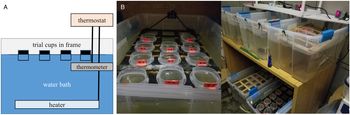
We constructed water baths using 51 L clear plastic bins housed in a constant temperature room set to 3°C (Fig. 1). The room was kept dark outside of brief daily examinations. We filled the bins with water and heated each bath using a 200 W aquarium heater with an external thermostat controller and thermometer (Hygger, China). We placed heaters on ceramic tiles at the bottom of the baths, with wired thermometers for the thermostats placed on the side of each container directly adjacent to the 0.12 L sample containers (Rubbermaid, USA). We used wood and metal frames to suspend sample containers so that water levels were matched inside and outside them. We refilled the bath and sample containers as needed to compensate for evaporation and used an unconnected thermometer to measure temperatures daily within control containers at each trial.
Water bath. (A) Diagram; (B) photos of set-up used for temperature trials in a constant temperature cold room, including frames, heaters and suspended containers. Photos C. Murphy.

Hatching observations from Petri dishes
To observe development and produce copepodids we placed individual egg sacs into petri dishes. We sorted eggs in the 3°C cold room, holding paired egg sacs separately, but with paired sample ID codes (e.g. P01A and P01B). We graded initial pigmentation from 0 (completely unpigmented) to 4 (heavily pigmented). We recorded pigmentation (0–4), opacity (Y/N), the presence of fungus (Y/N) and hatching (Y/N) daily. When hatching was observed, we gathered video footage of hatching in the lab using a Zeiss Axio Zoom V.16 stereomicroscope equipped with an AmScope MU1000 camera and software or shot video of an open petri dish containing a ruptured egg sac to track time to swimming in the cold room using a DSLR camera (Nikon D3300). A subset of nauplii were removed for preservation in EM fixative solution (2.5% glutaraldehyde, 1% paraformaldehyde in 1 m sodium cacodylate buffer) and submitted to the Oregon State University Electron Microscopy Facility for SEM imaging. Copepodids were used in survival studies when sufficient quantities were available from a hatching event.
Paired egg development from temperature trials
We used pairs of egg sacs (n = 55) of mature adult female copepods from infected fish at Rock Creek Hatchery and infected fish reared at Smith Farm (i.e. fish that had been infected from copepodids collected throughout the state of Oregon). Each egg sac was moved to a 118 mL open plastic container and placed into a heated water bath (Fig. 1). As we did not know the specific date of extrusion from the female, we focused on comparing the relative speed of development for paired egg sacs held under different thermal conditions. Paired sacs from each mature adult female were labelled as A or B and distributed within the four temperature trials including 3, 8, 12 and 15°C. One egg sac from each pair was held at 12°C whereas the other was held to the respective 3, 8 or 15°C trial. We checked hatching and measured realized temperature conditions on a daily basis in sample containers not containing eggs within each bath. For degree-day calculations, we summed the realized temperatures of each developmental day in a respective bath (before hatching) for each egg sac.
Copepodid survival across thermal conditions
When hatching was observed for egg sacs in Petri dishes, 5 sets of 15 copepodids each plus another 20 were removed (total of 95 copepodids). We did not use egg sacs that produced fewer than 95 copepodids (see Egg sac length in Results). Each set of 15 copepodids were moved to a 118 mL open plastic container. Each container was labelled based on temperature and batch (in case of disease; T °C-#; e.g. the fourth set would be labelled 3-4, 8-4, 12-4, or 15-4 – see ‘Paired egg development from temperature trials’ in Methods), with 8 replicates of the 15 copepodids per treatment. Containers were placed into heated water baths that maintained temperatures of 3.1, 8.6, 11.7, 14.5 or 18.1°C (Fig. 1). The additional 20 copepodids were placed in a container in the lab (at room temperature of 21.4°C).
We checked each water bath container daily. We used a dissecting scope in the constant temperature room (3°C), to avoid mortality due to exposure to room temperature, and removed mortalities by pipet for confirmation. We defined mortalities as copepodids that were fully immobile (including mouthparts). This was determined more accurate than active swimming because copepodids exhibited extended ‘resting’ periods followed by bursts of swimming activity. We noted that mouthparts were mobile even during these ‘resting’ periods. When no live copepodids were observed for 3 days, we removed the container from the water bath and filtered the contents using a 106 μm sieve to check for any remaining copepodids in the lab. Because of the long observation times to thoroughly examine each container, replication for copepodid survival trials was limited (eight replicates per temperature). We followed the same survival determination protocol for the copepods at room temperature (21.4°C). However, room temperature containers were examined under a microscope at room temperature, not 3°C.
We estimated the 50% mortality threshold using the ecdf (Empirical Cumulative Distribution Plot) function in R based on our survival data (R Core Team, 2014). We used simple regression analyses (95% confidence intervals) to test potential associations between thermal regimes and copepod life stages using SigmaPlot Ver. 13 (Systat Software, Inc.). We used WebPlotDigitizer (Rohatgi, Reference Rohatgi2011) to extract data from Conley and Curtis (Reference Conley and Curtis1993; Fig. 5) and compared our findings to the temperature-survival data of S. edwardsii.
Results
Evidence of naupliar stage
We found that a naupliar stage is present for S. californiensis. In all observations, we first noted the rupture of the egg sac. We did not experience any egg sac ruptures upon removal from the female (egg sacs are sealed below their attachment to the body of the female), rather this process appeared only related to hatching. The loose eggs, released when an egg sac ruptured, hatched shortly thereafter (typically within a day even at cold temperatures), but were non-mobile nauplii. The nauplii then moulted into swimming copepodids. Under the microscope at room temperature, this took ~20 min (Video S1). For eggs reared in the constant temperature room (3°C), the duration between nauplii to copepodid took hours in some cases, though exact quantification of the timing was not possible due to technical limitations in the cold room. Video and SEM confirmed the presence of a naupliar stage that moulted into the copepodid (Fig. 2). We observed that nearly all nauplii moulted under cold-room conditions, but it appeared that moulting was less consistent at room temperature (~20°C); with some nauplii failing to moult completely at room temperature conditions (21°C).
Naupliar stage documentation including. (A) SEM of an unmoulted nauplius; (B) photos of hatching and secondary moult from a nauplius to copepodid. Photos C. Murphy.

Temperature effects on egg development
Eggs became progressively more pigmented as they developed and development had a strong relationship to temperature, where higher temperatures reduced the time to hatching (see Fig 3 and Fig. S3; P < 0.001). We observed an approximate 1:1 relationship for degree-days to hatching (the sum of daily temperature exposure above 0°C) when comparing paired sacs incubated at different temperatures (Fig. 3). The slope did not vary depending on the alternate trials (Fig. S1), nor the collection site (Fig. 3). The difference in the remaining degree days to hatch observed in the experiment was consistent with the pigmentation of the egg sacs at the onset of the trial, where Smith Farm egg sacs appeared less developed when we harvested the female copepods relative to egg sacs collected from fish at Rock Creek Hatchery. Hatching occurred for both egg sacs in 42 of 55 pairs (76%). Both egg sacs failed to develop in ten pairs (18%) whereas in three pairs (5%) only one sac successfully hatched. For those three pairs, the member of the pair assigned to the warmer trial was the sac that failed to hatch. Of the pairs of sacs that failed to hatch, all but one had eggs in one or both sacs turning blue or pink, indicating potential disease (Fig. S2).
Correspondence of degree days until hatch for paired egg sacs held at different temperatures. Laboratory infections (from Smith Farm) represent eggs that were removed at an earlier stage of development and may be closer to the total degree days necessary from egg sac formation to hatching.

Temperature effects on copepodid survival
Copepodid survival was highly dependent on temperature, with a direct linear relationship between the estimated 50% survival in days and the temperature (cooler temperatures corresponded to longer survival; Fig. 4A). Median survival time decreased with increasing temperature. The longest-lived individual died after 19 days at 4°C. Five percent of copepodids were missed throughout the observations in the constant temperature room and were subsequently recovered by sieve at the ends of the trials. Copepodids that were missed prior to sieving were excluded from the analyses. The strength of the relationship between temperature and survival for S. californiensis (r 2 = 0.99) was comparable to that found for S. edwardsii (Conley and Curtis, Reference Conley and Curtis1993; Fig. 4B).
Survival in days post-hatch at six temperature treatments. (A) Percent survival by day for each temperature; (B) number of days post hatch of 50% survival by temperature with linear regression for all treatments.

Relationship of egg sac length and copepodid production
Egg sac size was linearly related to the number of eggs (Fig. 5A; P < 0.001). Interestingly, egg sac length was not always the same for paired egg sacs (Fig. 5B). The number of eggs observed in an individual sac ranged from 35 to 368, indicating highly variable reproductive rates would be derived from individual reproductive events.
Egg sac length. (A) Relationship to total number of eggs contained; (B) variability even for pairs within a single female. Photo W. Gerth.

Discussion
Our findings demonstrate the strong association between temperature and development in S. californiensis, where warmer temperatures speed development. We also found a strong relationship between temperature and survival, where cooler temperatures increase survival time. This type of association has also been documented for S. edwardsii (Conley and Curtis, Reference Conley and Curtis1993). The predicted intercepts based on our observations would indicate that copepodids of S. californiensis may have a shorter maximum lifespan, on average, under cold conditions than S. edwardsii, and a longer lifespan, on average, under warm conditions. The temperature was able to explain almost all of the variability in development and survival, and was linearly related in both cases. For egg development, the greatest degree-days to hatch for a pair was 158.2–171.7 thermal units. Given the uncertainty of previous conditions and that the initial ages of the paired egg sacs were unknown, we expect this is likely an underestimate for the total degree-days needed during incubation. However, given pigmentation and the total of our observations, we think this is potentially close to the thermal units needed for development and that it represents a number that can be used to estimate time to production for each batch of eggs.
The previous studies suggesting two batches of eggs for Salmincola spp. appear to have been identifying that two batches were present including one interior and one extruded (see Fasten, Reference Fasten1921 and citing literature). If we assume that further production did not happen, we would expect to find at least one empty female with external egg sacs. In contrast, we did not observe any females lacking interior eggs during our collections for these trials. This suggests that egg sacs could be replaced continuously, allowing females to produce more than two batches of paired egg sacs. Regardless, at optimal thermal conditions for Chinook Salmon juveniles (~12–19°C, Richter and Kolmes, Reference Richter and Kolmes2005), a fish demographic known to experience high infection burdens in reservoirs (Monzyk et al., Reference Monzyk, Friesen and Romer2015), for example, we expect that extruded egg sacs would require at least 9–14 days to hatch from an attached adult copepod female. Given that spring Chinook Salmon adults are present in the Columbia-Willamette system from spring until fall spawning (Keefer et al., Reference Keefer, Peery, Jepson, Tolotti, Bjornn and Stuehrenberg2004) and spring Chinook Salmon juveniles may be present in rivers and reservoirs for months to years (Keefer et al., Reference Keefer, Taylor, Garletts, Helms, Gauthier, Pierce and Caudill2012), these species may be exposed to (and produce) multiple generations of S. californiensis throughout these periods of freshwater residence. Infections on non-anadromous trout in the basin headwaters (Murphy et al., Reference Murphy, Gerth, Pauk, Konstantinidis and Arismendi2020a) could also produce multiple S. californiensis generations, as trout may live for six years or more (Nicholas, Reference Nicholas1977).
The existence of the naupliar stage in S. californiensis is expected, especially considering the predominance of naupliar stages in free-living and other parasitic copepods and the recent description of a naupliar stage for the sister taxa S. edwardsii (Stankowska-Radziun and Radziun, Reference Stankowska-Radziun and Radziun1993). It is plausible that previous efforts did not observe the naupliar stage due to its brief duration and the thermal influence of microscope lights on egg development and hatching success. We found that eggs developed unevenly under a hot microscope lighting and that the hatching of eggs and the moult of nauplius to copepodid was often impaired (Fig. S3, also see nauplius in the upper left corner of Video S1). The period of naupliar immobility is also consistent with observations from previous studies where the movement was delayed (Kabata and Cousens, Reference Kabata and Cousens1973). While inspections under the constant temperature room (3°C) appear to remedy this problem, inspections were uncomfortable for the observers due to the extended duration of naupliar stages (over hours in some cases), and precluded observations at time scales finer than days. This prohibited quantification of the exact timing and duration of active moulting from nauplius to copepodid under different temperature conditions. The existence of the naupliar stage may be important in considering the likelihood of processes such as auto-infection (i.e. the reinfection of the host fish by copepodids produced by copepods on that fish). Auto-infection would seem unlikely for taxa that undergo moulting before swimming or infecting a host. Though it would explain the uneven distribution of adult parasites, it is alternatively possible that copepodids preferentially target infected fish to ensure reproduction or that infected fish are more susceptible to further infection. These questions warrant further exploration.
There are important management implications of the strong thermal dependence of the development and survival of S. californiensis. For example, fish growth models in reservoirs (Murphy et al., Reference Murphy, Lee, Johnson, Arismendi and Johnson2020b) with high prevalence and intensity of infected Chinook Salmon may incorporate metrics of infection risk based on thermal conditions of reservoirs. Understanding how quickly the chalimus stages develop on fish under different thermal conditions and how temperature affects the time to first egg production are outstanding questions that could greatly aid such efforts. Yet, there is a need to estimate the lifespan of the adult female and the number of egg batches that may be produced in her lifetime to provide useful information to these empirical models. The question also remains as to whether there are associations between the number of eggs produced and female copepod age, attachment location, or fish species. Parasites may represent an increasing problem for freshwater fishes (Marcogliese, Reference Marcogliese2008). This appears to be true for S. californiensis, even outside of climate change, as it is associated with global introductions of Pacific salmon and trout outside of their native ranges (Ruiz et al., Reference Ruiz, Rash, Besler, Roberts, Warren, Arias and Bullard2017; Mullin and Reyda, Reference Mullin and Reyda2020) and with reservoir habitats that are increasingly common worldwide (Hargis et al., Reference Hargis, Lepak, Vigil and Gunn2014; Monzyk et al., Reference Monzyk, Friesen and Romer2015). In this case, it appears that revisiting old assumptions is a necessary step to improving our knowledge of the life history and development of S. californiensis critical to planning contemporary management.
Supplementary material
The supplementary material for this article can be found at https://doi.org/10.1017/S0031182020001109
Acknowledgements
We thank the Oregon Department of Fisheries and Wildlife, especially the Elk River and South Santiam fish hatcheries personnel, for allowing us to remove copepods from processed fish. We acknowledge the US Army Corps of Engineers, JPL 19-03-SYS, and Oregon State University for funding and support during this research. This work would not have been possible without the support of the Oregon State University Department of Fisheries and Wildlife for space in the constant temperature room for these experiments and to the personnel at Smith Farm for access to copepods and discussions on disease. Emilee Mowlds provided invaluable assistance including long days in the constant temperature room. James Peterson, Travis Neal, Carl Shreck, Crystal Herron, Justin Saunders and Mike Kent provided invaluable copepod insights, expertise and enthusiasm. Thank you also to Rachel Neuenhoff, Greg Taylor, Jeremy Romer, Ben Cram, Terri Berling, and Todd Pierce for discussions and observations of copepods parasitizing fish collected in and below USACE projects. We thank the anonymous reviewers who provided comments and edits improving the final version of this manuscript. The views expressed in this publication are solely those of the authors, and do not reflect official policy of the U.S. Government nor endorse any products or commercial services.
Financial support
This work was supported by the US Army Corps of Engineers (grant number JPL 19-03-SYS).
Conflict of interest
The authors declare that they have no competing interests.
Ethical standards
The authors assert that all procedures contributing to this work comply with the ethical standards of the relevant national and institutional guides on the care and use of laboratory animals. All S. californiensis specimens used here were opportunistically collected from fish that had been euthanized for other projects and purposes.