Outbreaks of aspergillosis during hospital construction projects are well described. Guidelines for infection prevention during construction are supported by the demonstrated effectiveness of containment strategies.Reference Hahn, Cummings, Michalek, Lipman, Segal and McCarthy 1 – Reference Chang, Cheng and Devitt 3 In the modern era of carefully monitored renovations, construction-related Aspergillus outbreaks have decreased; recent reports note serious deviations from the advised infection prevention plan.Reference Chang, Cheng and Devitt 3 , Reference Freeman, Rogers and Roberts 4
The infection prevention department at our 800-bed tertiary care academic hospital was notified of an increase in positive Aspergillus clinical cultures simultaneously by clinicians and the mycology lab in December 2014. An investigation was performed, and assistance from Maryland Department of Health and Mental Hygiene was requested.
METHODS
The quarterly numbers of positive cultures for Aspergillus species for the previous 2 years were obtained from the infection prevention surveillance database. Charts of patients with positive Aspergillus cultures from September 1, 2014, onward were reviewed by 2 infectious disease physicians (M.D. and S.L.) for the presence of clinical disease and were classified as proven, probable, possible, or not consistent with disease following published guidelines.Reference De Pauw, Walsh and Donnelly 5 Each case of clinical disease was reviewed for possibility of healthcare-associated infection using criteria of symptom onset >7 days after admission or extensive healthcare exposure. For cases not consistent with disease, a determination of colonization or contamination was made based on risk factors and results of additional cultures.
All construction and renovation work in the hospital in the preceding 6 months was reviewed with special attention to type C and D projects, which by definition have the potential to generate a moderate amount of dust or involve removal of fixed building components or major demolition. 6 Ongoing construction activities received an on-site investigation.
Environmental sampling was performed with a Six-Stage Viable Andersen Cascade Impactor (Thermo Fisher Scientific, Waltham, MA)Reference Anderson 7 and settle plates in representative clinical areas and adjacent to renovation projects. Aspergillus isolates recovered from clinical and environmental samples underwent genotyping using random amplified polymorphic DNA analysis for A. flavus Reference Lutz, Jin, Rinaldi, Wickes and Huycke 8 and cell-surface protein typing for A. fumigatus.Reference Balajee, de Valk, Lasker, Meis and Klaassen 9
RESULTS
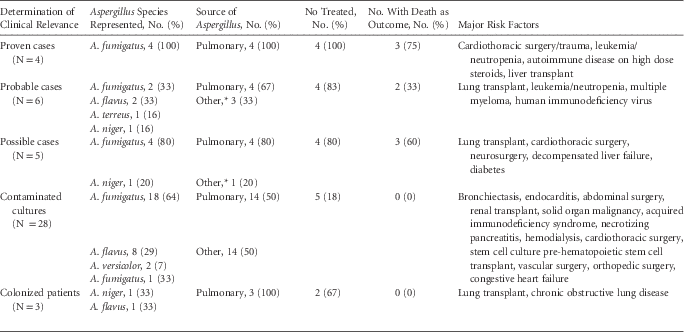
An increase in positive Aspergillus cultures was noted during October–December 2014, with 76 positive cultures from 46 patients compared to a baseline of 13 (±3) positive cultures from 14 (±2) patients for the previous 7 quarters. The total number of fungal cultures processed by the laboratory remained stable through all quarters. Positive cultures were primarily A. fumigatus (51 of 76; 67%) and A. flavus (18 of 76; 24%); they originated from diverse locations in all 4 hospital buildings, and 37 of 76 samples (49%) originated from unusual sources such as urine, pericardial fluid, wounds, and donor stem cells (Table 1). The majority of cultures (44 of 76; 57.9%) were considered likely to have been contaminated. Of 46 patients, 15 met the criteria for possible aspergillosis (n=5; 11%), probable aspergillosis (n=6; 13%), or proven (by histology) aspergillosis (n=4; 9%). Of these cases, 8 (53%) were considered community acquired. A total of 20 patients (43%) received antifungal therapy, including all proven cases and 5 probable cases. In addition, quality control slants in the mycology incubator grew Aspergillus fumigatus.
Characteristics of Patient Cultures Positive for Aspergillus spp. October 2014–December 2014 by Clinical Significance Group

* Other culture sources included central nervous system, ophthalmic, blood, mediastinal, pericardial, peritoneal, nasal sinus, urine, joint, and stem cell donor cultures.
Multiple type C and D construction projects had occurred or were ongoing at this hospital; the most significant was construction of a new inpatient unit 2 floors immediately above the laboratory. Standard containment procedures were being followed by construction personnel. Although construction sites were adequately sealed off, a stairwell with microbiology laboratory access was identified on the second floor that had a street exit on the ground floor. The mycology incubator was located in the laboratory immediately adjacent to the stairwell door, and adjacent to the stairwell’s street exit was a large, open dumpster that received construction debris via a chute. Laboratory and other staff also used the stairwell to access the street and sometimes propped the door open for re-entry.
Within the microbiology laboratory, blank settle plates were negative in several locations except within the mycology incubator, where 2 plates grew A. fumigatus. Initial air sampling revealed a focus of Aspergillus fumigatus (>19,000 cfu/m3) in the stairwell at the laboratory entrance on the second floor. Two additional samples from distinct floor sites at higher levels within the same stairwell and those from other locations within the laboratory space were negative (<7 cfu/m3 of any fungus), as were air samples from multiple hospital locations including air handlers at the point of supply. Repeat air sampling 2 weeks after cleaning of the stairwell revealed persistent low-level Aspergillus (average, 14 cfu/m3) at 3 sites.
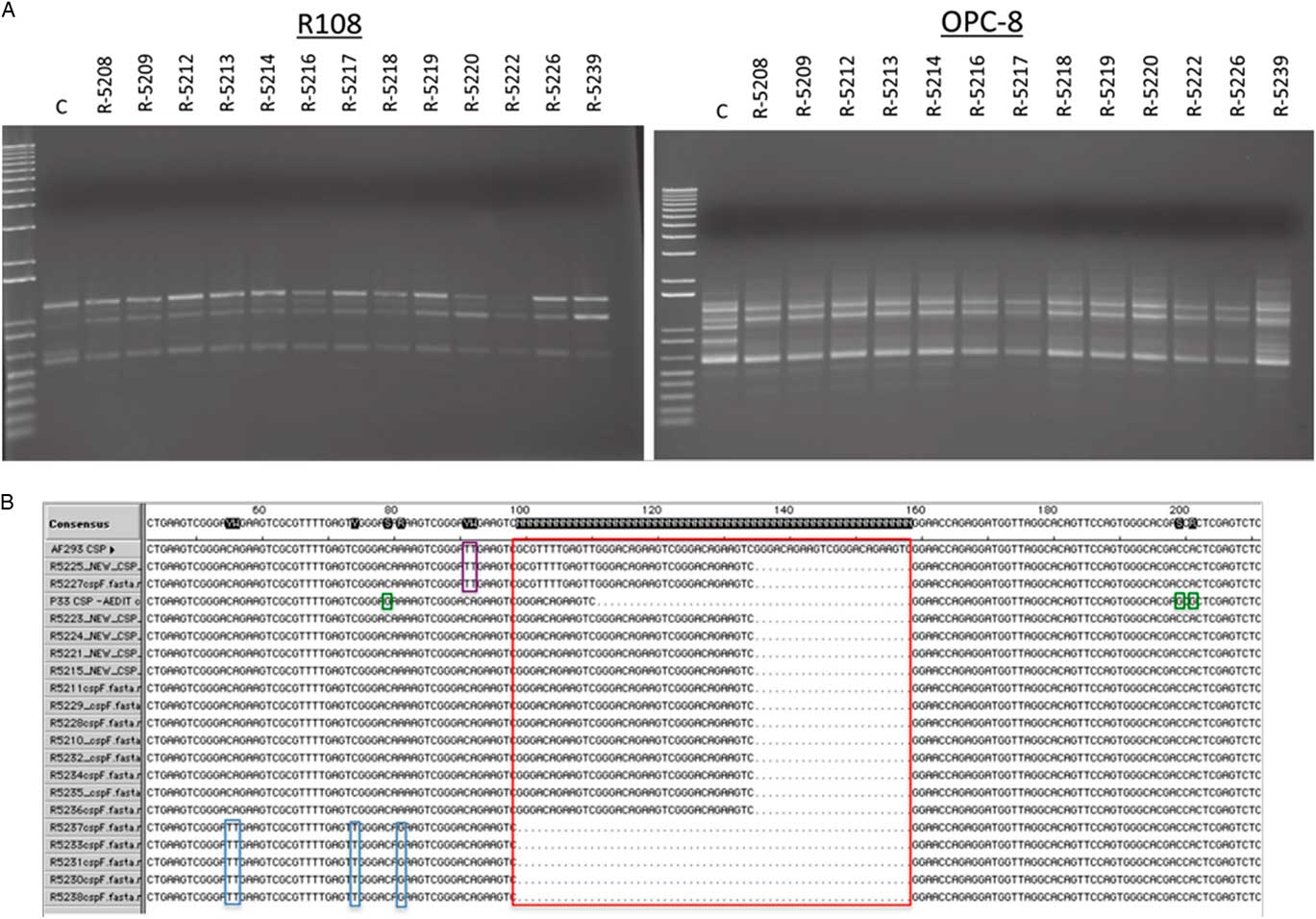
Genotyping was completed on 32 isolates; 29 (of 76) clinical and 3 environmental isolates revealed a high level of relatedness (Figure 1). Of 13 A. flavus isolates, 12 were identical; the only distinct A. flavus specimen was from a community-onset case. The A. fumigatus genotyped isolates were classified in 3 distinct groups: the largest genotypic group (n=12) contained 10 contaminated cultures and 2 possible cases; the smallest genotypic group (n=2) contained 1 contaminated culture and a settle plate from the incubator; and a third group (n=5) contained the environmental sample from the stairwell and 4 clinical cultures (1 proven case, 1 probable case, and 2 contaminated samples). No locations or procedures were identified that linked the patients with related isolates.
A pseudo-outbreak from contamination in the mycology incubator was suspected. Control measures included outsourcing of fungal cultures to another laboratory, cleaning of the mycology incubator, and relocation into a room spatially segregated from the stairwell, thus prohibiting laboratory staff access to the stairwell. These measures occurred simultaneously and yielded a decline in the following quarter to 21 positive cultures from 10 patients.
DISCUSSION
The results of the investigation were most consistent with a pseudo-outbreak from contamination of fungal cultures in the mycology incubator, with an exit stairwell serving as a potential “conduit” between construction debris and incubating cultures. The temporal clustering of multiple positive cultures with unusual specimen sources lacking clinical correlates supported this determination. Growth of Aspergillus spp. on settle plates and quality control slants in the incubator and genetic relatedness of nearly all isolates (2 species, 4 separate clusters) corroborated a pseudo-outbreak.
While lacking the devastation of true patient infections, pseudo-outbreaks are problematic. The clinical significance of positive mold cultures is often difficult to determine; most patients have risk factors prompting fungal culturing, and positive cultures lead to potentially unnecessary antifungal therapy. We detected a possible delay in diagnosis of true infection, as several patients had concurrent positive cultures with other microorganisms. Finally, the costs of environmental sampling, genotyping, and outsourcing of fungal culturing were substantial.
Limitations of this study include genotyping of only 38% of positive clinical cultures; many isolates were no longer viable by the time genotyping was performed. Air sampling volumes may not have been sufficient to detect lower-level Aspergillus contamination in the environment. Air sampling was also limited by the inherent inability to identify transient “plumes” of contaminants. The seeming relatedness of isolates from patients with clinical disease with those from contaminated cultures is difficult to explain. However, the proven case had concurrent positive cultures for Rhizopus spp., raising the possibility that the Aspergillus growth represented culture contamination in the presence of other fungal disease. The areas were these patients were housed have unique air handling systems, and several locations use HEPA filtration, making dissemination of Aspergillus via air supply highly unlikely.
Our experience should alert hospitals to the potential for construction-related Aspergillus outbreaks even in the setting of appropriate site containment provisions. It also reinforces the importance of good laboratory quality assurance in identifying inaccurate results.
Genotyping results of selected clinical and environmental cultures. (A) Random amplification analysis of A. flavus samples using Opc 10 and R108 primers. The control strain designated C is distinct from each specimen. Identical patterns for each specimen sample occur with each primer with the exception of isolate R5239. (B) Cell-surface protein typing for A. fumigatus samples along with unrelated controls AF293 and P33. These results suggest the presence of 3 groupings of related samples: R5225 and R5227, R5223 through R5236, and R5237 through R5238.

ACKNOWLEDGMENTS
Financial support: No financial support was provided relevant to this article.
Potential conflicts of interest: All authors report no conflicts of interest relevant to this article.