INTRODUCTION
The rise of Hamburg as a global marketplace and financial centre in the seventeenth century was a significant sign of the bourgeoning integration of European markets. In the early seventeenth century, the urban staple function in northwest Europe was largely concentrated in Amsterdam, while in the late seventeenth and eighteenth centuries London and Hamburg rose to preeminence. Hamburg served as a hub for international trade, connecting markets in England, Germany, Hungary, Poland, the Baltic, and the Mediterranean. Goods such as raisins, sugar, tobacco, salt, iron, and leather changed hands, with the transactions reflecting the widespread mercantile network in which Hamburg took part. Furthermore, the commercial development of Hamburg and the rise of the Prussian state were important steps in creating a well-ordered and integrated urban network in Germany long before political unification.Footnote 1
That several cities were connected in urban networks that transcended national borders was of great importance, since expansion of the network helped create stable economies that were less vulnerable to the disruptive effects of economic slumps, wars, and tariff policies.Footnote 2 The rise of Hamburg has traditionally been explained in terms of two factors: First, the city occupied a favorable geographical position due to its proximity to the expanding Atlantic traders England, the Netherlands, and France. Second, Hamburg is said to have possessed a unique spirit of tolerance and freedom that made its civic-minded merchant-entrepreneurs able to profit from the expanding international trade.Footnote 3
There is, however, an element of circular reasoning involved in explaining the rise of Hamburg in terms of external geographical factors. Its emergence as a marketplace was endogenous to the development of an urban hierarchy of commercial metropolises; it was not simply caused by external forces that acted to boost its commercial development.
Doubts have also been raised concerning the spirit of liberalism and tolerance that historians traditionally have attributed to Hamburg. As emphasized by Whaley, a long line of historians beginning around 1800 has created an image of Hamburg as a city with a liberal and egalitarian spirit, forgetting or downplaying the numerous social upheavals that also shook it from time to time.Footnote 4 Further, many foreign merchants met opposition, particularly from the clergy, whose concern for purity of faith made them hostile to non-Lutheran merchants. Nevertheless, despite opposition from some groups, Hamburg did develop a unique political economy (if not a political culture) in which indigenous and foreign merchants were, in economic terms, treated more or less equally.
This article explores why Hamburg, despite opposition from powerful groups, welcomed foreign merchants, and how it made the transition from an old-style central European corporative town, where trade was reserved for a small privileged circle, to a northwest European commercial metropolis that generated economic growth for the whole continent by its openness to immigration and wider economic participation. I will examine the internal political process that created the secure trading environment necessary for Hamburg's growth, and argue that its rise owed less to its geographical position and more to its unique political constitution. This political constitution, as will be shown, helped to create secure property rights for foreign and local merchants alike, mitigated religious intolerance, and made Hamburg an attractive trading center on a par with Amsterdam and London. Many historians have noted that the commercial dynamism of early modern Europe was centered in those western European cities that were engaged in the Atlantic and Baltic trades.Footnote 5 Paul Bairoch demonstrated that port cities recorded the fastest growth of all cities in Europe during the period between 1500 and 1700.Footnote 6 It cannot, however, be taken for granted that urbanization and rising prosperity will automatically arise from foreign trade, capital concentration, population growth, an increased division of labor, development of innovations, or technological transfers. Urbanization and rising prosperity were the results of historical developments, and dependent on a set of institutions that favored growth. The present study compares institutional development in Hamburg and Lübeck, the leading city of the mighty medieval Hanseatic League that declined into insignificance during the early modern period. This comparative study of two closely related cities with initially similar structures and fundamentally different growth paths sheds light on the importance of property-rights institutions for economic development in early modern Europe.
Conventional wisdom asserts that the Dutch dominated the Baltic trade in the sixteenth century and first half of the seventeenth century and that they maintained a strong position after this period. Large quantities of grain and, to lesser extents, wood, flax, hemp, iron, tar, copper, and other commodities were shipped from the Baltic to western markets. With the intrusion of Dutch merchants and shippers into the area, merchants of the old Hanseatic League were unable to keep up with the new competitors.Footnote 7 This image of events, however, is only partially true. Merchants in Baltic towns may have been forced out of the shipping market, but the foreign merchants still had to fetch their goods from the Baltic towns. In these towns, the foreign traders encountered local merchants who were equipped with local trade privileges that provided them with local monopolies when engaging in trade. That the Hanseatic League ceased to exist by 1669 (after a considerable period of decline) does not imply that the once important merchant guilds—into which the merchants in most cities were organized—no longer played a role in trade: in many cities merchants maintained their local trade monopolies even after relinquishing their trade activities in foreign lands.
Recent studies have debated the institution of merchant guilds as different institutional approaches to history have gained popularity. Traditionally, economists have been skeptical of the role of merchant guilds, since they were assumed to have acted largely as monopolists. However, a new strand in the social science and historical literature claims that merchant guilds played a crucial role in providing an institutional foundation for the commercial revolution in the late Middle Ages and early modern period. Resolving this issue will require additional empirical studies of the effects of merchant guilds on trade, and this article provides evidence that helps to address the theoretical debate.
INSTITUTIONS AND EARLY MODERN TRADE
The economist Avner Greif asserts, “We know very little about the institutional foundations of exchange in past societies.”Footnote 8 Greif identifies the possibility that traders might renege on previously made promises as the “fundamental problem of exchange,” and he proposes a research agenda in which social institutions fulfill a third-party contract-enforcement mechanism. One of the most important social institutions which Greif claims underpinned pre-modern commercial expansion was the merchant guild.Footnote 9 In this view, merchant guilds “emerged with the encouragement of the rulers of trading centers to be a countervailing power, enhancing the ruler's ability to commit. …”Footnote 10 Rulers voluntarily endowed powerful bodies of foreign merchants with the power to act in a countervailing fashion because, “Trading centers needed to be organized in ways that secured the person and property of the visiting merchants. Before a trading center became established, its ruler might be inclined to pledge that foreign traders would be secure and that their rights would be respected. Once trade was established, however, the medieval ruler faced the temptation to renege on that pledge, failing to provide the promised protection or abusing the merchant's property rights by using his coercive power.”Footnote 11
The merchant guild allegedly solved the ruler's commitment problems by enforcing compliance by its individual members, thereby providing a collective and credible threat of boycotting the ruler if he attempted to renege on his promises.Footnote 12 This interpretation of the pre-modern merchant guilds is thus an attempt to explain their existence in terms of their benefit to society. Members of guilds also used this argument to justify their existence.Footnote 13
Often taken for granted is that the growth of trade in early modern Europe was incompatible with the existence of feudal institutions and urban guilds. It has been suggested that trade expansion by itself undermined the position of these groups, or as Supple suggests: “Guilds, as institutional adjustments to static or circumscribed markets, designed to guard against vicissitudes of competition or change, were bound to decline in importance wherever marketing areas or lines of communication were extended.”Footnote 14 It is, however, misleading to generalize about the nature of institutional changes in early modern trade based on the development of English and Dutch mercantile practices and experiences. The English and Dutch cases, where the guilds declined rapidly after circa 1500, were exceptions to the general trend. In many parts of Europe, including the Baltic, economic and political resources were concentrated in the hands of a few via the generous use of legal privileges.
The literature on pro-merchant guilds is mainly concerned with the medieval period, since it is assumed merchant guilds were in decline after about 1500. The reason for the decline is said to have been the evolution of the state: “As the state system evolved, the need for the merchant guilds to secure merchants' rights declined.”Footnote 15 In purely theoretical terms, it might have been possible for merchant guilds to function in accordance with the credible commitment model summarized above, but recent historical studies call into question the positive view of merchant guilds. The historical record clearly shows that merchant guilds in most parts of Europe not only remained in existence after 1500, but actually increased in importance, despite the states' increasing capacity to guarantee law and order and commercial security for merchants.Footnote 16
Another prominent explanation for the existence and evolution of guilds has quite different implications for the question of economic efficiency, since it presents guilds as the origin of contractual difficulties rather than as their solution. What a merchant could not do without formalized cooperation with other merchants was protect himself from competition, and from taxation and expropriation by ruthless rulers. To control the degree of competition they faced, which they often described as “unfair,” wealthy merchant elites in many parts of Europe organized themselves into merchant guilds or dominated their local city councils, thereby obtaining monopolistic privileges and excluding outsiders.
There are many reasons why the markets in early modern Europe did not function smoothly. Powerful grain-growing lords and urban merchants had vastly greater political, economic, and often military resources than the rest of the population. In the sixteenth century, the Baltic area became increasingly important as a marketing area, and its lines of communication were extended. It is possible that the incentives for corporate groups to create different kinds of monopolies increased in early modern Europe as trade volumes rose.
The German Hansa, for example, was a result and not a cause of the great expansion of German trade in the fourteenth century. According to Postan, the prime reason for the Hansa's existence was to maintain by political means that place in European trade it had won for itself in the preceding epoch.Footnote 17 Similarly, the great expansion of proto-industries in central Europe between 1500 and 1800 in many places strengthened, rather than broke down, corporate institutions such as communities, craft guilds, and merchant guilds.Footnote 18
Thus, we cannot take for granted that a dynamic infrastructure of commercial institutions will arise as trade expands. The Baltic area produced huge quantities of grain, timber, flax, hemp, iron, and other raw materials that supplied the west European armies, navies, and civilian populations. The production of these basic goods took place in the vast regions surrounding the Baltic Sea, stretching far into Russia, central Europe, and Scandinavia. Swedish iron, Polish grain, Baltic hemp and flax, Russian leathers—all were produced in the Baltic hinterlands and later transported along the rivers that flowed into the Baltic and Arctic Sea. In return, salt, wine, raisins, spices, and bullion flowed eastward. Important trading cities developed at the mouths of the great rivers: Hamburg and Lübeck in northern Germany, Danzig and Königsberg in Prussia, Riga and Reval in the eastern Baltic, Stockholm in Sweden, and Archangelsk and St Petersburg in Russia, together with several minor towns. These cities were part of larger urban networks that included London and Amsterdam, as well as cities in Southern Europe. In some of them, legal privileges governed trade well into the nineteenth century, whereas in others such privileges broke down. As we shall see, this had a profound effect on the economic performance of these cities.
HAMBURG AND LÜBECK IN THE EARLY MODERN PERIODFootnote 19
The most famous of the great, guild-like merchant associations of medieval and early modern Europe was undoubtedly the German Hansa. The core of the Hansa was built around the cities of Lübeck and Hamburg in northern Germany; the relations between these cities were very close during the medieval period. Lübeck was the undisputed “capital” of the Hansa, while Hamburg's role has, with some exaggeration, been characterized as “the port of Lübeck” on the North Sea, since the merchants of Hamburg often acted as commissionaires for the wealthy merchants of Lübeck.Footnote 20 Over time, the close ties between the two cities deteriorated. By 1547, the council in Hamburg had already declared that the ancient connections with Lübeck were “of absolutely no value.”Footnote 21 From being an important trading place for the merchants of Lübeck and an ally in the politics of the Hansa, Hamburg soon began to outgrow her former sister city.
As the trading network of the Hansa broke down, Lübeck lost its dominant position within north European trade. From the mid-fifteenth century, it no longer functioned as the commercial link between the Baltic and western Europe.Footnote 22 With the rise of Dutch and English shipping, Lübeck lost its leading role as trade routes formed directly between the Baltic and west European ports. The Dutch successfully exploited conflicts of interest between Lübeck and the other Hansa towns around the Baltic Sea. Other towns were more interested in establishing direct trading routes with the west than in maintaining the old system whereby only Hanseatic merchants were allowed to trade in Hansa towns. Thus, the Hansa's monopoly of east–west trade was shattered, opening the way for the intrusion of, among others, Dutch and English merchants into the Baltic area.Footnote 23 By the end of the fifteenth century, the Dutch had a clear dominance over Baltic trade, although the richest trades, such as spices, remained in the hands of the Hansa merchants.Footnote 24 After the fall of Antwerp in 1585, Amsterdam emerged as northern Europe's economic center, and Dutch control of the Baltic spice trade at this time marked the end of the dominant role of the Hanseatic cities within northern European trade.Footnote 25 The biggest loser in this process was Lübeck. As Lübeck's century-long stagnation began, Hamburg rose as a leading global financial and economic marketplace, overshadowed in northwestern Europe only by London and Amsterdam.
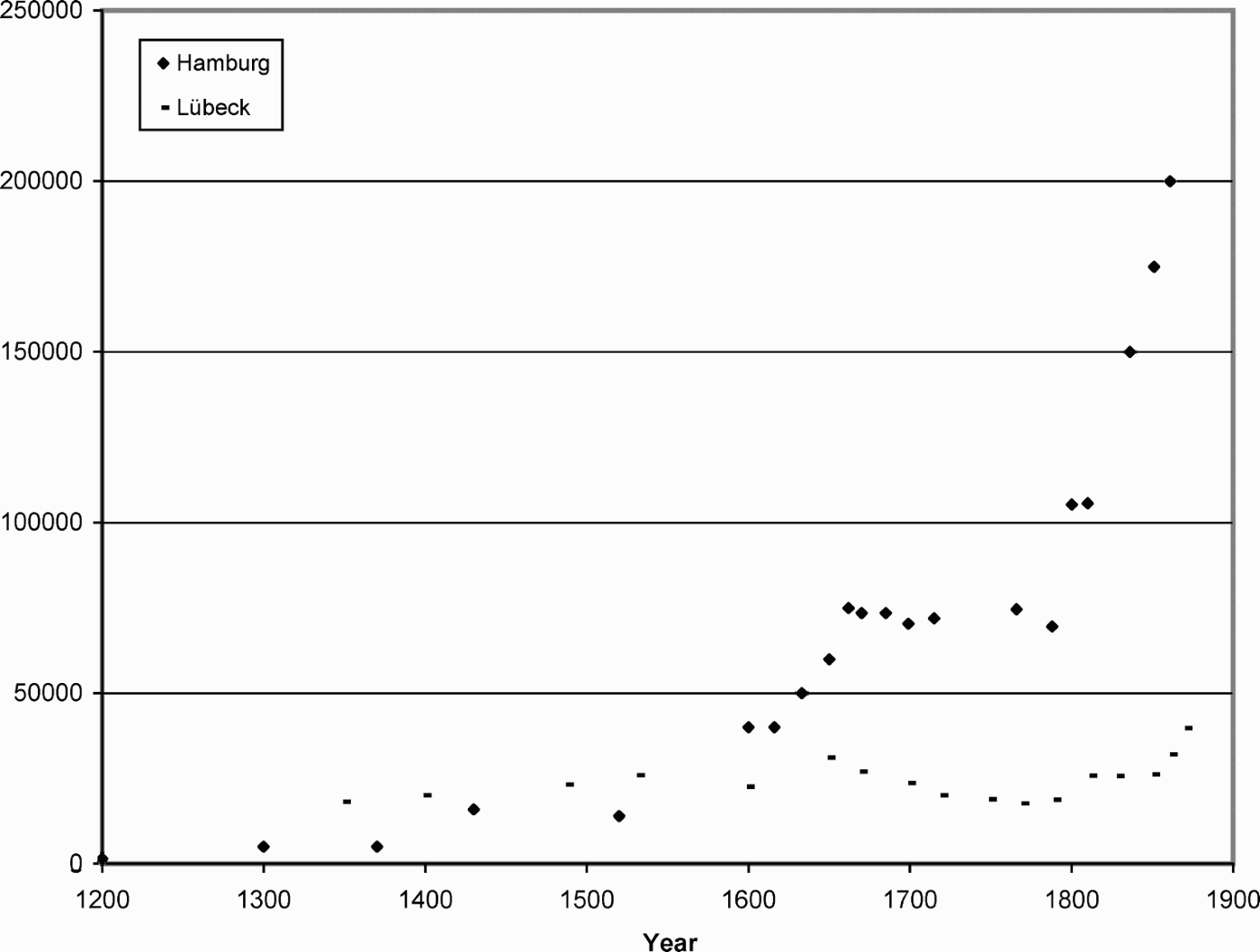
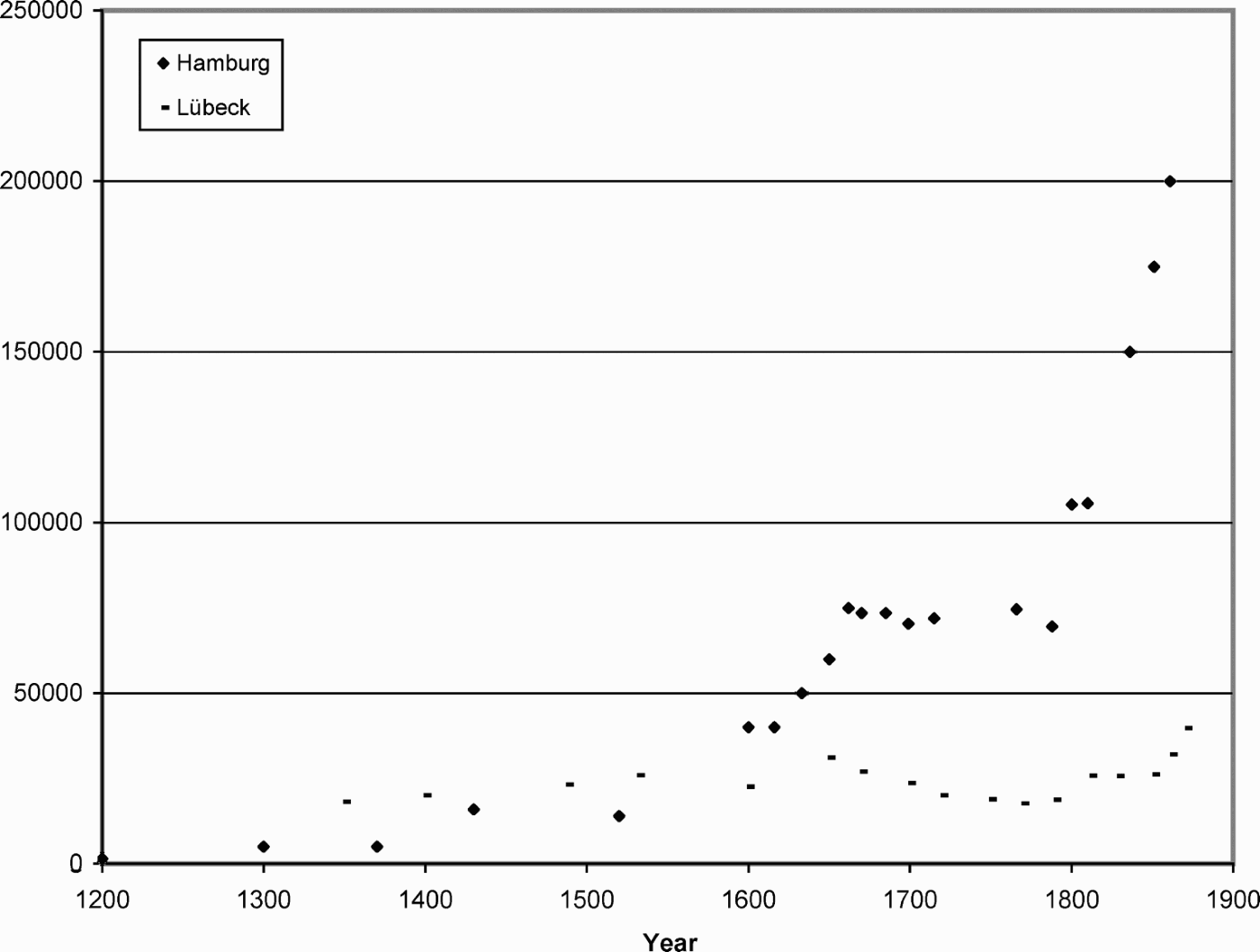
In the unfortunate absence of trade statistics and other data, the best way to trace the relative economic development of Hamburg and Lübeck is in terms of population figures (Figure 1). The larger cities of Europe were important nodes of information, industrial activity, and market exchange within urban networks. As cities could only exist in areas where economic specialization and agricultural productivity was able to support a large urban population, city size is often used as a rough indicator of economic prosperity.Footnote 26 The divergence in city size depicted in Figure 1 clearly reflects the different growth paths taken by Hamburg and Lübeck in the early modern period, starting in the sixteenth century.
The Population of Hamburg and Lübeck, 1300–1871. Source: E. Keyser 1939.Footnote 27
Trade statistics from the two cities are rare, but some figures from the mid-eighteenth century show that Hamburg's imports were ten times those of Lübeck—yet another indicator of the changed positions of the two cities.Footnote 28 The importance of imports was one thing that distinguished the economies of Hamburg and Lübeck from other cities around the Baltic. While most cities based their prosperity on the export of raw materials and semi-finished goods, from the late sixteenth century Hamburg was an important gateway for imports. Footnote 29
Hamburg's commercial supremacy also involved domestic trade, which took place via the great rivers. The Elbe River, famous in historical literature as the partition between feudal and backward eastern Europe and market-oriented western Europe, ran through the city and ended at the North Sea. This waterway is sometimes referred to as Hamburg's decisive advantage over Lübeck, which was situated close to the less-traveled Trave River, which flowed into the Baltic Sea. The advantages of having direct access to the Elbe River should not, however, be exaggerated. From 1398, Lübeck had access to the Elbe via the Stecknitz Canal. It is true that ships traveling along the canal had to pass through a number of locks, but the canal represented a direct waterway between Lübeck and the Elbe. The canal had two main functions: to transport salt from the city of Lüneburg and to transport all kinds of goods between Hamburg and Lübeck.Footnote 30
A turning point in terms of Hamburg's shipping on the Elbe occurred in the 1560s. Up to then, ships from Hamburg represented just 6 percent of all ships traveling upstream to the German hinterland, but after 1570 that share rose to more than 30 percent.Footnote 31 Any further expansion of trade along the river was prevented by an infamous structure of internal tolls, which cut up trade between different German territories until the Customs Union of the nineteenth century.
In general, however, the great German port cities were not situated close to densely populated market areas (in contrast to Dutch cities). Port cities in Germany were embedded in agricultural areas that were neither significant industrial producers nor important consumer markets; consequently, purchasing power was low. Hamburg was far from the most important markets: Leipzig was 370 km away, Vienna 700 km, and Berlin 285 km.Footnote 32 Geographic factors alone, then, cannot explain Hamburg's emergence as a global marketplace, and instead we must take a closer look at the political foundation of the city's commercial institutions, which enabled trade to expand.
THE COMPARATIVE POLITICAL ECONOMY OF HAMBURG AND LÜBECK
An important reason for the decline of Lübeck in the early modern period was its internal political economy. Beginning in 1605, strict rules were enforced against foreigners and non-Hanseatic merchants trading in Lübeck. This was a defensive strategy. In the face of increasing competition from Dutch and English merchants, the city chose to defend the home market, at least, as a place where its merchants could exercise their monopoly power. At first, the prohibition related only to particular foodstuffs—grain and salmon—but it was quickly extended to the important copper trade. Merchants from Hamburg usually imported copper from Sweden via Lübeck, where copper was reloaded for further transport to Hamburg or the European markets. The council of Lübeck prohibited this practice; instead, the goods had to be sold to a merchant residing in Lübeck, after which they could be resold to merchants from Hamburg or elsewhere.Footnote 33 By enforcing the principle that all goods had to be sold first to Lübeck merchants, an artificial barrier was created in the flow of trade between merchants from Hamburg and Amsterdam and those from the smaller towns around the Baltic. Previously, these merchants had met in Lübeck to exchange goods and payments. Unsurprisingly, foreign merchants strenuously opposed enforcement of this so-called “staple.”Footnote 34 Lübeck, however, was not alone in this practice: many small towns throughout northern, central, and southern Germany imposed similar measures in an attempt to protect the interests of local merchants at the expense of the wider society.Footnote 35
Lübeck combined its prohibition of transit trade with the enforcement of its staple: goods had to be unloaded in Lübeck and sold to a local merchant. According to Baasch, the prohibition of transit trade probably breached imperial law, and merchants from other cities also questioned it. However, imperial law forbade Hamburg from taking countermeasures such as prohibiting Lübeck from using the Elbe River to transport goods to Hamburg. The restrictions in Lübeck also affected merchants from other cities; Lübeck was, after all, still an important marketplace. The merchants of Nuremberg, for example, used to unload their Polish lead from Danzig at Lübeck for further transport to various markets. The new regulations meant that Lübeck merchants imposed a wedge between the sellers and buyers of lead, thereby leading to an increase in prices and interrupting the flow of goods.
Lübeck's right of staple was based on an imperial letter of privilege dating from the twelfth century, and it was considered a cornerstone of the city's wealth. The new trade regulations promulgated in 1607 codified the prohibition of free transit and the right of staple; that is, Lübeck was continuing into the early modern period guild restrictions on commerce which had been typical of most European cities in the medieval period. Trade in most of the goods coming from Denmark, Norway, Sweden, and Finland (including copper, iron, fur, and tar) was the privilege of Lübeck merchants. Other Hanseatic merchants trading there were only allowed to deal in Russian goods, and trade with the former Hansa counting house (Kontor) in Russia had long since ceased to be important.Footnote 36
Lübeck's merchants and artisans did not unanimously support the hostile treatment of foreign merchants (referred to as “merchant-strangers” or “guests”). In addition to the usual array of artisan guilds, Lübeck had several different merchant guilds with opposing interests. As already noted, many historians have taken it for granted that the archaic structure of trade in the form of guilds was dissolved during the early modern period. However, guilds in Lübeck, as in many other German towns, continued to play an important political and economic role well into the nineteenth century.Footnote 37
Lübeck's restrictions on foreign merchants harmed those local merchants who lost business opportunities due to them, but the regulations were supported by the largest and most important merchant guild: the Schonenfahrer. The Lübeck council was aware of the risks in employing such policies, and retailers and artisans claimed that the restrictive trade policies had greatly damaged trade.Footnote 38 The Schonenfahrer claimed to speak in the interest of all merchant guilds, and the Lübeck council was especially responsive to the wishes of this guild's wealthiest merchants.Footnote 39 However, the restrictive policies also had strong opponents among some of the wealthy merchants, who were engaged in the wholesale long-distance trade. Another guild, the Kaufleutecompagnie, repeatedly pointed out the dangers of barring foreign merchants, lest it lead to the cessation of trade in Lübeck. They argued that the city should open the important iron trade to all traders. The prophecy of the Kaufleutecompagnie proved to be true. The direct trade in iron between Hamburg and the Baltic increased in volume, especially after the 1630s.Footnote 40 Not until 1728 were foreign merchants in Lübeck allowed to trade freely with one other.Footnote 41
For the guilds to be able to restrict entry (both of foreign merchants and merchant apprentices), they had to gain political influence in the city. The guilds and the city council usually had conflicts of interest when it came to expanding the merchant population. The city council wanted to attract more merchants in order to stimulate trade, and to extract taxes from them, while the guilds wanted to restrict entry to increase the wealth of their established members. This was one of many fundamental conflicts of interest between city administrations and the guilds in German towns.Footnote 42 Lübeck was the home to many merchant guilds besides the Kaufleutecompanie and the Schonenfahrer: Nowgorodfahrer, Islandfahrer, Bergenfahrer, Rigafahrer, Stockholmfahrer, Gewandschneider, and Krämer-Compagnie.Footnote 43 These guilds were commonly in conflict regarding how to divide the different trade privileges.
The impact of the guilds was not restricted to the economy; they also had an important influence on politics and social trends. By organizing itself in terms of powerful corporations, which were social, political, and economic in character, Lübeck restricted the right to engage in the export trade. In 1669, when it was decreed that the majority of city council members had to be drawn from the established merchant guilds, the merchants finally attained almost full control over the city's politics.Footnote 44 This move had a profound effect on the principles of entry into different markets, as Lübeck became a closed city that served only established interests. As I have said, there were constant conflicts in all pre-industrial German cities between the city councils and citizens, especially the tax-paying minority engaged in handicrafts and trade—the burghers. Though wealthy merchants and magistracies shared many personal bonds, it is clear that merchants and artisans had different interests from those of the magistracies.
A question of particular controversy was how many people should be allowed to become burghers, which gave them the right to trade or conduct a craft. For the city councils, it was usually important to have an open attitude, since new burghers provided taxes and other services of great importance in financing the city's defense. The established burghers had a different view, since for them the overriding goal was to ensure that the number of burghers was kept constant—new burghers threatened the income of established ones.
POWER-SHARING IN EARLY MODERN CITIES: INSTITUTIONAL CHANGE AND ECONOMIC DEVELOPMENT
From medieval times, the city council controlled Lübeck's finances, and the burghers were the main taxpayers.Footnote 45 This arrangement was a source of perennial conflict as the burghers sought to control how the council used taxes and the council wanted to be free of their control. Not until 1669 were the burghers granted the right to participate in the government of the newly established city treasury.Footnote 46 In Lübeck, the council was dominated by a close-knit patriciate, a handful of families living on different forms of rent. A small group of patricians dominated Lübeck's politics from medieval times well into the nineteenth century, except for a few periods of unrest when merchants were able to briefly seize political power.
The city's constitution remained virtually unchanged until 1669. It stated that burghers should be consulted on major issues, but by and large, burgher-council relations remained unregulated. At times, this gave rise to conflicts between the two groups. There were no absolute boundaries between the council and merchants, but it is clear that the leading council members came from a small circle of five to six families who belonged to an association named the Zirkelkompanie, along with a further twenty-odd leading merchant families.Footnote 47 Some of these families were mainly landlords, living off land rents, while others were prominent merchants. That as many as one-third of the magistrates were not born in Lübeck does not contradict the observation that an inner circle dominated the council.Footnote 48 The council's two overriding tasks were to govern the city, including justice and administration, and to guard and protect the privileges of its citizens within the city and abroad.Footnote 49 Failure to perform these tasks seriously threatened the legitimacy of council members, who were ultimately dependent on the support of the citizens.Footnote 50
Conflicts between merchants and council were always provoked by issues of taxation. For example, the aforementioned tightening of the trade legislation in 1605 was the result of conflict between council and merchants around 1600. Lübeck had supported the losing side in the contest for the Swedish crown. Sigismund, a Catholic and son of the former Swedish King Johan III, had lost the crown to his uncle, Karl IX, who threatened to retaliate against his former adversaries. Because many merchants from Lübeck conducted their trade in the Baltic, which the Swedes then dominated, the politics of the period and the need to raise taxes to fund increasing military spending gave rise to great discord. The conflict was resolved in 1605 when Lübeck's burghers pledged allegiance to the council, which in turn promised to protect the interests of the existing burghers; the result was a tightening of trade regulations.
The conflicts between merchants and council in Lübeck reveal the fundamental conundrum of most early modern cities. The council was unable to defeat the merchants on political or military grounds because they financed the council's activities through their taxes. Any council threats toward the merchants were thus not credible. In the 1660s, the city faced a new crisis: the treasury was empty and the wars ravaging Germany threatened the city's independence. Denmark, too, posed a great threat, and the Danes conquered two small villages in a minor battle, highlighting how weak and vulnerable the city had become. After long negotiations, in which even the Emperor was involved, a principle of power sharing was constitutionally acknowledged for the first time in 1669. Before this accord, however, violent conflicts took place between council and burghers. Burghers captured the city council and confiscated the city's account books, and there was a pressing need to formulate a constitution upon which all parties could agree. A new city treasury was established and the burghers were granted the right to influence how the city's funds should be used.Footnote 51 The constitution of 1669 meant that the relations between council and burghers were now formally regulated, and the council was to remain the highest power in the city.Footnote 52 In return, the city's leading merchants managed to make the council enforce trade statutes that restricted the number of merchants. These were enforced until the revolutionary year of 1848. Lübeck's social and political structure remained frozen for nearly two centuries, unaffected by the huge transformation that took place in many other parts of early modern Europe.Footnote 53 However, this was by no means unique to Lübeck, and similar corporatism and economic petrifaction affected many other towns and cities in central Europe. Hamburg was the exception.
Many have noted that the development of Hamburg was unique in Germany. No other German city had such autonomy or played such a central role in the European economy.Footnote 54 Even more remarkable is that Hamburg's rise during the seventeenth century took place outside the process of the formation of nation-states. The growth of London and Amsterdam, for example, was boosted in part by the formation of the states in which they were embedded. Hamburg rose to become northern Europe's third-most important trading center after those two cities, but without being part of a larger territorial state. It became the center for trade with the Mediterranean, mainly Spain and Portugal, as well as with England.
It is important to ask how this unexpected rise to preeminence can be explained. As mentioned above, the great shift in Hamburg's history came in the sixteenth century. At this time the population began to grow, the inland trade on the Elbe River began to expand, and the English Merchant Adventurers were invited to settle in the city. One contributory factor to the transformation of the urban economy was the religious Reformation that swept through many German cities during the sixteenth century. In many cases, the Reformation also gave rise to political changes within the secular administration of cities. Its effects were particularly sweeping in Hamburg. This was reflected in the constitution of 1529, called the Long Ordinance (Langer Rezess) after its many paragraphs.Footnote 55 Many other cities, including Lübeck, were also shaken by social and political unrest, but in general, the existing patriciates managed to maintain or even strengthen their positions even while the Catholic institutions were abolished.
Hamburg's 1529 constitution had two important consequences: First, it acknowledged and formally recognized a number of institutions governed by merchants and artisans. Second, it explicitly defined a balance of power between different groups in the city, most importantly between the burghers and the council, with the consequence that no single party could monopolize political power. Of course, some families had more political power than others, but unlike Lübeck, in Hamburg there was no stable inner circle and all council members were active merchants.Footnote 56
Most importantly, the burghers acquired for the first time the right to supervise the council's activities. This right was extended in 1562 to ensure that no tax increases could be implemented without the consent of the burghers, a competence that they often used to block them.Footnote 57 As Bolland has observed, this principle of power sharing was unique. This period was the zenith of a growing absolutism found across Europe. In neighboring principalities, increasing state powers were centralized in the hands of absolute rulers, whereas Hamburg devised a principally civil constitution.Footnote 58 This does not mean that merchant-council relations were always smooth, but the Long Ordinance contained a feature that was novel in the history of Hamburg: paragraphs that defined how conflicts should be resolved.Footnote 59 The many disputes that had previously characterized the city's political life had generated no stable institutional foundations for governance.Footnote 60 This pattern of conflict was broken during the sixteenth century, and subsequent constitutions renewed the principle of power sharing. The 1712 constitution was particularly important in ensuring political stability, and it remained the city's governing document until the French invasion of 1806. It confirmed that the highest power in the city should be divided between council and burghers “for ever and unchangeably.”Footnote 61
INSTITUTIONAL POWER SHARING: THE CONSEQUENCES FOR URBAN GROWTH
At the beginning of the sixteenth century, merchant guilds like those in Lübeck still existed in Hamburg.Footnote 62 However, the most conspicuous characteristic of Hamburg's social structure was the absence of such organizations in the sphere of foreign trade.Footnote 63 In 1523, a single merchant guild was created with the aim of uniting all merchants under the umbrella of a single organization, though it soon disbanded due to internal disputes. We have seen that Lübeck's merchants often disputed over trade policies, and something similar might have been the case in Hamburg, with the difference that Hamburg's guild system was dissolved. Furthermore, it was no longer important for merchants to maintain a united front against the council, because the Long Ordinance gave them and other burghers a constitutional right to supervise city matters. The need for collective bargaining power was thus reduced. In 1558, the Hamburg Exchange was founded, the first in Germany, and this became the new marketplace for foreign and local merchants. For Hamburg, the time of organizing merchants into medieval-type guilds had passed, and the old guilds retained only a fraction of their former memberships.Footnote 64 With the Exchange, guild privileges no longer played a role in economic exchange. Consequently, Hamburg was the first German city to allow foreign merchants to reside locally, as the Exchange governed business opportunities. The presence of foreign merchants meant better business opportunities on the Exchange, even for local merchants. A social structure emerged that was closer to Amsterdam's than to those of Hamburg's old sister cities within the Hanseatic League.Footnote 65
A peculiar characteristic of Hamburg at this time was the large number of foreign merchants. In the seventeenth century, 50 to 60 percent of the city's merchants were immigrants, and this large foreign element continued thereafter.Footnote 66 The Dutch, Flemish, Portuguese, and English were the largest groups.Footnote 67 Hamburg, like Antwerp and Amsterdam, attracted these merchants by granting freedom of religion and commercial liberty. The foundation of the city's prosperity was free markets and competition, rather than privileges and special treatments as found in Lübeck, Königsberg, or Danzig.Footnote 68 The presence of so many foreign merchants with knowledge and important contacts was an important factor in the development of a commercial infrastructure in Hamburg, something unprecedented in Germany. The Hamburg Bank, the many merchant houses and insurance companies, the Exchange, and a large commercial fleet were all indications of Hamburg's position as a global trading center.
I have explained how the relationship between Hamburg and Lübeck began to change in the second half of the sixteenth century. Yet another indicator of the shift in their relative importance is the great migration that took place from Lübeck to Hamburg in the seventeenth century. Not just the wealthy but people from all strata of society made this move.Footnote 69 Hamburg was on her way to becoming a major trading center, while Lübeck suffered a flight of human capital. During the seventeenth century, there was also considerable migration from Lübeck to Amsterdam, where it was also relatively easy to settle as a merchant.Footnote 70
Superficially, trade regulations in Hamburg appeared in some respects similar to those in other German towns. The city's burghers enjoyed the privilege of trading in the most important goods, such as cloth, linen, metals, pitch, tar, and shipbuilding material, among many other items. However, these regulations were less restrictive in Hamburg since it was relatively easy to acquire the right to become a merchant there, compared to most cities in early modern northern Europe. In most other cities, aspiring merchants were required to first pass many years of “training.” In Lübeck, for example, this took eight to nine years. Hamburg had no such requirements.Footnote 71
An important step toward making Hamburg an open city was a 1567 treaty between the Senate of Hamburg and the English Merchant Adventurers. This has been termed a “milestone” in the history of Hamburg,Footnote 72 and in Michael North's words, Hamburg became “the continent's most English city.”Footnote 73 The Merchant Adventurers had long been the dominant merchant community in England. By virtue of a royal charter, they monopolized the trade in semi-finished woolen cloth. By the first decade of the seventeenth century, they controlled about half of London's total exports, since cloth composed three-quarters of London's exports and three-quarters of the exported cloth went to Germany and the Low Countries, the company's privileged trading areas.Footnote 74 Trade with the Low Countries became increasingly difficult, and when the English government accepted an offer to open a counting house in Hamburg, against the will of the other Hanseatic cities, English trade with Germany expanded. Thus, politics, not geography, localized the Merchant Adventurers to Hamburg. The first treaty was to run for ten years, with the expectation that it would be extended. However, there was strong opposition from Lübeck, supported by the other Hanseatic cities, and, backed by frequent decrees from the Emperor that the English must be thrown out, they managed to obstruct the permanent establishment of the Merchant Adventurers in Hamburg.
In 1611, however, Hamburg and the Merchant Adventurers managed to establish another agreement that gave the English a permanent trading place, with favorable privileges. Again they were invited on the initiative of the Senate of Hamburg.Footnote 75 Openness toward foreign merchants gradually increased, and by the mid-seventeenth century Hamburg had become the leading commercial center in northern Germany. It was not only the English who were allowed to settle there; following the Dutch Revolt against the Spanish Habsburgs in 1567, many merchants from the Low Countries were welcomed. The fall of Antwerp in 1585 had similar consequences as the Senate welcomed many merchants seeking refuge, despite opposition from the craft guilds and the clergy.Footnote 76 Another prominent group was the Sephardic Jews, who in the aftermath of Philip II's annexation of Portugal in 1580 left that country to escape the Inquisition. The refugees from Portugal were few in number—only about twenty households around 1610—but they were prominent merchants with many contacts and a high turnover in trade.Footnote 77 The Hamburg Senate protected the Portuguese Jews much as it did the English community.Footnote 78 After the 1685 revocation of the Edict of Nantes (which declared Protestantism illegal in France), a limited number of French Huguenots arrived in Hamburg. The city's newly won prominence on the European commercial scene was signaled by the city's 1663 exemption from the British Navigation Acts. These were British parliamentary legislation intended to secure the English carrying trade. The Act of 1651, the first of several similar acts, was primarily aimed at the Dutch and stipulated that goods could only be imported into England and her colonies on English ships or by ships of the country producing the goods in question. The passing of the Navigation Act bill was a contributory factor in the Anglo-Dutch war of 1652–1654, and a great economic blow to the Dutch carrying trade. Hamburg's exemption was of tremendous economic value.Footnote 79
The attitude in Lübeck toward foreign merchants was quite different. Lübeck accused the council of Hamburg with being too generous toward foreigners, claiming that only “one hundredth” of Hamburg's trade was conducted by Hamburg merchants, with the rest in the hands of the Dutch, south Germans, Italians, French, English, and others.Footnote 80 What was a virtue in Hamburg was a vice in Lübeck. Almost all of the foreign merchants that acquired town citizenship in Lübeck were from other German-speaking areas, since by imperial law they could not be hindered. But whereas the Senate of Hamburg welcomed fleeing Huguenots and other refugees, Lübeck granted only two Frenchmen town citizenship between 1661 and 1700.Footnote 81 In 1688, a traveling Englishman, William Carr, described Lübeck's xenophobic atmosphere: “And the reason of [the decay of the trade in Lübeck] was chiefly the inconsiderate zeal of their Lutheran ministers, who perswaded the magistrates, to banish all Roman Catholicks, Calvinists, Jews and all that dissent from them in matter of religion, even the English Company too, who all went and settled in Hambourg, to the great advantage of that city and almost ruine of Lubeck… .”Footnote 82
Again, not all of Hamburg's inhabitants appreciated the open policies toward foreigners. Some groups opposed the numerous privileges enjoyed by the English, such as tax exemptions, the gift of a large house, full freedom of trade in all areas except retailing, and freedom of religion.Footnote 83 The resistance came from the Lutheran church, and artisans and retailers.Footnote 84 Recurrent demands were made that the Merchant Adventurers be expelled from the city, but the council and leading merchants rejected these. As mentioned above, the Merchant Adventurers held a monopoly on the export of English cloth to Germany. When the English Crown dissolved this monopoly in 1688, membership in the company lost its importance, and the number of participants fell.Footnote 85
The Sephardic Jews were generally wealthy and lived in the most affluent quarters of the city. Their more or less open practice of their religion (though not in a public synagogue), combined with their ostentatious living, provoked protests against them. The 1660s marked the peak of their prosperity, but in the 1690s, the imposition of a special tax-levy and a new contract between the Senate and the Sephardic Jews destroyed the community. The Senate was under popular pressure to deprive them of their special protected status, and, faced with heavy taxes, increased collective insecurity, and personal degradation, the wealthiest Jews chose to leave Hamburg for the Netherlands. Though a few Sephardim stayed on, the new contract and the subsequent migration marked the end of the Portuguese community.Footnote 86
Foreigners were a focus of popular discontent, and the prime reason for discontent with foreigners was religion. The concern for the purity of Lutheran faith was the main theme that ran through the constitutional history of Hamburg after the Reformation, formally introduced in Hamburg in 1529.Footnote 87 Lutheran immigrants, including Lutheran Dutch, posed no problems and they soon gained full civil and political rights. Non-Lutherans were another matter, and they were discriminated against mainly by being denied the right to worship in public. Lutheranism was the established religion and only Lutherans could become full citizens and hold public office. Religion alone determined participation in the polity, including the administration of the established church. Therefore, the Lutheran clergy strongly opposed permitting public worship by other religions because this would imply the possibility of non-Lutherans participating in public affairs. Some non-Lutherans (we do not know how many) stayed in the city permanently under so-called Fremdenkontrakt (foreigners' contracts), whereas some became more assimilated by opting for limited citizenship.Footnote 88 As suggested by Reißmann, most foreign merchants preferred not to become full citizens, since in economic terms foreign merchants enjoyed considerable freedom, regardless of their civic status.Footnote 89 The lack of general tolerance and liberal spirit suggests an even more important role played by the workings of the Hamburg constitution. Conflicts were an integral part of the inner workings of the city's political life. As summarized by Whaley, turmoil was caused by a great variety of issues and shifting alliances, all surrounding one main issue: that of sovereignty.Footnote 90 In the mid-seventeenth century, confrontations between Senate and burghers escalated, and by century's end, the flame of antagonism between Senate and burghers had again been ignited. Law and order could be restored only by an intervention by an imperial commission. The constitution of 1712 embodied a final clarification of the division of powers that had emerged in 1529. This constitution, which was not replaced until 1860, provided the foundation of political stability in the city.Footnote 91
The foreign community in Hamburg played an important role in developing the new commercial infrastructure. It was the English Merchant Adventures, the Portuguese merchants, and the Dutch merchants who were behind the formation of the Bank of Hamburg in 1619, using the Amsterdam Wisselbank as a model.Footnote 92 The council of Lübeck immediately accused the new institution of harming the interests of Lübeck. The council of Hamburg scornfully replied that the bank was indeed very useful, but that the Lübeckers “had no experience, and could not understand [the] usefulness” of such things.Footnote 93 Other European merchants undoubtedly valued the Bank of Hamburg more than Lübeckers, since it enjoyed a good reputation. Writing in the early eighteenth century, an English commentator noted, “The Bank of Hamburg is reckon'd one of the best and richest, as well as one of the securest in Europe.”Footnote 94
CONCLUSION
That economies with secure property rights should prosper and grow faster than economies under the control of despotic governments is an old insight from both political theory and economic history. Montesquieu noted the close relationship between a country's constitution and the development of its trade. In his seminal treatise The Spirit of the Laws, he argued that commercial economies could only arise under republican governments: “Great commercial enterprises are not for monarchies, but for the government of many. In short, one's belief that one's prosperity is more certain in these states makes one undertake everything, and because one believes that what one has acquired is secure, one dares to expose it in order to acquire more; only the means for acquisitions are at risk; now, men expect much more of their fortune.”Footnote 95
Under republican governments based on the principle of power sharing, property rights were more secure than in absolutist states such as France. Montesquieu's observations have been confirmed by a statistical analysis by J. Bradford De Long and Andrei Shleifer, who found a strong correlation between economic growth in early modern Europe and the existence of non-autocratic constitutions.Footnote 96
The classic example of how power-sharing constitutions might lead to stable political conditions and secure property rights is the institutional stability that is believed to have arisen after the “Glorious Revolution” in England during 1688–1689. Douglass North and Barry Weingast suggest that the new constitution there laid the foundation for secure property rights, economic growth, and political freedom. The new balance between parliament and crown, supplemented by the growing role of the courts, endowed several actors with the power of veto; this marked the beginning of a division of powers. Under this system, the crown was unable to arbitrarily change the rules of the game or act opportunistically. In the end, this created a state that was credibly committed to secure property rights, and this in turn laid the foundation for the booming commercial success of England in the eighteenth century.Footnote 97 It was necessary for the sovereign's power to be restricted to ensure that the crown did not renege on promises not to confiscate merchants' wealth for purposes of financing war or funding luxury consumption. Constitutions and other political institutions can play this role, because they determine whether the state is permitted to issue laws that profit a small privileged elite or, alternatively, that benefit society at large. Montesquieu and Adam Smith compared the booming economies of England and the Dutch Republic with the stagnating economies of Europe's absolutist states. Smith was pondering the wealth of nations, but before the emergence of nation-states there had been great changes in the economic landscape that can also be explained by constitutional factors, and the pattern Smith and Montesquieu highlighted is applicable beyond republican Holland and constitutional England.Footnote 98 In recent years, many have criticized the use of the nation-state as a unit for historical analysis. For example, David Ormrod argued recently that commercial dynamism in early modern Europe was built not on nation-states but on a system of cities and largely autonomous city-states.Footnote 99 I have argued here that in order to understand the formation of urban networks we must consider the constitutional foundations of economic activity not only in states but also in cities, especially in terms of foreign trade, since trade was a key factor in creating urban networks that transcended national borders. As in the case of the Glorious Revolution in England, which led to the fall of the sovereign king and a division of power between parliament and the king, the constitutional changes in 1520s Hamburg were triggered by a financial crisis. An important result of the new constitution was that Hamburg's leading merchants did not oppose the proposal that foreign merchants be granted the right to settle in the city: the property rights of foreign merchants were thereby protected. In return, local merchants were granted influence over the city's administration and in decisions as to how tax revenues were spent.
A similar crisis arose in Lübeck in the 1660s. There, however, the compromise between council and merchants ended in a strengthening of the merchants' trade monopoly rather than a power-sharing constitution. In exchange, the council was able to rely on the merchants' support in upholding the council's political monopoly. In Hamburg, where the merchant guilds declined in importance, the constitution boosted economic development and economic growth, whereas in Lübeck the turn of events led to an institutional structure that favored a privileged few. True, Hamburg's political institutions did not protect the property rights of all citizens, were highly undemocratic, and boosted the powers of the merchant community. However, the secure property rights and a higher degree of economic freedom observed in Hamburg must be understood in relation to other cities and nations of the time, where privileged groups had much greater opportunities to act as harmful rent-seekers.
Thus, nothing in the present study supports the latest strand in the economics literature that claims that merchant guilds laid the institutional foundation for the securing of property rights or the growth of long distance trade. It was in Lübeck, precisely where local merchant guilds had the greatest influence, that economic development was slow and institutional inertia was great. Hamburg, where merchant guilds disappeared in the sixteenth century, developed unique commercial institutions that laid the foundation for the city's subsequent growth by protecting the property rights of foreign and local merchants alike.