Introduction
“And before I thank my parents and my agent, I would just like to pay tribute to the EU MEDIA programme …”.
If that particular Oscar acceptance speech passed you by, it is not surprising – it never happened. But the EU did provide €830,000 (US$1 million) to help with the distribution of Slumdog Millionaire; quite significant given that the total budget of the film is estimated at €11 million and that Slumdog was just one of the seven films funded by the MEDIA film support programme which featured at this year's Academy Award ceremony. From the point of view of anyone interested in the EU, of course the point about the Oscars' success story is revealed by a Google search, which shows that the press from India to China picked up the EU connection, but there was not a mention by any of the UK's newspapers or broadcasters.
So if you are interested in what is happening with a significant EU funding programme, the first rule would seem to be don't bother with the UK mainstream media. If this seems a little harsh, bear in mind the number of newspapers that you would have to disregard because their editorial line is so determinedly anti-EU. Then take out the press, radio and TV outlets that seem incapable of distinguishing the difference between an Advocate General's Opinion and the ruling of the Court of Justice, or between a vote in a European Parliament committee and a piece of legislation actually being passed, and you may also decide that for fair and accurate reporting of EU matters, we need to look elsewhere.
Sources of EU current awareness information
Europa Press room
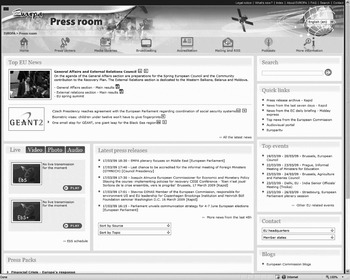
The first place to check would logically be the Europa press room at http://europa.eu/press_room/index_en.htm (Figure 1)
Europa Press room

This features press releases from not only the major EU institutions – the Commission, Council, Court of Justice and Parliament – but also a range of other bodies, including the Court of Auditors, Eurostat and the European Data Protection Supervisor. The option to see all the releases from the last 48-hours is certainly a good way to keep in touch with major developments. However, as with the Commission's Rapid database (from which it takes many of its entries), there is a relentless parade of material on every subject the EU covers – which means everything from “The sustainability of northern hake” to “Children under 12 won't have to give fingerprints”. Mix in the text of every speech given by every Commissioner and there is an awful lot of material to sift through looking for those “significant items”.
Rapid
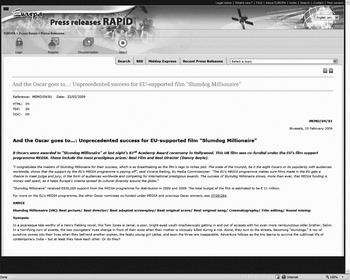
Remember also, when looking at Rapid (http://europa.eu/rapid/), (Figure 2) that the Commission covers material at what the institutions consider to be significant points in the adoption process. So when, on 11 March 2009, it welcomed the “adoption of the Directive on airport charges by the European Parliament and the Council”, there is no point in rushing off to the Official Journal to see the text because it will not be there. To the average user, the actual publication of the Directive would seem a good time to broadcast details of its adoption but, to the institutions, the process is completed when the Council and Parliament reach agreement. In this case the Directive appeared in the Official Journal three days later but, depending usually on translation time, it could have been three weeks.
Rapid

On the plus side, there are many useful press releases in Rapid, with the Memo series giving particularly interesting summaries and background details. See for example MEMO/09/82 (enter this in the “Reference” box under the heading “Optional Search Criteria”) which gives guidance on state aid enforcement by national courts.
Unfortunately, Rapid shares with all other sources of official news a decidedly anodyne approach to its subjects. Everything is presented from the angle of the institutions themselves, and even as contentious a subject as the opt-out from the Working Time Directive is reported with little indication of the deep and divisive arguments that have followed this particular piece of legislation.
Commission's London Representation
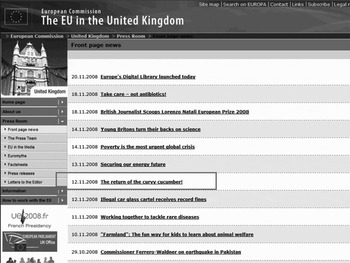
A good review of the EU news, with some focus on the impact on the UK, can be found on the press pages of the website of the Commission's London Representation, which is available at http://ec.europa.eu/unitedkingdom/ (click on “Press room”) (Figure 3).
European Commission Press room

As can be seen from the example above, its approach is a little more laid back than Rapid and it also offers access to “Euromyths” where an attempt is made to correct some of the more egregious misrepresentations by the UK tabloids.
European Parliament
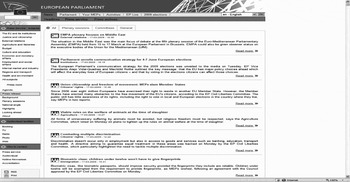
The European Parliament, at http://www.europarl.europa.eu (then click on “Headlines” and, towards the bottom of the page, “All the news”), (Figure 4) tends to provide more detail although, obviously, only of its own proceedings and actions. Whilst its reports do include more detail of the arguments put forward by the various MEPs in debates, you would probably need to go to the individual group websites for more political detail.
European Parliament – All the news

If you go to http://www.europarl.europa.eu/groups/default_en.htm, you will find links to all the political groups, including the Greens, the Socialists and the Christian Democrats, and while you will find a great deal of useful material, this is becoming a little too time-consuming to build into a daily search. So where can we turn for help?
Free daily updates
Fortunately there are sources which, if not totally replacing a regular scan of something like Rapid, will certainly complement such a routine and provide good coverage for anyone who wants to be kept aware of developments in the EU. These sources are commercially produced but can be accessed without charge. They include:
• http://euobserver.com, and
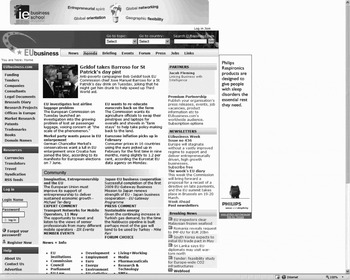
Items, such as that in EUBusiness on 18 March 2009, saying that Chancellor Merkel's party is against further enlargement of the Union at the present time, or in EU Observer in the same week, suggesting that “Sweden is preparing for difficult EU presidency”, would simply not appear in the official sources.
EU business

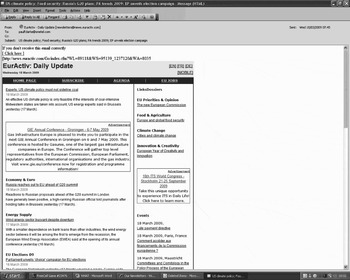
EurActiv

The advantage of these sites is that they both cover the political angle and, in most cases, give links to official sources. They also provide background reports and dossiers on issues of the day, and have staff who report back from the meetings and press conferences organised by the EU institutions. Add in interviews with key players on the European scene and the overall package is impressive. There is also one final bonus provided by these commercial sources: they offer free e-mail alert services, which means that you can have the day's headlines delivered to your PC each morning by simply adding your address at, for example, http://www.euractiv.com/en/Fixed/newsletters.htm.
Conclusion
To sum up, a subscription to one or two of the sources mentioned above should keep you up-to-date on what is happening in Europe, especially if you remember to check Rapid or Europa once a week. To cast your net even wider, there is always the option of setting up a Google alert at http://www.google.com (click on “More”, then “Even more” to access the alert service). Creating a simple search such as “EU employment” will bring you a daily e-mail which could include anything from a Commission press release, to a university report, to an interview in a Chinese newspaper. Sad to think that all of them will be more likely to be accurate than some of the UK's best-selling newspapers.
Biography
Having trained as a librarian, Paul Clarke moved into the field of EU information, eventually becoming a Visiting Fellow at the European Business Centre at Anglia Polytechnic University and the Managing Editor of the Lawtel EU database. In September 2001, he left Lawtel to set up EU Editorial Services Ltd.
The author of several books on European topics, including the Structural Funds and health and safety legislation, he now writes on a range of topics for publishers including Wolters Kluwer (UK) Ltd. Its chairman for the last year, Paul regularly runs training courses for the European Information Association (EIA) and has written and presented courses on EU funding for the European Commission.