

Introduction and Theoretical Background
Spelling correctly is possibly one of the most valued yet difficult skills in written communication (Wanzek et al., Reference Wanzek, Vaughn, Wexler, Swanson, Edmonds and Kim2006; Westwood, Reference Westwood2008a). It is curious that although we live in a highly literate society, surrounded by print, many people fail to learn to read and spell to a reasonable standard (Steffler, Reference Steffler2001). In fact, up to one third of students in some classrooms may struggle (Graham, Reference Graham2000; Graham et al., Reference Graham, Morphy, Harris, Fink-Chorzempa, Saddler, Moran and Mason2008; Schlagal, Reference Schlagal, Templeton and Bear1992; Westwood, Reference Westwood2005, Reference Westwood2008a). For some, this results in a lifetime of inhibition in all situations involving writing (Graham, Reference Graham1999; Ralston & Robinson, Reference Ralston and Robinson1997).
Why is learning to spell in English so difficult? One factor is the lack of transparency and regularity in English orthography; that is, the lack of one-to-one correspondence between sounds and letters in the language. For example, while the sound /p/ is represented only by the letters <p> or <pp>, the sound /ei/ maps onto many letter strings, including frame (82% of spellings), brain (10%), say (4%), as well as they, and nine other minority spellings (5%) (Carney, Reference Carney1994). Undoubtedly, the opacity of the English spelling system is in part due to the fact that that the 44 phonemesFootnote 1 of spoken English must be represented by an alphabet of only 26 letters, resulting in some phonemes having to be represented by particular combinations or clusters of letters (graphemes), rather than by single letters. In addition, some of the most common words in English are irregular in that their (often Anglo-Saxon) spellings are not readily predictable from their sounds: said (/sed/), should (/ʃƱd/), does (/dʌz/), women (/wɪmɪn/), and even was (/wɒz/).
Nevertheless, significant consistencies, regularities and patterns do exist (Carney, Reference Carney1994; Hanna, Hanna, Hodges, & Rudorf, Reference Hanna, Hanna, Hodges and Rudorf1966; Kessler, Reference Kessler2009; Kessler & Treiman, Reference Kessler and Treiman2003; Venezky, Reference Venezky1970). According to Fischer, Shankweiler, and Liberman (Reference Fischer, Shankweiler and Liberman1985), consistency in English orthography works at three broad levels. At the first level are words whose orthographic realisation is relatively close to their phonetic form, and whose spelling patterns have a high degree of occurrence (i.e., regular sound–letter associations such as cat, step, and take). At the second level are words whose sound–letter mappings are more or less straightforward, except that they contain a segment that is ambiguous or problematic, where the relationship between the symbols, sound and/or the morphemic structure is not transparent in the spelling. This typically occurs when rule-governed morphological changes are applied. For example, when the past tense morphemeFootnote 2 <-ed> is added to the verb tap, the sound /p/ is represented not by <p> but by <pp>, the doubled consonant signalling that the letter <a> is pronounced /æ/ rather than /eɪ/ as in taped. The third level consists of words whose foreign or archaic origins make it difficult to derive their spelling from morphophonemic knowledge alone. Such words contain one or more segments which either do not normally occur in English, or which occur infrequently, such as the words debt, indict, bourgeois, Fahrenheit, or zeitgeist.
For many young learners, especially those struggling with literacy, the complexity inherent in the English spelling system may be exacerbated by the teacher's choice of instructional approach (Ehri, Reference Ehri1989). In particular, approaches that concentrate primarily on rote visual memorisation and/or that promote incidental learning, such as the whole language approach, contribute to the challenges faced by many learners, especially low progress spellers (Ehri, Reference Ehri1989; McNaughton, Hughes, & Clark, Reference McNaughton, Hughes and Clark1994; Ralston & Robinson, Reference Ralston and Robinson1997; Schlagal, Reference Schlagal2002; Templeton, Reference Templeton1991; Templeton & Morris, Reference Templeton and Morris1999; Westwood, Reference Westwood2005, Reference Westwood2008a, Reference Westwood2008b). Although rote visual memorisation works well as a strategy for learning irregular or ‘hermit’ spellings, it tends to be insufficient to establish spelling patterns in long-term memory, especially where weaker spellers are concerned. The same applies to incidental learning approaches (where spelling is believed to be best learned from broad reading and writing alone). Neither rote visual memorisation or the incidental learning approach lead to the automaticity of recall needed for both reading and writing (Schlagal, Reference Schlagal2002; Templeton, Reference Templeton1991; Templeton & Morris, Reference Templeton and Morris1999).Footnote 3 What is required for automaticity of recall is spelling instruction that is explicit and systematic, focusing on exploring patterns that can be detected in the sound, structure, and meaning features of words, and thus reinforcing and consolidating children's understanding of how the spelling system works (Graham et al, Reference Graham, Morphy, Harris, Fink-Chorzempa, Saddler, Moran and Mason2008; Hammond, Reference Hammond2004; Schlagal, Reference Schlagal, Templeton and Bear1992; Westwood, Reference Westwood2005, Reference Westwood2008a).
A further factor that can contribute to poor spelling achievement is a lack of depth in teachers' knowledge about the spelling system (including basic phonology, morphology and phonics) and strategies used to teach spelling (Fielding-Barnsley, Reference Fielding-Barnsley2010; Fresch, Reference Fresch2007; Hammond, Reference Hammond2004; Johnston, Reference Johnston2001; Louden & Rohl, Reference Loudon and Rohl2006; Meehan & Hammond, Reference Meehan and Hammond2006; Moats, Reference Moats1995; Templeton & Morris, Reference Templeton and Morris1999; Westwood, Reference Westwood2005, Reference Westwood2008a). Teacher preparation courses do not always include studies in basic areas of linguistics (phonology, morphology, syntax and semantics), knowledge of which would greatly improve preservice teachers' understanding of how the English sound system, grammatical system, and orthographic system work (Carney, Reference Carney1994; Coltheart & Prior, Reference Coltheart and Prior2007; Fielding-Barnsley, Reference Fielding-Barnsley2010; Mahar & Richdale, Reference Mahar and Richdale2008; Treiman, Reference Treiman, Hulme and Joshi1998; Westwood, Reference Westwood2005, Reference Westwood2008a). As Hammond (Reference Hammond2004) rightly points out, ‘It is hard to teach spelling if you don't know the rules about the English language yourself’ (p. 16).
These factors, together with the need to fulfill state and national curricular requirements for regular spelling instruction, mean that many teachers turn to commercial spelling books to assist in designing their spelling programs.Footnote 4 However, commercial spelling programs (or basal spellers) have come under attack from researchers in spelling instruction. This is especially the case in the United States (US). A major and longstanding criticism is the failure of spelling textbooks to apply what is known from current research (Loomer, Fitzsimmons, & Strege, Reference Loomer, Fitzsimmons and Strege1990). In addition, serious questions have been raised as to whether they provide adequate support for students, especially weak spellers (Moats, Reference Moats1995; Schlagal, Reference Schlagal2002; Wilde, Reference Wilde1990). Other major criticisms include claims that basal spellers encourage the rote memorisation of words, provide spelling rules and generalisations that are often inaccurate, oversimplify or explain poorly the complexities of sound–symbol and sound–meaning relationships, and include activities which extend beyond spelling into other areas of language arts, or are in other ways inappropriate. Schlagal (Reference Schlagal2002) found that few US spelling series engaged students in activities specifically designed to help them perceive, manipulate, and automatise the orthographic generalisations required. When spelling programs did offer organised word lists, appropriate contrasts between the words were often not made explicit, thus depriving learners of the opportunity to understand orthographic concepts more logically. For weak spellers, Moats (Reference Moats1995) and Schlagal (Reference Schlagal2002) warn that spelling textbooks may be counterproductive if the level of difficulty is matched to the child's age or grade level rather than to their development spelling level (their instructional level). This is because weak spellers usually have not established sufficient knowledge of spelling patterns to be able to benefit from instruction at their grade level (Schlagal, Reference Schlagal2002). Weak spellers need, above all, spelling instruction that is appropriate to their developmental level, that is systematic, sequential, and well planned, and that provides copious opportunities for practice, reinforcement and review (Moats, Reference Moats1995; Morris, Blanton, Blanton, & Perney, Reference Morris, Blanton, Blanton and Perney1995; Westwood, Reference Westwood2008a, Reference Westwood2008b).
In the Australian context to date, there have been no empirical studies published that examine the content, structure and organisation of commercial spelling programs. Thus it is uncertain whether the criticisms outlined above also apply to materials used in Australia. With this in mind, the current paper examines several commercially published spelling books designed for use with middle to upper primary students (Years 4 to 6), with particular attention to the extent to which they reflect insights from contemporary research. The study examines the basis for the selection and organisation of words in the various spelling lists, the spelling rules, concepts, and generalisations presented, the instructional activities included, and the spelling strategies advocated. These aspects are examined with both average and weak spellers in mind.
The Study
A convenience sample of nine commercially produced, print-based spelling programs was examined. The programs were chosen firstly because they claimed to target spelling (all included the word ‘spelling’ in their title, introduction, and/or publicity blurb), and secondly because all programs were commercially available in major bookshop chains. For reasons of scope, only volumes dealing with Years 4 to 6 were included in the study.
Framework for Analysis
Within the last 20 years there have been very few published studies that analyse and compare commercial spelling programs (particularly with regard to their application of contemporary research findings), or that establish empirically which spelling textbook programs and methods are most effective. In particular, as stated above, there are, to the best of the author's knowledge, no published studies that examine Australian spelling book programs, let alone those for upper primary learners. Further, there appears to be little current agreement among researchers precisely what the major analytical parameters should be for such a study.
For the current study, two major starting points were selected: the general structure and organisation of the spelling programs, and the stages of spelling development. The first point of departure, comparing the general structure and organisation of the spelling programs, comprised the following features:
• theoretical orientation,
• the provision of word lists and the basis for selecting words (phoneme–grapheme correspondences, themes, morphemic principles, etc.), and
• the type and focus of instructional activities (word practice or extension activities).
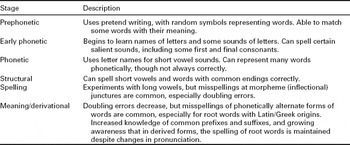
The second point of departure was research on how orthographic knowledge is acquired. Learning to spell is a long-term developmental process, and children typically go through a number of predictable stages (Bear, Invernizzi, Templeton, & Johnston, Reference Bear, Invernizzi, Templeton and Johnston1996; Beers, Reference Beers1995; Frith, Reference Frith, Patterson, Coltheart and Marshall1985; Moats, Reference Moats1995; Templeton, Reference Templeton1991, Reference Templeton, Templeton and Bear1992; Schlagal, Reference Schlagal, Templeton and Bear1992, Reference Schlagal, Graham, MacArthur and Fitzgerald2007; Westwood, Reference Westwood2005, Reference Westwood2008a). Evidence for these stages comes from empirical accounts of what children are able and unable to do at various levels, what they ‘use but confuse’, and what is absent in their spelling (Invernizzi, Abouzeid, & Gill, Reference Invernizzi, Abouzeid and Gill1994). Although different researchers use different labels to describe the stages, there is general agreement that certain skills and knowledge (in more or less detail) are evident in each stage.Footnote 5 The current paper uses Beers’ (Reference Beers1995) model of the spelling development process, a brief summary of which is included in Table 1 in order to give perspective to the current study.
Summary of the Stages of Spelling Development (Adapted From Beers, Reference Beers1995)

According to Beers’ (Reference Beers1995) model, by middle-to-late primary school, the average learner is moving (or has moved) from simple, concrete, sound–letter correspondences (the phonetic stage) to the structural and meaning/derivational stages. At this stage, there is still consolidation required in more complex sound–letter correspondences (especially the mappings of vowel sounds), but a major area of focus is knowledge of morphemic principles. The typical student at this level is uncertain about the changes that occur at word boundaries when inflectional or derivational morphemesFootnote 6 are added, and also the way English spelling preserves visual links between words and their meanings (such as in heal and health), even though the pronunciation may vary (Beers & Beers, Reference Beers, Beers, Templeton and Bear1992; Schlagal, Reference Schlagal, Templeton and Bear1992; Templeton, Reference Templeton1991, Reference Templeton, Templeton and Bear1992). In passing, it should be noted that morphemic aspects such as these constitute a particular area of difficulty for weaker spellers (Bourassa & Treiman, Reference Bourassa, Treiman, Snowling and Hulme2001; Carlisle, Reference Carlisle1987; Devonshire & Fluck, Reference Devonshire and Fluck2010), even when their progress in representing the phonological structure of words has improved to normal levels.
Moats (Reference Moats1995) observes that in comparison to the early grades, far less is known about the nature and sequence of later stages of spelling. Perhaps the most detailed picture of student orthographic knowledge at upper primary levels is contained in Cramer and Cipielewski (Reference Cramer and Cipielewski1995). Cramer and Cipielewski analysed the spelling errors taken from around 6800 compositions written by American children in grades 4–6, and concluded that spelling instruction at middle-to-late primary levels should focus on
• sound patterns involving less common phoneme–grapheme correspondences (especially variations in vowel sound mappings, but also in some consonant blends and digraphs, double consonants, and silent letters);
• word structure rules involving the addition of inflectional and derivational morphemes (inflected endings, such as <-s> or <-es>, <-ed>, <-ing>, <er>, <-est>, irregular plurals, and derivational prefixes and suffixes, including words that are related, such as compete and competition, and legal and legality);
• usage conventions (such as compound words; e.g., radioactive), homonyms (e.g., tied and tide), contractions (e.g., they're), or easily confused words (e.g., accept and except, principal and principle); and
• strategies for mastering a number of commonly misspelled words (such as a lot, because, favorite, too and through).
Support for Cramer and Cipielewski's criterial features is provided by not only Bear et al. (Reference Bear, Invernizzi, Templeton and Johnston1996) and Westwood (Reference Westwood2005, Reference Westwood2008a), but also Hammond (Reference Hammond2004), which is one of the few empirical studies of an effective spelling instruction program within the Australian context.
In what follows, as a first step, each book is examined for general structure and organisation. Then the books are examined according to the criterial features derived from Cramer and Cipielewski (Reference Cramer and Cipielewski1995).
Results
General Structure and Organisation of the Materials
(a) Theoretical Orientation
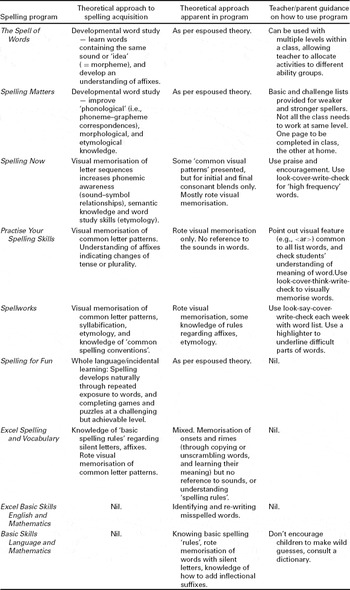
It is important to note that no teacher manuals were provided for any of the programs examined. Consequently, the theoretical orientation underpinning the books had to be inferred from the instructions to teachers (and/or parents or caregivers) that were contained in the introductory pages of each volume, and/or the cover blurb, if indeed any such instructions were provided. The content of the program was, however, another matter, and what was espoused in the introductory pages or cover blurb was not always reflected in the program, as Table 2 shows.
Theoretical Orientation of the Spelling Programs

As can be seen from Table 2, most programs displayed approaches to spelling development that were oriented more toward incidental learning, rote visual memorisation (typically without reference to sounds) and/or applying simplified morphological ‘rules’ than toward developing a more systematic and sophisticated understanding of the complex relationships between the phonological, morphological, and orthographic aspects of English. These aspects are explored in more detail in what follows.
(b) Spelling Focus and Provision of Word Lists
A major distinction was made between programs that provided word lists and those that did not. A long-standing research finding is that one of the most successful approaches in the teaching of spelling is the use of word lists (for a summary of early research see Loomer, Fitzsimmons, & Strege, Reference Loomer, Fitzsimmons and Strege1990), or, more to the point, word lists that help children to learn how to learn words (Schlagal, Reference Schlagal2002; Steffler, Reference Steffler2001; Templeton, Reference Templeton1991; Westwood, Reference Westwood2005, Reference Westwood2008a). Well-organised word lists assist children to take advantage of regularities in the language, and make connections between sound-and-letter and letter-and-meaning patterns so that they can better abstract rules and regularities from print and use this knowledge to produce accurate spellings (Steffler, Reference Steffler2001). Thus materials which do not organise words so as to highlight the stability of the specific features of the orthography, and which do not provide practice activities which help learners internalise these words and patterns, are far less effective than those that do (Darch, Kim, Johnson, & James, Reference Darch, Kim, Johnson and James2000; Morris et al., Reference Morris, Blanton, Blanton and Perney1995; Wanzek et al., Reference Wanzek, Vaughn, Wexler, Swanson, Edmonds and Kim2006).
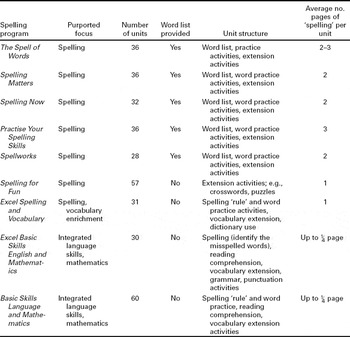
As Table 3 shows, only five of the nine spelling programs (termed ‘list-based series’) included word lists and accompanying instructional activities. The basis for selection of these words is examined below, though it should be remembered that none of the programs provided any rationale for word selection, nor any details about the word pool used to generate their word lists.
The Focus and Structure of the Spelling Programs

The word lists contained on average approximately 18 words, close to the number Templeton and Morris (Reference Templeton and Morris1999) recommend for this age and grade level, though the number of words contained in the lists varied between three and 53. However, for weak spellers, it should be borne in mind that instructional programs that present learners with too many new words can exacerbate problems (Morris et al., Reference Morris, Blanton, Blanton and Perney1995). Moats (Reference Moats1995) recommends limiting the number of words to no more than five or six words per day, and for those with severe spelling difficulties, three words per day is advised.
Of the remaining four series (termed ‘non-list-based series’), the spelling focus was diverse, consisting, for the most part, of activities such as crosswords, proofreading, word puzzles, choosing the correct homophone, and/or fill-the-gap exercises. Only one series (Excel Spelling and Vocabulary; Clutterbuck, Reference Clutterbuck1998) contained spelling ‘rules’ or generalisations (many of which were inaccurate or unhelpful) and accompanying practice activities. In two series, spelling was very much a minor focus, taking up less than half a page per unit, and suggesting that the inclusion of spelling may have been more to do with marketing than with pedagogy.
(c) The Basis for Selection of List Words
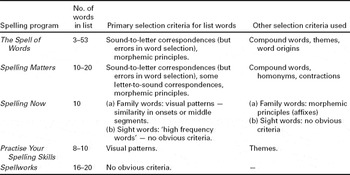
As Table 4 below shows, there was considerable variation in the basis for generating and organising list words: sound-to-letter correspondences, letter-to-sound correspondences, letter patterns (visual), morphological features (plurals and other affixes), usage conventions (homophones, compound words), themes, and random selection.
Features of Word Lists in the Spelling Programs

One series, The Spell of Words (Aylward, Reference Aylward1979), based word selection almost entirely on sound-to-letter correspondences. Unfortunately, though, some lists (a small number) included words that did not contain the targeted sound. For example, in a list of 53 words purporting to contain long ‘e’ (/i:/), 18 words did not contain the targeted sound, including five members of the <ear> = /ıә/ familyFootnote 7 (spear, fear, etc.), five words with the prefix <de> = /dә/ (deliver, delight, etc.), cheer (/tʃıә/), and reply (/rә`plaı/) (The Spell of Words Level 6 Book 1; Aylward, Reference Aylward1979, p. 26).
The other series that used sound-to-letter correspondence as a primary basis for word list selection, Spelling Matters (Woods, Reference Woods2002), also contained a small number of inconsistencies, with words not containing the sound indicated. An example is the unit entitled ‘ough as in cough’, where only two words (out of 15) mapped the sounds /of/ as in cough onto the letters <ough>. The other list words contained four other mappings of the grapheme <ough>: /oƱ/ as in though, /ʌf/ as in rough, /aƱ/ as in plough, and /ɔ:/ as in thought (Spelling Matters Book 6, Woods, Reference Woods2002, p. 22). In this case, the list words have been selected according to letter-to-sound correspondences, rather than sound-to-letter correspondence. Letter-to-sound mappings are utilised in reading, whereas spelling utilises sound-to-letter mappings. Organising spelling lists according to both sound-to-letter and letter-to-sound correspondences could well run the risk of confusing learners, especially the weaker spellers, destabilising their emergent knowledge of sound–letter pattern rules and generalisations.
The issue is an important one, as the act of spelling is, to a large degree, a phonological translation task (Weeks, Brooks, & Everatt, Reference Weeks, Brooks and Everatt2002), requiring the encoding of words from the phonological lexicon into print. Reading, on the other hand, is a decoding process, separate from the process of spelling (Templeton, Reference Templeton1991), and proceeds from the orthography (print) to spoken output (in the case of reading aloud). The correspondence system is far more predictable for reading than it is for spelling (Carney, Reference Carney1994; Moats, Reference Moats1995). While knowledge of a word's spelling invariably informs the reading of that word, the converse is not always the case: knowledge of how to read a word is no guarantee of the ability to spell it (Foorman & Francis, Reference Foorman and Francis1994),Footnote 8 and the phenomenon of the person who is a good reader but a poor speller is well documented (see, for example, Coltheart & Prior, Reference Coltheart and Prior2007; Treiman, Reference Treiman1993; Westwood, Reference Westwood2008a). The situation for students with learning difficulties is more serious, since transfer effects from reading to spelling have been found to be limited (Ehri & Roberts, Reference Ehri and Roberts1979; Lee & Pegler, Reference Lee and Pegler1982; Lovett & Steinbach, Reference Lovett and Steinbach1997). Weak spellers commonly have poorly developed phonological analysis skills (Vukovic & Siegel, Reference Vukovic and Siegel2006) and tend to have particular difficulties in using and remembering sound–letter correspondences (Lennox & Siegel, Reference Lennox, Siegel, Hulme and Joshi1998; Moats, Reference Moats1995), as they do not spontaneously perceive the semantic, phonological, or orthographic relationships among words. These learners typically benefit from explicit instruction where sound–symbol and meaning–symbol correspondences, syllable patterns or other language associations are presented to them in a logical, systematic way (Moats, Reference Moats1995). Such findings have clear consequences for the way list words should be selected and organised.
Inconsistent sound-to-letter mappings in word lists were also found in two other programs, Spelling Now (Francis & Francis, Reference Francis and Francis2003) and Practise Your Spelling Skills (Rose, Reference Rose1999). In both cases the inconsistencies were due to the fact that list words were selected primarily on the basis of simple visual patterning of letters, with very little consideration of sound-to-letter correspondences. For example, in Practise Your Spelling Skills Book 6 (Rose, Reference Rose1999, p. 1), a list of ‘ui words’ (p. 58) included not only bruise (/bru:z/) and fruit (/fru:t/) but also quiver (/kwɪvә/). In this case, confusing the vowel sound /u:/ with the orthographic unit <qu> (which is sounded as /kw/) is counterintuitive. In another confusing example, the words chemist and stomach occurred in not one but two lists: the ‘silent letters’ list (p. 43), and the ‘ch’ (/tʃ/ as in church) list (p. 37). In fact both words are examples of the correspondence <ch> = /k/, in common with character, choir and orchestra, and many other Greek learned and scientific words (e.g., architect, chlorine, chaos), and do not belong in the <ch> = /tʃ/ word list.
In the remaining list-based series, Spellworks (Barwick & Barwick, Reference Barwick and Barwick1998), the list words that appeared did not contain any obvious common orthographic features, implying that learners would need to memorise them individually. To illustrate, one list contained the following words: rein, treat, swear, salad, judge, weight, height, command, warmth, arrange, weird, battle, league, seize, traffic, value, disappoint, serious, neighbour, punishment (Spellworks 5; Barwick & Barwick, Reference Barwick and Barwick1998, p. 28).
According to the literature, word lists that are not organised to promote orthographic generalisations are counterproductive, because without a spelling pattern in common the student may be inadvertently forced to focus on individual words, and use rote visual memorisation, rather than recognise spelling patterns that apply to a large number of words (Templeton, Reference Templeton1991; Templeton & Morris, Reference Templeton and Morris1999). Students given direct instruction in rule-based phoneme–grapheme correspondence analysis have been found to significantly outperform students encouraged to use visual imagery (Darch & Simpson, Reference Darch and Simpson1990). This is because when faced with randomly organised lists (or running text) most students fail to discover by themselves the different layers of information contained in the spelling of words and the corresponding sound and meaning patterns (Templeton & Morris, Reference Templeton and Morris1999). What is needed is for words to be selected and organised in ways that can facilitate awareness, understanding and application of spelling patterns. Studying groups of words that share structural and/or semantic features in an ongoing, developmental basis throughout the primary years is, according to Templeton (Reference Templeton1991, p. 196), ‘[t]he central issue to which every learning and teaching issue in spelling continually reduces’. The brain is an ‘exquisitely designed pattern-detector’ (Bussis, Chittenden, Amarel, & Klausner, 1985, as cited in Templeton & Morris, Reference Templeton and Morris1999, p. 108), but its efficiency depends upon having adequate and appropriate information with which to work.
(d) Type and Focus of Instructional Activities
Two major types of activities were evident in the spelling programs: activities involving list words and/or the application of morphological principles and/or usage conventions (word practice activities), and activities dealing with other words or aspects of language use (extension activities).
The most common type of word practice activities were
• alphabetising list words (e.g., ‘Write the following words in alphabetical order’),
• displaying knowledge of their meaning (e.g., ‘Circle the correct definition of the list word’),
• finding smaller words in larger words,
• puzzles of various forms relating to list words, such as unscrambling words or word searches,
• completing paradigms (e.g., ‘Add –LY to these adjectives to make the adverb’).
Apart from the (important) secondary goals of offering cognitive challenge to maintain motivation and stimulate pupil interest, the intention of word practice activities appeared to be twofold: to focus students' attention on the visual form of the word(s) by forcing them to attend to each letter, and to have them write the word multiple times. Writing a word several times is the subject of some controversy, with some researchers advocating as little as two repetitions. However, according to scholars such as Nichols (1985, as cited in Westwood, Reference Westwood2005, p. 19) and Schlagal (Reference Schlagal2002), writing a word several times can help to develop a kinesthetic memory (muscle memory) for the word. For weak spellers, writing a target word a number of times, particularly with a focus on producing writing that is legible and fluent, and is quickly produced with little conscious attention, can assist with the development of faster, more legible handwriting (Graham, Reference Graham1999). Many students with learning difficulties have difficulties with handwriting: their writing tends to be less smooth, more variable and less legible than the writing of their regularly achieving counterparts (Graham & Weintraub, Reference Graham and Weintraub1996), and they write more slowly (Weintraub & Graham, Reference Weintraub and Graham1998).
The second category of extension activities, according to Wilde (Reference Wilde1990) in her examination of US spelling books, tends to ‘provide a little of everything that might be found in a language arts curriculum’ (p. 270). A similar tendency is apparent in the Australian spelling books too:
• general vocabulary enrichment, including reading comprehension passages, word meanings, idioms, similes, and proverbs, antonyms and synonyms, knowledge of word roots (e.g., <geo->, <-ology>) and etymology (e.g., ‘Use your dictionary to find out from what language these words are originally derived’);
• puzzles (‘How quickly can you find a nine-letter word ending in lia?’, ‘Change BEAR into TRAP in four moves by changing one letter at a time to form a new word’);
• dictionary skills (‘Use a dictionary to find out these words that begin with GR’, ‘Which of these two words come first in the dictionary?’);
• proofreading (‘Rewrite the passage and correct any spelling and punctuation errors’);
• explicit grammatical knowledge, such as identifying or classifying parts of speech, phrases and clauses (‘Classify these proper nouns’);
• general knowledge (‘Match these famous Australians with the reason for their fame’);
• drawing (‘Use all four words in one sentence and draw the scene’).
Wilde (Reference Wilde1990) questions the inclusion of activities related to vocabulary development in spelling books. However, vocabulary and spelling are two faces of the same knowledge coin (Templeton, Reference Templeton, Templeton and Bear1992), and it is very important at upper primary level for children to have a knowledge of morphological/meaning connections between words and their origins. Explicitly teaching primary level learners how to identify root morphemes, prefixes and suffixes, and how to apply this knowledge accurately, has been found to lead to significant improvements in spelling ability (Devonshire & Fluck, Reference Devonshire and Fluck2010). In the case of weak spellers, whose reading skills and knowledge of vocabulary tends to be poor, vocabulary study is especially important. However, vocabulary study should be related to developing the lexicon, and tasks requiring students to look words up in the dictionary when meanings are not at issue not only have no research support but also students are unlikely to develop orthographic knowledge (Schlagal, Reference Schlagal2002).
The Australian spelling programs contained a copious variety of puzzles. Researchers have expressed doubt whether certain types of puzzles, such as unscrambling words, translating them into secret codes, or alphabetising them, can help children memorise the spellings or develop generalisations about how words are spelled (e.g., Johnston, Reference Johnston2001). Schlagal (Reference Schlagal2002) goes even further, saying such activities ‘are unlikely to promote orthographic learning’ (p. 53), unless they involve list words, words previously studied, or words which are at the instructional level of the child.
In one series (Practise Your Spelling Skills, Rose, Reference Rose1999), two pages out of each three-page unit were devoted to word puzzles. However, the puzzles were typically unrelated to either words contained in the word list or to morphological generalisations contained in the unit. In many instances they were of fiendish difficulty, suggesting the series had not received comprehensive ‘road-testing’ with students in the target age group/grade level prior to publication. In a typical example, Year 5 students were asked to find ‘a six-letter word ending in –gue’ (no <-gue> words provided in the spelling list, nor were any semantic clues provided), to ‘change one letter in try to get a word meaning to raise with a lever’ (not in the spelling list), and to unjumble the letters ‘roginehbu’ to find a word (also not in the spelling list). Such puzzles, where the words were decontextualised, were all the more frustrating because, unlike the other series, no list of answers was provided. Puzzles such as these might be suitable for gifted students, but they can be demoralising, and even counterproductive, for less able spellers.
Tasks designed to develop dictionary use skills (such as placing words in alphabetical order and between guide words, generating likely spellings, and recognising when a correct word has been chosen) can, according to Wilde (Reference Wilde1990), develop useful component skills. However, she argues that their inclusion and format in spelling books makes the activities somewhat artificial, and they may be better covered in teacher-directed lessons where students can use their new knowledge immediately in the context of their own writing and editing. Similarly, activities involving general knowledge and drawing would appear to be better placed in other parts of the curriculum.
In the same vein, the ability to proofread is an important part of being a good writer (and speller), but there is considerable difference between being able to proofread one's own work, and being able to detect incorrect spellings in textbooks, often of phonetically plausible misspellings. Wilde (Reference Wilde1990) points out that there is no evidence that spotting artificial misspellings of words that one has just studied can transfer to proofreading one's own work. Many scholars do not consider proofreading to be a good method of teaching spelling (e.g., Schlagal, Reference Schlagal2002). Exposing learners to incorrect spelling in a textbook has been identified as problematic by Dixon and Kaminska (Reference Dixon and Kaminska1997), who found that even a single visual encounter with a word that is misspelled can cause the word to be misspelled in the future, even if the learner has spelled the word correctly before encountering the misspelling. Yet proofreading exercises were one of the most common activity types found.
An instructional activity relating to list words that was noticeably absent was the word sort (see Bear et al., Reference Bear, Invernizzi, Templeton and Johnston1996, for examples of word sorts for all primary levels). Word sorts encourage students to compare, contrast, and classify words according to sound, spelling pattern and meaning, thus developing sensitivity not only to the environment in which sounds and letters occur within a word but also to how meaning may be preserved in words despite pronunciation changes. Word sorts are an extremely valuable activity to develop children's understanding of similarities and differences between words in their sound, structure, and meaning features.
Criterial Features of the Spelling Programs
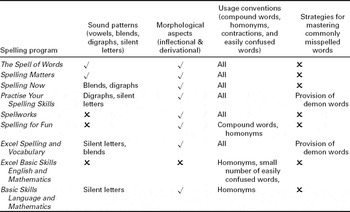
Turning now to the criteria set out by Cramer and Cipielewski (Reference Cramer and Cipielewski1995), the materials were evaluated to determine to what extent each program addressed (a) sound-letter patterns, (b) word structure rules, (c) usage conventions, and (d) strategies for overcoming common spelling errors. Table 5 summarises the extent to which each series addressed the criteria.
Summary of Features of the Spelling Programs

Note. ✓ indicates substantial occurrence of the feature; ✘ indicates non- or minimal occurrence.
(a) Lists and Activities Based on Sound-to-Letter Patterns
According to Steffler (Reference Steffler2001), spellers of all ages depend upon and use sound–letter correspondences when they attempt to encode unfamiliar words, and accurate knowledge of sound–letter correspondences is a vital component of spelling ability. However, whereas good spellers make connections between phonemes and their graphemic representations, very poor spellers are more inclined to rely on visually encoded representations of words (Lennox & Siegel, Reference Lennox, Siegel, Hulme and Joshi1998). This reliance is believed to occur because of problems understanding and applying phonic principles, which is in turn often caused by an underlying weakness in phonemic awareness (Vukovic & Siegel, Reference Vukovic and Siegel2006). Thus poor spellers stand to benefit from an explicit, systematic program of instruction focusing on phoneme–grapheme and grapheme–morpheme analysis (Darch & Simpson, Reference Darch and Simpson1990; McNaughton et al., Reference McNaughton, Hughes and Clark1994; Wanzek et al., Reference Wanzek, Vaughn, Wexler, Swanson, Edmonds and Kim2006), as has been argued previously.
Average spellers, too, can benefit from phoneme–grapheme and grapheme–morpheme analysis, particularly when dealing with unfamiliar or multisyllabic words (Beers & Beers, Reference Beers, Beers, Templeton and Bear1992). Even though spelling regularities become more complex at upper primary level, they do not cease to depend on sound (Ehri, Reference Ehri, Templeton and Bear1992). Hence, it would seem to make sense to build on this strategy in spelling programs by continuing to use sound-to-letter correspondences as a major basis for the selection and organisation of list words. Yet, as we have seen, only The Spell of Words and Spelling Matters do this.
These two programs were the only ones to address the spellings of complex vowel sounds, a surprising finding given that there is far more divergence in the spelling of vowel sounds (particularly the ‘schwa’ sound) than in the spelling of consonant sounds (Kessler, Reference Kessler2009; Kessler & Treiman, Reference Kessler and Treiman2003, Templeton, Reference Templeton1991). Vowel sounds are more difficult for children to master than consonant sounds (Treiman, Reference Treiman1993), and vowel errors are by far the most common errors made by children in Grades 4, 5 and 6 (Cramer & Cipielewski, Reference Cramer and Cipielewski1995).
Many people, lay and professional alike, think of spelling instruction in terms of explicit rules and generalisations which can help learners remember sound–letter combinations, such as the ‘<i> before <e>’ rule. However, spelling researchers urge caution in the use of spelling rules in general, arguing they are not particularly effective, as they lack consistency and can be too complex to understand and remember (Templeton & Morris, Reference Templeton and Morris1999; Wilde, Reference Wilde1990). Kessler (Reference Kessler2009) reminds us that spelling rules are unlike the rules of mathematics: they are often complex, not absolute and frequently have many exceptions. Indeed, formulating and explaining spelling rules or patterns is hard even for many spelling experts. Much knowledge used during spelling is implicit (Templeton & Morris, Reference Templeton and Morris1999; see also Steffler, Reference Steffler2001), and is best acquired through guided examination of how particular spelling features and patterns operate. Nonetheless, there are a number of what might be called strong tendencies, or general principles, that can be used as rules of thumb in spelling unfamiliar words, such as the ‘<i> before <e>’ and ‘bossy’ <e> generalisations, or the mnemonic ‘when two vowels go walking, the first one does the talking’.
There were relatively few of these general principles evident in the spelling programs examined. One list-based series included a short section on the ‘bossy’ or ‘magic’ <e> generalisation (which ‘makes the vowel say its name’, thus changing a short vowel to a long one), but, confusingly, only 11 of 16 list words displayed the rule (words such as windmill, afternoon, anywhere, and cupboard (Spellworks 4; Barwick & Barwick, Reference Barwick and Barwick1998, p. 38) clearly do not contain a bossy <e>). Surprisingly, among the nine series there was no coverage of the ‘two vowels go walking’ mnemonic.
Only one series, Excel Spelling and Vocabulary (Clutterbuck, Reference Clutterbuck1998), presented ‘spelling rules’ on a regular basis, although unfortunately in many cases these were unhelpful, confusing, or even linguistically inaccurate, often because of failure to distinguish between sounds and letters: ‘Every syllable contains a vowel sound. The vowels are a, e, i, o, and u. Sometimes y is used as a vowel’ (Excel Spelling and Vocabulary Years 5–6; Clutterbuck, Reference Clutterbuck1998, p. 9).
Wilde (Reference Wilde1990, after Wheat, Reference Wheat1932) claims there are only two sound–letter correspondence rules that are worthwhile teaching:
1. <i> before <e> except after <c> when the sound is /i:/,
2. When a word begins with a /k/, use <k> before <e> and <i>, <q> before /w/, and <c> elsewhere.
Rule 1 was covered in five of the nine series examined, but there was no coverage of Rule 2. In passing, Wilde's rule itself is incomplete, as it fails to account for /k/ spelt as <ch> as in architect, chasm, and chorus, or for /kw/ spelt as <ch> as in choir (all of which are patterns covered in The Spell of Words, Book 6; Aylward, Reference Aylward1979).
(b) Word Structure Rules Involving Inflectional and Derivational Morphemes
As pointed out previously, there is strong evidence that spelling patterns involving inflectional and derivational morphemes cause persistent problems at all primary levels, even the upper grades (Beers, Reference Beers1995; Schlagal, Reference Schlagal, Templeton and Bear1992; Templeton, Reference Templeton, Templeton and Bear1992), According to Schlagal (Reference Schlagal, Templeton and Bear1992), the five morphological features that pose the most difficulties at middle and upper primary levels are consonant doubling, <e>-drop, affixes, derivational forms, and resolving the identity of vowels in unaccented syllables. An ideal way to approach the study of morphological principles is the word sort, as it emphasises invariant features, thus promoting a sense of order and predictability (Schlagal, Reference Schlagal, Templeton and Bear1992). However, as noted earlier, word sorts did not occur in any of the series surveyed.
Nonetheless, there was better coverage of the morphemic aspects of spelling across the programs surveyed than coverage of sound–letter correspondences, especially in the Year 5 and 6 textbooks. However, coverage of the way the meaning is visually preserved among words that are related (e.g., medicine, medicinal, medical) was poorly addressed. Further, apart from The Spell of Words, Spelling Matters and Spellworks, there was no systematic treatment of the semantic or meaning aspects of affixes. In most exercises, students were simply required to attach given affixes to words, with no reference to how the affix affected meaning. This represents a failure to capitalise on an important teaching point.
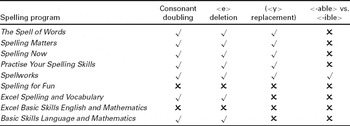
All programs except one (Excel Basic Skills English and Mathematics) contained at least one unit dealing with changes required at word boundary level when an affix is added. According to Wilde (Reference Wilde1990, after Wheat, Reference Wheat1932), only four morphophonemic rules are worthwhile teaching:
1. doubling consonants after a suffix,
2. <e> deletion before the addition of a suffix,
3. changing <y> to <i> (<y> replacement),
4. if a root word can stand alone, <-able> is more likely, if not, <-ible> is more likely.
As Table 6 shows, while all the list-based series addressed the first three of these rules, only one series addressed the fourth rule, although the account given was not especially helpful (‘There is no easy rule to tell when to use –ABLE or –IBLE’, Spellworks, Book 6; Barwick & Barwick, Reference Barwick and Barwick1998, p. 34).
The Coverage of Wilde's (Reference Wilde1990) Four Morphophonemic Spelling Rules

(c) Usage Conventions
Cramer and Cipielewski (Reference Cramer and Cipielewski1995) found the spelling of homophones to be a pervasive problem at upper primary level. Misspelling of homophones is believed to occur because the writer has failed to link the correct orthography to the intended meaning or usage. Most series included at least one section on homophones, but, surprisingly, there was little agreement on what homophones to present: only three homophone pairs occurred in two or more of the programs (stationary/stationery, check/cheque, and principal/principle). Some homophones presented were obscure for this age level (such as bark/barque, and bouillon/bullion).
To date, there is very limited research concerning which homonyms present learners with the most problems, and which should be covered at primary level (cf. Kohnen & Nickels, Reference Kohnen and Nickels2010), although Cramer and Cipielewski (Reference Cramer and Cipielewski1995) list the most frequently misspelled homophones across American grade levels as too, there, it's, our, know, you're, through, heard, would, whole, let's, one, presents, and buy. From this list, only seven homophones (there, know, heard, buy, through, it's, and you're) were found in any more than one of the series, suggesting that the treatment of homophones across the series is inadequate.
Other pervasive problems identified by Cramer and Cipielewski (Reference Cramer and Cipielewski1995) include words with apostrophes (such as it's, they're, you're, and there's, which also have homophonic variations), and compound words that are wrongly separated (such as out side). These aspects of usage conventions were addressed to some extent by all list-based programs, and by Excel Spelling and Vocabulary.
Coverage of words that are easily confused (such as advice and advise, practice and practise, possible and probable) was patchy. Words that are both easily confused and homophonic (such as its and it's, they're, there, and their, your and you're), which, according to Cramer and Cipielewski (Reference Cramer and Cipielewski1995), students misspell routinely even at secondary and tertiary level, received no treatment in the vast majority of the series.
(d) Strategies for Mastering a Number of Commonly Misspelled Words
As children progress through the developmental stages of spelling, they commonly use different strategies, and competent spellers have a repertoire of effective spelling strategies that they can call on as needed (Ralston & Robinson, Reference Ralston and Robinson1997; Rittle-Johnson & Siegler, Reference Rittle-Johnson and Siegler1999; Westwood, Reference Westwood2008b). Westwood (Reference Westwood2008b) stresses the importance of explicitly teaching children a variety of effective strategies with which to approach the spelling of difficult words, so that they do not just rely on the inefficient method of rote memorisation. The greater the variety of spelling strategies students are taught, the more efficiently and selectively learners will use them (Ralston & Robinson, Reference Ralston and Robinson1997).
Westwood (Reference Westwood2008b) identifies the following common strategies as being effective:
• Look-say-cover-write-check,
• Sounding out,
• Spelling by analogy (using ‘word families’, or sets of words with similar sound or visual patterns, such as east, yeast, easterly),
• Knowledge of morphemic principles.
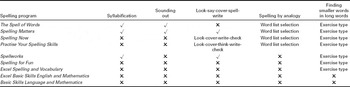
While some programs did not advocate any spelling strategies for use by students, others included three, four or even five strategies (see Table 7). The most common spelling strategy was some variant of ‘look-say-cover-write-check’. This is essentially a process of delayed copying, a strategy which has been shown to produce successful results (Brundson, Coltheart, & Nickels, Reference Brundson, Coltheart and Nickels2005; Frank, Wacker, Keith, & Sagen, Reference Frank, Wacker, Keith and Sagen1987; Stevens & Schuster, Reference Stevens and Schuster1987). Saying a word slowly and deliberately as it is written has been shown to be effective (Bradley, Reference Bradley1981) as it helps slower learners notice how each phoneme is represented, and hence consciously attend to the matching of sound to symbol (Moats, Reference Moats1995). However, the process may not work for all pupils with learning difficulties. More recent research has found that leaving at least a 10-second gap between the look-say-cover and the write-check stages greatly improves effectiveness (Brunsdon et al., Reference Brundson, Coltheart and Nickels2005). Unfortunately, in two series where the look-say-cover-write-check strategy was used, ‘say’ was either omitted or replaced by ‘think’, suggesting a rote visualisation perspective which does not reinforce phonic generalisations.
Spelling Strategies Advocated by the Nine Spelling Programs

The important strategy of sounding out was found in only two programs. Sounding out has been shown to be the predominant spelling strategy used by Year 5 children in Australia (Ralston & Robinson, Reference Ralston and Robinson1997), and Devonshire and Fluck (Reference Devonshire and Fluck2010) report similar findings for children in the UK regardless of age. Consequently, encouraging the use of this strategy would seem helpful. Syllabification (e.g., ‘Break the following words into syllables’) is another important spelling strategy for students with learning difficulties, but was found in only three series.
The strategy of using knowledge of morphemic principles to help master commonly misspelled words was not found in any of the programs. While most programs provided students with some knowledge about changes required at word boundaries during affixing, and contained some treatment of derivational prefixes (e.g., legal, illegal), there was very little attempt to encourage students to draw on this knowledge to master commonly misspelled words.
One activity that appears at first glance to be a spelling strategy was finding smaller words in longer ones, and all but two series contained exercises of this sort (e.g., ‘Find four words in fortune’). However, while the strategy can be helpful for mastering certain difficult or easily confused words (‘There is a rat in separate’, ‘The principal is your pal’), it is not clear how useful it is for a student to be asked to find four or five smaller words contained in a larger one; it may amount to no more than ‘busywork’. Further, as one anonymous reviewer remarked, finding unrelated words in a long word also provides ‘misinformation’ about the spelling system, and runs the risk of confusing students. A more beneficial activity would be to find smaller, related words; that is, identifying root morphemes.
Kohnen and Nickels (Reference Kohnen and Nickels2010) list a number of techniques for mastering unpredictable (or irregular) words, including delayed copying, letter naming and writing, mnemonics, and ‘overpronunciation’. They note that none of these strategies is better than any other, but that the techniques should be matched to the students' abilities and, it might be added, learning preferences. Of these strategies, only mnemonics was occasionally suggested in any of the series examined.
Discussion and Conclusion
As Kessler and Treiman (Reference Kessler and Treiman2003) observe, ‘English is not Finish. Its spelling system requires years of study to master, and many pupils find it frustrating’ (p. 287). The task ahead of such pupils may not be made much easier by some of the commercial spelling programs examined in the current study, and the majority of criticisms of American basal spellers would appear to apply equally to Australian programs. There was only limited evidence that the authors had tried to apply insights derived from contemporary research. In fact, most series contained practices that could be considered to detract from the basis of word learning (cf. Schlagal, Reference Schlagal2002), in particular the failure to provide for the systematical presentation and study of well-organised lists of words. Where spelling lists were provided, in all but two programs, rote visual memorisation of the words was, in effect, the only avenue open to the student because appropriate contrasts between words were not made explicit, were nonexistent, or were confusing. As Templeton and Morris (Reference Templeton and Morris1999) remind us, learning to spell should not just be about remembering the spelling of words, it should also be about understanding how words work — the conditions that govern their structure, and how their structure signals sound and meaning — and in this respect, most of the spelling programs were deficient.
In the majority of programs, the type and focus of instructional activities were highly variable, and few provided activities specifically designed to help students perceive, manipulate, and automatise orthographic consistencies, patterns and regularities. Some activities were overly difficult, and many others appeared to be wasteful ‘busywork’ practice. In a number of programs, activities extended beyond spelling into other areas, and though some activities could be justified on the grounds of vocabulary development or focusing attention on the structure of words, many were of questionable merit.
As regards Cramer and Cipielewski's (Reference Cramer and Cipielewski1995) criteria, only two programs contained comprehensive treatment of sound patterns involving less common phoneme–grapheme correspondences. Indeed, some programs showed a curious lack of awareness of the connection between spelling and the sounds of the language. This is despite strong evidence that higher-order knowledge of phoneme–grapheme correspondences is a vital basis for spelling and continues to develop across the grades (Cramer & Cipielewski, Reference Cramer and Cipielewski1995; Moats, Reference Moats1995; Templeton, Reference Templeton, Templeton and Bear1992).
Word structure rules involving morphemic principles received better coverage, although the way the spelling remains constant to indicate a shared meaning relationship among words (Templeton, Reference Templeton1991) was poorly addressed, and meaning aspects of affixes were not consistently provided. There was some coverage of usage conventions, such as compound words, homonyms, contractions, and easily confused words, but treatment was in general neither systematic nor extensive. Homonyms and easily confused words, which present particular problems in spelling acquisition, even for average spellers (Kohnen & Nickels, Reference Kohnen and Nickels2010), received cursory treatment overall. Finally, only a limited range of strategies for mastering misspelled words were evident in the series.
It is clear, then, that there is a need for Australian spelling book programs that are systematic, structured and sequential, with well-organised word lists and accompanying activities that are designed to encourage the learner to notice regularities in the spelling system, make connections between sound-and-letter and letter-and-meaning patterns, and reinforce memory for the spelling of words and patterns previously covered. At the upper primary level, such spelling programs should draw attention not only to the morphological and semantic principles of English, but also to complex sound-to-letter correspondences (especially the less common spellings of vowel sounds). Further, a more systematic focus on homophones is needed, as well as the presentation of a wide range of spelling strategies to master both commonly misspelled words and words that are often confused.
Finally, in closing, it needs to be stressed there is a strong need for more empirical research that specifically targets spelling development in learners at late primary level, with and without the benefit of a spelling program. There is also a need for research to help us establish what features make spelling book programs effective for this group of learners.
Acknowledgments
I am deeply grateful to Peter Westwood and Saskia Kohnen, as well as the anonymous reviewers, for their comments on earlier versions of this paper.