Dairy cows are susceptible to increased incidence and severity of disease during the transition period and immune responses may be impaired in populations with elevated inbreeding because of decreased genetic variability (O'Brien and Evermann, Reference O'Brien and Evermann1988; Aleri et al., Reference Aleri, Hine, Pyman, Mansell, Wales, Mallard and Fisher2016). Furthermore, the increase in inbreeding has been associated with fitness problems including enhanced risk of disease occurrence and reduced survival (Parland et al., Reference Parland, Kearney, Rath and Berry2007). Crossbreeding is one of several breeding strategies in dairy production used to increase economic profit. The main benefit of crossbreeding is heterosis and its effects is opposite to inbreeding depression. In animal breeding, heterosis is usually expressed as mid-parent heterosis or the superiority of the F1 cross over the mean performance of the two parents (Falconer, Reference Falconer1960). The crossing of Holstein and Simmental breeds aims to utilize the positive characteristics of each breed. Previous study showed improved fertility traits (shorter calving and calving to first service intervals) and prolonged longevity in HO × SI crossbred F1 population with respect to HO purebred (Knob et al., Reference Knob, Alessio, Thaler Neto and Mozzaquatro2016).
To our knowledge, the physiological trend of immunological traits of periparturient crossbred cows and the effect of heterosis for these traits, has not been studied. To fill this gap a large panel of cellular immune traits were assessed by flow cytometry to: (i) compare the immunological traits of Simmental (sire) × Holstein (dam) crossbred cows with parental breeds in peripartum and early lactation period; (ii) estimate the effects of heterosis for these traits.
Materials and methods
Animals and experimental design
The experimental procedure was carried out in compliance with the European Directive 2010/63/UE and the Italian regulation D Lgs n26/2014 (Health Ministry authorization no. 529/2017-PR). The animals were kept at the CREA Research Centre for Animal Production and Aquaculture as part of an experimental herd consisting of Italian Holstein (HO) cows, Italian Simmental (SI) cows and Italian Simmental (sire) × Italian Holstein (dam) crossbred (CR) cows as an F1 derived population (‘REDDBOV’ Project funded by the Italian Ministry of Agricultural, Food and Forestry Policies (MIPAAF), D.M. 19735/7303/2012). Thirty-two cows (17 primiparous and 15 multiparous): HO (n = 8), SI (n = 8) and CR (n = 16) were enrolled from 30 d before the expected calving date until 60 d post calving. All were kept under the same management conditions and fed ad libitum once a day with a total mixed ration.
Blood samples were collected from the jugular vein into BD Vacutainer® (Beckton Dickinson) containing K2 EDTA at six different time points: at around 30 and 15 d before the expected calving date, at calving or at the day after the calving (when it was not possible the same day), and at 15, 30 and 60 d after calving (timepoints 1, 2, 3, 4, 5, 6 respectively). The proportions of different leukocyte subsets (granulocytes, eosinophils, neutrophils, monocytes and lymphocytes) and lymphocyte subsets (CD3+ T lymphocytes and CD21+ B lymphocytes, CD4+ T helper, CD8+ T cytotoxic, CD4+:CD8+ ratio and CD335+ NK cells) were assessed by flow cytometry.
Flow cytometry
Briefly, 50 μl samples of whole blood were incubated for 30 min at 4°C in the dark with anti-CD3, CD4, CD8, CD14, CD21 and CD335 conjugated monoclonal antibodies (Supplementary Table S1). Erythrocytes were then lysed with 1 ml of Tris-buffered ammonium chloride solution (0.87% w/v, pH 7.3) for 10 min at room temperature. After a wash with 2 ml of cold phosphate buffered solution (PBS, pH 7.2), the cells were centrifuged at 300 g for 5 min, suspended in PBS and collected on a CytoFLEX flow cytometer (Beckman Coulter, USA). Detailed materials and methods related to cellular markers and flow cytometric analysis are described in the online Supplementary File.
Statistical analysis
The statistical analysis of the entire data archive was carried out with a PROC GLM procedure (SAS Inst. Inc., Cary, NC, USA, release 9.4) using a linear model that included assessment factors (genetic group, parity and interaction between time × genetic group and time × parity):
 $$y = M + B + P + \hbox{TxB} + \hbox{TxP} + \hbox{error}$$
where y is the observation vector for the each trait; M is total average; B is the Breed (3 levels): HO, SI, CR; P is the Parity (2 levels): primiparous, multiparous; T is the Time of sampling (6 levels): −30, −15, 0, +15, +30, +60 d relative to calving; error represents random effects of residues. The statistical significance of all traits and least-squares means were determined using Student's t test in the GLM procedure with a probability level of P < 0.05.
The estimation of the effect due to heterosis was carried out as the difference between the estimated average values of each single trait of the crossbreed and the half-sum of the estimated average values of the two pure parental breeds:
 $$\hbox{Heterosis} = CR\ndash \lpar 1/2 \times \hbox{HO} + 1/2 \times \hbox{SI}\rpar $$
Results
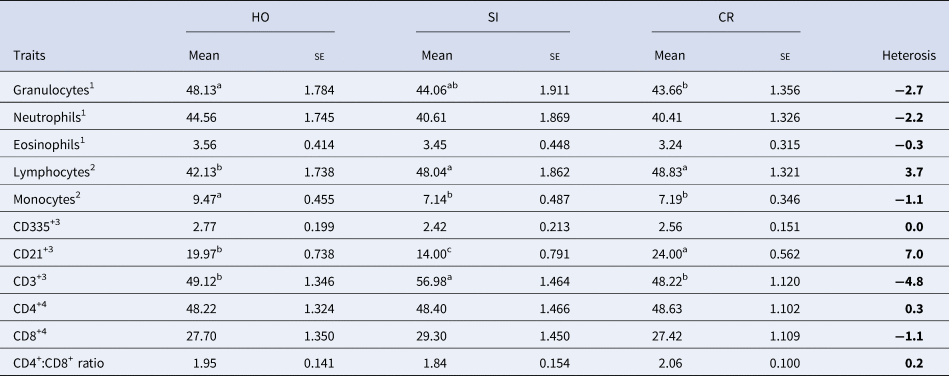
Significant differences were found in the estimated average values of percentage of immunological traits between the three genetic groups (Table 1). The CR cows showed a higher percentage of lymphocytes (P = 0.002) and a lower percentage of monocytes and granulocytes compared with HO cows (P < 0.05), a lower percentage of CD3+ T lymphocytes compared with the SI cows (P < 0.0001) and the highest proportions of CD21+ B lymphocytes with respect to each parental breed (P < 0.0001).
Estimated average values of percentage of immunological traits of the three genetic groups (HO = Italian Holstein, n = 8; SI = Italian Simmental, n = 8; CR = SI × HO crossbred, n = 16) and estimated heterosis effect

1% of total leukocytes that were granulocytes (neutrophils and eosinophils).
2% of total leukocytes that were either CD14 negative (lymphocytes) or CD14 positive (monocytes) on PBMC gate.
3% of PBMC that were CD3, CD21, CD335 positive.
4% of CD3 that were CD4 or CD8 positive.
a, b, cWithin the same row indicate significant differences between groups (P < 0.05).
A numerically lower percentage of neutrophils was observed in CR group compared with HO although this difference was not statistically significant (P = 0.06). The differences between the three genetic groups at time point are shown in online Supplementary Table S2.
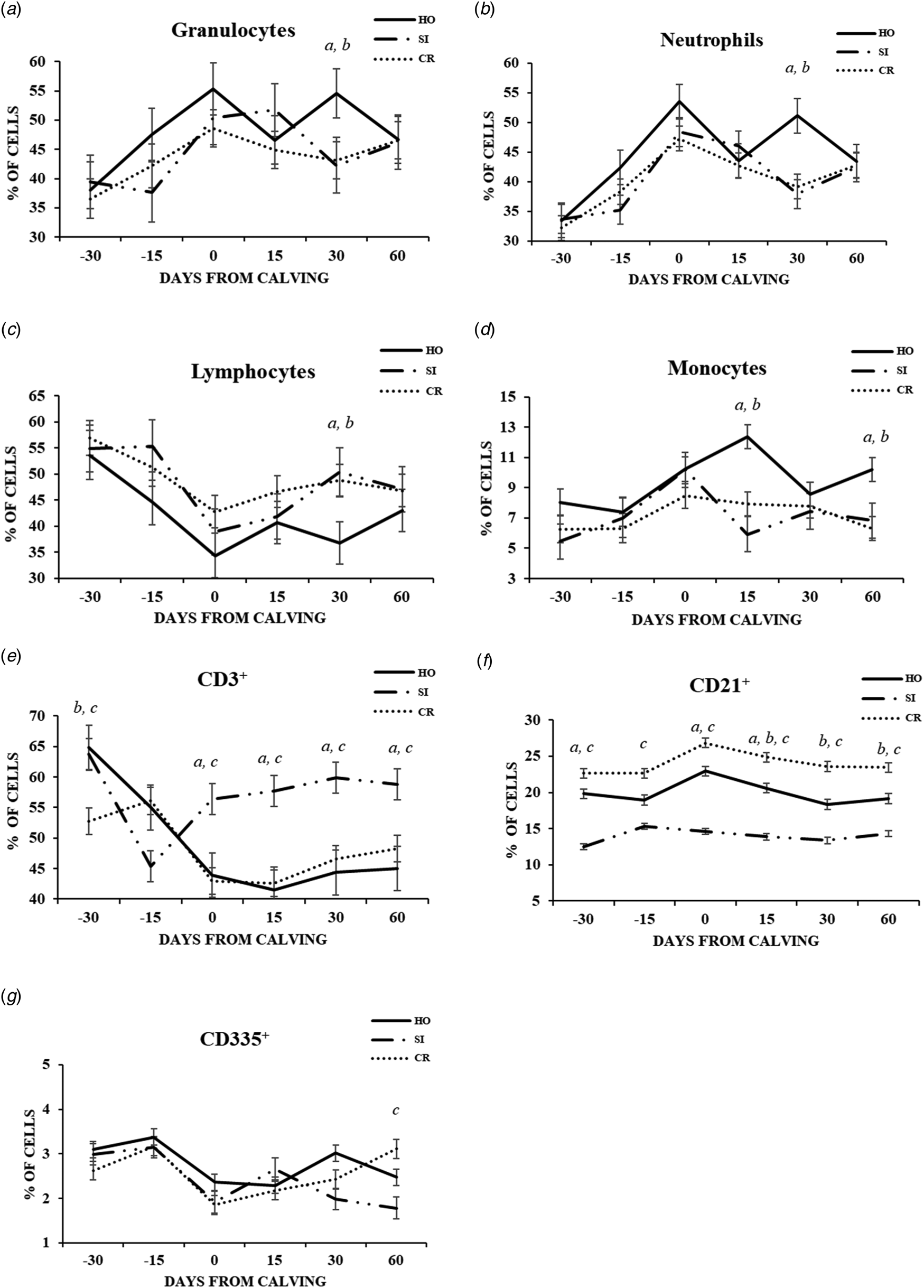
In all groups, an increased percentage of granulocytes, neutrophils and monocytes and a decrease of lymphocytes was observed at the time of calving (Fig. 1a–d). In the CR and SI groups at d + 30, the percentage of granulocytes and neutrophils was significantly lower (P < 0.05) and the percentage of lymphocytes was significantly higher (P < 0.05) compared to HO group; the percentage of monocytes was lower both at d + 15 (P < 0.01) and d + 60 (P < 0.05) compared to HO group.
Pattern of variation of the percentage of Granulocytes (a), Neutrophils (b), Lymphocytes (c), Monocytes (d), CD3+ T lymphocytes (e), CD21+ B lymphocytes (f) and CD335+ NK cells (g) in the three groups of cows during the observation period (0 = calving). Significant differences (P < 0.05) are indicated in each time point as: a = HO v. SI; b = HO v. CR; c = SI v. CR.

Interestingly, the percentage of T lymphocytes showed a similar trend in CR and HO groups, while an opposite trend was observed in SI group with significant differences from calving to d + 60 (P < 0.01) (Fig. 1e). Moreover, the percentage of the CD21+ B lymphocytes in the CR group was significantly higher for all time points compared with SI cows (P < 0.01) and from d + 15 to d + 60 compared with HO cows (P < 0.05) (Fig. 1f). The CR group showed a higher percentage of CD335+ natural killer (NK) cells at d + 60 (P < 0.05) compared with SI group (Fig. 1g). No significant differences were observed between the three groups at any time point in the estimated average values of percentage of eosinophils, CD4+ T helper and CD8+ T cytotoxic cells, or in the CD4+:CD8+ ratio.
Related to the effect of heterosis, positive values were found for the percentage of CD21+ B lymphocytes (7.0) and total lymphocytes (3.7) while negative values were found for the percentage of CD3+ T lymphocytes (−4.8), granulocytes (−2.7), neutrophils (−2.2), monocytes (−1.1) and CD8+ T cytotoxic cells (−1.1). Values close to zero were found for the percentage of eosinophils, CD4+ T helper, CD335+ NK cells and CD4+:CD8+ ratio (Table 1).
Discussion
In the innate immunity, neutrophils and monocyte cells are considered the first line of cellular defense against pathogens. During peripartum period, hormonal and physiological changes reduce their cellular activity, as well as the migration to infection sites with consequent increase in peripheral blood (Weber et al., Reference Weber, Toelboell, Chang, Tirrell, Saama, Smith and Burton2004; Meglia et al., Reference Meglia, Johannisson, Agenäs, Holtenius and Persson Waller2005). In our study the CR and SI groups showed a similar trend of the percentage of granulocytes, neutrophils, lymphocytes and monocytes. Furthermore, we highlighted that in CR and SI cows, after the calving, the values of these immunological traits were restored to prepartum levels, contrary to that observed in HO cows, in which at d + 30 there are values similar to those at calving. From these evidences we can suggest that the CR as well as SI cows had a better ability to restore immune homeostasis after calving.
The Holstein breed is a highly specialized breed for milk production while the Simmental breed is a dual-purpose breed selected for both meat and milk production. In the life of high yielding dairy cows, the transition period and early lactation are critical phases because of many physiological, nutritional and metabolic challenges. In two recent papers the different characteristics between the two breeds have been investigated (Lopreiato et al., Reference Lopreiato, Minuti, Trimboli, Britti, Morittu, Piccioli-Cappelli, Loor and Trevisi2019a; Lopreiato et al., Reference Lopreiato, Minuti, Morittu, Britti, Piccioli-Cappelli, Loor and Trevisi2019b). In the first study the authors concluded that immune-metabolic differences between Simmental and Holstein may be explained as a physiological characteristic because the breeds' purposes differ. Furthermore, Lopreiato et al. (Reference Lopreiato, Minuti, Morittu, Britti, Piccioli-Cappelli, Loor and Trevisi2019b) showed that Simmental cows have an upregulation of cell migration and adhesion-related genes (ITGB2, CD44, CX3CR1 and LGALS8) after calving and a more acute response during early lactation with respect to Holstein cows.
In the adaptive immunity, lymphocytes are important mediators of cellular immune response and act as sources of antibodies and cytokines. Interestingly, the most relevant differences between the three groups were found in the percentage of the CD3+ T lymphocytes and CD21+ B lymphocytes. T cells play an important role in the immune response for the ability to recognize antigens with a high degree of specificity and to regulate the intensity of immune response. They are defined by their cell surface expression of TCR, a transmembrane heterodimeric protein that binds processed antigen displayed by antigen presenting cells (APC) (Chaplin, Reference Chaplin2010).
Kimura et al. (Reference Kimura, Goff, Kehrli and Harp1999) showed a decrease of percentage of T cells at calving with a gradual increase until day 10 from calving, in Jersey cows. On the contrary, we found a decreased percentage of T lymphocytes in CR and HO groups from calving to d + 60. This finding could indicate a reduced cell-mediated immune response after calving in the two groups. Unexpectedly, in the SI group this subset increased at calving and remained high until d + 60.
Regarding B cells, previous studies have reported inconsistent results. Van Kampen and Mallard (Reference Van Kampen and Mallard1997) found in Holstein cows that the B cell proportions were highest before calving and lower after calving, while Meglia et al. (Reference Meglia, Johannisson, Agenäs, Holtenius and Persson Waller2005) reported that in Swedish Red and White dairy cows the percentage of the B cells increased after calving, an observation supported by Heiser et al. (Reference Heiser, McCarthy, Wedlock, Meier, Kay, Walker, Crookenden, Mitchell, Morgan, Watkins, Loor and Roche2015) in Holstein-Friesian and Holstein-Friesian × Jersey crossbred cows. In our study an increase of CD21+ B lymphocytes was observed at calving in CR group with a similar trend to HO group. In SI group, instead, no changes were found during all observation period and the percentage was constantly lower than the other two groups. This increase of the B cell proportions at calving could be explained by an activation of humoral immune response or by the requirement for the cows to produce increased antibody levels for secretion in colostrum (Stelwagen et al., Reference Stelwagen, Carpenter, Haigh, Hodgkinson and Wheeler2009).
The main benefit of crossbreeding is heterosis. This indicates to what extent the F1 population performed in relation to the mean of their parental breeds. Deviations from the mid-parent value can be positive or negative but are mostly found to be beneficial. In our study, we observed negative values of heterosis for the percentage of granulocytes, neutrophils and monocytes and positive values for the percentage of lymphocytes, in the direction of the Simmental parental breed. Since the increase of granulocytes, neutrophils and monocytes in the blood stream during peripartum period is due to reduced capacity of migration in the tissues, and since the decrease of lymphocytes is due to immunosuppression, the values of heterosis for these parameters in F1 group could indicate a possible ameliorative effect. On the contrary, the negative value of heterosis for CD3+ T lymphocytes was the lowest (−4.8) of all immunological traits and in the direction of the Holstein parental breed. Since a decrease of CD3+ T lymphocytes is associated with immunosuppression, this evidence could indicate a detrimental effect for this trait, in the F1 group. On the contrary, we found the highest positive value of heterosis for the percentage of CD21+ B lymphocytes (7.0). Since we have also found the highest estimated average value and a significant difference compared with the two parental breeds, the positive value of heterosis for this trait could indicate an ameliorative effect on the activation of humoral immune response. Cartwright et al. (Reference Cartwright, Begley, Schaeffer, Burnside and Mallard2011) showed in Holstein × Norwegian Red crossbreed calves an increased antibody-mediated immunity but no differences in cell-mediated immune response compared to Holstein breed.
In conclusion, the flow cytometric evaluation of cellular immunological traits during peripartum and early lactation period in crossbreds and the estimation of the heterosis for these traits, could be a useful tool in breeding strategy for disease resistance. Although it is necessary to increase the number of animals, this first study showed important leukocytes subset variations, and it is reasonable to suppose that these differences could influence the efficiency of the immune response to infection and/or stress events.
Supplementary material
The supplementary material for this article can be found at https://doi.org/10.1017/S0022029920000928
Acknowledgement
This research was funded by the Italian Ministry of Agriculture – MiPAAF – Directorate General for Rural Development (DISR IV) within the Research Project IMMA ‘Identification of immunological markers for disease resistance’- (D.M. 16850/7303/2016). The authors gratefully acknowledge Dr Alessandra Crisà, Manager of ‘REDDBOV’ Project, for the establishment of the experimental herd as well as Nicolò Pazzaglia, DVM and Mr Carlo Cesare Riccioni for skillful technical assistance with animals and blood sample collection.