Pantoea species are members of the family Enterobacteriaceae and are generally identified from environmental samples, including soil and water. Although rarely a cause of human illness, isolated infections and clusters have been reported in adults and children, usually following a penetrating trauma involving plants or in association with immunosuppression and indwelling vascular devices.Reference Cruz, Cazacu and Allen 1 – Reference Wong 5 Healthcare-associated outbreaks of Pantoea spp. due to contaminated medical products have also been reported and have been attributed to contaminated total parenteral nutrition, propofol, blood products, and anticoagulant citrate dextrose solution.Reference Habsah, Zeehaida and Van Rostenberghe 6 – Reference Stenhouse 10
During August 2012–February 2013, 8 patients were diagnosed with Pantoea agglomerans bloodstream infections (BSIs) at an Illinois outpatient oncology clinic (clinic A) that had no such infections in the previous year. The majority of infected patients developed rigors while receiving an intravenous infusion at clinic A; the only common exposure identified was commercially manufactured normal saline flush syringes. On February 19, 2013, clinic A stopped using the product and sent a batch of unopened saline flush syringes to the Centers for Disease Control and Prevention (CDC) for sterility testing. A culture performed at the facility’s laboratory of a single, used flush syringe grew P. agglomerans; however, no organisms were cultured from any of the unopened flushes at CDC and there were no other reports of Pantoea infections linked to this particular saline flush product in Illinois or nationwide.
In May 2013, 2 additional patients were diagnosed with Pantoea spp. BSIs at clinic A, prompting a request from the Cook County Department of Public Health, the Illinois Department of Public Health, and clinic A for on-site assistance from CDC. This report describes the findings of the investigation.
METHODS
Case Definition, Case Finding, and Data Collection
A case was defined as P. agglomerans cultured from blood or a catheter tip from a patient examined at clinic A during July 2012–May 2013. Case finding was performed by reviewing microbiology records from clinic A’s affiliated hospital during the period of interest. Medical charts of case patients were reviewed to identify common exposures.
Infection Prevention Assessment and Facility Inspection
Clinic A nursing and pharmacy staff were interviewed. Observations of relevant procedures were performed, including central line access, handling and administration of infusion products, medication preparation, and compounding practices. The facility’s plumbing system was also evaluated. Residual chlorine testing of water from the clinic’s sinks was performed on site using both dipstick and reagent methods.
Environmental Sampling and Laboratory Analysis
Environmental samples collected from clinic A included swab samples of high-touch surfaces in the infusion room and pharmacy; an ice machine; sink composite samples consisting of faucet, adjacent countertop, basin, and drain of each sink; and 1-liter tap water samples from each clinic sink. Surface samples were collected using sterile sponge sticks (3M). Water samples were collected in sterile containers with sodium thiosulfate tablets. Hand cultures were obtained from clinic nursing and pharmacy staff using established methods (Handi Wipes; Clorox).Reference Petersen, Collins and Marshall 11
All environmental samples and hand cultures were sent to the CDC for bacterial testing. Surface samples were processed by high-volume homogenization, concentrated by centrifugation, plated, and cultured for gram-negative organisms. Bacteriologic water testing was performed using heterotrophic plate counts and conventional culture. Suspect isolates were identified as P. agglomerans using an automated biochemical identification system (Vitek 2; bioMérieux). Pulsed-field gel electrophoresis was performed on all available patient and environmental isolates of P. agglomerans to determine genetic relatedness. Genomic DNA was restricted with the XbaI enzyme; electrophoresis conditions included switch times of 2 and 40 seconds for 22 hours. A dendrogram comparing the resulting band patterns was generated using Bionumerics, version 6.6 (Applied Maths).
RESULTS
Description of Cases
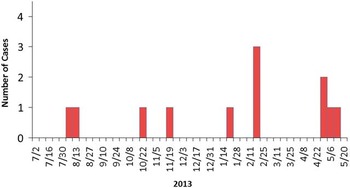
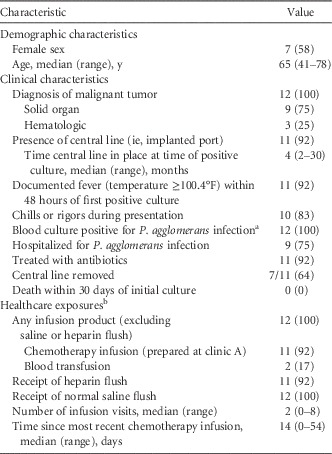
In total, 12 cases were identified; the first case occurred in August 2012 and the last in May 2013 (Figure 1). All 12 had at least one positive blood culture for P. agglomerans; one also had a positive catheter tip culture. Seven (58%) of the case-patients were female; the median (range) age was 65 (41–78) years (Table 1). All case patients had been diagnosed with a malignant tumor. Eleven case patients had a documented fever within 48 hours of their first positive P. agglomerans culture; 9 (75%) required hospitalization. None of the case patients died within 30 days of their first positive culture.
Epidemic curve for 12 Pantoea agglomerans cases at clinic A by week of first positive blood or catheter tip culture, July 2012-May 2013.

Demographic and Clinical Characteristics and Healthcare Exposures of 12 Pantoea agglomerans Case Patients at Clinic A in Illinois, 2012-2013

NOTE. Data are no. (%) of case-patients, unless otherwise indicated.
a One patient also had a positive catheter tip culture for P. agglomerans.
b Occurring within 3 weeks or 3 infusion visits prior to the date of the first positive Pantoea culture.
All 12 case-patients had received an infusion at clinic A before the onset of their P. agglomerans BSI (Table 1). Eleven case patients (92%) had an implanted port, and all 11 had received a chemotherapy infusion prepared at clinic A’s on-site pharmacy during the 3 weeks preceding their first positive culture.
Infection Prevention Assessment and Facility Inspection
Clinic A staff included 3 physicians, 3 registered nurses, and 3 pharmacy staff. The clinic provided infusions to 20–30 patients per day, with non-infusion visits accounting for an additional 40–50 patients per day. Chemotherapy, blood products, and other intravenous fluids were administered in an infusion room with 12 patient chairs and 5 sinks; all central lines were accessed exclusively by nursing staff. Limited observations of hand hygiene and port access revealed no systematic deficiencies. However, infusion products were sometimes noted to be placed on countertops immediately adjacent to sinks with the tubing of the infusate bags draping over the sink rim, creating the potential for splash-back of water onto the infusate bags and tubing.
The on-site pharmacy contained a small medication preparation room (“clean room”), separated from the rest of the pharmacy by a doorway, with 2 laminar airflow workbenches (“hoods”), one of which was primarily used for chemotherapy preparation. Several concerns with medication preparation in the pharmacy were noted, including occasional rinsing of hands without soap or adequate drying, gloved hands entering the hood without adequate disinfection, and occasional inadequate disinfection of medication vial septa. Most notably, the pharmacy clean room contained a sink that was located close to both hoods and next to a countertop where recently prepared infusion products were placed; the presence of a sink in the clean room is contrary to published guidelines. 12 , 13
The facility inspection revealed substantial dead-end piping in vacant areas of the building where clinic A was located. These included an out-of-use upstairs clinic, as well as a former radiation oncology suite adjacent to clinic A that had been vacated several months before the start of the outbreak. The radiation oncology suite had dead-end piping associated with equipment used for radiation treatments. This dead-end piping reduced water pressure to clinic A and depleted residual chlorine levels. Residual chlorine testing of water indicated levels below the accepted end-use level of 0.2 ppm (parts per million) in the clean room sink and 4 of the 5 infusion room sinks. Staff also indicated that water from the pharmacy and infusion room sinks had a yellow discoloration some mornings, especially after heavy rainstorms.
Laboratory Analysis
Fifty-one environmental samples and handwipe cultures were collected. P. agglomerans was isolated from composite samples of sinks in several rooms, including the infusion room (4 of 5 sinks), the pharmacy clean room, the staff bathroom, and a patient examination room. P. agglomerans was also isolated from a composite sample of the ice machine in the staff break room. No Pantoea were isolated from handwipe specimens, from surface samples, or directly from water samples. However, water samples from all 8 sinks exceeded the US Environmental Protection Agency’s ceiling heterotrophic plate count of 500 colony-forming units/mL, with counts ranging from 550 to more than 3,000 colony-forming units/mL from infusion room sinks and from 1,070 to more than 3,000 colony-forming units/mL from pharmacy sinks.
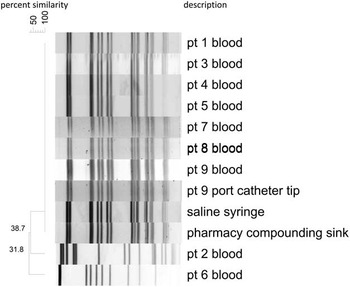
Of the 9 case patients from whom P. agglomerans isolates were available, 7 had a pulsed-field gel electrophoresis pattern indistinguishable from the isolate recovered from the sink composite sample in the pharmacy clean room (Figure 2). The isolate from a used syringe, which also matched the patient cluster, was deemed to have likely been contaminated by patient blood or tubing. The other patient and environmental isolates had distinct pulsed-field gel electrophoresis patterns.
Pulsed-field gel electrophoresis dendrogram of Pantoea isolates from clinic A patients and select environmental cultures. For ease of display, 7 environmental Pantoea isolates from clinic A not matching the outbreak strain were not included in this figure. Pharmacy compounding sink in the figure refers to the sink located in the on-site pharmacy clean room sink.

Control Measures
Recommendations to clinic A included immediate terminal cleaning, focusing on sink areas in all rooms, and consultation with state and local experts to improve the facility’s water system, including rectifying the inadequate residual chlorine and dead-end piping. Clinic A staff were advised to refrain from placing any infusion products in or adjacent to sinks and to ensure strict adherence to national standards for safe compounding. 12 , 13 This included reinforcing proper hand hygiene and medication preparation practices as well as implementing appropriate environmental controls in the pharmacy, including the removal of the clean room sink and the avoidance of any source of water near the hoods. Clinic A immediately moved chemotherapy preparation off-site and improved the building water system (cutting and capping many dead-end areas of piping back to the main line, increasing water system pressure, and regularly testing residual chlorine levels to ensure adequacy). Apart from 1 additional case of Pantoea BSI in a patient exposed before these interventions, no further cases were identified during the following year.
DISCUSSION
We describe a large outbreak of P. agglomerans BSIs at a single oncology clinic that was linked to a contaminated pharmacy sink. We identified aspects of the pharmacy layout and the preparation and handling of medications that likely facilitated the exposure of locally compounded infusates and/or associated tubing to water or splash from the sink. These included the presence of the sink in the cluttered pharmacy clean room, placement of infusate bags on counters adjacent to the sink, and inadequate hand drying by pharmacy personnel immediately prior to compounding. P. agglomerans was not directly recovered from any of the water samples; however, the elevated heterotrophic plate counts of water samples from all the sinks and growth of P. agglomerans strains from multiple sink composite samples throughout the facility suggest tap water could have been the source. A possible overgrowth of P. agglomerans in tap water could have been facilitated by the dead-end piping and low residual chlorine levels related to out-of-use building space and equipment. Alternatively, P. agglomerans could have been introduced into the sink drains and p-traps by an exogenous source, followed by splash-back out of the sinks to contaminate the surrounding environment. In this scenario, the problems with the facility’s water distribution system would have been unrelated to the outbreak.
Healthcare-associated outbreaks attributed to a water source have been commonly reported.Reference Williams, Armbruster and Arduino 14 – Reference Durojaiye, Carbarns, Murray and Majumdar 21 These clusters have often involved Legionella, non-tuberculous mycobacteria, or certain gram-negative pathogens, such as Pseudomonas aeruginosa and Acinetobacter baumannii. Sink p-traps and drains are increasingly recognized as sources for healthcare-associated outbreaks.Reference Peterson, Chitnis and Xiang 22 – Reference Vergara-López, Domínguez, Conejo, Pascual and Rodríguez-Baño 24 Even organisms less commonly associated with an environmental source, like multidrug-resistant Enterobacteriaceae, have been recovered from the sink basin, drain, or trap during an outbreak, suggesting that contaminated sinks and the drainage system (as a result of contaminated fluid waste going down the drain) might be an environmental reservoir for these organisms.Reference Lowe, Willey and O’Shaughnessy 23 , Reference Vergara-López, Domínguez, Conejo, Pascual and Rodríguez-Baño 24 Previous reports have indicated the potential for splash-back from sink drains to contaminate the surrounding environment, thereby serving as a source for transmission.Reference Peterson, Chitnis and Xiang 22 , Reference Hota, Hirji and Stockton 25 , Reference La Forgia, Franke, Hacek, Thomson, Robicsek and Peterson 26 In one study, the use of fluorescent marker revealed that splashes originating from sink drains were visible at least 1 meter from the sink, and that smaller particles might have traveled farther.Reference Hota, Hirji and Stockton 25
During outbreaks involving waterborne organisms, a direct link to a water source for individual patients can sometimes be difficult to establish since some of these organisms can also be transmitted patient-to-patient from contact with contaminated environmental surfaces or equipment or via hands of healthcare personnel.Reference Williams, Armbruster and Arduino 14 , Reference Decker and Palmore 27 Solving these outbreaks often involves isolation of the organism from tap water, faucets or aerators, or other sink components and the identification of opportunities for contamination of medications or equipment.Reference Livni, Yaniv and Samra 17 – Reference Kline, Cameron and Streifel 19 , Reference Lowe, Willey and O’Shaughnessy 23 , Reference Vergara-López, Domínguez, Conejo, Pascual and Rodríguez-Baño 24 The fact that 7 of the 9 patient isolates in this outbreak were the same strain as the isolate from the pharmacy clean room sink strongly implicated that sink as the source. Not surprisingly, other P. agglomerans strains were detected in the environment, and the isolation of distinct strains in 2 patients could point to additional pathways of infection from an environmental source.
To prevent healthcare-associated outbreaks related to a water source, interventions should focus on minimizing exposure to splash of droplets or aerosols from sinks or other water sources. Although in some situations this might be achieved with the use of splash barriers, another approach would be to avoid performing patient procedures and medication preparation, as well as storing medications and patient supplies and equipment, in the vicinity of a sink or other water sources. In addition, enhanced daily cleaning and disinfection of surfaces that might be contaminated by splash (eg, counters) or that might serve as a reservoir for organisms (eg, sink basins) might decrease the risk of transmission. Other interventions that could reduce the burden of contamination in and around sinks or other water sources might need to target facility premise plumbing, including drainage systems, as well as upstream pipe and water system. Because of the difficulty in eradicating biofilms with disinfectants, some facilities have replaced sinks or plumbing systems,Reference Lowe, Willey and O’Shaughnessy 23 , Reference Vergara-López, Domínguez, Conejo, Pascual and Rodríguez-Baño 24 , Reference Hong, Oh and Song 28 although recontamination can occur. Current guidelines for the decontamination and maintenance of healthcare facility water system are primarily focused on preventing Legionella outbreaks.Reference Sehulster and Chinn 29 As healthcare-associated outbreaks related to water contamination occur with increasing frequency, evidence-based recommendations for maintenance of facility water systems will need to target other organisms.
This outbreak also highlights ongoing concerns about medication preparation and handling in outpatient settings, where awareness of recommended practices can vary greatly. Currently, most outpatient facilities, including oncology clinics, are not regulated by a state or federal licensing/certification agency and thus are not routinely inspected for adherence to recommended infection prevention practices. Outpatient oncology facilities might be particularly concerning because they often treat an immunocompromised population and handle a high volume of injectable medications that require more complex compounding procedures (eg, preparation of chemotherapy infusions). Several outbreaks involving outpatient oncology facilities have been reported,Reference See, Nguyen and Chatterjee 30 – Reference Watson, Jones and Siston 34 and in some instances, injectable medications were prepared by personnel without formal training or in a facility without appropriate environmental controls (eg, placement of chemotherapy hood next to an open window).Reference See, Nguyen and Chatterjee 30 , Reference Dobbs, Guh and Oakes 31 Clinic A had an on-site pharmacy with professionally trained staff to perform compounding of sterile medications in a dedicated clean room; however, deficiencies in medication preparation and handling were still identified. These findings underscore the continued need to increase awareness of existing guidelines for the safe preparation and handling of injectable medications and to expand infection control oversight across all outpatient settings. 12 , 13 , Reference Siegel, Rhinehart, Jackson and Chiarello 35 In 2015, the CDC released a policy guide to assist health departments and policymakers to identify gaps in oversight of outpatient settings in their jurisdictions and pursue potential solutions. 36 The CDC is also working with state and federal partners to expand the uptake of infection prevention guidance materials in outpatient settings. 37 , 38
Our investigation had several limitations. Patient data were collected through retrospective medical chart reviews instead of patient interviews, and incomplete documentation in charts might have limited our ability to identify all potential exposures. Our investigation was conducted several months after the outbreak onset, and the practices and conditions that contributed to the risk of developing P. agglomerans infection might have changed. Isolates from 3 of the 12 cases were not available for molecular characterization; however, isolate data from the remaining cases supported a point-source outbreak. Because composite samples were used to collect environmental cultures from the sink and adjacent countertops, we could not definitively determine the specific sink components or countertop areas that were contaminated. We also could not determine the primary source of the P. agglomerans associated with the pharmacy clean room sink. P. agglomerans was not recovered from any of the tap water samples, but this could have been due to the transient contamination of water or sparse colony counts of this fastidious bacterium.
In conclusion, our investigation provides additional evidence for transmission of bacteria from contaminated sinks, resulting in substantial morbidity to patients. Further evaluation is needed to characterize the burden of healthcare-associated infections that result from water-related environmental contamination and the most effective interventions to address this mechanism of transmission, including recommendations for sink and plumbing system maintenance. Interventions that affect the placement of sinks in healthcare facilities must balance the impact on hand hygiene adherence of healthcare personnel with the risk for transmission from these sources.
ACKNOWLEDGMENTS
Financial support. None reported.
Potential conflicts of interest. All authors report no conflicts of interest relevant to this article.
Disclaimer: The findings and conclusions in this report are those of the authors and do not necessarily represent the official position of CDC.